Middlemarch and the Hidden Lives of an English Town
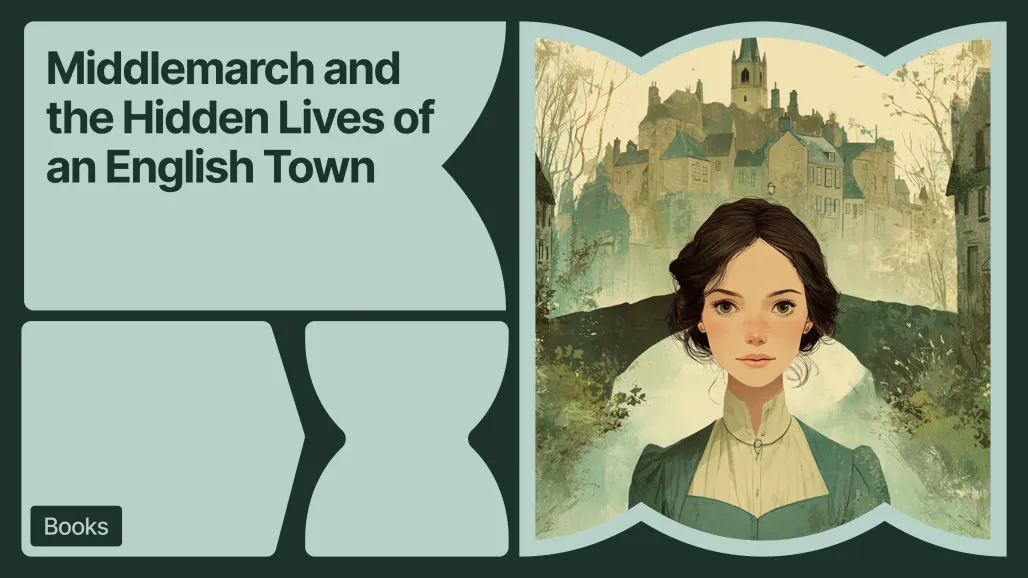
Read how Middlemarch explores the hidden lives of an English town, revealing ambition, marriage, and the quiet power of ordinary people.
George Eliot: The Woman Behind Middlemarch
A Town Under the Microscope
Dorothea Brooke: The Idealist
Tertius Lydgate: The Ambitious Reformer
Different Lives, Shared Choices
The Quiet Power of Ordinary Lives
Middlemarch by George Eliot is often called one of the greatest English novels ever written. But what is it really about? Is it a love story? A political novel? A book about marriage?
In truth, Middlemarch is something richer. It is a story about a whole town — and the different kinds of people who live in it. It shows how their dreams, mistakes, ambitions, and fears connect with one another.
As Eliot writes:

This question runs through the entire novel. Instead of focusing on one hero, George Eliot gives us a social ecosystem, where every life affects another.
George Eliot: The Woman Behind Middlemarch
George Eliot was the pen name of Mary Ann Evans (1819–1880), one of the most intelligent and respected writers of Victorian England. She chose a male name partly because women novelists were often dismissed as writers of light romances. Eliot wanted her work to be taken seriously.
Mary Ann Evans grew up in rural Warwickshire, in central England. The countryside, villages, and small-town society she observed there later helped inspire the setting of Middlemarch. As a young woman she worked as a translator and editor, bringing important German philosophical works into English. She also became the assistant editor of the influential intellectual journal The Westminster Review.
Eliot’s personal life also challenged Victorian conventions. She lived for many years with the writer and critic George Henry Lewes, even though he was legally married and unable to divorce. Because of this relationship, some people in society refused to accept her. Yet Lewes strongly supported her writing career, encouraging her to begin publishing fiction. By the time Middlemarch appeared in 1871–72, Eliot was already considered one of the greatest novelists in England.
Her writing reflects this thoughtful approach to life. In Middlemarch, she shows how ideas and beliefs shape human behavior:

This openness to different perspectives is one reason the novel feels rich and balanced.
A Town Under the Microscope
The novel takes place in the fictional town of Middlemarch, a provincial community in England during the early 1830s. At first it appears to be a quiet place, far from the excitement of London or other great cities. Yet George Eliot shows that even a small town contains a whole world of ambition, rivalry, generosity, and misunderstanding.
Middlemarch is full of different kinds of people: doctors trying to modernize medicine, businessmen concerned with money and status, landowners protecting tradition, clergymen debating religion, and families thinking about marriage and reputation. Politics, gossip, and personal relationships move through the town like invisible threads. When one person makes a decision, the effects spread outward and influence many others.

In this way, Middlemarch becomes more than a story about individuals. It becomes a portrait of an entire community. Eliot observes the town almost like a scientist examining a living system, noticing how ambition, pride, kindness, and fear interact with one another. Within this complex web of relationships, a few characters stand out — and their choices reveal the deeper tensions of the town.
Dorothea Brooke: The Idealist
Dorothea Brooke dreams of doing something meaningful. She believes that marrying the scholar Mr. Casaubon will allow her to help in important intellectual work. She sees marriage as a serious, almost sacred partnership. But Dorothea’s imagination is stronger than her understanding. Early in the novel, Eliot writes:

Dorothea must learn that greatness is not always found where she expects it. Her journey is about growth, self-knowledge, and learning to see people clearly rather than through dreams.
Tertius Lydgate: The Ambitious Reformer
Dr. Tertius Lydgate arrives in Middlemarch full of hope. He wants to improve medicine and bring scientific progress to the town. He believes he can remain independent and focused on his goals. But Eliot reminds us that ambition meets reality:
And what we have been makes us what we are.”

Lydgate’s choices, especially in marriage and finances, slowly limit his freedom. His story shows how social pressure, money, and personal weakness can shape even the most determined reformer.
Different Lives, Shared Choices
One of the most fascinating aspects of Middlemarch is the wide variety of people who live in the town. There are idealists like Dorothea, ambitious professionals like Lydgate, practical businessmen, proud scholars, anxious parents, and social climbers. Each person sees the world differently, yet they all influence one another.
George Eliot shows that human character is rarely simple. People often act with mixed motives — generosity mixed with pride, ambition mixed with insecurity. The novel invites readers to look closely at these contradictions rather than judging characters too quickly. Eliot explains this beautifully:

This famous line expresses Eliot’s deep sympathy for ordinary people. She believed that understanding others, even those who make mistakes, is one of the most important moral skills.
Marriage and money play a large role in these relationships. Some characters marry for love, others for status or comfort. Economic pressure also shapes their choices. Debt, inheritance, reputation, and social class quietly influence many decisions.
Eliot observes that no one lives completely independently from society:

Through these intertwined lives, Middlemarch shows how personal hopes collide with social reality.
The Quiet Power of Ordinary Lives
In Middlemarch, George Eliot does not focus on a single hero or dramatic event. Instead, she observes how many different lives unfold within one community. Ambitions rise and fade, friendships change, marriages succeed or fail, and people gradually discover their strengths and weaknesses.
Many characters begin the novel with large hopes. Dorothea dreams of a meaningful life devoted to learning and reform. Lydgate hopes to transform medicine. Others pursue wealth, comfort, or social recognition. Over time, these ambitions meet the realities of everyday life. Eliot was especially interested in the moral choices people make when no one is watching. Small acts of kindness, patience, and responsibility may seem insignificant, yet they quietly shape the lives of others.
This way of portraying an entire society places Middlemarch among other novels that explore communities rather than single heroes. Jane Austen’s Pride and Prejudice examines the social world of a small English circle, Elizabeth Gaskell’s Cranford depicts life in a provincial town, and Honoré de Balzac’s novels of French society map the ambitions and rivalries of many interconnected characters. Later writers continued this approach: Marilynne Robinson’s Gilead portrays the quiet spiritual life of a small American town, Zadie Smith’s White Teeth presents a vibrant multicultural London community, J.K. Rowling’s The Casual Vacancy examines the tensions of a modern English town, and Fredrik Backman’s Beartown shows how one crisis can reveal the strengths and divisions of an entire community. Like Eliot, these authors show how individual stories combine to form a larger portrait of society.