Why Mr Darcy Is the Most Loved Character in Pride and Prejudice
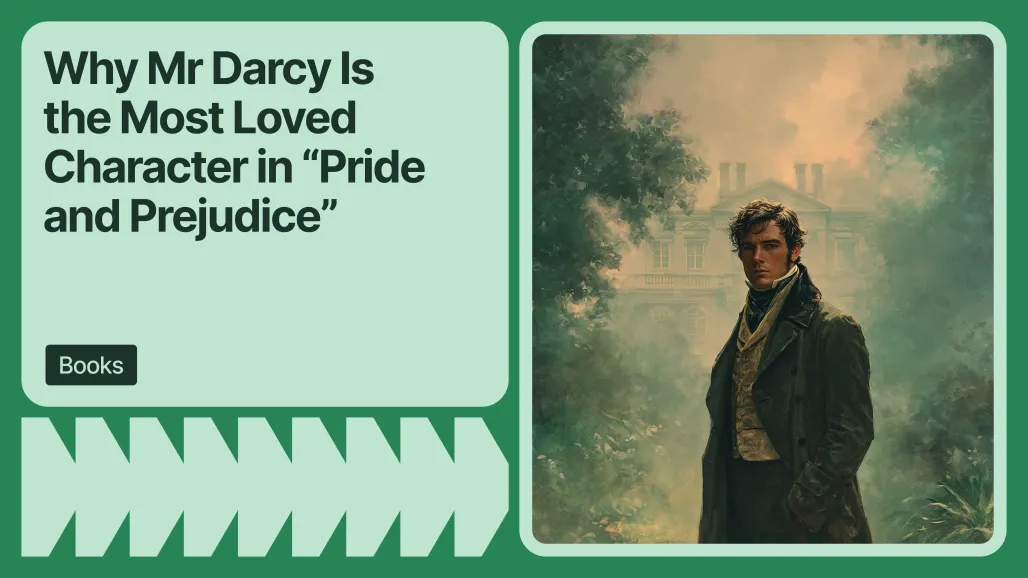
See how Mr Darcy’s journey from pride to growth makes him one of literature’s most loved heroes, defined by quiet strength, loyalty, and change.
Mr. Darcy and the World That Shapes Him
Why Mr. Darcy Feels So Real
Quiet Strength and Actions Over Words
The Mr Darcy Archetype in Modern Books and TV
A Character Who Earns His Happy Ending
More than two hundred years after Pride and Prejudice was published, Mr. Darcy remains one of the most admired characters in literature.
At first, he appears proud, distant, and even rude. But as the story unfolds, readers discover a very different person — thoughtful, loyal, and capable of change.
So why does Darcy still feel so compelling?
Mr. Darcy and the World That Shapes Him
Fitzwilliam Darcy is a wealthy landowner and the master of Pemberley, one of the finest estates in the novel. His position places him at the top of society, where class and reputation are taken very seriously. He feels a strong sense of responsibility, especially toward his younger sister, Georgiana. After Wickham nearly ruins her reputation, Darcy becomes more cautious and protective. This helps explain why he is slow to trust others.

Darcy is also influenced by people around him. His aunt, Lady Catherine de Bourgh, strongly believes in class hierarchy and expects others to obey her:

Her reaction to Elizabeth shows how strict these social rules are. Caroline Bingley shares similar views, judging people quickly based on status rather than character.
At the beginning, Darcy follows this way of thinking. He separates Bingley from Jane Bennet because he believes the match is not socially suitable. However, Darcy is not exactly like the others in his circle. He is capable of reflection and change. After Elizabeth criticizes him, he admits:

This ability to recognize his own faults sets him apart. Darcy is shaped by his world — but he is also able to question it.
Why Mr. Darcy Feels So Real
Darcy’s appeal comes from his inner conflict. He is intelligent and principled, but socially awkward and emotionally reserved (some might even suspect him having autistic traits). He admits his struggles openly:

This becomes even clearer when we compare him to his close friend, Charles Bingley. Bingley is naturally friendly and open. He enjoys conversation, makes a good impression easily, and quickly becomes popular wherever he goes. Darcy is the opposite. He is uncomfortable in social situations, speaks less, and often appears cold or proud. While Bingley is welcomed, Darcy is judged.

This difference shapes how others see them. Bingley is liked immediately. Darcy is misunderstood. We can see this clearly at the first ball: Bingley dances with everyone and is described as “lively and unreserved,” while Darcy stands apart and quickly gains a negative reputation.
This contrast affects their relationships. Bingley forms connections easily, especially with Jane Bennet. Darcy, however, struggles to express his feelings, especially with Elizabeth. His silence and stiffness make him seem distant, even when he is deeply interested.

This dynamic feels very real. In everyday life, people who are quiet or reserved are often seen as unfriendly, while more outgoing people are trusted more quickly. Darcy’s character captures this perfectly. His problem is not a lack of feeling, but a difficulty in showing it. Over time, as his actions begin to speak more clearly than his words, others (and the readers too) begin to understand him better.
Quiet Strength and Actions Over Words
One of the key reasons Darcy remains so attractive (especially to many women readers) is that he represents a particular kind of character: the reserved, “silent” type who reveals his true self through actions. Darcy does not speak easily about his feelings. His first proposal is awkward and full of pride. But his real character becomes clear later, in what he does, not what he says.
The most important example is his role in resolving Lydia Bennet’s scandal. When Lydia runs away with Wickham, the entire Bennet family faces social ruin. Darcy quietly finds the couple, pays Wickham’s debts, and arranges the marriage — all without telling Elizabeth.

Darcy also acts with care and responsibility in smaller moments. At Pemberley, he treats Elizabeth and her relatives with respect, despite their lower social position. He introduces her to his sister and behaves with openness and courtesy, very different from his earlier manner. These actions show a clear pattern. Darcy does not try to impress through charm or words. Instead, he proves his character through loyalty, responsibility, and quiet generosity.

This creates a powerful contrast: he may seem distant at first, but his actions reveal depth and sincerity. His true self is not immediately visible — it must be discovered. This is part of his lasting appeal. Darcy is not the easiest person to understand, but once understood, he proves to be deeply reliable and genuine.
The Mr Darcy Archetype in Modern Books and TV
Mr. Darcy did not remain only within the pages of Jane Austen’s novel. Over time, he became the model for a very specific kind of romantic hero: one who is reserved, difficult to read, and often misunderstood at first, but reveals depth and loyalty through actions.
This pattern appears again and again in modern stories. One of the most direct examples is Mark Darcy in Bridget Jones’s Diary, a clear reimagining of Austen’s character. Like his original, he seems awkward and distant at first, yet proves to be honest, dependable, and quietly devoted.
The same type of character can be seen in many popular books and series. In Jane Eyre, Mr. Rochester carries a similar emotional intensity and secrecy, while in Twilight, Edward Cullen reflects the same controlled, distant nature combined with strong devotion. In Outlander, Jamie Fraser shows another version of this ideal: honorable, protective, and emotionally grounded.
More recently, this archetype appears clearly in Bridgerton. Characters like Simon Basset, the Duke of Hastings, and Anthony Bridgerton follow the same pattern. Both are shaped by responsibility and past experience, both struggle to express emotion openly, and both must learn to balance pride with vulnerability.
Across all these stories, the appeal remains the same. These characters are not immediately open or easy to understand. Their emotions are hidden beneath restraint, and their true nature is revealed slowly. This sense of discovery, of seeing beyond first impressions is exactly what made Mr. Darcy so compelling in the first place. In this way, Darcy’s influence continues. He is the foundation of a romantic ideal that still shapes how stories are written and how readers imagine love.
A Character Who Earns His Happy Ending
What makes Darcy’s story satisfying is that it is based on growth, not charm or status. He listens to criticism, reflects on his behavior, and changes how he treats others. His second proposal to Elizabeth is calm, respectful, and free from pride. Their relationship becomes one of equality, not social advantage.

Darcy does not become a different person. He remains reserved and serious. But he learns to act with greater openness, humility, and understanding. This is what sets him apart from many romantic heroes. He earns his ending.
Mr. Darcy endures because he is not immediately likable, but deeply human. He shows how first impressions can be wrong, how people can change, and how true character is revealed through actions rather than words. His story is not about perfection, but about growing beyond pride and leaving prejudice behind. That is why Mr Darcy remains one of the most loved characters in literature — because he earns both respect and love.