What Moby-Dick Is Really About and the Meaning of the White Whale
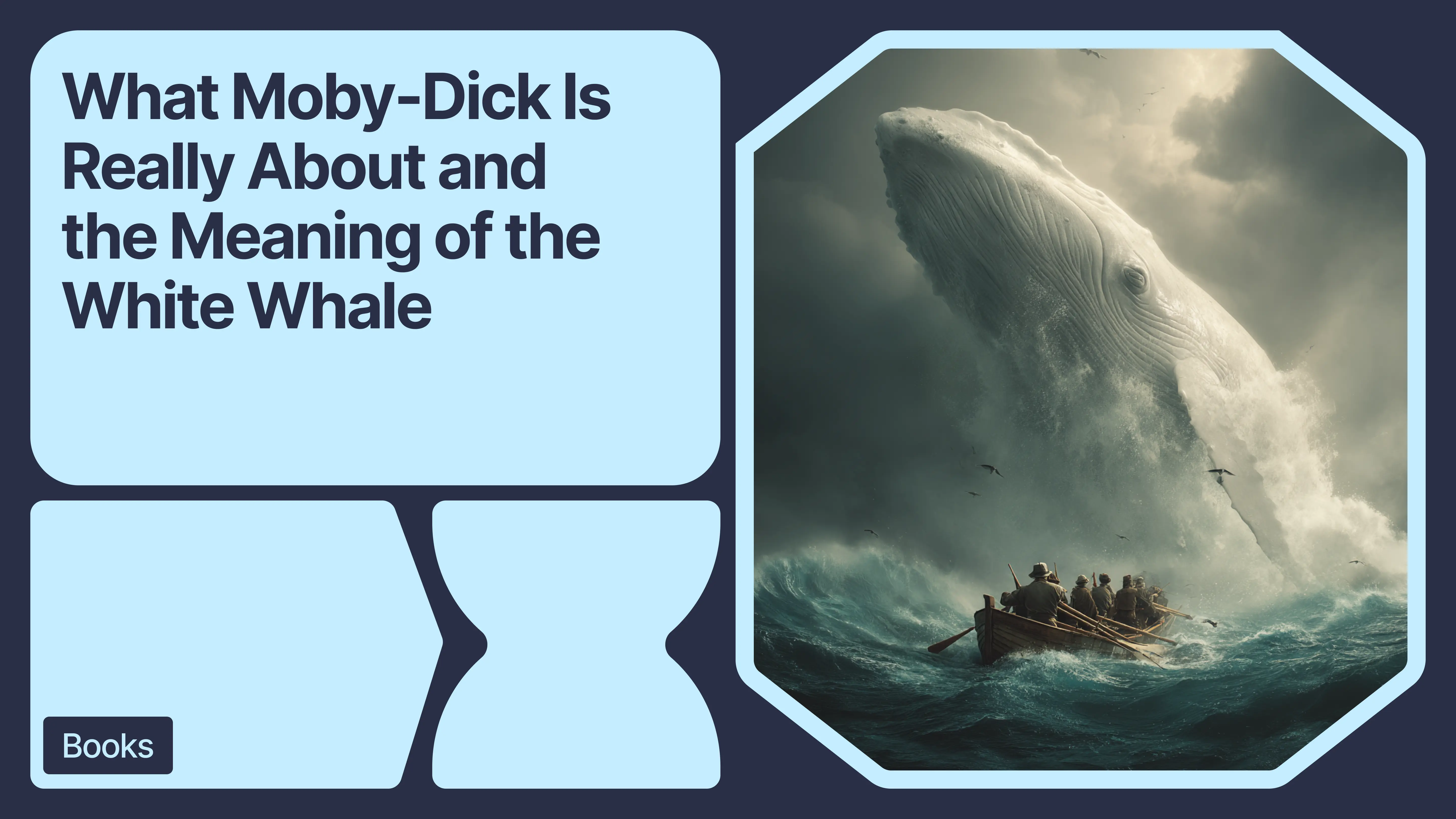
This article explores Moby-Dick as a story of obsession, Ahab’s pursuit, and the deeper meaning of the mysterious white whale.
A Journey That Becomes Something More
Captain Ahab and the Power of Obsession
The Meaning of the White Whale
A Story About Limits
At first glance, Moby-Dick looks like a story about a ship hunting a whale. But as the novel unfolds, it becomes clear that the whale is only part of a much deeper story.
Herman Melville tells a tale about obsession, human limits, and the struggle to understand a world that often feels vast and unknowable. Through the journey of the Pequod, and especially through Captain Ahab, the novel explores what happens when a single idea takes control of a person’s life.
A Journey That Becomes Something More
The story is told by Ishmael, a sailor who joins a whaling ship called the Pequod. At the beginning, he is simply looking for experience and adventure:

What starts as a practical voyage slowly changes into something more intense. The ship is not only hunting whales for oil. It is following the will of its captain, whose goal is very different.
As the journey continues, the sea feels larger, stranger, and more unpredictable. Ishmael describes it as a place that reflects the mystery of life itself:

The voyage becomes less about travel and more about what people bring with them into the unknown.
Captain Ahab and the Power of Obsession
Captain Ahab stands at the center of the novel. He is not interested in ordinary whaling. His entire purpose is to find one specific whale — Moby Dick.
Ahab’s obsession comes from a past encounter in which the whale destroyed his ship and took his leg. But his reaction goes far beyond revenge. He turns the whale into something larger, almost symbolic, as if it carries a hidden meaning that must be confronted. He declares:

This is not the language of a captain thinking about profit or safety. It is the voice of someone who has replaced all other goals with a single idea. At one point, Ahab explains how he sees the world:

For him, reality is only a surface. He believes something deeper and more powerful is hidden behind it, and that Moby Dick stands in his way. The whale becomes a target not only of anger, but of meaning itself. This belief changes how Ahab treats everything around him. The crew becomes part of his mission rather than individuals with their own lives. He uses their loyalty and fear to drive them forward, even when the danger is clear.
What makes Ahab especially striking is that he is aware of his own obsession. He is not confused or uncertain. He knows the cost, yet continues anyway. His will is strong, but it leaves no space for doubt or balance. At times, it feels as if Ahab is not only chasing the whale, but trying to challenge the limits of the world itself. The question remains: is he seeking revenge, or is he trying to prove that something hidden can finally be understood — and controlled?
The Meaning of the White Whale
Moby Dick himself remains difficult to define. The whale appears rarely, yet his presence shapes the entire story.
To some, the whale is simply a powerful creature of nature. To Ahab, it becomes something much more. Ishmael, however, sees something even more uncertain. He focuses on the strange effect of the whale’s whiteness:

The color white, often connected with purity or calm, here feels unsettling. It suggests something empty, vast, and impossible to fully grasp. Instead of giving meaning, it removes it. The whale does not act with clear intention. It does not speak, plan, or seek revenge. This makes Ahab’s struggle even more complex. He is fighting something that may not even recognize him as an enemy.
At the same time, the whale seems to reflect the thoughts of those who look at it. Ahab sees a force that must be destroyed. Ishmael sees something mysterious and unknowable. Other sailors see only danger. This raises an important idea. The whale may not carry meaning on its own. Instead, meaning may come from the people who try to understand it.
In the end, the whale resists definition. It is at once real and symbolic, present and distant. And this leads to a final question: is the whale truly something to be understood, or is it a reminder that some things will always remain beyond human understanding?
A Story About Limits
As the voyage continues, it becomes clear that Ahab’s goal leaves no room for doubt or change. He is not only hunting the whale, but pushing against the limits of what a person can control or understand.
The sea remains vast and indifferent, just as Ishmael describes it — a place that does not answer human questions. The whale, too, resists meaning. It does not explain itself, and it does not act according to human logic. Yet Ahab continues forward, driven by the belief that he can confront and overcome what stands before him. He refuses to accept that some things may not have answers, or that some forces cannot be mastered.
In this way, the novel becomes more than a story about a hunt. It shows what happens when a person refuses to accept limits — of nature, of knowledge, and of their own power. The question that remains is not whether Ahab can succeed, but whether the world he is fighting can ever be fully understood in the first place.