The Maltese Falcon, Detective Novel That Changed Crime Fiction
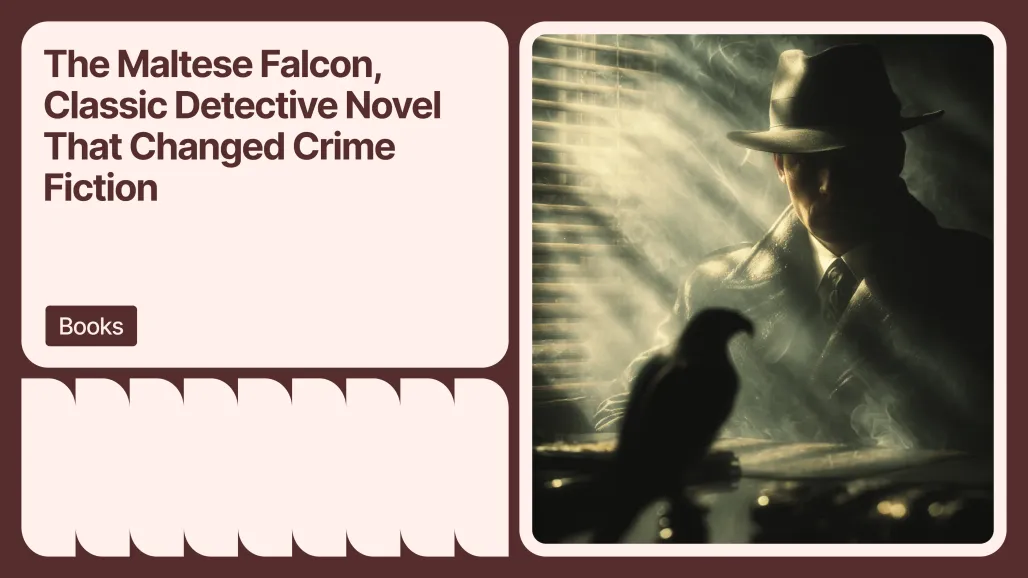
Explore The Maltese Falcon, the classic crime novel that defined detective fiction and still thrills with mystery, danger, and sharp dialogue.
The Author Who Knew the Streets: Dashiell Hammett
A Mystery That Grabs You From the First Page
Sam Spade: The First Cool Anti-Hero
San Francisco: A City of Shadows and Secrets
From Sam Spade to Blade Runner
“When a man's partner is killed he's supposed to do something about it.”
— Sam Spade, The Maltese Falcon
Some stories entertain you. Others create whole new worlds. The Maltese Falcon by Dashiell Hammett is one of those rare books that did both. First published in 1930, this classic detective novel redefined what crime fiction could be. With its unforgettable characters, dark atmosphere, and sharp dialogue, it shaped the modern mystery thriller, inspired generations of writers and filmmakers, and helped create the genre we now call film noir.
The Author Who Knew the Streets: Dashiell Hammett
Dashiell Hammett was a private detective who turned his real‑life experience into fiction. Working for the Pinkerton National Detective Agency before becoming a writer, Hammett understood the dangers, secrets, and double‑crosses of the criminal world. His writing brought authenticity and grit to a genre that had often been too polite and unrealistic.
Hammett’s style was revolutionary. Instead of long descriptions and clever drawing‑room puzzles, he wrote short, sharp scenes with realistic dialogue and tough, believable characters. Instead of perfect heroes solving neat little mysteries, he wrote about real people, making hard choices in a dirty, dangerous world. The Maltese Falcon became the model for what we now call hard‑boiled detective fiction.
A Mystery That Grabs You From the First Page
It all starts here: San Francisco in the 1930s, private detective Sam Spade and his partner Miles Archer are hired by a woman calling herself Miss Wonderly. But the case quickly turns deadly: Archer is murdered, and Spade becomes a suspect. The woman’s real name is Brigid O’Shaughnessy, and her story is a web of lies. Soon Spade is pulled into a dangerous hunt for a legendary treasure — a priceless statue known as the Maltese Falcon.
The plot is full of twists and betrayals. Dangerous rivals like the charming but deadly Joel Cairo, the calculating Kasper “The Fat Man” Gutman, and the violent Wilmer will stop at nothing to find the falcon. As the tension builds, Spade must decide whom he can trust — and how far he’s willing to go to solve the mystery.

Sam Spade: The First Cool Anti-Hero
Meet Sam Spade — not your classic good guy, and that’s exactly why he changed everything.
In the early 20th century, most fictional heroes were noble, clean-cut, and always did the right thing — think of Sherlock Holmes using pure logic to solve crimes, Hercule Poirot, or brave gentlemen in adventure novels who fought for queen and country. They followed the rules, told the truth, and rarely made mistakes.
Then along came Spade — with a sharp suit, a sharper tongue, and a personal code of justice that didn’t always match the law. He’s smart, tough, and unafraid to make hard choices. He doesn’t pretend to be perfect — and that’s what made him feel real.
Spade became the blueprint for the modern anti-hero. Characters like Raymond Chandler’s Philip Marlowe, the detectives in noir films, and even many of today’s flawed TV crime solvers all carry a little bit of Sam Spade’s attitude. He proved that heroes don’t have to be perfect — they just have to be true to themselves.
Then there’s Brigid O’Shaughnessy — stunning, mysterious, and way more than a pretty face. She’s the classic femme fatale, but she’s also ahead of her time: clever, manipulative, and always playing her own game. She isn’t a damsel in distress waiting to be saved — she’s writing her own story, even if it leads into the shadows.
Together, Spade and Brigid broke the rules of what characters were supposed to be — and created the mold for the gritty, complex leads we still love today.
San Francisco: A City of Shadows and Secrets
In The Maltese Falcon, San Francisco shapes everything that happens. Hammett knew this city well, and he shows it as it really was in the late 1920s: fast, rough, and full of contradictions.
At the time, San Francisco was a city of sharp contrasts. It was wealthy and ambitious on the surface, but underneath there was crime, corruption, and deep inequality. Prohibition was still in effect, which meant illegal bars, smuggling, and organized crime were part of everyday life. Police corruption was common, trust was fragile, and many people were trying to survive by bending the rules.
Hammett fills the novel with fog‑covered streets, cheap offices, shadowy hotels, and cramped apartments — the kinds of places where secrets are easy to hide. It was urban reality: people watching each other carefully, always unsure who to trust. The fog, a real and famous feature of San Francisco, becomes a perfect symbol for the moral confusion of the story.
Although the novel was published just before the Great Depression fully hit, it already reflects a growing sense of uncertainty and desperation in America. Money drives nearly every character. Everyone wants something — power, wealth, security — and very few people play fair. Ambition and fear walk side by side. After The Maltese Falcon, the city itself became a standard character in crime fiction: dark, dangerous, and impossible to fully understand.

From Sam Spade to Blade Runner
When The Maltese Falcon landed in 1930, it changed the whole game. Before Dashiell Hammett, a detective was usually a clever gentleman (maybe with a monocle) who solved a crime, sipped some tea, and put everything back in order. But Sam Spade? He was something else.
Spade was tough, sharp, and didn’t care much for tea. He worked in a city full of crooks, liars, and dangerous charmers, and he knew how to handle them. He didn’t follow the rules — he followed his rules. And readers loved it.
This new kind of crime fiction — gritty, fast-talking, morally complicated — became known as hardboiled. And it stuck. Writers like Raymond Chandler, Ross Macdonald, and later James Ellroy took what Hammett started and ran with it, creating stories full of shady deals, smoky bars, and characters who lived in the gray areas.
Then came Hollywood.
In 1941, The Maltese Falcon was turned into a movie starring Humphrey Bogart as Sam Spade. And just like that, film noir was born. Dark shadows. Cigarette smoke. Lonely detectives. Dangerous women. It wasn’t just a look — it was a mood. And audiences couldn’t get enough.
Hammett’s influence didn’t stop there. You can feel his style in stories even now:
- Chinatown (1974) — with Jack Nicholson as a detective who digs too deep.
- Blade Runner (1982) — a sci-fi noir, where the detective chases androids in the rain.
- The Usual Suspects (1995) — full of twists, lies, and mystery.
- True Detective, Luther, and even Batman — all carry echoes of Hammett’s dark, stylish world.
The Maltese Falcon made crime fiction cooler, sharper, and more real. It gave us characters who aren’t perfect, but who keep going anyway. And more than 90 years later, it still feels fresh — like a punchy line of dialogue or a shadow moving in a foggy alley.
Step into the fog. Follow Sam Spade into the heart of 1930s San Francisco. And discover the crime novel that started it all — The Maltese Falcon, the timeless detective story that continues to shape modern mystery fiction.