Madame Bovary and the Danger of Romantic Illusions in Marriage
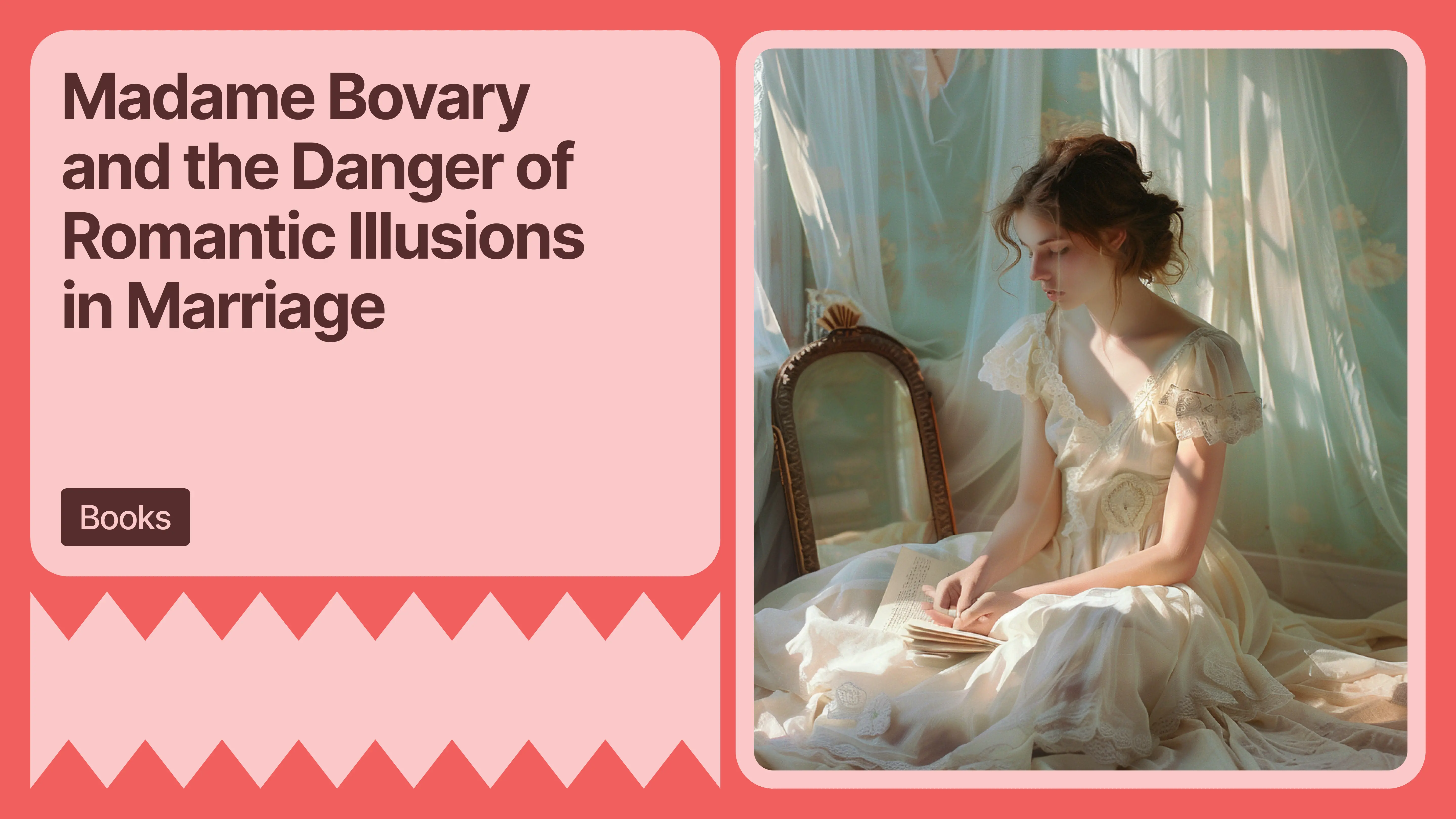
This article explores Emma Bovary’s marriage, her romantic illusions, and how her expectations turn love and life into disappointment.
Romantic Dreams Before Marriage
Marriage and the Shock of Reality
Looking for Escape
Expectations That Leave No Room
A Life Compared to an Image
Madame Bovary is often seen as one of the great novels of realism. It is also remembered as a sharp portrait of romantic disappointment.
At the center of the book is Emma Bovary, a woman who wants life to feel as beautiful and exciting as the stories she has read. She dreams of passion, luxury, and love that changes everything. Marriage, she believes, will open the door to that life. Unfortunately for her, it does not.
Instead, Emma finds a life filled with ordinary days, and a relationship that refuses to become a romance novel. Emma keeps measuring real life against fantasy, and real life always loses. Her story shows us how dangerous expectations can become when they are built more from dreams than experience.
Romantic Dreams Before Marriage
Before Emma Bovary becomes a wife, she is already living partly inside books.
As a teenager, she reads Paul and Virginia, a famous sentimental novel about innocent love, nature, and tragic feeling. She is building a whole world from it.

Later, she reads novels by Walter Scott, full of castles, old rooms, noble ladies, brave men, and dramatic history. These books give her a taste for lives that feel grand and meaningful. Emma begins to imagine love as something rare and beautiful, not something ordinary people live through day by day.

I find this part of the novel almost painfully understandable. Emma is not foolish because she loves books. Many of us have looked for ourselves in stories. The problem is that Emma starts using fiction as a map for real life.
She expects marriage to bring the same kind of feeling she finds in novels: deep emotion, beauty, surprise, and a sense that every moment matters. A husband, in her mind, should not simply be kind or loyal. He should transform the whole world around her.
Marriage and the Shock of Reality
So before Charles Bovary has any real chance to disappoint her, Emma has already created a dream he cannot enter. Her idea of married life comes from borrowed images: romantic gardens, distant castles, tragic heroines, and perfect love. Then she meets Charles.
Charles Bovary, a married country doctor, first enters Emma’s life when he is called to her father’s farm, Les Bertaux, to treat Monsieur Rouault’s broken leg. That is how Charles first sees Emma: not at a ball, not in a moonlit garden, but during something so trivial as a medical visit. Very Flaubert, really. Romance begins with a fracture.
After his first wife dies, Charles returns to Les Bertaux, still thinking of Emma, and later asks her father for permission to marry her. Charles is not an abusive or negligent husband. That is important. He cares for Emma, trusts her, and feels lucky to have her. In many ways, he is a decent husband. But his love is too gentle and practical. It does not turn daily life into poetry.

This is the first great disappointment of Emma’s married life. She expected marriage to open a new world, but after the wedding, the same world is still there. There are meals, household tasks, small visits, quiet evenings, and conversations that do not lift her out of herself. Charles gives her safety, and she was waiting for enchantment.

Emma believes happiness was promised to her somehow, by books, by romance, by marriage, by life itself. When it does not arrive, she feels robbed. The dream that settled in her mind early now begins to turn against her.
Looking for Escape
Emma does not accept her disappointment quietly. Once married life begins to feel small, she starts looking for a door out of it. At first, that door is only in her imagination.

Emma is waiting for life to rescue her. She wants an event, a person, a sudden change that will make everything brighter. Charles cannot really understand this struggle, because from his side the marriage looks peaceful and the life they share is enough for him.

His contentment makes her loneliness feel even sharper. Then come Léon and Rodolphe. With Léon, she finds someone who shares her love of books, music, and beautiful sadness. With Rodolphe, she finds confidence, attention, and the thrill of secrecy. Each man seems to offer the same promise: another life is possible.

She believes that somewhere inside this new feeling, a new version of herself is waiting. A happier Emma. A freer Emma. Someone who is no longer trapped by bleak rooms, ordinary meals, and a life that feels too small. That is why each affair feels so thrilling at first. It offers escape, change, and the hope of becoming the person she always imagined she could be.
But this hope is fragile, because Emma is still carrying the same unattainable dreams with her. She only changes the setting, but not the illusion, and that is where the next disappointment begins.
Expectations That Leave No Room
Rodolphe’s affair with Emma does not stay magical for long. What begins as passion slowly becomes yet another routine, only hidden from view. The secret meetings continue, but the feeling starts to shrink.

This is the cruel pattern of Emma’s life. She reaches the thing she thought would save her from the underwhelming reality, but then the thing itself becomes real too. And once it becomes real, it loses all the glow she expected from it. So she keeps searching and reaching.
She reaches for Léon. She reaches for luxury. She reaches for beautiful clothes, gifts, rooms, journeys, and objects that seem to belong to a more elegant life. Monsieur Lheureux understands this weakness perfectly. He offers her credit, flatters her taste, and slowly turns her longing into a crushing debt. By the time Emma understands what has happened, her private dreams have become a public disaster. The fantasy is now threatening her home, her marriage, and her name.

After this, Emma panics. The debt is no longer a private secret she can hide in drawers and excuses. The bailiff comes to the house. The life she tried to decorate into beauty is now being counted, priced, and prepared for sale. She runs from person to person, trying to find money before Charles discovers the truth. She turns to Léon, but he is weak and afraid. She even goes to Rodolphe, hoping the old romance might still mean something, but he refuses her too.
This is the final breaking point. Emma has spent years believing that somewhere, someone would open a door into a better life. Now every door closes at once. With shame closing in and no rescue coming, she makes her last desperate choice. She goes to Homais’s pharmacy, takes arsenic, and returns home to die.

A Life Compared to an Image
What makes Madame Bovary stay with us is how familiar Emma's longing feels. Emma learns desire from stories before she learns much from life. Books give her images of love that is grand, beautiful, and complete. Today, we might get those images from films, social media, or the carefully polished lives of other people. The source might have changed, but the pressure feels the same.
The problem is not that Emma wants more, because wanting a larger life is deeply human. The danger begins when an ideal becomes the only version of happiness she can accept. Then real life, with its subtle care and imperfect people, starts to look like failure.
That is the question Flaubert leaves us with: how do we keep our dreams without letting them make ordinary life feel worthless?
Because if we expect life to feel extraordinary all the time, we may lose the ability to enjoy what is simply real.