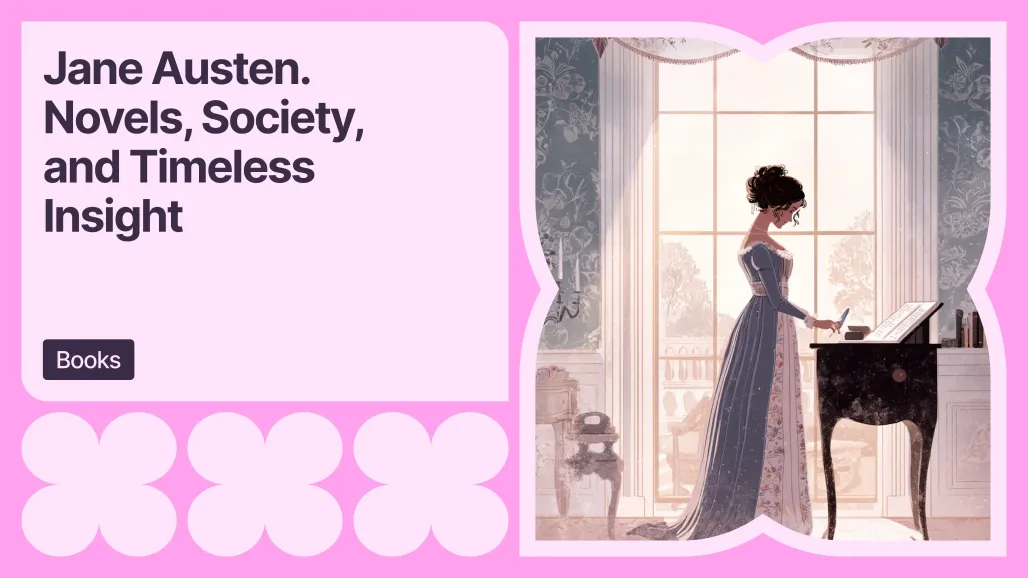
Jane Austen. Novels, Society, and Timeless Insight
Discover Jane Austen’s timeless novels, unforgettable characters, and sharp social insight that still speak to readers around the world today.
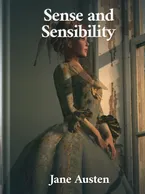
Sense and Sensibility (1811)
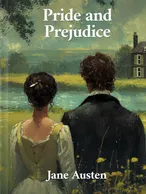
Pride and Prejudice (1813)
Northanger Abbey
Mansfield Park (1814)
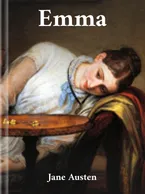
Emma (1815)
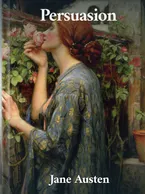
Persuasion (1817)
Why We Still Read Jane Austen Today
Jane Austen (1775–1817) lived and wrote during the Regency era, a period known for elegance, strict social rules, and a lively cultural scene. It was a time of beautiful gowns and formal manners, but also a time when a woman’s future depended heavily on marriage, property, and reputation. Austen, who grew up in a close-knit family in rural Hampshire, observed this world with sharp eyes and a keen sense of humor. She turned everyday moments — conversations at dinner, walks to the post office, visits to relatives — into stories full of wit, realism, and emotional truth.
Although she published her novels anonymously, her work was admired even in her own century. Queen Victoria herself was a devoted Austen fan, keeping copies of Austen’s novels in her personal library and praising their insight and morality. The queen’s admiration helped carry Austen’s reputation into the Victorian era, where her novels were valued for their gentle romance, strong moral lessons, and elegant style. This period transformed Austen from a quietly published writer into a respected literary figure.
Today, the fascination has only grown. Modern readers love Austen not only for her lively characters but also for her understanding of relationships, class dynamics, and personal growth — themes that still resonate. Her stories continue to inspire countless adaptations and reinventions. Shows like Bridgerton, though not based on Austen’s writing, draw heavily from the same Regency atmosphere: elaborate courting rituals, sharp social observations, and the tension between personal desire and public expectation. Austen’s influence can also be seen in modern retellings, from Clueless to Bridget Jones’s Diary.
Two hundred years after her death, Jane Austen remains one of the most beloved authors in the English-speaking world — a writer whose insight into love, society, and human nature feels just as fresh today as it did in the Regency drawing rooms she once observed.
This article explores Jane Austen’s six major novels — in the order she wrote them — and how they reflect both her personal growth and the society she lived in.
Sense and Sensibility (1811)
Jane Austen’s first published novel introduces readers to the Dashwood sisters, Elinor and Marianne. After their father's death, they and their mother are left with little income and forced to leave their family estate. The novel follows their experiences with heartbreak, friendship, and the different ways people show (or hide) emotion.
Elinor is calm and rational — full of “sense” — while Marianne is impulsive and romantic — full of “sensibility.” Through these contrasting characters, Austen explores how feelings and logic both shape our lives, especially when it comes to love and disappointment.
This book was written during a time when women had limited legal rights and relied on marriage to secure financial stability. Austen’s work gently critiques this system, showing how it leaves intelligent, capable women vulnerable.

Notable adaptation: Ang Lee’s 1995 film adaptation, starring Emma Thompson and Kate Winslet, captures the emotion of the novel while simplifying some plotlines. It adds visual beauty and romantic drama that resonate with modern audiences.
Pride and Prejudice (1813)
Possibly Austen’s most famous novel, Pride and Prejudice follows Elizabeth Bennet, the second of five daughters in a modestly wealthy family, and Fitzwilliam Darcy, a proud gentleman with a large estate. Their relationship starts with misunderstandings and misjudgments, but slowly grows as both characters learn more about themselves and each other.
Set against a backdrop of dances, drawing rooms, and country estates, the novel is full of wit and sharp social insight. Austen criticizes how women are judged by beauty and manners, and how class affects everything — from marriage prospects to reputation.
This story remains beloved because Elizabeth is quick, clever, and independent, and Darcy undergoes real character growth. Their evolving relationship feels deeply human.

Notable adaptations: The 2005 film with Keira Knightley takes creative liberties with tone and visuals, adding a romantic, almost dreamlike atmosphere. The 1995 BBC miniseries with Colin Firth stays closer to the book’s text and pacing — and is often considered the gold standard for Austen adaptations.
Northanger Abbey
(published posthumously in 1817)
Though written early in Austen’s career, Northanger Abbey was published after her death — and it reveals a playful, sharply observant side of her voice. The story follows Catherine Morland, a young woman with an active imagination and a love of gothic novels. When she visits the Tilney family at their grand estate, Northanger Abbey, she begins to imagine hidden secrets and dark mysteries — only to discover that reality is more ordinary, but no less complicated.
This novel gently parodies the gothic fiction popular at the time, full of haunted castles and brooding villains, while also exploring how books and expectations shape the way we see the world. Catherine is not a typical Austen heroine: she’s naive and inexperienced, but deeply relatable as she learns how to trust her judgment.
Austen uses her wit to remind readers to enjoy fiction — but not to let it cloud their understanding of real people.

Notable adaptation: The 2007 ITV adaptation starring Felicity Jones brings out the humor and charm of the original story while adding some stylized gothic flair. It stays close to the novel’s tone — light, funny, and insightful — with a dash of romantic suspense.
Mansfield Park (1814)
Mansfield Park tells the story of Fanny Price, a quiet, thoughtful girl from a poor family who is sent to live with wealthy relatives. Over time, she learns to observe and judge the complex social world around her. She remains true to her values, even when it costs her dearly.
This novel is more serious and less light-hearted than Austen’s earlier works. It deals with social responsibility, moral integrity, and the problems of wealth and privilege. Readers sometimes struggle with Fanny’s passivity — but others admire her quiet strength in a world where young women were often expected to remain silent.

Notable adaptation: The 1999 film version added elements that weren’t in the book — including a more modern, outspoken version of Fanny — which sparked debate among fans. Some welcomed the update; others felt it missed the point of Fanny’s moral core.
Emma (1815)
In Emma, we meet a wealthy, charming, and very confident young woman who believes she is an excellent matchmaker — even though she has no intention of marrying herself. But Emma's well-meaning plans for others often lead to confusion, hurt feelings, and comic mistakes.
This is Austen at her wittiest and most ironic. Emma must learn humility and empathy before she can understand herself — and love — clearly. The novel is filled with sharp observations about how wealth can isolate people, and how we often misread those around us.
Emma is a rare example of an unmarried, financially independent heroine, making her a fascinating character even today.

Notable adaptations: The 2020 film starring Anya Taylor-Joy brought fresh energy, beautiful visuals, and a sharper tone of satire. The 1996 version with Gwyneth Paltrow is softer and more romantic. The film Clueless (1995) is a brilliant modern retelling, set in a Beverly Hills high school.
Persuasion (1817)
This was the last novel Austen completed before her death, and it has a more reflective, emotional tone. It tells the story of Anne Elliot, who once turned down a man she loved because of family pressure. Years later, their paths cross again — but much has changed.
Persuasion explores themes of regret, second chances, and quiet strength. It is about what happens after youth — when choices carry more weight and time feels more precious. Anne is older than Austen’s other heroines and more introspective. Her story feels more personal, more mature.

Notable adaptations: The 1995 film starring Amanda Root is gentle and faithful to the novel. A 2022 Netflix version modernized the language and tone, but divided viewers — many fans felt it lost the subtlety and emotional depth that make the novel so powerful.
Why We Still Read Jane Austen Today
Jane Austen’s novels have lasted not just because of their romantic plots or historical charm, but because of the way they reflect real human behavior — sharp, flawed, and often funny. Her characters live beyond their time. Who can forget Mr. Collins, the awkward clergyman obsessed with rank and social climbing? Or Mrs. Bennet, whose anxious scheming about marrying off her daughters feels like something many parents today still worry about — only now it’s college admissions or job prospects.
Even minor characters — like the charming but unreliable Frank Churchill, the gossipy Miss Bates, or the insufferably smug Lady Catherine de Bourgh — reveal how people behave when pride, power, or insecurity take over. They are the kind of personalities you still meet at school gates, office meetings, or family dinners.
But beyond characters, Austen was a master at holding up a mirror to society. Her books question who gets to have power — in families, in love, and in communities. She quietly criticizes a world where women’s futures depend on wealth and marriage, and where appearances often matter more than sincerity. These issues haven’t disappeared. Today, we still talk about social pressure, economic inequality, and the value of emotional intelligence — all themes that Austen explored with elegance and insight.
Austen doesn’t tell us what to think, but she helps us see more clearly. Her humor softens the critique, but the message is there: status doesn’t equal virtue, money doesn’t guarantee happiness, and true character takes time to recognize.
We return to Austen not only for comfort and cleverness, but because she helps us think — about love, society, and ourselves.