The Great Gatsby and the Illusion of the American Dream
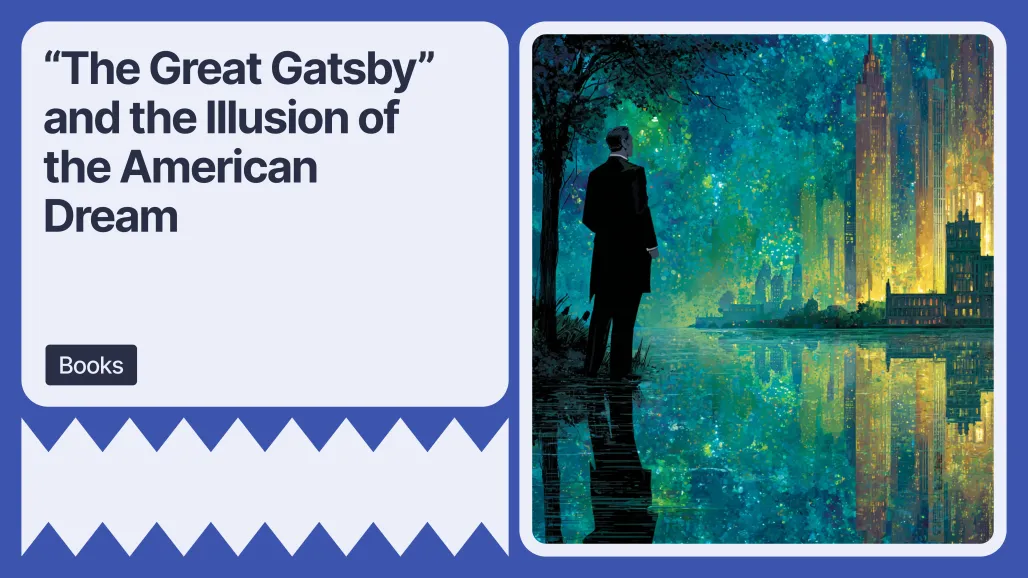
This article explores how The Great Gatsby presents the American Dream as an illusion shaped by class, desire, and social limits.
A Dream Built on Reinvention
The Illusion of Belonging
Daisy and the Dream of Perfection
Society’s Judgment and Indifference
Symbols of a Dream That Slips Away
A Dream That Cannot Accept Reality
F. Scott Fitzgerald’s “The Great Gatsby” is often read as a story of ambition and success. But at its core, it is a study of a dream that cannot survive reality.
Gatsby achieves what the Dream promises — wealth, status, reinvention. Yet he remains outside the world he is trying to enter. The novel asks not whether the Dream is possible, but whether it is ever truly accepted.
A Dream Built on Reinvention
Jay Gatsby is not born into privilege. He creates himself — his name, his past, his fortune. His life is an act of careful construction. Nick describes this transformation with a sense of distance:

Gatsby does not just improve his life — he invents a new identity and believes in it completely. He is a self-made man, rags to riches - perfect embodiment of an American dream of success and making your own fortune, but despite his success, he feels shame for his past. His dream depends on control: if he can shape the present, he believes he can also reshape the past. This belief is captured in his famous insistence:

But this is where the Dream begins to break. Gatsby’s vision is not based on reality, but on memory and desire.
The Illusion of Belonging
Gatsby’s wealth allows him to enter the world of luxury, but not the world of acceptance. His mansion is full of guests, yet he remains isolated. People attend his parties, enjoy his generosity, and spread rumors about him — but few truly know him. Nick observes this quiet distance:

Gatsby becomes a spectacle rather than a person. Society consumes what he offers, but never fully includes him. Even his background becomes a subject of gossip:

These rumors show how easily society turns Gatsby into a myth. He is fascinating, but also suspicious, he is admired and rejected at the same time.
Daisy and the Dream of Perfection
Gatsby’s dream is centered on Daisy, but Daisy herself is part of the illusion. He does not love her as she is — he loves what she represents: beauty, status, and a perfect past:

Daisy is not just a person. She is a symbol of a world Gatsby wants to belong to, a world that will never fully accept him.

Even when Gatsby and Daisy are reunited, the illusion begins to fade:

The dream fails not because Daisy changes, but because it was never real to begin with.
Society’s Judgment and Indifference
One of the most revealing aspects of the novel is how people treat Gatsby, both in life and after his death. While he is alive, his parties are full. After his death, almost no one comes to his funeral. Nick reflects on this with quiet disappointment:

This moment exposes the emptiness of Gatsby’s social success. The same people who enjoyed his hospitality disappear when he is no longer useful. In contrast, Tom and Daisy remain protected by their wealth and status:

The novel suggests that society does not reward ambition alone. It protects those who already belong.
Symbols of a Dream That Slips Away
Fitzgerald uses symbols throughout the novel to show how the Dream always remains just out of reach.
The most famous is the green light at the end of Daisy’s dock. For Gatsby, it represents hope, desire, and the future he believes he can reach. Yet it is always distant — something he can see, but never truly possess. As the story progresses, the light loses its magic, just as Gatsby’s dream begins to fade.
The valley of ashes presents a sharp contrast to Gatsby’s world of luxury. It is a place of dust, poverty, and hard labor, reminding the reader that wealth is built on unseen struggle. It shows the cost of the Dream — what is left behind while others chase success.
Watching over this landscape are the eyes of Dr. T. J. Eckleburg, a faded billboard. These eyes suggest a silent presence, as if someone is observing the moral emptiness of the world. At the same time, they also point to the absence of real meaning or guidance — no one is truly watching or judging.
Together, these symbols show that the Dream is not solid or stable. It shifts, fades, and becomes harder to grasp the closer Gatsby gets. What seems bright and promising at a distance often turns out to be empty when approached.
A Dream That Cannot Accept Reality
Gatsby’s story shows what happens when the American Dream is built on illusion rather than reality. He achieves everything the Dream promises: wealth, status, and the ability to reinvent himself. Yet none of it brings him what he truly wants. He cannot recreate the past, and he cannot enter the world that Daisy represents.
Even at the height of his success, Gatsby remains alone. The people who fill his house disappear when he is no longer useful. In the end, his dream isolates him rather than connects him to others.
His fate suggests a deeper truth: the Dream, as Gatsby understands it, is not only difficult — it is fundamentally flawed. It promises that desire and effort are enough, but ignores the limits of time, class, and human nature.
Gatsby never stops believing in his vision, even when reality contradicts it. Yet the novel shows that such hope cannot survive in a world defined by class, privilege, and indifference. Gatsby can build wealth, but he cannot force acceptance or recreate the past. In the end, his dream does not fail because it is weak, but because it refuses to adjust to reality. And like the green light he reaches for, Gatsby’s dream remains forever visible — and forever out of reach.