Edith Nesbit and the Birth of Modern Children’s Literature
Read how Edith Nesbit transformed children’s literature with honest, imaginative stories that still inspire families and young readers today.
From Restless Childhood to Radical Adulthood
Writing for Children in a New Way
Five Children and It and the Magic Trilogy
The Railway Children
Nesbit as a Mother and a Storyteller
Other Works for Young and Adult Readers
A Lasting Influence
Edith Nesbit (1858–1924) helped shape what we now think of as modern children’s literature. She wrote stories that sound natural, feel warm, and treat children as real people with thoughts, tempers, fears, and hopes. At a time when children’s books often aimed to instruct or correct, her stories trusted young readers to understand the world in their own way.
Nesbit also lived a life that rarely followed Victorian expectations. She supported her family through writing, took part in political movements, and believed strongly in education and fairness. These beliefs appear in her books quietly, through situations and characters rather than direct lessons.
From Restless Childhood to Radical Adulthood
Edith Nesbit was born in London, but her childhood was unsettled. After her father’s early death, her family moved frequently across England and Europe. This early experience of loss and movement shaped her sensitivity to change and uncertainty — themes that later appear in her fiction.
As an adult, she married Hubert Bland, a political thinker and one of the founders of the Fabian Society, which supported social reform through education and gradual change. Edith was active in the group herself and wrote poems and essays supporting social justice. Her belief in cooperation, fairness, and shared responsibility runs gently through her stories.
Her family life, however, was deeply complicated. Hubert had long relationships with other women, and Edith helped raise children who were not biologically hers. According to biographical research, she was aware of these relationships and chose openness rather than secrecy — a decision that brought emotional strain but also reflected her belief in honesty. Despite this, she continued to write steadily and became the main financial support for her household.
Writing for Children in a New Way
Before Edith Nesbit, many children’s books were written mainly to teach lessons or warn against bad behavior. In the 18th and early 19th centuries, popular children’s stories often took the form of cautionary tales, where naughty children were punished to show readers what not to do. Books like The History of Little Goody Two-Shoes or the moral poems of Isaac Watts focused more on obedience than enjoyment.
Even well-loved fairy tales, such as those collected by the Brothers Grimm, were often dark and severe in tone. They reflected adult fears about danger, poverty, and discipline, and were not always written with children’s emotional experience in mind. Many Victorian children’s books assumed that adults knew best and that children needed constant correction. By the late 19th century, this view was slowly beginning to change. Education reform, new ideas about childhood psychology, and writers like Lewis Carroll had started to suggest that children had rich inner lives and deserved imagination, humor, and respect. Edith Nesbit took this shift much further.
Nesbit wrote about children as they actually behave: they argue, feel jealous, get bored, make plans that fail, and learn slowly through experience. Her stories do not lecture. Instead, they invite readers to observe, laugh, and think. The narrator often speaks directly to the child reader, with warmth and gentle irony, as if sharing a story rather than delivering a lesson. This approach reflected a broader cultural change. Children were increasingly seen not just as adults-in-training, but as individuals with emotions, imagination, and moral awareness. Nesbit trusted young readers to understand complexity, and that trust is one of the reasons her books still feel fresh today.
In his essay “The Writing of E. Nesbit”, published in “The New York Review of Books”, critic Gore Vidal noted that her great achievement was taking children seriously — not idealizing them, but observing them closely. He pointed out that her writing succeeds because it combines imagination with realism, allowing fantasy to grow naturally out of ordinary life rather than replacing it. You can read the essay here
This approach influenced later writers such as C. S. Lewis, J. R. R. Tolkien, and J. K. Rowling, especially the idea that magic can exist alongside everyday life and that children can be thoughtful participants in a story.
Five Children and It and the Magic Trilogy
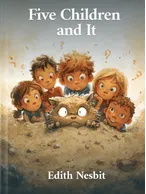
In Five Children and It (1902), Edith Nesbit tells the story of five siblings who discover a strange sand fairy called the Psammead, a magical creature who grants wishes — though never quite in the way the children expect.
The idea of a wish-granting being comes from old folklore and fairy tales, but unlike traditional fairy tales, where magic rewards virtue or punishes evil, Nesbit’s magic behaves unpredictably. Wishes go wrong not because the children are bad, but because they are impulsive, curious, and inexperienced. The Psammead itself is not a beautiful fairy but a grumpy, ancient creature with a dry sense of humor.

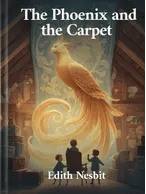
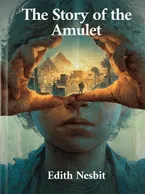
The success of the first book led to two sequels: The Phoenix and the Carpet (1904) and The Story of the Amulet (1906). In these stories, the magical elements grow larger — a talking phoenix, a flying carpet, time travel — but the emotional center remains the same. The children must learn how to handle freedom, responsibility, and disappointment.
In The Story of the Amulet, Nesbit moves beyond simple adventure and explores history and social ideas. The children travel through time, encountering ancient civilizations and imagining better futures. Here we can see her political interests quietly shaping the fantasy. The story asks what a fair and peaceful world might look like, but it never stops feeling like a children’s adventure.
The Railway Children
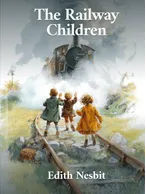
Perhaps Edith Nesbit’s most beloved novel, The Railway Children (1906) tells the story of three siblings who move from London to the countryside after their father suddenly disappears. Forced to adjust to a simpler life near a railway station, the children learn independence, patience, and quiet courage.
This story contains no magic, yet it feels just as powerful. The emotional core comes from real experience. Nesbit knew financial instability and public scandal in her own family life. Some critics suggest that the sudden loss of the father in the novel reflects the insecurity she herself felt at times. Her own views and ideas are also subtly present in the book, both in actions and through the characters' voices.
“Of course they can. Girls are just as clever as boys, and don’t you forget it!

The railway itself becomes a symbol of connection and hope. The novel treats poverty, injustice, and kindness with calm honesty. Children are not shielded from reality, but they are supported by love and community.
Nesbit as a Mother and a Storyteller
Edith Nesbit’s relationship with her own children was complex but deeply important to her writing. She was affectionate, playful, and involved in their imaginative games, often drawing inspiration directly from family life. Many scenes in her books reflect real conversations, arguments, and adventures shared with her children.
At the same time, biographers note that she could be emotionally demanding and sometimes overwhelmed by financial and personal strain. The article “The Life and Loves of E. Nesbit” highlights how her devotion to writing was also a necessity as she wrote constantly to support her family. Source
This mixture of warmth, pressure, imagination, and responsibility shaped her fiction. She understood children not as symbols of innocence, but as people living inside complicated families, much like her own.
The creative world in which Nesbit lived — full of writers, political thinkers, unconventional relationships, and artistic ambition — later inspired other novelists. Most notably, A. S. Byatt’s The Children’s Book (2009) draws on the atmosphere of Edwardian literary circles similar to Nesbit’s. Byatt reimagines the lives of children growing up among artistic adults, exploring both the beauty, hidden tensions and quiet tragedies behind such creative households. While not a direct biography, the novel echoes the kind of environment in which Nesbit lived and worked.
Other Works for Young and Adult Readers
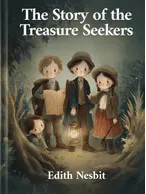
One of Edith Nesbit’s earliest and most beloved successes was The Story of the Treasure Seekers (1899), the first book about the Bastable children. This lively story follows a large family who try to restore their fortunes through imaginative and often chaotic schemes.
The Bastables were closely inspired by Nesbit’s own children and their friends. She observed their conversations, their competitions, and their creative plans, and she turned these into fiction with very little romanticizing.
The book was followed by sequels, including The Wouldbegoods (1901) and The New Treasure Seekers (1904). Together, these stories show children trying to improve themselves, manage money, and understand responsibility — always with humor rather than moral preaching.

Beyond children’s fiction, she wrote short stories and novels for adults, many of them darker and more realistic. These works explore marriage, disappointment, ambition, and social pressure, revealing a sharper and sometimes more bitter voice. Read “Man-Size in Marble”, a short story here
A Lasting Influence
Edith Nesbit helped shape children’s literature into something closer to what readers recognize today. She trusted children to be able to comprehend complex emotions and real-life difficulties. In her books, imagination does not escape reality — it helps children understand it.
She also lived by many of the values that appear in her stories. She supported herself through writing, believed strongly in education and social reform, and defended women’s creative and intellectual freedom. These ideas are not presented as lessons in her books. Instead, they live inside the characters and their choices.
Edith Nesbit wrote stories that respect the reader. She believed children deserved honesty, humor, and space to think for themselves. If you are looking for a book to read with your child that feels both imaginative and emotionally real, Nesbit is a wonderful choice. Her stories create space for conversation about responsibility, fairness, courage, and family life. And if you are an adult reader, returning to her books can feel like rediscovering childhood - as something thoughtful, lively, and deeply human.