Wild Words and Quiet Rebellions. The Brontë Sisters and Their Enduring Power
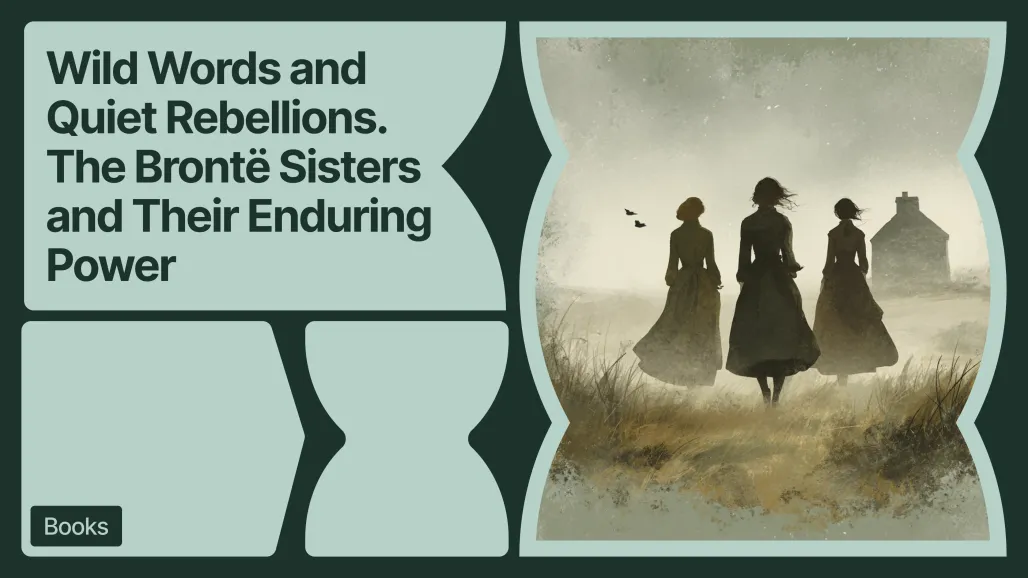
This article explores the Brontë sisters' lives, distinct styles, and lasting impact through their bold, emotional, and unforgettable novels.
Early Lives: Haworth, Headstones & Imagined Worlds
Charlotte Brontë & Jane Eyre
Emily Brontë & Wuthering Heights
Anne Brontë & The Tenant of Wildfell Hall
Their Collective Legacy: Style, Impact & Modern Relevance
Charlotte, Emily, and Anne Brontë emerged from the rugged moors of Yorkshire to write novels that changed English literature forever. Their works, filled with intense emotion, sharp social insight, and unforgettable heroines, continue to speak to readers more than 170 years later. From lonely childhoods in the parsonage to writing under male pseudonyms, the Brontës challenged both literary conventions and societal expectations. Their legacy lives on — in books, films, and the hearts of readers around the world.
Early Lives: Haworth, Headstones & Imagined Worlds
The Brontë sisters were born into a quiet corner of northern England — the village of Haworth — where their father was a clergyman and the surrounding moors became both playground and inspiration. Charlotte (1816–1855), Emily (1818–1848), and Anne (1820–1849) experienced loss early, with the deaths of their mother and two older sisters. Alongside their troubled brother Branwell, they retreated into rich fantasy worlds they invented themselves.
From a young age, they filled homemade books with stories of imaginary lands, complete with politics, wars, and epic romances. These early writings shaped their voices — dramatic, introspective, and deeply aware of human flaws and social structures. But when they sought publication, they faced another challenge: being women in a male-dominated literary world. They adopted male pseudonyms — Currer, Ellis, and Acton Bell — to ensure their books would be taken seriously. And it worked.
Charlotte Brontë & Jane Eyre
Charlotte’s breakthrough novel Jane Eyre tells the story of a poor orphaned girl who becomes a governess and falls in love with her employer, the mysterious Mr. Rochester. But Jane Eyre is much more than a romance. It’s a story of resilience, morality, and inner strength. Jane insists on being treated as an equal, even when it costs her dearly.
The novel broke ground with its emotional depth and the boldness of Jane’s voice. In a time when women were expected to be quiet and agreeable, Jane declares:

Charlotte's writing blends realism, gothic mystery, and spiritual reflection. Over time, Jane Eyre has become one of the most celebrated novels in English literature. Its many adaptations — from faithful BBC series to modern film — have focused on romance, but the real power lies in Jane’s fierce self-respect.
Emily Brontë & Wuthering Heights
Emily’s only novel, Wuthering Heights, is a wild, stormy tale of love and revenge set on the Yorkshire moors. The story centers on Heathcliff and Catherine — two people bound by a connection so deep it’s nearly destructive. The novel's dark tone, shifting narrators, and violent emotions shocked Victorian readers.
Emily’s style is bold and untamed, much like the landscape she describes. The moors become a symbol of passion and loneliness, while society’s rules seem distant or irrelevant. Catherine says:

Today, Wuthering Heights is admired for its psychological complexity and poetic force. Adaptations often romanticize the love story, but the book itself is more tragic than tender. It remains one of the most haunting novels ever written.
Anne Brontë & The Tenant of Wildfell Hall
Often the most overlooked of the three, Anne Brontë was in many ways the boldest. In The Tenant of Wildfell Hall, she tells the story of Helen Graham, a woman who leaves her alcoholic, abusive husband to protect her son — a shocking plot for 19th-century England. Through Helen’s journal, the novel exposes the dangers of unchecked male power and the need for female independence.
Anne’s writing is calm, direct, and quietly fierce. She believed in morality rooted in action, not just faith or words.

Though less often adapted, The Tenant of Wildfell Hall is now recognized as an early feminist novel. Scholars view Anne as the most progressive of the Brontës, with a clear-eyed look at marriage, addiction, and women’s rights.
Their Collective Legacy: Style, Impact & Modern Relevance
Though sisters, the Brontës wrote in distinct voices. Charlotte created passionate, principled women struggling for dignity. Emily wrote with elemental force, giving life to raw emotion and stark landscapes. Anne offered clear moral vision and social critique. Together, they redefined what novels could be — personal, poetic, and socially aware.
They challenged Victorian ideals of femininity, marriage, class, and religion. Their books featured female characters with agency, male characters who defied convention, and settings that reflected emotional states.
Their influence reaches far: Virginia Woolf praised Charlotte Brontë’s genius, while modern retellings like Wide Sargasso Sea, The Infernal Devices, and even gothic romance novels owe much to Emily’s intensity. Films and shows based on their books — such as To Walk Invisible, Jane Eyre (2011), or Wuthering Heights (2009) — continue to reimagine their stories for new generations.
We return to the Brontës because their books speak to something timeless: the desire to be seen, to be free, and to feel deeply. Their stories are not just about love, but about the cost of love — the power struggles, the silence, the choices that shape who we become.
Their characters — from Jane Eyre’s fierce independence to Heathcliff’s stormy brooding, to Helen Graham’s quiet defiance — remain unforgettable. Even minor figures like Mr. Brocklehurst, Joseph the servant, or the drunken Arthur Huntingdon reflect the society that tried to shape and sometimes destroy them.
The Brontës invite us to feel deeply and question boldly. They remind us that women’s voices — even in whispers — can change the world.