British English vs. American English - What’s the Difference?
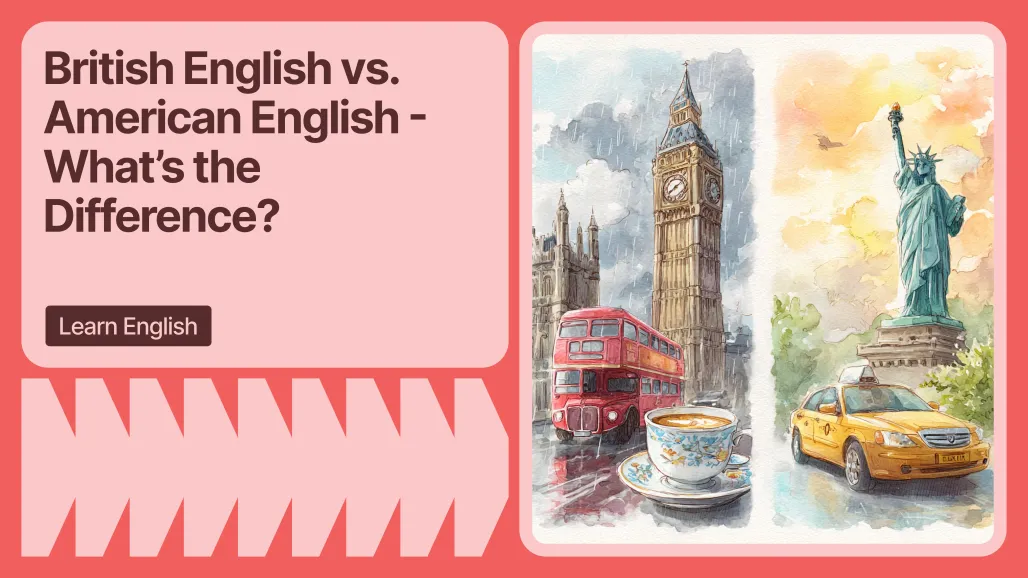
British and American English use different words, spellings, and sounds. This guide helps you understand and enjoy both versions!
1. Vocabulary: Different Words for the Same Thing
2. Spelling: Small Changes, Same Meaning
3. Pronunciation: How Words Sound
4. Grammar Differences (But Only a Few)
Final Tip
English is one language, but it’s not always the same. If you read a book from London and another from New York, you may notice something funny: some of the words are different!
Don’t worry—British English and American English are like cousins. They understand each other, but they sometimes use different words, spellings, and pronunciations.
Let’s look at the most important differences—and learn some useful examples!
1. Vocabulary: Different Words for the Same Thing
British and American English often use different words for the same object. Here are some examples:


2. Spelling: Small Changes, Same Meaning
American English often likes things shorter or simpler. That’s why some spellings are different.


Some rules to help you remember:
- 🇬🇧 -our → 🇺🇸 -or (colour → color, honour → honor)
- 🇬🇧 -re → 🇺🇸 -er (centre → center, metre → meter)
- 🇬🇧 -ise → 🇺🇸 -ize (organise → organize, realise → realize)
- 🇬🇧 double -ll in past tense → 🇺🇸 one -l (travelled → traveled, cancelled → canceled)
3. Pronunciation: How Words Sound
The words are often spelled the same, but sound different. For example:

Here are some easy tips to help you notice the difference:
-
🇺🇸 American English often has a strong “r” sound at the end of words (car, better, mother).
-
🇬🇧 British English usually makes the “r” softer or silent, especially at the end (cah, bettuh, mothuh).
-
In 🇬🇧 British English, vowels are often longer (glass → glaahss, dance → dahns).
In 🇺🇸 American English, vowels are shorter (glass → glas, dance → dance). -
🇬🇧 “-ile” endings often sound like “-yle” (mobile → MOH-byle),
🇺🇸 while Americans say “-ul” (mobile → MOH-bul).
Don't worry! Native speakers are used to both, and will understand you.

4. Grammar Differences (But Only a Few)
Grammar is mostly the same—but there are some small changes:

These are small grammar points—both versions are correct depending on where you are.

Final Tip
You don’t need to choose one “right” version—but it can help to know the difference, especially if you're planning to travel, study, or work in an English-speaking country.
British English is more common in Europe, Africa, and parts of Asia.
American English is more common in the USA, Latin America, and online media.
Be consistent. If you write “colour,” keep using “colour” (not “color”) in the same document. If you’re learning for school, business, or travel—pick the version that matches your goal.
And most of all: keep reading! Classic books are a great way to learn both versions of English. You'll pick up new words, styles, and grammar without even trying.