'Women and Economics' was first published in 1898.
[{"id":"para_1","index":0,"start":0,"offset":313,"words":3,"paraNum":"","lastModified":1623737706000,"semanticType":"title-book-title","voicework":"no_audio","blockId":"women_and_economics_ffa_en-bl2u","language":"en","wordsRange":{"start":319000000,"end":339000000},"paragraphVersion":48,"direction":"ltr","paragraph":"<h1 class=\"ilm-title\" id=\"para_1\" semantictype=\"title-book-title\" data-ilmid=\"women_and_economics_ffa_en-bl2u\" data-chapter=\"para_1\" data-words-count=\"3\" data-before=\"0\" data-ww=\"\"><span class=\"block-pb\"> <span class=\"block-pb is-animated\"></span> </span><span class=\"itm-wrap\">Women and Economics<br></span></h1>","hasContent":true,"isFirst":true,"isLast":false},{"id":"para_2","index":1,"start":313,"offset":398,"words":16,"paraNum":"","lastModified":1623737912000,"semanticType":"title-subtitle","voicework":"no_audio","blockId":"women_and_economics_ffa_en-blj3","language":"en","wordsRange":{"start":372333333,"end":405666667},"paragraphVersion":58,"direction":"ltr","paragraph":"<h1 class=\"ilm-title ilm-subtitle ilm-nopad\" id=\"para_2\" semantictype=\"title-subtitle\" data-ilmid=\"women_and_economics_ffa_en-blj3\" data-chapter=\"para_2\" data-words-count=\"16\" data-before=\"3\" data-ww=\"\"><span class=\"block-pb\"> <span class=\"block-pb is-animated\"></span> </span><span class=\"itm-wrap\">A Study of the Economic Relation Between Men and Women as a Factor in Social Evolution</span></h1>","hasContent":true,"isFirst":false,"isLast":false},{"id":"para_3","index":2,"start":711,"offset":354,"words":3,"paraNum":"","lastModified":1640092381000,"semanticType":"title-author","voicework":"no_audio","blockId":"women_and_economics_ffa_en-bl2v","language":"en","wordsRange":{"start":439000000,"end":441000000},"paragraphVersion":75,"direction":"ltr","paragraph":"<h1 class=\"ilm-title ilm-author ilm-nopad ilm-x-large\" id=\"para_3\" semantictype=\"title-author\" data-ilmid=\"women_and_economics_ffa_en-bl2v\" data-chapter=\"para_3\" data-words-count=\"3\" data-before=\"19\" data-ww=\"\"><span class=\"block-pb\"> <span class=\"block-pb is-animated\"></span> </span><span class=\"itm-wrap\">by<br>Charlotte Perkins Gilman<br></span></h1>","hasContent":true,"isFirst":false,"isLast":false},{"id":"para_4","index":3,"start":1065,"offset":155,"words":0,"paraNum":"","lastModified":1623754136000,"semanticType":"line","blockId":"women_and_economics_ffa_en-bljk","language":"en","wordsRange":{"start":509000000,"end":577000000},"paragraphVersion":33,"direction":"ltr","paragraph":"<hr class=\"ilm-hr ilm-small\" id=\"para_4\" semantictype=\"line\" data-ilmid=\"women_and_economics_ffa_en-bljk\" data-words-count=\"0\" data-before=\"22\" data-ww=\"\">","hasContent":true,"isFirst":false,"isLast":false},{"id":"para_5","index":4,"start":1220,"offset":2089,"words":0,"paraNum":"","lastModified":1623240457000,"semanticType":"illustration","blockId":"women_and_economics_ffa_en-bl2x","language":"en","wordsRange":{"start":645000000,"end":647000000},"paragraphVersion":47,"direction":"ltr","paragraph":"<div class=\"ilm-illustration\" id=\"para_5\" semantictype=\"illustration\" data-ilmid=\"women_and_economics_ffa_en-bl2x\" data-words-count=\"0\" data-before=\"22\" data-ww=\"\"><img width=\"411\" height=\"600\" data-src=\"ch0p0\" src=\"data:image/webp;base64,UklGRkgFAABXRUJQVlA4IDwFAACQGACdASopADwAPmkkj0WkIaEarfwAQAaEtIAJ6YxNcevnB+T5h/xX7c/kPGLvR90+TnuVe0Kp7/oPUC9m/nX/B8DTUC7mf5T1N/zz/W/l56uXgDfP/7d7AH8t/qH/I9kL+E/9H9s/I72O/nH93/8n9/+AL+Tf2D/g/3/2ufX3+x/stfrqO/nJZ0SAWM++c6Ba8dffRdYSpFF0/ZgWra0Bmm5IVMaL7/aClLhPYhunKoQvq0ovzeDG1yVxeHt1NSM02GZ8vbwv4nkDgAAAAP765Gs8TWY03Ro/U0u1Ucbig91mVRpFxu5qs5pIJRGFZodbEwI+uRiziTofPspdA1V/CW5eR92ezv7LyG79vZqWpQPP74LBaBZkRP7TFgQTJ5faEemMMC8DD6+6jQfxFzYg+/4pSUDAED+mrbjrlw8C3vFXqnNPZ2zMyIEv+jNLeUlimHeA4mZJ4D/ntC0XGSO1FuI3U07iT0TwwnfLmUFJ47DH0ZUP96+vilPwwrWn6w9Fr62+nGx44eKPik9bcRWHbTE9zXDCOc/aFDGfW3UlAugypJVEx+yOngyJF8qz+/Ezf+d/ZYx79yQOz5EZLabdwe/lx9R3F3RbopsBe78EktwN9X1F2AK5/xbZSpLwDF3RVv5Zwu7tthg8L5RVQ/Bo/b793cYP8UrwwoaRtwKvHRFab8fGC5KppcmFcDj3qiN0fCCDa8Vzkyzx/X24KXKAF1l5yr5DXAyea5PumwgjHvABiB1/O1A1/Cf3mT/3b0PIqgJ/j9UgPgGsqkwoMl3pN0AvZQIc4g8jiXKtQhAP+KCn2TR2r6kZcCMtifP9aGZZG32MGJvh1ejbuZYsVerwzOW5J1q1z9MwUhwpHU4V1/TxyNl+oR0ksOHXx8+Dl3BT50GogHkXltx3+ejuItFsBOJcUPwVSbsbgC8P4jSw9MX0303mEld9Ae+zIqWZx3AyfZFN/+2Td3gfIS72eUlZzlRtz9CtBj2ROc93cR3qopsd24KUqSi7JfpIUTawBcsxyFhwSvBNIN1/UwW23eWf32423yd5stwOzprhI8lGSG2Wq/y97ixkhJn0a6gVht2r/Ao80Q1BXcNF5hu5QqJp8j75UvhVc7UYGLHTrlJiTH28BNUNDZ1LvmcGPnB0M5XYNBX1g851AyCrGy69yQZx0iQZ/m4LfQJYO905IdHB/2b1mPDEqLmaKkDj4sQHSDu0VxrLgLymHE29EC98/yzdlpZFeCgyvN6I2V7W+btGEBFjaxVEftRLuuS6sWLXM+Yomda4D2W2gYUn7ekfGNt1YG3JDgFTt7Q9dN9T2QrCLDlk1tGyZBnf8mKHotoowCuDf6O3K0u9CChJetmDww5mGJP8v4ENE++fe7wEY7++Vys6ScmE1W1JvohCXca0gmfK1wM7BaJuBJzxRQXFLzgZaxgDcyePbANwL54+x6XLn9WUqmul9J3UqphTD5Y1ItUGoMTz9zdYnW+L8Ukm7Fp4XRhYlq8EWq0fnIb2h9w5iHpYMzH6mdDfcyOnONi0elrPS9QNgycvjgHR9ZkNpbkLn9ez7DE6E2It20kosoMJN+zoAgaa8fpdi+WjljtgBsSuvGv+h2hn4nkJO4v25YE5vwxL3Av/AHoPy8F9PBDjBrHnuqfkkB0qraRVsN3hAPJl5hfae4EYYRiGfTgd04Cw7evtYbwxIAPVmBeqVjAHr4ATt7lqRtrr4T1QNpEu2BECx3YwV5NSuanBPwWXLAt/xy6ky8RjczG8ayRG8hp5ydVNUKLap4sRoAAAAA==\" alt=\"Women and Economics\"></div>","hasContent":true,"isFirst":false,"isLast":false},{"id":"para_6","index":5,"start":3309,"offset":494,"words":1,"paraNum":"","lastModified":1623738023000,"semanticType":"header-chapter-header","voicework":"no_audio","blockId":"women_and_economics_ffa_en-bl31","language":"en","wordsRange":{"start":1060000000,"end":1062000000},"paragraphVersion":64,"direction":"ltr","paragraph":"<h2 class=\"ilm-header ilm-h2 ilm-large\" id=\"para_6\" semantictype=\"header-chapter-header\" data-ilmid=\"women_and_economics_ffa_en-bl31\" data-chapter=\"para_6\" data-words-count=\"1\" data-before=\"22\" data-ww=\"\"><span class=\"block-pb\"> <span class=\"block-pb is-animated\"></span> </span><span class=\"itm-wrap\"><span class=\"chapter-text\"><span class=\"chapter-number\"><span class=\"chapter-label\"></span><span class=\"chapter-value\"></span></span><span class=\"chapter-title\">Proem</span></span></span></h2>","hasContent":true,"isFirst":false,"isLast":false},{"id":"para_7","index":6,"start":3803,"offset":800,"words":33,"paraNum":"p1.1","lastModified":1624940744000,"semanticType":"par","voicework":"no_audio","blockId":"women_and_economics_ffa_en-bl32","language":"en","wordsRange":{"start":1162000000,"end":1173000000},"paragraphVersion":80,"direction":"ltr","paragraph":"<p class=\"ilm-blockquote\" id=\"para_7\" semantictype=\"par\" data-ilmid=\"women_and_economics_ffa_en-bl32\" data-words-count=\"33\" data-before=\"23\" data-ww=\"\"><span class=\"block-num\" data-id=\"p1.1\"></span><span class=\"block-pb\"> <span class=\"block-pb is-animated\"></span> </span><span class=\"itm-wrap\"><i>In </i><i>dark </i><i>and </i><i>early </i><i>ages, </i><i>through </i><i>the </i><i>primal </i><i>forests </i><i>faring,</i><i> </i><i><br>Ere </i><i>the </i><i>soul </i><i>came </i><i>shining </i><i>into </i><i>prehistoric </i><i>night,</i><i><br>Twofold </i><i>man </i><i>was </i><i>equal; </i><i>they </i><i>were </i><i>comrades </i><i>dear </i><i>and </i><i>daring,</i><i><br>Living </i><i>wild </i><i>and </i><i>free </i><i>together </i><i>in </i><i>unreasoning </i><i>delight.</i><br></span></p>","hasContent":true,"isFirst":false,"isLast":false},{"id":"para_8","index":7,"start":4603,"offset":806,"words":37,"paraNum":"p1.2","lastModified":1623739266000,"semanticType":"par","voicework":"no_audio","blockId":"women_and_economics_ffa_en-bl36","language":"en","wordsRange":{"start":1602000000,"end":1612000000},"paragraphVersion":69,"direction":"ltr","paragraph":"<p class=\"ilm-blockquote\" id=\"para_8\" semantictype=\"par\" data-ilmid=\"women_and_economics_ffa_en-bl36\" data-words-count=\"37\" data-before=\"56\" data-ww=\"\"><span class=\"block-num\" data-id=\"p1.2\"></span><span class=\"block-pb\"> <span class=\"block-pb is-animated\"></span> </span><span class=\"itm-wrap\"><i>Ere </i><i>the </i><i>soul </i><i>was </i><i>born </i><i>and </i><i>consciousness </i><i>came </i><i>slowly,</i><i> </i><i><br>Ere </i><i>the </i><i>soul </i><i>was </i><i>born, </i><i>to </i><i>man </i><i>and </i><i>woman, </i><i>too,</i><i><br>Ere </i><i>he </i><i>found </i><i>the </i><i>Tree </i><i>of </i><i>Knowledge, </i><i>that </i><i>awful </i><i>tree </i><i>and </i><i>holy,</i><i><br>Ere </i><i>he </i><i>knew </i><i>he </i><i>felt, </i><i>and </i><i>knew </i><i>he </i><i>knew.</i><br></span></p>","hasContent":true,"isFirst":false,"isLast":false},{"id":"para_9","index":8,"start":5409,"offset":908,"words":46,"paraNum":"p1.3","lastModified":1623739272000,"semanticType":"par","voicework":"no_audio","blockId":"women_and_economics_ffa_en-bl3a","language":"en","wordsRange":{"start":2046000000,"end":2060000000},"paragraphVersion":76,"direction":"ltr","paragraph":"<p class=\"ilm-blockquote\" id=\"para_9\" semantictype=\"par\" data-ilmid=\"women_and_economics_ffa_en-bl3a\" data-words-count=\"46\" data-before=\"93\" data-ww=\"\"><span class=\"block-num\" data-id=\"p1.3\"></span><span class=\"block-pb\"> <span class=\"block-pb is-animated\"></span> </span><span class=\"itm-wrap\"><i>Then </i><i>said </i><i>he </i><i>to </i><i>Pain, </i><i>“I </i><i>am </i><i>wise </i><i>now, </i><i>and </i><i>I </i><i>know </i><i>you!</i><i> </i><i><br>No </i><i>more </i><i>will </i><i>I </i><i>suffer </i><i>while </i><i>power </i><i>and </i><i>wisdom </i><i>last!”</i><i><br>Then </i><i>said </i><i>he </i><i>to </i><i>Pleasure, </i><i>“I </i><i>am </i><i>strong, </i><i>and </i><i>I </i><i>will </i><i>show </i><i>you</i><i><br>That </i><i>the </i><i>will </i><i>of </i><i>man </i><i>can </i><i>seize </i><i>you, — </i><i>aye, </i><i>and </i><i>hold </i><i>you </i><i>fast!”</i><br></span></p>","hasContent":true,"isFirst":false,"isLast":false},{"id":"para_10","index":9,"start":6317,"offset":801,"words":35,"paraNum":"p1.4","lastModified":1623739274000,"semanticType":"par","voicework":"no_audio","blockId":"women_and_economics_ffa_en-bl3e","language":"en","wordsRange":{"start":2499000000,"end":2511000000},"paragraphVersion":82,"direction":"ltr","paragraph":"<p class=\"ilm-blockquote\" id=\"para_10\" semantictype=\"par\" data-ilmid=\"women_and_economics_ffa_en-bl3e\" data-words-count=\"35\" data-before=\"139\" data-ww=\"\"><span class=\"block-num\" data-id=\"p1.4\"></span><span class=\"block-pb\"> <span class=\"block-pb is-animated\"></span> </span><span class=\"itm-wrap\"><i>Food </i><i>he </i><i>ate </i><i>for </i><i>pleasure, </i><i>and </i><i>wine </i><i>he </i><i>drank </i><i>for </i><i>gladness.</i><i> </i><i><br>And </i><i>woman? </i><i>Ah, </i><i>the </i><i>woman! </i><i>the </i><i>crown </i><i>of </i><i>all </i><i>delight!</i><i><br>His </i><i>now, — </i><i>he </i><i>knew </i><i>it! </i><i>He </i><i>was </i><i>strong </i><i>to </i><i>madness</i><i><br>In </i><i>that </i><i>early </i><i>dawning </i><i>after </i><i>prehistoric </i><i>night.</i><br></span></p>","hasContent":true,"isFirst":false,"isLast":false},{"id":"para_11","index":10,"start":7118,"offset":900,"words":43,"paraNum":"p1.5","lastModified":1627545226000,"semanticType":"par","voicework":"no_audio","blockId":"women_and_economics_ffa_en-bl3i","language":"en","wordsRange":{"start":2941000000,"end":2950000000},"paragraphVersion":91,"direction":"ltr","paragraph":"<p class=\"ilm-blockquote\" id=\"para_11\" semantictype=\"par\" data-ilmid=\"women_and_economics_ffa_en-bl3i\" data-words-count=\"43\" data-before=\"174\" data-ww=\"\"><span class=\"block-num\" data-id=\"p1.5\"></span><span class=\"block-pb\"> <span class=\"block-pb is-animated\"></span> </span><span class=\"itm-wrap\"><i>His, — </i><i>his </i><i>forever! </i><i>That </i><i>glory </i><i>sweet </i><i>and </i><i>tender!</i><i> </i><i><br>Ah, </i><i>but </i><i>he </i><i>would </i><i>love </i><i>her! </i><i>And </i><i>she </i><i>should </i><i>love </i><i>but </i><i>him!</i><i><br>He </i><i>would </i><i>work </i><i>and </i><i>struggle </i><i>for </i><i>her, </i><i>he </i><i>would </i><i>shelter </i><i>and </i><i>defend </i><i>her, —</i><i><br>She </i><i>should </i><i>never </i><i>leave </i><i>him, </i><i>never, </i><i>till </i><i>their </i><i>eyes </i><i>in </i><i>death </i><i>were </i><i>dim.</i><br></span></p>","hasContent":true,"isFirst":false,"isLast":false},{"id":"para_12","index":11,"start":8018,"offset":859,"words":41,"paraNum":"p1.6","lastModified":1623739280000,"semanticType":"par","voicework":"no_audio","blockId":"women_and_economics_ffa_en-bl3m","language":"en","wordsRange":{"start":3392000000,"end":3404000000},"paragraphVersion":92,"direction":"ltr","paragraph":"<p class=\"ilm-blockquote\" id=\"para_12\" semantictype=\"par\" data-ilmid=\"women_and_economics_ffa_en-bl3m\" data-words-count=\"41\" data-before=\"217\" data-ww=\"\"><span class=\"block-num\" data-id=\"p1.6\"></span><span class=\"block-pb\"> <span class=\"block-pb is-animated\"></span> </span><span class=\"itm-wrap\"><i>Close, </i><i>close </i><i>he </i><i>bound </i><i>her, </i><i>that </i><i>she </i><i>should </i><i>leave </i><i>him </i><i>never;</i><i> </i><i><br>Weak </i><i>still </i><i>he </i><i>kept </i><i>her, </i><i>lest </i><i>she </i><i>be </i><i>strong </i><i>to </i><i>flee;</i><i><br>And </i><i>the </i><i>fainting </i><i>flame </i><i>of </i><i>passion </i><i>he </i><i>kept </i><i>alive </i><i>forever</i><i><br>With </i><i>all </i><i>the </i><i>arts </i><i>and </i><i>forces </i><i>of </i><i>earth </i><i>and </i><i>sky </i><i>and </i><i>sea.</i><br></span></p>","hasContent":true,"isFirst":false,"isLast":false},{"id":"para_13","index":12,"start":8877,"offset":848,"words":38,"paraNum":"p1.7","lastModified":1623739283000,"semanticType":"par","voicework":"no_audio","blockId":"women_and_economics_ffa_en-bl3q","language":"en","wordsRange":{"start":3840000000,"end":3851000000},"paragraphVersion":98,"direction":"ltr","paragraph":"<p class=\"ilm-blockquote\" id=\"para_13\" semantictype=\"par\" data-ilmid=\"women_and_economics_ffa_en-bl3q\" data-words-count=\"38\" data-before=\"258\" data-ww=\"\"><span class=\"block-num\" data-id=\"p1.7\"></span><span class=\"block-pb\"> <span class=\"block-pb is-animated\"></span> </span><span class=\"itm-wrap\"><i>And, </i><i>ah, </i><i>the </i><i>long </i><i>journey! </i><i>The </i><i>slow </i><i>and </i><i>awful </i><i>ages</i><i> </i><i><br>They </i><i>have </i><i>labored </i><i>up </i><i>together, </i><i>blind </i><i>and </i><i>crippled, </i><i>all </i><i>astray!</i><i><br>Through </i><i>what </i><i>a </i><i>mighty </i><i>volume, </i><i>with </i><i>a </i><i>million </i><i>shameful </i><i>pages,</i><i><br>From </i><i>the </i><i>freedom </i><i>of </i><i>the </i><i>forests </i><i>to </i><i>the </i><i>prisons </i><i>of </i><i>to-day!</i><br></span></p>","hasContent":true,"isFirst":false,"isLast":false},{"id":"para_14","index":13,"start":9725,"offset":902,"words":44,"paraNum":"p1.8","lastModified":1623739291000,"semanticType":"par","voicework":"no_audio","blockId":"women_and_economics_ffa_en-bl3u","language":"en","wordsRange":{"start":4285000000,"end":4297000000},"paragraphVersion":104,"direction":"ltr","paragraph":"<p class=\"ilm-blockquote\" id=\"para_14\" semantictype=\"par\" data-ilmid=\"women_and_economics_ffa_en-bl3u\" data-words-count=\"44\" data-before=\"296\" data-ww=\"\"><span class=\"block-num\" data-id=\"p1.8\"></span><span class=\"block-pb\"> <span class=\"block-pb is-animated\"></span> </span><span class=\"itm-wrap\"><i>Food </i><i>he </i><i>ate </i><i>for </i><i>pleasure, </i><i>and </i><i>it </i><i>slew </i><i>him </i><i>with </i><i>diseases!</i><i> </i><i><br>Wine </i><i>he </i><i>drank </i><i>for </i><i>gladness, </i><i>and </i><i>it </i><i>led </i><i>the </i><i>way </i><i>to </i><i>crime!</i><i><br>And </i><i>woman? </i><i>He </i><i>will </i><i>hold </i><i>her, — </i><i>he </i><i>will </i><i>have </i><i>her </i><i>when </i><i>he </i><i>pleases, —</i><i><br>And </i><i>he </i><i>never </i><i>once </i><i>hath </i><i>seen </i><i>her </i><i>since </i><i>the </i><i>prehistoric </i><i>time!</i><br></span></p>","hasContent":true,"isFirst":false,"isLast":false},{"id":"para_15","index":14,"start":10627,"offset":821,"words":36,"paraNum":"p1.9","lastModified":1623739293000,"semanticType":"par","voicework":"no_audio","blockId":"women_and_economics_ffa_en-bl3y","language":"en","wordsRange":{"start":4736000000,"end":4749000000},"paragraphVersion":110,"direction":"ltr","paragraph":"<p class=\"ilm-blockquote\" id=\"para_15\" semantictype=\"par\" data-ilmid=\"women_and_economics_ffa_en-bl3y\" data-words-count=\"36\" data-before=\"340\" data-ww=\"\"><span class=\"block-num\" data-id=\"p1.9\"></span><span class=\"block-pb\"> <span class=\"block-pb is-animated\"></span> </span><span class=\"itm-wrap\"><i>Gone </i><i>the </i><i>friend </i><i>and </i><i>comrade </i><i>of </i><i>the </i><i>day </i><i>when </i><i>life </i><i>was </i><i>younger,</i><i> </i><i><br>She </i><i>who </i><i>rests </i><i>and </i><i>comforts, </i><i>she </i><i>who </i><i>helps </i><i>and </i><i>saves.</i><i><br>Still </i><i>he </i><i>seeks </i><i>her </i><i>vainly, </i><i>with </i><i>a </i><i>never-dying </i><i>hunger;</i><i><br>Alone </i><i>beneath </i><i>his </i><i>tyrants, </i><i>alone </i><i>above </i><i>his </i><i>slaves!</i><br></span></p>","hasContent":true,"isFirst":false,"isLast":false},{"id":"para_16","index":15,"start":11448,"offset":875,"words":41,"paraNum":"p1.10","lastModified":1623739295000,"semanticType":"par","voicework":"no_audio","blockId":"women_and_economics_ffa_en-bl42","language":"en","wordsRange":{"start":5180000000,"end":5192000000},"paragraphVersion":116,"direction":"ltr","paragraph":"<p class=\"ilm-blockquote\" id=\"para_16\" semantictype=\"par\" data-ilmid=\"women_and_economics_ffa_en-bl42\" data-words-count=\"41\" data-before=\"376\" data-ww=\"\"><span class=\"block-num\" data-id=\"p1.10\"></span><span class=\"block-pb\"> <span class=\"block-pb is-animated\"></span> </span><span class=\"itm-wrap\"><i>Toiler, </i><i>bent </i><i>and </i><i>weary </i><i>with </i><i>the </i><i>load </i><i>of </i><i>thine </i><i>own </i><i>making!</i><i> </i><i><br>Thou </i><i>who </i><i>art </i><i>sad </i><i>and </i><i>lonely, </i><i>though </i><i>lonely </i><i>all </i><i>in </i><i>vain!</i><i><br>Who </i><i>hast </i><i>sought </i><i>to </i><i>conquer </i><i>Pleasure </i><i>and </i><i>have </i><i>her </i><i>for </i><i>the </i><i>taking,</i><i><br>And </i><i>found </i><i>that </i><i>Pleasure </i><i>only </i><i>was </i><i>another </i><i>name </i><i>for </i><i>Pain —</i><br></span></p>","hasContent":true,"isFirst":false,"isLast":false},{"id":"para_17","index":16,"start":12323,"offset":797,"words":32,"paraNum":"p1.11","lastModified":1623739302000,"semanticType":"par","voicework":"no_audio","blockId":"women_and_economics_ffa_en-bl46","language":"en","wordsRange":{"start":5628000000,"end":5635000000},"paragraphVersion":122,"direction":"ltr","paragraph":"<p class=\"ilm-blockquote\" id=\"para_17\" semantictype=\"par\" data-ilmid=\"women_and_economics_ffa_en-bl46\" data-words-count=\"32\" data-before=\"417\" data-ww=\"\"><span class=\"block-num\" data-id=\"p1.11\"></span><span class=\"block-pb\"> <span class=\"block-pb is-animated\"></span> </span><span class=\"itm-wrap\"><i>Nature </i><i>hath </i><i>reclaimed </i><i>thee, </i><i>forgiving </i><i>dispossession!</i><i> </i><i><br>God </i><i>hath </i><i>not </i><i>forgotten, </i><i>though </i><i>man </i><i>doth </i><i>still </i><i>forget!</i><i><br>The </i><i>woman-soul </i><i>is </i><i>rising, </i><i>in </i><i>despite </i><i>of </i><i>thy </i><i>transgression —</i><i><br>Loose </i><i>her </i><i>now, </i><i>and </i><i>trust </i><i>her! </i><i>She </i><i>will </i><i>love </i><i>thee </i><i>yet!</i><br></span></p>","hasContent":true,"isFirst":false,"isLast":false},{"id":"para_18","index":17,"start":13120,"offset":847,"words":39,"paraNum":"p1.12","lastModified":1623739303000,"semanticType":"par","voicework":"no_audio","blockId":"women_and_economics_ffa_en-bl4a","language":"en","wordsRange":{"start":6067000000,"end":6078000000},"paragraphVersion":128,"direction":"ltr","paragraph":"<p class=\"ilm-blockquote\" id=\"para_18\" semantictype=\"par\" data-ilmid=\"women_and_economics_ffa_en-bl4a\" data-words-count=\"39\" data-before=\"449\" data-ww=\"\"><span class=\"block-num\" data-id=\"p1.12\"></span><span class=\"block-pb\"> <span class=\"block-pb is-animated\"></span> </span><span class=\"itm-wrap\"><i>Love </i><i>thee? </i><i>She </i><i>will </i><i>love </i><i>thee </i><i>as </i><i>only </i><i>freedom </i><i>knoweth!</i><i> </i><i><br>Love </i><i>thee? </i><i>She </i><i>will </i><i>love </i><i>thee </i><i>while </i><i>Love </i><i>itself </i><i>doth </i><i>live!</i><i><br>Fear </i><i>not </i><i>the </i><i>heart </i><i>of </i><i>woman! </i><i>No </i><i>bitterness </i><i>it </i><i>showeth!</i><i><br>The </i><i>ages </i><i>of </i><i>her </i><i>sorrow </i><i>have </i><i>but </i><i>taught </i><i>her </i><i>to </i><i>forgive!</i><br></span></p>","hasContent":true,"isFirst":false,"isLast":false},{"id":"para_19","index":18,"start":13967,"offset":157,"words":0,"paraNum":"","lastModified":1623738291000,"semanticType":"line","blockId":"women_and_economics_ffa_en-blj4","language":"en","wordsRange":{"start":6446333333,"end":6479666667},"paragraphVersion":51,"direction":"ltr","paragraph":"<hr class=\"ilm-hr ilm-small\" id=\"para_19\" semantictype=\"line\" data-ilmid=\"women_and_economics_ffa_en-blj4\" data-words-count=\"0\" data-before=\"488\" data-ww=\"\">","hasContent":true,"isFirst":false,"isLast":false},{"id":"para_20","index":19,"start":14124,"offset":499,"words":1,"paraNum":"","lastModified":1623738033000,"semanticType":"header-chapter-header","voicework":"no_audio","blockId":"women_and_economics_ffa_en-bl4e","language":"en","wordsRange":{"start":6513000000,"end":6515000000},"paragraphVersion":64,"direction":"ltr","paragraph":"<h2 class=\"ilm-header ilm-h2 ilm-large\" id=\"para_20\" semantictype=\"header-chapter-header\" data-ilmid=\"women_and_economics_ffa_en-bl4e\" data-chapter=\"para_20\" data-words-count=\"1\" data-before=\"488\" data-ww=\"\"><span class=\"block-pb\"> <span class=\"block-pb is-animated\"></span> </span><span class=\"itm-wrap\"><span class=\"chapter-text\"><span class=\"chapter-number\"><span class=\"chapter-label\"></span><span class=\"chapter-value\"></span></span><span class=\"chapter-title\">Preface</span></span></span></h2>","hasContent":true,"isFirst":false,"isLast":false},{"id":"para_21","index":20,"start":14623,"offset":962,"words":51,"paraNum":"p2.1","lastModified":1623738033000,"semanticType":"par","voicework":"no_audio","blockId":"women_and_economics_ffa_en-bl4f","language":"en","wordsRange":{"start":6615000000,"end":6667000000},"paragraphVersion":54,"direction":"ltr","paragraph":"<p id=\"para_21\" semantictype=\"par\" data-ilmid=\"women_and_economics_ffa_en-bl4f\" data-words-count=\"51\" data-before=\"489\" data-ww=\"\"><span class=\"block-num\" data-id=\"p2.1\"></span><span class=\"block-pb\"> <span class=\"block-pb is-animated\"></span> </span><span class=\"itm-wrap\"><i>This </i><i>book </i><i>is </i><i>written </i><i>to </i><i>offer </i><i>a </i><i>simple </i><i>and </i><i>natural </i><i>explanation </i><i>of </i><i>one </i><i>of </i><i>the </i><i>most </i><i>common </i><i>and </i><i>most </i><i>perplexing </i><i>problems </i><i>of </i><i>human </i><i>life, — </i><i>a </i><i>problem </i><i>which </i><i>presents </i><i>itself </i><i>to </i><i>almost </i><i>every </i><i>individual </i><i>for </i><i>practical </i><i>solution, </i><i>and </i><i>which </i><i>demands </i><i>the </i><i>most </i><i>serious </i><i>attention </i><i>of </i><i>the </i><i>moralist, </i><i>the </i><i>physician, </i><i>and </i><i>the </i><i>sociologist</i> —</span></p>","hasContent":true,"isFirst":false,"isLast":false},{"id":"para_22","index":21,"start":15585,"offset":889,"words":47,"paraNum":"p2.2","lastModified":1623738033000,"semanticType":"par","voicework":"no_audio","blockId":"women_and_economics_ffa_en-bl4g","language":"en","wordsRange":{"start":6767000000,"end":6815000000},"paragraphVersion":54,"direction":"ltr","paragraph":"<p id=\"para_22\" semantictype=\"par\" data-ilmid=\"women_and_economics_ffa_en-bl4g\" data-words-count=\"47\" data-before=\"540\" data-ww=\"\"><span class=\"block-num\" data-id=\"p2.2\"></span><span class=\"block-pb\"> <span class=\"block-pb is-animated\"></span> </span><span class=\"itm-wrap\"><i>To </i><i>show </i><i>how </i><i>some </i><i>of </i><i>the </i><i>worst </i><i>evils </i><i>under </i><i>which </i><i>we </i><i>suffer, </i><i>evils </i><i>long </i><i>supposed </i><i>to </i><i>be </i><i>inherent </i><i>and </i><i>ineradicable </i><i>in </i><i>our </i><i>natures, </i><i>are </i><i>but </i><i>the </i><i>result </i><i>of </i><i>certain </i><i>arbitrary </i><i>conditions </i><i>of </i><i>our </i><i>own </i><i>adoption, </i><i>and </i><i>how, </i><i>by </i><i>removing </i><i>those </i><i>conditions, </i><i>we </i><i>may </i><i>remove </i><i>the </i><i>evils </i><i>resultant</i> —</span></p>","hasContent":true,"isFirst":false,"isLast":false},{"id":"para_23","index":22,"start":16474,"offset":906,"words":47,"paraNum":"p2.3","lastModified":1623738033000,"semanticType":"par","voicework":"no_audio","blockId":"women_and_economics_ffa_en-bl4h","language":"en","wordsRange":{"start":6915000000,"end":6963000000},"paragraphVersion":54,"direction":"ltr","paragraph":"<p id=\"para_23\" semantictype=\"par\" data-ilmid=\"women_and_economics_ffa_en-bl4h\" data-words-count=\"47\" data-before=\"587\" data-ww=\"\"><span class=\"block-num\" data-id=\"p2.3\"></span><span class=\"block-pb\"> <span class=\"block-pb is-animated\"></span> </span><span class=\"itm-wrap\"><i>To </i><i>point </i><i>out </i><i>how </i><i>far </i><i>we </i><i>have </i><i>already </i><i>gone </i><i>in </i><i>the </i><i>path </i><i>of </i><i>improvement, </i><i>and </i><i>how </i><i>irresistibly </i><i>the </i><i>social </i><i>forces </i><i>of </i><i>to-day </i><i>are </i><i>compelling </i><i>us </i><i>further, </i><i>even </i><i>without </i><i>our </i><i>knowledge </i><i>and </i><i>against </i><i>our </i><i>violent </i><i>opposition, — </i><i>an </i><i>advance </i><i>which </i><i>may </i><i>be </i><i>greatly </i><i>quickened </i><i>by </i><i>our </i><i>recognition </i><i>and </i><i>assistance</i> —</span></p>","hasContent":true,"isFirst":false,"isLast":false},{"id":"para_24","index":23,"start":17380,"offset":722,"words":34,"paraNum":"p2.4","lastModified":1623738033000,"semanticType":"par","voicework":"no_audio","blockId":"women_and_economics_ffa_en-bl4i","language":"en","wordsRange":{"start":7063000000,"end":7098000000},"paragraphVersion":54,"direction":"ltr","paragraph":"<p id=\"para_24\" semantictype=\"par\" data-ilmid=\"women_and_economics_ffa_en-bl4i\" data-words-count=\"34\" data-before=\"634\" data-ww=\"\"><span class=\"block-num\" data-id=\"p2.4\"></span><span class=\"block-pb\"> <span class=\"block-pb is-animated\"></span> </span><span class=\"itm-wrap\"><i>To </i><i>reach </i><i>in </i><i>especial </i><i>the </i><i>thinking </i><i>women </i><i>of </i><i>to-day, </i><i>and </i><i>urge </i><i>upon </i><i>them </i><i>a </i><i>new </i><i>sense, </i><i>not </i><i>only </i><i>of </i><i>their </i><i>social </i><i>responsibility </i><i>as </i><i>individuals, </i><i>but </i><i>of </i><i>their </i><i>measureless </i><i>racial </i><i>importance </i><i>as </i><i>makers </i><i>of </i><i>men.</i></span></p>","hasContent":true,"isFirst":false,"isLast":false},{"id":"para_25","index":24,"start":18102,"offset":670,"words":30,"paraNum":"p2.5","lastModified":1623738033000,"semanticType":"par","voicework":"no_audio","blockId":"women_and_economics_ffa_en-bl4j","language":"en","wordsRange":{"start":7198000000,"end":7229000000},"paragraphVersion":54,"direction":"ltr","paragraph":"<p id=\"para_25\" semantictype=\"par\" data-ilmid=\"women_and_economics_ffa_en-bl4j\" data-words-count=\"30\" data-before=\"668\" data-ww=\"\"><span class=\"block-num\" data-id=\"p2.5\"></span><span class=\"block-pb\"> <span class=\"block-pb is-animated\"></span> </span><span class=\"itm-wrap\"><i>It </i><i>is </i><i>hoped </i><i>also </i><i>that </i><i>the </i><i>theory </i><i>advanced </i><i>will </i><i>prove </i><i>sufficiently </i><i>suggestive </i><i>to </i><i>give </i><i>rise </i><i>to </i><i>such </i><i>further </i><i>study </i><i>and </i><i>discussion </i><i>as </i><i>shall </i><i>prove </i><i>its </i><i>error </i><i>or </i><i>establish </i><i>its </i><i>truth.</i></span></p>","hasContent":true,"isFirst":false,"isLast":false},{"id":"para_26","index":25,"start":18772,"offset":349,"words":3,"paraNum":"p2.6","lastModified":1624879012000,"semanticType":"par","voicework":"no_audio","blockId":"women_and_economics_ffa_en-bl4k","language":"en","wordsRange":{"start":7329000000,"end":7333000000},"paragraphVersion":62,"direction":"ltr","paragraph":"<p class=\"ilm-right\" id=\"para_26\" semantictype=\"par\" data-ilmid=\"women_and_economics_ffa_en-bl4k\" data-words-count=\"3\" data-before=\"698\" data-ww=\"\"><span class=\"block-num\" data-id=\"p2.6\"></span><span class=\"block-pb\"> <span class=\"block-pb is-animated\"></span> </span><span class=\"itm-wrap\"><i>CHARLOTTE </i><i>PERKINS </i><i>STETSON.</i></span></p>","hasContent":true,"isFirst":false,"isLast":false},{"id":"para_27","index":26,"start":19121,"offset":157,"words":0,"paraNum":"","lastModified":1623738311000,"semanticType":"line","blockId":"women_and_economics_ffa_en-blj5","language":"en","wordsRange":{"start":7366333333,"end":7399666667},"paragraphVersion":49,"direction":"ltr","paragraph":"<hr class=\"ilm-hr ilm-small\" id=\"para_27\" semantictype=\"line\" data-ilmid=\"women_and_economics_ffa_en-blj5\" data-words-count=\"0\" data-before=\"701\" data-ww=\"\">","hasContent":true,"isFirst":false,"isLast":false},{"id":"para_28","index":27,"start":19278,"offset":497,"words":1,"paraNum":"","lastModified":1623738064000,"semanticType":"header-chapter-header","voicework":"no_audio","blockId":"women_and_economics_ffa_en-bl4l","language":"en","wordsRange":{"start":7433000000,"end":7435000000},"paragraphVersion":64,"direction":"ltr","paragraph":"<h2 class=\"ilm-header ilm-h2 ilm-large\" id=\"para_28\" semantictype=\"header-chapter-header\" data-ilmid=\"women_and_economics_ffa_en-bl4l\" data-chapter=\"para_28\" data-words-count=\"1\" data-before=\"701\" data-ww=\"\"><span class=\"block-pb\"> <span class=\"block-pb is-animated\"></span> </span><span class=\"itm-wrap\"><span class=\"chapter-text\"><span class=\"chapter-number\"><span class=\"chapter-label\"></span><span class=\"chapter-value\"></span></span><span class=\"chapter-title\">I<br></span></span></span></h2>","hasContent":true,"isFirst":false,"isLast":false},{"id":"para_29","index":28,"start":19775,"offset":803,"words":90,"paraNum":"1.1","lastModified":1623737981000,"semanticType":"par","voicework":"no_audio","blockId":"women_and_economics_ffa_en-bl4m","language":"en","wordsRange":{"start":7535000000,"end":7626000000},"paragraphVersion":52,"direction":"ltr","paragraph":"<p id=\"para_29\" semantictype=\"par\" data-ilmid=\"women_and_economics_ffa_en-bl4m\" data-words-count=\"90\" data-before=\"702\" data-ww=\"\"><span class=\"block-num\" data-id=\"1.1\"></span><span class=\"block-pb\"> <span class=\"block-pb is-animated\"></span> </span><span class=\"itm-wrap\">Since we have learned to study the development of human life as we study the evolution of species throughout the animal kingdom, some peculiar phenomena which have puzzled the philosopher and moralist for so long, begin to show themselves in a new light. We begin to see that, so far from being inscrutable problems, requiring another life to explain, these sorrows and perplexities of our lives are but the natural results of natural causes, and that, as soon as we ascertain the causes, we can do much to remove them.</span></p>","hasContent":true,"isFirst":false,"isLast":false},{"id":"para_30","index":29,"start":20578,"offset":832,"words":97,"paraNum":"1.2","lastModified":1623737981000,"semanticType":"par","voicework":"no_audio","blockId":"women_and_economics_ffa_en-bl4n","language":"en","wordsRange":{"start":7726000000,"end":7824000000},"paragraphVersion":52,"direction":"ltr","paragraph":"<p id=\"para_30\" semantictype=\"par\" data-ilmid=\"women_and_economics_ffa_en-bl4n\" data-words-count=\"97\" data-before=\"792\" data-ww=\"\"><span class=\"block-num\" data-id=\"1.2\"></span><span class=\"block-pb\"> <span class=\"block-pb is-animated\"></span> </span><span class=\"itm-wrap\">In spite of the power of the individual will to struggle against conditions, to resist them for a while, and sometimes to overcome them, it remains true that the human creature is affected by his environment, as is every other living thing. The power of the individual will to resist natural law is well proven by the life and death of the ascetic. In any one of those suicidal martyrs may be seen the will, misdirected by the ill-informed intelligence, forcing the body to defy every natural impulse, — even to the door of death, and through it.</span></p>","hasContent":true,"isFirst":false,"isLast":false},{"id":"para_31","index":30,"start":21410,"offset":1335,"words":176,"paraNum":"1.3","lastModified":1623814336000,"semanticType":"par","voicework":"no_audio","blockId":"women_and_economics_ffa_en-bl4o","language":"en","wordsRange":{"start":7924000000,"end":8102000000},"paragraphVersion":56,"direction":"ltr","paragraph":"<p id=\"para_31\" semantictype=\"par\" data-ilmid=\"women_and_economics_ffa_en-bl4o\" data-words-count=\"176\" data-before=\"889\" data-ww=\"\"><span class=\"block-num\" data-id=\"1.3\"></span><span class=\"block-pb\"> <span class=\"block-pb is-animated\"></span> </span><span class=\"itm-wrap\">But, while these exceptions show what the human will can do, the general course of life shows the inexorable effect of conditions upon humanity. Of these conditions we share with other living things the environment of the material universe. We are affected by climate and locality, by physical, chemical, electrical forces, as are all animals and plants. With the animals, we farther share the effect of our own activity, the reactionary force of exercise. What we do, as well as what is done to us, makes us what we are. But, beyond these forces, we come under the effect of a third set of conditions peculiar to our human status; namely, social conditions. In the organic interchanges which constitute social life, we are affected by each other to a degree beyond what is found even among the most gregarious of animals. This third factor, the social environment, is of enormous force as a modifier of human life. Throughout all these environing conditions, those which affect us through our economic necessities are most marked in their influence.</span></p>","hasContent":true,"isFirst":false,"isLast":false},{"id":"para_32","index":31,"start":22745,"offset":1418,"words":189,"paraNum":"1.4","lastModified":1623747688000,"semanticType":"par","voicework":"no_audio","blockId":"women_and_economics_ffa_en-bl4p","language":"en","wordsRange":{"start":8202000000,"end":8393000000},"paragraphVersion":56,"direction":"ltr","paragraph":"<p id=\"para_32\" semantictype=\"par\" data-ilmid=\"women_and_economics_ffa_en-bl4p\" data-words-count=\"189\" data-before=\"1065\" data-ww=\"\"><span class=\"block-num\" data-id=\"1.4\"></span><span class=\"block-pb\"> <span class=\"block-pb is-animated\"></span> </span><span class=\"itm-wrap\">Without touching yet upon the influence of the social factors, treating the human being merely as an individual animal, we see that he is modified most by his economic conditions, as is every other animal. Differ as they may in color and size, in strength and speed, in minor adaptation to minor conditions, all animals that live on grass have distinctive traits in common, and all animals that eat flesh have distinctive traits in common, — so distinctive and so common that it is by teeth, by nutritive apparatus in general, that they are classified, rather than by means of defence or locomotion. The food supply of the animal is the largest passive factor in his development; the processes by which he obtains his food supply, the largest active factor in his development. It is these activities, the incessant repetition of the exertions by which he is fed, which most modify his structure and develope his functions. The sheep, the cow, the deer, differ in their adaptation to the weather, their locomotive ability, their means of defence; but they agree in main characteristics, because of their common method of nutrition.</span></p>","hasContent":true,"isFirst":false,"isLast":false},{"id":"para_33","index":32,"start":24163,"offset":2026,"words":291,"paraNum":"1.5","lastModified":1623747767000,"semanticType":"par","voicework":"no_audio","blockId":"women_and_economics_ffa_en-bl4q","language":"en","wordsRange":{"start":8493000000,"end":8786000000},"paragraphVersion":56,"direction":"ltr","paragraph":"<p id=\"para_33\" semantictype=\"par\" data-ilmid=\"women_and_economics_ffa_en-bl4q\" data-words-count=\"291\" data-before=\"1254\" data-ww=\"\"><span class=\"block-num\" data-id=\"1.5\"></span><span class=\"block-pb\"> <span class=\"block-pb is-animated\"></span> </span><span class=\"itm-wrap\">The human animal is no exception to this rule. Climate affects him, weather affects him, enemies affect him; but most of all he is affected, like every other living creature, by what he does for his living. Under all the influence of his later and wider life, all the reactive effect of social institutions, the individual is still inexorably modified by his means of livelihood: “the hand of the dyer is subdued to what he works in.” As one clear, world-known instance of the effect of economic conditions upon the human creature, note the marked race-modification of the Hebrew people under the enforced restrictions of the last two thousand years. Here is a people rising to national prominence, first as a pastoral, and then as an agricultural nation; only partially commercial through race affinity with the Phœnicians, the pioneer traders of the world. Under the social power of a united Christendom — united at least in this most unchristian deed — the Jew was forced to get his livelihood by commercial methods solely. Many effects can be traced in him to the fierce pressure of the social conditions to which he was subjected: the intense family devotion of a people who had no country, no king, no room for joy and pride except the family; the reduced size and tremendous vitality and endurance of the pitilessly selected survivors of the Ghetto; the repeated bursts of erratic genius from the human spirit so inhumanly restrained. But more patent still is the effect of the economic conditions, — the artificial development of a race of traders and dealers in money, from the lowest pawnbroker to the house of Rothschild; a special kind of people, bred of the economic environment in which they were compelled to live.</span></p>","hasContent":true,"isFirst":false,"isLast":false},{"id":"para_34","index":33,"start":26189,"offset":884,"words":102,"paraNum":"1.6","lastModified":1623747773000,"semanticType":"par","voicework":"no_audio","blockId":"women_and_economics_ffa_en-bl4r","language":"en","wordsRange":{"start":8886000000,"end":8990000000},"paragraphVersion":56,"direction":"ltr","paragraph":"<p id=\"para_34\" semantictype=\"par\" data-ilmid=\"women_and_economics_ffa_en-bl4r\" data-words-count=\"102\" data-before=\"1545\" data-ww=\"\"><span class=\"block-num\" data-id=\"1.6\"></span><span class=\"block-pb\"> <span class=\"block-pb is-animated\"></span> </span><span class=\"itm-wrap\">One rough but familiar instance of the same effect, from the same cause, we can all see in the marked distinction between the pastoral, the agricultural, and the manufacturing classes in any nation, though their other conditions be the same. On the clear line of argument that functions and organs are developed by use, that what we use most is developed most, and that the daily processes of supplying economic needs are the processes that we most use, it follows that, when we find special economic conditions affecting any special class of people, we may look for special results, and find them.</span></p>","hasContent":true,"isFirst":false,"isLast":false},{"id":"para_35","index":34,"start":27073,"offset":829,"words":93,"paraNum":"1.7","lastModified":1623737981000,"semanticType":"par","voicework":"no_audio","blockId":"women_and_economics_ffa_en-bl4s","language":"en","wordsRange":{"start":9090000000,"end":9184000000},"paragraphVersion":52,"direction":"ltr","paragraph":"<p id=\"para_35\" semantictype=\"par\" data-ilmid=\"women_and_economics_ffa_en-bl4s\" data-words-count=\"93\" data-before=\"1647\" data-ww=\"\"><span class=\"block-num\" data-id=\"1.7\"></span><span class=\"block-pb\"> <span class=\"block-pb is-animated\"></span> </span><span class=\"itm-wrap\">In view of these facts, attention is now called to a certain marked and peculiar economic condition affecting the human race, and unparalleled in the organic world. We are the only animal species in which the female depends on the male for food, the only animal species in which the sex-relation is also an economic relation. With us an entire sex lives in a relation of economic dependence upon the other sex, and the economic relation is combined with the sex-relation. The economic status of the human female is relative to the sex-relation.</span></p>","hasContent":true,"isFirst":false,"isLast":false},{"id":"para_36","index":35,"start":27902,"offset":1495,"words":224,"paraNum":"1.8","lastModified":1623747778000,"semanticType":"par","voicework":"no_audio","blockId":"women_and_economics_ffa_en-bl4t","language":"en","wordsRange":{"start":9284000000,"end":9510000000},"paragraphVersion":56,"direction":"ltr","paragraph":"<p id=\"para_36\" semantictype=\"par\" data-ilmid=\"women_and_economics_ffa_en-bl4t\" data-words-count=\"224\" data-before=\"1740\" data-ww=\"\"><span class=\"block-num\" data-id=\"1.8\"></span><span class=\"block-pb\"> <span class=\"block-pb is-animated\"></span> </span><span class=\"itm-wrap\">It is commonly assumed that this condition also obtains among other animals, but such is not the case. There are many birds among which, during the nesting season, the male helps the female feed the young, and partially feeds her; and, with certain of the higher carnivora, the male helps the female feed the young, and partially feeds her. In no case does she depend on him absolutely, even during this season, save in that of the hornbill, where the female, sitting on her nest in a hollow tree, is walled in with clay by the male, so that only her beak projects; and then he feeds her while the eggs are developing. But even the female hornbill does not expect to be fed at any other time. The female bee and ant are economically dependent, but not on the male. The workers are females, too, specialized to economic functions solely. And with the carnivora, if the young are to lose one parent, it might far better be the father: the mother is quite competent to take care of them herself. With many species, as in the case of the common cat, she not only feeds herself and her young, but has to defend the young against the male as well. In no case is the female throughout her life supported by the male.</span></p>","hasContent":true,"isFirst":false,"isLast":false},{"id":"para_37","index":36,"start":29397,"offset":610,"words":54,"paraNum":"1.9","lastModified":1623737981000,"semanticType":"par","voicework":"no_audio","blockId":"women_and_economics_ffa_en-bl4u","language":"en","wordsRange":{"start":9610000000,"end":9665000000},"paragraphVersion":52,"direction":"ltr","paragraph":"<p id=\"para_37\" semantictype=\"par\" data-ilmid=\"women_and_economics_ffa_en-bl4u\" data-words-count=\"54\" data-before=\"1964\" data-ww=\"\"><span class=\"block-num\" data-id=\"1.9\"></span><span class=\"block-pb\"> <span class=\"block-pb is-animated\"></span> </span><span class=\"itm-wrap\">In the human species the condition is permanent and general, though there are exceptions, and though the present century is witnessing the beginnings of a great change in this respect. We have not been accustomed to face this fact beyond our loose generalization that it was “natural,” and that other animals did so, too.</span></p>","hasContent":true,"isFirst":false,"isLast":false},{"id":"para_38","index":37,"start":30007,"offset":1553,"words":218,"paraNum":"1.10","lastModified":1623747788000,"semanticType":"par","voicework":"no_audio","blockId":"women_and_economics_ffa_en-bl4v","language":"en","wordsRange":{"start":9765000000,"end":9985000000},"paragraphVersion":56,"direction":"ltr","paragraph":"<p id=\"para_38\" semantictype=\"par\" data-ilmid=\"women_and_economics_ffa_en-bl4v\" data-words-count=\"218\" data-before=\"2018\" data-ww=\"\"><span class=\"block-num\" data-id=\"1.10\"></span><span class=\"block-pb\"> <span class=\"block-pb is-animated\"></span> </span><span class=\"itm-wrap\">To many this view will not seem clear at first; and the case of working peasant women or females of savage tribes, and the general household industry of women, will be instanced against it. Some careful and honest discrimination is needed to make plain to ourselves the essential facts of the relation, even in these cases. The horse, in his free natural condition, is economically independent. He gets his living by his own exertions, irrespective of any other creature. The horse, in his present condition of slavery, is economically dependent. He gets his living at the hands of his master; and his exertions, though strenuous, bear no direct relation to his living. In fact, the horses who are the best fed and cared for and the horses who are the hardest worked are quite different animals. The horse works, it is true; but what he gets to eat depends on the power and will of his master. His living comes through another. He is economically dependent. So with the hard-worked savage or peasant women. Their labor is the property of another: they work under another will; and what they receive depends not on their labor, but on the power and will of another. They are economically dependent. This is true of the human female both individually and collectively.</span></p>","hasContent":true,"isFirst":false,"isLast":false},{"id":"para_39","index":38,"start":31560,"offset":1289,"words":155,"paraNum":"1.11","lastModified":1623747793000,"semanticType":"par","voicework":"no_audio","blockId":"women_and_economics_ffa_en-bl4w","language":"en","wordsRange":{"start":10085000000,"end":10242000000},"paragraphVersion":56,"direction":"ltr","paragraph":"<p id=\"para_39\" semantictype=\"par\" data-ilmid=\"women_and_economics_ffa_en-bl4w\" data-words-count=\"155\" data-before=\"2236\" data-ww=\"\"><span class=\"block-num\" data-id=\"1.11\"></span><span class=\"block-pb\"> <span class=\"block-pb is-animated\"></span> </span><span class=\"itm-wrap\">In studying the economic position of the sexes collectively, the difference is most marked. As a social animal, the economic status of man rests on the combined and exchanged services of vast numbers of progressively specialized individuals. The economic progress of the race, its maintenance at any period, its continued advance, involve the collective activities of all the trades, crafts, arts, manufactures, inventions, discoveries, and all the civil and military institutions that go to maintain them. The economic status of any race at any time, with its involved effect on all the constituent individuals, depends on their world-wide labors and their free exchange. Economic progress, however, is almost exclusively masculine. Such economic processes as women have been allowed to exercise are of the earliest and most primitive kind. Were men to perform no economic services save such as are still performed by women, our racial status in economics would be reduced to most painful limitations.</span></p>","hasContent":true,"isFirst":false,"isLast":false},{"id":"para_40","index":39,"start":32849,"offset":1057,"words":132,"paraNum":"1.12","lastModified":1623747799000,"semanticType":"par","voicework":"no_audio","blockId":"women_and_economics_ffa_en-bl4x","language":"en","wordsRange":{"start":10342000000,"end":10476000000},"paragraphVersion":56,"direction":"ltr","paragraph":"<p id=\"para_40\" semantictype=\"par\" data-ilmid=\"women_and_economics_ffa_en-bl4x\" data-words-count=\"132\" data-before=\"2391\" data-ww=\"\"><span class=\"block-num\" data-id=\"1.12\"></span><span class=\"block-pb\"> <span class=\"block-pb is-animated\"></span> </span><span class=\"itm-wrap\">To take from any community its male workers would paralyze it economically to a far greater degree than to remove its female workers. The labor now performed by the women could be performed by the men, requiring only the setting back of many advanced workers into earlier forms of industry; but the labor now performed by the men could not be performed by the women without generations of effort and adaptation. Men can cook, clean, and sew as well as women; but the making and managing of the great engines of modern industry, the threading of earth and sea in our vast systems of transportation, the handling of our elaborate machinery of trade, commerce, government, — these things could not be done so well by women in their present degree of economic development.</span></p>","hasContent":true,"isFirst":false,"isLast":false},{"id":"para_41","index":40,"start":33906,"offset":968,"words":123,"paraNum":"1.13","lastModified":1623737981000,"semanticType":"par","voicework":"no_audio","blockId":"women_and_economics_ffa_en-bl4y","language":"en","wordsRange":{"start":10576000000,"end":10700000000},"paragraphVersion":52,"direction":"ltr","paragraph":"<p id=\"para_41\" semantictype=\"par\" data-ilmid=\"women_and_economics_ffa_en-bl4y\" data-words-count=\"123\" data-before=\"2523\" data-ww=\"\"><span class=\"block-num\" data-id=\"1.13\"></span><span class=\"block-pb\"> <span class=\"block-pb is-animated\"></span> </span><span class=\"itm-wrap\">This is not owing to lack of the essential human faculties necessary to such achievements, nor to any inherent disability of sex, but to the present condition of woman, forbidding the development of this degree of economic ability. The male human being is thousands of years in advance of the female in economic status. Speaking collectively, men produce and distribute wealth; and women receive it at their hands. As men hunt, fish, keep cattle, or raise corn, so do women eat game, fish, beef, or corn. As men go down to the sea in ships, and bring coffee and spices and silks and gems from far away, so do women partake of the coffee and spices and silks and gems the men bring.</span></p>","hasContent":true,"isFirst":false,"isLast":false},{"id":"para_42","index":41,"start":34874,"offset":470,"words":34,"paraNum":"1.14","lastModified":1623737981000,"semanticType":"par","voicework":"no_audio","blockId":"women_and_economics_ffa_en-bl4z","language":"en","wordsRange":{"start":10800000000,"end":10835000000},"paragraphVersion":52,"direction":"ltr","paragraph":"<p id=\"para_42\" semantictype=\"par\" data-ilmid=\"women_and_economics_ffa_en-bl4z\" data-words-count=\"34\" data-before=\"2646\" data-ww=\"\"><span class=\"block-num\" data-id=\"1.14\"></span><span class=\"block-pb\"> <span class=\"block-pb is-animated\"></span> </span><span class=\"itm-wrap\">The economic status of the human race in any nation, at any time, is governed mainly by the activities of the male: the female obtains her share in the racial advance only through him.</span></p>","hasContent":true,"isFirst":false,"isLast":false},{"id":"para_43","index":42,"start":35344,"offset":1576,"words":218,"paraNum":"1.15","lastModified":1623747837000,"semanticType":"par","voicework":"no_audio","blockId":"women_and_economics_ffa_en-bl50","language":"en","wordsRange":{"start":10935000000,"end":11155000000},"paragraphVersion":56,"direction":"ltr","paragraph":"<p id=\"para_43\" semantictype=\"par\" data-ilmid=\"women_and_economics_ffa_en-bl50\" data-words-count=\"218\" data-before=\"2680\" data-ww=\"\"><span class=\"block-num\" data-id=\"1.15\"></span><span class=\"block-pb\"> <span class=\"block-pb is-animated\"></span> </span><span class=\"itm-wrap\">Studied individually, the facts are even more plainly visible, more open and familiar. From the day laborer to the millionnaire, the wife’s worn dress or flashing jewels, her low roof or her lordly one, her weary feet or her rich equipage, — these speak of the economic ability of the husband. The comfort, the luxury, the necessities of life itself, which the woman receives, are obtained by the husband, and given her by him. And, when the woman, left alone with no man to “support” her, tries to meet her own economic necessities, the difficulties which confront her prove conclusively what the general economic status of the woman is. None can deny these patent facts, — that the economic status of women generally depends upon that of men generally, and that the economic status of women individually depends upon that of men individually, those men to whom they are related. But we are instantly confronted by the commonly received opinion that, although it must be admitted that men make and distribute the wealth of the world, yet women earn their share of it as wives. This assumes either that the husband is in the position of employer and the wife as employee, or that marriage is a “partnership,” and the wife an equal factor with the husband in producing wealth.</span></p>","hasContent":true,"isFirst":false,"isLast":false},{"id":"para_44","index":43,"start":36920,"offset":1222,"words":159,"paraNum":"1.16","lastModified":1623747842000,"semanticType":"par","voicework":"no_audio","blockId":"women_and_economics_ffa_en-bl51","language":"en","wordsRange":{"start":11255000000,"end":11416000000},"paragraphVersion":56,"direction":"ltr","paragraph":"<p id=\"para_44\" semantictype=\"par\" data-ilmid=\"women_and_economics_ffa_en-bl51\" data-words-count=\"159\" data-before=\"2898\" data-ww=\"\"><span class=\"block-num\" data-id=\"1.16\"></span><span class=\"block-pb\"> <span class=\"block-pb is-animated\"></span> </span><span class=\"itm-wrap\">Economic independence is a relative condition at best. In the broadest sense, all living things are economically dependent upon others, — the animals upon the vegetables, and man upon both. In a narrower sense, all social life is economically interdependent, man producing collectively what he could by no possibility produce separately. But, in the closest interpretation, individual economic independence among human beings means that the individual pays for what he gets, works for what he gets, gives to the other an equivalent for what the other gives him. I depend on the shoemaker for shoes, and the tailor for coats; but, if I give the shoemaker and the tailor enough of my own labor as a house-builder to pay for the shoes and coats they give me, I retain my personal independence. I have not taken of their product, and given nothing of mine. As long as what I get is obtained by what I give, I am economically independent.</span></p>","hasContent":true,"isFirst":false,"isLast":false},{"id":"para_45","index":44,"start":38142,"offset":925,"words":110,"paraNum":"1.17","lastModified":1623737981000,"semanticType":"par","voicework":"no_audio","blockId":"women_and_economics_ffa_en-bl52","language":"en","wordsRange":{"start":11516000000,"end":11627000000},"paragraphVersion":52,"direction":"ltr","paragraph":"<p id=\"para_45\" semantictype=\"par\" data-ilmid=\"women_and_economics_ffa_en-bl52\" data-words-count=\"110\" data-before=\"3057\" data-ww=\"\"><span class=\"block-num\" data-id=\"1.17\"></span><span class=\"block-pb\"> <span class=\"block-pb is-animated\"></span> </span><span class=\"itm-wrap\">Women consume economic goods. What economic product do they give in exchange for what they consume? The claim that marriage is a partnership, in which the two persons married produce wealth which neither of them, separately, could produce, will not bear examination. A man happy and comfortable can produce more than one unhappy and uncomfortable, but this is as true of a father or son as of a husband. To take from a man any of the conditions which make him happy and strong is to cripple his industry, generally speaking. But those relatives who make him happy are not therefore his business partners, and entitled to share his income.</span></p>","hasContent":true,"isFirst":false,"isLast":false},{"id":"para_46","index":45,"start":39067,"offset":1433,"words":201,"paraNum":"1.18","lastModified":1623747849000,"semanticType":"par","voicework":"no_audio","blockId":"women_and_economics_ffa_en-bl53","language":"en","wordsRange":{"start":11727000000,"end":11930000000},"paragraphVersion":56,"direction":"ltr","paragraph":"<p id=\"para_46\" semantictype=\"par\" data-ilmid=\"women_and_economics_ffa_en-bl53\" data-words-count=\"201\" data-before=\"3167\" data-ww=\"\"><span class=\"block-num\" data-id=\"1.18\"></span><span class=\"block-pb\"> <span class=\"block-pb is-animated\"></span> </span><span class=\"itm-wrap\">Grateful return for happiness conferred is not the method of exchange in a partnership. The comfort a man takes with his wife is not in the nature of a business partnership, nor are her frugality and industry. A housekeeper, in her place, might be as frugal, as industrious, but would not therefore be a partner. Man and wife are partners truly in their mutual obligation to their children, — their common love, duty, and service. But a manufacturer who marries, or a doctor, or a lawyer, does not take a partner in his business, when he takes a partner in parenthood, unless his wife is also a manufacturer, a doctor, or a lawyer. In his business, she cannot even advise wisely without training and experience. To love her husband, the composer, does not enable her to compose; and the loss of a man’s wife, though it may break his heart, does not cripple his business, unless his mind is affected by grief. She is in no sense a business partner, unless she contributes capital or experience or labor, as a man would in like relation. Most men would hesitate very seriously before entering a business partnership with any woman, wife or not.</span></p>","hasContent":true,"isFirst":false,"isLast":false},{"id":"para_47","index":46,"start":40500,"offset":822,"words":93,"paraNum":"1.19","lastModified":1623747856000,"semanticType":"par","voicework":"no_audio","blockId":"women_and_economics_ffa_en-bl54","language":"en","wordsRange":{"start":12030000000,"end":12125000000},"paragraphVersion":56,"direction":"ltr","paragraph":"<p id=\"para_47\" semantictype=\"par\" data-ilmid=\"women_and_economics_ffa_en-bl54\" data-words-count=\"93\" data-before=\"3368\" data-ww=\"\"><span class=\"block-num\" data-id=\"1.19\"></span><span class=\"block-pb\"> <span class=\"block-pb is-animated\"></span> </span><span class=\"itm-wrap\">If the wife is not, then, truly a business partner, in what way does she earn from her husband the food, clothing, and shelter she receives at his hands? By house service, it will be instantly replied. This is the general misty idea upon the subject, — that women earn all they get, and more, by house service. Here we come to a very practical and definite economic ground. Although not producers of wealth, women serve in the final processes of preparation and distribution. Their labor in the household has a genuine economic value.</span></p>","hasContent":true,"isFirst":false,"isLast":false},{"id":"para_48","index":47,"start":41322,"offset":1078,"words":143,"paraNum":"1.20","lastModified":1623737981000,"semanticType":"par","voicework":"no_audio","blockId":"women_and_economics_ffa_en-bl55","language":"en","wordsRange":{"start":12225000000,"end":12369000000},"paragraphVersion":52,"direction":"ltr","paragraph":"<p id=\"para_48\" semantictype=\"par\" data-ilmid=\"women_and_economics_ffa_en-bl55\" data-words-count=\"143\" data-before=\"3461\" data-ww=\"\"><span class=\"block-num\" data-id=\"1.20\"></span><span class=\"block-pb\"> <span class=\"block-pb is-animated\"></span> </span><span class=\"itm-wrap\">For a certain percentage of persons to serve other persons, in order that the ones so served may produce more, is a contribution not to be overlooked. The labor of women in the house, certainly, enables men to produce more wealth than they otherwise could; and in this way women are economic factors in society. But so are horses. The labor of horses enables men to produce more wealth than they otherwise could. The horse is an economic factor in society. But the horse is not economically independent, nor is the woman. If a man plus a valet can perform more useful service than he could minus a valet, then the valet is performing useful service. But, if the valet is the property of the man, is obliged to perform this service, and is not paid for it, he is not economically independent.</span></p>","hasContent":true,"isFirst":false,"isLast":false},{"id":"para_49","index":48,"start":42400,"offset":650,"words":68,"paraNum":"1.21","lastModified":1625483249000,"semanticType":"par","voicework":"no_audio","blockId":"women_and_economics_ffa_en-bl56","language":"en","wordsRange":{"start":12469000000,"end":12539000000},"paragraphVersion":59,"direction":"ltr","paragraph":"<p id=\"para_49\" semantictype=\"par\" data-ilmid=\"women_and_economics_ffa_en-bl56\" data-words-count=\"68\" data-before=\"3604\" data-ww=\"\"><span class=\"block-num\" data-id=\"1.21\"></span><span class=\"block-pb\"> <span class=\"block-pb is-animated\"></span> </span><span class=\"itm-wrap\">The labor which the wife performs in the household is given as part of her functional duty, not as employment. The wife of the poor man, who works hard in a small house, doing all the work for the family, or the wife of the rich man, who wisely and gracefully manages a large house and administers its functions, each is entitled to fair pay for services rendered.</span></p>","hasContent":true,"isFirst":false,"isLast":false},{"id":"para_50","index":49,"start":43050,"offset":1156,"words":155,"paraNum":"1.22","lastModified":1623737981000,"semanticType":"par","voicework":"no_audio","blockId":"women_and_economics_ffa_en-bl57","language":"en","wordsRange":{"start":12639000000,"end":12795000000},"paragraphVersion":52,"direction":"ltr","paragraph":"<p id=\"para_50\" semantictype=\"par\" data-ilmid=\"women_and_economics_ffa_en-bl57\" data-words-count=\"155\" data-before=\"3672\" data-ww=\"\"><span class=\"block-num\" data-id=\"1.22\"></span><span class=\"block-pb\"> <span class=\"block-pb is-animated\"></span> </span><span class=\"itm-wrap\">To take this ground and hold it honestly, wives, as earners through domestic service, are entitled to the wages of cooks, housemaids, nursemaids, seamstresses, or housekeepers, and to no more. This would of course reduce the spending money of the wives of the rich, and put it out of the power of the poor man to “support” a wife at all, unless, indeed, the poor man faced the situation fully, paid his wife her wages as house servant, and then she and he combined their funds in the support of their children. He would be keeping a servant: she would be helping keep the family. But nowhere on earth would there be “a rich woman” by these means. Even the highest class of private housekeeper, useful as her services are, does not accumulate a fortune. She does not buy diamonds and sables and keep a carriage. Things like these are not earned by house service.</span></p>","hasContent":true,"isFirst":false,"isLast":false},{"id":"para_51","index":50,"start":44206,"offset":1252,"words":174,"paraNum":"1.23","lastModified":1623747870000,"semanticType":"par","voicework":"no_audio","blockId":"women_and_economics_ffa_en-bl58","language":"en","wordsRange":{"start":12895000000,"end":13071000000},"paragraphVersion":56,"direction":"ltr","paragraph":"<p id=\"para_51\" semantictype=\"par\" data-ilmid=\"women_and_economics_ffa_en-bl58\" data-words-count=\"174\" data-before=\"3827\" data-ww=\"\"><span class=\"block-num\" data-id=\"1.23\"></span><span class=\"block-pb\"> <span class=\"block-pb is-animated\"></span> </span><span class=\"itm-wrap\">But the salient fact in this discussion is that, whatever the economic value of the domestic industry of women is, they do not get it. The women who do the most work get the least money, and the women who have the most money do the least work. Their labor is neither given nor taken as a factor in economic exchange. It is held to be their duty as women to do this work; and their economic status bears no relation to their domestic labors, unless an inverse one. Moreover, if they were thus fairly paid, — given what they earned, and — no more, — all women working in this way would be reduced to the economic status of the house servant. Few women — or men either — care to face this condition. The ground that women earn their living by domestic labor is instantly forsaken, and we are told that they obtain their livelihood as mothers. This is a peculiar position. We speak of it commonly enough, and often with deep feeling, but without due analysis.</span></p>","hasContent":true,"isFirst":false,"isLast":false},{"id":"para_52","index":51,"start":45458,"offset":648,"words":62,"paraNum":"1.24","lastModified":1623737981000,"semanticType":"par","voicework":"no_audio","blockId":"women_and_economics_ffa_en-bl59","language":"en","wordsRange":{"start":13171000000,"end":13234000000},"paragraphVersion":52,"direction":"ltr","paragraph":"<p id=\"para_52\" semantictype=\"par\" data-ilmid=\"women_and_economics_ffa_en-bl59\" data-words-count=\"62\" data-before=\"4001\" data-ww=\"\"><span class=\"block-num\" data-id=\"1.24\"></span><span class=\"block-pb\"> <span class=\"block-pb is-animated\"></span> </span><span class=\"itm-wrap\">In treating of an economic exchange, asking what return in goods or labor women make for the goods and labor given them, — either to the race collectively or to their husbands individually, — what payment women make for their clothes and shoes and furniture and food and shelter, we are told that the duties and services of the mother entitle her to support.</span></p>","hasContent":true,"isFirst":false,"isLast":false},{"id":"para_53","index":52,"start":46106,"offset":1926,"words":287,"paraNum":"1.25","lastModified":1623747882000,"semanticType":"par","voicework":"no_audio","blockId":"women_and_economics_ffa_en-bl5a","language":"en","wordsRange":{"start":13334000000,"end":13624000000},"paragraphVersion":58,"direction":"ltr","paragraph":"<p id=\"para_53\" semantictype=\"par\" data-ilmid=\"women_and_economics_ffa_en-bl5a\" data-words-count=\"287\" data-before=\"4063\" data-ww=\"\"><span class=\"block-num\" data-id=\"1.25\"></span><span class=\"block-pb\"> <span class=\"block-pb is-animated\"></span> </span><span class=\"itm-wrap\">If this is so, if motherhood is an exchangeable commodity given by women in payment for clothes and food, then we must of course find some relation between the quantity or quality of the motherhood and the quantity and quality of the pay. This being true, then the women who are not mothers have no economic status at all; and the economic status of those who are must be shown to be relative to their motherhood. This is obviously absurd. The childless wife has as much money as the mother of many, — more; for the children of the latter consume what would otherwise be hers; and the inefficient mother is no less provided for than the efficient one. Visibly, and upon the face of it, women are not maintained in economic prosperity proportioned to their motherhood. Motherhood bears no relation to their economic status. Among primitive races, it is true, — in the patriarchal period, for instance, — there was some truth in this position. Women being of no value whatever save as bearers of children, their favor and indulgence did bear direct relation to maternity; and they had reason to exult on more grounds than one when they could boast a son. To-day, however, the maintenance of the woman is not conditioned upon this. A man is not allowed to discard his wife because she is barren. The claim of motherhood as a factor in economic exchange is false to-day. But suppose it were true. Are we willing to hold this ground, even in theory? Are we willing to consider motherhood as a business, a form of commercial exchange? Are the cares and duties of the mother, her travail and her love, commodities to be exchanged for bread?</span></p>","hasContent":true,"isFirst":false,"isLast":false},{"id":"para_54","index":53,"start":48032,"offset":1339,"words":176,"paraNum":"1.26","lastModified":1623737981000,"semanticType":"par","voicework":"no_audio","blockId":"women_and_economics_ffa_en-bl5b","language":"en","wordsRange":{"start":13724000000,"end":13901000000},"paragraphVersion":52,"direction":"ltr","paragraph":"<p id=\"para_54\" semantictype=\"par\" data-ilmid=\"women_and_economics_ffa_en-bl5b\" data-words-count=\"176\" data-before=\"4350\" data-ww=\"\"><span class=\"block-num\" data-id=\"1.26\"></span><span class=\"block-pb\"> <span class=\"block-pb is-animated\"></span> </span><span class=\"itm-wrap\">It is revolting so to consider them; and, if we dare face our own thoughts, and force them to their logical conclusion, we shall see that nothing could be more repugnant to human feeling, or more socially and individually injurious, than to make motherhood a trade. Driven off these alleged grounds of women’s economic independence; shown that women, as a class, neither produce nor distribute wealth; that women, as individuals, labor mainly as house servants, are not paid as such, and would not be satisfied with such an economic status if they were so paid; that wives are not business partners or co-producers of wealth with their husbands, unless they actually practise the same profession; that they are not salaried as mothers, and that it would be unspeakably degrading if they were, — what remains to those who deny that women are supported by men? This (and a most amusing position it is), — that the function of maternity unfits a woman for economic production, and, therefore, it is right that she should be supported by her husband.</span></p>","hasContent":true,"isFirst":false,"isLast":false},{"id":"para_55","index":54,"start":49371,"offset":1132,"words":148,"paraNum":"1.27","lastModified":1623747888000,"semanticType":"par","voicework":"no_audio","blockId":"women_and_economics_ffa_en-bl5c","language":"en","wordsRange":{"start":14001000000,"end":14151000000},"paragraphVersion":56,"direction":"ltr","paragraph":"<p id=\"para_55\" semantictype=\"par\" data-ilmid=\"women_and_economics_ffa_en-bl5c\" data-words-count=\"148\" data-before=\"4526\" data-ww=\"\"><span class=\"block-num\" data-id=\"1.27\"></span><span class=\"block-pb\"> <span class=\"block-pb is-animated\"></span> </span><span class=\"itm-wrap\">The ground is taken that the human female is not economically independent, that she is fed by the male of her species. In denial of this, it is first alleged that she is economically independent, — that she does support herself by her own industry in the house. It being shown that there is no relation between the economic status of woman and the labor she performs in the home, it is then alleged that not as house servant, but as mother, does woman earn her living. It being shown that the economic status of woman bears no relation to her motherhood, either in quantity or quality, it is then alleged that motherhood renders a woman unfit for economic production, and that, therefore, it is right that she be supported by her husband. Before going farther, let us seize upon this admission, — that she <i>is</i> supported by her husband.</span></p>","hasContent":true,"isFirst":false,"isLast":false},{"id":"para_56","index":55,"start":50503,"offset":706,"words":78,"paraNum":"1.28","lastModified":1623737981000,"semanticType":"par","voicework":"no_audio","blockId":"women_and_economics_ffa_en-bl5d","language":"en","wordsRange":{"start":14251000000,"end":14330000000},"paragraphVersion":52,"direction":"ltr","paragraph":"<p id=\"para_56\" semantictype=\"par\" data-ilmid=\"women_and_economics_ffa_en-bl5d\" data-words-count=\"78\" data-before=\"4674\" data-ww=\"\"><span class=\"block-num\" data-id=\"1.28\"></span><span class=\"block-pb\"> <span class=\"block-pb is-animated\"></span> </span><span class=\"itm-wrap\">Without going into either the ethics or the necessities of the case, we have reached so much common ground: the female of genus homo is supported by the male. Whereas, in other species of animals, male and female alike graze and browse, hunt and kill, climb, swim, dig, run, and fly for their livings, in our species the female does not seek her own living in the specific activities of our race, but is fed by the male.</span></p>","hasContent":true,"isFirst":false,"isLast":false},{"id":"para_57","index":56,"start":51209,"offset":809,"words":96,"paraNum":"1.29","lastModified":1623747896000,"semanticType":"par","voicework":"no_audio","blockId":"women_and_economics_ffa_en-bl5e","language":"en","wordsRange":{"start":14430000000,"end":14528000000},"paragraphVersion":56,"direction":"ltr","paragraph":"<p id=\"para_57\" semantictype=\"par\" data-ilmid=\"women_and_economics_ffa_en-bl5e\" data-words-count=\"96\" data-before=\"4752\" data-ww=\"\"><span class=\"block-num\" data-id=\"1.29\"></span><span class=\"block-pb\"> <span class=\"block-pb is-animated\"></span> </span><span class=\"itm-wrap\">Now as to the alleged necessity. Because of her maternal duties, the human female is said to be unable to get her own living. As the maternal duties of other females do not unfit them for getting their own living and also the livings of their young, it would seem that the human maternal duties require the segregation of the entire energies of the mother to the service of the child during her entire adult life, or so large a proportion of them that not enough remains to devote to the individual interests of the mother.</span></p>","hasContent":true,"isFirst":false,"isLast":false},{"id":"para_58","index":57,"start":52018,"offset":797,"words":88,"paraNum":"1.30","lastModified":1623737981000,"semanticType":"par","voicework":"no_audio","blockId":"women_and_economics_ffa_en-bl5f","language":"en","wordsRange":{"start":14628000000,"end":14717000000},"paragraphVersion":52,"direction":"ltr","paragraph":"<p id=\"para_58\" semantictype=\"par\" data-ilmid=\"women_and_economics_ffa_en-bl5f\" data-words-count=\"88\" data-before=\"4848\" data-ww=\"\"><span class=\"block-num\" data-id=\"1.30\"></span><span class=\"block-pb\"> <span class=\"block-pb is-animated\"></span> </span><span class=\"itm-wrap\">Such a condition, did it exist, would of course excuse and justify the pitiful dependence of the human female, and her support by the male. As the queen bee, modified entirely to maternity, is supported, not by the male, to be sure, but by her co-workers, the “old maids,” the barren working bees, who labor so patiently and lovingly in their branch of the maternal duties of the hive, so would the human female, modified entirely to maternity, become unfit for any other exertion, and a helpless dependant.</span></p>","hasContent":true,"isFirst":false,"isLast":false},{"id":"para_59","index":58,"start":52815,"offset":682,"words":67,"paraNum":"1.31","lastModified":1623737981000,"semanticType":"par","voicework":"no_audio","blockId":"women_and_economics_ffa_en-bl5g","language":"en","wordsRange":{"start":14817000000,"end":14885000000},"paragraphVersion":52,"direction":"ltr","paragraph":"<p id=\"para_59\" semantictype=\"par\" data-ilmid=\"women_and_economics_ffa_en-bl5g\" data-words-count=\"67\" data-before=\"4936\" data-ww=\"\"><span class=\"block-num\" data-id=\"1.31\"></span><span class=\"block-pb\"> <span class=\"block-pb is-animated\"></span> </span><span class=\"itm-wrap\">Is this the condition of human motherhood? Does the human mother, by her motherhood, thereby lose control of brain and body, lose power and skill and desire for any other work? Do we see before us the human race, with all its females segregated entirely to the uses of motherhood, consecrated, set apart, specially developed, spending every power of their nature on the service of their children?</span></p>","hasContent":true,"isFirst":false,"isLast":false},{"id":"para_60","index":59,"start":53497,"offset":691,"words":74,"paraNum":"1.32","lastModified":1623747908000,"semanticType":"par","voicework":"no_audio","blockId":"women_and_economics_ffa_en-bl5h","language":"en","wordsRange":{"start":14985000000,"end":15061000000},"paragraphVersion":56,"direction":"ltr","paragraph":"<p id=\"para_60\" semantictype=\"par\" data-ilmid=\"women_and_economics_ffa_en-bl5h\" data-words-count=\"74\" data-before=\"5003\" data-ww=\"\"><span class=\"block-num\" data-id=\"1.32\"></span><span class=\"block-pb\"> <span class=\"block-pb is-animated\"></span> </span><span class=\"itm-wrap\">We do not. We see the human mother worked far harder than a mare, laboring her life long in the service, not of her children only, but of men; husbands, brothers, fathers, whatever male relatives she has; for mother and sister also; for the church a little, if she is allowed; for society, if she is able; for charity and education and reform, — working in many ways that are not the ways of motherhood.</span></p>","hasContent":true,"isFirst":false,"isLast":false}]
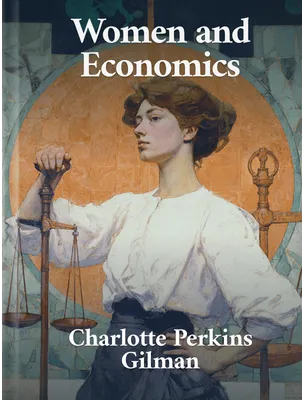
Women and Economics
A Study of the Economic Relation Between Men and Women as a Factor in Social Evolution
by
Charlotte Perkins Gilman

Proem
In dark and early ages, through the primal forests faring,
Ere the soul came shining into prehistoric night,
Twofold man was equal; they were comrades dear and daring,
Living wild and free together in unreasoning delight.
Ere the soul was born and consciousness came slowly,
Ere the soul was born, to man and woman, too,
Ere he found the Tree of Knowledge, that awful tree and holy,
Ere he knew he felt, and knew he knew.
Then said he to Pain, “I am wise now, and I know you!
No more will I suffer while power and wisdom last!”
Then said he to Pleasure, “I am strong, and I will show you
That the will of man can seize you, — aye, and hold you fast!”
Food he ate for pleasure, and wine he drank for gladness.
And woman? Ah, the woman! the crown of all delight!
His now, — he knew it! He was strong to madness
In that early dawning after prehistoric night.
His, — his forever! That glory sweet and tender!
Ah, but he would love her! And she should love but him!
He would work and struggle for her, he would shelter and defend her, —
She should never leave him, never, till their eyes in death were dim.
Close, close he bound her, that she should leave him never;
Weak still he kept her, lest she be strong to flee;
And the fainting flame of passion he kept alive forever
With all the arts and forces of earth and sky and sea.
And, ah, the long journey! The slow and awful ages
They have labored up together, blind and crippled, all astray!
Through what a mighty volume, with a million shameful pages,
From the freedom of the forests to the prisons of to-day!
Food he ate for pleasure, and it slew him with diseases!
Wine he drank for gladness, and it led the way to crime!
And woman? He will hold her, — he will have her when he pleases, —
And he never once hath seen her since the prehistoric time!
Gone the friend and comrade of the day when life was younger,
She who rests and comforts, she who helps and saves.
Still he seeks her vainly, with a never-dying hunger;
Alone beneath his tyrants, alone above his slaves!
Toiler, bent and weary with the load of thine own making!
Thou who art sad and lonely, though lonely all in vain!
Who hast sought to conquer Pleasure and have her for the taking,
And found that Pleasure only was another name for Pain —
Nature hath reclaimed thee, forgiving dispossession!
God hath not forgotten, though man doth still forget!
The woman-soul is rising, in despite of thy transgression —
Loose her now, and trust her! She will love thee yet!
Love thee? She will love thee as only freedom knoweth!
Love thee? She will love thee while Love itself doth live!
Fear not the heart of woman! No bitterness it showeth!
The ages of her sorrow have but taught her to forgive!
Preface
This book is written to offer a simple and natural explanation of one of the most common and most perplexing problems of human life, — a problem which presents itself to almost every individual for practical solution, and which demands the most serious attention of the moralist, the physician, and the sociologist —
To show how some of the worst evils under which we suffer, evils long supposed to be inherent and ineradicable in our natures, are but the result of certain arbitrary conditions of our own adoption, and how, by removing those conditions, we may remove the evils resultant —
To point out how far we have already gone in the path of improvement, and how irresistibly the social forces of to-day are compelling us further, even without our knowledge and against our violent opposition, — an advance which may be greatly quickened by our recognition and assistance —
To reach in especial the thinking women of to-day, and urge upon them a new sense, not only of their social responsibility as individuals, but of their measureless racial importance as makers of men.
It is hoped also that the theory advanced will prove sufficiently suggestive to give rise to such further study and discussion as shall prove its error or establish its truth.
CHARLOTTE PERKINS STETSON.
I
Since we have learned to study the development of human life as we study the evolution of species throughout the animal kingdom, some peculiar phenomena which have puzzled the philosopher and moralist for so long, begin to show themselves in a new light. We begin to see that, so far from being inscrutable problems, requiring another life to explain, these sorrows and perplexities of our lives are but the natural results of natural causes, and that, as soon as we ascertain the causes, we can do much to remove them.
In spite of the power of the individual will to struggle against conditions, to resist them for a while, and sometimes to overcome them, it remains true that the human creature is affected by his environment, as is every other living thing. The power of the individual will to resist natural law is well proven by the life and death of the ascetic. In any one of those suicidal martyrs may be seen the will, misdirected by the ill-informed intelligence, forcing the body to defy every natural impulse, — even to the door of death, and through it.
But, while these exceptions show what the human will can do, the general course of life shows the inexorable effect of conditions upon humanity. Of these conditions we share with other living things the environment of the material universe. We are affected by climate and locality, by physical, chemical, electrical forces, as are all animals and plants. With the animals, we farther share the effect of our own activity, the reactionary force of exercise. What we do, as well as what is done to us, makes us what we are. But, beyond these forces, we come under the effect of a third set of conditions peculiar to our human status; namely, social conditions. In the organic interchanges which constitute social life, we are affected by each other to a degree beyond what is found even among the most gregarious of animals. This third factor, the social environment, is of enormous force as a modifier of human life. Throughout all these environing conditions, those which affect us through our economic necessities are most marked in their influence.
Without touching yet upon the influence of the social factors, treating the human being merely as an individual animal, we see that he is modified most by his economic conditions, as is every other animal. Differ as they may in color and size, in strength and speed, in minor adaptation to minor conditions, all animals that live on grass have distinctive traits in common, and all animals that eat flesh have distinctive traits in common, — so distinctive and so common that it is by teeth, by nutritive apparatus in general, that they are classified, rather than by means of defence or locomotion. The food supply of the animal is the largest passive factor in his development; the processes by which he obtains his food supply, the largest active factor in his development. It is these activities, the incessant repetition of the exertions by which he is fed, which most modify his structure and develope his functions. The sheep, the cow, the deer, differ in their adaptation to the weather, their locomotive ability, their means of defence; but they agree in main characteristics, because of their common method of nutrition.
The human animal is no exception to this rule. Climate affects him, weather affects him, enemies affect him; but most of all he is affected, like every other living creature, by what he does for his living. Under all the influence of his later and wider life, all the reactive effect of social institutions, the individual is still inexorably modified by his means of livelihood: “the hand of the dyer is subdued to what he works in.” As one clear, world-known instance of the effect of economic conditions upon the human creature, note the marked race-modification of the Hebrew people under the enforced restrictions of the last two thousand years. Here is a people rising to national prominence, first as a pastoral, and then as an agricultural nation; only partially commercial through race affinity with the Phœnicians, the pioneer traders of the world. Under the social power of a united Christendom — united at least in this most unchristian deed — the Jew was forced to get his livelihood by commercial methods solely. Many effects can be traced in him to the fierce pressure of the social conditions to which he was subjected: the intense family devotion of a people who had no country, no king, no room for joy and pride except the family; the reduced size and tremendous vitality and endurance of the pitilessly selected survivors of the Ghetto; the repeated bursts of erratic genius from the human spirit so inhumanly restrained. But more patent still is the effect of the economic conditions, — the artificial development of a race of traders and dealers in money, from the lowest pawnbroker to the house of Rothschild; a special kind of people, bred of the economic environment in which they were compelled to live.
One rough but familiar instance of the same effect, from the same cause, we can all see in the marked distinction between the pastoral, the agricultural, and the manufacturing classes in any nation, though their other conditions be the same. On the clear line of argument that functions and organs are developed by use, that what we use most is developed most, and that the daily processes of supplying economic needs are the processes that we most use, it follows that, when we find special economic conditions affecting any special class of people, we may look for special results, and find them.
In view of these facts, attention is now called to a certain marked and peculiar economic condition affecting the human race, and unparalleled in the organic world. We are the only animal species in which the female depends on the male for food, the only animal species in which the sex-relation is also an economic relation. With us an entire sex lives in a relation of economic dependence upon the other sex, and the economic relation is combined with the sex-relation. The economic status of the human female is relative to the sex-relation.
It is commonly assumed that this condition also obtains among other animals, but such is not the case. There are many birds among which, during the nesting season, the male helps the female feed the young, and partially feeds her; and, with certain of the higher carnivora, the male helps the female feed the young, and partially feeds her. In no case does she depend on him absolutely, even during this season, save in that of the hornbill, where the female, sitting on her nest in a hollow tree, is walled in with clay by the male, so that only her beak projects; and then he feeds her while the eggs are developing. But even the female hornbill does not expect to be fed at any other time. The female bee and ant are economically dependent, but not on the male. The workers are females, too, specialized to economic functions solely. And with the carnivora, if the young are to lose one parent, it might far better be the father: the mother is quite competent to take care of them herself. With many species, as in the case of the common cat, she not only feeds herself and her young, but has to defend the young against the male as well. In no case is the female throughout her life supported by the male.
In the human species the condition is permanent and general, though there are exceptions, and though the present century is witnessing the beginnings of a great change in this respect. We have not been accustomed to face this fact beyond our loose generalization that it was “natural,” and that other animals did so, too.
To many this view will not seem clear at first; and the case of working peasant women or females of savage tribes, and the general household industry of women, will be instanced against it. Some careful and honest discrimination is needed to make plain to ourselves the essential facts of the relation, even in these cases. The horse, in his free natural condition, is economically independent. He gets his living by his own exertions, irrespective of any other creature. The horse, in his present condition of slavery, is economically dependent. He gets his living at the hands of his master; and his exertions, though strenuous, bear no direct relation to his living. In fact, the horses who are the best fed and cared for and the horses who are the hardest worked are quite different animals. The horse works, it is true; but what he gets to eat depends on the power and will of his master. His living comes through another. He is economically dependent. So with the hard-worked savage or peasant women. Their labor is the property of another: they work under another will; and what they receive depends not on their labor, but on the power and will of another. They are economically dependent. This is true of the human female both individually and collectively.
In studying the economic position of the sexes collectively, the difference is most marked. As a social animal, the economic status of man rests on the combined and exchanged services of vast numbers of progressively specialized individuals. The economic progress of the race, its maintenance at any period, its continued advance, involve the collective activities of all the trades, crafts, arts, manufactures, inventions, discoveries, and all the civil and military institutions that go to maintain them. The economic status of any race at any time, with its involved effect on all the constituent individuals, depends on their world-wide labors and their free exchange. Economic progress, however, is almost exclusively masculine. Such economic processes as women have been allowed to exercise are of the earliest and most primitive kind. Were men to perform no economic services save such as are still performed by women, our racial status in economics would be reduced to most painful limitations.
To take from any community its male workers would paralyze it economically to a far greater degree than to remove its female workers. The labor now performed by the women could be performed by the men, requiring only the setting back of many advanced workers into earlier forms of industry; but the labor now performed by the men could not be performed by the women without generations of effort and adaptation. Men can cook, clean, and sew as well as women; but the making and managing of the great engines of modern industry, the threading of earth and sea in our vast systems of transportation, the handling of our elaborate machinery of trade, commerce, government, — these things could not be done so well by women in their present degree of economic development.
This is not owing to lack of the essential human faculties necessary to such achievements, nor to any inherent disability of sex, but to the present condition of woman, forbidding the development of this degree of economic ability. The male human being is thousands of years in advance of the female in economic status. Speaking collectively, men produce and distribute wealth; and women receive it at their hands. As men hunt, fish, keep cattle, or raise corn, so do women eat game, fish, beef, or corn. As men go down to the sea in ships, and bring coffee and spices and silks and gems from far away, so do women partake of the coffee and spices and silks and gems the men bring.
The economic status of the human race in any nation, at any time, is governed mainly by the activities of the male: the female obtains her share in the racial advance only through him.
Studied individually, the facts are even more plainly visible, more open and familiar. From the day laborer to the millionnaire, the wife’s worn dress or flashing jewels, her low roof or her lordly one, her weary feet or her rich equipage, — these speak of the economic ability of the husband. The comfort, the luxury, the necessities of life itself, which the woman receives, are obtained by the husband, and given her by him. And, when the woman, left alone with no man to “support” her, tries to meet her own economic necessities, the difficulties which confront her prove conclusively what the general economic status of the woman is. None can deny these patent facts, — that the economic status of women generally depends upon that of men generally, and that the economic status of women individually depends upon that of men individually, those men to whom they are related. But we are instantly confronted by the commonly received opinion that, although it must be admitted that men make and distribute the wealth of the world, yet women earn their share of it as wives. This assumes either that the husband is in the position of employer and the wife as employee, or that marriage is a “partnership,” and the wife an equal factor with the husband in producing wealth.
Economic independence is a relative condition at best. In the broadest sense, all living things are economically dependent upon others, — the animals upon the vegetables, and man upon both. In a narrower sense, all social life is economically interdependent, man producing collectively what he could by no possibility produce separately. But, in the closest interpretation, individual economic independence among human beings means that the individual pays for what he gets, works for what he gets, gives to the other an equivalent for what the other gives him. I depend on the shoemaker for shoes, and the tailor for coats; but, if I give the shoemaker and the tailor enough of my own labor as a house-builder to pay for the shoes and coats they give me, I retain my personal independence. I have not taken of their product, and given nothing of mine. As long as what I get is obtained by what I give, I am economically independent.
Women consume economic goods. What economic product do they give in exchange for what they consume? The claim that marriage is a partnership, in which the two persons married produce wealth which neither of them, separately, could produce, will not bear examination. A man happy and comfortable can produce more than one unhappy and uncomfortable, but this is as true of a father or son as of a husband. To take from a man any of the conditions which make him happy and strong is to cripple his industry, generally speaking. But those relatives who make him happy are not therefore his business partners, and entitled to share his income.
Grateful return for happiness conferred is not the method of exchange in a partnership. The comfort a man takes with his wife is not in the nature of a business partnership, nor are her frugality and industry. A housekeeper, in her place, might be as frugal, as industrious, but would not therefore be a partner. Man and wife are partners truly in their mutual obligation to their children, — their common love, duty, and service. But a manufacturer who marries, or a doctor, or a lawyer, does not take a partner in his business, when he takes a partner in parenthood, unless his wife is also a manufacturer, a doctor, or a lawyer. In his business, she cannot even advise wisely without training and experience. To love her husband, the composer, does not enable her to compose; and the loss of a man’s wife, though it may break his heart, does not cripple his business, unless his mind is affected by grief. She is in no sense a business partner, unless she contributes capital or experience or labor, as a man would in like relation. Most men would hesitate very seriously before entering a business partnership with any woman, wife or not.
If the wife is not, then, truly a business partner, in what way does she earn from her husband the food, clothing, and shelter she receives at his hands? By house service, it will be instantly replied. This is the general misty idea upon the subject, — that women earn all they get, and more, by house service. Here we come to a very practical and definite economic ground. Although not producers of wealth, women serve in the final processes of preparation and distribution. Their labor in the household has a genuine economic value.
For a certain percentage of persons to serve other persons, in order that the ones so served may produce more, is a contribution not to be overlooked. The labor of women in the house, certainly, enables men to produce more wealth than they otherwise could; and in this way women are economic factors in society. But so are horses. The labor of horses enables men to produce more wealth than they otherwise could. The horse is an economic factor in society. But the horse is not economically independent, nor is the woman. If a man plus a valet can perform more useful service than he could minus a valet, then the valet is performing useful service. But, if the valet is the property of the man, is obliged to perform this service, and is not paid for it, he is not economically independent.
The labor which the wife performs in the household is given as part of her functional duty, not as employment. The wife of the poor man, who works hard in a small house, doing all the work for the family, or the wife of the rich man, who wisely and gracefully manages a large house and administers its functions, each is entitled to fair pay for services rendered.
To take this ground and hold it honestly, wives, as earners through domestic service, are entitled to the wages of cooks, housemaids, nursemaids, seamstresses, or housekeepers, and to no more. This would of course reduce the spending money of the wives of the rich, and put it out of the power of the poor man to “support” a wife at all, unless, indeed, the poor man faced the situation fully, paid his wife her wages as house servant, and then she and he combined their funds in the support of their children. He would be keeping a servant: she would be helping keep the family. But nowhere on earth would there be “a rich woman” by these means. Even the highest class of private housekeeper, useful as her services are, does not accumulate a fortune. She does not buy diamonds and sables and keep a carriage. Things like these are not earned by house service.
But the salient fact in this discussion is that, whatever the economic value of the domestic industry of women is, they do not get it. The women who do the most work get the least money, and the women who have the most money do the least work. Their labor is neither given nor taken as a factor in economic exchange. It is held to be their duty as women to do this work; and their economic status bears no relation to their domestic labors, unless an inverse one. Moreover, if they were thus fairly paid, — given what they earned, and — no more, — all women working in this way would be reduced to the economic status of the house servant. Few women — or men either — care to face this condition. The ground that women earn their living by domestic labor is instantly forsaken, and we are told that they obtain their livelihood as mothers. This is a peculiar position. We speak of it commonly enough, and often with deep feeling, but without due analysis.
In treating of an economic exchange, asking what return in goods or labor women make for the goods and labor given them, — either to the race collectively or to their husbands individually, — what payment women make for their clothes and shoes and furniture and food and shelter, we are told that the duties and services of the mother entitle her to support.
If this is so, if motherhood is an exchangeable commodity given by women in payment for clothes and food, then we must of course find some relation between the quantity or quality of the motherhood and the quantity and quality of the pay. This being true, then the women who are not mothers have no economic status at all; and the economic status of those who are must be shown to be relative to their motherhood. This is obviously absurd. The childless wife has as much money as the mother of many, — more; for the children of the latter consume what would otherwise be hers; and the inefficient mother is no less provided for than the efficient one. Visibly, and upon the face of it, women are not maintained in economic prosperity proportioned to their motherhood. Motherhood bears no relation to their economic status. Among primitive races, it is true, — in the patriarchal period, for instance, — there was some truth in this position. Women being of no value whatever save as bearers of children, their favor and indulgence did bear direct relation to maternity; and they had reason to exult on more grounds than one when they could boast a son. To-day, however, the maintenance of the woman is not conditioned upon this. A man is not allowed to discard his wife because she is barren. The claim of motherhood as a factor in economic exchange is false to-day. But suppose it were true. Are we willing to hold this ground, even in theory? Are we willing to consider motherhood as a business, a form of commercial exchange? Are the cares and duties of the mother, her travail and her love, commodities to be exchanged for bread?
It is revolting so to consider them; and, if we dare face our own thoughts, and force them to their logical conclusion, we shall see that nothing could be more repugnant to human feeling, or more socially and individually injurious, than to make motherhood a trade. Driven off these alleged grounds of women’s economic independence; shown that women, as a class, neither produce nor distribute wealth; that women, as individuals, labor mainly as house servants, are not paid as such, and would not be satisfied with such an economic status if they were so paid; that wives are not business partners or co-producers of wealth with their husbands, unless they actually practise the same profession; that they are not salaried as mothers, and that it would be unspeakably degrading if they were, — what remains to those who deny that women are supported by men? This (and a most amusing position it is), — that the function of maternity unfits a woman for economic production, and, therefore, it is right that she should be supported by her husband.
The ground is taken that the human female is not economically independent, that she is fed by the male of her species. In denial of this, it is first alleged that she is economically independent, — that she does support herself by her own industry in the house. It being shown that there is no relation between the economic status of woman and the labor she performs in the home, it is then alleged that not as house servant, but as mother, does woman earn her living. It being shown that the economic status of woman bears no relation to her motherhood, either in quantity or quality, it is then alleged that motherhood renders a woman unfit for economic production, and that, therefore, it is right that she be supported by her husband. Before going farther, let us seize upon this admission, — that she is supported by her husband.
Without going into either the ethics or the necessities of the case, we have reached so much common ground: the female of genus homo is supported by the male. Whereas, in other species of animals, male and female alike graze and browse, hunt and kill, climb, swim, dig, run, and fly for their livings, in our species the female does not seek her own living in the specific activities of our race, but is fed by the male.
Now as to the alleged necessity. Because of her maternal duties, the human female is said to be unable to get her own living. As the maternal duties of other females do not unfit them for getting their own living and also the livings of their young, it would seem that the human maternal duties require the segregation of the entire energies of the mother to the service of the child during her entire adult life, or so large a proportion of them that not enough remains to devote to the individual interests of the mother.
Such a condition, did it exist, would of course excuse and justify the pitiful dependence of the human female, and her support by the male. As the queen bee, modified entirely to maternity, is supported, not by the male, to be sure, but by her co-workers, the “old maids,” the barren working bees, who labor so patiently and lovingly in their branch of the maternal duties of the hive, so would the human female, modified entirely to maternity, become unfit for any other exertion, and a helpless dependant.
Is this the condition of human motherhood? Does the human mother, by her motherhood, thereby lose control of brain and body, lose power and skill and desire for any other work? Do we see before us the human race, with all its females segregated entirely to the uses of motherhood, consecrated, set apart, specially developed, spending every power of their nature on the service of their children?
We do not. We see the human mother worked far harder than a mare, laboring her life long in the service, not of her children only, but of men; husbands, brothers, fathers, whatever male relatives she has; for mother and sister also; for the church a little, if she is allowed; for society, if she is able; for charity and education and reform, — working in many ways that are not the ways of motherhood.