'Trust (adapted)' is a retelling of Jack London's story that explores themes of loyalty, betrayal, and the human spirit in challenging circumstances.
[{"id":"para_1","index":0,"start":0,"offset":322,"words":1,"paraNum":"","lastModified":1760494864000,"semanticType":"title-book-title","voicework":"tts","blockId":"trust_short_story_ffa_1_en-bl88","language":"en","wordsRange":{"start":100000000,"end":102000000},"paragraphVersion":26,"direction":"ltr","paragraph":"<h1 class=\"ilm-title ilm-x-large\" id=\"para_1\" semantictype=\"title-book-title\" data-ilmid=\"trust_short_story_ffa_1_en-bl88\" data-audio=\"1\" data-chapter=\"para_1\" data-words-count=\"1\" data-before=\"0\" data-ww=\"\"><span class=\"block-pb\"> <span class=\"block-pb is-animated\"></span> </span><span class=\"itm-wrap\">Trust</span></h1>","hasContent":true,"isFirst":true,"isLast":false},{"id":"para_2","index":1,"start":322,"offset":325,"words":1,"paraNum":"","lastModified":1760494834000,"semanticType":"title-subtitle","voicework":"tts","blockId":"trust_short_story_ffa_1_en-bla5","language":"en","wordsRange":{"start":135333333,"end":168666667},"paragraphVersion":38,"direction":"ltr","paragraph":"<h1 class=\"ilm-title ilm-subtitle\" id=\"para_2\" semantictype=\"title-subtitle\" data-ilmid=\"trust_short_story_ffa_1_en-bla5\" data-audio=\"1\" data-chapter=\"para_2\" data-words-count=\"1\" data-before=\"1\" data-ww=\"\"><span class=\"block-pb\"> <span class=\"block-pb is-animated\"></span> </span><span class=\"itm-wrap\">[adapted]</span></h1>","hasContent":true,"isFirst":false,"isLast":false},{"id":"para_3","index":2,"start":647,"offset":350,"words":2,"paraNum":"","lastModified":1760494919000,"semanticType":"title-author","voicework":"tts","blockId":"trust_short_story_ffa_1_en-bla2","language":"en","wordsRange":{"start":202000000,"end":206000000},"paragraphVersion":33,"direction":"ltr","paragraph":"<h1 class=\"ilm-title ilm-author ilm-large ilm-nopad\" id=\"para_3\" semantictype=\"title-author\" data-ilmid=\"trust_short_story_ffa_1_en-bla2\" data-audio=\"1\" data-chapter=\"para_3\" data-words-count=\"2\" data-before=\"2\" data-ww=\"\"><span class=\"block-pb\"> <span class=\"block-pb is-animated\"></span> </span><span class=\"itm-wrap\">by <br>Jack London</span></h1>","hasContent":true,"isFirst":false,"isLast":false},{"id":"para_4","index":3,"start":997,"offset":154,"words":0,"paraNum":"","lastModified":1660220721000,"semanticType":"line","blockId":"trust_short_story_ffa_1_en-bla3","language":"en","wordsRange":{"start":306000000,"end":406000000},"paragraphVersion":12,"direction":"ltr","paragraph":"<hr class=\"ilm-hr ilm-small\" id=\"para_4\" semantictype=\"line\" data-ilmid=\"trust_short_story_ffa_1_en-bla3\" data-words-count=\"0\" data-before=\"4\" data-ww=\"\">","hasContent":true,"isFirst":false,"isLast":false},{"id":"para_5","index":4,"start":1151,"offset":1556,"words":0,"paraNum":"","lastModified":1760441605000,"semanticType":"illustration","blockId":"trust_short_story_ffa_1_en-bla4","language":"en","wordsRange":{"start":506000000,"end":606000000},"paragraphVersion":12,"direction":"ltr","paragraph":"<div class=\"ilm-illustration\" id=\"para_5\" semantictype=\"illustration\" data-ilmid=\"trust_short_story_ffa_1_en-bla4\" data-words-count=\"0\" data-before=\"4\" data-ww=\"\"><img width=\"600\" height=\"400\" data-src=\"ch0p0\" src=\"data:image/webp;base64,UklGRrwDAABXRUJQVlA4ILADAABwEACdASo8ACgAPm0wlUekIqIhKBVaqIANiUAVhmCKHUaHNvpS2/G3wOyLvR8ZvrKSccB0s98srFgZpPmdiUC7wa1i9xOXggboAfJS/BWvYi5/8wcVwhI0CO5gFaYi5THs8cSE6p4j6f8cxvOe5WvGLOWmnemWJisByH+BL5XT2jjGDaOXkkc5jObvwAD+/D9asq/Ja/6bH6ALeVTCK2lp1dpgZpADRJHL7ayVRzX0suY1/9RfE/oJ9XBRDKjn6TLgpcRLhFTltxoVqD7xqYe8ofKrB+iENIfoZlMS+5ZrFh6bvYMT669saXZ6h6gCcPfN4nqL71o5qSyNrifzuR+priQSynMQyTF4FsLtb1I5SoyiCrSASNb4mlhXU/QA1IyPYJGOjSBo5fpoxPeqD1PmKrfxwhQeN2IzAkyUn7yCGN1+lcLyu2h94TRPuOQGrJr9h7R6eWMv51BF+MjUGAD3ZdQTygrpLc2tDnpGkmK4AsEIz8hb40DpUlmzHLCxtrWlNKHvErGehzhZOgJ0nR1cSy0BkhyaU971hLhYBF90R9dfJqOuvStoBbTYLgUSrCzi8jXcmMVjCfO62kkxk9tlr6SRgJrqJuGX50sPKgaKjGkcSkZpWklYe2CQR60z2fLK5ZKDSeVYLxy1y2AN01wL0B+B/053u9tjSOyA3jvR8pLTKY+J3aEXMbkaRdzpe8h9aiN6ltEUsHQT+J2I2ynHrBaoZfquql0684Lc9P8n/jsvRQIAaNpYmNvYxCMI1A+FGQofZkLOPhtkeAZHlYD0g0HSU/wVzObrsXjNtaTjTGF7nCOPSEj7qFQlXkDGaiIjmiLzTBOBByy+7D4PAoKcCsXaQjkyv1TeChRsFgz0Y7aSGvPGnVdT+Au2j38OE+qlEpwea/drYEUWmBiMnbU5oKqTGpmeqSHAn4HfPO3gTtwkF1BNlLshXjzhngKwuxw30Sf0XHfJCEywXIWyip+gT16vPmVUbqZURciXjBJgimxEm8biXuSpJaNvQPeMxuMtfDyQ6ICYwV76etmqMQBmcC8C2coEEO5xTBAyGX1+xo1Zw9HBAUB6+FYjGD6kbhPxzx3Afdkjf+lHt7lhzrIZg0wa8tpLbjaXKXyVXogDnO7A+R5UHaL24AzRuqChs5ClYK49n5xqBTyvSQnMZlAgvcmJlwWuA3Mhoj4Spu12zuZZOxThAXW1KPNdh01GxFywtrCnft68V29cH9LKp5rWi9EjocqbXIlUk7bczgAAAA==\" alt=\"Trust (adapted)\"></div>","hasContent":true,"isFirst":false,"isLast":false},{"id":"para_6","index":5,"start":2707,"offset":1071,"words":132,"paraNum":"1","lastModified":1760494672000,"semanticType":"par","voicework":"tts","blockId":"trust_short_story_ffa_1_en-bl89","language":"en","wordsRange":{"start":706000000,"end":834000000},"paragraphVersion":30,"direction":"ltr","paragraph":"<p id=\"para_6\" semantictype=\"par\" data-ilmid=\"trust_short_story_ffa_1_en-bl89\" data-audio=\"1\" data-words-count=\"132\" data-before=\"4\" data-ww=\"\"><span class=\"block-num\" data-id=\"1\"></span><span class=\"block-pb\"> <span class=\"block-pb is-animated\"></span> </span><span class=\"itm-wrap\">All ropes had been untied, and the <i>Seattle </i><i>No. </i><i>4</i> was moving slowly away from the shore. Her decks were piled high with cargo and baggage, and were crowded with a mixed group of Indians, dogs, and dog sled drivers, prospectors, traders, and gold-seekers going home. A large part of Dawson was lined up on the bank, saying good-by. As the gang-plank came in and the steamer moved into the river, the noise of farewell became very loud. Also, at the last moment, everybody began to remember last goodbye messages and to shout them back and forth across the water that was getting wider. Louis Bondell, curling his yellow mustache with one hand and lazily waving the other hand to his friends on shore, suddenly remembered something and jumped to the railing.</span></p>","hasContent":true,"isFirst":false,"isLast":false},{"id":"para_7","index":6,"start":3778,"offset":338,"words":6,"paraNum":"2","lastModified":1760494672000,"semanticType":"par","voicework":"tts","blockId":"trust_short_story_ffa_1_en-bl8a","language":"en","wordsRange":{"start":934000000,"end":941000000},"paragraphVersion":27,"direction":"ltr","paragraph":"<p id=\"para_7\" semantictype=\"par\" data-ilmid=\"trust_short_story_ffa_1_en-bl8a\" data-audio=\"1\" data-words-count=\"6\" data-before=\"136\" data-ww=\"\"><span class=\"block-num\" data-id=\"2\"></span><span class=\"block-pb\"> <span class=\"block-pb is-animated\"></span> </span><span class=\"itm-wrap\">“Oh, Fred!” he shouted. “Oh, Fred!”</span></p>","hasContent":true,"isFirst":false,"isLast":false},{"id":"para_8","index":7,"start":4116,"offset":561,"words":45,"paraNum":"3","lastModified":1760494672000,"semanticType":"par","voicework":"tts","blockId":"trust_short_story_ffa_1_en-bl8b","language":"en","wordsRange":{"start":1041000000,"end":1085000000},"paragraphVersion":38,"direction":"ltr","paragraph":"<p id=\"para_8\" semantictype=\"par\" data-ilmid=\"trust_short_story_ffa_1_en-bl8b\" data-audio=\"1\" data-words-count=\"45\" data-before=\"142\" data-ww=\"\"><span class=\"block-num\" data-id=\"3\"></span><span class=\"block-pb\"> <span class=\"block-pb is-animated\"></span> </span><span class=\"itm-wrap\">The “Fred” desired pushed a strong pair of shoulders through the front of the crowd on the bank and tried to catch Louis Bondell’s message. Louis Bondell turned red in the face from useless shouting. Still the water grew wider between the steamboat and shore.</span></p>","hasContent":true,"isFirst":false,"isLast":false},{"id":"para_9","index":8,"start":4677,"offset":380,"words":13,"paraNum":"4","lastModified":1760496007000,"semanticType":"par","voicework":"tts","blockId":"trust_short_story_ffa_1_en-bl8c","language":"en","wordsRange":{"start":1185000000,"end":1198000000},"paragraphVersion":26,"direction":"ltr","paragraph":"<p id=\"para_9\" semantictype=\"par\" data-ilmid=\"trust_short_story_ffa_1_en-bl8c\" data-audio=\"1\" data-words-count=\"13\" data-before=\"187\" data-ww=\"\"><span class=\"block-num\" data-id=\"4\"></span><span class=\"block-pb\"> <span class=\"block-pb is-animated\"></span> </span><span class=\"itm-wrap\">“Hey you, Captain Scott!” he shouted at the pilot’s room. “Stop the boat!”</span></p>","hasContent":true,"isFirst":false,"isLast":false},{"id":"para_10","index":9,"start":5057,"offset":788,"words":81,"paraNum":"5","lastModified":1760495721000,"semanticType":"par","voicework":"tts","blockId":"trust_short_story_ffa_1_en-bl8d","language":"en","wordsRange":{"start":1298000000,"end":1378000000},"paragraphVersion":34,"direction":"ltr","paragraph":"<p id=\"para_10\" semantictype=\"par\" data-ilmid=\"trust_short_story_ffa_1_en-bl8d\" data-audio=\"1\" data-words-count=\"81\" data-before=\"200\" data-ww=\"\"><span class=\"block-num\" data-id=\"5\"></span><span class=\"block-pb\"> <span class=\"block-pb is-animated\"></span> </span><span class=\"itm-wrap\">The gongs rang loudly, and the big back wheel went backward, then stopped. Everyone on the steamboat and on the river bank used this pause to say final, new, and urgent good-byes. More useless than ever was Louis Bondell’s effort to make himself heard. The <i>Seattle </i><i>No. </i><i>4</i> lost speed and drifted downstream, and Captain Scott had to go forward and go backward a second time. His head disappeared inside the steering room, appearing a moment later behind a big megaphone.</span></p>","hasContent":true,"isFirst":false,"isLast":false},{"id":"para_11","index":10,"start":5845,"offset":579,"words":53,"paraNum":"6","lastModified":1760495997000,"semanticType":"par","voicework":"tts","blockId":"trust_short_story_ffa_1_en-bl8e","language":"en","wordsRange":{"start":1478000000,"end":1530000000},"paragraphVersion":30,"direction":"ltr","paragraph":"<p id=\"para_11\" semantictype=\"par\" data-ilmid=\"trust_short_story_ffa_1_en-bl8e\" data-audio=\"1\" data-words-count=\"53\" data-before=\"281\" data-ww=\"\"><span class=\"block-num\" data-id=\"6\"></span><span class=\"block-pb\"> <span class=\"block-pb is-animated\"></span> </span><span class=\"itm-wrap\">Now Captain Scott had a very loud voice, and the “Shut up!” he shouted at the crowd on deck and on shore could have been heard at the top of Moosehide Mountain and as far as Klondike City. This official warning from the pilot-house spread a thin cover of silence over the noise.</span></p>","hasContent":true,"isFirst":false,"isLast":false},{"id":"para_12","index":11,"start":6424,"offset":353,"words":10,"paraNum":"7","lastModified":1760495647000,"semanticType":"par","voicework":"tts","blockId":"trust_short_story_ffa_1_en-bl8f","language":"en","wordsRange":{"start":1630000000,"end":1641000000},"paragraphVersion":27,"direction":"ltr","paragraph":"<p id=\"para_12\" semantictype=\"par\" data-ilmid=\"trust_short_story_ffa_1_en-bl8f\" data-audio=\"1\" data-words-count=\"10\" data-before=\"334\" data-ww=\"\"><span class=\"block-num\" data-id=\"7\"></span><span class=\"block-pb\"> <span class=\"block-pb is-animated\"></span> </span><span class=\"itm-wrap\">“Now, what do you want to say?” Captain Scott asked.</span></p>","hasContent":true,"isFirst":false,"isLast":false},{"id":"para_13","index":12,"start":6777,"offset":479,"words":35,"paraNum":"8","lastModified":1760495588000,"semanticType":"par","voicework":"tts","blockId":"trust_short_story_ffa_1_en-bl8g","language":"en","wordsRange":{"start":1741000000,"end":1777000000},"paragraphVersion":27,"direction":"ltr","paragraph":"<p id=\"para_13\" semantictype=\"par\" data-ilmid=\"trust_short_story_ffa_1_en-bl8g\" data-audio=\"1\" data-words-count=\"35\" data-before=\"344\" data-ww=\"\"><span class=\"block-num\" data-id=\"8\"></span><span class=\"block-pb\"> <span class=\"block-pb is-animated\"></span> </span><span class=\"itm-wrap\">“Tell Fred Churchill — he’s on the bank there — tell him to go to Macdonald. It’s in his safe — a small bag of mine. Tell him to get it and bring it out when he comes.”</span></p>","hasContent":true,"isFirst":false,"isLast":false},{"id":"para_14","index":13,"start":7256,"offset":381,"words":13,"paraNum":"9","lastModified":1760495619000,"semanticType":"par","voicework":"tts","blockId":"trust_short_story_ffa_1_en-bl8h","language":"en","wordsRange":{"start":1877000000,"end":1890000000},"paragraphVersion":26,"direction":"ltr","paragraph":"<p id=\"para_14\" semantictype=\"par\" data-ilmid=\"trust_short_story_ffa_1_en-bl8h\" data-audio=\"1\" data-words-count=\"13\" data-before=\"379\" data-ww=\"\"><span class=\"block-num\" data-id=\"9\"></span><span class=\"block-pb\"> <span class=\"block-pb is-animated\"></span> </span><span class=\"itm-wrap\">In the silence Captain Scott shouted the message to shore through the megaphone: —</span></p>","hasContent":true,"isFirst":false,"isLast":false},{"id":"para_15","index":14,"start":7637,"offset":446,"words":23,"paraNum":"10","lastModified":1760496023000,"semanticType":"par","voicework":"tts","blockId":"trust_short_story_ffa_1_en-bl8i","language":"en","wordsRange":{"start":1990000000,"end":2015000000},"paragraphVersion":27,"direction":"ltr","paragraph":"<p id=\"para_15\" semantictype=\"par\" data-ilmid=\"trust_short_story_ffa_1_en-bl8i\" data-audio=\"1\" data-words-count=\"23\" data-before=\"392\" data-ww=\"\"><span class=\"block-num\" data-id=\"10\"></span><span class=\"block-pb\"> <span class=\"block-pb is-animated\"></span> </span><span class=\"itm-wrap\">“You, Fred Churchill, go to Macdonald — in his safe — small bag — belongs to Louis Bondell — important! Bring it when you come! Got it?”</span></p>","hasContent":true,"isFirst":false,"isLast":false},{"id":"para_16","index":15,"start":8083,"offset":700,"words":68,"paraNum":"11","lastModified":1760496097000,"semanticType":"par","voicework":"tts","blockId":"trust_short_story_ffa_1_en-bl8j","language":"en","wordsRange":{"start":2115000000,"end":2184000000},"paragraphVersion":33,"direction":"ltr","paragraph":"<p id=\"para_16\" semantictype=\"par\" data-ilmid=\"trust_short_story_ffa_1_en-bl8j\" data-audio=\"1\" data-words-count=\"68\" data-before=\"415\" data-ww=\"\"><span class=\"block-num\" data-id=\"11\"></span><span class=\"block-pb\"> <span class=\"block-pb is-animated\"></span> </span><span class=\"itm-wrap\">Churchill waved his hand to show that he understood. Actually, if Macdonald, half a mile away, had opened his window, he would have understood it, too. The loud noise of farewell rose again, the gongs rang, and the <i>Seattle </i><i>No. </i><i>4</i> went ahead, moved out into the stream, turned quickly, and went down the Yukon, Bondell and Churchill waving goodbye and love for each other to the end.</span></p>","hasContent":true,"isFirst":false,"isLast":false},{"id":"para_17","index":16,"start":8783,"offset":1102,"words":151,"paraNum":"12","lastModified":1760496172000,"semanticType":"par","voicework":"tts","blockId":"trust_short_story_ffa_1_en-bl8k","language":"en","wordsRange":{"start":2284000000,"end":2431000000},"paragraphVersion":30,"direction":"ltr","paragraph":"<p id=\"para_17\" semantictype=\"par\" data-ilmid=\"trust_short_story_ffa_1_en-bl8k\" data-audio=\"1\" data-words-count=\"151\" data-before=\"483\" data-ww=\"\"><span class=\"block-num\" data-id=\"12\"></span><span class=\"block-pb\"> <span class=\"block-pb is-animated\"></span> </span><span class=\"itm-wrap\">That was in midsummer. In the fall of the year, the <i>W.</i><i>H. </i><i>Willis</i> started up the Yukon with two hundred people going home on board. Among them was Churchill. In his cabin, in the middle of a clothes bag, was Louis Bondell’s suitcase. It was a small, strong leather bag, and its weight of forty pounds always made Churchill nervous when he went too far from it. The man in the next cabin had a treasure of gold dust hidden in the same way in a clothes bag, and the two of them finally agreed to take turns watching. While one went down to eat, the other kept an eye on the two cabin doors. When Churchill wanted to play whist, the other man stood guard, and when the other man wanted to rest, Churchill read newspapers that were four months old on a camp stool between the two doors.</span></p>","hasContent":true,"isFirst":false,"isLast":false},{"id":"para_18","index":17,"start":9885,"offset":1358,"words":189,"paraNum":"13","lastModified":1760496266000,"semanticType":"par","voicework":"tts","blockId":"trust_short_story_ffa_1_en-bl8l","language":"en","wordsRange":{"start":2531000000,"end":2719000000},"paragraphVersion":30,"direction":"ltr","paragraph":"<p id=\"para_18\" semantictype=\"par\" data-ilmid=\"trust_short_story_ffa_1_en-bl8l\" data-audio=\"1\" data-words-count=\"189\" data-before=\"634\" data-ww=\"\"><span class=\"block-num\" data-id=\"13\"></span><span class=\"block-pb\"> <span class=\"block-pb is-animated\"></span> </span><span class=\"itm-wrap\">There were signs of an early winter, and the question that was talked about from sunrise till dark, and late into the night, was whether they would get out before the river froze or be forced to leave the steamboat and walk out over the ice. There were annoying delays. Twice the engines broke down and had to be fixed, and each time there was light snow to warn them that winter was near. Nine times the <i>W.</i><i>H. </i><i>Willis</i> tried to go up the Five-Finger Rapids with her damaged machinery, and when she succeeded, she was four days behind her very easy schedule. The question that then came up was whether the steamboat <i>Flora</i> would wait for her above the Box Cañon. The part of the river between the start of the Box Cañon and the bottom of the White Horse Rapids was not safe for steamboats and passengers were moved at that point, walking around the rapids from one steamboat to the other. There were no telephones in the country, so no way of telling the waiting <i>Flora</i> that the <i>Willis</i> was four days late, but coming.</span></p>","hasContent":true,"isFirst":false,"isLast":false},{"id":"para_19","index":18,"start":11243,"offset":1431,"words":207,"paraNum":"14","lastModified":1760496323000,"semanticType":"par","voicework":"tts","blockId":"trust_short_story_ffa_1_en-bl8m","language":"en","wordsRange":{"start":2819000000,"end":3023000000},"paragraphVersion":30,"direction":"ltr","paragraph":"<p id=\"para_19\" semantictype=\"par\" data-ilmid=\"trust_short_story_ffa_1_en-bl8m\" data-audio=\"1\" data-words-count=\"207\" data-before=\"823\" data-ww=\"\"><span class=\"block-num\" data-id=\"14\"></span><span class=\"block-pb\"> <span class=\"block-pb is-animated\"></span> </span><span class=\"itm-wrap\">When the <i>W.</i><i>H. </i><i>Willis</i> came into White Horse, they learned that the <i>Flora</i> had waited three days more than the time allowed, and had left only a few hours before. Also, they learned that she would stop at Tagish Post until nine o’clock, Sunday morning. It was then four o’clock Saturday afternoon. The travelers called a meeting. On board there was a large Peterborough canoe, sent to the police post at the head of Lake Bennett. They agreed to take care of it and to deliver it. Next, they called for volunteers. Two men were needed to race to catch the <i>Flora.</i> Twenty men volunteered at once. Among them was Churchill, because he was that kind of man, and he volunteered before he thought of Bondell’s bag. When he thought of this, he started to hope that he would not be chosen; but a man who had made a name for himself as captain of a college football team, as a president of a sports club, as a dog-sled driver and a gold-seeker in the Yukon, and, also, who had such big shoulders as he had, had no right to refuse the honor. It was forced on him and on a very big German, Nick Antonsen.</span></p>","hasContent":true,"isFirst":false,"isLast":false},{"id":"para_20","index":19,"start":12674,"offset":796,"words":103,"paraNum":"15","lastModified":1760496079000,"semanticType":"par","voicework":"tts","blockId":"trust_short_story_ffa_1_en-bl8n","language":"en","wordsRange":{"start":3123000000,"end":3230000000},"paragraphVersion":30,"direction":"ltr","paragraph":"<p id=\"para_20\" semantictype=\"par\" data-ilmid=\"trust_short_story_ffa_1_en-bl8n\" data-audio=\"1\" data-words-count=\"103\" data-before=\"1030\" data-ww=\"\"><span class=\"block-num\" data-id=\"15\"></span><span class=\"block-pb\"> <span class=\"block-pb is-animated\"></span> </span><span class=\"itm-wrap\">While a crowd of the travelers, the canoe on their shoulders, started to run over the land path, Churchill ran to his cabin. He emptied the clothes bag onto the floor and picked up the bag, planning to give it to the man next door. Then the thought hit him that it was not his bag, and that he had no right to let it out of his own hands. So he ran to the shore with it and ran up the land path, changing it often from one hand to the other, and wondering if it was really more than forty pounds.</span></p>","hasContent":true,"isFirst":false,"isLast":false},{"id":"para_21","index":20,"start":13470,"offset":1114,"words":157,"paraNum":"16","lastModified":1760496075000,"semanticType":"par","voicework":"tts","blockId":"trust_short_story_ffa_1_en-bl8o","language":"en","wordsRange":{"start":3330000000,"end":3474333333},"paragraphVersion":34,"direction":"ltr","paragraph":"<p id=\"para_21\" semantictype=\"par\" data-ilmid=\"trust_short_story_ffa_1_en-bl8o\" data-audio=\"1\" data-words-count=\"157\" data-before=\"1133\" data-ww=\"\"><span class=\"block-num\" data-id=\"16\"></span><span class=\"block-pb\"> <span class=\"block-pb is-animated\"></span> </span><span class=\"itm-wrap\">It was 4:30 in the afternoon when the two men started. The current of the Thirty Mile River was so strong that they could rarely use the paddles. It was out on one bank with a pulling rope over the shoulders, stumbling over the rocks, making a way through the bushes, slipping at times and falling into the water, wading often up to the knees and waist; and then, when a bluff too high to pass was met, it was into the canoe, take out the paddles, and a wild and losing rush across the current to the other bank, put the paddles in, over the side, and out pulling rope again. It was very tiring work. Antonsen worked hard like the giant he was, not complaining, steady, but pushed to his limit by the strong body and the unbreakable mind of Churchill. They never stopped for rest. It was go, go, and keep on going.</span></p>","hasContent":true,"isFirst":false,"isLast":false},{"id":"para_22","index":21,"start":14584,"offset":1130,"words":157,"paraNum":"17","lastModified":1760495700000,"semanticType":"par","voicework":"tts","blockId":"trust_short_story_ffa_1_en-bla6","language":"en","wordsRange":{"start":3474666667,"end":3619000000},"paragraphVersion":21,"direction":"ltr","paragraph":"<p id=\"para_22\" semantictype=\"par\" data-ilmid=\"trust_short_story_ffa_1_en-bla6\" data-audio=\"1\" data-words-count=\"157\" data-before=\"1290\" data-ww=\"\"><span class=\"block-num\" data-id=\"17\"></span><span class=\"block-pb\"> <span class=\"block-pb is-animated\"></span> </span><span class=\"itm-wrap\">A cold wind blew down the river, freezing their hands and making it necessary, from time to time, to beat their hands to make the blood come back into the numb fingers. As night came, they were forced to trust luck. They fell again and again on the banks where no one went and tore their clothes into pieces in the bushes they could not see. Both men were badly scratched and bleeding. A dozen times, in their wild dashes from bank to bank, they hit hidden logs and their canoe turned over. The first time this happened, Churchill dived and felt around in three feet of water for the bag. He lost half an hour in getting it back, and after that it was carried tied on tightly to the canoe. As long as the canoe floated it was safe. Antonsen mocked the bag, and toward morning began to curse it; but Churchill gave no explanations.</span></p>","hasContent":true,"isFirst":false,"isLast":false},{"id":"para_23","index":22,"start":15714,"offset":1408,"words":200,"paraNum":"18","lastModified":1760495734000,"semanticType":"par","voicework":"tts","blockId":"trust_short_story_ffa_1_en-bl8p","language":"en","wordsRange":{"start":3719000000,"end":3915000000},"paragraphVersion":30,"direction":"ltr","paragraph":"<p id=\"para_23\" semantictype=\"par\" data-ilmid=\"trust_short_story_ffa_1_en-bl8p\" data-audio=\"1\" data-words-count=\"200\" data-before=\"1447\" data-ww=\"\"><span class=\"block-num\" data-id=\"18\"></span><span class=\"block-pb\"> <span class=\"block-pb is-animated\"></span> </span><span class=\"itm-wrap\">Their delays and bad luck were endless. On one fast bend, around which poured a strong young rapid, they lost two hours, making many attempts and turning over twice. At this point, on both banks, were steep cliffs, rising out of deep water, and along which they could neither tow nor push with a pole, while they could not move forward with the paddles against the current. At each attempt they worked as hard as possible with the paddles, and each time, with hearts almost bursting from the effort, they were worn out and pushed back. They finally succeeded by accident. In the fastest current, near the end of another failure, a trick of the current turned the canoe out of Churchill’s control and threw it against the cliff. Churchill made a blind jump at the cliff and landed in a crack. Holding on with one hand, he held the canoe full of water with the other until Antonsen pulled himself out of the water. Then they pulled the canoe out and rested. A fresh start at this important point took them past. They landed on the bank above and went immediately ashore and into the bushes with the tow-line.</span></p>","hasContent":true,"isFirst":false,"isLast":false},{"id":"para_24","index":23,"start":17122,"offset":976,"words":125,"paraNum":"19","lastModified":1760497438000,"semanticType":"par","voicework":"tts","blockId":"trust_short_story_ffa_1_en-bl8q","language":"en","wordsRange":{"start":4015000000,"end":4139000000},"paragraphVersion":32,"direction":"ltr","paragraph":"<p id=\"para_24\" semantictype=\"par\" data-ilmid=\"trust_short_story_ffa_1_en-bl8q\" data-audio=\"1\" data-words-count=\"125\" data-before=\"1647\" data-ww=\"\"><span class=\"block-num\" data-id=\"19\"></span><span class=\"block-pb\"> <span class=\"block-pb is-animated\"></span> </span><span class=\"itm-wrap\">When daylight came, they were far below Tagish Post. At nine o’clock Sunday morning they could hear the Flora whistle as she left. And when, at ten o’clock, they dragged themselves in to the Post, they could just barely see the <i>Flora’s</i> smoke far to the south. It was a pair of worn-out ragged men that Captain Jones of the Mounted Police welcomed and fed, and he later said that they had two of the biggest appetites he had ever seen. They lay down and slept in their wet rags by the stove. At the end of two hours Churchill got up, carried Bondell’s bag, which he had used for a pillow, down to the canoe, kicked Antonsen awake, and started to chase the Flora.</span></p>","hasContent":true,"isFirst":false,"isLast":false},{"id":"para_25","index":24,"start":18098,"offset":496,"words":34,"paraNum":"20","lastModified":1760496080000,"semanticType":"par","voicework":"tts","blockId":"trust_short_story_ffa_1_en-bl8r","language":"en","wordsRange":{"start":4239000000,"end":4271000000},"paragraphVersion":29,"direction":"ltr","paragraph":"<p id=\"para_25\" semantictype=\"par\" data-ilmid=\"trust_short_story_ffa_1_en-bl8r\" data-audio=\"1\" data-words-count=\"34\" data-before=\"1772\" data-ww=\"\"><span class=\"block-num\" data-id=\"20\"></span><span class=\"block-pb\"> <span class=\"block-pb is-animated\"></span> </span><span class=\"itm-wrap\">“We can’t know what might happen — the engine might break down or something,” was his reply to Captain Jones’s protests. “I am going to catch that ship and send it back for the boys.”</span></p>","hasContent":true,"isFirst":false,"isLast":false},{"id":"para_26","index":25,"start":18594,"offset":1307,"words":191,"paraNum":"21","lastModified":1760497526000,"semanticType":"par","voicework":"tts","blockId":"trust_short_story_ffa_1_en-bl8s","language":"en","wordsRange":{"start":4371000000,"end":4551000000},"paragraphVersion":32,"direction":"ltr","paragraph":"<p id=\"para_26\" semantictype=\"par\" data-ilmid=\"trust_short_story_ffa_1_en-bl8s\" data-audio=\"1\" data-words-count=\"191\" data-before=\"1806\" data-ww=\"\"><span class=\"block-num\" data-id=\"21\"></span><span class=\"block-pb\"> <span class=\"block-pb is-animated\"></span> </span><span class=\"itm-wrap\">Tagish Lake was white with a strong autumn wind that blew in their faces. Big, rolling waves rushed at the canoe, forcing one man to scoop out water and leaving one man to paddle. They could not make any progress. They ran along the shallow shore and went into the water, one man ahead on the tow rope, the other pushing on the canoe. They fought the strong wind up to their waists in the icy water, often up to their necks, often over their heads and covered by the big waves with white tops. There was no rest, never a moment’s pause from the sad, tiring fight. That night, at the end of Tagish Lake, in the middle of a heavy snowstorm, they caught up with the <i>Flora.</i> Antonsen fell on board, lay where he had fallen, and snored. Churchill looked like a wild man. His clothes barely stayed on him. His face was iced up and swollen from the long effort of twenty-four hours, while his hands were so swollen that he could not close his fingers. As for his feet, it was very painful to stand on them.</span></p>","hasContent":true,"isFirst":false,"isLast":false},{"id":"para_27","index":26,"start":19901,"offset":707,"words":75,"paraNum":"22","lastModified":1760497469000,"semanticType":"par","voicework":"tts","blockId":"trust_short_story_ffa_1_en-bl8t","language":"en","wordsRange":{"start":4651000000,"end":4726000000},"paragraphVersion":32,"direction":"ltr","paragraph":"<p id=\"para_27\" semantictype=\"par\" data-ilmid=\"trust_short_story_ffa_1_en-bl8t\" data-audio=\"1\" data-words-count=\"75\" data-before=\"1997\" data-ww=\"\"><span class=\"block-num\" data-id=\"22\"></span><span class=\"block-pb\"> <span class=\"block-pb is-animated\"></span> </span><span class=\"itm-wrap\">The captain of the <i>Flora</i> did not want to go back to White Horse. Churchill kept asking and gave orders; the captain was stubborn. He finally said that it would not help to go back, because the only ocean steamer at Dyea, the <i>Athenian,</i> was going to sail on Tuesday morning, and that he could not make the trip back to White Horse and bring up the stuck travelers in time to make the connection.</span></p>","hasContent":true,"isFirst":false,"isLast":false},{"id":"para_28","index":27,"start":20608,"offset":361,"words":8,"paraNum":"23","lastModified":1760497550000,"semanticType":"par","voicework":"tts","blockId":"trust_short_story_ffa_1_en-bl8u","language":"en","wordsRange":{"start":4826000000,"end":4835000000},"paragraphVersion":32,"direction":"ltr","paragraph":"<p id=\"para_28\" semantictype=\"par\" data-ilmid=\"trust_short_story_ffa_1_en-bl8u\" data-audio=\"1\" data-words-count=\"8\" data-before=\"2072\" data-ww=\"\"><span class=\"block-num\" data-id=\"23\"></span><span class=\"block-pb\"> <span class=\"block-pb is-animated\"></span> </span><span class=\"itm-wrap\">“What time does the <i>Athenian</i> sail?” Churchill asked.</span></p>","hasContent":true,"isFirst":false,"isLast":false},{"id":"para_29","index":28,"start":20969,"offset":337,"words":4,"paraNum":"24","lastModified":1760495696000,"semanticType":"par","voicework":"tts","blockId":"trust_short_story_ffa_1_en-bl8v","language":"en","wordsRange":{"start":4935000000,"end":4940000000},"paragraphVersion":29,"direction":"ltr","paragraph":"<p id=\"para_29\" semantictype=\"par\" data-ilmid=\"trust_short_story_ffa_1_en-bl8v\" data-audio=\"1\" data-words-count=\"4\" data-before=\"2080\" data-ww=\"\"><span class=\"block-num\" data-id=\"24\"></span><span class=\"block-pb\"> <span class=\"block-pb is-animated\"></span> </span><span class=\"itm-wrap\">“Seven o’clock, Tuesday morning.”</span></p>","hasContent":true,"isFirst":false,"isLast":false},{"id":"para_30","index":29,"start":21306,"offset":488,"words":32,"paraNum":"25","lastModified":1760497566000,"semanticType":"par","voicework":"tts","blockId":"trust_short_story_ffa_1_en-bl8w","language":"en","wordsRange":{"start":5040000000,"end":5072000000},"paragraphVersion":32,"direction":"ltr","paragraph":"<p id=\"para_30\" semantictype=\"par\" data-ilmid=\"trust_short_story_ffa_1_en-bl8w\" data-audio=\"1\" data-words-count=\"32\" data-before=\"2084\" data-ww=\"\"><span class=\"block-num\" data-id=\"25\"></span><span class=\"block-pb\"> <span class=\"block-pb is-animated\"></span> </span><span class=\"itm-wrap\">“All right,” Churchill said, at the same time tapping on the ribs of the snoring Antonsen with his foot. “You go back to White Horse. We’ll go ahead and keep the <i>Athenian.”</i></span></p>","hasContent":true,"isFirst":false,"isLast":false},{"id":"para_31","index":30,"start":21794,"offset":537,"words":44,"paraNum":"26","lastModified":1760495756000,"semanticType":"par","voicework":"tts","blockId":"trust_short_story_ffa_1_en-bl8x","language":"en","wordsRange":{"start":5172000000,"end":5217000000},"paragraphVersion":32,"direction":"ltr","paragraph":"<p id=\"para_31\" semantictype=\"par\" data-ilmid=\"trust_short_story_ffa_1_en-bl8x\" data-audio=\"1\" data-words-count=\"44\" data-before=\"2116\" data-ww=\"\"><span class=\"block-num\" data-id=\"26\"></span><span class=\"block-pb\"> <span class=\"block-pb is-animated\"></span> </span><span class=\"itm-wrap\">Antonsen, very sleepy, not yet fully awake, was put into the canoe, and did not understand what had happened until he was wet all over with the very cold spray from the big sea, and heard Churchill shouting at him angrily in the dark: —</span></p>","hasContent":true,"isFirst":false,"isLast":false},{"id":"para_32","index":31,"start":22331,"offset":362,"words":11,"paraNum":"27","lastModified":1760495848000,"semanticType":"par","voicework":"tts","blockId":"trust_short_story_ffa_1_en-bl8y","language":"en","wordsRange":{"start":5317000000,"end":5327000000},"paragraphVersion":29,"direction":"ltr","paragraph":"<p id=\"para_32\" semantictype=\"par\" data-ilmid=\"trust_short_story_ffa_1_en-bl8y\" data-audio=\"1\" data-words-count=\"11\" data-before=\"2160\" data-ww=\"\"><span class=\"block-num\" data-id=\"27\"></span><span class=\"block-pb\"> <span class=\"block-pb is-animated\"></span> </span><span class=\"itm-wrap\">“Paddle, can’t you! Do you want to be filled with water?”</span></p>","hasContent":true,"isFirst":false,"isLast":false},{"id":"para_33","index":32,"start":22693,"offset":1135,"words":157,"paraNum":"28","lastModified":1760496141000,"semanticType":"par","voicework":"tts","blockId":"trust_short_story_ffa_1_en-bl8z","language":"en","wordsRange":{"start":5427000000,"end":5579333333},"paragraphVersion":36,"direction":"ltr","paragraph":"<p id=\"para_33\" semantictype=\"par\" data-ilmid=\"trust_short_story_ffa_1_en-bl8z\" data-audio=\"1\" data-words-count=\"157\" data-before=\"2171\" data-ww=\"\"><span class=\"block-num\" data-id=\"28\"></span><span class=\"block-pb\"> <span class=\"block-pb is-animated\"></span> </span><span class=\"itm-wrap\">In the morning they were at Caribou Crossing, the wind getting weaker, and Antonsen was too exhausted to use a paddle. Churchill pulled the canoe onto a quiet beach, where they slept. He made sure to twist his arm under the weight of his head. Every few minutes the pain from the stopped blood woke him, then he would look at his watch and twist the other arm under his head. At the end of two hours he fought with Antonsen to wake him. Then they started. Lake Bennett, thirty miles long, was like a very calm mill pond; but, halfway across, a strong wind from the south hit them and turned the water white. Hour after hour they repeated the struggle on Tagish, over the side, pulling and pushing on the canoe, up to their waists and necks, and over their heads, in the icy water; toward the end the kind giant was completely worn out.</span></p>","hasContent":true,"isFirst":false,"isLast":false},{"id":"para_34","index":33,"start":23828,"offset":991,"words":132,"paraNum":"29","lastModified":1760495657000,"semanticType":"par","voicework":"tts","blockId":"trust_short_story_ffa_1_en-bla7","language":"en","wordsRange":{"start":5579666667,"end":5707000000},"paragraphVersion":20,"direction":"ltr","paragraph":"<p id=\"para_34\" semantictype=\"par\" data-ilmid=\"trust_short_story_ffa_1_en-bla7\" data-audio=\"1\" data-words-count=\"132\" data-before=\"2328\" data-ww=\"\"><span class=\"block-num\" data-id=\"29\"></span><span class=\"block-pb\"> <span class=\"block-pb is-animated\"></span> </span><span class=\"itm-wrap\">Churchill pushed him very hard; but when he fell forward and almost drowned in three feet of water, the other dragged him into the canoe. After that, Churchill kept going alone, arriving at the police post at the head of Bennett in the early afternoon. He tried to help Antonsen out of the canoe, but failed. He listened to the very tired man’s heavy breathing, and was jealous of him when he thought of what he still had to go through. Antonsen could lie there and sleep; but he, late, must go on over big Chilcoot and down to the sea. The real struggle was still ahead of him, and he almost was sorry for the strength that was in his body because of the pain it could cause to that body.</span></p>","hasContent":true,"isFirst":false,"isLast":false},{"id":"para_35","index":34,"start":24819,"offset":421,"words":22,"paraNum":"30","lastModified":1760495820000,"semanticType":"par","voicework":"tts","blockId":"trust_short_story_ffa_1_en-bl90","language":"en","wordsRange":{"start":5807000000,"end":5829000000},"paragraphVersion":32,"direction":"ltr","paragraph":"<p id=\"para_35\" semantictype=\"par\" data-ilmid=\"trust_short_story_ffa_1_en-bl90\" data-audio=\"1\" data-words-count=\"22\" data-before=\"2460\" data-ww=\"\"><span class=\"block-num\" data-id=\"30\"></span><span class=\"block-pb\"> <span class=\"block-pb is-animated\"></span> </span><span class=\"itm-wrap\">Churchill pulled the canoe up on the beach, grabbed Bondell’s bag, and started to run with a limp to the police station.</span></p>","hasContent":true,"isFirst":false,"isLast":false},{"id":"para_36","index":35,"start":25240,"offset":562,"words":47,"paraNum":"31","lastModified":1760495745000,"semanticType":"par","voicework":"tts","blockId":"trust_short_story_ffa_1_en-bl91","language":"en","wordsRange":{"start":5929000000,"end":5977000000},"paragraphVersion":31,"direction":"ltr","paragraph":"<p id=\"para_36\" semantictype=\"par\" data-ilmid=\"trust_short_story_ffa_1_en-bl91\" data-audio=\"1\" data-words-count=\"47\" data-before=\"2482\" data-ww=\"\"><span class=\"block-num\" data-id=\"31\"></span><span class=\"block-pb\"> <span class=\"block-pb is-animated\"></span> </span><span class=\"itm-wrap\">“There’s a canoe down there, sent to you from Dawson,” he said quickly to the officer who opened the door. “And there’s a man in it almost dead. Nothing serious; only very tired. Take care of him. I have to hurry. Good-by. Want to catch the Athenian.”</span></p>","hasContent":true,"isFirst":false,"isLast":false},{"id":"para_37","index":36,"start":25802,"offset":1054,"words":151,"paraNum":"32","lastModified":1760495866000,"semanticType":"par","voicework":"tts","blockId":"trust_short_story_ffa_1_en-bl92","language":"en","wordsRange":{"start":6077000000,"end":6222000000},"paragraphVersion":31,"direction":"ltr","paragraph":"<p id=\"para_37\" semantictype=\"par\" data-ilmid=\"trust_short_story_ffa_1_en-bl92\" data-audio=\"1\" data-words-count=\"151\" data-before=\"2529\" data-ww=\"\"><span class=\"block-num\" data-id=\"32\"></span><span class=\"block-pb\"> <span class=\"block-pb is-animated\"></span> </span><span class=\"itm-wrap\">A mile-long path connected Lake Bennett and Lake Linderman, and his last words he called back after him as he started to trot again. It was a very painful trot, but he pressed his teeth together and kept on, forgetting his pain most of the time because of the hot, strong feeling with which he looked at the bag. It was a big problem. He swung it from one hand to the other, and back again. He put it under his arm. He put one hand over the other shoulder, and the bag bumped and hit hard on his back as he ran along. He could hardly hold it in his sore and swollen fingers, and several times he dropped it. Once, in changing from one hand to the other, it slipped from his grip and fell in front of him, tripped him up, and threw him hard to the ground.</span></p>","hasContent":true,"isFirst":false,"isLast":false},{"id":"para_38","index":37,"start":26856,"offset":1343,"words":205,"paraNum":"33","lastModified":1760496341000,"semanticType":"par","voicework":"tts","blockId":"trust_short_story_ffa_1_en-bl93","language":"en","wordsRange":{"start":6322000000,"end":6514000000},"paragraphVersion":31,"direction":"ltr","paragraph":"<p id=\"para_38\" semantictype=\"par\" data-ilmid=\"trust_short_story_ffa_1_en-bl93\" data-audio=\"1\" data-words-count=\"205\" data-before=\"2680\" data-ww=\"\"><span class=\"block-num\" data-id=\"33\"></span><span class=\"block-pb\"> <span class=\"block-pb is-animated\"></span> </span><span class=\"itm-wrap\">At the far end of the place where boats are carried he bought an old set of carrying straps for a dollar, and in them he hung the suitcase. Also, he hired a small boat to take him the six miles to the upper end of Lake Linderman, where he arrived at four in the afternoon. The Athenian was to sail from Dyea next morning at seven. Dyea was twenty-eight miles away, and between rose the high Chilcoot. He sat down to fix his shoes for the long climb, and woke up. He had fallen asleep the moment he sat down, though he had not slept thirty seconds. He was afraid his next sleep might be longer, so he finished fixing his shoes standing up. Even then sleep took him for a short moment. He felt himself go out for a moment; becoming aware of it, in the air, as his relaxed body was sinking to the ground and as he caught himself, he made his muscles stiff with a sudden jerk, and escaped the fall. The sudden jerk back to being awake left him sick and shaking. He hit his head with the heel of his hand, knocking being awake into the tired brain.</span></p>","hasContent":true,"isFirst":false,"isLast":false},{"id":"para_39","index":38,"start":28199,"offset":1397,"words":207,"paraNum":"34","lastModified":1760495841000,"semanticType":"par","voicework":"tts","blockId":"trust_short_story_ffa_1_en-bl94","language":"en","wordsRange":{"start":6614000000,"end":6811000000},"paragraphVersion":31,"direction":"ltr","paragraph":"<p id=\"para_39\" semantictype=\"par\" data-ilmid=\"trust_short_story_ffa_1_en-bl94\" data-audio=\"1\" data-words-count=\"207\" data-before=\"2885\" data-ww=\"\"><span class=\"block-num\" data-id=\"34\"></span><span class=\"block-pb\"> <span class=\"block-pb is-animated\"></span> </span><span class=\"itm-wrap\">Jack Burns’s pack train was going back with little load to Crater Lake, and Churchill was offered a mule. Burns wanted to put the bag on another animal, but Churchill held on to it, carrying it on the front of his saddle. But he kept falling asleep, and the bag kept dropping off the front of the saddle, to one side or the other, each time waking him with a sick feeling. Then, in the early darkness, Churchill’s mule brushed him against a sticking-out branch that cut his cheek. To make it worse, the mule stumbled off the trail and fell, throwing rider and bag onto the rocks. After that, Churchill walked, or rather stumbled, over the very bad trail, leading the mule. Strange and terrible smells, drifting from each side of the trail, told of the horses that had died in the rush for gold. But he did not mind. He was too sleepy. By the time they reached Long Lake, however, he had recovered from his sleepiness; and at Deep Lake he gave up the bag to Burns. But after that, by the light of the dim stars, he kept his eyes on Burns. There were not going to be any accidents with that bag.</span></p>","hasContent":true,"isFirst":false,"isLast":false},{"id":"para_40","index":39,"start":29596,"offset":1121,"words":156,"paraNum":"35","lastModified":1760496226000,"semanticType":"par","voicework":"tts","blockId":"trust_short_story_ffa_1_en-bl95","language":"en","wordsRange":{"start":6911000000,"end":7074000000},"paragraphVersion":34,"direction":"ltr","paragraph":"<p id=\"para_40\" semantictype=\"par\" data-ilmid=\"trust_short_story_ffa_1_en-bl95\" data-audio=\"1\" data-words-count=\"156\" data-before=\"3092\" data-ww=\"\"><span class=\"block-num\" data-id=\"35\"></span><span class=\"block-pb\"> <span class=\"block-pb is-animated\"></span> </span><span class=\"itm-wrap\">At Crater Lake the pack animals made camp, and Churchill, putting the bag on his back, started the steep climb to the top. For the first time, on that very steep wall, he realized how tired he was. He crept and crawled like a crab, weighed down by the weight of his arms and legs. A clear and painful effort was needed each time he lifted a foot. He imagined that he was wearing lead shoes, like a deep-sea diver, and it was very hard not to reach down and feel the lead. As for Bondell’s bag, it was unbelievable that forty pounds could weigh so much. It pressed him down like a mountain, and he looked back in disbelief to the year before, when he had climbed that same pass with a hundred and fifty pounds on his back. If those loads had weighed a hundred and fifty pounds, then Bondell’s bag weighed five hundred.</span></p>","hasContent":true,"isFirst":false,"isLast":false},{"id":"para_41","index":40,"start":30717,"offset":838,"words":105,"paraNum":"36","lastModified":1760496407000,"semanticType":"par","voicework":"tts","blockId":"trust_short_story_ffa_1_en-bl96","language":"en","wordsRange":{"start":7174000000,"end":7278000000},"paragraphVersion":31,"direction":"ltr","paragraph":"<p id=\"para_41\" semantictype=\"par\" data-ilmid=\"trust_short_story_ffa_1_en-bl96\" data-audio=\"1\" data-words-count=\"105\" data-before=\"3248\" data-ww=\"\"><span class=\"block-num\" data-id=\"36\"></span><span class=\"block-pb\"> <span class=\"block-pb is-animated\"></span> </span><span class=\"itm-wrap\">The first climb up the ridge from Crater Lake was across a small glacier. Here was a clear trail. But above the glacier, which was also above the trees, was nothing but a mess of bare rock and huge stones. There was no way of seeing the trail in the darkness, and he stumbled on, using three times the usual effort for all that he did. He reached the top in the middle of strong wind and heavy snow, luckily finding a small, empty tent, and he crawled into it. There he found and ate quickly some very old fried potatoes and six raw eggs.</span></p>","hasContent":true,"isFirst":false,"isLast":false},{"id":"para_42","index":41,"start":31555,"offset":951,"words":126,"paraNum":"37","lastModified":1760496148000,"semanticType":"par","voicework":"tts","blockId":"trust_short_story_ffa_1_en-bl97","language":"en","wordsRange":{"start":7378000000,"end":7496333333},"paragraphVersion":35,"direction":"ltr","paragraph":"<p id=\"para_42\" semantictype=\"par\" data-ilmid=\"trust_short_story_ffa_1_en-bl97\" data-audio=\"1\" data-words-count=\"126\" data-before=\"3353\" data-ww=\"\"><span class=\"block-num\" data-id=\"37\"></span><span class=\"block-pb\"> <span class=\"block-pb is-animated\"></span> </span><span class=\"itm-wrap\">When the snow stopped and the wind died down, he began the almost impossible climb down. There was no path, and he stumbled and tripped, often finding himself, at the last moment, on the edge of rocky walls and steep slopes, and he had no way to know how deep they were. Part way down, the stars were covered by clouds again, and because it was dark he slipped and rolled and slid for a hundred feet, landing bruised and bleeding at the bottom of a big, not deep hole. From all around him came the stink of dead horses. The hole was close to the path, and the people with pack animals had made a habit of throwing into it their hurt and dying animals.</span></p>","hasContent":true,"isFirst":false,"isLast":false},{"id":"para_43","index":42,"start":32506,"offset":1048,"words":147,"paraNum":"38","lastModified":1760496190000,"semanticType":"par","voicework":"tts","blockId":"trust_short_story_ffa_1_en-bla8","language":"en","wordsRange":{"start":7496666667,"end":7635000000},"paragraphVersion":22,"direction":"ltr","paragraph":"<p id=\"para_43\" semantictype=\"par\" data-ilmid=\"trust_short_story_ffa_1_en-bla8\" data-audio=\"1\" data-words-count=\"147\" data-before=\"3479\" data-ww=\"\"><span class=\"block-num\" data-id=\"38\"></span><span class=\"block-pb\"> <span class=\"block-pb is-animated\"></span> </span><span class=\"itm-wrap\">The bad smell was too strong for him, making him very sick, and as in a bad dream he climbed out quickly. Halfway up, he remembered Bondell’s bag. It had fallen into the hole with him; it seemed the strap had broken, and he had forgotten it. Back he went into the foul pit of death, where he crawled around on hands and knees and felt around for half an hour. In all he found and counted seventeen dead horses (and one horse still alive that he shot with his gun) before he found Bondell’s bag. Looking back on a life that had not been without bravery and success, he said to himself at once that this return for the bag was the bravest thing he had ever done. It was so brave that he was twice about to faint before he crawled out of the hole.</span></p>","hasContent":true,"isFirst":false,"isLast":false},{"id":"para_44","index":43,"start":33554,"offset":986,"words":137,"paraNum":"39","lastModified":1760495786000,"semanticType":"par","voicework":"tts","blockId":"trust_short_story_ffa_1_en-bl98","language":"en","wordsRange":{"start":7735000000,"end":7869000000},"paragraphVersion":34,"direction":"ltr","paragraph":"<p id=\"para_44\" semantictype=\"par\" data-ilmid=\"trust_short_story_ffa_1_en-bl98\" data-audio=\"1\" data-words-count=\"137\" data-before=\"3626\" data-ww=\"\"><span class=\"block-num\" data-id=\"39\"></span><span class=\"block-pb\"> <span class=\"block-pb is-animated\"></span> </span><span class=\"itm-wrap\">By the time he had gone down to the Scales, the steep slope of Chilcoot was past, and the way became easier. Not that it was an easy way, however, even in the best places; but it became a path he could really take, on which he could have gone fast if he had not been very tired, if he had had light to see where to step, and if it had not been for Bondell’s bag. To him, in his very tired condition, it was too much. Having barely enough strength to move himself along, the extra weight of the bag was enough to make him fall nearly every time he tripped or stumbled. And when he did not trip, branches reached out in the dark, caught the bag between his shoulders, and held him back.</span></p>","hasContent":true,"isFirst":false,"isLast":false},{"id":"para_45","index":44,"start":34540,"offset":1057,"words":151,"paraNum":"40","lastModified":1760496442000,"semanticType":"par","voicework":"tts","blockId":"trust_short_story_ffa_1_en-bl99","language":"en","wordsRange":{"start":7969000000,"end":8123000000},"paragraphVersion":33,"direction":"ltr","paragraph":"<p id=\"para_45\" semantictype=\"par\" data-ilmid=\"trust_short_story_ffa_1_en-bl99\" data-audio=\"1\" data-words-count=\"151\" data-before=\"3763\" data-ww=\"\"><span class=\"block-num\" data-id=\"40\"></span><span class=\"block-pb\"> <span class=\"block-pb is-animated\"></span> </span><span class=\"itm-wrap\">He had decided that if he missed the Athenian it would be the fault of the bag. In fact, only two things stayed in his mind — Bondell’s bag and the ship. He knew only those two things, and they became connected, in a way, with some hard job that he had traveled and worked hard at for hundreds of years. He walked and struggled on as in a dream. A part of the dream was his arrival at Sheep Camp. He stumbled into a bar, slipped his shoulders out of the straps, and started to put the bag at his feet. But it slipped from his fingers and hit the floor with a loud bang that two men who were just leaving noticed. Churchill drank a glass of whiskey, told the bartender to call him in ten minutes, and sat down, his feet on the bag, his head on his knees.</span></p>","hasContent":true,"isFirst":false,"isLast":false},{"id":"para_46","index":45,"start":35597,"offset":465,"words":31,"paraNum":"41","lastModified":1760495742000,"semanticType":"par","voicework":"tts","blockId":"trust_short_story_ffa_1_en-bl9a","language":"en","wordsRange":{"start":8223000000,"end":8256000000},"paragraphVersion":36,"direction":"ltr","paragraph":"<p id=\"para_46\" semantictype=\"par\" data-ilmid=\"trust_short_story_ffa_1_en-bl9a\" data-audio=\"1\" data-words-count=\"31\" data-before=\"3914\" data-ww=\"\"><span class=\"block-num\" data-id=\"41\"></span><span class=\"block-pb\"> <span class=\"block-pb is-animated\"></span> </span><span class=\"itm-wrap\">His badly used body became so stiff that when he was called it took another ten minutes and a second glass of whiskey to straighten his joints and loosen his muscles.</span></p>","hasContent":true,"isFirst":false,"isLast":false},{"id":"para_47","index":46,"start":36062,"offset":1500,"words":239,"paraNum":"42","lastModified":1760496442000,"semanticType":"par","voicework":"tts","blockId":"trust_short_story_ffa_1_en-bl9b","language":"en","wordsRange":{"start":8356000000,"end":8595000000},"paragraphVersion":33,"direction":"ltr","paragraph":"<p id=\"para_47\" semantictype=\"par\" data-ilmid=\"trust_short_story_ffa_1_en-bl9b\" data-audio=\"1\" data-words-count=\"239\" data-before=\"3945\" data-ww=\"\"><span class=\"block-num\" data-id=\"42\"></span><span class=\"block-pb\"> <span class=\"block-pb is-animated\"></span> </span><span class=\"itm-wrap\">“Hey! not that way!” the barkeeper shouted, and then went after him and led him through the darkness toward Canyon City. A small voice inside told Churchill that the direction was right, and, still as in a dream, he took the canyon trail. He did not know what warned him, but after what seemed like many years of travelling, he felt danger and pulled out his revolver. Still in the dream, he saw two men step out and heard them stop him. His revolver went off four times, and he saw the flashes and heard the shots from their revolvers. He also knew that he had been hit in the thigh. He saw one man fall, and, as the other came at him, he hit him with a straight blow with the heavy revolver right in the face. Then he turned and ran. He came out of the dream shortly afterward, to find himself going down the trail at a limping run. His first thought was for the bag. It was still on his back. He was sure that what had happened was a dream until he felt for his revolver and found it gone. Then he noticed a sharp sting in his thigh, and after checking, he found his hand warm with blood. It was a shallow wound, but it was real. He became more awake, and kept up the heavy run to Canyon City.</span></p>","hasContent":true,"isFirst":false,"isLast":false},{"id":"para_48","index":47,"start":37562,"offset":762,"words":95,"paraNum":"43","lastModified":1760496256000,"semanticType":"par","voicework":"tts","blockId":"trust_short_story_ffa_1_en-bl9c","language":"en","wordsRange":{"start":8695000000,"end":8783000000},"paragraphVersion":33,"direction":"ltr","paragraph":"<p id=\"para_48\" semantictype=\"par\" data-ilmid=\"trust_short_story_ffa_1_en-bl9c\" data-audio=\"1\" data-words-count=\"95\" data-before=\"4184\" data-ww=\"\"><span class=\"block-num\" data-id=\"43\"></span><span class=\"block-pb\"> <span class=\"block-pb is-animated\"></span> </span><span class=\"itm-wrap\">He found a man, with a team of horses and a wagon, who got out of bed and put the harness on for twenty dollars. Churchill crawled onto the wagon bed and slept, the bag still on his back. It was a rough ride, over big rocks washed by water down the Dyea Valley; but he woke up only when the wagon hit the highest places. Any height of his body above the wagon bed that was less than a foot did not bother him. The last mile was smooth going, and he slept soundly.</span></p>","hasContent":true,"isFirst":false,"isLast":false},{"id":"para_49","index":48,"start":38324,"offset":465,"words":31,"paraNum":"44","lastModified":1760496276000,"semanticType":"par","voicework":"tts","blockId":"trust_short_story_ffa_1_en-bl9d","language":"en","wordsRange":{"start":8883000000,"end":8913000000},"paragraphVersion":33,"direction":"ltr","paragraph":"<p id=\"para_49\" semantictype=\"par\" data-ilmid=\"trust_short_story_ffa_1_en-bl9d\" data-audio=\"1\" data-words-count=\"31\" data-before=\"4279\" data-ww=\"\"><span class=\"block-num\" data-id=\"44\"></span><span class=\"block-pb\"> <span class=\"block-pb is-animated\"></span> </span><span class=\"itm-wrap\">He woke up in the gray early morning, the driver shaking him hard and shouting into his ear that the Athenian was gone. Churchill looked in shock at the empty harbor.</span></p>","hasContent":true,"isFirst":false,"isLast":false},{"id":"para_50","index":49,"start":38789,"offset":349,"words":9,"paraNum":"45","lastModified":1760495859000,"semanticType":"par","voicework":"tts","blockId":"trust_short_story_ffa_1_en-bl9e","language":"en","wordsRange":{"start":9013000000,"end":9023000000},"paragraphVersion":33,"direction":"ltr","paragraph":"<p id=\"para_50\" semantictype=\"par\" data-ilmid=\"trust_short_story_ffa_1_en-bl9e\" data-audio=\"1\" data-words-count=\"9\" data-before=\"4310\" data-ww=\"\"><span class=\"block-num\" data-id=\"45\"></span><span class=\"block-pb\"> <span class=\"block-pb is-animated\"></span> </span><span class=\"itm-wrap\">“There is smoke over at Skaguay,” the man said.</span></p>","hasContent":true,"isFirst":false,"isLast":false},{"id":"para_51","index":50,"start":39138,"offset":395,"words":18,"paraNum":"46","lastModified":1760495732000,"semanticType":"par","voicework":"tts","blockId":"trust_short_story_ffa_1_en-bl9f","language":"en","wordsRange":{"start":9123000000,"end":9142000000},"paragraphVersion":33,"direction":"ltr","paragraph":"<p id=\"para_51\" semantictype=\"par\" data-ilmid=\"trust_short_story_ffa_1_en-bl9f\" data-audio=\"1\" data-words-count=\"18\" data-before=\"4319\" data-ww=\"\"><span class=\"block-num\" data-id=\"46\"></span><span class=\"block-pb\"> <span class=\"block-pb is-animated\"></span> </span><span class=\"itm-wrap\">Churchill’s eyes were too puffy to see that far, but he said: “It’s her. Get me a boat.”</span></p>","hasContent":true,"isFirst":false,"isLast":false},{"id":"para_52","index":51,"start":39533,"offset":957,"words":134,"paraNum":"47","lastModified":1760495839000,"semanticType":"par","voicework":"tts","blockId":"trust_short_story_ffa_1_en-bl9g","language":"en","wordsRange":{"start":9242000000,"end":9371000000},"paragraphVersion":33,"direction":"ltr","paragraph":"<p id=\"para_52\" semantictype=\"par\" data-ilmid=\"trust_short_story_ffa_1_en-bl9g\" data-audio=\"1\" data-words-count=\"134\" data-before=\"4337\" data-ww=\"\"><span class=\"block-num\" data-id=\"47\"></span><span class=\"block-pb\"> <span class=\"block-pb is-animated\"></span> </span><span class=\"itm-wrap\">The driver was helpful, and found a small boat and a man to row it for ten dollars, paid before the trip. Churchill paid, and was helped into the small boat. He could not get in by himself. It was six miles to Skaguay, and he had a happy thought of sleeping those six miles. But the man did not know how to row, and Churchill took the oars and worked hard for a very long time. He never knew six longer and more painful miles. A quick little wind blew up the narrow bay and held him back. He had an empty feeling in the bottom of his stomach, and he felt faint and numb. When he told him to, the man took the small bucket and threw salt water into his face.</span></p>","hasContent":true,"isFirst":false,"isLast":false},{"id":"para_53","index":52,"start":40490,"offset":421,"words":24,"paraNum":"48","lastModified":1760496166000,"semanticType":"par","voicework":"tts","blockId":"trust_short_story_ffa_1_en-bl9h","language":"en","wordsRange":{"start":9471000000,"end":9493000000},"paragraphVersion":33,"direction":"ltr","paragraph":"<p id=\"para_53\" semantictype=\"par\" data-ilmid=\"trust_short_story_ffa_1_en-bl9h\" data-audio=\"1\" data-words-count=\"24\" data-before=\"4471\" data-ww=\"\"><span class=\"block-num\" data-id=\"48\"></span><span class=\"block-pb\"> <span class=\"block-pb is-animated\"></span> </span><span class=\"itm-wrap\">The Athenian’s anchor was almost up when they came next to it, and Churchill was at the end of his last bit of strength.</span></p>","hasContent":true,"isFirst":false,"isLast":false},{"id":"para_54","index":53,"start":40911,"offset":388,"words":14,"paraNum":"49","lastModified":1760496311000,"semanticType":"par","voicework":"tts","blockId":"trust_short_story_ffa_1_en-bl9i","language":"en","wordsRange":{"start":9593000000,"end":9605000000},"paragraphVersion":33,"direction":"ltr","paragraph":"<p id=\"para_54\" semantictype=\"par\" data-ilmid=\"trust_short_story_ffa_1_en-bl9i\" data-audio=\"1\" data-words-count=\"14\" data-before=\"4495\" data-ww=\"\"><span class=\"block-num\" data-id=\"49\"></span><span class=\"block-pb\"> <span class=\"block-pb is-animated\"></span> </span><span class=\"itm-wrap\">“Stop her! Stop her!” he shouted in a rough voice. “Important message! Stop her!”</span></p>","hasContent":true,"isFirst":false,"isLast":false},{"id":"para_55","index":54,"start":41299,"offset":982,"words":137,"paraNum":"50","lastModified":1760496232000,"semanticType":"par","voicework":"tts","blockId":"trust_short_story_ffa_1_en-bl9j","language":"en","wordsRange":{"start":9705000000,"end":9840000000},"paragraphVersion":33,"direction":"ltr","paragraph":"<p id=\"para_55\" semantictype=\"par\" data-ilmid=\"trust_short_story_ffa_1_en-bl9j\" data-audio=\"1\" data-words-count=\"137\" data-before=\"4509\" data-ww=\"\"><span class=\"block-num\" data-id=\"50\"></span><span class=\"block-pb\"> <span class=\"block-pb is-animated\"></span> </span><span class=\"itm-wrap\">Then he dropped his chin on his chest and slept. “When six men started to carry him up the plank to the ship, he woke up, reached for the bag, and held on to it like a drowning man. On deck he became a center of fear and interest. The clothing in which he had left White Horse was only a few rags, and he was as worn out as his clothing. He had traveled for fifty-five hours at the limit of his strength. He had slept six hours in that time, and he was twenty pounds lighter than when he started. Face and hands and body were scratched and bruised, and he could barely see. He tried to stand up, but failed, falling down on the deck, holding on to the bag, and giving his message.</span></p>","hasContent":true,"isFirst":false,"isLast":false},{"id":"para_56","index":55,"start":42281,"offset":366,"words":13,"paraNum":"51","lastModified":1760496355000,"semanticType":"par","voicework":"tts","blockId":"trust_short_story_ffa_1_en-bl9k","language":"en","wordsRange":{"start":9940000000,"end":9954000000},"paragraphVersion":33,"direction":"ltr","paragraph":"<p id=\"para_56\" semantictype=\"par\" data-ilmid=\"trust_short_story_ffa_1_en-bl9k\" data-audio=\"1\" data-words-count=\"13\" data-before=\"4646\" data-ww=\"\"><span class=\"block-num\" data-id=\"51\"></span><span class=\"block-pb\"> <span class=\"block-pb is-animated\"></span> </span><span class=\"itm-wrap\">“Now, put me to bed,” he said; “I’ll eat when I wake up.”</span></p>","hasContent":true,"isFirst":false,"isLast":false},{"id":"para_57","index":56,"start":42647,"offset":662,"words":69,"paraNum":"52","lastModified":1760495882000,"semanticType":"par","voicework":"tts","blockId":"trust_short_story_ffa_1_en-bl9l","language":"en","wordsRange":{"start":10054000000,"end":10121000000},"paragraphVersion":33,"direction":"ltr","paragraph":"<p id=\"para_57\" semantictype=\"par\" data-ilmid=\"trust_short_story_ffa_1_en-bl9l\" data-audio=\"1\" data-words-count=\"69\" data-before=\"4659\" data-ww=\"\"><span class=\"block-num\" data-id=\"52\"></span><span class=\"block-pb\"> <span class=\"block-pb is-animated\"></span> </span><span class=\"itm-wrap\">They honored him, carrying him down in his rags and dirt and putting him and Bondell’s suitcase in the wedding room, which was the biggest and most fancy cabin on the ship. Twice he slept for a whole day, and he had bathed and shaved and eaten and was leaning over the rail smoking a cigar when the two hundred pilgrims from White Horse came up beside the ship.</span></p>","hasContent":true,"isFirst":false,"isLast":false},{"id":"para_58","index":57,"start":43309,"offset":777,"words":89,"paraNum":"53","lastModified":1760497699000,"semanticType":"par","voicework":"tts","blockId":"trust_short_story_ffa_1_en-bl9m","language":"en","wordsRange":{"start":10221000000,"end":10310000000},"paragraphVersion":39,"direction":"ltr","paragraph":"<p id=\"para_58\" semantictype=\"par\" data-ilmid=\"trust_short_story_ffa_1_en-bl9m\" data-audio=\"1\" data-words-count=\"89\" data-before=\"4728\" data-ww=\"\"><span class=\"block-num\" data-id=\"53\"></span><span class=\"block-pb\"> <span class=\"block-pb is-animated\"></span> </span><span class=\"itm-wrap\">By the time the <i>Athenian</i> arrived in Seattle, Churchill had fully recovered, and he went on land with Bondell’s bag in his hand. He felt proud of that bag. To him it meant success and honesty and trust. “I have done what I promised,” was the way he said these big ideas to himself. It was early in the evening, and he went straight to Bondell’s home. Louis Bondell was glad to see him, shaking hands with both hands at the same time and pulling him into the house.</span></p>","hasContent":true,"isFirst":false,"isLast":false},{"id":"para_59","index":58,"start":44086,"offset":396,"words":20,"paraNum":"54","lastModified":1760496448000,"semanticType":"par","voicework":"tts","blockId":"trust_short_story_ffa_1_en-bl9n","language":"en","wordsRange":{"start":10410000000,"end":10431000000},"paragraphVersion":33,"direction":"ltr","paragraph":"<p id=\"para_59\" semantictype=\"par\" data-ilmid=\"trust_short_story_ffa_1_en-bl9n\" data-audio=\"1\" data-words-count=\"20\" data-before=\"4817\" data-ww=\"\"><span class=\"block-num\" data-id=\"54\"></span><span class=\"block-pb\"> <span class=\"block-pb is-animated\"></span> </span><span class=\"itm-wrap\">“Oh, thanks, old man; it was kind of you to bring it here,” Bondell said when he got the bag.</span></p>","hasContent":true,"isFirst":false,"isLast":false},{"id":"para_60","index":59,"start":44482,"offset":472,"words":30,"paraNum":"55","lastModified":1760495904000,"semanticType":"par","voicework":"tts","blockId":"trust_short_story_ffa_1_en-bl9o","language":"en","wordsRange":{"start":10531000000,"end":10560000000},"paragraphVersion":33,"direction":"ltr","paragraph":"<p id=\"para_60\" semantictype=\"par\" data-ilmid=\"trust_short_story_ffa_1_en-bl9o\" data-audio=\"1\" data-words-count=\"30\" data-before=\"4837\" data-ww=\"\"><span class=\"block-num\" data-id=\"55\"></span><span class=\"block-pb\"> <span class=\"block-pb is-animated\"></span> </span><span class=\"itm-wrap\">He threw it carelessly onto a couch, and Churchill noticed with a pleased look the bounce of its weight from the springs. Bondell was asking him many questions very quickly.</span></p>","hasContent":true,"isFirst":false,"isLast":false}]
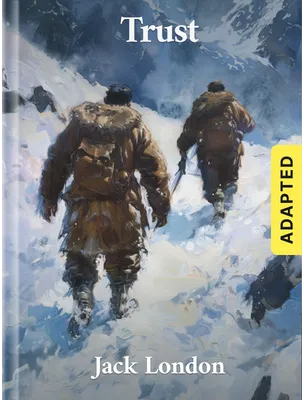
[adapted]
by
Jack London

All ropes had been untied, and the Seattle No. 4 was moving slowly away from the shore. Her decks were piled high with cargo and baggage, and were crowded with a mixed group of Indians, dogs, and dog sled drivers, prospectors, traders, and gold-seekers going home. A large part of Dawson was lined up on the bank, saying good-by. As the gang-plank came in and the steamer moved into the river, the noise of farewell became very loud. Also, at the last moment, everybody began to remember last goodbye messages and to shout them back and forth across the water that was getting wider. Louis Bondell, curling his yellow mustache with one hand and lazily waving the other hand to his friends on shore, suddenly remembered something and jumped to the railing.
“Oh, Fred!” he shouted. “Oh, Fred!”
The “Fred” desired pushed a strong pair of shoulders through the front of the crowd on the bank and tried to catch Louis Bondell’s message. Louis Bondell turned red in the face from useless shouting. Still the water grew wider between the steamboat and shore.
“Hey you, Captain Scott!” he shouted at the pilot’s room. “Stop the boat!”
The gongs rang loudly, and the big back wheel went backward, then stopped. Everyone on the steamboat and on the river bank used this pause to say final, new, and urgent good-byes. More useless than ever was Louis Bondell’s effort to make himself heard. The Seattle No. 4 lost speed and drifted downstream, and Captain Scott had to go forward and go backward a second time. His head disappeared inside the steering room, appearing a moment later behind a big megaphone.
Now Captain Scott had a very loud voice, and the “Shut up!” he shouted at the crowd on deck and on shore could have been heard at the top of Moosehide Mountain and as far as Klondike City. This official warning from the pilot-house spread a thin cover of silence over the noise.
“Now, what do you want to say?” Captain Scott asked.
“Tell Fred Churchill — he’s on the bank there — tell him to go to Macdonald. It’s in his safe — a small bag of mine. Tell him to get it and bring it out when he comes.”
In the silence Captain Scott shouted the message to shore through the megaphone: —
“You, Fred Churchill, go to Macdonald — in his safe — small bag — belongs to Louis Bondell — important! Bring it when you come! Got it?”
Churchill waved his hand to show that he understood. Actually, if Macdonald, half a mile away, had opened his window, he would have understood it, too. The loud noise of farewell rose again, the gongs rang, and the Seattle No. 4 went ahead, moved out into the stream, turned quickly, and went down the Yukon, Bondell and Churchill waving goodbye and love for each other to the end.
That was in midsummer. In the fall of the year, the W.H. Willis started up the Yukon with two hundred people going home on board. Among them was Churchill. In his cabin, in the middle of a clothes bag, was Louis Bondell’s suitcase. It was a small, strong leather bag, and its weight of forty pounds always made Churchill nervous when he went too far from it. The man in the next cabin had a treasure of gold dust hidden in the same way in a clothes bag, and the two of them finally agreed to take turns watching. While one went down to eat, the other kept an eye on the two cabin doors. When Churchill wanted to play whist, the other man stood guard, and when the other man wanted to rest, Churchill read newspapers that were four months old on a camp stool between the two doors.
There were signs of an early winter, and the question that was talked about from sunrise till dark, and late into the night, was whether they would get out before the river froze or be forced to leave the steamboat and walk out over the ice. There were annoying delays. Twice the engines broke down and had to be fixed, and each time there was light snow to warn them that winter was near. Nine times the W.H. Willis tried to go up the Five-Finger Rapids with her damaged machinery, and when she succeeded, she was four days behind her very easy schedule. The question that then came up was whether the steamboat Flora would wait for her above the Box Cañon. The part of the river between the start of the Box Cañon and the bottom of the White Horse Rapids was not safe for steamboats and passengers were moved at that point, walking around the rapids from one steamboat to the other. There were no telephones in the country, so no way of telling the waiting Flora that the Willis was four days late, but coming.
When the W.H. Willis came into White Horse, they learned that the Flora had waited three days more than the time allowed, and had left only a few hours before. Also, they learned that she would stop at Tagish Post until nine o’clock, Sunday morning. It was then four o’clock Saturday afternoon. The travelers called a meeting. On board there was a large Peterborough canoe, sent to the police post at the head of Lake Bennett. They agreed to take care of it and to deliver it. Next, they called for volunteers. Two men were needed to race to catch the Flora. Twenty men volunteered at once. Among them was Churchill, because he was that kind of man, and he volunteered before he thought of Bondell’s bag. When he thought of this, he started to hope that he would not be chosen; but a man who had made a name for himself as captain of a college football team, as a president of a sports club, as a dog-sled driver and a gold-seeker in the Yukon, and, also, who had such big shoulders as he had, had no right to refuse the honor. It was forced on him and on a very big German, Nick Antonsen.
While a crowd of the travelers, the canoe on their shoulders, started to run over the land path, Churchill ran to his cabin. He emptied the clothes bag onto the floor and picked up the bag, planning to give it to the man next door. Then the thought hit him that it was not his bag, and that he had no right to let it out of his own hands. So he ran to the shore with it and ran up the land path, changing it often from one hand to the other, and wondering if it was really more than forty pounds.
It was 4:30 in the afternoon when the two men started. The current of the Thirty Mile River was so strong that they could rarely use the paddles. It was out on one bank with a pulling rope over the shoulders, stumbling over the rocks, making a way through the bushes, slipping at times and falling into the water, wading often up to the knees and waist; and then, when a bluff too high to pass was met, it was into the canoe, take out the paddles, and a wild and losing rush across the current to the other bank, put the paddles in, over the side, and out pulling rope again. It was very tiring work. Antonsen worked hard like the giant he was, not complaining, steady, but pushed to his limit by the strong body and the unbreakable mind of Churchill. They never stopped for rest. It was go, go, and keep on going.
A cold wind blew down the river, freezing their hands and making it necessary, from time to time, to beat their hands to make the blood come back into the numb fingers. As night came, they were forced to trust luck. They fell again and again on the banks where no one went and tore their clothes into pieces in the bushes they could not see. Both men were badly scratched and bleeding. A dozen times, in their wild dashes from bank to bank, they hit hidden logs and their canoe turned over. The first time this happened, Churchill dived and felt around in three feet of water for the bag. He lost half an hour in getting it back, and after that it was carried tied on tightly to the canoe. As long as the canoe floated it was safe. Antonsen mocked the bag, and toward morning began to curse it; but Churchill gave no explanations.
Their delays and bad luck were endless. On one fast bend, around which poured a strong young rapid, they lost two hours, making many attempts and turning over twice. At this point, on both banks, were steep cliffs, rising out of deep water, and along which they could neither tow nor push with a pole, while they could not move forward with the paddles against the current. At each attempt they worked as hard as possible with the paddles, and each time, with hearts almost bursting from the effort, they were worn out and pushed back. They finally succeeded by accident. In the fastest current, near the end of another failure, a trick of the current turned the canoe out of Churchill’s control and threw it against the cliff. Churchill made a blind jump at the cliff and landed in a crack. Holding on with one hand, he held the canoe full of water with the other until Antonsen pulled himself out of the water. Then they pulled the canoe out and rested. A fresh start at this important point took them past. They landed on the bank above and went immediately ashore and into the bushes with the tow-line.
When daylight came, they were far below Tagish Post. At nine o’clock Sunday morning they could hear the Flora whistle as she left. And when, at ten o’clock, they dragged themselves in to the Post, they could just barely see the Flora’s smoke far to the south. It was a pair of worn-out ragged men that Captain Jones of the Mounted Police welcomed and fed, and he later said that they had two of the biggest appetites he had ever seen. They lay down and slept in their wet rags by the stove. At the end of two hours Churchill got up, carried Bondell’s bag, which he had used for a pillow, down to the canoe, kicked Antonsen awake, and started to chase the Flora.
“We can’t know what might happen — the engine might break down or something,” was his reply to Captain Jones’s protests. “I am going to catch that ship and send it back for the boys.”
Tagish Lake was white with a strong autumn wind that blew in their faces. Big, rolling waves rushed at the canoe, forcing one man to scoop out water and leaving one man to paddle. They could not make any progress. They ran along the shallow shore and went into the water, one man ahead on the tow rope, the other pushing on the canoe. They fought the strong wind up to their waists in the icy water, often up to their necks, often over their heads and covered by the big waves with white tops. There was no rest, never a moment’s pause from the sad, tiring fight. That night, at the end of Tagish Lake, in the middle of a heavy snowstorm, they caught up with the Flora. Antonsen fell on board, lay where he had fallen, and snored. Churchill looked like a wild man. His clothes barely stayed on him. His face was iced up and swollen from the long effort of twenty-four hours, while his hands were so swollen that he could not close his fingers. As for his feet, it was very painful to stand on them.
The captain of the Flora did not want to go back to White Horse. Churchill kept asking and gave orders; the captain was stubborn. He finally said that it would not help to go back, because the only ocean steamer at Dyea, the Athenian, was going to sail on Tuesday morning, and that he could not make the trip back to White Horse and bring up the stuck travelers in time to make the connection.
“What time does the Athenian sail?” Churchill asked.
“Seven o’clock, Tuesday morning.”
“All right,” Churchill said, at the same time tapping on the ribs of the snoring Antonsen with his foot. “You go back to White Horse. We’ll go ahead and keep the Athenian.”
Antonsen, very sleepy, not yet fully awake, was put into the canoe, and did not understand what had happened until he was wet all over with the very cold spray from the big sea, and heard Churchill shouting at him angrily in the dark: —
“Paddle, can’t you! Do you want to be filled with water?”
In the morning they were at Caribou Crossing, the wind getting weaker, and Antonsen was too exhausted to use a paddle. Churchill pulled the canoe onto a quiet beach, where they slept. He made sure to twist his arm under the weight of his head. Every few minutes the pain from the stopped blood woke him, then he would look at his watch and twist the other arm under his head. At the end of two hours he fought with Antonsen to wake him. Then they started. Lake Bennett, thirty miles long, was like a very calm mill pond; but, halfway across, a strong wind from the south hit them and turned the water white. Hour after hour they repeated the struggle on Tagish, over the side, pulling and pushing on the canoe, up to their waists and necks, and over their heads, in the icy water; toward the end the kind giant was completely worn out.
Churchill pushed him very hard; but when he fell forward and almost drowned in three feet of water, the other dragged him into the canoe. After that, Churchill kept going alone, arriving at the police post at the head of Bennett in the early afternoon. He tried to help Antonsen out of the canoe, but failed. He listened to the very tired man’s heavy breathing, and was jealous of him when he thought of what he still had to go through. Antonsen could lie there and sleep; but he, late, must go on over big Chilcoot and down to the sea. The real struggle was still ahead of him, and he almost was sorry for the strength that was in his body because of the pain it could cause to that body.
Churchill pulled the canoe up on the beach, grabbed Bondell’s bag, and started to run with a limp to the police station.
“There’s a canoe down there, sent to you from Dawson,” he said quickly to the officer who opened the door. “And there’s a man in it almost dead. Nothing serious; only very tired. Take care of him. I have to hurry. Good-by. Want to catch the Athenian.”
A mile-long path connected Lake Bennett and Lake Linderman, and his last words he called back after him as he started to trot again. It was a very painful trot, but he pressed his teeth together and kept on, forgetting his pain most of the time because of the hot, strong feeling with which he looked at the bag. It was a big problem. He swung it from one hand to the other, and back again. He put it under his arm. He put one hand over the other shoulder, and the bag bumped and hit hard on his back as he ran along. He could hardly hold it in his sore and swollen fingers, and several times he dropped it. Once, in changing from one hand to the other, it slipped from his grip and fell in front of him, tripped him up, and threw him hard to the ground.
At the far end of the place where boats are carried he bought an old set of carrying straps for a dollar, and in them he hung the suitcase. Also, he hired a small boat to take him the six miles to the upper end of Lake Linderman, where he arrived at four in the afternoon. The Athenian was to sail from Dyea next morning at seven. Dyea was twenty-eight miles away, and between rose the high Chilcoot. He sat down to fix his shoes for the long climb, and woke up. He had fallen asleep the moment he sat down, though he had not slept thirty seconds. He was afraid his next sleep might be longer, so he finished fixing his shoes standing up. Even then sleep took him for a short moment. He felt himself go out for a moment; becoming aware of it, in the air, as his relaxed body was sinking to the ground and as he caught himself, he made his muscles stiff with a sudden jerk, and escaped the fall. The sudden jerk back to being awake left him sick and shaking. He hit his head with the heel of his hand, knocking being awake into the tired brain.
Jack Burns’s pack train was going back with little load to Crater Lake, and Churchill was offered a mule. Burns wanted to put the bag on another animal, but Churchill held on to it, carrying it on the front of his saddle. But he kept falling asleep, and the bag kept dropping off the front of the saddle, to one side or the other, each time waking him with a sick feeling. Then, in the early darkness, Churchill’s mule brushed him against a sticking-out branch that cut his cheek. To make it worse, the mule stumbled off the trail and fell, throwing rider and bag onto the rocks. After that, Churchill walked, or rather stumbled, over the very bad trail, leading the mule. Strange and terrible smells, drifting from each side of the trail, told of the horses that had died in the rush for gold. But he did not mind. He was too sleepy. By the time they reached Long Lake, however, he had recovered from his sleepiness; and at Deep Lake he gave up the bag to Burns. But after that, by the light of the dim stars, he kept his eyes on Burns. There were not going to be any accidents with that bag.
At Crater Lake the pack animals made camp, and Churchill, putting the bag on his back, started the steep climb to the top. For the first time, on that very steep wall, he realized how tired he was. He crept and crawled like a crab, weighed down by the weight of his arms and legs. A clear and painful effort was needed each time he lifted a foot. He imagined that he was wearing lead shoes, like a deep-sea diver, and it was very hard not to reach down and feel the lead. As for Bondell’s bag, it was unbelievable that forty pounds could weigh so much. It pressed him down like a mountain, and he looked back in disbelief to the year before, when he had climbed that same pass with a hundred and fifty pounds on his back. If those loads had weighed a hundred and fifty pounds, then Bondell’s bag weighed five hundred.
The first climb up the ridge from Crater Lake was across a small glacier. Here was a clear trail. But above the glacier, which was also above the trees, was nothing but a mess of bare rock and huge stones. There was no way of seeing the trail in the darkness, and he stumbled on, using three times the usual effort for all that he did. He reached the top in the middle of strong wind and heavy snow, luckily finding a small, empty tent, and he crawled into it. There he found and ate quickly some very old fried potatoes and six raw eggs.
When the snow stopped and the wind died down, he began the almost impossible climb down. There was no path, and he stumbled and tripped, often finding himself, at the last moment, on the edge of rocky walls and steep slopes, and he had no way to know how deep they were. Part way down, the stars were covered by clouds again, and because it was dark he slipped and rolled and slid for a hundred feet, landing bruised and bleeding at the bottom of a big, not deep hole. From all around him came the stink of dead horses. The hole was close to the path, and the people with pack animals had made a habit of throwing into it their hurt and dying animals.
The bad smell was too strong for him, making him very sick, and as in a bad dream he climbed out quickly. Halfway up, he remembered Bondell’s bag. It had fallen into the hole with him; it seemed the strap had broken, and he had forgotten it. Back he went into the foul pit of death, where he crawled around on hands and knees and felt around for half an hour. In all he found and counted seventeen dead horses (and one horse still alive that he shot with his gun) before he found Bondell’s bag. Looking back on a life that had not been without bravery and success, he said to himself at once that this return for the bag was the bravest thing he had ever done. It was so brave that he was twice about to faint before he crawled out of the hole.
By the time he had gone down to the Scales, the steep slope of Chilcoot was past, and the way became easier. Not that it was an easy way, however, even in the best places; but it became a path he could really take, on which he could have gone fast if he had not been very tired, if he had had light to see where to step, and if it had not been for Bondell’s bag. To him, in his very tired condition, it was too much. Having barely enough strength to move himself along, the extra weight of the bag was enough to make him fall nearly every time he tripped or stumbled. And when he did not trip, branches reached out in the dark, caught the bag between his shoulders, and held him back.
He had decided that if he missed the Athenian it would be the fault of the bag. In fact, only two things stayed in his mind — Bondell’s bag and the ship. He knew only those two things, and they became connected, in a way, with some hard job that he had traveled and worked hard at for hundreds of years. He walked and struggled on as in a dream. A part of the dream was his arrival at Sheep Camp. He stumbled into a bar, slipped his shoulders out of the straps, and started to put the bag at his feet. But it slipped from his fingers and hit the floor with a loud bang that two men who were just leaving noticed. Churchill drank a glass of whiskey, told the bartender to call him in ten minutes, and sat down, his feet on the bag, his head on his knees.
His badly used body became so stiff that when he was called it took another ten minutes and a second glass of whiskey to straighten his joints and loosen his muscles.
“Hey! not that way!” the barkeeper shouted, and then went after him and led him through the darkness toward Canyon City. A small voice inside told Churchill that the direction was right, and, still as in a dream, he took the canyon trail. He did not know what warned him, but after what seemed like many years of travelling, he felt danger and pulled out his revolver. Still in the dream, he saw two men step out and heard them stop him. His revolver went off four times, and he saw the flashes and heard the shots from their revolvers. He also knew that he had been hit in the thigh. He saw one man fall, and, as the other came at him, he hit him with a straight blow with the heavy revolver right in the face. Then he turned and ran. He came out of the dream shortly afterward, to find himself going down the trail at a limping run. His first thought was for the bag. It was still on his back. He was sure that what had happened was a dream until he felt for his revolver and found it gone. Then he noticed a sharp sting in his thigh, and after checking, he found his hand warm with blood. It was a shallow wound, but it was real. He became more awake, and kept up the heavy run to Canyon City.
He found a man, with a team of horses and a wagon, who got out of bed and put the harness on for twenty dollars. Churchill crawled onto the wagon bed and slept, the bag still on his back. It was a rough ride, over big rocks washed by water down the Dyea Valley; but he woke up only when the wagon hit the highest places. Any height of his body above the wagon bed that was less than a foot did not bother him. The last mile was smooth going, and he slept soundly.
He woke up in the gray early morning, the driver shaking him hard and shouting into his ear that the Athenian was gone. Churchill looked in shock at the empty harbor.
“There is smoke over at Skaguay,” the man said.
Churchill’s eyes were too puffy to see that far, but he said: “It’s her. Get me a boat.”
The driver was helpful, and found a small boat and a man to row it for ten dollars, paid before the trip. Churchill paid, and was helped into the small boat. He could not get in by himself. It was six miles to Skaguay, and he had a happy thought of sleeping those six miles. But the man did not know how to row, and Churchill took the oars and worked hard for a very long time. He never knew six longer and more painful miles. A quick little wind blew up the narrow bay and held him back. He had an empty feeling in the bottom of his stomach, and he felt faint and numb. When he told him to, the man took the small bucket and threw salt water into his face.
The Athenian’s anchor was almost up when they came next to it, and Churchill was at the end of his last bit of strength.
“Stop her! Stop her!” he shouted in a rough voice. “Important message! Stop her!”
Then he dropped his chin on his chest and slept. “When six men started to carry him up the plank to the ship, he woke up, reached for the bag, and held on to it like a drowning man. On deck he became a center of fear and interest. The clothing in which he had left White Horse was only a few rags, and he was as worn out as his clothing. He had traveled for fifty-five hours at the limit of his strength. He had slept six hours in that time, and he was twenty pounds lighter than when he started. Face and hands and body were scratched and bruised, and he could barely see. He tried to stand up, but failed, falling down on the deck, holding on to the bag, and giving his message.
“Now, put me to bed,” he said; “I’ll eat when I wake up.”
They honored him, carrying him down in his rags and dirt and putting him and Bondell’s suitcase in the wedding room, which was the biggest and most fancy cabin on the ship. Twice he slept for a whole day, and he had bathed and shaved and eaten and was leaning over the rail smoking a cigar when the two hundred pilgrims from White Horse came up beside the ship.
By the time the Athenian arrived in Seattle, Churchill had fully recovered, and he went on land with Bondell’s bag in his hand. He felt proud of that bag. To him it meant success and honesty and trust. “I have done what I promised,” was the way he said these big ideas to himself. It was early in the evening, and he went straight to Bondell’s home. Louis Bondell was glad to see him, shaking hands with both hands at the same time and pulling him into the house.
“Oh, thanks, old man; it was kind of you to bring it here,” Bondell said when he got the bag.
He threw it carelessly onto a couch, and Churchill noticed with a pleased look the bounce of its weight from the springs. Bondell was asking him many questions very quickly.