The book was published in 1916.
[{"id":"para_1","index":0,"start":0,"offset":344,"words":3,"paraNum":"","lastModified":1722250136000,"semanticType":"title-book-title","voicework":"audio_file","blockId":"the_trust_property_short_story_ffa_en-blfb","language":"en","wordsRange":{"start":100000000,"end":104000000},"paragraphVersion":36,"direction":"ltr","paragraph":"<h1 class=\"ilm-title ilm-large\" id=\"para_1\" semantictype=\"title-book-title\" data-ilmid=\"the_trust_property_short_story_ffa_en-blfb\" data-audio=\"1\" data-chapter=\"para_1\" data-words-count=\"3\" data-before=\"0\" data-ww=\"\"><span class=\"block-pb\"> <span class=\"block-pb is-animated\"></span> </span><span class=\"itm-wrap\">The Trust Property</span></h1>","hasContent":true,"isFirst":true,"isLast":false},{"id":"para_2","index":1,"start":344,"offset":370,"words":2,"paraNum":"","lastModified":1722250850000,"semanticType":"title-author","voicework":"audio_file","blockId":"the_trust_property_short_story_ffa_en-bltf","language":"en","wordsRange":{"start":107703704,"end":111407407},"paragraphVersion":38,"direction":"ltr","paragraph":"<h1 class=\"ilm-title ilm-author ilm-nopad ilm-x-large\" id=\"para_2\" semantictype=\"title-author\" data-ilmid=\"the_trust_property_short_story_ffa_en-bltf\" data-audio=\"1\" data-chapter=\"para_2\" data-words-count=\"2\" data-before=\"3\" data-ww=\"\"><span class=\"block-pb\"> <span class=\"block-pb is-animated\"></span> </span><span class=\"itm-wrap\">by<br>Rabindranath Tagore</span></h1>","hasContent":true,"isFirst":false,"isLast":false},{"id":"para_3","index":2,"start":714,"offset":165,"words":0,"paraNum":"","lastModified":1722250351000,"semanticType":"line","blockId":"the_trust_property_short_story_ffa_en-blte","language":"en","wordsRange":{"start":115111111,"end":126222222},"paragraphVersion":27,"direction":"ltr","paragraph":"<hr class=\"ilm-hr ilm-small\" id=\"para_3\" semantictype=\"line\" data-ilmid=\"the_trust_property_short_story_ffa_en-blte\" data-words-count=\"0\" data-before=\"5\" data-ww=\"\">","hasContent":true,"isFirst":false,"isLast":false},{"id":"para_4","index":3,"start":879,"offset":1558,"words":0,"paraNum":"","lastModified":1722247623000,"semanticType":"illustration","blockId":"the_trust_property_short_story_ffa_en-bltd","language":"en","wordsRange":{"start":137333333,"end":170666667},"paragraphVersion":25,"direction":"ltr","paragraph":"<div class=\"ilm-illustration\" id=\"para_4\" semantictype=\"illustration\" data-ilmid=\"the_trust_property_short_story_ffa_en-bltd\" data-words-count=\"0\" data-before=\"5\" data-ww=\"\"><img width=\"600\" height=\"343\" data-src=\"ch0p0\" src=\"data:image/webp;base64,UklGRrQDAABXRUJQVlA4IKgDAABQEACdASo8ACIAPm0skUWkIqGYDq1UQAbEsoBdkOQzc317wX8IPqCSVcB9Pf1PkJ3n+9fJLuwGYOIf6uaxgZRz76gHS+NUN8nZNXvsOk45OCh1DlQgPgPqILuMRO5jqKY3KvrP3NngxOqTYYYnZz8xnb8ZEMzZci6PS8ogxHiuYFcBRW9Dgbdkv/yAAP7+Z2l6554kgdcZfzfwksu3m3Gz5G2lrN5RLUSlGar3CVouJdj31TbWEj5NiPalHFKuwli4xfLnC4PydVVfHjI4p+XSYCxYQHjLm5TELuN7+wZDJLl7rn05JXZl3CDjMpQAoIJM1etPB7/Q3pVInNa+JDoV8xoKOHQYB1eim9DU/poYLnYO9K33+ky2V/sUar3FH7YmLxJF+hOLWncau4tdO3JsvLNQm6ipzk/PVX2CY9aIJ18IJYffxOKUjbjJKm8f2uOgTFVpANyY5qbtUTKlrztoi990Hkvo9CwYZ0MH0pwaomdA6T2iZwZHjbXMT0WTVa50ZuEAzp3yKTNpFjEHf57ChIlr8MKup/v3Y80TI/Ttv0vfldLlZ4OKdKKQUgj7DZ/5f4nIcv/Qz/YGKiEpV2K86Mm3rXbI/Z+xTTaBXvv6on3ZV7/xAZvUWmLDYdIlZi6jyVJiAm5sZRvrX7zTDHRGlpja5jl0tALuvRNJOwTWprtQeu2oeC8xn5oTGsnpN9iAIffW+H3MBAx1hJ3a2U7jAL4Mqhk6ictuJidtywXHuVozzERXzvvmcn22IwQvWHaOhrW3ehon4dhkjOcD+GmVPy5p85UKJHM5IShTL0guSPbRpNz8RTg0jmOCCYsy2UZ1VMFV1+19buveZuL6O0gHJ/V6PMuuHs5nxehvxGHMRzn+j8x9+j6I/vAYjmPhEu2DLx4mgWf/zWqSSCDSFUUgbhvDvhhQ7YjGQ0gR/ozvGugclHem/Zem3tR5dr0AsZtXODnp6La2KZIrpw3kBR6efO1r//vYhUsv3wfdkvoQ5Gaij9edUMA5NTZzCUWIQiJ/4a+jsFuydWM8y3/Ap+ufS/Hs9zpJruF8VUoTW1pFcUHIFbUAQgaIJ5IuJwiJVYUdrB1n1ZSFuf7U4g8bz3R5/QLamSF1Cod7NfcPkQEV6FDZuQd5p/citJgguRR3RciQ4a2jT9N5wxHsWSaiyQ3mbl4b0z0fL3X9X21ryTCTa+mz0A/0lkqFsUD7b+kybTfiGymkGVMKNQJtNi27f/34WXUkCAAAAAA=\" alt=\"The Trust Property\"></div>","hasContent":true,"isFirst":false,"isLast":false},{"id":"para_5","index":4,"start":2437,"offset":310,"words":1,"paraNum":"","lastModified":1722250822000,"semanticType":"header-subheader","voicework":"no_audio","blockId":"the_trust_property_short_story_ffa_en-blfc","language":"en","wordsRange":{"start":204000000,"end":206000000},"paragraphVersion":30,"direction":"ltr","paragraph":"<h3 class=\"ilm-header ilm-h3\" id=\"para_5\" semantictype=\"header-subheader\" data-ilmid=\"the_trust_property_short_story_ffa_en-blfc\" data-chapter=\"para_5\" data-words-count=\"1\" data-before=\"5\" data-ww=\"\"><span class=\"block-pb\"> <span class=\"block-pb is-animated\"></span> </span><span class=\"itm-wrap\">I</span></h3>","hasContent":true,"isFirst":false,"isLast":false},{"id":"para_6","index":5,"start":2747,"offset":389,"words":16,"paraNum":"1.1","lastModified":1721996125000,"semanticType":"par","voicework":"audio_file","blockId":"the_trust_property_short_story_ffa_en-blfd","language":"en","wordsRange":{"start":306000000,"end":323000000},"paragraphVersion":28,"direction":"ltr","paragraph":"<p id=\"para_6\" semantictype=\"par\" data-ilmid=\"the_trust_property_short_story_ffa_en-blfd\" data-audio=\"1\" data-words-count=\"16\" data-before=\"6\" data-ww=\"\"><span class=\"block-num\" data-id=\"1.1\"></span><span class=\"block-pb\"> <span class=\"block-pb is-animated\"></span> </span><span class=\"itm-wrap\">Brindaban Kundu came to his father in a rage and said: ‘I am off this moment.’</span></p>","hasContent":true,"isFirst":false,"isLast":false},{"id":"para_7","index":6,"start":3136,"offset":502,"words":33,"paraNum":"1.2","lastModified":1722250170000,"semanticType":"par","voicework":"audio_file","blockId":"the_trust_property_short_story_ffa_en-blfe","language":"en","wordsRange":{"start":423000000,"end":457000000},"paragraphVersion":32,"direction":"ltr","paragraph":"<p id=\"para_7\" semantictype=\"par\" data-ilmid=\"the_trust_property_short_story_ffa_en-blfe\" data-audio=\"1\" data-words-count=\"33\" data-before=\"22\" data-ww=\"\"><span class=\"block-num\" data-id=\"1.2\"></span><span class=\"block-pb\"> <span class=\"block-pb is-animated\"></span> </span><span class=\"itm-wrap\">‘Ungrateful wretch!’ sneered the father, Jaganath Kundu. ‘When you have paid me back all that I have spent on your food and clothing, it will be time enough to give yourself these airs.’</span></p>","hasContent":true,"isFirst":false,"isLast":false},{"id":"para_8","index":7,"start":3638,"offset":791,"words":82,"paraNum":"1.3","lastModified":1722250196000,"semanticType":"par","voicework":"audio_file","blockId":"the_trust_property_short_story_ffa_en-blff","language":"en","wordsRange":{"start":557000000,"end":640000000},"paragraphVersion":32,"direction":"ltr","paragraph":"<p id=\"para_8\" semantictype=\"par\" data-ilmid=\"the_trust_property_short_story_ffa_en-blff\" data-audio=\"1\" data-words-count=\"82\" data-before=\"55\" data-ww=\"\"><span class=\"block-num\" data-id=\"1.3\"></span><span class=\"block-pb\"> <span class=\"block-pb is-animated\"></span> </span><span class=\"itm-wrap\">Such food and clothing as was customary in Jaganath’s household could not have cost very much. Our <i>rishis</i> of old managed to feed and clothe themselves on an incredibly small outlay. Jaganath’s behaviour showed that his ideal in these respects was equally high. That he could not fully live up to it was due partly to the bad influence of the degenerate society around him, and partly to certain unreasonable demands of Nature in her attempt to keep body and soul together.</span></p>","hasContent":true,"isFirst":false,"isLast":false},{"id":"para_9","index":8,"start":4429,"offset":738,"words":77,"paraNum":"1.4","lastModified":1722250265000,"semanticType":"par","voicework":"audio_file","blockId":"the_trust_property_short_story_ffa_en-blfg","language":"en","wordsRange":{"start":740000000,"end":818000000},"paragraphVersion":32,"direction":"ltr","paragraph":"<p id=\"para_9\" semantictype=\"par\" data-ilmid=\"the_trust_property_short_story_ffa_en-blfg\" data-audio=\"1\" data-words-count=\"77\" data-before=\"137\" data-ww=\"\"><span class=\"block-num\" data-id=\"1.4\"></span><span class=\"block-pb\"> <span class=\"block-pb is-animated\"></span> </span><span class=\"itm-wrap\">So long as Brindaban was single, things went smoothly enough, but after his marriage he began to depart from the high and rarefied standard cherished by his sire. It was clear that the son’s ideas of comfort were moving away from the spiritual to the material, and imitating the ways of the world. He was unwilling to put up with the discomforts of heat and cold, thirst and hunger. His minimum of food and clothing rose apace.</span></p>","hasContent":true,"isFirst":false,"isLast":false},{"id":"para_10","index":9,"start":5167,"offset":1112,"words":84,"paraNum":"1.5","lastModified":1721996125000,"semanticType":"par","voicework":"audio_file","blockId":"the_trust_property_short_story_ffa_en-blfh","language":"en","wordsRange":{"start":918000000,"end":1004000000},"paragraphVersion":28,"direction":"ltr","paragraph":"<p id=\"para_10\" semantictype=\"par\" data-ilmid=\"the_trust_property_short_story_ffa_en-blfh\" data-audio=\"1\" data-words-count=\"84\" data-before=\"214\" data-ww=\"\"><span class=\"block-num\" data-id=\"1.5\"></span><span class=\"block-pb\"> <span class=\"block-pb is-animated\"></span> </span><span class=\"itm-wrap\">Frequent were the quarrels between the father and the son. At last Brindaban’s wife became seriously ill and a <span class=\"intricate-word\"><span class=\"-nowrap-content\"><i>kabiraj</i><i><a data-fnid=\"1\" epub:type=\"noteref\" href=\"#n0\" class=\"space\"></a> </i></span></span> was called in. But when the doctor prescribed a costly medicine for his patient, Jaganath took it as a proof of sheer incompetence, and turned him out immediately. At first Brindaban besought his father to allow the treatment to continue; then he quarrelled with him about it, but to no purpose. When his wife died, he abused his father and called him a murderer. </span></p><aside id=\"n0\" data-audio=\"0\" data-fnid=\"1\" class=\"bh-fn\" epub:type=\"footnote\" data-ww=\"\"><span>Country doctor, unqualified by any medical training.</span></aside>","hasContent":true,"isFirst":false,"isLast":false},{"id":"para_11","index":10,"start":6279,"offset":624,"words":53,"paraNum":"1.6","lastModified":1721996718000,"semanticType":"par","voicework":"audio_file","blockId":"the_trust_property_short_story_ffa_en-blfj","language":"en","wordsRange":{"start":1104000000,"end":1158000000},"paragraphVersion":28,"direction":"ltr","paragraph":"<p id=\"para_11\" semantictype=\"par\" data-ilmid=\"the_trust_property_short_story_ffa_en-blfj\" data-audio=\"1\" data-words-count=\"53\" data-before=\"298\" data-ww=\"\"><span class=\"block-num\" data-id=\"1.6\"></span><span class=\"block-pb\"> <span class=\"block-pb is-animated\"></span> </span><span class=\"itm-wrap\">‘Nonsense!’ said the father. ‘Don’t people die even after swallowing all kinds of drugs? If costly medicines could save life, how is it that kings and emperors are not immortal? You don’t expect your wife to die with more pomp and ceremony than did your mother and your grandmother before her, do you?’</span></p>","hasContent":true,"isFirst":false,"isLast":false},{"id":"para_12","index":11,"start":6903,"offset":941,"words":105,"paraNum":"1.7","lastModified":1721996718000,"semanticType":"par","voicework":"audio_file","blockId":"the_trust_property_short_story_ffa_en-blfk","language":"en","wordsRange":{"start":1258000000,"end":1364000000},"paragraphVersion":28,"direction":"ltr","paragraph":"<p id=\"para_12\" semantictype=\"par\" data-ilmid=\"the_trust_property_short_story_ffa_en-blfk\" data-audio=\"1\" data-words-count=\"105\" data-before=\"351\" data-ww=\"\"><span class=\"block-num\" data-id=\"1.7\"></span><span class=\"block-pb\"> <span class=\"block-pb is-animated\"></span> </span><span class=\"itm-wrap\">Brindaban might really have derived a great consolation from these words, had he not been overwhelmed with grief and incapable of proper thinking. Neither his mother nor his grandmother had taken any medicine before making their exit from this world, and this was the time-honoured custom of the family. But, alas, the younger generation was unwilling to die according to ancient custom. The English had newly come to the country at the time we speak of. Even in those remote days, the good old folks were horrified at the unorthodox ways of the new generation, and sat speechless, trying to draw comfort from their <i>hookas.</i></span></p>","hasContent":true,"isFirst":false,"isLast":false},{"id":"para_13","index":12,"start":7844,"offset":399,"words":19,"paraNum":"1.8","lastModified":1722250634000,"semanticType":"par","voicework":"audio_file","blockId":"the_trust_property_short_story_ffa_en-blfl","language":"en","wordsRange":{"start":1464000000,"end":1484000000},"paragraphVersion":32,"direction":"ltr","paragraph":"<p id=\"para_13\" semantictype=\"par\" data-ilmid=\"the_trust_property_short_story_ffa_en-blfl\" data-audio=\"1\" data-words-count=\"19\" data-before=\"456\" data-ww=\"\"><span class=\"block-num\" data-id=\"1.8\"></span><span class=\"block-pb\"> <span class=\"block-pb is-animated\"></span> </span><span class=\"itm-wrap\">Be that as it may, the modern Brindaban said to his old fogy of a father: ‘I am off.’</span></p>","hasContent":true,"isFirst":false,"isLast":false},{"id":"para_14","index":13,"start":8243,"offset":621,"words":56,"paraNum":"1.9","lastModified":1721996718000,"semanticType":"par","voicework":"audio_file","blockId":"the_trust_property_short_story_ffa_en-blfm","language":"en","wordsRange":{"start":1584000000,"end":1641000000},"paragraphVersion":28,"direction":"ltr","paragraph":"<p id=\"para_14\" semantictype=\"par\" data-ilmid=\"the_trust_property_short_story_ffa_en-blfm\" data-audio=\"1\" data-words-count=\"56\" data-before=\"475\" data-ww=\"\"><span class=\"block-num\" data-id=\"1.9\"></span><span class=\"block-pb\"> <span class=\"block-pb is-animated\"></span> </span><span class=\"itm-wrap\">The father instantly agreed, and wished publicly that, should he ever give his son one single pice in future, the gods might reckon his act as shedding the holy blood of cows. Brindaban in his turn similarly wished that, should he ever accept anything from his father, his act might be held as bad as matricide.</span></p>","hasContent":true,"isFirst":false,"isLast":false},{"id":"para_15","index":14,"start":8864,"offset":1042,"words":133,"paraNum":"1.10","lastModified":1722250680000,"semanticType":"par","voicework":"audio_file","blockId":"the_trust_property_short_story_ffa_en-blfn","language":"en","wordsRange":{"start":1741000000,"end":1875000000},"paragraphVersion":32,"direction":"ltr","paragraph":"<p id=\"para_15\" semantictype=\"par\" data-ilmid=\"the_trust_property_short_story_ffa_en-blfn\" data-audio=\"1\" data-words-count=\"133\" data-before=\"531\" data-ww=\"\"><span class=\"block-num\" data-id=\"1.10\"></span><span class=\"block-pb\"> <span class=\"block-pb is-animated\"></span> </span><span class=\"itm-wrap\">The people of the village looked upon this small revolution as a great relief after a long period of monotony. And when Jaganath disinherited his only son, every one did his best to console him. All were unanimous in the opinion that to quarrel with a father for the sake of a wife was possible only in these degenerate days. And the reason they gave was sound too. ‘When your wife dies,’ they said, ‘you can find a second one without delay. But when your father dies, you can’t get another to replace him for love or money.’ Their logic no doubt was perfect, but we suspect that the utter hopelessness of getting another father did not trouble the misguided son very much. On the contrary, he looked upon it as a mercy.</span></p>","hasContent":true,"isFirst":false,"isLast":false},{"id":"para_16","index":15,"start":9906,"offset":803,"words":87,"paraNum":"1.11","lastModified":1722250979000,"semanticType":"par","voicework":"audio_file","blockId":"the_trust_property_short_story_ffa_en-blfo","language":"en","wordsRange":{"start":1975000000,"end":2063000000},"paragraphVersion":38,"direction":"ltr","paragraph":"<p id=\"para_16\" semantictype=\"par\" data-ilmid=\"the_trust_property_short_story_ffa_en-blfo\" data-audio=\"1\" data-words-count=\"87\" data-before=\"664\" data-ww=\"\"><span class=\"block-num\" data-id=\"1.11\"></span><span class=\"block-pb\"> <span class=\"block-pb is-animated\"></span> </span><span class=\"itm-wrap\">Nor did separation from Brindaban weigh heavily on the mind of his father. In the first place, his absence from home reduced the household expenses. Then, again, the father was freed from a great anxiety. The fear of being poisoned by his son and heir had always haunted him. When he ate his scanty fare, he could never banish the thought of poison from his mind. This fear had abated somewhat after the death of his daughter-in-law, and, now that the son was gone, it disappeared altogether.</span></p>","hasContent":true,"isFirst":false,"isLast":false},{"id":"para_17","index":16,"start":10709,"offset":834,"words":97,"paraNum":"1.12","lastModified":1722253505000,"semanticType":"par","voicework":"audio_file","blockId":"the_trust_property_short_story_ffa_en-blfp","language":"en","wordsRange":{"start":2163000000,"end":2261000000},"paragraphVersion":38,"direction":"ltr","paragraph":"<p id=\"para_17\" semantictype=\"par\" data-ilmid=\"the_trust_property_short_story_ffa_en-blfp\" data-audio=\"1\" data-words-count=\"97\" data-before=\"751\" data-ww=\"\"><span class=\"block-num\" data-id=\"1.12\"></span><span class=\"block-pb\"> <span class=\"block-pb is-animated\"></span> </span><span class=\"itm-wrap\">But there was one tender spot in the old man’s heart. Brindaban had taken away with him his four-year-old son, Gokul Chandra. Now, the expense of keeping the child was comparatively small, and so Jaganath’s affection for him was without a drawback. Still, when Brindaban took him away, his grief, sincere as it was, was mingled at first with calculation as to how much he would save a month by the absence of the two, how much the sum would come to in the year, and what would be the capital to bring it in as interest.</span></p>","hasContent":true,"isFirst":false,"isLast":false},{"id":"para_18","index":17,"start":11543,"offset":1652,"words":199,"paraNum":"1.13","lastModified":1722259552000,"semanticType":"par","voicework":"audio_file","blockId":"the_trust_property_short_story_ffa_en-blfq","language":"en","wordsRange":{"start":2361000000,"end":2563000000},"paragraphVersion":38,"direction":"ltr","paragraph":"<p id=\"para_18\" semantictype=\"par\" data-ilmid=\"the_trust_property_short_story_ffa_en-blfq\" data-audio=\"1\" data-words-count=\"199\" data-before=\"848\" data-ww=\"\"><span class=\"block-num\" data-id=\"1.13\"></span><span class=\"block-pb\"> <span class=\"block-pb is-animated\"></span> </span><span class=\"itm-wrap\">But the empty house, without Gokul Chandra in it to make mischief, became more and more difficult for the old man to live in. There was no one now to play tricks upon him when he was engaged in his <i>puja,</i><span class=\"intricate-word\"><span class=\"-nowrap-content\"><a data-fnid=\"1\" epub:type=\"noteref\" href=\"#n1\"></a> </span></span>no one to snatch away his food and eat it, no one to run away with his inkpot, when he was writing up his accounts. His daily routine of life, now uninterrupted, became an intolerable burden to him. He bethought him that this unworried peace was endurable only in the world to come. When he caught sight of the holes made in his quilt by his grandchild, and the pen-and-ink sketches executed by the same artist on his rush-mat, his heart was heavy with grief. Once upon a time he had reproached the boy bitterly because he had torn his <i>dhoti</i> into pieces within the short space of two years; now tears stood in Jaganath’s eyes as he gazed upon the dirty remnants lying in the bedroom. He carefully put them away in his safe, and registered a vow that, should Gokul ever come back again, he should not be reprimanded even if he destroyed one <i>dhoti</i> a year. </span></p><aside id=\"n1\" data-audio=\"0\" data-fnid=\"1\" class=\"bh-fn\" epub:type=\"footnote\" data-ww=\"\"><span>A ceremonial worship.</span></aside>","hasContent":true,"isFirst":false,"isLast":false},{"id":"para_19","index":18,"start":13195,"offset":410,"words":17,"paraNum":"1.14","lastModified":1722250783000,"semanticType":"par","voicework":"audio_file","blockId":"the_trust_property_short_story_ffa_en-blfs","language":"en","wordsRange":{"start":2663000000,"end":2681000000},"paragraphVersion":32,"direction":"ltr","paragraph":"<p id=\"para_19\" semantictype=\"par\" data-ilmid=\"the_trust_property_short_story_ffa_en-blfs\" data-audio=\"1\" data-words-count=\"17\" data-before=\"1047\" data-ww=\"\"><span class=\"block-num\" data-id=\"1.14\"></span><span class=\"block-pb\"> <span class=\"block-pb is-animated\"></span> </span><span class=\"itm-wrap\">But Gokul did not return, and poor Jaganath aged rapidly. His empty home seemed emptier every day.</span></p>","hasContent":true,"isFirst":false,"isLast":false},{"id":"para_20","index":19,"start":13605,"offset":1822,"words":142,"paraNum":"1.15","lastModified":1722260041000,"semanticType":"par","voicework":"audio_file","blockId":"the_trust_property_short_story_ffa_en-blft","language":"en","wordsRange":{"start":2781000000,"end":2926000000},"paragraphVersion":38,"direction":"ltr","paragraph":"<p id=\"para_20\" semantictype=\"par\" data-ilmid=\"the_trust_property_short_story_ffa_en-blft\" data-audio=\"1\" data-words-count=\"142\" data-before=\"1064\" data-ww=\"\"><span class=\"block-num\" data-id=\"1.15\"></span><span class=\"block-pb\"> <span class=\"block-pb is-animated\"></span> </span><span class=\"itm-wrap\">No longer could the old man stay peacefully at home. Even in the middle of the day, when all respectable folks in the village enjoyed their after-dinner siesta, Jaganath might be seen roaming over the village, <i>hooka</i> in hand. The boys, at sight of him, would give up their play, and, retiring in a body to a safe distance, chant verses composed by a local poet, praising the old gentleman’s economical habits. No one ventured to say his real name, lest he should have to go without his meal that day<span class=\"intricate-word\"><span class=\"-nowrap-content\"><a data-fnid=\"1\" epub:type=\"noteref\" href=\"#n2\" class=\"space\"></a> — </span></span>and so people gave him names after their own fancy. Elderly people called him <span class=\"intricate-word\"><span class=\"-nowrap-content\">Jaganash,<a data-fnid=\"2\" epub:type=\"noteref\" href=\"#n3\"></a> </span></span>but the reason why the younger generation preferred to call him a vampire was hard to guess. It may be that the bloodless, dried-up skin of the old man had some physical resemblance to the vampire’s. </span></p><aside id=\"n2\" data-audio=\"0\" data-fnid=\"1\" class=\"bh-fn\" epub:type=\"footnote\" data-ww=\"\"><span>It is a superstition current in Bengal that if a man pronounces the name of a very miserly individual, he has to go without his meal that day.</span></aside><aside id=\"n3\" data-audio=\"0\" data-fnid=\"2\" class=\"bh-fn\" epub:type=\"footnote\" data-ww=\"\"><span>Jaganath is the Lord of Festivity, and Jaganash would mean the despoiler of it.</span></aside>","hasContent":true,"isFirst":false,"isLast":false},{"id":"para_21","index":20,"start":15427,"offset":169,"words":0,"paraNum":"","lastModified":1721897903000,"semanticType":"line","blockId":"the_trust_property_short_story_ffa_en-blt9","language":"en","wordsRange":{"start":3026000000,"end":3028000000},"paragraphVersion":17,"direction":"ltr","paragraph":"<hr class=\"ilm-hr ilm-small\" id=\"para_21\" semantictype=\"line\" data-ilmid=\"the_trust_property_short_story_ffa_en-blt9\" data-words-count=\"0\" data-before=\"1206\" data-ww=\"\">","hasContent":true,"isFirst":false,"isLast":false},{"id":"para_22","index":21,"start":15596,"offset":316,"words":1,"paraNum":"","lastModified":1722250811000,"semanticType":"header-subheader","voicework":"no_audio","blockId":"the_trust_property_short_story_ffa_en-blfw","language":"en","wordsRange":{"start":3128000000,"end":3130000000},"paragraphVersion":29,"direction":"ltr","paragraph":"<h3 class=\"ilm-header ilm-h3\" id=\"para_22\" semantictype=\"header-subheader\" data-ilmid=\"the_trust_property_short_story_ffa_en-blfw\" data-chapter=\"para_22\" data-words-count=\"1\" data-before=\"1206\" data-ww=\"\"><span class=\"block-pb\"> <span class=\"block-pb is-animated\"></span> </span><span class=\"itm-wrap\">II</span></h3>","hasContent":true,"isFirst":false,"isLast":false},{"id":"para_23","index":22,"start":15912,"offset":1248,"words":172,"paraNum":"2.1","lastModified":1722260507000,"semanticType":"par","voicework":"audio_file","blockId":"the_trust_property_short_story_ffa_en-blfx","language":"en","wordsRange":{"start":3230000000,"end":3403000000},"paragraphVersion":32,"direction":"ltr","paragraph":"<p id=\"para_23\" semantictype=\"par\" data-ilmid=\"the_trust_property_short_story_ffa_en-blfx\" data-audio=\"1\" data-words-count=\"172\" data-before=\"1207\" data-ww=\"\"><span class=\"block-num\" data-id=\"2.1\"></span><span class=\"block-pb\"> <span class=\"block-pb is-animated\"></span> </span><span class=\"itm-wrap\">One afternoon, when Jaganath was rambling as usual through the village lanes shaded by mango topes, he saw a boy, apparently a stranger, assuming the captaincy of the village boys and explaining to them the scheme of some new prank. Won by the force of his character and the startling novelty of his ideas, the boys had all sworn allegiance to him. Unlike the others, he did not run away from the old man as he approached, but came quite close to him and began to shake his own <i>chadar.</i> The result was that a live lizard sprang out of it on to the old man’s body, ran down his back and off towards the jungle. Sudden fright made the poor man shiver from head to foot, to the great amusement of the other boys, who shouted with glee. Before Jaganath had gone far, cursing and swearing, the <i>gamcha</i> on his shoulder suddenly disappeared, and the next moment it was seen on the head of the new boy, transformed into a turban.</span></p>","hasContent":true,"isFirst":false,"isLast":false},{"id":"para_24","index":23,"start":17160,"offset":586,"words":52,"paraNum":"2.2","lastModified":1722251037000,"semanticType":"par","voicework":"audio_file","blockId":"the_trust_property_short_story_ffa_en-blfy","language":"en","wordsRange":{"start":3503000000,"end":3556000000},"paragraphVersion":32,"direction":"ltr","paragraph":"<p id=\"para_24\" semantictype=\"par\" data-ilmid=\"the_trust_property_short_story_ffa_en-blfy\" data-audio=\"1\" data-words-count=\"52\" data-before=\"1379\" data-ww=\"\"><span class=\"block-num\" data-id=\"2.2\"></span><span class=\"block-pb\"> <span class=\"block-pb is-animated\"></span> </span><span class=\"itm-wrap\">The novel attentions of this manikin came as a great relief to Jaganath. It was long since any boy had taken such freedom with him. After a good deal of coaxing and many fair promises, he at last persuaded the boy to come to him, and this was the conversation which followed:</span></p>","hasContent":true,"isFirst":false,"isLast":false},{"id":"para_25","index":24,"start":17746,"offset":343,"words":5,"paraNum":"2.3","lastModified":1721996718000,"semanticType":"par","voicework":"audio_file","blockId":"the_trust_property_short_story_ffa_en-blfz","language":"en","wordsRange":{"start":3656000000,"end":3662000000},"paragraphVersion":28,"direction":"ltr","paragraph":"<p id=\"para_25\" semantictype=\"par\" data-ilmid=\"the_trust_property_short_story_ffa_en-blfz\" data-audio=\"1\" data-words-count=\"5\" data-before=\"1431\" data-ww=\"\"><span class=\"block-num\" data-id=\"2.3\"></span><span class=\"block-pb\"> <span class=\"block-pb is-animated\"></span> </span><span class=\"itm-wrap\">‘What’s your name, my boy?’</span></p>","hasContent":true,"isFirst":false,"isLast":false},{"id":"para_26","index":25,"start":18089,"offset":326,"words":2,"paraNum":"2.4","lastModified":1722251086000,"semanticType":"par","voicework":"audio_file","blockId":"the_trust_property_short_story_ffa_en-blg0","language":"en","wordsRange":{"start":3762000000,"end":3765000000},"paragraphVersion":32,"direction":"ltr","paragraph":"<p id=\"para_26\" semantictype=\"par\" data-ilmid=\"the_trust_property_short_story_ffa_en-blg0\" data-audio=\"1\" data-words-count=\"2\" data-before=\"1436\" data-ww=\"\"><span class=\"block-num\" data-id=\"2.4\"></span><span class=\"block-pb\"> <span class=\"block-pb is-animated\"></span> </span><span class=\"itm-wrap\">‘Nitai Pal.’</span></p>","hasContent":true,"isFirst":false,"isLast":false},{"id":"para_27","index":26,"start":18415,"offset":336,"words":3,"paraNum":"2.5","lastModified":1722251100000,"semanticType":"par","voicework":"audio_file","blockId":"the_trust_property_short_story_ffa_en-blg1","language":"en","wordsRange":{"start":3865000000,"end":3869000000},"paragraphVersion":32,"direction":"ltr","paragraph":"<p id=\"para_27\" semantictype=\"par\" data-ilmid=\"the_trust_property_short_story_ffa_en-blg1\" data-audio=\"1\" data-words-count=\"3\" data-before=\"1438\" data-ww=\"\"><span class=\"block-num\" data-id=\"2.5\"></span><span class=\"block-pb\"> <span class=\"block-pb is-animated\"></span> </span><span class=\"itm-wrap\">‘Where’s your home?’</span></p>","hasContent":true,"isFirst":false,"isLast":false},{"id":"para_28","index":27,"start":18751,"offset":329,"words":2,"paraNum":"2.6","lastModified":1721996125000,"semanticType":"par","voicework":"audio_file","blockId":"the_trust_property_short_story_ffa_en-blg2","language":"en","wordsRange":{"start":3969000000,"end":3972000000},"paragraphVersion":28,"direction":"ltr","paragraph":"<p id=\"para_28\" semantictype=\"par\" data-ilmid=\"the_trust_property_short_story_ffa_en-blg2\" data-audio=\"1\" data-words-count=\"2\" data-before=\"1441\" data-ww=\"\"><span class=\"block-num\" data-id=\"2.6\"></span><span class=\"block-pb\"> <span class=\"block-pb is-animated\"></span> </span><span class=\"itm-wrap\">‘Won’t tell.’</span></p>","hasContent":true,"isFirst":false,"isLast":false},{"id":"para_29","index":28,"start":19080,"offset":336,"words":3,"paraNum":"2.7","lastModified":1722251119000,"semanticType":"par","voicework":"audio_file","blockId":"the_trust_property_short_story_ffa_en-blg3","language":"en","wordsRange":{"start":4072000000,"end":4076000000},"paragraphVersion":32,"direction":"ltr","paragraph":"<p id=\"para_29\" semantictype=\"par\" data-ilmid=\"the_trust_property_short_story_ffa_en-blg3\" data-audio=\"1\" data-words-count=\"3\" data-before=\"1443\" data-ww=\"\"><span class=\"block-num\" data-id=\"2.7\"></span><span class=\"block-pb\"> <span class=\"block-pb is-animated\"></span> </span><span class=\"itm-wrap\">‘Who’s your father?’</span></p>","hasContent":true,"isFirst":false,"isLast":false},{"id":"para_30","index":29,"start":19416,"offset":329,"words":2,"paraNum":"2.8","lastModified":1721996718000,"semanticType":"par","voicework":"audio_file","blockId":"the_trust_property_short_story_ffa_en-blg4","language":"en","wordsRange":{"start":4176000000,"end":4179000000},"paragraphVersion":28,"direction":"ltr","paragraph":"<p id=\"para_30\" semantictype=\"par\" data-ilmid=\"the_trust_property_short_story_ffa_en-blg4\" data-audio=\"1\" data-words-count=\"2\" data-before=\"1446\" data-ww=\"\"><span class=\"block-num\" data-id=\"2.8\"></span><span class=\"block-pb\"> <span class=\"block-pb is-animated\"></span> </span><span class=\"itm-wrap\">‘Won’t tell.’</span></p>","hasContent":true,"isFirst":false,"isLast":false},{"id":"para_31","index":30,"start":19745,"offset":332,"words":3,"paraNum":"2.9","lastModified":1722260587000,"semanticType":"par","voicework":"audio_file","blockId":"the_trust_property_short_story_ffa_en-blg5","language":"en","wordsRange":{"start":4279000000,"end":4283000000},"paragraphVersion":38,"direction":"ltr","paragraph":"<p id=\"para_31\" semantictype=\"par\" data-ilmid=\"the_trust_property_short_story_ffa_en-blg5\" data-audio=\"1\" data-words-count=\"3\" data-before=\"1448\" data-ww=\"\"><span class=\"block-num\" data-id=\"2.9\"></span><span class=\"block-pb\"> <span class=\"block-pb is-animated\"></span> </span><span class=\"itm-wrap\">‘Why won’t you?’</span></p>","hasContent":true,"isFirst":false,"isLast":false},{"id":"para_32","index":31,"start":20077,"offset":351,"words":7,"paraNum":"2.10","lastModified":1722251151000,"semanticType":"par","voicework":"audio_file","blockId":"the_trust_property_short_story_ffa_en-blg6","language":"en","wordsRange":{"start":4383000000,"end":4391000000},"paragraphVersion":32,"direction":"ltr","paragraph":"<p id=\"para_32\" semantictype=\"par\" data-ilmid=\"the_trust_property_short_story_ffa_en-blg6\" data-audio=\"1\" data-words-count=\"7\" data-before=\"1451\" data-ww=\"\"><span class=\"block-num\" data-id=\"2.10\"></span><span class=\"block-pb\"> <span class=\"block-pb is-animated\"></span> </span><span class=\"itm-wrap\">‘Because I have run away from home.’</span></p>","hasContent":true,"isFirst":false,"isLast":false},{"id":"para_33","index":32,"start":20428,"offset":337,"words":5,"paraNum":"2.11","lastModified":1722251168000,"semanticType":"par","voicework":"audio_file","blockId":"the_trust_property_short_story_ffa_en-blg7","language":"en","wordsRange":{"start":4491000000,"end":4497000000},"paragraphVersion":32,"direction":"ltr","paragraph":"<p id=\"para_33\" semantictype=\"par\" data-ilmid=\"the_trust_property_short_story_ffa_en-blg7\" data-audio=\"1\" data-words-count=\"5\" data-before=\"1458\" data-ww=\"\"><span class=\"block-num\" data-id=\"2.11\"></span><span class=\"block-pb\"> <span class=\"block-pb is-animated\"></span> </span><span class=\"itm-wrap\">‘What made you do it?’</span></p>","hasContent":true,"isFirst":false,"isLast":false},{"id":"para_34","index":33,"start":20765,"offset":355,"words":8,"paraNum":"2.12","lastModified":1722251182000,"semanticType":"par","voicework":"audio_file","blockId":"the_trust_property_short_story_ffa_en-blg8","language":"en","wordsRange":{"start":4597000000,"end":4606000000},"paragraphVersion":32,"direction":"ltr","paragraph":"<p id=\"para_34\" semantictype=\"par\" data-ilmid=\"the_trust_property_short_story_ffa_en-blg8\" data-audio=\"1\" data-words-count=\"8\" data-before=\"1463\" data-ww=\"\"><span class=\"block-num\" data-id=\"2.12\"></span><span class=\"block-pb\"> <span class=\"block-pb is-animated\"></span> </span><span class=\"itm-wrap\">‘My father wanted to send me to school.’</span></p>","hasContent":true,"isFirst":false,"isLast":false},{"id":"para_35","index":34,"start":21120,"offset":477,"words":31,"paraNum":"2.13","lastModified":1722251199000,"semanticType":"par","voicework":"audio_file","blockId":"the_trust_property_short_story_ffa_en-blg9","language":"en","wordsRange":{"start":4706000000,"end":4738000000},"paragraphVersion":32,"direction":"ltr","paragraph":"<p id=\"para_35\" semantictype=\"par\" data-ilmid=\"the_trust_property_short_story_ffa_en-blg9\" data-audio=\"1\" data-words-count=\"31\" data-before=\"1471\" data-ww=\"\"><span class=\"block-num\" data-id=\"2.13\"></span><span class=\"block-pb\"> <span class=\"block-pb is-animated\"></span> </span><span class=\"itm-wrap\">It occurred to Jaganath that it would be useless extravagance to send such a boy to school, and his father must have been an unpractical fool not to have thought so.</span></p>","hasContent":true,"isFirst":false,"isLast":false},{"id":"para_36","index":35,"start":21597,"offset":395,"words":14,"paraNum":"2.14","lastModified":1722251499000,"semanticType":"par","voicework":"audio_file","blockId":"the_trust_property_short_story_ffa_en-blga","language":"en","wordsRange":{"start":4838000000,"end":4853000000},"paragraphVersion":34,"direction":"ltr","paragraph":"<p id=\"para_36\" semantictype=\"par\" data-ilmid=\"the_trust_property_short_story_ffa_en-blga\" data-audio=\"1\" data-words-count=\"14\" data-before=\"1502\" data-ww=\"\"><span class=\"block-num\" data-id=\"2.14\"></span><span class=\"block-pb\"> <span class=\"block-pb is-animated\"></span> </span><span class=\"itm-wrap\">‘Well, well,’ said Jaganath, ‘how would you like to come and stay with me?’</span></p>","hasContent":true,"isFirst":false,"isLast":false},{"id":"para_37","index":36,"start":21992,"offset":900,"words":105,"paraNum":"2.15","lastModified":1722251250000,"semanticType":"par","voicework":"audio_file","blockId":"the_trust_property_short_story_ffa_en-blgb","language":"en","wordsRange":{"start":4953000000,"end":5059000000},"paragraphVersion":32,"direction":"ltr","paragraph":"<p id=\"para_37\" semantictype=\"par\" data-ilmid=\"the_trust_property_short_story_ffa_en-blgb\" data-audio=\"1\" data-words-count=\"105\" data-before=\"1516\" data-ww=\"\"><span class=\"block-num\" data-id=\"2.15\"></span><span class=\"block-pb\"> <span class=\"block-pb is-animated\"></span> </span><span class=\"itm-wrap\">‘Don’t mind,’ said the boy, and forthwith he installed himself in Jaganath’s house. He felt as little hesitation as though it were the shadow of a tree by the wayside. And not only that. He began to proclaim his wishes as regards his food and clothing with such coolness that you would have thought he had paid his reckoning in full beforehand; and, when anything went wrong, he did not scruple to quarrel with the old man. It had been easy enough for Jaganath to get the better of his own child; but, now, where another man’s child was concerned, he had to acknowledge defeat.</span></p>","hasContent":true,"isFirst":false,"isLast":false},{"id":"para_38","index":37,"start":22892,"offset":169,"words":0,"paraNum":"","lastModified":1721897903000,"semanticType":"line","blockId":"the_trust_property_short_story_ffa_en-blta","language":"en","wordsRange":{"start":5159000000,"end":5161000000},"paragraphVersion":17,"direction":"ltr","paragraph":"<hr class=\"ilm-hr ilm-small\" id=\"para_38\" semantictype=\"line\" data-ilmid=\"the_trust_property_short_story_ffa_en-blta\" data-words-count=\"0\" data-before=\"1621\" data-ww=\"\">","hasContent":true,"isFirst":false,"isLast":false},{"id":"para_39","index":38,"start":23061,"offset":317,"words":1,"paraNum":"","lastModified":1722260607000,"semanticType":"header-subheader","voicework":"no_audio","blockId":"the_trust_property_short_story_ffa_en-blgc","language":"en","wordsRange":{"start":5261000000,"end":5263000000},"paragraphVersion":35,"direction":"ltr","paragraph":"<h3 class=\"ilm-header ilm-h3\" id=\"para_39\" semantictype=\"header-subheader\" data-ilmid=\"the_trust_property_short_story_ffa_en-blgc\" data-chapter=\"para_39\" data-words-count=\"1\" data-before=\"1621\" data-ww=\"\"><span class=\"block-pb\"> <span class=\"block-pb is-animated\"></span> </span><span class=\"itm-wrap\">III</span></h3>","hasContent":true,"isFirst":false,"isLast":false},{"id":"para_40","index":39,"start":23378,"offset":686,"words":72,"paraNum":"3.1","lastModified":1722259158000,"semanticType":"par","voicework":"audio_file","blockId":"the_trust_property_short_story_ffa_en-blgd","language":"en","wordsRange":{"start":5363000000,"end":5436000000},"paragraphVersion":34,"direction":"ltr","paragraph":"<p id=\"para_40\" semantictype=\"par\" data-ilmid=\"the_trust_property_short_story_ffa_en-blgd\" data-audio=\"1\" data-words-count=\"72\" data-before=\"1622\" data-ww=\"\"><span class=\"block-num\" data-id=\"3.1\"></span><span class=\"block-pb\"> <span class=\"block-pb is-animated\"></span> </span><span class=\"itm-wrap\">The people of the village marvelled when Nitai Pal was unexpectedly made so much of by Jaganath. They felt sure that the old man’s end was near, and the prospect of his bequeathing all his property to this unknown brat made their hearts sore. Furious with envy, they determined to do the boy an injury, but the old man took care of him as though he was a rib in his breast.</span></p>","hasContent":true,"isFirst":false,"isLast":false},{"id":"para_41","index":40,"start":24064,"offset":532,"words":42,"paraNum":"3.2","lastModified":1722251317000,"semanticType":"par","voicework":"audio_file","blockId":"the_trust_property_short_story_ffa_en-blge","language":"en","wordsRange":{"start":5536000000,"end":5579000000},"paragraphVersion":32,"direction":"ltr","paragraph":"<p id=\"para_41\" semantictype=\"par\" data-ilmid=\"the_trust_property_short_story_ffa_en-blge\" data-audio=\"1\" data-words-count=\"42\" data-before=\"1694\" data-ww=\"\"><span class=\"block-num\" data-id=\"3.2\"></span><span class=\"block-pb\"> <span class=\"block-pb is-animated\"></span> </span><span class=\"itm-wrap\">At times, the boy threatened that he would go away, and the old man used to say to him temptingly: ‘I will leave you all the property I possess.’ Young as he was, the boy fully understood the grandeur of this promise.</span></p>","hasContent":true,"isFirst":false,"isLast":false},{"id":"para_42","index":41,"start":24596,"offset":644,"words":61,"paraNum":"3.3","lastModified":1722260659000,"semanticType":"par","voicework":"audio_file","blockId":"the_trust_property_short_story_ffa_en-blgf","language":"en","wordsRange":{"start":5679000000,"end":5741000000},"paragraphVersion":38,"direction":"ltr","paragraph":"<p id=\"para_42\" semantictype=\"par\" data-ilmid=\"the_trust_property_short_story_ffa_en-blgf\" data-audio=\"1\" data-words-count=\"61\" data-before=\"1736\" data-ww=\"\"><span class=\"block-num\" data-id=\"3.3\"></span><span class=\"block-pb\"> <span class=\"block-pb is-animated\"></span> </span><span class=\"itm-wrap\">The village people then began to make inquiries after the father of the boy. Their hearts melted with compassion for the agonised parents, and they declared that the son must be a rascal to cause them so much suffering. They heaped abuses on his head, but the heat with which they did it betrayed envy rather than a sense of justice.</span></p>","hasContent":true,"isFirst":false,"isLast":false},{"id":"para_43","index":42,"start":25240,"offset":698,"words":69,"paraNum":"3.4","lastModified":1722251350000,"semanticType":"par","voicework":"audio_file","blockId":"the_trust_property_short_story_ffa_en-blgg","language":"en","wordsRange":{"start":5841000000,"end":5911000000},"paragraphVersion":32,"direction":"ltr","paragraph":"<p id=\"para_43\" semantictype=\"par\" data-ilmid=\"the_trust_property_short_story_ffa_en-blgg\" data-audio=\"1\" data-words-count=\"69\" data-before=\"1797\" data-ww=\"\"><span class=\"block-num\" data-id=\"3.4\"></span><span class=\"block-pb\"> <span class=\"block-pb is-animated\"></span> </span><span class=\"itm-wrap\">One day the old man learned from a wayfarer that one Damodar Pal was seeking his lost son, and was even now coming towards the village. Nitai, when he heard this, became very restless and was ready to run away, leaving his future wealth to take care of itself. Jaganath reassured him, saying: ‘I mean to hide you where nobody can find you — not even the village people themselves.’</span></p>","hasContent":true,"isFirst":false,"isLast":false},{"id":"para_44","index":43,"start":25938,"offset":390,"words":15,"paraNum":"3.5","lastModified":1721996323000,"semanticType":"par","voicework":"audio_file","blockId":"the_trust_property_short_story_ffa_en-blgh","language":"en","wordsRange":{"start":6011000000,"end":6027000000},"paragraphVersion":28,"direction":"ltr","paragraph":"<p id=\"para_44\" semantictype=\"par\" data-ilmid=\"the_trust_property_short_story_ffa_en-blgh\" data-audio=\"1\" data-words-count=\"15\" data-before=\"1866\" data-ww=\"\"><span class=\"block-num\" data-id=\"3.5\"></span><span class=\"block-pb\"> <span class=\"block-pb is-animated\"></span> </span><span class=\"itm-wrap\">This whetted the curiosity of the boy and he said: ‘Oh, where? Do show me.’</span></p>","hasContent":true,"isFirst":false,"isLast":false},{"id":"para_45","index":44,"start":26328,"offset":391,"words":15,"paraNum":"3.6","lastModified":1722251398000,"semanticType":"par","voicework":"audio_file","blockId":"the_trust_property_short_story_ffa_en-blgi","language":"en","wordsRange":{"start":6127000000,"end":6143000000},"paragraphVersion":32,"direction":"ltr","paragraph":"<p id=\"para_45\" semantictype=\"par\" data-ilmid=\"the_trust_property_short_story_ffa_en-blgi\" data-audio=\"1\" data-words-count=\"15\" data-before=\"1881\" data-ww=\"\"><span class=\"block-num\" data-id=\"3.6\"></span><span class=\"block-pb\"> <span class=\"block-pb is-animated\"></span> </span><span class=\"itm-wrap\">‘People will know, if I show you now. Wait till it is night,’ said Jaganath.</span></p>","hasContent":true,"isFirst":false,"isLast":false},{"id":"para_46","index":45,"start":26719,"offset":674,"words":64,"paraNum":"3.7","lastModified":1722251429000,"semanticType":"par","voicework":"audio_file","blockId":"the_trust_property_short_story_ffa_en-blgj","language":"en","wordsRange":{"start":6243000000,"end":6308000000},"paragraphVersion":32,"direction":"ltr","paragraph":"<p id=\"para_46\" semantictype=\"par\" data-ilmid=\"the_trust_property_short_story_ffa_en-blgj\" data-audio=\"1\" data-words-count=\"64\" data-before=\"1896\" data-ww=\"\"><span class=\"block-num\" data-id=\"3.7\"></span><span class=\"block-pb\"> <span class=\"block-pb is-animated\"></span> </span><span class=\"itm-wrap\">The hope of discovering the mysterious hiding-place delighted Nitai. He planned to himself how, as soon as his father had gone away without him, he would have a bet with his comrades, and play hide-and-seek. Nobody would be able to find him. Wouldn’t it be fun? His father, too, would ransack the whole village, and not find him — that would be rare fun also.</span></p>","hasContent":true,"isFirst":false,"isLast":false},{"id":"para_47","index":46,"start":27393,"offset":448,"words":25,"paraNum":"3.8","lastModified":1721996824000,"semanticType":"par","voicework":"audio_file","blockId":"the_trust_property_short_story_ffa_en-blgk","language":"en","wordsRange":{"start":6408000000,"end":6434000000},"paragraphVersion":28,"direction":"ltr","paragraph":"<p id=\"para_47\" semantictype=\"par\" data-ilmid=\"the_trust_property_short_story_ffa_en-blgk\" data-audio=\"1\" data-words-count=\"25\" data-before=\"1960\" data-ww=\"\"><span class=\"block-num\" data-id=\"3.8\"></span><span class=\"block-pb\"> <span class=\"block-pb is-animated\"></span> </span><span class=\"itm-wrap\">At noon, Jaganath shut the boy up in his house, and disappeared for some time. When he came home again, Nitai worried him with questions.</span></p>","hasContent":true,"isFirst":false,"isLast":false},{"id":"para_48","index":47,"start":27841,"offset":385,"words":13,"paraNum":"3.9","lastModified":1722251523000,"semanticType":"par","voicework":"audio_file","blockId":"the_trust_property_short_story_ffa_en-blgl","language":"en","wordsRange":{"start":6534000000,"end":6548000000},"paragraphVersion":32,"direction":"ltr","paragraph":"<p id=\"para_48\" semantictype=\"par\" data-ilmid=\"the_trust_property_short_story_ffa_en-blgl\" data-audio=\"1\" data-words-count=\"13\" data-before=\"1985\" data-ww=\"\"><span class=\"block-num\" data-id=\"3.9\"></span><span class=\"block-pb\"> <span class=\"block-pb is-animated\"></span> </span><span class=\"itm-wrap\">No sooner was it dark than Nitai said: ‘Grandfather, shall we go now?’</span></p>","hasContent":true,"isFirst":false,"isLast":false},{"id":"para_49","index":48,"start":28226,"offset":356,"words":6,"paraNum":"3.10","lastModified":1722259374000,"semanticType":"par","voicework":"audio_file","blockId":"the_trust_property_short_story_ffa_en-blgm","language":"en","wordsRange":{"start":6648000000,"end":6655000000},"paragraphVersion":38,"direction":"ltr","paragraph":"<p id=\"para_49\" semantictype=\"par\" data-ilmid=\"the_trust_property_short_story_ffa_en-blgm\" data-audio=\"1\" data-words-count=\"6\" data-before=\"1998\" data-ww=\"\"><span class=\"block-num\" data-id=\"3.10\"></span><span class=\"block-pb\"> <span class=\"block-pb is-animated\"></span> </span><span class=\"itm-wrap\">‘It isn’t night yet,’ replied Jaganath.</span></p>","hasContent":true,"isFirst":false,"isLast":false},{"id":"para_50","index":49,"start":28582,"offset":404,"words":15,"paraNum":"3.11","lastModified":1722251588000,"semanticType":"par","voicework":"audio_file","blockId":"the_trust_property_short_story_ffa_en-blgn","language":"en","wordsRange":{"start":6755000000,"end":6771000000},"paragraphVersion":32,"direction":"ltr","paragraph":"<p id=\"para_50\" semantictype=\"par\" data-ilmid=\"the_trust_property_short_story_ffa_en-blgn\" data-audio=\"1\" data-words-count=\"15\" data-before=\"2004\" data-ww=\"\"><span class=\"block-num\" data-id=\"3.11\"></span><span class=\"block-pb\"> <span class=\"block-pb is-animated\"></span> </span><span class=\"itm-wrap\">A little while later the boy exclaimed: ‘It is night now, grandfather; come let’s go.’</span></p>","hasContent":true,"isFirst":false,"isLast":false},{"id":"para_51","index":50,"start":28986,"offset":383,"words":10,"paraNum":"3.12","lastModified":1722251612000,"semanticType":"par","voicework":"audio_file","blockId":"the_trust_property_short_story_ffa_en-blgo","language":"en","wordsRange":{"start":6871000000,"end":6882000000},"paragraphVersion":32,"direction":"ltr","paragraph":"<p id=\"para_51\" semantictype=\"par\" data-ilmid=\"the_trust_property_short_story_ffa_en-blgo\" data-audio=\"1\" data-words-count=\"10\" data-before=\"2019\" data-ww=\"\"><span class=\"block-num\" data-id=\"3.12\"></span><span class=\"block-pb\"> <span class=\"block-pb is-animated\"></span> </span><span class=\"itm-wrap\">‘The village people haven’t gone to bed yet,’ whispered Jaganath.</span></p>","hasContent":true,"isFirst":false,"isLast":false},{"id":"para_52","index":51,"start":29369,"offset":434,"words":22,"paraNum":"3.13","lastModified":1721996323000,"semanticType":"par","voicework":"audio_file","blockId":"the_trust_property_short_story_ffa_en-blgp","language":"en","wordsRange":{"start":6982000000,"end":7005000000},"paragraphVersion":28,"direction":"ltr","paragraph":"<p id=\"para_52\" semantictype=\"par\" data-ilmid=\"the_trust_property_short_story_ffa_en-blgp\" data-audio=\"1\" data-words-count=\"22\" data-before=\"2029\" data-ww=\"\"><span class=\"block-num\" data-id=\"3.13\"></span><span class=\"block-pb\"> <span class=\"block-pb is-animated\"></span> </span><span class=\"itm-wrap\">Nitai waited but a moment, and said: ‘They have gone to bed now, grandfather; I am sure they have. Let’s start now.’</span></p>","hasContent":true,"isFirst":false,"isLast":false},{"id":"para_53","index":52,"start":29803,"offset":869,"words":102,"paraNum":"3.14","lastModified":1722251651000,"semanticType":"par","voicework":"audio_file","blockId":"the_trust_property_short_story_ffa_en-blgq","language":"en","wordsRange":{"start":7105000000,"end":7208000000},"paragraphVersion":32,"direction":"ltr","paragraph":"<p id=\"para_53\" semantictype=\"par\" data-ilmid=\"the_trust_property_short_story_ffa_en-blgq\" data-audio=\"1\" data-words-count=\"102\" data-before=\"2051\" data-ww=\"\"><span class=\"block-num\" data-id=\"3.14\"></span><span class=\"block-pb\"> <span class=\"block-pb is-animated\"></span> </span><span class=\"itm-wrap\">The night advanced. Sleep began to weigh heavily on the eyelids of the poor boy, and it was a hard struggle for him to keep awake. At midnight, Jaganath caught hold of the boy’s arm, and left the house, groping through the dark lanes of the sleeping village. Not a sound disturbed the stillness, except the occasional howl of a dog, when all the other dogs far and near would join in chorus, or perhaps the flapping of a night-bird, scared by the sound of human footsteps at that unusual hour. Nitai trembled with fear, and held Jaganath fast by the arm.</span></p>","hasContent":true,"isFirst":false,"isLast":false},{"id":"para_54","index":53,"start":30672,"offset":776,"words":83,"paraNum":"3.15","lastModified":1721996192000,"semanticType":"par","voicework":"audio_file","blockId":"the_trust_property_short_story_ffa_en-blgr","language":"en","wordsRange":{"start":7308000000,"end":7392000000},"paragraphVersion":28,"direction":"ltr","paragraph":"<p id=\"para_54\" semantictype=\"par\" data-ilmid=\"the_trust_property_short_story_ffa_en-blgr\" data-audio=\"1\" data-words-count=\"83\" data-before=\"2153\" data-ww=\"\"><span class=\"block-num\" data-id=\"3.15\"></span><span class=\"block-pb\"> <span class=\"block-pb is-animated\"></span> </span><span class=\"itm-wrap\">Across many a field they went, and at last came to a jungle, where stood a dilapidated temple without a god in it. ‘What, here!’ exclaimed Nitai in a tone of disappointment. It was nothing like what he had imagined. There was not much mystery about it. Often, since running away from home, he had passed nights in deserted temples like this. It was not a bad place for playing hide-and-seek; still it was quite possible that his comrades might track him there.</span></p>","hasContent":true,"isFirst":false,"isLast":false},{"id":"para_55","index":54,"start":31448,"offset":581,"words":48,"paraNum":"3.16","lastModified":1722251919000,"semanticType":"par","voicework":"audio_file","blockId":"the_trust_property_short_story_ffa_en-blgs","language":"en","wordsRange":{"start":7492000000,"end":7541000000},"paragraphVersion":32,"direction":"ltr","paragraph":"<p id=\"para_55\" semantictype=\"par\" data-ilmid=\"the_trust_property_short_story_ffa_en-blgs\" data-audio=\"1\" data-words-count=\"48\" data-before=\"2236\" data-ww=\"\"><span class=\"block-num\" data-id=\"3.16\"></span><span class=\"block-pb\"> <span class=\"block-pb is-animated\"></span> </span><span class=\"itm-wrap\">From the middle of the floor inside, Jaganath removed a slab of stone, and an underground room with a lamp burning in it was revealed to the astonished eyes of the boy. Fear and curiosity assailed his little heart. Jaganath descended by a ladder and Nitai followed him.</span></p>","hasContent":true,"isFirst":false,"isLast":false},{"id":"para_56","index":55,"start":32029,"offset":1256,"words":62,"paraNum":"3.17","lastModified":1722251949000,"semanticType":"par","voicework":"audio_file","blockId":"the_trust_property_short_story_ffa_en-blgt","language":"en","wordsRange":{"start":7641000000,"end":7707000000},"paragraphVersion":32,"direction":"ltr","paragraph":"<p id=\"para_56\" semantictype=\"par\" data-ilmid=\"the_trust_property_short_story_ffa_en-blgt\" data-audio=\"1\" data-words-count=\"62\" data-before=\"2284\" data-ww=\"\"><span class=\"block-num\" data-id=\"3.17\"></span><span class=\"block-pb\"> <span class=\"block-pb is-animated\"></span> </span><span class=\"itm-wrap\">Looking around, the boy saw that there were brass <span class=\"intricate-word\"><span class=\"-nowrap-content\"><i>ghurras</i><i><a data-fnid=\"1\" epub:type=\"noteref\" href=\"#n4\" class=\"space\"></a> </i></span></span> on all sides of him. In the middle lay spread an <i>assan,</i><span class=\"intricate-word\"><span class=\"-nowrap-content\"><a data-fnid=\"2\" epub:type=\"noteref\" href=\"#n5\"></a> </span></span>and in front of it were arranged vermilion, sandal paste, flowers, and other articles of <i>puja.</i> To satisfy his curiosity the boy dipped his hand into some of the <i>ghurras,</i> and drew out their contents. They were rupees and gold <i>mohurs.</i> </span></p><aside id=\"n4\" data-audio=\"0\" data-fnid=\"1\" class=\"bh-fn\" epub:type=\"footnote\" data-ww=\"\"><span>A water-pot holding about three gallons of water.</span></aside><aside id=\"n5\" data-audio=\"0\" data-fnid=\"2\" class=\"bh-fn\" epub:type=\"footnote\" data-ww=\"\"><span>A prayer carpet.</span></aside>","hasContent":true,"isFirst":false,"isLast":false},{"id":"para_57","index":56,"start":33285,"offset":516,"words":37,"paraNum":"3.18","lastModified":1721996903000,"semanticType":"par","voicework":"audio_file","blockId":"the_trust_property_short_story_ffa_en-blgw","language":"en","wordsRange":{"start":7807000000,"end":7845000000},"paragraphVersion":28,"direction":"ltr","paragraph":"<p id=\"para_57\" semantictype=\"par\" data-ilmid=\"the_trust_property_short_story_ffa_en-blgw\" data-audio=\"1\" data-words-count=\"37\" data-before=\"2346\" data-ww=\"\"><span class=\"block-num\" data-id=\"3.18\"></span><span class=\"block-pb\"> <span class=\"block-pb is-animated\"></span> </span><span class=\"itm-wrap\">Jaganath, addressing the boy, said: ‘I told you, Nitai, that I would give you all my money. I have not got much, — these <i>ghurras</i> are all that I possess. These I will make over to you to-day.’</span></p>","hasContent":true,"isFirst":false,"isLast":false},{"id":"para_58","index":57,"start":33801,"offset":412,"words":16,"paraNum":"3.19","lastModified":1722252001000,"semanticType":"par","voicework":"audio_file","blockId":"the_trust_property_short_story_ffa_en-blgx","language":"en","wordsRange":{"start":7945000000,"end":7962000000},"paragraphVersion":32,"direction":"ltr","paragraph":"<p id=\"para_58\" semantictype=\"par\" data-ilmid=\"the_trust_property_short_story_ffa_en-blgx\" data-audio=\"1\" data-words-count=\"16\" data-before=\"2383\" data-ww=\"\"><span class=\"block-num\" data-id=\"3.19\"></span><span class=\"block-pb\"> <span class=\"block-pb is-animated\"></span> </span><span class=\"itm-wrap\">The boy jumped with delight. ‘All?’ he exclaimed; ‘you won’t take back a rupee, will you?’</span></p>","hasContent":true,"isFirst":false,"isLast":false},{"id":"para_59","index":58,"start":34213,"offset":658,"words":64,"paraNum":"3.20","lastModified":1722260689000,"semanticType":"par","voicework":"audio_file","blockId":"the_trust_property_short_story_ffa_en-blgy","language":"en","wordsRange":{"start":8062000000,"end":8127000000},"paragraphVersion":42,"direction":"ltr","paragraph":"<p id=\"para_59\" semantictype=\"par\" data-ilmid=\"the_trust_property_short_story_ffa_en-blgy\" data-audio=\"1\" data-words-count=\"64\" data-before=\"2399\" data-ww=\"\"><span class=\"block-num\" data-id=\"3.20\"></span><span class=\"block-pb\"> <span class=\"block-pb is-animated\"></span> </span><span class=\"itm-wrap\">‘If I do,’ said the old man in solemn tones, ‘may my hand be attacked with leprosy. But there is one condition. If ever my grandson, Gokul Chandra, or his son, or his grandson, or his great-grandson or any of his progeny should happen to pass this way, then you must make over to him, or to them, every rupee and every <i>mohur</i> here.’</span></p>","hasContent":true,"isFirst":false,"isLast":false},{"id":"para_60","index":59,"start":34871,"offset":356,"words":9,"paraNum":"3.21","lastModified":1722252058000,"semanticType":"par","voicework":"audio_file","blockId":"the_trust_property_short_story_ffa_en-blgz","language":"en","wordsRange":{"start":8227000000,"end":8236333333},"paragraphVersion":36,"direction":"ltr","paragraph":"<p id=\"para_60\" semantictype=\"par\" data-ilmid=\"the_trust_property_short_story_ffa_en-blgz\" data-audio=\"1\" data-words-count=\"9\" data-before=\"2463\" data-ww=\"\"><span class=\"block-num\" data-id=\"3.21\"></span><span class=\"block-pb\"> <span class=\"block-pb is-animated\"></span> </span><span class=\"itm-wrap\">The boy thought that the old man was raving. </span></p>","hasContent":true,"isFirst":false,"isLast":false}]
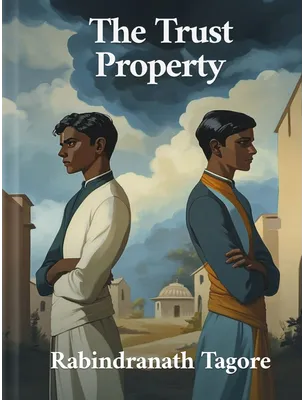
by
Rabindranath Tagore

I
Brindaban Kundu came to his father in a rage and said: ‘I am off this moment.’
‘Ungrateful wretch!’ sneered the father, Jaganath Kundu. ‘When you have paid me back all that I have spent on your food and clothing, it will be time enough to give yourself these airs.’
Such food and clothing as was customary in Jaganath’s household could not have cost very much. Our rishis of old managed to feed and clothe themselves on an incredibly small outlay. Jaganath’s behaviour showed that his ideal in these respects was equally high. That he could not fully live up to it was due partly to the bad influence of the degenerate society around him, and partly to certain unreasonable demands of Nature in her attempt to keep body and soul together.
So long as Brindaban was single, things went smoothly enough, but after his marriage he began to depart from the high and rarefied standard cherished by his sire. It was clear that the son’s ideas of comfort were moving away from the spiritual to the material, and imitating the ways of the world. He was unwilling to put up with the discomforts of heat and cold, thirst and hunger. His minimum of food and clothing rose apace.
Frequent were the quarrels between the father and the son. At last Brindaban’s wife became seriously ill and a kabiraj was called in. But when the doctor prescribed a costly medicine for his patient, Jaganath took it as a proof of sheer incompetence, and turned him out immediately. At first Brindaban besought his father to allow the treatment to continue; then he quarrelled with him about it, but to no purpose. When his wife died, he abused his father and called him a murderer.
‘Nonsense!’ said the father. ‘Don’t people die even after swallowing all kinds of drugs? If costly medicines could save life, how is it that kings and emperors are not immortal? You don’t expect your wife to die with more pomp and ceremony than did your mother and your grandmother before her, do you?’
Brindaban might really have derived a great consolation from these words, had he not been overwhelmed with grief and incapable of proper thinking. Neither his mother nor his grandmother had taken any medicine before making their exit from this world, and this was the time-honoured custom of the family. But, alas, the younger generation was unwilling to die according to ancient custom. The English had newly come to the country at the time we speak of. Even in those remote days, the good old folks were horrified at the unorthodox ways of the new generation, and sat speechless, trying to draw comfort from their hookas.
Be that as it may, the modern Brindaban said to his old fogy of a father: ‘I am off.’
The father instantly agreed, and wished publicly that, should he ever give his son one single pice in future, the gods might reckon his act as shedding the holy blood of cows. Brindaban in his turn similarly wished that, should he ever accept anything from his father, his act might be held as bad as matricide.
The people of the village looked upon this small revolution as a great relief after a long period of monotony. And when Jaganath disinherited his only son, every one did his best to console him. All were unanimous in the opinion that to quarrel with a father for the sake of a wife was possible only in these degenerate days. And the reason they gave was sound too. ‘When your wife dies,’ they said, ‘you can find a second one without delay. But when your father dies, you can’t get another to replace him for love or money.’ Their logic no doubt was perfect, but we suspect that the utter hopelessness of getting another father did not trouble the misguided son very much. On the contrary, he looked upon it as a mercy.
Nor did separation from Brindaban weigh heavily on the mind of his father. In the first place, his absence from home reduced the household expenses. Then, again, the father was freed from a great anxiety. The fear of being poisoned by his son and heir had always haunted him. When he ate his scanty fare, he could never banish the thought of poison from his mind. This fear had abated somewhat after the death of his daughter-in-law, and, now that the son was gone, it disappeared altogether.
But there was one tender spot in the old man’s heart. Brindaban had taken away with him his four-year-old son, Gokul Chandra. Now, the expense of keeping the child was comparatively small, and so Jaganath’s affection for him was without a drawback. Still, when Brindaban took him away, his grief, sincere as it was, was mingled at first with calculation as to how much he would save a month by the absence of the two, how much the sum would come to in the year, and what would be the capital to bring it in as interest.
But the empty house, without Gokul Chandra in it to make mischief, became more and more difficult for the old man to live in. There was no one now to play tricks upon him when he was engaged in his puja, no one to snatch away his food and eat it, no one to run away with his inkpot, when he was writing up his accounts. His daily routine of life, now uninterrupted, became an intolerable burden to him. He bethought him that this unworried peace was endurable only in the world to come. When he caught sight of the holes made in his quilt by his grandchild, and the pen-and-ink sketches executed by the same artist on his rush-mat, his heart was heavy with grief. Once upon a time he had reproached the boy bitterly because he had torn his dhoti into pieces within the short space of two years; now tears stood in Jaganath’s eyes as he gazed upon the dirty remnants lying in the bedroom. He carefully put them away in his safe, and registered a vow that, should Gokul ever come back again, he should not be reprimanded even if he destroyed one dhoti a year.
But Gokul did not return, and poor Jaganath aged rapidly. His empty home seemed emptier every day.
No longer could the old man stay peacefully at home. Even in the middle of the day, when all respectable folks in the village enjoyed their after-dinner siesta, Jaganath might be seen roaming over the village, hooka in hand. The boys, at sight of him, would give up their play, and, retiring in a body to a safe distance, chant verses composed by a local poet, praising the old gentleman’s economical habits. No one ventured to say his real name, lest he should have to go without his meal that day — and so people gave him names after their own fancy. Elderly people called him Jaganash, but the reason why the younger generation preferred to call him a vampire was hard to guess. It may be that the bloodless, dried-up skin of the old man had some physical resemblance to the vampire’s.
II
One afternoon, when Jaganath was rambling as usual through the village lanes shaded by mango topes, he saw a boy, apparently a stranger, assuming the captaincy of the village boys and explaining to them the scheme of some new prank. Won by the force of his character and the startling novelty of his ideas, the boys had all sworn allegiance to him. Unlike the others, he did not run away from the old man as he approached, but came quite close to him and began to shake his own chadar. The result was that a live lizard sprang out of it on to the old man’s body, ran down his back and off towards the jungle. Sudden fright made the poor man shiver from head to foot, to the great amusement of the other boys, who shouted with glee. Before Jaganath had gone far, cursing and swearing, the gamcha on his shoulder suddenly disappeared, and the next moment it was seen on the head of the new boy, transformed into a turban.
The novel attentions of this manikin came as a great relief to Jaganath. It was long since any boy had taken such freedom with him. After a good deal of coaxing and many fair promises, he at last persuaded the boy to come to him, and this was the conversation which followed:
‘What’s your name, my boy?’
‘Nitai Pal.’
‘Where’s your home?’
‘Won’t tell.’
‘Who’s your father?’
‘Won’t tell.’
‘Why won’t you?’
‘Because I have run away from home.’
‘What made you do it?’
‘My father wanted to send me to school.’
It occurred to Jaganath that it would be useless extravagance to send such a boy to school, and his father must have been an unpractical fool not to have thought so.
‘Well, well,’ said Jaganath, ‘how would you like to come and stay with me?’
‘Don’t mind,’ said the boy, and forthwith he installed himself in Jaganath’s house. He felt as little hesitation as though it were the shadow of a tree by the wayside. And not only that. He began to proclaim his wishes as regards his food and clothing with such coolness that you would have thought he had paid his reckoning in full beforehand; and, when anything went wrong, he did not scruple to quarrel with the old man. It had been easy enough for Jaganath to get the better of his own child; but, now, where another man’s child was concerned, he had to acknowledge defeat.
III
The people of the village marvelled when Nitai Pal was unexpectedly made so much of by Jaganath. They felt sure that the old man’s end was near, and the prospect of his bequeathing all his property to this unknown brat made their hearts sore. Furious with envy, they determined to do the boy an injury, but the old man took care of him as though he was a rib in his breast.
At times, the boy threatened that he would go away, and the old man used to say to him temptingly: ‘I will leave you all the property I possess.’ Young as he was, the boy fully understood the grandeur of this promise.
The village people then began to make inquiries after the father of the boy. Their hearts melted with compassion for the agonised parents, and they declared that the son must be a rascal to cause them so much suffering. They heaped abuses on his head, but the heat with which they did it betrayed envy rather than a sense of justice.
One day the old man learned from a wayfarer that one Damodar Pal was seeking his lost son, and was even now coming towards the village. Nitai, when he heard this, became very restless and was ready to run away, leaving his future wealth to take care of itself. Jaganath reassured him, saying: ‘I mean to hide you where nobody can find you — not even the village people themselves.’
This whetted the curiosity of the boy and he said: ‘Oh, where? Do show me.’
‘People will know, if I show you now. Wait till it is night,’ said Jaganath.
The hope of discovering the mysterious hiding-place delighted Nitai. He planned to himself how, as soon as his father had gone away without him, he would have a bet with his comrades, and play hide-and-seek. Nobody would be able to find him. Wouldn’t it be fun? His father, too, would ransack the whole village, and not find him — that would be rare fun also.
At noon, Jaganath shut the boy up in his house, and disappeared for some time. When he came home again, Nitai worried him with questions.
No sooner was it dark than Nitai said: ‘Grandfather, shall we go now?’
‘It isn’t night yet,’ replied Jaganath.
A little while later the boy exclaimed: ‘It is night now, grandfather; come let’s go.’
‘The village people haven’t gone to bed yet,’ whispered Jaganath.
Nitai waited but a moment, and said: ‘They have gone to bed now, grandfather; I am sure they have. Let’s start now.’
The night advanced. Sleep began to weigh heavily on the eyelids of the poor boy, and it was a hard struggle for him to keep awake. At midnight, Jaganath caught hold of the boy’s arm, and left the house, groping through the dark lanes of the sleeping village. Not a sound disturbed the stillness, except the occasional howl of a dog, when all the other dogs far and near would join in chorus, or perhaps the flapping of a night-bird, scared by the sound of human footsteps at that unusual hour. Nitai trembled with fear, and held Jaganath fast by the arm.
Across many a field they went, and at last came to a jungle, where stood a dilapidated temple without a god in it. ‘What, here!’ exclaimed Nitai in a tone of disappointment. It was nothing like what he had imagined. There was not much mystery about it. Often, since running away from home, he had passed nights in deserted temples like this. It was not a bad place for playing hide-and-seek; still it was quite possible that his comrades might track him there.
From the middle of the floor inside, Jaganath removed a slab of stone, and an underground room with a lamp burning in it was revealed to the astonished eyes of the boy. Fear and curiosity assailed his little heart. Jaganath descended by a ladder and Nitai followed him.
Looking around, the boy saw that there were brass ghurras on all sides of him. In the middle lay spread an assan, and in front of it were arranged vermilion, sandal paste, flowers, and other articles of puja. To satisfy his curiosity the boy dipped his hand into some of the ghurras, and drew out their contents. They were rupees and gold mohurs.
Jaganath, addressing the boy, said: ‘I told you, Nitai, that I would give you all my money. I have not got much, — these ghurras are all that I possess. These I will make over to you to-day.’
The boy jumped with delight. ‘All?’ he exclaimed; ‘you won’t take back a rupee, will you?’
‘If I do,’ said the old man in solemn tones, ‘may my hand be attacked with leprosy. But there is one condition. If ever my grandson, Gokul Chandra, or his son, or his grandson, or his great-grandson or any of his progeny should happen to pass this way, then you must make over to him, or to them, every rupee and every mohur here.’
The boy thought that the old man was raving.