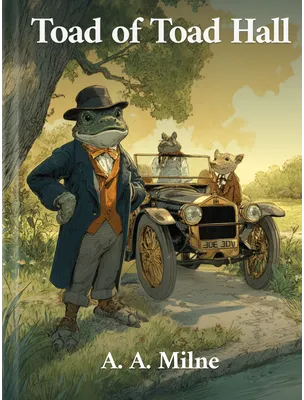
'Toad of Toad Hall' was first published in 1929.
[{"id":"para_1","index":0,"start":0,"offset":326,"words":4,"paraNum":"","lastModified":1753395852000,"semanticType":"title-book-title","voicework":"tts","blockId":"toad_of_toad_hall_en-bl2s","language":"en","wordsRange":{"start":100000000,"end":105000000},"paragraphVersion":32,"direction":"ltr","paragraph":"<h1 class=\"ilm-title ilm-large\" id=\"para_1\" semantictype=\"title-book-title\" data-ilmid=\"toad_of_toad_hall_en-bl2s\" data-audio=\"1\" data-chapter=\"para_1\" data-words-count=\"4\" data-before=\"0\" data-ww=\"\"><span class=\"block-pb\"> <span class=\"block-pb is-animated\"></span> </span><span class=\"itm-wrap\">Toad of Toad Hall</span></h1>","hasContent":true,"isFirst":true,"isLast":false},{"id":"para_2","index":1,"start":326,"offset":395,"words":6,"paraNum":"","lastModified":1753115646000,"semanticType":"title-subtitle","voicework":"tts","blockId":"toad_of_toad_hall_en-bl2t","language":"en","wordsRange":{"start":205000000,"end":212000000},"paragraphVersion":21,"direction":"ltr","paragraph":"<h1 class=\"ilm-title ilm-subtitle ilm-h1\" id=\"para_2\" semantictype=\"title-subtitle\" data-ilmid=\"toad_of_toad_hall_en-bl2t\" data-audio=\"1\" data-chapter=\"para_2\" data-words-count=\"6\" data-before=\"4\" data-ww=\"\"><span class=\"block-pb\"> <span class=\"block-pb is-animated\"></span> </span><span class=\"itm-wrap\"><i>A </i><i>Play </i><i>from </i><i>Kenneth </i><i>Grahame’s </i><i>Book</i></span></h1>","hasContent":true,"isFirst":false,"isLast":false},{"id":"para_3","index":2,"start":721,"offset":345,"words":2,"paraNum":"","lastModified":1753395858000,"semanticType":"title-author","voicework":"tts","blockId":"toad_of_toad_hall_en-bl2u","language":"en","wordsRange":{"start":312000000,"end":317000000},"paragraphVersion":61,"direction":"ltr","paragraph":"<h1 class=\"ilm-title ilm-author ilm-large ilm-nopad\" id=\"para_3\" semantictype=\"title-author\" data-ilmid=\"toad_of_toad_hall_en-bl2u\" data-audio=\"1\" data-chapter=\"para_3\" data-words-count=\"2\" data-before=\"10\" data-ww=\"\"><span class=\"block-pb\"> <span class=\"block-pb is-animated\"></span> </span><span class=\"itm-wrap\">by <br>A. A. Milne</span></h1>","hasContent":true,"isFirst":false,"isLast":false},{"id":"para_4","index":3,"start":1066,"offset":149,"words":0,"paraNum":"","lastModified":1752758098000,"semanticType":"line","blockId":"toad_of_toad_hall_en-bl34","language":"en","wordsRange":{"start":417000000,"end":419000000},"paragraphVersion":13,"direction":"ltr","paragraph":"<hr class=\"ilm-hr ilm-small\" id=\"para_4\" semantictype=\"line\" data-ilmid=\"toad_of_toad_hall_en-bl34\" data-words-count=\"0\" data-before=\"12\" data-ww=\"\">","hasContent":true,"isFirst":false,"isLast":false},{"id":"para_5","index":4,"start":1215,"offset":1841,"words":0,"paraNum":"","lastModified":1752758150000,"semanticType":"illustration","blockId":"toad_of_toad_hall_en-bla9","language":"en","wordsRange":{"start":519000000,"end":521000000},"paragraphVersion":20,"direction":"ltr","paragraph":"<div class=\"ilm-illustration\" id=\"para_5\" semantictype=\"illustration\" data-ilmid=\"toad_of_toad_hall_en-bla9\" data-words-count=\"0\" data-before=\"12\" data-ww=\"\"><img width=\"600\" height=\"600\" data-src=\"ch0p0\" src=\"data:image/webp;base64,UklGRpYEAABXRUJQVlA4WAoAAAAQAAAAOwAAOwAAQUxQSOUAAAABgJ3IttzoYgegDJSA8lIiCsVrFophNiXi3Y93G+YtoHeYz4GIUBsAaSOS3rbAC5Zha9aP5+Xi7qyAu1+W89inZ1awMRt2V5rhuhvSUyujU4QQoq8vPIYAcTLbFuxmeDtla20Df8PcZbmx7oNXatEIqfHio8snZ154Yrt0XszZ2JSRpshy+uUQa6NtB+NgtuNNc4LzZmf9Na8V1bUfCalWVIHxTJAQPHBeiKqILBdcFc7FhZH1EEEe/FvA3/0HtX+3VjNotYpWI2m1mVYTarWoVAOLtbdS84u9htTjSL2V3NNJvaQBAFZQOCCKAwAA0BAAnQEqPAA8AD5tNpVIpCMiISQYCbiADYliALUb+xdDNrvkdzcE886zafJsDuOjvXl1aZJon0BEQ5nEkTIXV1lQjiW5VjXX/RI2yyoB7hhGK+insC/w9iFMWFWIsWYrr4Y8Bxa693CtM7YUULNiayF9mmhsfyPdevmICZ8yAiYbuc2W6PZKtu9RCYfEpAAA/v8i38T4Tyi9rtfOM7aL4e/WGKZCbdYphdVSeoQQgTsUK7PgNCc7G8ei2VY+nw053v348ynEMhJYrYvctVHzyTG5rlqScK/pWo+A6r9FIf+IpTwB2YFVhRw7YdQrUAQmNP4wZcXdl3BDJGDfp9Yvt/jHUY1cydFJtAXfthSjj4+XHQqpsPd96iLoAfkDuNoLPrJKI7W9WhTjL0zf3yboY1kl8TgYGpCDI6wdwstrCEFonU4mC2lhVeZQJA1eF8AUB/4ZROn1vFLrSYFzjGOqZwFz+H/DP+bKMj62yOzgNuY4em1efbfCmoPock6a2oy52k6k0+A8AH0Od9IDv8SG3TCwdrv2Kyn9XIk7ckWJUXtdp084VbDZjSP/gD5cTASN501oeC78+H2PLtiUdl29KOnSdRyh7T6qkydLqmJAQV8FyPmI07QXA20WGAK1ugErf+NVd3UKAXtj3ZiczQSordspDoRBFvnHv1SoOO7vJDgR/glqKmugZ4OFP+pg2YdvpoG7jIKMh4UBbdWUdKASz/xucqLihgcZfetNIt+3QaCJ0xgOcA+3PV2//6WC15dmxMrpjXntpKFu2W8nIz/9cFn0WLUn/Q0LgEJMSa24lHiaIiXkYPsGLLaeD9DTQDFS2FCvkL8Yowm3i/LmoxfeAZyRUjaqJ+8L//s6o4BDjoyec5zGvvQZ5pHPbtYWGWPiZhkaWU0xsDGEcGRrWUSiJYKLl5Ulj3PPyUc+L41TbKfGiizBCtRBf16PHJDoSizXy654fEn8dKMJhBcfY+T9ee4NjOIyEW1P5ynvwwhc5w5Cg/kxVvrYjj7tsvCtwg+xmv+0tOLTP6zNUgfI9hfzdM0pdG71opb2yR4guFMfBCIRCCBVv2QN/gKENQXiGTafVnUztSl2aexMqK4o9FIm9s7A4sZknhO+mwFBxI+PxBBCpk2JrgwUtuEu3kIANX46m1YH7FxLSKTAKQrFgywN0Fwfp7JDGuHrLox81DaGbEey26ZD7CkAAAAA\" alt=\"Toad of Toad Hall\"></div>","hasContent":true,"isFirst":false,"isLast":false},{"id":"para_6","index":5,"start":3056,"offset":320,"words":1,"paraNum":"","lastModified":1753115660000,"semanticType":"header-subheader","voicework":"tts","blockId":"toad_of_toad_hall_en-bl2v","language":"en","wordsRange":{"start":621000000,"end":623000000},"paragraphVersion":25,"direction":"ltr","paragraph":"<h3 class=\"ilm-header ilm-h3\" id=\"para_6\" semantictype=\"header-subheader\" data-ilmid=\"toad_of_toad_hall_en-bl2v\" data-audio=\"1\" data-chapter=\"para_6\" data-words-count=\"1\" data-before=\"12\" data-ww=\"\"><span class=\"block-pb\"> <span class=\"block-pb is-animated\"></span> </span><span class=\"itm-wrap\">Introduction</span></h3>","hasContent":true,"isFirst":false,"isLast":false},{"id":"para_7","index":6,"start":3376,"offset":951,"words":116,"paraNum":"i.1","lastModified":1753115860000,"semanticType":"par","voicework":"tts","blockId":"toad_of_toad_hall_en-bl2w","language":"en","wordsRange":{"start":723000000,"end":839000000},"paragraphVersion":25,"direction":"ltr","paragraph":"<p id=\"para_7\" semantictype=\"par\" data-ilmid=\"toad_of_toad_hall_en-bl2w\" data-audio=\"1\" data-words-count=\"116\" data-before=\"13\" data-ww=\"\"><span class=\"block-num\" data-id=\"i.1\"></span><span class=\"block-pb\"> <span class=\"block-pb is-animated\"></span> </span><span class=\"itm-wrap\">There are familiarities which we will allow only ourselves to take. Your hands and my hands are no cleaner than any body else’s hands, yet the sort of well-thumbed bread-and-butter which we prefer is that on which we have placed our own thumbs. It may be that to turn Mr. Kenneth Grahame into a play is to leave unattractive finger marks all over him, but I love his books so much that I cannot bear to think of anybody else disfiguring them. That is why I accepted a suggestion, which I should have refused in the case of any other book as too difficult for me, that I should dramatize <i>The </i><i>Wind </i><i>in </i><i>the </i><i>Willows</i><i>.</i></span></p>","hasContent":true,"isFirst":false,"isLast":false},{"id":"para_8","index":7,"start":4327,"offset":1121,"words":154,"paraNum":"i.2","lastModified":1753116015000,"semanticType":"par","voicework":"tts","blockId":"toad_of_toad_hall_en-bl2x","language":"en","wordsRange":{"start":939000000,"end":1094000000},"paragraphVersion":40,"direction":"ltr","paragraph":"<p id=\"para_8\" semantictype=\"par\" data-ilmid=\"toad_of_toad_hall_en-bl2x\" data-audio=\"1\" data-words-count=\"154\" data-before=\"129\" data-ww=\"\"><span class=\"block-num\" data-id=\"i.2\"></span><span class=\"block-pb\"> <span class=\"block-pb is-animated\"></span> </span><span class=\"itm-wrap\">There are two well-known ways in which to make a play out of a book. You may insist on being faithful to the author, which means that the scene in the airplane on page 673 must be got in somehow, however impossible dramatically; or with somebody else’s idea in your pocket, you may insist on being faithful to yourself, which means that by the middle of Act III everybody will realize how right the original author was to have made a book of it. There may be a third way, in which case I have tried to follow it. If, as is more likely, there isn’t, then I have not made a play of <i>The </i><i>Wind </i><i>in </i><i>the </i><i>Willows.</i> But I have, I hope, made some sort of entertainment, with enough of Kenneth Grahame in it to appease his many admirers, and enough of me in it to justify my name upon the title-page.</span></p>","hasContent":true,"isFirst":false,"isLast":false},{"id":"para_9","index":8,"start":5448,"offset":1215,"words":167,"paraNum":"i.3","lastModified":1753115906000,"semanticType":"par","voicework":"tts","blockId":"toad_of_toad_hall_en-bl2y","language":"en","wordsRange":{"start":1194000000,"end":1362000000},"paragraphVersion":25,"direction":"ltr","paragraph":"<p id=\"para_9\" semantictype=\"par\" data-ilmid=\"toad_of_toad_hall_en-bl2y\" data-audio=\"1\" data-words-count=\"167\" data-before=\"283\" data-ww=\"\"><span class=\"block-num\" data-id=\"i.3\"></span><span class=\"block-pb\"> <span class=\"block-pb is-animated\"></span> </span><span class=\"itm-wrap\">Of course I have left out all the best parts of the book; and for that, if he has any knowledge of the theater, Mr. Grahame will thank me. With a Rat and Mole from the Green Room Club, a Baby Otter from Conti, a Pan from Clarkson’s, and a wind (off) whispering in the reeds of Harker, we are not going to add any fresh thrill to the thrill which the loveliness of <i>The </i><i>Piper </i><i>at </i><i>the </i><i>Gates </i><i>of </i><i>Dawn</i> has already given its readers. Whether there is, indeed, any way of putting these animals on the stage must be left to managers, professional and amateur, to find out. But it seemed clear to me that Rat and Toad, Mole and Badger could only face the footlights with hope of success if they were content to amuse their audiences. There are both beauty and comedy in the book, but the beauty must be left to blossom there, for I, anyhow, shall not attempt to transplant it.</span></p>","hasContent":true,"isFirst":false,"isLast":false},{"id":"para_10","index":9,"start":6663,"offset":914,"words":105,"paraNum":"i.4","lastModified":1753115823000,"semanticType":"par","voicework":"tts","blockId":"toad_of_toad_hall_en-bl2z","language":"en","wordsRange":{"start":1462000000,"end":1568000000},"paragraphVersion":25,"direction":"ltr","paragraph":"<p id=\"para_10\" semantictype=\"par\" data-ilmid=\"toad_of_toad_hall_en-bl2z\" data-audio=\"1\" data-words-count=\"105\" data-before=\"450\" data-ww=\"\"><span class=\"block-num\" data-id=\"i.4\"></span><span class=\"block-pb\"> <span class=\"block-pb is-animated\"></span> </span><span class=\"itm-wrap\">But can one transplant even the comedy? Perhaps it has happened to you, as it has certainly happened to me, that you have tried to explain a fantastic idea to an entirely matter-of-fact person. “But they don’t,” he says, and “You can’t,” and “I don’t see why, just because,” and “Even if you assume that,” and “I thought you said just now that he hadn’t.” By this time you have thrown the ink-pot at him, with enough accuracy, let us hope, to save you from his ultimatum, which is this: “However fantastic your assumption, you must work it out logically,” that is to say, realistically.</span></p>","hasContent":true,"isFirst":false,"isLast":false},{"id":"para_11","index":10,"start":7577,"offset":927,"words":116,"paraNum":"i.5","lastModified":1753115912000,"semanticType":"par","voicework":"tts","blockId":"toad_of_toad_hall_en-bl30","language":"en","wordsRange":{"start":1668000000,"end":1785000000},"paragraphVersion":25,"direction":"ltr","paragraph":"<p id=\"para_11\" semantictype=\"par\" data-ilmid=\"toad_of_toad_hall_en-bl30\" data-audio=\"1\" data-words-count=\"116\" data-before=\"555\" data-ww=\"\"><span class=\"block-num\" data-id=\"i.5\"></span><span class=\"block-pb\"> <span class=\"block-pb is-animated\"></span> </span><span class=\"itm-wrap\">To such a mind <i>The </i><i>Wind </i><i>in </i><i>the </i><i>Willows</i> makes no appeal, for it is not worked out logically. In reading the book it is necessary to think of Mole, for instance, sometimes as an actual mole, sometimes as such a mole in human clothes, sometimes as a mole grown to human size, sometimes as walking on two legs, sometimes on four. He is a mole, he isn’t a mole. What is he? I don’t know. And, not being a matter-of-fact person, I don’t mind. At least, I do know, and still I don’t mind. He is a fairy, like so many immortal characters in fiction; and, as a fairy, he can do, or be, anything.</span></p>","hasContent":true,"isFirst":false,"isLast":false},{"id":"para_12","index":11,"start":8504,"offset":543,"words":49,"paraNum":"i.6","lastModified":1753115822000,"semanticType":"par","voicework":"tts","blockId":"toad_of_toad_hall_en-bl31","language":"en","wordsRange":{"start":1885000000,"end":1935000000},"paragraphVersion":25,"direction":"ltr","paragraph":"<p id=\"para_12\" semantictype=\"par\" data-ilmid=\"toad_of_toad_hall_en-bl31\" data-audio=\"1\" data-words-count=\"49\" data-before=\"671\" data-ww=\"\"><span class=\"block-num\" data-id=\"i.6\"></span><span class=\"block-pb\"> <span class=\"block-pb is-animated\"></span> </span><span class=\"itm-wrap\">But the stage has no place for fairies. There is a horrid realism about the theater, from which, however hard we try, we can never quite escape. Once we put Mole and his friends on the boards we have to be definite about them. What do they look like?</span></p>","hasContent":true,"isFirst":false,"isLast":false},{"id":"para_13","index":12,"start":9047,"offset":1042,"words":131,"paraNum":"i.7","lastModified":1753115930000,"semanticType":"par","voicework":"tts","blockId":"toad_of_toad_hall_en-bl32","language":"en","wordsRange":{"start":2035000000,"end":2167000000},"paragraphVersion":25,"direction":"ltr","paragraph":"<p id=\"para_13\" semantictype=\"par\" data-ilmid=\"toad_of_toad_hall_en-bl32\" data-audio=\"1\" data-words-count=\"131\" data-before=\"720\" data-ww=\"\"><span class=\"block-num\" data-id=\"i.7\"></span><span class=\"block-pb\"> <span class=\"block-pb is-animated\"></span> </span><span class=\"itm-wrap\">To answer this here is difficult. To say at rehearsal what they do not look like will be easy. Vaguely I see them made up on the lines of the Cat in <i>The </i><i>Blue </i><i>Bird</i> and the Hen Pheasant in <i>Chantecler</i>. As regards their relative sizes, Toad should be short and fat, Badger tall and elderly, Rat and Mole young and slender. Indeed Mole might well be played by some boyish young actress. The “humans,” Judge, Policeman, Usher and the rest, should be as fantastic as possible, with a hint of the animal world about them. Only Phoebe must keep her own pretty face, but even she must be no mortal. I see her in a ballet skirt or something entirely unsuitable to a gaoler’s daughter, pirouetting absurdly about the prison.</span></p>","hasContent":true,"isFirst":false,"isLast":false},{"id":"para_14","index":13,"start":10089,"offset":573,"words":53,"paraNum":"i.8","lastModified":1753115835000,"semanticType":"par","voicework":"tts","blockId":"toad_of_toad_hall_en-bl33","language":"en","wordsRange":{"start":2267000000,"end":2321000000},"paragraphVersion":24,"direction":"ltr","paragraph":"<p id=\"para_14\" semantictype=\"par\" data-ilmid=\"toad_of_toad_hall_en-bl33\" data-audio=\"1\" data-words-count=\"53\" data-before=\"851\" data-ww=\"\"><span class=\"block-num\" data-id=\"i.8\"></span><span class=\"block-pb\"> <span class=\"block-pb is-animated\"></span> </span><span class=\"itm-wrap\">But no doubt the producer will see them all differently. If he is an amateur, I shall congratulate him on his enterprise and wish him luck; if he is a professional, I shall be there to watch him, and, no doubt, to tell him enthusiastically how much better his ideas are than mine.</span></p>","hasContent":true,"isFirst":false,"isLast":false},{"id":"para_15","index":14,"start":10662,"offset":151,"words":0,"paraNum":"","lastModified":1752758098000,"semanticType":"line","blockId":"toad_of_toad_hall_en-blco","language":"en","wordsRange":{"start":2421000000,"end":2423000000},"paragraphVersion":13,"direction":"ltr","paragraph":"<hr class=\"ilm-hr ilm-small\" id=\"para_15\" semantictype=\"line\" data-ilmid=\"toad_of_toad_hall_en-blco\" data-words-count=\"0\" data-before=\"904\" data-ww=\"\">","hasContent":true,"isFirst":false,"isLast":false},{"id":"para_16","index":15,"start":10813,"offset":321,"words":2,"paraNum":"","lastModified":1753116094000,"semanticType":"header-section-header","voicework":"tts","blockId":"toad_of_toad_hall_en-blcp","language":"en","wordsRange":{"start":2523000000,"end":2526000000},"paragraphVersion":27,"direction":"ltr","paragraph":"<h1 class=\"ilm-header ilm-h1\" id=\"para_16\" semantictype=\"header-section-header\" data-ilmid=\"toad_of_toad_hall_en-blcp\" data-audio=\"1\" data-chapter=\"para_16\" data-words-count=\"2\" data-before=\"904\" data-ww=\"\"><span class=\"block-pb\"> <span class=\"block-pb is-animated\"></span> </span><span class=\"itm-wrap\">Act I</span></h1>","hasContent":true,"isFirst":false,"isLast":false},{"id":"para_17","index":16,"start":11134,"offset":520,"words":4,"paraNum":"","lastModified":1753116126000,"semanticType":"header-chapter-header","voicework":"tts","blockId":"toad_of_toad_hall_en-bl35","language":"en","wordsRange":{"start":2626000000,"end":2631000000},"paragraphVersion":31,"direction":"ltr","paragraph":"<h2 class=\"ilm-header ilm-h2 ilm-large\" id=\"para_17\" semantictype=\"header-chapter-header\" data-ilmid=\"toad_of_toad_hall_en-bl35\" data-audio=\"1\" data-chapter=\"para_17\" data-words-count=\"4\" data-before=\"906\" data-ww=\"\"><span class=\"block-pb\"> <span class=\"block-pb is-animated\"></span> </span><span class=\"itm-wrap\"><span class=\"chapter-text\"><span class=\"chapter-number\"><span class=\"chapter-label\"></span><span class=\"chapter-value\"></span></span><span class=\"chapter-title\">Down by the Willows</span></span></span></h2>","hasContent":true,"isFirst":false,"isLast":false},{"id":"para_18","index":17,"start":11654,"offset":1159,"words":71,"paraNum":"1.1.1","lastModified":1753116729000,"semanticType":"par","voicework":"tts","blockId":"toad_of_toad_hall_en-bl36","language":"en","wordsRange":{"start":2731000000,"end":2801000000},"paragraphVersion":33,"direction":"ltr","paragraph":"<p class=\"ilm-blockquote\" id=\"para_18\" semantictype=\"par\" data-ilmid=\"toad_of_toad_hall_en-bl36\" data-audio=\"1\" data-words-count=\"71\" data-before=\"910\" data-ww=\"\"><span class=\"block-num\" data-id=\"1.1.1\"></span><span class=\"block-pb\"> <span class=\"block-pb is-animated\"></span> </span><span class=\"itm-wrap\">Scene. <i>The </i><i>River </i><i>Bank. </i><i>A </i><i>warm </i><i>morning </i><i>in </i><i>spring.</i> Nurse <i>was </i><i>knitting </i><i>a </i><i>sock, </i><i>but </i><i>seems </i><i>to </i><i>have </i><i>fallen </i><i>asleep </i><i>over </i><i>it. </i><i>This </i><i>leaves</i> Marigold <i>(</i><i>who </i><i>is </i><i>twelve) </i><i>to </i><i>amuse </i><i>herself. </i><i>She </i><i>is </i><i>lying </i><i>on </i><i>her </i><i>front, </i><i>and </i><i>talking </i><i>down </i><i>the </i><i>telephone. </i><i>At </i><i>least </i><i>she </i><i>has </i><i>the </i><i>trumpet </i><i>of </i><i>one </i><i>daffodil </i><i>to </i><i>her </i><i>ear, </i><i>and </i><i>of </i><i>another </i><i>to </i><i>her </i><i>mouth, </i><i>and </i><i>has </i><i>apparently </i><i>just </i><i>got </i><i>on </i><i>to </i><i>the </i><i>Exchange</i><i>.</i></span></p>","hasContent":true,"isFirst":false,"isLast":false},{"id":"para_19","index":18,"start":12813,"offset":1373,"words":181,"paraNum":"1.1.2","lastModified":1753442591000,"semanticType":"par","voicework":"tts","blockId":"toad_of_toad_hall_en-bl37","language":"en","wordsRange":{"start":2901000000,"end":3085000000},"paragraphVersion":54,"direction":"ltr","paragraph":"<p id=\"para_19\" semantictype=\"par\" data-ilmid=\"toad_of_toad_hall_en-bl37\" data-audio=\"1\" data-words-count=\"181\" data-before=\"981\" data-ww=\"\"><span class=\"block-num\" data-id=\"1.1.2\"></span><span class=\"block-pb\"> <span class=\"block-pb is-animated\"></span> </span><span class=\"itm-wrap\">MARIGOLD <br>Hallo, is that the Exchange? I want River Bank 1001…. Hallo, is that the Water Rat’s house?… Oh, I beg your pardon. They’ve given me the wrong number…. Oh, Exchange, you’ve given me the wrong number. I wanted Mr. Rat’s house and you’ve given me Mr. Badger’s. (<i>To herself</i>) Sorry you’ve been tr-r-roubled…. Hallo, is that the Water Rat’s house? Is that Mr. Rat speaking? Good morning, Mr. Rat, this is Marigold speaking…. Yes, isn’t it a delightful day?… Yes. Well, almost alone. Nurse is here, but she’s asleep. How’s Mr. Mole?… Oh, haven’t you seen him? I expect he’s very busy spring cleaning. You see, when your house is all basement, there’s such a lot of spring cleaning to be done…. Yes, I prefer a riverside residence too…. May I really come one day? How lovely…. No, not tomorrow, I’m having tea with Mr. Toad…. Yes, conceited, but so nice…. I saw Mr. Otter just now, just before I rang you up…. No, I don’t know him very well, but I think he’s sweet…. Will you really? And if Mr. Mole—</span></p>","hasContent":true,"isFirst":false,"isLast":false},{"id":"para_20","index":19,"start":14186,"offset":394,"words":13,"paraNum":"1.1.3","lastModified":1753189296000,"semanticType":"par","voicework":"tts","blockId":"toad_of_toad_hall_en-bl38","language":"en","wordsRange":{"start":3185000000,"end":3202000000},"paragraphVersion":41,"direction":"ltr","paragraph":"<p id=\"para_20\" semantictype=\"par\" data-ilmid=\"toad_of_toad_hall_en-bl38\" data-audio=\"1\" data-words-count=\"13\" data-before=\"1162\" data-ww=\"\"><span class=\"block-num\" data-id=\"1.1.3\"></span><span class=\"block-pb\"> <span class=\"block-pb is-animated\"></span> </span><span class=\"itm-wrap\">NURSE (<i>who was not asleep</i>)<br>Well, I declare, Miss Marigold, you do think of funny things.</span></p>","hasContent":true,"isFirst":false,"isLast":false},{"id":"para_21","index":20,"start":14580,"offset":493,"words":20,"paraNum":"1.1.4","lastModified":1753220362000,"semanticType":"par","voicework":"tts","blockId":"toad_of_toad_hall_en-bl39","language":"en","wordsRange":{"start":3302000000,"end":3323000000},"paragraphVersion":40,"direction":"ltr","paragraph":"<p id=\"para_21\" semantictype=\"par\" data-ilmid=\"toad_of_toad_hall_en-bl39\" data-audio=\"1\" data-words-count=\"20\" data-before=\"1175\" data-ww=\"\"><span class=\"block-num\" data-id=\"1.1.4\"></span><span class=\"block-pb\"> <span class=\"block-pb is-animated\"></span> </span><span class=\"itm-wrap\">MARIGOLD (<i>hurriedly</i>)<br>Oh, Nurse is awake. Good-bye. (<i>She </i><i>puts </i><i>down </i><i>the </i><i>telephone </i><i>and </i><i>says </i><i>sternly</i>) Have you been overhearing, Nurse?</span></p>","hasContent":true,"isFirst":false,"isLast":false},{"id":"para_22","index":21,"start":15073,"offset":376,"words":12,"paraNum":"1.1.5","lastModified":1753190659000,"semanticType":"par","voicework":"tts","blockId":"toad_of_toad_hall_en-bl3a","language":"en","wordsRange":{"start":3423000000,"end":3436000000},"paragraphVersion":36,"direction":"ltr","paragraph":"<p id=\"para_22\" semantictype=\"par\" data-ilmid=\"toad_of_toad_hall_en-bl3a\" data-audio=\"1\" data-words-count=\"12\" data-before=\"1195\" data-ww=\"\"><span class=\"block-num\" data-id=\"1.1.5\"></span><span class=\"block-pb\"> <span class=\"block-pb is-animated\"></span> </span><span class=\"itm-wrap\">NURSE (<i>nodding</i>)<br>And wondering at you, dearie. Who ever heard the like?</span></p>","hasContent":true,"isFirst":false,"isLast":false},{"id":"para_23","index":22,"start":15449,"offset":389,"words":11,"paraNum":"1.1.6","lastModified":1753220379000,"semanticType":"par","voicework":"tts","blockId":"toad_of_toad_hall_en-bl3b","language":"en","wordsRange":{"start":3536000000,"end":3549000000},"paragraphVersion":37,"direction":"ltr","paragraph":"<p id=\"para_23\" semantictype=\"par\" data-ilmid=\"toad_of_toad_hall_en-bl3b\" data-audio=\"1\" data-words-count=\"11\" data-before=\"1207\" data-ww=\"\"><span class=\"block-num\" data-id=\"1.1.6\"></span><span class=\"block-pb\"> <span class=\"block-pb is-animated\"></span> </span><span class=\"itm-wrap\">MARIGOLD<br>It’s very bad manners to overhear a perfectly private telephone conversation.</span></p>","hasContent":true,"isFirst":false,"isLast":false},{"id":"para_24","index":23,"start":15838,"offset":430,"words":23,"paraNum":"1.1.7","lastModified":1753189357000,"semanticType":"par","voicework":"tts","blockId":"toad_of_toad_hall_en-bl3c","language":"en","wordsRange":{"start":3649000000,"end":3674000000},"paragraphVersion":33,"direction":"ltr","paragraph":"<p id=\"para_24\" semantictype=\"par\" data-ilmid=\"toad_of_toad_hall_en-bl3c\" data-audio=\"1\" data-words-count=\"23\" data-before=\"1218\" data-ww=\"\"><span class=\"block-num\" data-id=\"1.1.7\"></span><span class=\"block-pb\"> <span class=\"block-pb is-animated\"></span> </span><span class=\"itm-wrap\">NURSE<br>Couldn’t help it, dearie, you’re that funny—with your Mr. Rat and Mr. Toad and all, just as if they were yooman beings.</span></p>","hasContent":true,"isFirst":false,"isLast":false},{"id":"para_25","index":24,"start":16268,"offset":329,"words":5,"paraNum":"1.1.8","lastModified":1753116995000,"semanticType":"par","voicework":"tts","blockId":"toad_of_toad_hall_en-bl3d","language":"en","wordsRange":{"start":3774000000,"end":3781000000},"paragraphVersion":33,"direction":"ltr","paragraph":"<p id=\"para_25\" semantictype=\"par\" data-ilmid=\"toad_of_toad_hall_en-bl3d\" data-audio=\"1\" data-words-count=\"5\" data-before=\"1241\" data-ww=\"\"><span class=\"block-num\" data-id=\"1.1.8\"></span><span class=\"block-pb\"> <span class=\"block-pb is-animated\"></span> </span><span class=\"itm-wrap\">MARIGOLD<br>Well, but so they are.</span></p>","hasContent":true,"isFirst":false,"isLast":false},{"id":"para_26","index":25,"start":16597,"offset":345,"words":4,"paraNum":"1.1.9","lastModified":1753189368000,"semanticType":"par","voicework":"tts","blockId":"toad_of_toad_hall_en-bl3e","language":"en","wordsRange":{"start":3881000000,"end":3888000000},"paragraphVersion":36,"direction":"ltr","paragraph":"<p id=\"para_26\" semantictype=\"par\" data-ilmid=\"toad_of_toad_hall_en-bl3e\" data-audio=\"1\" data-words-count=\"4\" data-before=\"1246\" data-ww=\"\"><span class=\"block-num\" data-id=\"1.1.9\"></span><span class=\"block-pb\"> <span class=\"block-pb is-animated\"></span> </span><span class=\"itm-wrap\">NURSE (<i>surprised at this</i>)<br>Yooman beings?</span></p>","hasContent":true,"isFirst":false,"isLast":false},{"id":"para_27","index":26,"start":16942,"offset":374,"words":15,"paraNum":"1.1.10","lastModified":1753220417000,"semanticType":"par","voicework":"tts","blockId":"toad_of_toad_hall_en-bl3f","language":"en","wordsRange":{"start":3988000000,"end":4005000000},"paragraphVersion":37,"direction":"ltr","paragraph":"<p id=\"para_27\" semantictype=\"par\" data-ilmid=\"toad_of_toad_hall_en-bl3f\" data-audio=\"1\" data-words-count=\"15\" data-before=\"1250\" data-ww=\"\"><span class=\"block-num\" data-id=\"1.1.10\"></span><span class=\"block-pb\"> <span class=\"block-pb is-animated\"></span> </span><span class=\"itm-wrap\">MARIGOLD<br>Yes. I mean they are as human to themselves as—as we are to us.</span></p>","hasContent":true,"isFirst":false,"isLast":false},{"id":"para_28","index":27,"start":17316,"offset":386,"words":10,"paraNum":"1.1.11","lastModified":1753442616000,"semanticType":"par","voicework":"tts","blockId":"toad_of_toad_hall_en-bl3g","language":"en","wordsRange":{"start":4105000000,"end":4120000000},"paragraphVersion":50,"direction":"ltr","paragraph":"<p id=\"para_28\" semantictype=\"par\" data-ilmid=\"toad_of_toad_hall_en-bl3g\" data-audio=\"1\" data-words-count=\"10\" data-before=\"1265\" data-ww=\"\"><span class=\"block-num\" data-id=\"1.1.11\"></span><span class=\"block-pb\"> <span class=\"block-pb is-animated\"></span> </span><span class=\"itm-wrap\">NURSE (<i>after a gallant effort</i>)<br>No, it’s no good, dearie, I can’t follow it.</span></p>","hasContent":true,"isFirst":false,"isLast":false},{"id":"para_29","index":28,"start":17702,"offset":479,"words":36,"paraNum":"1.1.12","lastModified":1753220436000,"semanticType":"par","voicework":"tts","blockId":"toad_of_toad_hall_en-bl3h","language":"en","wordsRange":{"start":4220000000,"end":4258000000},"paragraphVersion":37,"direction":"ltr","paragraph":"<p id=\"para_29\" semantictype=\"par\" data-ilmid=\"toad_of_toad_hall_en-bl3h\" data-audio=\"1\" data-words-count=\"36\" data-before=\"1275\" data-ww=\"\"><span class=\"block-num\" data-id=\"1.1.12\"></span><span class=\"block-pb\"> <span class=\"block-pb is-animated\"></span> </span><span class=\"itm-wrap\">MARIGOLD<br>I mean, they must seem quite big and grown up and human to each other, and if we lived in their world, then they would seem big and grown up to us, just like real people.</span></p>","hasContent":true,"isFirst":false,"isLast":false},{"id":"para_30","index":29,"start":18181,"offset":321,"words":3,"paraNum":"1.1.13","lastModified":1753189386000,"semanticType":"par","voicework":"tts","blockId":"toad_of_toad_hall_en-bl3i","language":"en","wordsRange":{"start":4358000000,"end":4363000000},"paragraphVersion":33,"direction":"ltr","paragraph":"<p id=\"para_30\" semantictype=\"par\" data-ilmid=\"toad_of_toad_hall_en-bl3i\" data-audio=\"1\" data-words-count=\"3\" data-before=\"1311\" data-ww=\"\"><span class=\"block-num\" data-id=\"1.1.13\"></span><span class=\"block-pb\"> <span class=\"block-pb is-animated\"></span> </span><span class=\"itm-wrap\">NURSE<br>Now, fancy that!</span></p>","hasContent":true,"isFirst":false,"isLast":false},{"id":"para_31","index":30,"start":18502,"offset":1198,"words":161,"paraNum":"1.1.14","lastModified":1753116578000,"semanticType":"par","voicework":"tts","blockId":"toad_of_toad_hall_en-bl3j","language":"en","wordsRange":{"start":4463000000,"end":4626000000},"paragraphVersion":33,"direction":"ltr","paragraph":"<p id=\"para_31\" semantictype=\"par\" data-ilmid=\"toad_of_toad_hall_en-bl3j\" data-audio=\"1\" data-words-count=\"161\" data-before=\"1314\" data-ww=\"\"><span class=\"block-num\" data-id=\"1.1.14\"></span><span class=\"block-pb\"> <span class=\"block-pb is-animated\"></span> </span><span class=\"itm-wrap\">MARIGOLD<br>Mr. Toad, he’s all puffed out and conceited, but very nice, you know, and very sorry afterwards for talking so much about himself. And Mr. Rat’s a dear; that’s him I was talking to just now. He’s very quick and clever and helpful, and his little sharp eyes are always looking out so as to see that he doesn’t hurt people’s feelings. And Mr. Mole, I’m not sure about him. You see, he lives underground a good deal and doesn’t go out into society much, so I should think he’d be rather simple and not liking to talk about himself, and just saying “Yes” and “No,” and waiting to be asked before he has a second cup. And then Mr. Badger. Of course he’s gray and much older than the others, and very fatherly, and sleeps a good deal with a handkerchief over his face, and says “Now, now, now,” and “Well, well, well” when he’s woken up. And Mr. Otter—</span></p>","hasContent":true,"isFirst":false,"isLast":false},{"id":"para_32","index":31,"start":19700,"offset":401,"words":19,"paraNum":"1.1.15","lastModified":1753189327000,"semanticType":"par","voicework":"tts","blockId":"toad_of_toad_hall_en-bl3k","language":"en","wordsRange":{"start":4726000000,"end":4848000000},"paragraphVersion":38,"direction":"ltr","paragraph":"<p id=\"para_32\" semantictype=\"par\" data-ilmid=\"toad_of_toad_hall_en-bl3k\" data-audio=\"1\" data-words-count=\"19\" data-before=\"1475\" data-ww=\"\"><span class=\"block-num\" data-id=\"1.1.15\"></span><span class=\"block-pb\"> <span class=\"block-pb is-animated\"></span> </span><span class=\"itm-wrap\">NURSE<br>Well, well, well, fancy that now! Why, you might almost have seen them at it, the way you talk.</span></p>","hasContent":true,"isFirst":false,"isLast":false},{"id":"para_33","index":32,"start":20101,"offset":315,"words":2,"paraNum":"1.1.16","lastModified":1753116965000,"semanticType":"par","voicework":"tts","blockId":"toad_of_toad_hall_en-bl3m","language":"en","wordsRange":{"start":4948000000,"end":4952000000},"paragraphVersion":36,"direction":"ltr","paragraph":"<p id=\"para_33\" semantictype=\"par\" data-ilmid=\"toad_of_toad_hall_en-bl3m\" data-audio=\"1\" data-words-count=\"2\" data-before=\"1494\" data-ww=\"\"><span class=\"block-num\" data-id=\"1.1.16\"></span><span class=\"block-pb\"> <span class=\"block-pb is-animated\"></span> </span><span class=\"itm-wrap\">MARIGOLD<br>I have.</span></p>","hasContent":true,"isFirst":false,"isLast":false},{"id":"para_34","index":33,"start":20416,"offset":311,"words":1,"paraNum":"1.1.17","lastModified":1753220499000,"semanticType":"par","voicework":"tts","blockId":"toad_of_toad_hall_en-bl3n","language":"en","wordsRange":{"start":5052000000,"end":5055000000},"paragraphVersion":39,"direction":"ltr","paragraph":"<p id=\"para_34\" semantictype=\"par\" data-ilmid=\"toad_of_toad_hall_en-bl3n\" data-audio=\"1\" data-words-count=\"1\" data-before=\"1496\" data-ww=\"\"><span class=\"block-num\" data-id=\"1.1.17\"></span><span class=\"block-pb\"> <span class=\"block-pb is-animated\"></span> </span><span class=\"itm-wrap\">NURSE<br>Never!</span></p>","hasContent":true,"isFirst":false,"isLast":false},{"id":"para_35","index":34,"start":20727,"offset":592,"words":54,"paraNum":"1.1.18","lastModified":1753220510000,"semanticType":"par","voicework":"tts","blockId":"toad_of_toad_hall_en-bl3o","language":"en","wordsRange":{"start":5155000000,"end":5211000000},"paragraphVersion":39,"direction":"ltr","paragraph":"<p id=\"para_35\" semantictype=\"par\" data-ilmid=\"toad_of_toad_hall_en-bl3o\" data-audio=\"1\" data-words-count=\"54\" data-before=\"1497\" data-ww=\"\"><span class=\"block-num\" data-id=\"1.1.18\"></span><span class=\"block-pb\"> <span class=\"block-pb is-animated\"></span> </span><span class=\"itm-wrap\">MARIGOLD<br>Yes. One morning. I came out here early, oh, ever so early. Nobody was up; you weren’t up, and the birds weren’t up and even the sun wasn’t up. And everything was so still that there was no sound in all the world, except just the wind in the willows, whispering ever so gently.</span></p>","hasContent":true,"isFirst":false,"isLast":false},{"id":"para_36","index":35,"start":21319,"offset":410,"words":15,"paraNum":"1.1.19","lastModified":1753220522000,"semanticType":"par","voicework":"tts","blockId":"toad_of_toad_hall_en-bl3p","language":"en","wordsRange":{"start":5311000000,"end":5326000000},"paragraphVersion":45,"direction":"ltr","paragraph":"<p id=\"para_36\" semantictype=\"par\" data-ilmid=\"toad_of_toad_hall_en-bl3p\" data-audio=\"1\" data-words-count=\"15\" data-before=\"1551\" data-ww=\"\"><span class=\"block-num\" data-id=\"1.1.19\"></span><span class=\"block-pb\"> <span class=\"block-pb is-animated\"></span> </span><span class=\"itm-wrap\">NURSE (<i>professionally</i>)<br>What your poor mother would have said. (<i>Eagerly</i>) Well, and what happened?</span></p>","hasContent":true,"isFirst":false,"isLast":false},{"id":"para_37","index":36,"start":21729,"offset":715,"words":79,"paraNum":"1.1.20","lastModified":1753190218000,"semanticType":"par","voicework":"tts","blockId":"toad_of_toad_hall_en-bl3q","language":"en","wordsRange":{"start":5426000000,"end":5507000000},"paragraphVersion":39,"direction":"ltr","paragraph":"<p id=\"para_37\" semantictype=\"par\" data-ilmid=\"toad_of_toad_hall_en-bl3q\" data-audio=\"1\" data-words-count=\"79\" data-before=\"1566\" data-ww=\"\"><span class=\"block-num\" data-id=\"1.1.20\"></span><span class=\"block-pb\"> <span class=\"block-pb is-animated\"></span> </span><span class=\"itm-wrap\">MARIGOLD<br>I don’t know. I sat there and waited for everything to wake up, and then by and by I heard something, music, very thin and clear and far off. And then, well then there was the sun, and it was daylight, and it seemed as if I had just woken up myself. But it was all different. Something had happened. I didn’t know what, but I seemed to understand more than I did before—to have been <i>with</i> them.</span></p>","hasContent":true,"isFirst":false,"isLast":false},{"id":"para_38","index":37,"start":22444,"offset":340,"words":8,"paraNum":"1.1.21","lastModified":1753190645000,"semanticType":"par","voicework":"tts","blockId":"toad_of_toad_hall_en-bl3r","language":"en","wordsRange":{"start":5607000000,"end":5617000000},"paragraphVersion":35,"direction":"ltr","paragraph":"<p id=\"para_38\" semantictype=\"par\" data-ilmid=\"toad_of_toad_hall_en-bl3r\" data-audio=\"1\" data-words-count=\"8\" data-before=\"1645\" data-ww=\"\"><span class=\"block-num\" data-id=\"1.1.21\"></span><span class=\"block-pb\"> <span class=\"block-pb is-animated\"></span> </span><span class=\"itm-wrap\">NURSE<br>Mr. Toad and Mr. Mole and all them?</span></p>","hasContent":true,"isFirst":false,"isLast":false},{"id":"para_39","index":38,"start":22784,"offset":670,"words":65,"paraNum":"1.1.22","lastModified":1753133854000,"semanticType":"par","voicework":"tts","blockId":"toad_of_toad_hall_en-bl3s","language":"en","wordsRange":{"start":5717000000,"end":5786000000},"paragraphVersion":49,"direction":"ltr","paragraph":"<p id=\"para_39\" semantictype=\"par\" data-ilmid=\"toad_of_toad_hall_en-bl3s\" data-audio=\"1\" data-words-count=\"65\" data-before=\"1653\" data-ww=\"\"><span class=\"block-num\" data-id=\"1.1.22\"></span><span class=\"block-pb\"> <span class=\"block-pb is-animated\"></span> </span><span class=\"itm-wrap\">MARIGOLD<br>Yes. I’ve never really seen them since. I pretend to talk to them just as if they were really there, but—(<i>With sudden excitement</i>) Wouldn’t it be lovely if they suddenly came out and began to talk—Mole from under the ground there, and the Water Rat from his hole in the bank, and the old Badger from the dead leaves in the ditch, and Mr. Toad—</span></p>","hasContent":true,"isFirst":false,"isLast":false},{"id":"para_40","index":39,"start":23454,"offset":356,"words":10,"paraNum":"1.1.23","lastModified":1753189264000,"semanticType":"par","voicework":"tts","blockId":"toad_of_toad_hall_en-bl3t","language":"en","wordsRange":{"start":5886000000,"end":5898000000},"paragraphVersion":35,"direction":"ltr","paragraph":"<p id=\"para_40\" semantictype=\"par\" data-ilmid=\"toad_of_toad_hall_en-bl3t\" data-audio=\"1\" data-words-count=\"10\" data-before=\"1718\" data-ww=\"\"><span class=\"block-num\" data-id=\"1.1.23\"></span><span class=\"block-pb\"> <span class=\"block-pb is-animated\"></span> </span><span class=\"itm-wrap\">NURSE<br>I should be that frightened, if they were all big.</span></p>","hasContent":true,"isFirst":false,"isLast":false},{"id":"para_41","index":40,"start":23810,"offset":547,"words":38,"paraNum":"1.1.24","lastModified":1753117013000,"semanticType":"par","voicework":"tts","blockId":"toad_of_toad_hall_en-bl3u","language":"en","wordsRange":{"start":5998000000,"end":6038000000},"paragraphVersion":35,"direction":"ltr","paragraph":"<p id=\"para_41\" semantictype=\"par\" data-ilmid=\"toad_of_toad_hall_en-bl3u\" data-audio=\"1\" data-words-count=\"38\" data-before=\"1728\" data-ww=\"\"><span class=\"block-num\" data-id=\"1.1.24\"></span><span class=\"block-pb\"> <span class=\"block-pb is-animated\"></span> </span><span class=\"itm-wrap\">MARIGOLD<br>Oh no, you wouldn’t, because they wouldn’t know we were here. We should just listen to them without their knowing anything about it. (<i>She </i><i>calls </i><i>out</i>) Mr. Mole! Mr. Rat! Mr. Toad! Oh, Nurse, wouldn’t it be lovely?</span></p>","hasContent":true,"isFirst":false,"isLast":false},{"id":"para_42","index":41,"start":24357,"offset":338,"words":6,"paraNum":"1.1.25","lastModified":1753190674000,"semanticType":"par","voicework":"tts","blockId":"toad_of_toad_hall_en-bl3v","language":"en","wordsRange":{"start":6138000000,"end":6146000000},"paragraphVersion":35,"direction":"ltr","paragraph":"<p id=\"para_42\" semantictype=\"par\" data-ilmid=\"toad_of_toad_hall_en-bl3v\" data-audio=\"1\" data-words-count=\"6\" data-before=\"1766\" data-ww=\"\"><span class=\"block-num\" data-id=\"1.1.25\"></span><span class=\"block-pb\"> <span class=\"block-pb is-animated\"></span> </span><span class=\"itm-wrap\">NURSE<br>Oo, I can hear something! Listen!</span></p>","hasContent":true,"isFirst":false,"isLast":false},{"id":"para_43","index":42,"start":24695,"offset":346,"words":6,"paraNum":"1.1.26","lastModified":1753116934000,"semanticType":"par","voicework":"tts","blockId":"toad_of_toad_hall_en-bl3w","language":"en","wordsRange":{"start":6246000000,"end":6254000000},"paragraphVersion":35,"direction":"ltr","paragraph":"<p id=\"para_43\" semantictype=\"par\" data-ilmid=\"toad_of_toad_hall_en-bl3w\" data-audio=\"1\" data-words-count=\"6\" data-before=\"1772\" data-ww=\"\"><span class=\"block-num\" data-id=\"1.1.26\"></span><span class=\"block-pb\"> <span class=\"block-pb is-animated\"></span> </span><span class=\"itm-wrap\">MARIGOLD<br>That’s the music again. Quick! Hide!</span></p>","hasContent":true,"isFirst":false,"isLast":false},{"id":"para_44","index":43,"start":25041,"offset":1310,"words":81,"paraNum":"1.1.27","lastModified":1753220608000,"semanticType":"par","voicework":"tts","blockId":"toad_of_toad_hall_en-bl3x","language":"en","wordsRange":{"start":6354000000,"end":6435000000},"paragraphVersion":39,"direction":"ltr","paragraph":"<p class=\"ilm-blockquote\" id=\"para_44\" semantictype=\"par\" data-ilmid=\"toad_of_toad_hall_en-bl3x\" data-audio=\"1\" data-words-count=\"81\" data-before=\"1778\" data-ww=\"\"><span class=\"block-num\" data-id=\"1.1.27\"></span><span class=\"block-pb\"> <span class=\"block-pb is-animated\"></span> </span><span class=\"itm-wrap\">(<i>It </i><i>is </i><i>dark </i><i>suddenly, </i><i>and </i><i>we </i><i>hear </i><i>music, </i><i>very </i><i>thin </i><i>and </i><i>clear </i><i>and </i><i>far </i><i>off: </i><i>“the </i><i>horns </i><i>of </i><i>Elfland </i><i>faintly </i><i>blowing.” </i><i>Gradually </i><i>it </i><i>grows </i><i>light </i><i>again. </i><i>There </i><i>is </i><i>no</i> NURSE<i>, </i><i>no</i> MARIGOLD <i>now. </i><i>But </i><i>near </i><i>where</i> MARIGOLD <i>was </i><i>lying </i><i>there </i><i>is </i><i>a </i><i>curious </i><i>upheaval </i><i>going </i><i>on. </i><i>The </i><i>earth </i><i>moves </i><i>and </i><i>humps </i><i>up </i><i>and </i><i>falls </i><i>back </i><i>again. </i><i>Somebody </i><i>is </i><i>at </i><i>work </i><i>underneath. </i><i>We </i><i>hear </i><i>breathings </i><i>and</i> <i>mutterings. </i><i>In </i><i>a </i><i>little </i><i>while </i><i>we </i><i>can </i><i>distinguish </i><i>words. </i><i>It </i><i>is </i><i>our </i><i>old </i><i>friend</i> MOLE.)</span></p>","hasContent":true,"isFirst":false,"isLast":false},{"id":"para_45","index":44,"start":26351,"offset":1016,"words":86,"paraNum":"1.1.28","lastModified":1753442632000,"semanticType":"par","voicework":"tts","blockId":"toad_of_toad_hall_en-bl3y","language":"en","wordsRange":{"start":6535000000,"end":6629000000},"paragraphVersion":49,"direction":"ltr","paragraph":"<p id=\"para_45\" semantictype=\"par\" data-ilmid=\"toad_of_toad_hall_en-bl3y\" data-audio=\"1\" data-words-count=\"86\" data-before=\"1859\" data-ww=\"\"><span class=\"block-num\" data-id=\"1.1.28\"></span><span class=\"block-pb\"> <span class=\"block-pb is-animated\"></span> </span><span class=\"itm-wrap\">MOLE (<i>as he comes laboriously into the daylight</i>)<br>Scrape and scratch and scrabble and scrooge, scrooge and scrabble and scrape and scratch. Up we go, up we go…. Pop! (<i>He </i><i>stands </i><i>up </i><i>and </i><i>brushes </i><i>himself.</i>) Ah! (<i>He </i><i>takes </i><i>a </i><i>deep </i><i>breath </i><i>of </i><i>daylight.</i>) This is fine. This is better than whitewash. Hang spring cleaning! (<i>He </i><i>walks </i><i>about, </i><i>making </i><i>ecstatic </i><i>noises </i><i>to </i><i>himself.</i>) Oh, what a day. Oh my, oh my, oh my. Blow spring cleaning! (<i>He </i><i>rubs </i><i>his </i><i>eyes </i><i>with </i><i>his </i><i>paw.</i>) Is that a river? Oh my, oh my. Bother spring cleaning!</span></p>","hasContent":true,"isFirst":false,"isLast":false},{"id":"para_46","index":45,"start":27367,"offset":1070,"words":66,"paraNum":"1.1.29","lastModified":1753116763000,"semanticType":"par","voicework":"tts","blockId":"toad_of_toad_hall_en-bl3z","language":"en","wordsRange":{"start":6729000000,"end":6795000000},"paragraphVersion":35,"direction":"ltr","paragraph":"<p class=\"ilm-blockquote\" id=\"para_46\" semantictype=\"par\" data-ilmid=\"toad_of_toad_hall_en-bl3z\" data-audio=\"1\" data-words-count=\"66\" data-before=\"1945\" data-ww=\"\"><span class=\"block-num\" data-id=\"1.1.29\"></span><span class=\"block-pb\"> <span class=\"block-pb is-animated\"></span> </span><span class=\"itm-wrap\">(<i>The </i><i>river </i><i>has </i><i>hollowed </i><i>out </i><i>a </i><i>little </i><i>bay </i><i>here </i><i>so </i><i>that</i> NURSE <i>and</i> MARIGOLD<i>, </i><i>from </i><i>where </i><i>they </i><i>are </i><i>sitting </i><i>in </i><i>Box </i><i>B, </i><i>can </i><i>see </i><i>their </i><i>own </i><i>side </i><i>of </i><i>the </i><i>bank, </i><i>where </i><i>it </i><i>bends </i><i>round </i><i>in </i><i>a </i><i>curve; </i><i>and </i><i>they </i><i>can </i><i>see</i> RAT’S <i>front </i><i>door </i><i>and </i><i>they </i><i>can </i><i>see </i><i>bright </i><i>eyes </i><i>and </i><i>a </i><i>sharp </i><i>friendly </i><i>face </i><i>with </i><i>whiskers </i><i>as </i><i>the</i> WATER RAT <i>comes </i><i>out </i><i>of </i><i>it.</i>)</span></p>","hasContent":true,"isFirst":false,"isLast":false},{"id":"para_47","index":46,"start":28437,"offset":316,"words":2,"paraNum":"1.1.30","lastModified":1754680243000,"semanticType":"par","voicework":"tts","blockId":"toad_of_toad_hall_en-bl40","language":"en","wordsRange":{"start":6895000000,"end":6899000000},"paragraphVersion":57,"direction":"ltr","paragraph":"<p id=\"para_47\" semantictype=\"par\" data-ilmid=\"toad_of_toad_hall_en-bl40\" data-audio=\"1\" data-words-count=\"2\" data-before=\"2011\" data-ww=\"\"><span class=\"block-num\" data-id=\"1.1.30\"></span><span class=\"block-pb\"> <span class=\"block-pb is-animated\"></span> </span><span class=\"itm-wrap\">RAT<br>Hallo, Mole. </span></p>","hasContent":true,"isFirst":false,"isLast":false},{"id":"para_48","index":47,"start":28753,"offset":315,"words":2,"paraNum":"1.1.31","lastModified":1754680274000,"semanticType":"par","voicework":"tts","blockId":"toad_of_toad_hall_en-bl41","language":"en","wordsRange":{"start":6999000000,"end":7003000000},"paragraphVersion":57,"direction":"ltr","paragraph":"<p id=\"para_48\" semantictype=\"par\" data-ilmid=\"toad_of_toad_hall_en-bl41\" data-audio=\"1\" data-words-count=\"2\" data-before=\"2013\" data-ww=\"\"><span class=\"block-num\" data-id=\"1.1.31\"></span><span class=\"block-pb\"> <span class=\"block-pb is-animated\"></span> </span><span class=\"itm-wrap\">MOLE<br>Hallo, Rat.</span></p>","hasContent":true,"isFirst":false,"isLast":false},{"id":"para_49","index":48,"start":29068,"offset":346,"words":8,"paraNum":"1.1.32","lastModified":1753192426000,"semanticType":"par","voicework":"tts","blockId":"toad_of_toad_hall_en-bl42","language":"en","wordsRange":{"start":7103000000,"end":7113000000},"paragraphVersion":35,"direction":"ltr","paragraph":"<p id=\"para_49\" semantictype=\"par\" data-ilmid=\"toad_of_toad_hall_en-bl42\" data-audio=\"1\" data-words-count=\"8\" data-before=\"2015\" data-ww=\"\"><span class=\"block-num\" data-id=\"1.1.32\"></span><span class=\"block-pb\"> <span class=\"block-pb is-animated\"></span> </span><span class=\"itm-wrap\">RAT<br>Don’t seem to have seen you about before.</span></p>","hasContent":true,"isFirst":false,"isLast":false},{"id":"para_50","index":49,"start":29414,"offset":357,"words":11,"paraNum":"1.1.33","lastModified":1753190105000,"semanticType":"par","voicework":"tts","blockId":"toad_of_toad_hall_en-bl43","language":"en","wordsRange":{"start":7213000000,"end":7225000000},"paragraphVersion":38,"direction":"ltr","paragraph":"<p id=\"para_50\" semantictype=\"par\" data-ilmid=\"toad_of_toad_hall_en-bl43\" data-audio=\"1\" data-words-count=\"11\" data-before=\"2023\" data-ww=\"\"><span class=\"block-num\" data-id=\"1.1.33\"></span><span class=\"block-pb\"> <span class=\"block-pb is-animated\"></span> </span><span class=\"itm-wrap\">MOLE (<i>shyly</i>)<br>I—I don’t go out much, as a rule.</span></p>","hasContent":true,"isFirst":false,"isLast":false},{"id":"para_51","index":50,"start":29771,"offset":386,"words":14,"paraNum":"1.1.34","lastModified":1753194170000,"semanticType":"par","voicework":"tts","blockId":"toad_of_toad_hall_en-bl44","language":"en","wordsRange":{"start":7325000000,"end":7340000000},"paragraphVersion":38,"direction":"ltr","paragraph":"<p id=\"para_51\" semantictype=\"par\" data-ilmid=\"toad_of_toad_hall_en-bl44\" data-audio=\"1\" data-words-count=\"14\" data-before=\"2034\" data-ww=\"\"><span class=\"block-num\" data-id=\"1.1.34\"></span><span class=\"block-pb\"> <span class=\"block-pb is-animated\"></span> </span><span class=\"itm-wrap\">RAT (<i>cheerily</i>)<br>Prefer home life? <i>I</i> know. Very good thing too in its way.</span></p>","hasContent":true,"isFirst":false,"isLast":false},{"id":"para_52","index":51,"start":30157,"offset":351,"words":10,"paraNum":"1.1.35","lastModified":1753215104000,"semanticType":"par","voicework":"tts","blockId":"toad_of_toad_hall_en-bl45","language":"en","wordsRange":{"start":7440000000,"end":7452000000},"paragraphVersion":42,"direction":"ltr","paragraph":"<p id=\"para_52\" semantictype=\"par\" data-ilmid=\"toad_of_toad_hall_en-bl45\" data-audio=\"1\" data-words-count=\"10\" data-before=\"2048\" data-ww=\"\"><span class=\"block-num\" data-id=\"1.1.35\"></span><span class=\"block-pb\"> <span class=\"block-pb is-animated\"></span> </span><span class=\"itm-wrap\">MOLE<br>Yes, you see, I—This is a river, isn’t it?</span></p>","hasContent":true,"isFirst":false,"isLast":false},{"id":"para_53","index":52,"start":30508,"offset":320,"words":3,"paraNum":"1.1.36","lastModified":1753193437000,"semanticType":"par","voicework":"tts","blockId":"toad_of_toad_hall_en-bl46","language":"en","wordsRange":{"start":7552000000,"end":7556000000},"paragraphVersion":35,"direction":"ltr","paragraph":"<p id=\"para_53\" semantictype=\"par\" data-ilmid=\"toad_of_toad_hall_en-bl46\" data-audio=\"1\" data-words-count=\"3\" data-before=\"2058\" data-ww=\"\"><span class=\"block-num\" data-id=\"1.1.36\"></span><span class=\"block-pb\"> <span class=\"block-pb is-animated\"></span> </span><span class=\"itm-wrap\">RAT<br><i>The</i> River.</span></p>","hasContent":true,"isFirst":false,"isLast":false},{"id":"para_54","index":53,"start":30828,"offset":353,"words":8,"paraNum":"1.1.37","lastModified":1753220697000,"semanticType":"par","voicework":"tts","blockId":"toad_of_toad_hall_en-bl47","language":"en","wordsRange":{"start":7656000000,"end":7665000000},"paragraphVersion":44,"direction":"ltr","paragraph":"<p id=\"para_54\" semantictype=\"par\" data-ilmid=\"toad_of_toad_hall_en-bl47\" data-audio=\"1\" data-words-count=\"8\" data-before=\"2061\" data-ww=\"\"><span class=\"block-num\" data-id=\"1.1.37\"></span><span class=\"block-pb\"> <span class=\"block-pb is-animated\"></span> </span><span class=\"itm-wrap\">MOLE (<i>simply</i>)<br>I’ve never seen a river before.</span></p>","hasContent":true,"isFirst":false,"isLast":false},{"id":"para_55","index":54,"start":31181,"offset":390,"words":15,"paraNum":"1.1.38","lastModified":1753220726000,"semanticType":"par","voicework":"tts","blockId":"toad_of_toad_hall_en-bl48","language":"en","wordsRange":{"start":7765000000,"end":7781000000},"paragraphVersion":49,"direction":"ltr","paragraph":"<p id=\"para_55\" semantictype=\"par\" data-ilmid=\"toad_of_toad_hall_en-bl48\" data-audio=\"1\" data-words-count=\"15\" data-before=\"2069\" data-ww=\"\"><span class=\"block-num\" data-id=\"1.1.38\"></span><span class=\"block-pb\"> <span class=\"block-pb is-animated\"></span> </span><span class=\"itm-wrap\">RAT (<i>staggered</i>)<br>Never seen a—You never—Well, I—What have you been doing then?</span></p>","hasContent":true,"isFirst":false,"isLast":false},{"id":"para_56","index":55,"start":31571,"offset":326,"words":6,"paraNum":"1.1.39","lastModified":1753190705000,"semanticType":"par","voicework":"tts","blockId":"toad_of_toad_hall_en-bl49","language":"en","wordsRange":{"start":7881000000,"end":7889000000},"paragraphVersion":35,"direction":"ltr","paragraph":"<p id=\"para_56\" semantictype=\"par\" data-ilmid=\"toad_of_toad_hall_en-bl49\" data-audio=\"1\" data-words-count=\"6\" data-before=\"2084\" data-ww=\"\"><span class=\"block-num\" data-id=\"1.1.39\"></span><span class=\"block-pb\"> <span class=\"block-pb is-animated\"></span> </span><span class=\"itm-wrap\">MOLE<br>Is it as nice as that?</span></p>","hasContent":true,"isFirst":false,"isLast":false},{"id":"para_57","index":56,"start":31897,"offset":590,"words":49,"paraNum":"1.1.40","lastModified":1753194192000,"semanticType":"par","voicework":"tts","blockId":"toad_of_toad_hall_en-bl4a","language":"en","wordsRange":{"start":7989000000,"end":8039000000},"paragraphVersion":42,"direction":"ltr","paragraph":"<p id=\"para_57\" semantictype=\"par\" data-ilmid=\"toad_of_toad_hall_en-bl4a\" data-audio=\"1\" data-words-count=\"49\" data-before=\"2090\" data-ww=\"\"><span class=\"block-num\" data-id=\"1.1.40\"></span><span class=\"block-pb\"> <span class=\"block-pb is-animated\"></span> </span><span class=\"itm-wrap\">RAT<br>Nice? My dear young friend, believe me, it’s the <i>only</i> thing. There is nothing, absolutely nothing, half so much worth doing as simply messing about by a river. (<i>Dreamily</i>) Simply messing, messing about by a river, or in a river or on a river. It doesn’t matter which.</span></p>","hasContent":true,"isFirst":false,"isLast":false},{"id":"para_58","index":57,"start":32487,"offset":330,"words":5,"paraNum":"1.1.41","lastModified":1753190134000,"semanticType":"par","voicework":"tts","blockId":"toad_of_toad_hall_en-bl4b","language":"en","wordsRange":{"start":8139000000,"end":8146000000},"paragraphVersion":35,"direction":"ltr","paragraph":"<p id=\"para_58\" semantictype=\"par\" data-ilmid=\"toad_of_toad_hall_en-bl4b\" data-audio=\"1\" data-words-count=\"5\" data-before=\"2139\" data-ww=\"\"><span class=\"block-num\" data-id=\"1.1.41\"></span><span class=\"block-pb\"> <span class=\"block-pb is-animated\"></span> </span><span class=\"itm-wrap\">MOLE<br>But what do you <i>do?</i></span></p>","hasContent":true,"isFirst":false,"isLast":false},{"id":"para_59","index":58,"start":32817,"offset":611,"words":55,"paraNum":"1.1.42","lastModified":1753195213000,"semanticType":"par","voicework":"tts","blockId":"toad_of_toad_hall_en-bl4c","language":"en","wordsRange":{"start":8246000000,"end":8303000000},"paragraphVersion":35,"direction":"ltr","paragraph":"<p id=\"para_59\" semantictype=\"par\" data-ilmid=\"toad_of_toad_hall_en-bl4c\" data-audio=\"1\" data-words-count=\"55\" data-before=\"2144\" data-ww=\"\"><span class=\"block-num\" data-id=\"1.1.42\"></span><span class=\"block-pb\"> <span class=\"block-pb is-animated\"></span> </span><span class=\"itm-wrap\">RAT<br>Nothing. Just mess about. That’s the charm of it. You’re always busy, and yet you never do anything in particular; and when you’ve done it, there’s always something else to do, and you can do it if you like, but you’d much better not…. And so you’ve never even seen a river before? Well, well.</span></p>","hasContent":true,"isFirst":false,"isLast":false},{"id":"para_60","index":59,"start":33428,"offset":369,"words":13,"paraNum":"1.1.43","lastModified":1753220768000,"semanticType":"par","voicework":"tts","blockId":"toad_of_toad_hall_en-bl4d","language":"en","wordsRange":{"start":8403000000,"end":8418000000},"paragraphVersion":39,"direction":"ltr","paragraph":"<p id=\"para_60\" semantictype=\"par\" data-ilmid=\"toad_of_toad_hall_en-bl4d\" data-audio=\"1\" data-words-count=\"13\" data-before=\"2199\" data-ww=\"\"><span class=\"block-num\" data-id=\"1.1.43\"></span><span class=\"block-pb\"> <span class=\"block-pb is-animated\"></span> </span><span class=\"itm-wrap\">MOLE<br>Never. And you actually live by it. What a jolly life it sounds.</span></p>","hasContent":true,"isFirst":false,"isLast":false}]
A Play from Kenneth Grahame’s Book
by
A. A. Milne

Introduction
There are familiarities which we will allow only ourselves to take. Your hands and my hands are no cleaner than any body else’s hands, yet the sort of well-thumbed bread-and-butter which we prefer is that on which we have placed our own thumbs. It may be that to turn Mr. Kenneth Grahame into a play is to leave unattractive finger marks all over him, but I love his books so much that I cannot bear to think of anybody else disfiguring them. That is why I accepted a suggestion, which I should have refused in the case of any other book as too difficult for me, that I should dramatize The Wind in the Willows.
There are two well-known ways in which to make a play out of a book. You may insist on being faithful to the author, which means that the scene in the airplane on page 673 must be got in somehow, however impossible dramatically; or with somebody else’s idea in your pocket, you may insist on being faithful to yourself, which means that by the middle of Act III everybody will realize how right the original author was to have made a book of it. There may be a third way, in which case I have tried to follow it. If, as is more likely, there isn’t, then I have not made a play of The Wind in the Willows. But I have, I hope, made some sort of entertainment, with enough of Kenneth Grahame in it to appease his many admirers, and enough of me in it to justify my name upon the title-page.
Of course I have left out all the best parts of the book; and for that, if he has any knowledge of the theater, Mr. Grahame will thank me. With a Rat and Mole from the Green Room Club, a Baby Otter from Conti, a Pan from Clarkson’s, and a wind (off) whispering in the reeds of Harker, we are not going to add any fresh thrill to the thrill which the loveliness of The Piper at the Gates of Dawn has already given its readers. Whether there is, indeed, any way of putting these animals on the stage must be left to managers, professional and amateur, to find out. But it seemed clear to me that Rat and Toad, Mole and Badger could only face the footlights with hope of success if they were content to amuse their audiences. There are both beauty and comedy in the book, but the beauty must be left to blossom there, for I, anyhow, shall not attempt to transplant it.
But can one transplant even the comedy? Perhaps it has happened to you, as it has certainly happened to me, that you have tried to explain a fantastic idea to an entirely matter-of-fact person. “But they don’t,” he says, and “You can’t,” and “I don’t see why, just because,” and “Even if you assume that,” and “I thought you said just now that he hadn’t.” By this time you have thrown the ink-pot at him, with enough accuracy, let us hope, to save you from his ultimatum, which is this: “However fantastic your assumption, you must work it out logically,” that is to say, realistically.
To such a mind The Wind in the Willows makes no appeal, for it is not worked out logically. In reading the book it is necessary to think of Mole, for instance, sometimes as an actual mole, sometimes as such a mole in human clothes, sometimes as a mole grown to human size, sometimes as walking on two legs, sometimes on four. He is a mole, he isn’t a mole. What is he? I don’t know. And, not being a matter-of-fact person, I don’t mind. At least, I do know, and still I don’t mind. He is a fairy, like so many immortal characters in fiction; and, as a fairy, he can do, or be, anything.
But the stage has no place for fairies. There is a horrid realism about the theater, from which, however hard we try, we can never quite escape. Once we put Mole and his friends on the boards we have to be definite about them. What do they look like?
To answer this here is difficult. To say at rehearsal what they do not look like will be easy. Vaguely I see them made up on the lines of the Cat in The Blue Bird and the Hen Pheasant in Chantecler. As regards their relative sizes, Toad should be short and fat, Badger tall and elderly, Rat and Mole young and slender. Indeed Mole might well be played by some boyish young actress. The “humans,” Judge, Policeman, Usher and the rest, should be as fantastic as possible, with a hint of the animal world about them. Only Phoebe must keep her own pretty face, but even she must be no mortal. I see her in a ballet skirt or something entirely unsuitable to a gaoler’s daughter, pirouetting absurdly about the prison.
But no doubt the producer will see them all differently. If he is an amateur, I shall congratulate him on his enterprise and wish him luck; if he is a professional, I shall be there to watch him, and, no doubt, to tell him enthusiastically how much better his ideas are than mine.
Act I
Down by the Willows
Scene. The River Bank. A warm morning in spring. Nurse was knitting a sock, but seems to have fallen asleep over it. This leaves Marigold (who is twelve) to amuse herself. She is lying on her front, and talking down the telephone. At least she has the trumpet of one daffodil to her ear, and of another to her mouth, and has apparently just got on to the Exchange.
MARIGOLD
Hallo, is that the Exchange? I want River Bank 1001…. Hallo, is that the Water Rat’s house?… Oh, I beg your pardon. They’ve given me the wrong number…. Oh, Exchange, you’ve given me the wrong number. I wanted Mr. Rat’s house and you’ve given me Mr. Badger’s. (To herself) Sorry you’ve been tr-r-roubled…. Hallo, is that the Water Rat’s house? Is that Mr. Rat speaking? Good morning, Mr. Rat, this is Marigold speaking…. Yes, isn’t it a delightful day?… Yes. Well, almost alone. Nurse is here, but she’s asleep. How’s Mr. Mole?… Oh, haven’t you seen him? I expect he’s very busy spring cleaning. You see, when your house is all basement, there’s such a lot of spring cleaning to be done…. Yes, I prefer a riverside residence too…. May I really come one day? How lovely…. No, not tomorrow, I’m having tea with Mr. Toad…. Yes, conceited, but so nice…. I saw Mr. Otter just now, just before I rang you up…. No, I don’t know him very well, but I think he’s sweet…. Will you really? And if Mr. Mole—
NURSE (who was not asleep)
Well, I declare, Miss Marigold, you do think of funny things.
MARIGOLD (hurriedly)
Oh, Nurse is awake. Good-bye. (She puts down the telephone and says sternly) Have you been overhearing, Nurse?
NURSE (nodding)
And wondering at you, dearie. Who ever heard the like?
MARIGOLD
It’s very bad manners to overhear a perfectly private telephone conversation.
NURSE
Couldn’t help it, dearie, you’re that funny—with your Mr. Rat and Mr. Toad and all, just as if they were yooman beings.
MARIGOLD
Well, but so they are.
NURSE (surprised at this)
Yooman beings?
MARIGOLD
Yes. I mean they are as human to themselves as—as we are to us.
NURSE (after a gallant effort)
No, it’s no good, dearie, I can’t follow it.
MARIGOLD
I mean, they must seem quite big and grown up and human to each other, and if we lived in their world, then they would seem big and grown up to us, just like real people.
NURSE
Now, fancy that!
MARIGOLD
Mr. Toad, he’s all puffed out and conceited, but very nice, you know, and very sorry afterwards for talking so much about himself. And Mr. Rat’s a dear; that’s him I was talking to just now. He’s very quick and clever and helpful, and his little sharp eyes are always looking out so as to see that he doesn’t hurt people’s feelings. And Mr. Mole, I’m not sure about him. You see, he lives underground a good deal and doesn’t go out into society much, so I should think he’d be rather simple and not liking to talk about himself, and just saying “Yes” and “No,” and waiting to be asked before he has a second cup. And then Mr. Badger. Of course he’s gray and much older than the others, and very fatherly, and sleeps a good deal with a handkerchief over his face, and says “Now, now, now,” and “Well, well, well” when he’s woken up. And Mr. Otter—
NURSE
Well, well, well, fancy that now! Why, you might almost have seen them at it, the way you talk.
MARIGOLD
I have.
NURSE
Never!
MARIGOLD
Yes. One morning. I came out here early, oh, ever so early. Nobody was up; you weren’t up, and the birds weren’t up and even the sun wasn’t up. And everything was so still that there was no sound in all the world, except just the wind in the willows, whispering ever so gently.
NURSE (professionally)
What your poor mother would have said. (Eagerly) Well, and what happened?
MARIGOLD
I don’t know. I sat there and waited for everything to wake up, and then by and by I heard something, music, very thin and clear and far off. And then, well then there was the sun, and it was daylight, and it seemed as if I had just woken up myself. But it was all different. Something had happened. I didn’t know what, but I seemed to understand more than I did before—to have been with them.
NURSE
Mr. Toad and Mr. Mole and all them?
MARIGOLD
Yes. I’ve never really seen them since. I pretend to talk to them just as if they were really there, but—(With sudden excitement) Wouldn’t it be lovely if they suddenly came out and began to talk—Mole from under the ground there, and the Water Rat from his hole in the bank, and the old Badger from the dead leaves in the ditch, and Mr. Toad—
NURSE
I should be that frightened, if they were all big.
MARIGOLD
Oh no, you wouldn’t, because they wouldn’t know we were here. We should just listen to them without their knowing anything about it. (She calls out) Mr. Mole! Mr. Rat! Mr. Toad! Oh, Nurse, wouldn’t it be lovely?
NURSE
Oo, I can hear something! Listen!
MARIGOLD
That’s the music again. Quick! Hide!
(It is dark suddenly, and we hear music, very thin and clear and far off: “the horns of Elfland faintly blowing.” Gradually it grows light again. There is no NURSE, no MARIGOLD now. But near where MARIGOLD was lying there is a curious upheaval going on. The earth moves and humps up and falls back again. Somebody is at work underneath. We hear breathings and mutterings. In a little while we can distinguish words. It is our old friend MOLE.)
MOLE (as he comes laboriously into the daylight)
Scrape and scratch and scrabble and scrooge, scrooge and scrabble and scrape and scratch. Up we go, up we go…. Pop! (He stands up and brushes himself.) Ah! (He takes a deep breath of daylight.) This is fine. This is better than whitewash. Hang spring cleaning! (He walks about, making ecstatic noises to himself.) Oh, what a day. Oh my, oh my, oh my. Blow spring cleaning! (He rubs his eyes with his paw.) Is that a river? Oh my, oh my. Bother spring cleaning!
(The river has hollowed out a little bay here so that NURSE and MARIGOLD, from where they are sitting in Box B, can see their own side of the bank, where it bends round in a curve; and they can see RAT’S front door and they can see bright eyes and a sharp friendly face with whiskers as the WATER RAT comes out of it.)
RAT
Hallo, Mole.
MOLE
Hallo, Rat.
RAT
Don’t seem to have seen you about before.
MOLE (shyly)
I—I don’t go out much, as a rule.
RAT (cheerily)
Prefer home life? I know. Very good thing too in its way.
MOLE
Yes, you see, I—This is a river, isn’t it?
RAT
The River.
MOLE (simply)
I’ve never seen a river before.
RAT (staggered)
Never seen a—You never—Well, I—What have you been doing then?
MOLE
Is it as nice as that?
RAT
Nice? My dear young friend, believe me, it’s the only thing. There is nothing, absolutely nothing, half so much worth doing as simply messing about by a river. (Dreamily) Simply messing, messing about by a river, or in a river or on a river. It doesn’t matter which.
MOLE
But what do you do?
RAT
Nothing. Just mess about. That’s the charm of it. You’re always busy, and yet you never do anything in particular; and when you’ve done it, there’s always something else to do, and you can do it if you like, but you’d much better not…. And so you’ve never even seen a river before? Well, well.
MOLE
Never. And you actually live by it. What a jolly life it sounds.