The adapted version of 'The Thief' was published in 2023, bringing Guy de Maupassant's classic story to new readers.
[{"id":"para_1","index":0,"start":0,"offset":330,"words":2,"paraNum":"","lastModified":1759193345000,"semanticType":"title-book-title","voicework":"tts","blockId":"the_thief_short_story_ffa_1_en-bl2s","language":"en","wordsRange":{"start":100000000,"end":103000000},"paragraphVersion":25,"direction":"ltr","paragraph":"<h1 class=\"ilm-title ilm-x-large\" id=\"para_1\" semantictype=\"title-book-title\" data-ilmid=\"the_thief_short_story_ffa_1_en-bl2s\" data-audio=\"1\" data-chapter=\"para_1\" data-words-count=\"2\" data-before=\"0\" data-ww=\"\"><span class=\"block-pb\"> <span class=\"block-pb is-animated\"></span> </span><span class=\"itm-wrap\">The Thief</span></h1>","hasContent":true,"isFirst":true,"isLast":false},{"id":"para_2","index":1,"start":330,"offset":329,"words":1,"paraNum":"","lastModified":1759193359000,"semanticType":"title-subtitle","voicework":"tts","blockId":"the_thief_short_story_ffa_1_en-bl3f","language":"en","wordsRange":{"start":136333333,"end":169666667},"paragraphVersion":32,"direction":"ltr","paragraph":"<h1 class=\"ilm-title ilm-subtitle\" id=\"para_2\" semantictype=\"title-subtitle\" data-ilmid=\"the_thief_short_story_ffa_1_en-bl3f\" data-audio=\"1\" data-chapter=\"para_2\" data-words-count=\"1\" data-before=\"2\" data-ww=\"\"><span class=\"block-pb\"> <span class=\"block-pb is-animated\"></span> </span><span class=\"itm-wrap\">[adapted]</span></h1>","hasContent":true,"isFirst":false,"isLast":false},{"id":"para_3","index":2,"start":659,"offset":360,"words":3,"paraNum":"","lastModified":1759193384000,"semanticType":"title-author","voicework":"tts","blockId":"the_thief_short_story_ffa_1_en-bl3c","language":"en","wordsRange":{"start":203000000,"end":208000000},"paragraphVersion":32,"direction":"ltr","paragraph":"<h1 class=\"ilm-title ilm-author ilm-large ilm-nopad\" id=\"para_3\" semantictype=\"title-author\" data-ilmid=\"the_thief_short_story_ffa_1_en-bl3c\" data-audio=\"1\" data-chapter=\"para_3\" data-words-count=\"3\" data-before=\"3\" data-ww=\"\"><span class=\"block-pb\"> <span class=\"block-pb is-animated\"></span> </span><span class=\"itm-wrap\">by <br>Guy de Maupassant</span></h1>","hasContent":true,"isFirst":false,"isLast":false},{"id":"para_4","index":3,"start":1019,"offset":158,"words":0,"paraNum":"","lastModified":1657772425000,"semanticType":"line","blockId":"the_thief_short_story_ffa_1_en-bl3b","language":"en","wordsRange":{"start":308000000,"end":408000000},"paragraphVersion":9,"direction":"ltr","paragraph":"<hr class=\"ilm-hr ilm-small\" id=\"para_4\" semantictype=\"line\" data-ilmid=\"the_thief_short_story_ffa_1_en-bl3b\" data-words-count=\"0\" data-before=\"6\" data-ww=\"\">","hasContent":true,"isFirst":false,"isLast":false},{"id":"para_5","index":4,"start":1177,"offset":1400,"words":0,"paraNum":"","lastModified":1658824189000,"semanticType":"illustration","blockId":"the_thief_short_story_ffa_1_en-bl3e","language":"en","wordsRange":{"start":508000000,"end":608000000},"paragraphVersion":9,"direction":"ltr","paragraph":"<div class=\"ilm-illustration\" id=\"para_5\" semantictype=\"illustration\" data-ilmid=\"the_thief_short_story_ffa_1_en-bl3e\" data-words-count=\"0\" data-before=\"6\" data-ww=\"\"><img width=\"600\" height=\"496\" data-src=\"ch0p0\" src=\"data:image/webp;base64,UklGRkIDAABXRUJQVlA4IDYDAACwDwCdASo8ADIAPm0yk0ekIqGhJhqrEIANiWkAEggZ/vkuC2yP/O1yNiU1IJAH+g8Ab6J/rvPX5/WcN6Q9gjpN/tH7KrEk+bEPSK291HARLrATv6RCt3QTxL4ac1V/lyUH0aN7jDJ3LGeV+YpxuGb6EZy1xjm9O7wfiBmlSNwKzP4RwbHAAAD+/cMoQbBsXr7D9rx9prwz5f9t0PF57TN/p/pfdaZIXf5qTVPJe7td2Q08hYYMbzwj0+x99TfgRU1l73C5AsJnfMfEpxkKxCMO8EcL2juloNgEnpVi1LMWSddsU66yfHKMNi+qBXEe6viPWW1PemOlFyHNbmOSOd6dggmCz6V3w2id48BCWEacw5+Vw/rHO98YZPVGtof7diIT2hwFMGrMg2cHMWsRn63gAVNTVcf9VklyYrvlIFZfskNhtfpYstRuxCauZvb0DYCq6imb7vtWmdY5cxtIzJ11EB538+bXTZA4r+XDQBk5qZov/miadkRkGJXlQOBGdMqGjQJhm+klWQiiaXCqFlf45deG/pKJviOtipdIA64xTNrldHQzlk5/YK49pbVq4Cjqq8OOr+YcKZ8dFfVvpXYAzSNKANdf6Q5mxktFrM1dATx4MARQrqGl/cxS3UddFiZQZ3qfsgKmWPdGSaNuA4eZ3+UoIaDhUEVXz4uxby+orZ3fzKoT0OQB2P71daoupwSqcgPpkdXpqFyaI2PdpHLuYBEg78R03oONWDEhVAbmLmHgApdx/IUWNSlHZxQcf8IygP9NbwZpI/LXuEt7s6N0BEZ/DafKZNPCa3i3zytsVsUY6U/7XxbSC6yJNhTDW/A1Y3qlg8eDtxiqIoi2MQCJ3O+Mkx0TRHLE+FpvLJrSA0Nrzvns/0Glmn/B6R08Oryb99eSPttx9U36UF7IF1RmssOcey5v/QeE8Uxl+jDEG65pN1pViJm+h8cwe4vuC5EwBj+4xJTYqTWiy3X4WflbI6Ss0gY5ngkT5dyvVNtQam6yNQo3ogKcTpIhvFjjieusb/9Y88UejMNiZzBH4kg12oeDERsXjv7sU8hcKLOZX7g/JJ740D4Q3RrBL89gVSmxWQ9AAAA=\" alt=\"The Thief (adapted)\"></div>","hasContent":true,"isFirst":false,"isLast":false},{"id":"para_6","index":5,"start":2577,"offset":958,"words":122,"paraNum":"1","lastModified":1759193165000,"semanticType":"par","voicework":"tts","blockId":"the_thief_short_story_ffa_1_en-bl2t","language":"en","wordsRange":{"start":708000000,"end":812000000},"paragraphVersion":24,"direction":"ltr","paragraph":"<p id=\"para_6\" semantictype=\"par\" data-ilmid=\"the_thief_short_story_ffa_1_en-bl2t\" data-audio=\"1\" data-words-count=\"122\" data-before=\"6\" data-ww=\"\"><span class=\"block-num\" data-id=\"1\"></span><span class=\"block-pb\"> <span class=\"block-pb is-animated\"></span> </span><span class=\"itm-wrap\">While seeming to think of something else, Dr. Sorbier had been listening quietly to those amazing stories of break-ins and dangerous acts that could have been taken from the court case of Cartouche. “Certainly,” he cried, “certainly, I know no worse fault or any meaner act than to attack a girl’s innocence, to spoil her, to take advantage of a moment when she is not thinking, weak, and confused, when her heart is beating like that of a scared young deer, and her pure lips look for those of the one who tries to make her do it; when she gives herself up without thinking of the stain that cannot be washed away, or of her fall, or of the next day.</span></p>","hasContent":true,"isFirst":false,"isLast":false},{"id":"para_7","index":6,"start":3535,"offset":892,"words":118,"paraNum":"2","lastModified":1759193165000,"semanticType":"par","voicework":"tts","blockId":"the_thief_short_story_ffa_1_en-bl2u","language":"en","wordsRange":{"start":912000000,"end":1034000000},"paragraphVersion":24,"direction":"ltr","paragraph":"<p id=\"para_7\" semantictype=\"par\" data-ilmid=\"the_thief_short_story_ffa_1_en-bl2u\" data-audio=\"1\" data-words-count=\"118\" data-before=\"128\" data-ww=\"\"><span class=\"block-num\" data-id=\"2\"></span><span class=\"block-pb\"> <span class=\"block-pb is-animated\"></span> </span><span class=\"itm-wrap\">“The man who has caused this slowly, cruelly, who can say with what skill in evil, and who, in such a case, does not have calm and self-control enough to put out that fire with some cold words, who does not have enough sense for both, who cannot get back his calm and control the wild animal inside him, and who loses control on the edge of the cliff over which she is going to fall, is as bad as any man who breaks open a lock, or as any crook looking for a house left without protection or for some easy and dishonest deal, or as that thief whose many tricks you have just told us about.</span></p>","hasContent":true,"isFirst":false,"isLast":false},{"id":"para_8","index":7,"start":4427,"offset":944,"words":119,"paraNum":"3","lastModified":1759193165000,"semanticType":"par","voicework":"tts","blockId":"the_thief_short_story_ffa_1_en-bl2v","language":"en","wordsRange":{"start":1134000000,"end":1244000000},"paragraphVersion":24,"direction":"ltr","paragraph":"<p id=\"para_8\" semantictype=\"par\" data-ilmid=\"the_thief_short_story_ffa_1_en-bl2v\" data-audio=\"1\" data-words-count=\"119\" data-before=\"246\" data-ww=\"\"><span class=\"block-num\" data-id=\"3\"></span><span class=\"block-pb\"> <span class=\"block-pb is-animated\"></span> </span><span class=\"itm-wrap\">“As for me, I completely refuse to forgive him, even when there are excuses for him, even when he is playing a dangerous game of flirting, in which a man tries without success to stay in control, not to go past the limits of the game, just like in lawn tennis; even when the roles are reversed and a man’s opponent is some curious, very attractive girl who knows too much for her age, who shows you at once that she has nothing to learn and nothing to go through, except the last chapter of love, one of those girls from whom, may fate always protect our sons, and whom a writer of psychological novels has named ‘The Semi-Virgins.’”</span></p>","hasContent":true,"isFirst":false,"isLast":false},{"id":"para_9","index":8,"start":5371,"offset":1374,"words":205,"paraNum":"4","lastModified":1759193600000,"semanticType":"par","voicework":"tts","blockId":"the_thief_short_story_ffa_1_en-bl2w","language":"en","wordsRange":{"start":1344000000,"end":1545000000},"paragraphVersion":24,"direction":"ltr","paragraph":"<p id=\"para_9\" semantictype=\"par\" data-ilmid=\"the_thief_short_story_ffa_1_en-bl2w\" data-audio=\"1\" data-words-count=\"205\" data-before=\"365\" data-ww=\"\"><span class=\"block-num\" data-id=\"4\"></span><span class=\"block-pb\"> <span class=\"block-pb is-animated\"></span> </span><span class=\"itm-wrap\">It is, of course, difficult and painful for that rough and very deep pride which is in every man, and which might be called ‘malism’, not to stir up such a lovely fire, difficult to act like Joseph and like a fool, to turn away his eyes, and, so to speak, to put wax in his ears, like the friends of Ulysses when they were drawn by the sweet, tempting songs of the Sirens, difficult only to touch that pretty table covered with a brand new cloth, at which you are invited to sit down before anyone else, in such a tempting voice, and are asked to drink until you are not thirsty and to taste that new wine, whose fresh and strange taste you will never forget. But who would hesitate to use such self-control if, when he quickly looks into his own heart, in one of those natural returns to his calm self in which a man thinks clearly and becomes calm again, he were to measure how serious his mistake is, consider it, think of its results, of the revenge, of the worry which he would always feel in the future, and which would destroy the rest and happiness of his life?</span></p>","hasContent":true,"isFirst":false,"isLast":false},{"id":"para_10","index":9,"start":6745,"offset":532,"words":45,"paraNum":"5","lastModified":1759193635000,"semanticType":"par","voicework":"tts","blockId":"the_thief_short_story_ffa_1_en-bl2x","language":"en","wordsRange":{"start":1645000000,"end":1689000000},"paragraphVersion":24,"direction":"ltr","paragraph":"<p id=\"para_10\" semantictype=\"par\" data-ilmid=\"the_thief_short_story_ffa_1_en-bl2x\" data-audio=\"1\" data-words-count=\"45\" data-before=\"570\" data-ww=\"\"><span class=\"block-num\" data-id=\"5\"></span><span class=\"block-pb\"> <span class=\"block-pb is-animated\"></span> </span><span class=\"itm-wrap\">“You may guess that behind all these thoughts about right and wrong, such as an old man like myself may enjoy, there is a hidden story, and, sad as it is, I am sure it will interest you because of the strange bravery it shows.”</span></p>","hasContent":true,"isFirst":false,"isLast":false},{"id":"para_11","index":10,"start":7277,"offset":569,"words":53,"paraNum":"6","lastModified":1759193725000,"semanticType":"par","voicework":"tts","blockId":"the_thief_short_story_ffa_1_en-bl2y","language":"en","wordsRange":{"start":1789000000,"end":1844000000},"paragraphVersion":24,"direction":"ltr","paragraph":"<p id=\"para_11\" semantictype=\"par\" data-ilmid=\"the_thief_short_story_ffa_1_en-bl2y\" data-audio=\"1\" data-words-count=\"53\" data-before=\"615\" data-ww=\"\"><span class=\"block-num\" data-id=\"6\"></span><span class=\"block-pb\"> <span class=\"block-pb is-animated\"></span> </span><span class=\"itm-wrap\">He was silent for a few moments, as if to sort his memories, and, with his elbows on the arms of his armchair and his eyes staring into space, he continued in the slow voice of a hospital teacher who is explaining a case to his class of medical students, at a bedside:</span></p>","hasContent":true,"isFirst":false,"isLast":false},{"id":"para_12","index":11,"start":7846,"offset":868,"words":111,"paraNum":"7","lastModified":1759193750000,"semanticType":"par","voicework":"tts","blockId":"the_thief_short_story_ffa_1_en-bl2z","language":"en","wordsRange":{"start":1944000000,"end":2065000000},"paragraphVersion":24,"direction":"ltr","paragraph":"<p id=\"para_12\" semantictype=\"par\" data-ilmid=\"the_thief_short_story_ffa_1_en-bl2z\" data-audio=\"1\" data-words-count=\"111\" data-before=\"668\" data-ww=\"\"><span class=\"block-num\" data-id=\"7\"></span><span class=\"block-pb\"> <span class=\"block-pb is-animated\"></span> </span><span class=\"itm-wrap\">“He was one of those men who, as our grandfathers used to say, never met a cruel woman, the kind of brave knight who was always searching, who was a bit naughty, but who did not care about danger and was bold, even too bold. He was very eager to seek pleasure, and was very charming, one of those men whose worst actions we excuse as the most natural things in the world. He had spent all his money on gambling and on pretty girls, and so became, in a way, a soldier of fortune. He had fun whenever and however he could, and was at that time staying at Versailles.</span></p>","hasContent":true,"isFirst":false,"isLast":false},{"id":"para_13","index":12,"start":8714,"offset":1073,"words":144,"paraNum":"8","lastModified":1759193680000,"semanticType":"par","voicework":"tts","blockId":"the_thief_short_story_ffa_1_en-bl30","language":"en","wordsRange":{"start":2165000000,"end":2307000000},"paragraphVersion":24,"direction":"ltr","paragraph":"<p id=\"para_13\" semantictype=\"par\" data-ilmid=\"the_thief_short_story_ffa_1_en-bl30\" data-audio=\"1\" data-words-count=\"144\" data-before=\"779\" data-ww=\"\"><span class=\"block-num\" data-id=\"8\"></span><span class=\"block-pb\"> <span class=\"block-pb is-animated\"></span> </span><span class=\"itm-wrap\">“I knew him completely, to the very depths of his childlike heart, which could very easily be seen through and understood, and I loved him like some old unmarried uncle loves a nephew who plays tricks on him, but who knows how to please him. He had made me his secret-keeper rather than his guide, told me about his smallest tricks, though he always pretended to be speaking about one of his friends, and not about himself; and I must admit that his youthful energy, his carefree happiness, and his strong love sometimes took my mind away and made me envy the handsome, strong young man who was so happy to be alive that I did not have the courage to stop him, to show him the right way, and to call out to him: ‘Take care!’ as children do at blind man’s buff.”</span></p>","hasContent":true,"isFirst":false,"isLast":false},{"id":"para_14","index":13,"start":9787,"offset":792,"words":96,"paraNum":"9","lastModified":1759193634000,"semanticType":"par","voicework":"tts","blockId":"the_thief_short_story_ffa_1_en-bl31","language":"en","wordsRange":{"start":2407000000,"end":2504000000},"paragraphVersion":24,"direction":"ltr","paragraph":"<p id=\"para_14\" semantictype=\"par\" data-ilmid=\"the_thief_short_story_ffa_1_en-bl31\" data-audio=\"1\" data-words-count=\"96\" data-before=\"923\" data-ww=\"\"><span class=\"block-num\" data-id=\"9\"></span><span class=\"block-pb\"> <span class=\"block-pb is-animated\"></span> </span><span class=\"itm-wrap\">“And one day, after one of those very long dances, where the couples do not leave each other for hours, and can go away together without anybody thinking of noticing them, the poor man at last discovered what love was, that real love which lives in the very centre of the heart and in the brain, and is proud of being there, and which rules like a king and a cruel master, and he became madly in love with a pretty but badly brought up girl, who was as worrying and wild as she was pretty.</span></p>","hasContent":true,"isFirst":false,"isLast":false},{"id":"para_15","index":14,"start":10579,"offset":1090,"words":149,"paraNum":"10","lastModified":1759193799000,"semanticType":"par","voicework":"tts","blockId":"the_thief_short_story_ffa_1_en-bl32","language":"en","wordsRange":{"start":2604000000,"end":2745000000},"paragraphVersion":23,"direction":"ltr","paragraph":"<p id=\"para_15\" semantictype=\"par\" data-ilmid=\"the_thief_short_story_ffa_1_en-bl32\" data-audio=\"1\" data-words-count=\"149\" data-before=\"1019\" data-ww=\"\"><span class=\"block-num\" data-id=\"10\"></span><span class=\"block-pb\"> <span class=\"block-pb is-animated\"></span> </span><span class=\"itm-wrap\">She loved him, however, or rather she loved him in a very strong, controlling way, madly, with all her happy soul and all her being. Left to do as she liked by careless and silly parents, suffering from a nervous illness, because of the bad friendships which she made at the school run by nuns, taught by what she saw and heard and knew was going on around her, in spite of her lying and fake behavior, knowing that neither her father nor her mother, who were very proud of their family as well as greedy, would ever agree to let her marry the man whom she liked, that handsome man who had little besides dreams, ideas and debts, and who was from the middle class, she put aside all doubts about right and wrong, thought of nothing but of becoming his, no matter what might be the cost.</span></p>","hasContent":true,"isFirst":false,"isLast":false},{"id":"para_16","index":15,"start":11669,"offset":519,"words":39,"paraNum":"11","lastModified":1759193608000,"semanticType":"par","voicework":"tts","blockId":"the_thief_short_story_ffa_1_en-bl33","language":"en","wordsRange":{"start":2845000000,"end":2885000000},"paragraphVersion":24,"direction":"ltr","paragraph":"<p id=\"para_16\" semantictype=\"par\" data-ilmid=\"the_thief_short_story_ffa_1_en-bl33\" data-audio=\"1\" data-words-count=\"39\" data-before=\"1168\" data-ww=\"\"><span class=\"block-num\" data-id=\"11\"></span><span class=\"block-pb\"> <span class=\"block-pb is-animated\"></span> </span><span class=\"itm-wrap\">“Little by little, the poor man’s strength failed, his heart became soft, and he let himself be carried away by the current that hit him, surrounded him, and left him on the shore like a lost and homeless person.</span></p>","hasContent":true,"isFirst":false,"isLast":false},{"id":"para_17","index":16,"start":12188,"offset":560,"words":48,"paraNum":"12","lastModified":1759193767000,"semanticType":"par","voicework":"tts","blockId":"the_thief_short_story_ffa_1_en-bl34","language":"en","wordsRange":{"start":2985000000,"end":3032000000},"paragraphVersion":24,"direction":"ltr","paragraph":"<p id=\"para_17\" semantictype=\"par\" data-ilmid=\"the_thief_short_story_ffa_1_en-bl34\" data-audio=\"1\" data-words-count=\"48\" data-before=\"1207\" data-ww=\"\"><span class=\"block-num\" data-id=\"12\"></span><span class=\"block-pb\"> <span class=\"block-pb is-animated\"></span> </span><span class=\"itm-wrap\">“They wrote letters full of strong love to each other, and not a day passed without them meeting, either by chance, as it seemed, or at parties and dances. She had let him kiss her in long, warm kisses, which had made their promise of shared love sure.”</span></p>","hasContent":true,"isFirst":false,"isLast":false},{"id":"para_18","index":17,"start":12748,"offset":496,"words":39,"paraNum":"13","lastModified":1759193578000,"semanticType":"par","voicework":"tts","blockId":"the_thief_short_story_ffa_1_en-bl35","language":"en","wordsRange":{"start":3132000000,"end":3172000000},"paragraphVersion":24,"direction":"ltr","paragraph":"<p id=\"para_18\" semantictype=\"par\" data-ilmid=\"the_thief_short_story_ffa_1_en-bl35\" data-audio=\"1\" data-words-count=\"39\" data-before=\"1255\" data-ww=\"\"><span class=\"block-num\" data-id=\"13\"></span><span class=\"block-pb\"> <span class=\"block-pb is-animated\"></span> </span><span class=\"itm-wrap\">The doctor stopped, and his eyes suddenly filled with tears, as these past problems came back to his mind; and then, in a rough voice, he went on, full of the fear of what he was going to tell:</span></p>","hasContent":true,"isFirst":false,"isLast":false},{"id":"para_19","index":18,"start":13244,"offset":701,"words":70,"paraNum":"14","lastModified":1759193761000,"semanticType":"par","voicework":"tts","blockId":"the_thief_short_story_ffa_1_en-bl36","language":"en","wordsRange":{"start":3272000000,"end":3341000000},"paragraphVersion":24,"direction":"ltr","paragraph":"<p id=\"para_19\" semantictype=\"par\" data-ilmid=\"the_thief_short_story_ffa_1_en-bl36\" data-audio=\"1\" data-words-count=\"70\" data-before=\"1294\" data-ww=\"\"><span class=\"block-num\" data-id=\"14\"></span><span class=\"block-pb\"> <span class=\"block-pb is-animated\"></span> </span><span class=\"itm-wrap\">“For months he climbed over the garden wall, and, holding his breath and listening for the smallest sound, like a thief who is going to go into a house, he went in through the servants’ door, which she had left open, went quietly barefoot down a long hallway and up the wide stairs, which sometimes creaked, to the second floor, where his girlfriend’s room was, and stayed there for hours.”</span></p>","hasContent":true,"isFirst":false,"isLast":false},{"id":"para_20","index":19,"start":13945,"offset":1340,"words":187,"paraNum":"15","lastModified":1759193727000,"semanticType":"par","voicework":"tts","blockId":"the_thief_short_story_ffa_1_en-bl37","language":"en","wordsRange":{"start":3441000000,"end":3627000000},"paragraphVersion":24,"direction":"ltr","paragraph":"<p id=\"para_20\" semantictype=\"par\" data-ilmid=\"the_thief_short_story_ffa_1_en-bl37\" data-audio=\"1\" data-words-count=\"187\" data-before=\"1364\" data-ww=\"\"><span class=\"block-num\" data-id=\"15\"></span><span class=\"block-pb\"> <span class=\"block-pb is-animated\"></span> </span><span class=\"itm-wrap\">“One night, when it was darker than usual, and he was hurrying so he would not be later than the agreed time, he bumped against a piece of furniture in the hallway and knocked it over. It happened that the girl’s mother was not asleep, either because she had a bad headache, or else because she had stayed up late reading some novel, and, scared by that strange noise which broke the silence of the house, she jumped out of bed, opened the door, saw someone, not clearly, running away and keeping close to the wall, and, at once thinking that there were thieves in the house, she woke her husband and the servants with her wild screams. The unlucky man understood the situation; and, seeing what terrible trouble he was in, and choosing to be taken for a common thief rather than bringing shame on his loved one’s name, he ran into the living room, felt on the tables and shelves, filled his pockets at random with valuable small objects, and then crouched down behind the grand piano, which blocked the corner of a large room.”</span></p>","hasContent":true,"isFirst":false,"isLast":false},{"id":"para_21","index":20,"start":15285,"offset":964,"words":125,"paraNum":"16","lastModified":1759193732000,"semanticType":"par","voicework":"tts","blockId":"the_thief_short_story_ffa_1_en-bl38","language":"en","wordsRange":{"start":3727000000,"end":3846000000},"paragraphVersion":24,"direction":"ltr","paragraph":"<p id=\"para_21\" semantictype=\"par\" data-ilmid=\"the_thief_short_story_ffa_1_en-bl38\" data-audio=\"1\" data-words-count=\"125\" data-before=\"1551\" data-ww=\"\"><span class=\"block-num\" data-id=\"16\"></span><span class=\"block-pb\"> <span class=\"block-pb is-animated\"></span> </span><span class=\"itm-wrap\">“The servants, who had come running with lit candles, found him, and, shouting insults at him, grabbed him by the collar and dragged him, breathing hard and seeming almost half dead with shame and fear, to the nearest police station. He defended himself on purpose in a clumsy way when he was taken to court, kept up his act with complete calm and without any sign of the deep sadness and pain that he felt in his heart, and, when he was found guilty and shamed and made to suffer greatly for his honor as a man and a soldier—he was an officer—he did not complain, but went to prison as one of those criminals that society gets rid of like harmful pests.</span></p>","hasContent":true,"isFirst":false,"isLast":false},{"id":"para_22","index":21,"start":16249,"offset":811,"words":95,"paraNum":"17","lastModified":1759193757000,"semanticType":"par","voicework":"tts","blockId":"the_thief_short_story_ffa_1_en-bl39","language":"en","wordsRange":{"start":3946000000,"end":4040000000},"paragraphVersion":24,"direction":"ltr","paragraph":"<p id=\"para_22\" semantictype=\"par\" data-ilmid=\"the_thief_short_story_ffa_1_en-bl39\" data-audio=\"1\" data-words-count=\"95\" data-before=\"1676\" data-ww=\"\"><span class=\"block-num\" data-id=\"17\"></span><span class=\"block-pb\"> <span class=\"block-pb is-animated\"></span> </span><span class=\"itm-wrap\">“He died there of misery and deep bitterness of spirit, with the name of the fair-haired one he loved, for whom he had given up everything, on his lips, as if it were a joyful prayer, and he entrusted his will to the priest who gave him the last rites, and asked him to give it to me. In it, without naming anyone, and without revealing anything at all, he at last explained the mystery, and proved he was innocent of those accusations, the terrible burden of which he had carried until his last breath.”</span></p>","hasContent":true,"isFirst":false,"isLast":false},{"id":"para_23","index":22,"start":17060,"offset":489,"words":33,"paraNum":"18","lastModified":1759193596000,"semanticType":"par","voicework":"tts","blockId":"the_thief_short_story_ffa_1_en-bl3a","language":"en","wordsRange":{"start":4140000000,"end":4177000000},"paragraphVersion":24,"direction":"ltr","paragraph":"<p id=\"para_23\" semantictype=\"par\" data-ilmid=\"the_thief_short_story_ffa_1_en-bl3a\" data-audio=\"1\" data-words-count=\"33\" data-before=\"1771\" data-ww=\"\"><span class=\"block-num\" data-id=\"18\"></span><span class=\"block-pb\"> <span class=\"block-pb is-animated\"></span> </span><span class=\"itm-wrap\">“I have always thought, though I do not know why, that the girl married and had several nice children, who she raised with very strict rules and with serious faith of earlier times!”</span></p>","hasContent":true,"isFirst":false,"isLast":false},{"id":"para_24","index":23,"start":17549,"offset":162,"words":0,"paraNum":"","lastModified":1657786217000,"semanticType":"line","blockId":"the_thief_short_story_ffa_1_en-bl3d","language":"en","wordsRange":{"start":4277000000,"end":4377000000},"paragraphVersion":9,"direction":"ltr","paragraph":"<hr class=\"ilm-hr ilm-small\" id=\"para_24\" semantictype=\"line\" data-ilmid=\"the_thief_short_story_ffa_1_en-bl3d\" data-words-count=\"0\" data-before=\"1804\" data-ww=\"\">","hasContent":true,"isFirst":false,"isLast":true}]
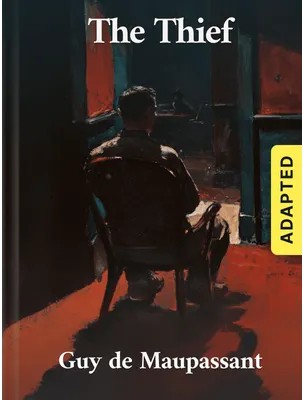
[adapted]
by
Guy de Maupassant

While seeming to think of something else, Dr. Sorbier had been listening quietly to those amazing stories of break-ins and dangerous acts that could have been taken from the court case of Cartouche. “Certainly,” he cried, “certainly, I know no worse fault or any meaner act than to attack a girl’s innocence, to spoil her, to take advantage of a moment when she is not thinking, weak, and confused, when her heart is beating like that of a scared young deer, and her pure lips look for those of the one who tries to make her do it; when she gives herself up without thinking of the stain that cannot be washed away, or of her fall, or of the next day.
“The man who has caused this slowly, cruelly, who can say with what skill in evil, and who, in such a case, does not have calm and self-control enough to put out that fire with some cold words, who does not have enough sense for both, who cannot get back his calm and control the wild animal inside him, and who loses control on the edge of the cliff over which she is going to fall, is as bad as any man who breaks open a lock, or as any crook looking for a house left without protection or for some easy and dishonest deal, or as that thief whose many tricks you have just told us about.
“As for me, I completely refuse to forgive him, even when there are excuses for him, even when he is playing a dangerous game of flirting, in which a man tries without success to stay in control, not to go past the limits of the game, just like in lawn tennis; even when the roles are reversed and a man’s opponent is some curious, very attractive girl who knows too much for her age, who shows you at once that she has nothing to learn and nothing to go through, except the last chapter of love, one of those girls from whom, may fate always protect our sons, and whom a writer of psychological novels has named ‘The Semi-Virgins.’”
It is, of course, difficult and painful for that rough and very deep pride which is in every man, and which might be called ‘malism’, not to stir up such a lovely fire, difficult to act like Joseph and like a fool, to turn away his eyes, and, so to speak, to put wax in his ears, like the friends of Ulysses when they were drawn by the sweet, tempting songs of the Sirens, difficult only to touch that pretty table covered with a brand new cloth, at which you are invited to sit down before anyone else, in such a tempting voice, and are asked to drink until you are not thirsty and to taste that new wine, whose fresh and strange taste you will never forget. But who would hesitate to use such self-control if, when he quickly looks into his own heart, in one of those natural returns to his calm self in which a man thinks clearly and becomes calm again, he were to measure how serious his mistake is, consider it, think of its results, of the revenge, of the worry which he would always feel in the future, and which would destroy the rest and happiness of his life?
“You may guess that behind all these thoughts about right and wrong, such as an old man like myself may enjoy, there is a hidden story, and, sad as it is, I am sure it will interest you because of the strange bravery it shows.”
He was silent for a few moments, as if to sort his memories, and, with his elbows on the arms of his armchair and his eyes staring into space, he continued in the slow voice of a hospital teacher who is explaining a case to his class of medical students, at a bedside:
“He was one of those men who, as our grandfathers used to say, never met a cruel woman, the kind of brave knight who was always searching, who was a bit naughty, but who did not care about danger and was bold, even too bold. He was very eager to seek pleasure, and was very charming, one of those men whose worst actions we excuse as the most natural things in the world. He had spent all his money on gambling and on pretty girls, and so became, in a way, a soldier of fortune. He had fun whenever and however he could, and was at that time staying at Versailles.
“I knew him completely, to the very depths of his childlike heart, which could very easily be seen through and understood, and I loved him like some old unmarried uncle loves a nephew who plays tricks on him, but who knows how to please him. He had made me his secret-keeper rather than his guide, told me about his smallest tricks, though he always pretended to be speaking about one of his friends, and not about himself; and I must admit that his youthful energy, his carefree happiness, and his strong love sometimes took my mind away and made me envy the handsome, strong young man who was so happy to be alive that I did not have the courage to stop him, to show him the right way, and to call out to him: ‘Take care!’ as children do at blind man’s buff.”
“And one day, after one of those very long dances, where the couples do not leave each other for hours, and can go away together without anybody thinking of noticing them, the poor man at last discovered what love was, that real love which lives in the very centre of the heart and in the brain, and is proud of being there, and which rules like a king and a cruel master, and he became madly in love with a pretty but badly brought up girl, who was as worrying and wild as she was pretty.
She loved him, however, or rather she loved him in a very strong, controlling way, madly, with all her happy soul and all her being. Left to do as she liked by careless and silly parents, suffering from a nervous illness, because of the bad friendships which she made at the school run by nuns, taught by what she saw and heard and knew was going on around her, in spite of her lying and fake behavior, knowing that neither her father nor her mother, who were very proud of their family as well as greedy, would ever agree to let her marry the man whom she liked, that handsome man who had little besides dreams, ideas and debts, and who was from the middle class, she put aside all doubts about right and wrong, thought of nothing but of becoming his, no matter what might be the cost.
“Little by little, the poor man’s strength failed, his heart became soft, and he let himself be carried away by the current that hit him, surrounded him, and left him on the shore like a lost and homeless person.
“They wrote letters full of strong love to each other, and not a day passed without them meeting, either by chance, as it seemed, or at parties and dances. She had let him kiss her in long, warm kisses, which had made their promise of shared love sure.”
The doctor stopped, and his eyes suddenly filled with tears, as these past problems came back to his mind; and then, in a rough voice, he went on, full of the fear of what he was going to tell:
“For months he climbed over the garden wall, and, holding his breath and listening for the smallest sound, like a thief who is going to go into a house, he went in through the servants’ door, which she had left open, went quietly barefoot down a long hallway and up the wide stairs, which sometimes creaked, to the second floor, where his girlfriend’s room was, and stayed there for hours.”
“One night, when it was darker than usual, and he was hurrying so he would not be later than the agreed time, he bumped against a piece of furniture in the hallway and knocked it over. It happened that the girl’s mother was not asleep, either because she had a bad headache, or else because she had stayed up late reading some novel, and, scared by that strange noise which broke the silence of the house, she jumped out of bed, opened the door, saw someone, not clearly, running away and keeping close to the wall, and, at once thinking that there were thieves in the house, she woke her husband and the servants with her wild screams. The unlucky man understood the situation; and, seeing what terrible trouble he was in, and choosing to be taken for a common thief rather than bringing shame on his loved one’s name, he ran into the living room, felt on the tables and shelves, filled his pockets at random with valuable small objects, and then crouched down behind the grand piano, which blocked the corner of a large room.”
“The servants, who had come running with lit candles, found him, and, shouting insults at him, grabbed him by the collar and dragged him, breathing hard and seeming almost half dead with shame and fear, to the nearest police station. He defended himself on purpose in a clumsy way when he was taken to court, kept up his act with complete calm and without any sign of the deep sadness and pain that he felt in his heart, and, when he was found guilty and shamed and made to suffer greatly for his honor as a man and a soldier—he was an officer—he did not complain, but went to prison as one of those criminals that society gets rid of like harmful pests.
“He died there of misery and deep bitterness of spirit, with the name of the fair-haired one he loved, for whom he had given up everything, on his lips, as if it were a joyful prayer, and he entrusted his will to the priest who gave him the last rites, and asked him to give it to me. In it, without naming anyone, and without revealing anything at all, he at last explained the mystery, and proved he was innocent of those accusations, the terrible burden of which he had carried until his last breath.”
“I have always thought, though I do not know why, that the girl married and had several nice children, who she raised with very strict rules and with serious faith of earlier times!”