The adapted version of 'The Skeleton' was published in 2023, making Rabindranath Tagore's classic accessible to a new generation of readers.
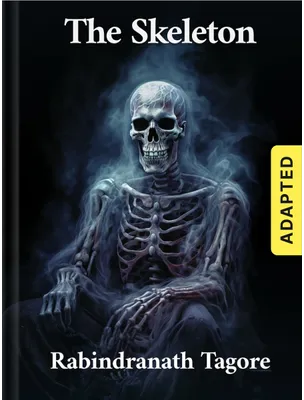
A man returns to his childhood room, where long ago he and his friends studied a real skeleton. One sleepless night, he hears strange sounds and a voice claiming to be the spirit of the woman whose bones they once used. She tells him about her youth, her beauty, and her love for a young doctor. As the night goes on, she shares the story of her life—and what led to her death. This is an adapted version of the story, simplified to A2 level.
In "The Skeleton," adapted from the timeless work of Rabindranath Tagore, readers are drawn into a world where the boundaries between life and death blur in hauntingly beautiful ways. The story revolves around the curious character of a young man named Kedar, whose chance encounter with a mysterious skeleton leads him on a journey of self-discovery and deep reflection. As Kedar grapples with the themes of mortality and the essence of existence, he finds himself entangled in a web of emotions that challenge his understanding of life itself.
Set against the backdrop of a richly woven Indian landscape, the narrative is both enchanting and thought-provoking, inviting readers to ponder the fragile nature of human experience. Tagore's lyrical prose captures the essence of longing and introspection, making "The Skeleton" a poignant exploration of the human condition. As Kedar navigates his quest, the story raises questions about love, loss, and the inevitable passage of time, creating a tapestry of feelings that resonates deeply with every reader.
Full Name: Rabindranath Tagore
Birthdate: May 7, 1861
Place of Birth: Calcutta, India
Date and Place of Death: August 7, 1941, in Calcutta, India
Occupation: Poet, playwright, novelist, musician, and painter
Notable Works: "Gitanjali," "The Home and the World," "The Post Office," and "Fruit-Gathering"
Early Life: Rabindranath Tagore was born into a wealthy family in Calcutta. He was the youngest of fourteen children. His father, Debendranath Tagore, was a prominent figure in the Brahmo Samaj, a reformist religious movement. Tagore showed an early interest in literature and music.
Literary Career: Tagore began writing poetry at a young age. He gained fame with his collection "Gitanjali," which won him the Nobel Prize in Literature in 1913. He wrote in Bengali and later translated his works into English, making them accessible to a global audience. His writings often explored themes of nature, love, and spirituality.
Personal Life: Tagore married Mrinalini Devi in 1883, and they had five children. He was deeply affected by the loss of his family members over the years. Tagore was also a social reformer, advocating for education and women's rights. He founded Visva-Bharati University in 1921, emphasizing a holistic approach to education.
Rabindranath Tagore was an Indian poet, playwright, and philosopher, known for being the first non-European to win the Nobel Prize in Literature in 1913.
'The Skeleton' is a work of fiction that blends elements of drama and philosophy, typical of Tagore's literary style.
The main characters include a curious young girl, her wise grandmother, and a mysterious skeleton that engages them in deep conversations.
The story revolves around a young girl who discovers a skeleton. Through their interactions, she learns valuable life lessons and reflects on mortality and existence.
Key themes include the nature of life and death, the importance of wisdom, and the exploration of human emotions and relationships.
The skeleton symbolizes the inevitability of death and serves as a reminder to cherish life and seek deeper understanding.
The book has been positively received, with readers praising its depth and ability to provoke thought about life and death.
Yes, 'The Skeleton' has been adapted into various stage plays and short films, showcasing its timeless themes.
The story has had a significant cultural impact, encouraging discussions about mortality and the human experience across different communities.