The book was originally published in 1893 and has since been adapted for modern readers.
[{"id":"para_1","index":0,"start":0,"offset":357,"words":5,"paraNum":"","lastModified":1774877752000,"semanticType":"title-book-title","voicework":"tts","blockId":"the_philosophy_of_relative_en-bl2s","language":"en","wordsRange":{"start":100000000,"end":106000000},"paragraphVersion":26,"direction":"ltr","paragraph":"<h1 class=\"ilm-title ilm-x-large\" id=\"para_1\" semantictype=\"title-book-title\" data-ilmid=\"the_philosophy_of_relative_en-bl2s\" data-audio=\"1\" data-chapter=\"para_1\" data-words-count=\"5\" data-before=\"0\" data-ww=\"\"><span class=\"block-pb\"> <span class=\"block-pb is-animated\"></span> </span><span class=\"itm-wrap\">The Philosophy of Relative Existences</span></h1>","hasContent":true,"isFirst":true,"isLast":false},{"id":"para_2","index":1,"start":357,"offset":328,"words":1,"paraNum":"","lastModified":1774877807000,"semanticType":"title-subtitle","voicework":"tts","blockId":"the_philosophy_of_relative_en-bl4m","language":"en","wordsRange":{"start":139333333,"end":172666667},"paragraphVersion":29,"direction":"ltr","paragraph":"<h1 class=\"ilm-title ilm-subtitle\" id=\"para_2\" semantictype=\"title-subtitle\" data-ilmid=\"the_philosophy_of_relative_en-bl4m\" data-audio=\"1\" data-chapter=\"para_2\" data-words-count=\"1\" data-before=\"5\" data-ww=\"\"><span class=\"block-pb\"> <span class=\"block-pb is-animated\"></span> </span><span class=\"itm-wrap\">[adapted]</span></h1>","hasContent":true,"isFirst":false,"isLast":false},{"id":"para_3","index":2,"start":685,"offset":359,"words":3,"paraNum":"","lastModified":1774878104000,"semanticType":"title-author","voicework":"tts","blockId":"the_philosophy_of_relative_en-bl2t","language":"en","wordsRange":{"start":206000000,"end":211000000},"paragraphVersion":33,"direction":"ltr","paragraph":"<h1 class=\"ilm-title ilm-author ilm-nopad ilm-large\" id=\"para_3\" semantictype=\"title-author\" data-ilmid=\"the_philosophy_of_relative_en-bl2t\" data-audio=\"1\" data-chapter=\"para_3\" data-words-count=\"3\" data-before=\"6\" data-ww=\"\"><span class=\"block-pb\"> <span class=\"block-pb is-animated\"></span> </span><span class=\"itm-wrap\">by <br>Frank R. Stockton</span></h1>","hasContent":true,"isFirst":false,"isLast":false},{"id":"para_4","index":3,"start":1044,"offset":157,"words":0,"paraNum":"","lastModified":1722941006000,"semanticType":"line","blockId":"the_philosophy_of_relative_en-bl4i","language":"en","wordsRange":{"start":311000000,"end":411000000},"paragraphVersion":11,"direction":"ltr","paragraph":"<hr class=\"ilm-hr ilm-small\" id=\"para_4\" semantictype=\"line\" data-ilmid=\"the_philosophy_of_relative_en-bl4i\" data-words-count=\"0\" data-before=\"9\" data-ww=\"\">","hasContent":true,"isFirst":false,"isLast":false},{"id":"para_5","index":4,"start":1201,"offset":1657,"words":0,"paraNum":"","lastModified":1723017641000,"semanticType":"illustration","blockId":"the_philosophy_of_relative_en-bl4k","language":"en","wordsRange":{"start":511000000,"end":611000000},"paragraphVersion":11,"direction":"ltr","paragraph":"<div class=\"ilm-illustration\" id=\"para_5\" semantictype=\"illustration\" data-ilmid=\"the_philosophy_of_relative_en-bl4k\" data-words-count=\"0\" data-before=\"9\" data-ww=\"\"><img width=\"600\" height=\"343\" data-src=\"ch0p0\" src=\"data:image/webp;base64,UklGRu4DAABXRUJQVlA4IOIDAABQEQCdASo8ACIAPm0ukkakIiGhLVZqSIANiUATplVQL5LFvf4f1Z7aPniG7F/gPBHxR+rI9FwfS337++/JbvTGVeJfTJfJvO16EOejUK6VpDJ/CelQgWm82ITIjJHILcQXzFPk4akV/V1tmS7nB84Xl6cVkl6HQ17gk8O567xg5EE1TADK2CtdaYAIFCskscMYLagA/vzqeEEe85wzVz8GHeMRLoHr3fDgDr9Zzg1XfffoaE+ZFWX/NRbryHssS7Lz22/n5hluZ1PllA5f3cj413fcTa1vS3/EYSEPARvSSbG/tVsb1pa8pkNcPa+NDNiyjUENC105CqwoIDXFtxTPh9U+vxfP3UAXfawK5qZYBEtfcVdEX/70UdXa/Ze3RNE86IDFAJhJU3UsvX5SBPBWLSQN//GzvH6fpTUBBfZaZFQ73dWU/kIp3ywAfpGZQeGPRZ701pJS/nPORScEypW0Be1MdgZ51sZ//VJdNLpcQsn3dl7QrNrqWJfVxUdYhKX0I3Ytej2Tmrz48rAS7K90Lmjt3+q7HqItHlRj2Nfz27wrQA184nAF5ltx3mUkhXAErcC805s5O04S0QPol99uczGzqiooYWSXqU0nIpJsgHBUAG9AeO6mtx9gWfw/8ypwjs+t+IUIcoytJNRX0daMKbO+3AtLaESPSHTyN2jToVoUPOfXDjlbah91v1DSdxdsGGyT78v9Qcrvj468Lu14+zkYAOBDsWWcDKFEqTSGyMPaLTGk7GKEfba4bIzLcs22YO4x2cRBULxAsLV28dbq+FZxwu7mHTChpkS43Mx1whCJKrjLJ5tspjAzktsx8T0ULB216uqe4ejx7ypSXRnSsxwlMjkHiB0cX2ljlsXiGHqh7Pu5pl7a+qcIwP0uxJ6ob1nrjn18foml7ncixp3Lvu/a3t/4xhYeO1VvrOXYvmdAVI/LyNo+JjnjFP0LB8ioC4wnPxZPVVCs5OF9iOKILqXF5/C5g1nRGKjy+oaFFbSVuauQeLefmK0ZspYCvdYgcqfnrvVkqq70gF6in5hXmwPKBH8+s7JEISkX7Xwx/l7UYEFrXpoTtOFHgs3d0uuPvYicbO5mDtxqOiH4DcVvZ7NbLoUgrFWApOWJAnQs0+wYDJm66RZ3EQH8/1X67IbmEN1gijrKhtY5FsuYwGv6qA4CJHdwrfr/D/Uz6I4xDfLWHWqfOsjQrBzLrBM5Af3PdDzxwkUfaoz7YRJC1tmUQf+oFMK0VIxgddv7mRNRP6v9Boi7nDYIdDYGKlk8XtfRs4dr8Z+mzTZGwO2v+CNsc0lmfra+XqKMpAr50CqGXAAA\" alt=\"'The Philosophy of Relative Existences' (adapted)\"></div>","hasContent":true,"isFirst":false,"isLast":false},{"id":"para_6","index":5,"start":2858,"offset":990,"words":131,"paraNum":"1","lastModified":1774877743000,"semanticType":"par","voicework":"tts","blockId":"the_philosophy_of_relative_en-bl2u","language":"en","wordsRange":{"start":711000000,"end":839000000},"paragraphVersion":24,"direction":"ltr","paragraph":"<p id=\"para_6\" semantictype=\"par\" data-ilmid=\"the_philosophy_of_relative_en-bl2u\" data-audio=\"1\" data-words-count=\"131\" data-before=\"9\" data-ww=\"\"><span class=\"block-num\" data-id=\"1\"></span><span class=\"block-pb\"> <span class=\"block-pb is-animated\"></span> </span><span class=\"itm-wrap\">In a certain summer, not long ago, my friend Bentley and I found ourselves in a small village which looked over a calm valley, through which a river moved gently, going in curves through green fields until it turned around the end of a line of low hills and was out of sight. Beyond this river, far away, but visible from the door of the cottage where we lived, there was a city. Through the mist that floated over the valley we could see the shapes of church towers and tall roofs; and buildings of a kind that showed care with money and business stretched down to the other side of the river. The more distant parts of the city, clearly a small one, lost themselves in the misty summer air.</span></p>","hasContent":true,"isFirst":false,"isLast":false},{"id":"para_7","index":6,"start":3848,"offset":981,"words":135,"paraNum":"2","lastModified":1774877877000,"semanticType":"par","voicework":"tts","blockId":"the_philosophy_of_relative_en-bl2v","language":"en","wordsRange":{"start":939000000,"end":1073000000},"paragraphVersion":24,"direction":"ltr","paragraph":"<p id=\"para_7\" semantictype=\"par\" data-ilmid=\"the_philosophy_of_relative_en-bl2v\" data-audio=\"1\" data-words-count=\"135\" data-before=\"140\" data-ww=\"\"><span class=\"block-num\" data-id=\"2\"></span><span class=\"block-pb\"> <span class=\"block-pb is-animated\"></span> </span><span class=\"itm-wrap\">Bentley was young, blond, and a poet; I was a thinker, or trying to be one. We were good friends, and had come to this quiet area to work together. Although we had run away from the busy noise and distractions of the town, the sight, in this country area, of a city, which, as far as we could see, had no effect on the quiet nature of the valley where it lay, made us interested. No boats went up and down the river; there were no bridges from one side to the other; there were none of those spread-out and half-dirty homes which usually are found on the edge of a city; there came to us no far-off sound of bells; and not the smallest curl of smoke rose from any of the buildings.</span></p>","hasContent":true,"isFirst":false,"isLast":false},{"id":"para_8","index":7,"start":4829,"offset":1121,"words":165,"paraNum":"3","lastModified":1774878480000,"semanticType":"par","voicework":"tts","blockId":"the_philosophy_of_relative_en-bl2x","language":"en","wordsRange":{"start":1173000000,"end":1349333333},"paragraphVersion":28,"direction":"ltr","paragraph":"<p id=\"para_8\" semantictype=\"par\" data-ilmid=\"the_philosophy_of_relative_en-bl2x\" data-audio=\"1\" data-words-count=\"165\" data-before=\"275\" data-ww=\"\"><span class=\"block-num\" data-id=\"3\"></span><span class=\"block-pb\"> <span class=\"block-pb is-animated\"></span> </span><span class=\"itm-wrap\">In answer to our questions our landlord told us that the city over the river had been built by one man, who was a dreamer, and who had much more money than sense. “It is not as big a town as you would think, sirs,” he said, “because the mist in this valley makes things look larger than they are. Those hills, for example, when you get to them, are not as high as they look from here. But the town is big enough, and much too big; because it ruined its builder and owner, who, when he died, did not have money enough left to put up a simple tombstone at the head of his grave. He had a strange idea that he would like to have his town all finished before anybody lived in it, and so he kept on working and spending money year after year and year after year until the city was finished and he had not a cent left.”</span></p>","hasContent":true,"isFirst":false,"isLast":false},{"id":"para_9","index":8,"start":5950,"offset":904,"words":123,"paraNum":"4","lastModified":1774878107000,"semanticType":"par","voicework":"tts","blockId":"the_philosophy_of_relative_en-bl4l","language":"en","wordsRange":{"start":1349666667,"end":1476000000},"paragraphVersion":25,"direction":"ltr","paragraph":"<p id=\"para_9\" semantictype=\"par\" data-ilmid=\"the_philosophy_of_relative_en-bl4l\" data-audio=\"1\" data-words-count=\"123\" data-before=\"440\" data-ww=\"\"><span class=\"block-num\" data-id=\"4\"></span><span class=\"block-pb\"> <span class=\"block-pb is-animated\"></span> </span><span class=\"itm-wrap\">While the place was being built, hundreds of people came to him to buy houses, or to rent them, but he would not agree to anything like that. No one was allowed to live in his town until it was all done. Even his workers had to go away at night to sleep. It is a town, sirs, I am told, where nobody has slept even for one night. There are streets there, and places of business, and churches, and public halls, and everything that a town full of people could need; but it is all empty and without people, and has been this way as long as I can remember, and I came to this area when I was a little boy.”</span></p>","hasContent":true,"isFirst":false,"isLast":false},{"id":"para_10","index":9,"start":6854,"offset":449,"words":27,"paraNum":"5","lastModified":1774878172000,"semanticType":"par","voicework":"tts","blockId":"the_philosophy_of_relative_en-bl2z","language":"en","wordsRange":{"start":1576000000,"end":1605000000},"paragraphVersion":27,"direction":"ltr","paragraph":"<p id=\"para_10\" semantictype=\"par\" data-ilmid=\"the_philosophy_of_relative_en-bl2z\" data-audio=\"1\" data-words-count=\"27\" data-before=\"563\" data-ww=\"\"><span class=\"block-num\" data-id=\"5\"></span><span class=\"block-pb\"> <span class=\"block-pb is-animated\"></span> </span><span class=\"itm-wrap\">“And is there no one to guard the place?” we asked; “no one to protect it from wandering tramps who might choose to take over the buildings?”</span></p>","hasContent":true,"isFirst":false,"isLast":false},{"id":"para_11","index":10,"start":7303,"offset":449,"words":28,"paraNum":"6","lastModified":1774878623000,"semanticType":"par","voicework":"tts","blockId":"the_philosophy_of_relative_en-bl30","language":"en","wordsRange":{"start":1705000000,"end":1734000000},"paragraphVersion":25,"direction":"ltr","paragraph":"<p id=\"para_11\" semantictype=\"par\" data-ilmid=\"the_philosophy_of_relative_en-bl30\" data-audio=\"1\" data-words-count=\"28\" data-before=\"590\" data-ww=\"\"><span class=\"block-num\" data-id=\"6\"></span><span class=\"block-pb\"> <span class=\"block-pb is-animated\"></span> </span><span class=\"itm-wrap\">“There are not many homeless people in this part of the country,” he said, “and if there were they would not go to that city. It has ghosts.”</span></p>","hasContent":true,"isFirst":false,"isLast":false},{"id":"para_12","index":11,"start":7752,"offset":319,"words":3,"paraNum":"7","lastModified":1774878351000,"semanticType":"par","voicework":"tts","blockId":"the_philosophy_of_relative_en-bl31","language":"en","wordsRange":{"start":1834000000,"end":1839000000},"paragraphVersion":26,"direction":"ltr","paragraph":"<p id=\"para_12\" semantictype=\"par\" data-ilmid=\"the_philosophy_of_relative_en-bl31\" data-audio=\"1\" data-words-count=\"3\" data-before=\"618\" data-ww=\"\"><span class=\"block-num\" data-id=\"7\"></span><span class=\"block-pb\"> <span class=\"block-pb is-animated\"></span> </span><span class=\"itm-wrap\">“How?” we asked.</span></p>","hasContent":true,"isFirst":false,"isLast":false},{"id":"para_13","index":12,"start":8071,"offset":564,"words":51,"paraNum":"8","lastModified":1774878277000,"semanticType":"par","voicework":"tts","blockId":"the_philosophy_of_relative_en-bl32","language":"en","wordsRange":{"start":1939000000,"end":1990000000},"paragraphVersion":29,"direction":"ltr","paragraph":"<p id=\"para_13\" semantictype=\"par\" data-ilmid=\"the_philosophy_of_relative_en-bl32\" data-audio=\"1\" data-words-count=\"51\" data-before=\"621\" data-ww=\"\"><span class=\"block-num\" data-id=\"8\"></span><span class=\"block-pb\"> <span class=\"block-pb is-animated\"></span> </span><span class=\"itm-wrap\">“Well, sirs, I can hardly tell you; strange creatures that are not made of flesh and blood, and that is all I know about it. Many people living around here have visited that place once in their lives, but I do not know anyone who has gone there a second time.”</span></p>","hasContent":true,"isFirst":false,"isLast":false},{"id":"para_14","index":13,"start":8635,"offset":404,"words":17,"paraNum":"9","lastModified":1774878081000,"semanticType":"par","voicework":"tts","blockId":"the_philosophy_of_relative_en-bl33","language":"en","wordsRange":{"start":2090000000,"end":2107000000},"paragraphVersion":26,"direction":"ltr","paragraph":"<p id=\"para_14\" semantictype=\"par\" data-ilmid=\"the_philosophy_of_relative_en-bl33\" data-audio=\"1\" data-words-count=\"17\" data-before=\"672\" data-ww=\"\"><span class=\"block-num\" data-id=\"9\"></span><span class=\"block-pb\"> <span class=\"block-pb is-animated\"></span> </span><span class=\"itm-wrap\">“And travelers,” I said, “aren’t they curious to go and see that strange city with no people?”</span></p>","hasContent":true,"isFirst":false,"isLast":false},{"id":"para_15","index":14,"start":9039,"offset":632,"words":62,"paraNum":"10","lastModified":1774878700000,"semanticType":"par","voicework":"tts","blockId":"the_philosophy_of_relative_en-bl34","language":"en","wordsRange":{"start":2207000000,"end":2273000000},"paragraphVersion":33,"direction":"ltr","paragraph":"<p id=\"para_15\" semantictype=\"par\" data-ilmid=\"the_philosophy_of_relative_en-bl34\" data-audio=\"1\" data-words-count=\"62\" data-before=\"689\" data-ww=\"\"><span class=\"block-num\" data-id=\"10\"></span><span class=\"block-pb\"> <span class=\"block-pb is-animated\"></span> </span><span class=\"itm-wrap\">“Oh yes,” our host said; “almost all visitors to the valley go over to that strange city — usually in small groups, for it is not a place where one wants to walk around alone. Sometimes they see things and sometimes they don’t. But I never knew any man or woman who wanted to live there, though it is a very good town.”</span></p>","hasContent":true,"isFirst":false,"isLast":false},{"id":"para_16","index":15,"start":9671,"offset":1013,"words":146,"paraNum":"11","lastModified":1774878058000,"semanticType":"par","voicework":"tts","blockId":"the_philosophy_of_relative_en-bl35","language":"en","wordsRange":{"start":2373000000,"end":2516333333},"paragraphVersion":30,"direction":"ltr","paragraph":"<p id=\"para_16\" semantictype=\"par\" data-ilmid=\"the_philosophy_of_relative_en-bl35\" data-audio=\"1\" data-words-count=\"146\" data-before=\"751\" data-ww=\"\"><span class=\"block-num\" data-id=\"11\"></span><span class=\"block-pb\"> <span class=\"block-pb is-animated\"></span> </span><span class=\"itm-wrap\">This was said at dinner time, and, as it was the time of the full moon, Bentley and I decided to visit the haunted city that evening. Our host tried to stop us, saying that no one ever went over there at night; but since we would not be stopped he told us where we would find his small boat tied to a post on the river bank. We soon crossed the river, and landed at a wide but low stone pier, where, at the land end, a line of tall grasses waved in the gentle night wind as if they were guards warning us not to enter the silent city. We pushed through these, and walked up a fairly wide street, and so well paved that we saw none of the weeds and other plants that usually mean a place is empty or used little.</span></p>","hasContent":true,"isFirst":false,"isLast":false},{"id":"para_17","index":16,"start":10684,"offset":844,"words":100,"paraNum":"12","lastModified":1774878683000,"semanticType":"par","voicework":"tts","blockId":"the_philosophy_of_relative_en-bl4n","language":"en","wordsRange":{"start":2516666667,"end":2621000000},"paragraphVersion":26,"direction":"ltr","paragraph":"<p id=\"para_17\" semantictype=\"par\" data-ilmid=\"the_philosophy_of_relative_en-bl4n\" data-audio=\"1\" data-words-count=\"100\" data-before=\"897\" data-ww=\"\"><span class=\"block-num\" data-id=\"12\"></span><span class=\"block-pb\"> <span class=\"block-pb is-animated\"></span> </span><span class=\"itm-wrap\">By the bright light of the moon we could see that the buildings were simple, and very pleasing to the eye. All the buildings were of stone, and of good size. We were very excited and interested, and decided to keep walking until the moon went down, and to come back the next morning — “to live here, perhaps,” said Bentley. “What could be so romantic and yet so real? What could be better for the joining of poetry and philosophy?” But as he said this we saw around the corner of a side street some shapes like people hurrying away.</span></p>","hasContent":true,"isFirst":false,"isLast":false},{"id":"para_18","index":17,"start":11528,"offset":362,"words":11,"paraNum":"13","lastModified":1774878336000,"semanticType":"par","voicework":"tts","blockId":"the_philosophy_of_relative_en-bl37","language":"en","wordsRange":{"start":2721000000,"end":2733000000},"paragraphVersion":32,"direction":"ltr","paragraph":"<p id=\"para_18\" semantictype=\"par\" data-ilmid=\"the_philosophy_of_relative_en-bl37\" data-audio=\"1\" data-words-count=\"11\" data-before=\"997\" data-ww=\"\"><span class=\"block-num\" data-id=\"13\"></span><span class=\"block-pb\"> <span class=\"block-pb is-animated\"></span> </span><span class=\"itm-wrap\">“The ghosts,” said my friend, putting his hand on my arm.</span></p>","hasContent":true,"isFirst":false,"isLast":false},{"id":"para_19","index":18,"start":11890,"offset":440,"words":20,"paraNum":"14","lastModified":1774878127000,"semanticType":"par","voicework":"tts","blockId":"the_philosophy_of_relative_en-bl38","language":"en","wordsRange":{"start":2833000000,"end":2857000000},"paragraphVersion":28,"direction":"ltr","paragraph":"<p id=\"para_19\" semantictype=\"par\" data-ilmid=\"the_philosophy_of_relative_en-bl38\" data-audio=\"1\" data-words-count=\"20\" data-before=\"1008\" data-ww=\"\"><span class=\"block-num\" data-id=\"14\"></span><span class=\"block-pb\"> <span class=\"block-pb is-animated\"></span> </span><span class=\"itm-wrap\">“Homeless people, more likely,” I answered, “who have used the local superstition to take this comfort and beauty for themselves.”</span></p>","hasContent":true,"isFirst":false,"isLast":false},{"id":"para_20","index":19,"start":12330,"offset":376,"words":13,"paraNum":"15","lastModified":1774878741000,"semanticType":"par","voicework":"tts","blockId":"the_philosophy_of_relative_en-bl39","language":"en","wordsRange":{"start":2957000000,"end":2972000000},"paragraphVersion":28,"direction":"ltr","paragraph":"<p id=\"para_20\" semantictype=\"par\" data-ilmid=\"the_philosophy_of_relative_en-bl39\" data-audio=\"1\" data-words-count=\"13\" data-before=\"1028\" data-ww=\"\"><span class=\"block-num\" data-id=\"15\"></span><span class=\"block-pb\"> <span class=\"block-pb is-animated\"></span> </span><span class=\"itm-wrap\">“If that is so,” said Bentley, “we must be careful to stay alive.”</span></p>","hasContent":true,"isFirst":false,"isLast":false},{"id":"para_21","index":20,"start":12706,"offset":860,"words":105,"paraNum":"16","lastModified":1774879822000,"semanticType":"par","voicework":"tts","blockId":"the_philosophy_of_relative_en-bl3a","language":"en","wordsRange":{"start":3072000000,"end":3173000000},"paragraphVersion":35,"direction":"ltr","paragraph":"<p id=\"para_21\" semantictype=\"par\" data-ilmid=\"the_philosophy_of_relative_en-bl3a\" data-audio=\"1\" data-words-count=\"105\" data-before=\"1041\" data-ww=\"\"><span class=\"block-num\" data-id=\"16\"></span><span class=\"block-pb\"> <span class=\"block-pb is-animated\"></span> </span><span class=\"itm-wrap\">We went carefully, and soon saw other shapes running away before us and going out of sight, as we thought, around corners and into houses. And now, suddenly finding ourselves on the edge of a wide, open public square, we saw in the dim light — for a tall church tower blocked the moon — the shapes of carts, horses, and men moving here and there. But before, in our surprise, we could say a word to each other, the moon moved past the church tower, and in its bright light we could see none of the signs of life and movement which had just surprised us.</span></p>","hasContent":true,"isFirst":false,"isLast":false},{"id":"para_22","index":21,"start":13566,"offset":881,"words":113,"paraNum":"17","lastModified":1774878372000,"semanticType":"par","voicework":"tts","blockId":"the_philosophy_of_relative_en-bl3b","language":"en","wordsRange":{"start":3273000000,"end":3382000000},"paragraphVersion":34,"direction":"ltr","paragraph":"<p id=\"para_22\" semantictype=\"par\" data-ilmid=\"the_philosophy_of_relative_en-bl3b\" data-audio=\"1\" data-words-count=\"113\" data-before=\"1146\" data-ww=\"\"><span class=\"block-num\" data-id=\"17\"></span><span class=\"block-pb\"> <span class=\"block-pb is-animated\"></span> </span><span class=\"itm-wrap\">Nervously, with hearts beating fast, but with no thought of turning back, and no fear of beggars — for we were now sure that what we had seen was not a real person of flesh and blood, and so harmless — we crossed the open space and entered a street where the moon shone clearly. Here and there we saw faint shapes, which quickly disappeared; but, as we came near a low stone balcony in front of one of the houses, we were surprised to see, sitting on it and bending over a book which lay open on top of the carved railing, the shape of a woman who did not seem to notice us.</span></p>","hasContent":true,"isFirst":false,"isLast":false},{"id":"para_23","index":22,"start":14447,"offset":383,"words":14,"paraNum":"18","lastModified":1774878486000,"semanticType":"par","voicework":"tts","blockId":"the_philosophy_of_relative_en-bl3d","language":"en","wordsRange":{"start":3482000000,"end":3496000000},"paragraphVersion":28,"direction":"ltr","paragraph":"<p id=\"para_23\" semantictype=\"par\" data-ilmid=\"the_philosophy_of_relative_en-bl3d\" data-audio=\"1\" data-words-count=\"14\" data-before=\"1259\" data-ww=\"\"><span class=\"block-num\" data-id=\"18\"></span><span class=\"block-pb\"> <span class=\"block-pb is-animated\"></span> </span><span class=\"itm-wrap\">“That is a real person,” Bentley said quietly, “and she does not see us.”</span></p>","hasContent":true,"isFirst":false,"isLast":false},{"id":"para_24","index":23,"start":14830,"offset":368,"words":12,"paraNum":"19","lastModified":1774878697000,"semanticType":"par","voicework":"tts","blockId":"the_philosophy_of_relative_en-bl3e","language":"en","wordsRange":{"start":3596000000,"end":3610000000},"paragraphVersion":28,"direction":"ltr","paragraph":"<p id=\"para_24\" semantictype=\"par\" data-ilmid=\"the_philosophy_of_relative_en-bl3e\" data-audio=\"1\" data-words-count=\"12\" data-before=\"1273\" data-ww=\"\"><span class=\"block-num\" data-id=\"19\"></span><span class=\"block-pb\"> <span class=\"block-pb is-animated\"></span> </span><span class=\"itm-wrap\">“No,” I said; “it is like the others. Let’s go near it.”</span></p>","hasContent":true,"isFirst":false,"isLast":false},{"id":"para_25","index":24,"start":15198,"offset":569,"words":55,"paraNum":"20","lastModified":1774878502000,"semanticType":"par","voicework":"tts","blockId":"the_philosophy_of_relative_en-bl3f","language":"en","wordsRange":{"start":3710000000,"end":3766000000},"paragraphVersion":28,"direction":"ltr","paragraph":"<p id=\"para_25\" semantictype=\"par\" data-ilmid=\"the_philosophy_of_relative_en-bl3f\" data-audio=\"1\" data-words-count=\"55\" data-before=\"1285\" data-ww=\"\"><span class=\"block-num\" data-id=\"20\"></span><span class=\"block-pb\"> <span class=\"block-pb is-animated\"></span> </span><span class=\"itm-wrap\">We came close to the balcony and stood before it. Then the figure raised its head and looked at us. It was beautiful, it was young; but its body seemed to be of a very light, airy kind that we had never seen or known. With its full, soft eyes looking at us, it spoke.</span></p>","hasContent":true,"isFirst":false,"isLast":false},{"id":"para_26","index":25,"start":15767,"offset":860,"words":118,"paraNum":"21","lastModified":1774878193000,"semanticType":"par","voicework":"tts","blockId":"the_philosophy_of_relative_en-bl3g","language":"en","wordsRange":{"start":3866000000,"end":3983000000},"paragraphVersion":28,"direction":"ltr","paragraph":"<p id=\"para_26\" semantictype=\"par\" data-ilmid=\"the_philosophy_of_relative_en-bl3g\" data-audio=\"1\" data-words-count=\"118\" data-before=\"1340\" data-ww=\"\"><span class=\"block-num\" data-id=\"21\"></span><span class=\"block-pb\"> <span class=\"block-pb is-animated\"></span> </span><span class=\"itm-wrap\">“Why are you here?” it asked. “I said to myself that the next time I saw any of you I would ask you why you come to bother us. Can’t you live happily in your own places and worlds, knowing, as you must know, how easily scared we are, and how you scare us and make us unhappy? In all this city, I believe, there is not one of us except myself who does not run away and hide from you whenever you come here and are cruel. Even I would do that, if I had not told myself that I would see you and speak to you, and try to get you to leave us in peace.”</span></p>","hasContent":true,"isFirst":false,"isLast":false},{"id":"para_27","index":26,"start":16627,"offset":778,"words":95,"paraNum":"22","lastModified":1774878265000,"semanticType":"par","voicework":"tts","blockId":"the_philosophy_of_relative_en-bl3i","language":"en","wordsRange":{"start":4083000000,"end":4183000000},"paragraphVersion":28,"direction":"ltr","paragraph":"<p id=\"para_27\" semantictype=\"par\" data-ilmid=\"the_philosophy_of_relative_en-bl3i\" data-audio=\"1\" data-words-count=\"95\" data-before=\"1458\" data-ww=\"\"><span class=\"block-num\" data-id=\"22\"></span><span class=\"block-pb\"> <span class=\"block-pb is-animated\"></span> </span><span class=\"itm-wrap\">The clear, honest voice of the speaker made me feel brave. “We are two men,” I answered, “strangers in this area, and living for now in the beautiful country on the other side of the river. We heard about this quiet city, and we have come to see it for ourselves. We had thought it was empty, but now that we see this is not so, we truly tell you from our hearts that we do not want to bother any one who lives here. We only came as honest travellers to see the city.”</span></p>","hasContent":true,"isFirst":false,"isLast":false},{"id":"para_28","index":27,"start":17405,"offset":631,"words":65,"paraNum":"23","lastModified":1774878219000,"semanticType":"par","voicework":"tts","blockId":"the_philosophy_of_relative_en-bl3j","language":"en","wordsRange":{"start":4283000000,"end":4348000000},"paragraphVersion":28,"direction":"ltr","paragraph":"<p id=\"para_28\" semantictype=\"par\" data-ilmid=\"the_philosophy_of_relative_en-bl3j\" data-audio=\"1\" data-words-count=\"65\" data-before=\"1553\" data-ww=\"\"><span class=\"block-num\" data-id=\"23\"></span><span class=\"block-pb\"> <span class=\"block-pb is-animated\"></span> </span><span class=\"itm-wrap\">The figure now sat down again, and as her face was closer to us, we could see that it was full of serious thought. For a moment she looked at us without speaking. “Men!” she said. “And so I have been right. For a long time I have believed that the ones who sometimes come here, and fill us with fear and wonder, are men.”</span></p>","hasContent":true,"isFirst":false,"isLast":false},{"id":"para_29","index":28,"start":18036,"offset":438,"words":24,"paraNum":"24","lastModified":1774879895000,"semanticType":"par","voicework":"tts","blockId":"the_philosophy_of_relative_en-bl3k","language":"en","wordsRange":{"start":4448000000,"end":4471000000},"paragraphVersion":35,"direction":"ltr","paragraph":"<p id=\"para_29\" semantictype=\"par\" data-ilmid=\"the_philosophy_of_relative_en-bl3k\" data-audio=\"1\" data-words-count=\"24\" data-before=\"1618\" data-ww=\"\"><span class=\"block-num\" data-id=\"24\"></span><span class=\"block-pb\"> <span class=\"block-pb is-animated\"></span> </span><span class=\"itm-wrap\">“And you,” I shouted — ” who are you, and who are these people that we have seen, these strange people who live in this city?”</span></p>","hasContent":true,"isFirst":false,"isLast":false},{"id":"para_30","index":29,"start":18474,"offset":648,"words":67,"paraNum":"25","lastModified":1774878730000,"semanticType":"par","voicework":"tts","blockId":"the_philosophy_of_relative_en-bl3l","language":"en","wordsRange":{"start":4571000000,"end":4642000000},"paragraphVersion":28,"direction":"ltr","paragraph":"<p id=\"para_30\" semantictype=\"par\" data-ilmid=\"the_philosophy_of_relative_en-bl3l\" data-audio=\"1\" data-words-count=\"67\" data-before=\"1642\" data-ww=\"\"><span class=\"block-num\" data-id=\"25\"></span><span class=\"block-pb\"> <span class=\"block-pb is-animated\"></span> </span><span class=\"itm-wrap\">She smiled softly as she answered, “We are ghosts from the future. We are the people who will live in this city many generations from now. But not all of us know that, mainly because we do not think about it or study it enough to know it. And most people believe that the men and women who sometimes come here are ghosts who haunt the place.”</span></p>","hasContent":true,"isFirst":false,"isLast":false},{"id":"para_31","index":30,"start":19122,"offset":423,"words":23,"paraNum":"26","lastModified":1774878712000,"semanticType":"par","voicework":"tts","blockId":"the_philosophy_of_relative_en-bl3n","language":"en","wordsRange":{"start":4742000000,"end":4764000000},"paragraphVersion":28,"direction":"ltr","paragraph":"<p id=\"para_31\" semantictype=\"par\" data-ilmid=\"the_philosophy_of_relative_en-bl3n\" data-audio=\"1\" data-words-count=\"23\" data-before=\"1709\" data-ww=\"\"><span class=\"block-num\" data-id=\"26\"></span><span class=\"block-pb\"> <span class=\"block-pb is-animated\"></span> </span><span class=\"itm-wrap\">“And that is why you are very afraid and run away from us?” I said. “You think we are ghosts from another world?”</span></p>","hasContent":true,"isFirst":false,"isLast":false},{"id":"para_32","index":31,"start":19545,"offset":381,"words":14,"paraNum":"27","lastModified":1774878801000,"semanticType":"par","voicework":"tts","blockId":"the_philosophy_of_relative_en-bl3o","language":"en","wordsRange":{"start":4864000000,"end":4879000000},"paragraphVersion":28,"direction":"ltr","paragraph":"<p id=\"para_32\" semantictype=\"par\" data-ilmid=\"the_philosophy_of_relative_en-bl3o\" data-audio=\"1\" data-words-count=\"14\" data-before=\"1732\" data-ww=\"\"><span class=\"block-num\" data-id=\"27\"></span><span class=\"block-pb\"> <span class=\"block-pb is-animated\"></span> </span><span class=\"itm-wrap\">“Yes,” she said; “that is what people think, and what I used to think.”</span></p>","hasContent":true,"isFirst":false,"isLast":false},{"id":"para_33","index":32,"start":19926,"offset":366,"words":11,"paraNum":"28","lastModified":1774878141000,"semanticType":"par","voicework":"tts","blockId":"the_philosophy_of_relative_en-bl3p","language":"en","wordsRange":{"start":4979000000,"end":4992000000},"paragraphVersion":28,"direction":"ltr","paragraph":"<p id=\"para_33\" semantictype=\"par\" data-ilmid=\"the_philosophy_of_relative_en-bl3p\" data-audio=\"1\" data-words-count=\"11\" data-before=\"1746\" data-ww=\"\"><span class=\"block-num\" data-id=\"28\"></span><span class=\"block-pb\"> <span class=\"block-pb is-animated\"></span> </span><span class=\"itm-wrap\">“And you,” I asked, “are ghosts of people not born yet?”</span></p>","hasContent":true,"isFirst":false,"isLast":false},{"id":"para_34","index":33,"start":20292,"offset":449,"words":26,"paraNum":"29","lastModified":1774879907000,"semanticType":"par","voicework":"tts","blockId":"the_philosophy_of_relative_en-bl3q","language":"en","wordsRange":{"start":5092000000,"end":5119000000},"paragraphVersion":39,"direction":"ltr","paragraph":"<p id=\"para_34\" semantictype=\"par\" data-ilmid=\"the_philosophy_of_relative_en-bl3q\" data-audio=\"1\" data-words-count=\"26\" data-before=\"1757\" data-ww=\"\"><span class=\"block-num\" data-id=\"29\"></span><span class=\"block-pb\"> <span class=\"block-pb is-animated\"></span> </span><span class=\"itm-wrap\">“Yes,” she answered; “but not for a long time. Generations of people — I do not know how many — must pass before we are men and women.”</span></p>","hasContent":true,"isFirst":false,"isLast":false},{"id":"para_35","index":34,"start":20741,"offset":435,"words":23,"paraNum":"30","lastModified":1774878831000,"semanticType":"par","voicework":"tts","blockId":"the_philosophy_of_relative_en-bl3r","language":"en","wordsRange":{"start":5219000000,"end":5243000000},"paragraphVersion":28,"direction":"ltr","paragraph":"<p id=\"para_35\" semantictype=\"par\" data-ilmid=\"the_philosophy_of_relative_en-bl3r\" data-audio=\"1\" data-words-count=\"23\" data-before=\"1783\" data-ww=\"\"><span class=\"block-num\" data-id=\"30\"></span><span class=\"block-pb\"> <span class=\"block-pb is-animated\"></span> </span><span class=\"itm-wrap\">“Heavens!” said Bentley, holding his hands together and looking up at the sky, “I will be a ghost before you become a woman.”</span></p>","hasContent":true,"isFirst":false,"isLast":false},{"id":"para_36","index":35,"start":21176,"offset":403,"words":19,"paraNum":"31","lastModified":1774878682000,"semanticType":"par","voicework":"tts","blockId":"the_philosophy_of_relative_en-bl3s","language":"en","wordsRange":{"start":5343000000,"end":5363000000},"paragraphVersion":28,"direction":"ltr","paragraph":"<p id=\"para_36\" semantictype=\"par\" data-ilmid=\"the_philosophy_of_relative_en-bl3s\" data-audio=\"1\" data-words-count=\"19\" data-before=\"1806\" data-ww=\"\"><span class=\"block-num\" data-id=\"31\"></span><span class=\"block-pb\"> <span class=\"block-pb is-animated\"></span> </span><span class=\"itm-wrap\">“Maybe,” she said again, with a sweet smile on her face, “you may live to be very, very old.”</span></p>","hasContent":true,"isFirst":false,"isLast":false},{"id":"para_37","index":36,"start":21579,"offset":565,"words":50,"paraNum":"32","lastModified":1774878113000,"semanticType":"par","voicework":"tts","blockId":"the_philosophy_of_relative_en-bl3t","language":"en","wordsRange":{"start":5463000000,"end":5513000000},"paragraphVersion":28,"direction":"ltr","paragraph":"<p id=\"para_37\" semantictype=\"par\" data-ilmid=\"the_philosophy_of_relative_en-bl3t\" data-audio=\"1\" data-words-count=\"50\" data-before=\"1825\" data-ww=\"\"><span class=\"block-num\" data-id=\"32\"></span><span class=\"block-pb\"> <span class=\"block-pb is-animated\"></span> </span><span class=\"itm-wrap\">But Bentley shook his head. This did not comfort him. For a few minutes I stood in thought, looking at the stone pavement under my feet. “And this,” I cried, “is a city lived in by the ghosts of the future, who think men and women are ghosts and spirits?”</span></p>","hasContent":true,"isFirst":false,"isLast":false},{"id":"para_38","index":37,"start":22144,"offset":320,"words":4,"paraNum":"33","lastModified":1774878410000,"semanticType":"par","voicework":"tts","blockId":"the_philosophy_of_relative_en-bl3u","language":"en","wordsRange":{"start":5613000000,"end":5618000000},"paragraphVersion":28,"direction":"ltr","paragraph":"<p id=\"para_38\" semantictype=\"par\" data-ilmid=\"the_philosophy_of_relative_en-bl3u\" data-audio=\"1\" data-words-count=\"4\" data-before=\"1875\" data-ww=\"\"><span class=\"block-num\" data-id=\"33\"></span><span class=\"block-pb\"> <span class=\"block-pb is-animated\"></span> </span><span class=\"itm-wrap\">She bowed her head.</span></p>","hasContent":true,"isFirst":false,"isLast":false},{"id":"para_39","index":38,"start":22464,"offset":404,"words":20,"paraNum":"34","lastModified":1774878787000,"semanticType":"par","voicework":"tts","blockId":"the_philosophy_of_relative_en-bl3v","language":"en","wordsRange":{"start":5718000000,"end":5736000000},"paragraphVersion":28,"direction":"ltr","paragraph":"<p id=\"para_39\" semantictype=\"par\" data-ilmid=\"the_philosophy_of_relative_en-bl3v\" data-audio=\"1\" data-words-count=\"20\" data-before=\"1879\" data-ww=\"\"><span class=\"block-num\" data-id=\"34\"></span><span class=\"block-pb\"> <span class=\"block-pb is-animated\"></span> </span><span class=\"itm-wrap\">“But how is it,” I asked, “that you found out that you are spirits and we people who can die?”</span></p>","hasContent":true,"isFirst":false,"isLast":false},{"id":"para_40","index":39,"start":22868,"offset":682,"words":76,"paraNum":"35","lastModified":1774878325000,"semanticType":"par","voicework":"tts","blockId":"the_philosophy_of_relative_en-bl3w","language":"en","wordsRange":{"start":5836000000,"end":5914000000},"paragraphVersion":31,"direction":"ltr","paragraph":"<p id=\"para_40\" semantictype=\"par\" data-ilmid=\"the_philosophy_of_relative_en-bl3w\" data-audio=\"1\" data-words-count=\"76\" data-before=\"1899\" data-ww=\"\"><span class=\"block-num\" data-id=\"35\"></span><span class=\"block-pb\"> <span class=\"block-pb is-animated\"></span> </span><span class=\"itm-wrap\">“There are so few of us who think of such things,” she answered, “so few who study and think carefully. I like to study, and I love big ideas; and from reading many books I have learned much. From the book I have here I have learned the most; and from what it teaches I have slowly come to believe, which you tell me is the right one, that we are spirits and you are men.”</span></p>","hasContent":true,"isFirst":false,"isLast":false},{"id":"para_41","index":40,"start":23550,"offset":338,"words":7,"paraNum":"36","lastModified":1774878530000,"semanticType":"par","voicework":"tts","blockId":"the_philosophy_of_relative_en-bl3x","language":"en","wordsRange":{"start":6014000000,"end":6022000000},"paragraphVersion":28,"direction":"ltr","paragraph":"<p id=\"para_41\" semantictype=\"par\" data-ilmid=\"the_philosophy_of_relative_en-bl3x\" data-audio=\"1\" data-words-count=\"7\" data-before=\"1975\" data-ww=\"\"><span class=\"block-num\" data-id=\"36\"></span><span class=\"block-pb\"> <span class=\"block-pb is-animated\"></span> </span><span class=\"itm-wrap\">“And what book is that?” I asked.</span></p>","hasContent":true,"isFirst":false,"isLast":false},{"id":"para_42","index":41,"start":23888,"offset":367,"words":10,"paraNum":"37","lastModified":1774878645000,"semanticType":"par","voicework":"tts","blockId":"the_philosophy_of_relative_en-bl3y","language":"en","wordsRange":{"start":6122000000,"end":6133000000},"paragraphVersion":28,"direction":"ltr","paragraph":"<p id=\"para_42\" semantictype=\"par\" data-ilmid=\"the_philosophy_of_relative_en-bl3y\" data-audio=\"1\" data-words-count=\"10\" data-before=\"1982\" data-ww=\"\"><span class=\"block-num\" data-id=\"37\"></span><span class=\"block-pb\"> <span class=\"block-pb is-animated\"></span> </span><span class=\"itm-wrap\">“It is ‘The Ideas about Related Lives,’ by Rupert Vance.”</span></p>","hasContent":true,"isFirst":false,"isLast":false},{"id":"para_43","index":42,"start":24255,"offset":463,"words":29,"paraNum":"38","lastModified":1774878442000,"semanticType":"par","voicework":"tts","blockId":"the_philosophy_of_relative_en-bl3z","language":"en","wordsRange":{"start":6233000000,"end":6264000000},"paragraphVersion":28,"direction":"ltr","paragraph":"<p id=\"para_43\" semantictype=\"par\" data-ilmid=\"the_philosophy_of_relative_en-bl3z\" data-audio=\"1\" data-words-count=\"29\" data-before=\"1992\" data-ww=\"\"><span class=\"block-num\" data-id=\"38\"></span><span class=\"block-pb\"> <span class=\"block-pb is-animated\"></span> </span><span class=\"itm-wrap\">“Goodness!” I shouted, jumping onto the balcony, “that is my book, and I am Rupert Vance.” I stepped toward the book to grab it, but she raised her hand.</span></p>","hasContent":true,"isFirst":false,"isLast":false},{"id":"para_44","index":43,"start":24718,"offset":393,"words":18,"paraNum":"39","lastModified":1774878638000,"semanticType":"par","voicework":"tts","blockId":"the_philosophy_of_relative_en-bl40","language":"en","wordsRange":{"start":6364000000,"end":6383000000},"paragraphVersion":28,"direction":"ltr","paragraph":"<p id=\"para_44\" semantictype=\"par\" data-ilmid=\"the_philosophy_of_relative_en-bl40\" data-audio=\"1\" data-words-count=\"18\" data-before=\"2021\" data-ww=\"\"><span class=\"block-num\" data-id=\"39\"></span><span class=\"block-pb\"> <span class=\"block-pb is-animated\"></span> </span><span class=\"itm-wrap\">“You cannot touch it,” she said. “It is the ghost of a book. And did you write it?”</span></p>","hasContent":true,"isFirst":false,"isLast":false},{"id":"para_45","index":44,"start":25111,"offset":376,"words":14,"paraNum":"40","lastModified":1774878396000,"semanticType":"par","voicework":"tts","blockId":"the_philosophy_of_relative_en-bl41","language":"en","wordsRange":{"start":6483000000,"end":6498000000},"paragraphVersion":28,"direction":"ltr","paragraph":"<p id=\"para_45\" semantictype=\"par\" data-ilmid=\"the_philosophy_of_relative_en-bl41\" data-audio=\"1\" data-words-count=\"14\" data-before=\"2039\" data-ww=\"\"><span class=\"block-num\" data-id=\"40\"></span><span class=\"block-pb\"> <span class=\"block-pb is-animated\"></span> </span><span class=\"itm-wrap\">“Write it? No,” I said; “I am writing it. It is not yet finished.”</span></p>","hasContent":true,"isFirst":false,"isLast":false},{"id":"para_46","index":45,"start":25487,"offset":485,"words":34,"paraNum":"41","lastModified":1774878547000,"semanticType":"par","voicework":"tts","blockId":"the_philosophy_of_relative_en-bl42","language":"en","wordsRange":{"start":6598000000,"end":6635000000},"paragraphVersion":28,"direction":"ltr","paragraph":"<p id=\"para_46\" semantictype=\"par\" data-ilmid=\"the_philosophy_of_relative_en-bl42\" data-audio=\"1\" data-words-count=\"34\" data-before=\"2053\" data-ww=\"\"><span class=\"block-num\" data-id=\"41\"></span><span class=\"block-pb\"> <span class=\"block-pb is-animated\"></span> </span><span class=\"itm-wrap\">“But here it is,” she said, turning the last pages. “As a spirit book it is finished. It is very successful; it is well thought of by smart thinkers; it is an important book.”</span></p>","hasContent":true,"isFirst":false,"isLast":false},{"id":"para_47","index":46,"start":25972,"offset":385,"words":12,"paraNum":"42","lastModified":1774878651000,"semanticType":"par","voicework":"tts","blockId":"the_philosophy_of_relative_en-bl43","language":"en","wordsRange":{"start":6735000000,"end":6748000000},"paragraphVersion":28,"direction":"ltr","paragraph":"<p id=\"para_47\" semantictype=\"par\" data-ilmid=\"the_philosophy_of_relative_en-bl43\" data-audio=\"1\" data-words-count=\"12\" data-before=\"2087\" data-ww=\"\"><span class=\"block-num\" data-id=\"42\"></span><span class=\"block-pb\"> <span class=\"block-pb is-animated\"></span> </span><span class=\"itm-wrap\">I stood shaking with feeling. “Great respect!” I said. “An important book!”</span></p>","hasContent":true,"isFirst":false,"isLast":false},{"id":"para_48","index":47,"start":26357,"offset":439,"words":22,"paraNum":"43","lastModified":1774878426000,"semanticType":"par","voicework":"tts","blockId":"the_philosophy_of_relative_en-bl44","language":"en","wordsRange":{"start":6848000000,"end":6871000000},"paragraphVersion":28,"direction":"ltr","paragraph":"<p id=\"para_48\" semantictype=\"par\" data-ilmid=\"the_philosophy_of_relative_en-bl44\" data-audio=\"1\" data-words-count=\"22\" data-before=\"2099\" data-ww=\"\"><span class=\"block-num\" data-id=\"43\"></span><span class=\"block-pb\"> <span class=\"block-pb is-animated\"></span> </span><span class=\"itm-wrap\">“Oh yes,” she answered, with excitement; “and it really deserves its great success, especially at the end. I have read it twice.”</span></p>","hasContent":true,"isFirst":false,"isLast":false},{"id":"para_49","index":48,"start":26796,"offset":395,"words":19,"paraNum":"44","lastModified":1774878231000,"semanticType":"par","voicework":"tts","blockId":"the_philosophy_of_relative_en-bl46","language":"en","wordsRange":{"start":6971000000,"end":6990000000},"paragraphVersion":28,"direction":"ltr","paragraph":"<p id=\"para_49\" semantictype=\"par\" data-ilmid=\"the_philosophy_of_relative_en-bl46\" data-audio=\"1\" data-words-count=\"19\" data-before=\"2121\" data-ww=\"\"><span class=\"block-num\" data-id=\"44\"></span><span class=\"block-pb\"> <span class=\"block-pb is-animated\"></span> </span><span class=\"itm-wrap\">“But let me see these last pages,” I said. “Let me look at what I am going to write.”</span></p>","hasContent":true,"isFirst":false,"isLast":false},{"id":"para_50","index":49,"start":27191,"offset":473,"words":35,"paraNum":"45","lastModified":1774878516000,"semanticType":"par","voicework":"tts","blockId":"the_philosophy_of_relative_en-bl47","language":"en","wordsRange":{"start":7090000000,"end":7126000000},"paragraphVersion":28,"direction":"ltr","paragraph":"<p id=\"para_50\" semantictype=\"par\" data-ilmid=\"the_philosophy_of_relative_en-bl47\" data-audio=\"1\" data-words-count=\"35\" data-before=\"2140\" data-ww=\"\"><span class=\"block-num\" data-id=\"45\"></span><span class=\"block-pb\"> <span class=\"block-pb is-animated\"></span> </span><span class=\"itm-wrap\">She smiled, and shook her head, and closed the book. “I would like to do that,” she said, “but if you are really a man you must not know what you are going to do.”</span></p>","hasContent":true,"isFirst":false,"isLast":false},{"id":"para_51","index":50,"start":27664,"offset":454,"words":26,"paraNum":"46","lastModified":1774878247000,"semanticType":"par","voicework":"tts","blockId":"the_philosophy_of_relative_en-bl48","language":"en","wordsRange":{"start":7226000000,"end":7253000000},"paragraphVersion":28,"direction":"ltr","paragraph":"<p id=\"para_51\" semantictype=\"par\" data-ilmid=\"the_philosophy_of_relative_en-bl48\" data-audio=\"1\" data-words-count=\"26\" data-before=\"2175\" data-ww=\"\"><span class=\"block-num\" data-id=\"46\"></span><span class=\"block-pb\"> <span class=\"block-pb is-animated\"></span> </span><span class=\"itm-wrap\">“Oh, tell me, tell me,” shouted Bentley from below, “do you know a book called ‘Stellar Studies,’ by Arthur Bentley? It is a book of poems.”</span></p>","hasContent":true,"isFirst":false,"isLast":false},{"id":"para_52","index":51,"start":28118,"offset":389,"words":16,"paraNum":"47","lastModified":1774878307000,"semanticType":"par","voicework":"tts","blockId":"the_philosophy_of_relative_en-bl49","language":"en","wordsRange":{"start":7353000000,"end":7368000000},"paragraphVersion":31,"direction":"ltr","paragraph":"<p id=\"para_52\" semantictype=\"par\" data-ilmid=\"the_philosophy_of_relative_en-bl49\" data-audio=\"1\" data-words-count=\"16\" data-before=\"2201\" data-ww=\"\"><span class=\"block-num\" data-id=\"47\"></span><span class=\"block-pb\"> <span class=\"block-pb is-animated\"></span> </span><span class=\"itm-wrap\">The figure looked at him. “No,” it said, after a moment, “I never heard of it.”</span></p>","hasContent":true,"isFirst":false,"isLast":false},{"id":"para_53","index":52,"start":28507,"offset":444,"words":31,"paraNum":"48","lastModified":1774878757000,"semanticType":"par","voicework":"tts","blockId":"the_philosophy_of_relative_en-bl4a","language":"en","wordsRange":{"start":7468000000,"end":7496000000},"paragraphVersion":28,"direction":"ltr","paragraph":"<p id=\"para_53\" semantictype=\"par\" data-ilmid=\"the_philosophy_of_relative_en-bl4a\" data-audio=\"1\" data-words-count=\"31\" data-before=\"2217\" data-ww=\"\"><span class=\"block-num\" data-id=\"48\"></span><span class=\"block-pb\"> <span class=\"block-pb is-animated\"></span> </span><span class=\"itm-wrap\">I stood shaking. If the young person in front of me had been a real person, if the book had been a real one, I would have grabbed it from her.</span></p>","hasContent":true,"isFirst":false,"isLast":false},{"id":"para_54","index":53,"start":28951,"offset":591,"words":62,"paraNum":"49","lastModified":1774881468000,"semanticType":"par","voicework":"tts","blockId":"the_philosophy_of_relative_en-bl4b","language":"en","wordsRange":{"start":7596000000,"end":7662000000},"paragraphVersion":35,"direction":"ltr","paragraph":"<p id=\"para_54\" semantictype=\"par\" data-ilmid=\"the_philosophy_of_relative_en-bl4b\" data-audio=\"1\" data-words-count=\"62\" data-before=\"2248\" data-ww=\"\"><span class=\"block-num\" data-id=\"49\"></span><span class=\"block-pb\"> <span class=\"block-pb is-animated\"></span> </span><span class=\"itm-wrap\">“Oh wise and lovely person!” I cried out, falling on my knees before her, “be also kind and generous. Let me only see the last page of my book. If I have been of help to your world; above all, if I have been of help to you, let me see, I beg you — let me see how I have done it.”</span></p>","hasContent":true,"isFirst":false,"isLast":false},{"id":"para_55","index":54,"start":29542,"offset":520,"words":43,"paraNum":"50","lastModified":1774878592000,"semanticType":"par","voicework":"tts","blockId":"the_philosophy_of_relative_en-bl4c","language":"en","wordsRange":{"start":7762000000,"end":7805000000},"paragraphVersion":28,"direction":"ltr","paragraph":"<p id=\"para_55\" semantictype=\"par\" data-ilmid=\"the_philosophy_of_relative_en-bl4c\" data-audio=\"1\" data-words-count=\"43\" data-before=\"2310\" data-ww=\"\"><span class=\"block-num\" data-id=\"50\"></span><span class=\"block-pb\"> <span class=\"block-pb is-animated\"></span> </span><span class=\"itm-wrap\">She stood up with the book in her hand. “You only have to wait until you have done it,” she said, “and then you will know everything that you could see here.” I jumped to my feet and stood alone on the balcony.</span></p>","hasContent":true,"isFirst":false,"isLast":false},{"id":"para_56","index":55,"start":30062,"offset":639,"words":65,"paraNum":"51","lastModified":1774878204000,"semanticType":"par","voicework":"tts","blockId":"the_philosophy_of_relative_en-bl4d","language":"en","wordsRange":{"start":7905000000,"end":7980000000},"paragraphVersion":28,"direction":"ltr","paragraph":"<p id=\"para_56\" semantictype=\"par\" data-ilmid=\"the_philosophy_of_relative_en-bl4d\" data-audio=\"1\" data-words-count=\"65\" data-before=\"2353\" data-ww=\"\"><span class=\"block-num\" data-id=\"51\"></span><span class=\"block-pb\"> <span class=\"block-pb is-animated\"></span> </span><span class=\"itm-wrap\">“I am sorry,” said Bentley, as we walked toward the dock where we had left our boat, “that we talked only to that ghost girl, and that the other ghosts were all afraid of us. People whose minds are full of philosophy do not usually like poetry; and even if my book becomes well known, it is clear that she may not know about it.”</span></p>","hasContent":true,"isFirst":false,"isLast":false},{"id":"para_57","index":56,"start":30701,"offset":535,"words":43,"paraNum":"52","lastModified":1774878158000,"semanticType":"par","voicework":"tts","blockId":"the_philosophy_of_relative_en-bl4e","language":"en","wordsRange":{"start":8080000000,"end":8118000000},"paragraphVersion":31,"direction":"ltr","paragraph":"<p id=\"para_57\" semantictype=\"par\" data-ilmid=\"the_philosophy_of_relative_en-bl4e\" data-audio=\"1\" data-words-count=\"43\" data-before=\"2418\" data-ww=\"\"><span class=\"block-num\" data-id=\"52\"></span><span class=\"block-pb\"> <span class=\"block-pb is-animated\"></span> </span><span class=\"itm-wrap\">I walked proud. The moon, almost touching the edge of the sky, shone like red gold. “My dear friend,” I said, “I have always told you that you should put more ideas about life into your poetry. That would make it feel alive.”</span></p>","hasContent":true,"isFirst":false,"isLast":false},{"id":"para_58","index":57,"start":31236,"offset":437,"words":24,"paraNum":"53","lastModified":1774878700000,"semanticType":"par","voicework":"tts","blockId":"the_philosophy_of_relative_en-bl4f","language":"en","wordsRange":{"start":8218000000,"end":8241000000},"paragraphVersion":28,"direction":"ltr","paragraph":"<p id=\"para_58\" semantictype=\"par\" data-ilmid=\"the_philosophy_of_relative_en-bl4f\" data-audio=\"1\" data-words-count=\"24\" data-before=\"2461\" data-ww=\"\"><span class=\"block-num\" data-id=\"53\"></span><span class=\"block-pb\"> <span class=\"block-pb is-animated\"></span> </span><span class=\"itm-wrap\">“And I have always told you,” he said, “that you should not put so much poetry into your ideas about life. It confuses people.”</span></p>","hasContent":true,"isFirst":false,"isLast":false},{"id":"para_59","index":58,"start":31673,"offset":348,"words":8,"paraNum":"54","lastModified":1774878771000,"semanticType":"par","voicework":"tts","blockId":"the_philosophy_of_relative_en-bl4g","language":"en","wordsRange":{"start":8341000000,"end":8350000000},"paragraphVersion":28,"direction":"ltr","paragraph":"<p id=\"para_59\" semantictype=\"par\" data-ilmid=\"the_philosophy_of_relative_en-bl4g\" data-audio=\"1\" data-words-count=\"8\" data-before=\"2485\" data-ww=\"\"><span class=\"block-num\" data-id=\"54\"></span><span class=\"block-pb\"> <span class=\"block-pb is-animated\"></span> </span><span class=\"itm-wrap\">“It didn’t fool that ghost girl,” I said.</span></p>","hasContent":true,"isFirst":false,"isLast":false},{"id":"para_60","index":59,"start":32021,"offset":631,"words":63,"paraNum":"55","lastModified":1774878819000,"semanticType":"par","voicework":"tts","blockId":"the_philosophy_of_relative_en-bl4h","language":"en","wordsRange":{"start":8450000000,"end":8511000000},"paragraphVersion":28,"direction":"ltr","paragraph":"<p id=\"para_60\" semantictype=\"par\" data-ilmid=\"the_philosophy_of_relative_en-bl4h\" data-audio=\"1\" data-words-count=\"63\" data-before=\"2493\" data-ww=\"\"><span class=\"block-num\" data-id=\"55\"></span><span class=\"block-pb\"> <span class=\"block-pb is-animated\"></span> </span><span class=\"itm-wrap\">“How do you know?” said Bentley. “Maybe she is wrong, and the other people in the city are right, and we may be the ghosts after all. Such things, you know, depend on how you look at them. Anyway,” he went on, after a short pause, “I wish I knew that those ghosts are now reading the poem that I will start tomorrow.”</span></p>","hasContent":true,"isFirst":false,"isLast":false}]
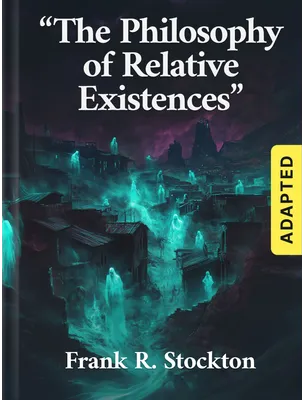
[adapted]
by
Frank R. Stockton

In a certain summer, not long ago, my friend Bentley and I found ourselves in a small village which looked over a calm valley, through which a river moved gently, going in curves through green fields until it turned around the end of a line of low hills and was out of sight. Beyond this river, far away, but visible from the door of the cottage where we lived, there was a city. Through the mist that floated over the valley we could see the shapes of church towers and tall roofs; and buildings of a kind that showed care with money and business stretched down to the other side of the river. The more distant parts of the city, clearly a small one, lost themselves in the misty summer air.
Bentley was young, blond, and a poet; I was a thinker, or trying to be one. We were good friends, and had come to this quiet area to work together. Although we had run away from the busy noise and distractions of the town, the sight, in this country area, of a city, which, as far as we could see, had no effect on the quiet nature of the valley where it lay, made us interested. No boats went up and down the river; there were no bridges from one side to the other; there were none of those spread-out and half-dirty homes which usually are found on the edge of a city; there came to us no far-off sound of bells; and not the smallest curl of smoke rose from any of the buildings.
In answer to our questions our landlord told us that the city over the river had been built by one man, who was a dreamer, and who had much more money than sense. “It is not as big a town as you would think, sirs,” he said, “because the mist in this valley makes things look larger than they are. Those hills, for example, when you get to them, are not as high as they look from here. But the town is big enough, and much too big; because it ruined its builder and owner, who, when he died, did not have money enough left to put up a simple tombstone at the head of his grave. He had a strange idea that he would like to have his town all finished before anybody lived in it, and so he kept on working and spending money year after year and year after year until the city was finished and he had not a cent left.”
While the place was being built, hundreds of people came to him to buy houses, or to rent them, but he would not agree to anything like that. No one was allowed to live in his town until it was all done. Even his workers had to go away at night to sleep. It is a town, sirs, I am told, where nobody has slept even for one night. There are streets there, and places of business, and churches, and public halls, and everything that a town full of people could need; but it is all empty and without people, and has been this way as long as I can remember, and I came to this area when I was a little boy.”
“And is there no one to guard the place?” we asked; “no one to protect it from wandering tramps who might choose to take over the buildings?”
“There are not many homeless people in this part of the country,” he said, “and if there were they would not go to that city. It has ghosts.”
“How?” we asked.
“Well, sirs, I can hardly tell you; strange creatures that are not made of flesh and blood, and that is all I know about it. Many people living around here have visited that place once in their lives, but I do not know anyone who has gone there a second time.”
“And travelers,” I said, “aren’t they curious to go and see that strange city with no people?”
“Oh yes,” our host said; “almost all visitors to the valley go over to that strange city — usually in small groups, for it is not a place where one wants to walk around alone. Sometimes they see things and sometimes they don’t. But I never knew any man or woman who wanted to live there, though it is a very good town.”
This was said at dinner time, and, as it was the time of the full moon, Bentley and I decided to visit the haunted city that evening. Our host tried to stop us, saying that no one ever went over there at night; but since we would not be stopped he told us where we would find his small boat tied to a post on the river bank. We soon crossed the river, and landed at a wide but low stone pier, where, at the land end, a line of tall grasses waved in the gentle night wind as if they were guards warning us not to enter the silent city. We pushed through these, and walked up a fairly wide street, and so well paved that we saw none of the weeds and other plants that usually mean a place is empty or used little.
By the bright light of the moon we could see that the buildings were simple, and very pleasing to the eye. All the buildings were of stone, and of good size. We were very excited and interested, and decided to keep walking until the moon went down, and to come back the next morning — “to live here, perhaps,” said Bentley. “What could be so romantic and yet so real? What could be better for the joining of poetry and philosophy?” But as he said this we saw around the corner of a side street some shapes like people hurrying away.
“The ghosts,” said my friend, putting his hand on my arm.
“Homeless people, more likely,” I answered, “who have used the local superstition to take this comfort and beauty for themselves.”
“If that is so,” said Bentley, “we must be careful to stay alive.”
We went carefully, and soon saw other shapes running away before us and going out of sight, as we thought, around corners and into houses. And now, suddenly finding ourselves on the edge of a wide, open public square, we saw in the dim light — for a tall church tower blocked the moon — the shapes of carts, horses, and men moving here and there. But before, in our surprise, we could say a word to each other, the moon moved past the church tower, and in its bright light we could see none of the signs of life and movement which had just surprised us.
Nervously, with hearts beating fast, but with no thought of turning back, and no fear of beggars — for we were now sure that what we had seen was not a real person of flesh and blood, and so harmless — we crossed the open space and entered a street where the moon shone clearly. Here and there we saw faint shapes, which quickly disappeared; but, as we came near a low stone balcony in front of one of the houses, we were surprised to see, sitting on it and bending over a book which lay open on top of the carved railing, the shape of a woman who did not seem to notice us.
“That is a real person,” Bentley said quietly, “and she does not see us.”
“No,” I said; “it is like the others. Let’s go near it.”
We came close to the balcony and stood before it. Then the figure raised its head and looked at us. It was beautiful, it was young; but its body seemed to be of a very light, airy kind that we had never seen or known. With its full, soft eyes looking at us, it spoke.
“Why are you here?” it asked. “I said to myself that the next time I saw any of you I would ask you why you come to bother us. Can’t you live happily in your own places and worlds, knowing, as you must know, how easily scared we are, and how you scare us and make us unhappy? In all this city, I believe, there is not one of us except myself who does not run away and hide from you whenever you come here and are cruel. Even I would do that, if I had not told myself that I would see you and speak to you, and try to get you to leave us in peace.”
The clear, honest voice of the speaker made me feel brave. “We are two men,” I answered, “strangers in this area, and living for now in the beautiful country on the other side of the river. We heard about this quiet city, and we have come to see it for ourselves. We had thought it was empty, but now that we see this is not so, we truly tell you from our hearts that we do not want to bother any one who lives here. We only came as honest travellers to see the city.”
The figure now sat down again, and as her face was closer to us, we could see that it was full of serious thought. For a moment she looked at us without speaking. “Men!” she said. “And so I have been right. For a long time I have believed that the ones who sometimes come here, and fill us with fear and wonder, are men.”
“And you,” I shouted — ” who are you, and who are these people that we have seen, these strange people who live in this city?”
She smiled softly as she answered, “We are ghosts from the future. We are the people who will live in this city many generations from now. But not all of us know that, mainly because we do not think about it or study it enough to know it. And most people believe that the men and women who sometimes come here are ghosts who haunt the place.”
“And that is why you are very afraid and run away from us?” I said. “You think we are ghosts from another world?”
“Yes,” she said; “that is what people think, and what I used to think.”
“And you,” I asked, “are ghosts of people not born yet?”
“Yes,” she answered; “but not for a long time. Generations of people — I do not know how many — must pass before we are men and women.”
“Heavens!” said Bentley, holding his hands together and looking up at the sky, “I will be a ghost before you become a woman.”
“Maybe,” she said again, with a sweet smile on her face, “you may live to be very, very old.”
But Bentley shook his head. This did not comfort him. For a few minutes I stood in thought, looking at the stone pavement under my feet. “And this,” I cried, “is a city lived in by the ghosts of the future, who think men and women are ghosts and spirits?”
She bowed her head.
“But how is it,” I asked, “that you found out that you are spirits and we people who can die?”
“There are so few of us who think of such things,” she answered, “so few who study and think carefully. I like to study, and I love big ideas; and from reading many books I have learned much. From the book I have here I have learned the most; and from what it teaches I have slowly come to believe, which you tell me is the right one, that we are spirits and you are men.”
“And what book is that?” I asked.
“It is ‘The Ideas about Related Lives,’ by Rupert Vance.”
“Goodness!” I shouted, jumping onto the balcony, “that is my book, and I am Rupert Vance.” I stepped toward the book to grab it, but she raised her hand.
“You cannot touch it,” she said. “It is the ghost of a book. And did you write it?”
“Write it? No,” I said; “I am writing it. It is not yet finished.”
“But here it is,” she said, turning the last pages. “As a spirit book it is finished. It is very successful; it is well thought of by smart thinkers; it is an important book.”
I stood shaking with feeling. “Great respect!” I said. “An important book!”
“Oh yes,” she answered, with excitement; “and it really deserves its great success, especially at the end. I have read it twice.”
“But let me see these last pages,” I said. “Let me look at what I am going to write.”
She smiled, and shook her head, and closed the book. “I would like to do that,” she said, “but if you are really a man you must not know what you are going to do.”
“Oh, tell me, tell me,” shouted Bentley from below, “do you know a book called ‘Stellar Studies,’ by Arthur Bentley? It is a book of poems.”
The figure looked at him. “No,” it said, after a moment, “I never heard of it.”
I stood shaking. If the young person in front of me had been a real person, if the book had been a real one, I would have grabbed it from her.
“Oh wise and lovely person!” I cried out, falling on my knees before her, “be also kind and generous. Let me only see the last page of my book. If I have been of help to your world; above all, if I have been of help to you, let me see, I beg you — let me see how I have done it.”
She stood up with the book in her hand. “You only have to wait until you have done it,” she said, “and then you will know everything that you could see here.” I jumped to my feet and stood alone on the balcony.
“I am sorry,” said Bentley, as we walked toward the dock where we had left our boat, “that we talked only to that ghost girl, and that the other ghosts were all afraid of us. People whose minds are full of philosophy do not usually like poetry; and even if my book becomes well known, it is clear that she may not know about it.”
I walked proud. The moon, almost touching the edge of the sky, shone like red gold. “My dear friend,” I said, “I have always told you that you should put more ideas about life into your poetry. That would make it feel alive.”
“And I have always told you,” he said, “that you should not put so much poetry into your ideas about life. It confuses people.”
“It didn’t fool that ghost girl,” I said.
“How do you know?” said Bentley. “Maybe she is wrong, and the other people in the city are right, and we may be the ghosts after all. Such things, you know, depend on how you look at them. Anyway,” he went on, after a short pause, “I wish I knew that those ghosts are now reading the poem that I will start tomorrow.”