[{"id":"para_1","index":0,"start":0,"offset":346,"words":5,"paraNum":"","lastModified":1773189741000,"semanticType":"title-book-title","voicework":"tts","blockId":"no_place_for_a_woman_short_story_en-bl2s","language":"en","wordsRange":{"start":100000000,"end":106000000},"paragraphVersion":17,"direction":"ltr","paragraph":"<h1 class=\"ilm-title ilm-x-large\" id=\"para_1\" semantictype=\"title-book-title\" data-ilmid=\"no_place_for_a_woman_short_story_en-bl2s\" data-audio=\"1\" data-chapter=\"para_1\" data-words-count=\"5\" data-before=\"0\" data-ww=\"\"><span class=\"block-pb\"> <span class=\"block-pb is-animated\"></span> </span><span class=\"itm-wrap\">No Place for a Woman</span></h1>","hasContent":true,"isFirst":true,"isLast":false},{"id":"para_2","index":1,"start":346,"offset":334,"words":1,"paraNum":"","lastModified":1773189726000,"semanticType":"title-subtitle","voicework":"tts","blockId":"no_place_for_a_woman_short_story_en-bl4m","language":"en","wordsRange":{"start":139333333,"end":172666667},"paragraphVersion":30,"direction":"ltr","paragraph":"<h1 class=\"ilm-title ilm-subtitle\" id=\"para_2\" semantictype=\"title-subtitle\" data-ilmid=\"no_place_for_a_woman_short_story_en-bl4m\" data-audio=\"1\" data-chapter=\"para_2\" data-words-count=\"1\" data-before=\"5\" data-ww=\"\"><span class=\"block-pb\"> <span class=\"block-pb is-animated\"></span> </span><span class=\"itm-wrap\">[adapted]</span></h1>","hasContent":true,"isFirst":false,"isLast":false},{"id":"para_3","index":2,"start":680,"offset":364,"words":2,"paraNum":"","lastModified":1773189914000,"semanticType":"title-author","voicework":"tts","blockId":"no_place_for_a_woman_short_story_en-bl2t","language":"en","wordsRange":{"start":206000000,"end":210000000},"paragraphVersion":28,"direction":"ltr","paragraph":"<h1 class=\"ilm-title ilm-author ilm-large ilm-nopad\" id=\"para_3\" semantictype=\"title-author\" data-ilmid=\"no_place_for_a_woman_short_story_en-bl2t\" data-audio=\"1\" data-chapter=\"para_3\" data-words-count=\"2\" data-before=\"6\" data-ww=\"\"><span class=\"block-pb\"> <span class=\"block-pb is-animated\"></span> </span><span class=\"itm-wrap\">by <br>Henry Lawson<br></span></h1>","hasContent":true,"isFirst":false,"isLast":false},{"id":"para_4","index":3,"start":1044,"offset":163,"words":0,"paraNum":"","lastModified":1722854025000,"semanticType":"line","blockId":"no_place_for_a_woman_short_story_en-bl4h","language":"en","wordsRange":{"start":310000000,"end":410000000},"paragraphVersion":9,"direction":"ltr","paragraph":"<hr class=\"ilm-hr ilm-small\" id=\"para_4\" semantictype=\"line\" data-ilmid=\"no_place_for_a_woman_short_story_en-bl4h\" data-words-count=\"0\" data-before=\"8\" data-ww=\"\">","hasContent":true,"isFirst":false,"isLast":false},{"id":"para_5","index":4,"start":1207,"offset":1760,"words":0,"paraNum":"","lastModified":1722952236000,"semanticType":"illustration","blockId":"no_place_for_a_woman_short_story_en-bl4j","language":"en","wordsRange":{"start":510000000,"end":610000000},"paragraphVersion":9,"direction":"ltr","paragraph":"<div class=\"ilm-illustration\" id=\"para_5\" semantictype=\"illustration\" data-ilmid=\"no_place_for_a_woman_short_story_en-bl4j\" data-words-count=\"0\" data-before=\"8\" data-ww=\"\"><img width=\"600\" height=\"343\" data-src=\"ch0p0\" src=\"data:image/webp;base64,UklGRkQEAABXRUJQVlA4IDgEAACwEQCdASo8ACIAPm0wk0WkIyGWrM20QAbEsQBOmVxfwkCWxqMx1LbdtAacB6AH6ARwxoS934OkQvtLwv79/eQnXIqvBt1EZMTK97p6GPPC9T+wZ0nSY/Z9ev2b+DdA8YMswG5RGOmurmtEjI+Y/LFHCx8FG+lNOAzgEHfeu3gbLAn6qNl9r4YVLcFBpVxrULWXMsYHFAAA/vkGmygdzEGnqI8+NRyn7xHmiPpH9x5tkbZsWcH2xO+qkixAgpMIfHU0wOES+9xfVN7jmx6XO0n1O51ytjktof1loiqwzZMrMaGGfYNmZPKUENfY2rw315VvegfajG4B+9IxpIQEXl9Nwj2aokOKiEYMNtlExqSzCV3Nu8VYc6Lz1WHlqjvFO7mPA9/rljb6MjXG0LTvYWF/zlcK6+uUQTCHGgQwUz2HxrGdeYf2W+yYGTA93CuhNF5QTQwvimgdXfkr3SC0h98SSzKbQctGUcBtwc7WEfdYneViaz1Xv6CUI7o/EMWUOGelL19niDvBwnA4yNSXRq/fxyKXIxbaPuAXuNDg1OhU6V56vcwgxmWs5Dv7z2OqFiQEj5KQVd3qeAz8NDdPZbRvXZeKY+E8j69OZfqTSMYfvRhlZsNtGxrKBeP75u2m+hjtewmK7bVfXFeyuNRDcfKdVopQu9fIVOi1jtaDnRK2n+Rexq1A38P4G2zi7UKAjbe13AYmPBompsA2K4e4jfD8x7OXnCZN+7KYjvixd3o8vIAwuYvjjUjSm9lMXf4QmG6f71P4Ct97rRENGzAtBKZ8N8FvXuioVR0ON/T71NPlCaoJJkCgKp97zQbMh//fWQdDN7t1d9Y/0MalynLB/6ktQCEIlv+KqsRRJNvubGSiNzXmzscBRXES5eX8atr5etKKjOWZAOIvRzo7O9ELO5PZNnstAF3vYlM0lxY+myOONfgdp36Ri+N5zJd7mv0Wga7V9/oI4v8D3WRizUX8rD6wm46htBwGqgJ7rmOdGGCQFCLdV1g/3BiUTfpcsDWi8++31p8mvq1lQkLaz1OpSx1PIg1pc1qrqTNdkczjUkjsn0gvGqL8E/CyTdOLJYYD+dIVDuVMlcdQRMWMSBGFNS1qhAQdsC3hqeNBf5FteqyqGfK25/cpDSZB9wqk+DIRTrQ/+inhnMt256KZKlH/aGvvOaJ8vRFc2SCRlHQ/3q19ImVXnWqjwXPp2Sy7D9Q7SUsp82/doBQTM0//Rz4FfKxZNHVNdq5SIcUi+OT4SVln4jenByGGXknM9c6QdzXUisOopDC4NdKXH9X0P6mrNtn9476hJmWgVYl+w/yol2HJfsdkjTrkDREdIbOHpasZhCAdjP8PGVHxPd8v+M5HKhowWq4/QcfXjmjuQ1NM8xFzStpKBYMBVxUoynn840QfvwuX/7nb39fDqrbCQAiveMvNQ1KY97KDAAA=\" alt=\"No Place for a Woman (adapted)\"></div>","hasContent":true,"isFirst":false,"isLast":false},{"id":"para_6","index":5,"start":2967,"offset":870,"words":112,"paraNum":"1","lastModified":1773189701000,"semanticType":"par","voicework":"tts","blockId":"no_place_for_a_woman_short_story_en-bl2u","language":"en","wordsRange":{"start":710000000,"end":813000000},"paragraphVersion":25,"direction":"ltr","paragraph":"<p id=\"para_6\" semantictype=\"par\" data-ilmid=\"no_place_for_a_woman_short_story_en-bl2u\" data-audio=\"1\" data-words-count=\"112\" data-before=\"8\" data-ww=\"\"><span class=\"block-num\" data-id=\"1\"></span><span class=\"block-pb\"> <span class=\"block-pb is-animated\"></span> </span><span class=\"itm-wrap\">He had a small farm on a long bushy slope of the ridges, about half a mile back and up from the coach road. There were no neighbours that I ever heard of, and the nearest “town” was thirty miles away. He grew wheat among the stumps on his cleared land, sold the crop while it was still standing to a small farmer who lived ten miles away, and had some extra sons; or, some seasons, he cut it by hand, had it beaten out by a travelling “steamer” (a small steam engine and machine), and carried the grain, a few bags at a time, into the mill on his shaky cart.</span></p>","hasContent":true,"isFirst":false,"isLast":false},{"id":"para_7","index":6,"start":3837,"offset":1159,"words":152,"paraNum":"2","lastModified":1773189719000,"semanticType":"par","voicework":"tts","blockId":"no_place_for_a_woman_short_story_en-bl2v","language":"en","wordsRange":{"start":913000000,"end":1073000000},"paragraphVersion":24,"direction":"ltr","paragraph":"<p id=\"para_7\" semantictype=\"par\" data-ilmid=\"no_place_for_a_woman_short_story_en-bl2v\" data-audio=\"1\" data-words-count=\"152\" data-before=\"120\" data-ww=\"\"><span class=\"block-num\" data-id=\"2\"></span><span class=\"block-pb\"> <span class=\"block-pb is-animated\"></span> </span><span class=\"itm-wrap\">He had lived alone for more than 15 years, and was known by those who knew him as “Ratty Howlett”. Travellers and strangers did not see anything very “ratty” about him. It was known, or at least believed, without question, that while at work he kept his horse with saddle and bridle on, and tied to the fence, or eating grass, with the saddle on — or, anyway, close and ready at a moment’s notice — and whenever he saw, over the low bushes and through the quarter-mile gap in them, a traveller on the road, he would jump on his horse and chase him. If it was a rider he usually stopped him within a mile. Stories were told of failed chases, misunderstandings, and problems coming from Howlett’s habit of chasing and stopping travellers. Sometimes he caught one every day for a week, sometimes not one for weeks — it was a lonely track.</span></p>","hasContent":true,"isFirst":false,"isLast":false},{"id":"para_8","index":7,"start":4996,"offset":1146,"words":166,"paraNum":"3","lastModified":1773189614000,"semanticType":"par","voicework":"tts","blockId":"no_place_for_a_woman_short_story_en-bl2x","language":"en","wordsRange":{"start":1173000000,"end":1333000000},"paragraphVersion":24,"direction":"ltr","paragraph":"<p id=\"para_8\" semantictype=\"par\" data-ilmid=\"no_place_for_a_woman_short_story_en-bl2x\" data-audio=\"1\" data-words-count=\"166\" data-before=\"272\" data-ww=\"\"><span class=\"block-num\" data-id=\"3\"></span><span class=\"block-pb\"> <span class=\"block-pb is-animated\"></span> </span><span class=\"itm-wrap\">The reason was simple, good enough, and very natural — from a bushman’s way of thinking. Ratty only wanted to have a chat. He and the traveller would camp in the shade for half an hour or so and chat and smoke. The old man would find out where the traveller came from, and how long he’d been there, and where he was going to, and how long he thought he’d be away; and ask if there had been any rain along the way he had come, and how the country looked after the long dry time; and he’d get the traveller’s ideas on big, general questions — if he had any. If it was a man on foot (swagman), and he was short of tobacco, old Howlett always had half a stick ready for him. Sometimes, but not often, he’d invite the swagman back to the hut for a pint of tea, or a bit of meat, flour, tea, or sugar, to help him along the track.</span></p>","hasContent":true,"isFirst":false,"isLast":false},{"id":"para_9","index":8,"start":6142,"offset":532,"words":45,"paraNum":"4","lastModified":1773189682000,"semanticType":"par","voicework":"tts","blockId":"no_place_for_a_woman_short_story_en-bl2y","language":"en","wordsRange":{"start":1433000000,"end":1478000000},"paragraphVersion":25,"direction":"ltr","paragraph":"<p id=\"para_9\" semantictype=\"par\" data-ilmid=\"no_place_for_a_woman_short_story_en-bl2y\" data-audio=\"1\" data-words-count=\"45\" data-before=\"438\" data-ww=\"\"><span class=\"block-num\" data-id=\"4\"></span><span class=\"block-pb\"> <span class=\"block-pb is-animated\"></span> </span><span class=\"itm-wrap\">And, after the chat by the road, they said, the old man would ride back, feeling better, to his lonely farm, and work on into the night as long as he could see his only old plough horse, or the blade of his long-handled shovel.</span></p>","hasContent":true,"isFirst":false,"isLast":false},{"id":"para_10","index":9,"start":6674,"offset":663,"words":71,"paraNum":"5","lastModified":1773189679000,"semanticType":"par","voicework":"tts","blockId":"no_place_for_a_woman_short_story_en-bl2z","language":"en","wordsRange":{"start":1578000000,"end":1648000000},"paragraphVersion":35,"direction":"ltr","paragraph":"<p id=\"para_10\" semantictype=\"par\" data-ilmid=\"no_place_for_a_woman_short_story_en-bl2z\" data-audio=\"1\" data-words-count=\"71\" data-before=\"483\" data-ww=\"\"><span class=\"block-num\" data-id=\"5\"></span><span class=\"block-pb\"> <span class=\"block-pb is-animated\"></span> </span><span class=\"itm-wrap\">And so it happened that I got to know him — or, rather, that he got to know me. I was riding easily along the track — I was going to the north-west with a pack horse — when about a mile past the track to the farm I heard, “Hi, Mister!” and saw a dust cloud following me. I had heard of “Old Ratty Howlett” in passing, and so was ready for him.</span></p>","hasContent":true,"isFirst":false,"isLast":false},{"id":"para_11","index":10,"start":7337,"offset":952,"words":123,"paraNum":"6","lastModified":1773190106000,"semanticType":"par","voicework":"tts","blockId":"no_place_for_a_woman_short_story_en-bl30","language":"en","wordsRange":{"start":1748000000,"end":1865000000},"paragraphVersion":27,"direction":"ltr","paragraph":"<p id=\"para_11\" semantictype=\"par\" data-ilmid=\"no_place_for_a_woman_short_story_en-bl30\" data-audio=\"1\" data-words-count=\"123\" data-before=\"554\" data-ww=\"\"><span class=\"block-num\" data-id=\"6\"></span><span class=\"block-pb\"> <span class=\"block-pb is-animated\"></span> </span><span class=\"itm-wrap\">A tall thin man on a little horse. He had no beard, except for a small beard under his chin, and his long wavy, dark hair was turning grey; a square, strong-faced man, and he made me think of one picture of Gladstone, showing his full face, more than any other face I had seen. He had large reddish-brown eyes, set deep under heavy eyebrows, and with something of the blackfellow in them — the sort of eyes that will look hard at something on the horizon that no one else can see. He had a habit of talking to the horizon, too — more than to his friend; and he had a deep up-and-down wrinkle in his forehead that no smile could make smaller.</span></p>","hasContent":true,"isFirst":false,"isLast":false},{"id":"para_12","index":11,"start":8289,"offset":641,"words":70,"paraNum":"7","lastModified":1773189984000,"semanticType":"par","voicework":"tts","blockId":"no_place_for_a_woman_short_story_en-bl31","language":"en","wordsRange":{"start":1965000000,"end":2032000000},"paragraphVersion":21,"direction":"ltr","paragraph":"<p id=\"para_12\" semantictype=\"par\" data-ilmid=\"no_place_for_a_woman_short_story_en-bl31\" data-audio=\"1\" data-words-count=\"70\" data-before=\"677\" data-ww=\"\"><span class=\"block-num\" data-id=\"7\"></span><span class=\"block-pb\"> <span class=\"block-pb is-animated\"></span> </span><span class=\"itm-wrap\">I got down and took out my pipe, and we sat on a log and talked for a while about the bush; and then, after a pause, he moved in an uncomfortable way, it seemed to me, and asked very suddenly, and in a different tone, if I was married. A strange question to ask a traveller; especially in my case, as I was little more than a boy then.</span></p>","hasContent":true,"isFirst":false,"isLast":false},{"id":"para_13","index":12,"start":8930,"offset":821,"words":100,"paraNum":"8","lastModified":1773190000000,"semanticType":"par","voicework":"tts","blockId":"no_place_for_a_woman_short_story_en-bl32","language":"en","wordsRange":{"start":2132000000,"end":2235000000},"paragraphVersion":24,"direction":"ltr","paragraph":"<p id=\"para_13\" semantictype=\"par\" data-ilmid=\"no_place_for_a_woman_short_story_en-bl32\" data-audio=\"1\" data-words-count=\"100\" data-before=\"747\" data-ww=\"\"><span class=\"block-num\" data-id=\"8\"></span><span class=\"block-pb\"> <span class=\"block-pb is-animated\"></span> </span><span class=\"itm-wrap\">He talked again about old things and places where we had both been, and asked about men he knew, or had known — drovers and others — and whether they were still alive. Most of his questions went back to before my time; but some of the drovers, one or two overlanders he had been mates with then, had grown old in my time, and I knew them. I see now, though I didn’t then — and if I had, it would not have seemed strange from a bush point of view — that he didn’t ask for news, or seem interested in it.</span></p>","hasContent":true,"isFirst":false,"isLast":false},{"id":"para_14","index":13,"start":9751,"offset":543,"words":45,"paraNum":"9","lastModified":1773190027000,"semanticType":"par","voicework":"tts","blockId":"no_place_for_a_woman_short_story_en-bl33","language":"en","wordsRange":{"start":2335000000,"end":2381000000},"paragraphVersion":24,"direction":"ltr","paragraph":"<p id=\"para_14\" semantictype=\"par\" data-ilmid=\"no_place_for_a_woman_short_story_en-bl33\" data-audio=\"1\" data-words-count=\"45\" data-before=\"847\" data-ww=\"\"><span class=\"block-num\" data-id=\"9\"></span><span class=\"block-pb\"> <span class=\"block-pb is-animated\"></span> </span><span class=\"itm-wrap\">Then after another uncomfortable pause, while he drew crosses in the dust with a stick, he asked me, in the same strange voice and without looking at me or looking up, if I knew anything about being a doctor — if I had ever studied it.</span></p>","hasContent":true,"isFirst":false,"isLast":false},{"id":"para_15","index":14,"start":10294,"offset":861,"words":110,"paraNum":"10","lastModified":1773190121000,"semanticType":"par","voicework":"tts","blockId":"no_place_for_a_woman_short_story_en-bl34","language":"en","wordsRange":{"start":2481000000,"end":2587000000},"paragraphVersion":21,"direction":"ltr","paragraph":"<p id=\"para_15\" semantictype=\"par\" data-ilmid=\"no_place_for_a_woman_short_story_en-bl34\" data-audio=\"1\" data-words-count=\"110\" data-before=\"892\" data-ww=\"\"><span class=\"block-num\" data-id=\"10\"></span><span class=\"block-pb\"> <span class=\"block-pb is-animated\"></span> </span><span class=\"itm-wrap\">I asked him if anyone was sick at his place. He paused, and said “No.” Then I wanted to know why he had asked me that question, and he took so long to answer that I began to think he could not hear well, when, at last, he said something quietly about my face making him think of a young man he knew who had gone to Sydney to “study to be a doctor”. That might be true, and seemed natural enough; but why didn’t he ask me directly if I was the man he “knowed of”? Travellers do not like it when people do not speak directly in conversation.</span></p>","hasContent":true,"isFirst":false,"isLast":false},{"id":"para_16","index":15,"start":11155,"offset":574,"words":54,"paraNum":"11","lastModified":1773190013000,"semanticType":"par","voicework":"tts","blockId":"no_place_for_a_woman_short_story_en-bl35","language":"en","wordsRange":{"start":2687000000,"end":2741000000},"paragraphVersion":21,"direction":"ltr","paragraph":"<p id=\"para_16\" semantictype=\"par\" data-ilmid=\"no_place_for_a_woman_short_story_en-bl35\" data-audio=\"1\" data-words-count=\"54\" data-before=\"1002\" data-ww=\"\"><span class=\"block-num\" data-id=\"11\"></span><span class=\"block-pb\"> <span class=\"block-pb is-animated\"></span> </span><span class=\"itm-wrap\">He sat in silence for a long time, with his arms folded, and looking away without thinking over the very flat land of the big scrub that spread from the bottom of the ridge we were on to where a blue peak or two of far mountains showed above the bush on the horizon.</span></p>","hasContent":true,"isFirst":false,"isLast":false},{"id":"para_17","index":16,"start":11729,"offset":559,"words":50,"paraNum":"12","lastModified":1773190132000,"semanticType":"par","voicework":"tts","blockId":"no_place_for_a_woman_short_story_en-bl36","language":"en","wordsRange":{"start":2841000000,"end":2890000000},"paragraphVersion":21,"direction":"ltr","paragraph":"<p id=\"para_17\" semantictype=\"par\" data-ilmid=\"no_place_for_a_woman_short_story_en-bl36\" data-audio=\"1\" data-words-count=\"50\" data-before=\"1056\" data-ww=\"\"><span class=\"block-num\" data-id=\"12\"></span><span class=\"block-pb\"> <span class=\"block-pb is-animated\"></span> </span><span class=\"itm-wrap\">I stood up and put my smoking pipe away and stretched. Then he seemed to wake up. “Better come back to the little house and have a bit of dinner,” he said. “My wife will have it ready soon, and I’ll give you a handful of hay for the horses.”</span></p>","hasContent":true,"isFirst":false,"isLast":false},{"id":"para_18","index":17,"start":12288,"offset":1160,"words":173,"paraNum":"13","lastModified":1773190049000,"semanticType":"par","voicework":"tts","blockId":"no_place_for_a_woman_short_story_en-bl37","language":"en","wordsRange":{"start":2990000000,"end":3154000000},"paragraphVersion":24,"direction":"ltr","paragraph":"<p id=\"para_18\" semantictype=\"par\" data-ilmid=\"no_place_for_a_woman_short_story_en-bl37\" data-audio=\"1\" data-words-count=\"173\" data-before=\"1106\" data-ww=\"\"><span class=\"block-num\" data-id=\"13\"></span><span class=\"block-pb\"> <span class=\"block-pb is-animated\"></span> </span><span class=\"itm-wrap\">The hay decided it. It was a dry season. I was surprised to hear of a wife, for I thought he was a man who lived alone — I had always heard so; but perhaps I had been wrong, and he had married lately; or had got a housekeeper. The farm was an odd-shaped open space in the bush, with a good many stumps in it, with a broken two-rail fence along the front, and logs and “dog-leg” the rest. It was about as lonely a place as I had seen, and I had seen some far-away, forgotten places where men lived alone. The hut was in the top corner, a two-roomed rough wooden hut, with a roof of wooden shingles, which must have been not common round there in the days when that hut was built. I was used to building in the bush, and saw that the place had been put up by a man who had a lot of life and hope ahead of him, and for someone else besides himself.</span></p>","hasContent":true,"isFirst":false,"isLast":false},{"id":"para_19","index":18,"start":13448,"offset":865,"words":107,"paraNum":"14","lastModified":1773190151000,"semanticType":"par","voicework":"tts","blockId":"no_place_for_a_woman_short_story_en-bl4k","language":"en","wordsRange":{"start":3254000000,"end":3354000000},"paragraphVersion":21,"direction":"ltr","paragraph":"<p id=\"para_19\" semantictype=\"par\" data-ilmid=\"no_place_for_a_woman_short_story_en-bl4k\" data-audio=\"1\" data-words-count=\"107\" data-before=\"1279\" data-ww=\"\"><span class=\"block-num\" data-id=\"14\"></span><span class=\"block-pb\"> <span class=\"block-pb is-animated\"></span> </span><span class=\"itm-wrap\">But there were two unfinished lean-to rooms built on to the back of the hut; the posts, floor beams, and wall beams had been well put up and fitted, and the slab walls were up, but the roof had never been put on. There was nothing but prickly weeds and nettles inside those walls, and an old wooden plough for bullocks and two yokes were going rotten across the back doorway. What was left of a straw stack, some hay under a bark shelter, a small iron plough, and an old stiff grey work horse with a coffin-shaped head, were all that I saw about the place.</span></p>","hasContent":true,"isFirst":false,"isLast":false},{"id":"para_20","index":19,"start":14313,"offset":1394,"words":205,"paraNum":"15","lastModified":1773190081000,"semanticType":"par","voicework":"tts","blockId":"no_place_for_a_woman_short_story_en-bl38","language":"en","wordsRange":{"start":3454000000,"end":3654000000},"paragraphVersion":24,"direction":"ltr","paragraph":"<p id=\"para_20\" semantictype=\"par\" data-ilmid=\"no_place_for_a_woman_short_story_en-bl38\" data-audio=\"1\" data-words-count=\"205\" data-before=\"1386\" data-ww=\"\"><span class=\"block-num\" data-id=\"15\"></span><span class=\"block-pb\"> <span class=\"block-pb is-animated\"></span> </span><span class=\"itm-wrap\">But there was a small surprise for me inside, in the form of a clean white tablecloth on the rough slab table which stood on posts pushed into the ground. The cloth was rough, but it was a tablecloth — not an extra sheet put on to honor unexpected visitors — and perfectly clean. The tin plates, small tin cups, and jam tins that were used as sugar bowls and salt holders were polished until they shone. The walls and fireplace were painted white, the clay floor swept, and clean sheets of newspaper laid on the slab mantel shelf under the row of biscuit tins that held the food. I thought that his wife, or housekeeper, or whoever she was, was a clean and tidy woman in a house. I saw no woman; but on the sofa — a light wooden slatted one, with arms with bars at the ends — lay a woman’s dress on a lot of sheets of old, stained, and faded newspapers. He looked at it in a puzzled way, wrinkling his forehead, then took it up without thinking and folded it. I saw then that it was a riding skirt and jacket. He wrapped them in the newspapers and took them into the bedroom.</span></p>","hasContent":true,"isFirst":false,"isLast":false},{"id":"para_21","index":20,"start":15707,"offset":798,"words":93,"paraNum":"16","lastModified":1773190059000,"semanticType":"par","voicework":"tts","blockId":"no_place_for_a_woman_short_story_en-bl39","language":"en","wordsRange":{"start":3754000000,"end":3846000000},"paragraphVersion":21,"direction":"ltr","paragraph":"<p id=\"para_21\" semantictype=\"par\" data-ilmid=\"no_place_for_a_woman_short_story_en-bl39\" data-audio=\"1\" data-words-count=\"93\" data-before=\"1591\" data-ww=\"\"><span class=\"block-num\" data-id=\"16\"></span><span class=\"block-pb\"> <span class=\"block-pb is-animated\"></span> </span><span class=\"itm-wrap\">“The wife was going to visit down the creek this afternoon,” he said quickly and without looking at me, but bending down as if to have another look through the door at those far mountain tops. “I suppose she got tired of waiting, and went and took the daughter with her. But, never mind, the food is ready.” There was a camp-oven with a leg of lamb and potatoes cooking in it by the fire, and pots hanging over the fire. I noticed the pots had been cleaned, and the lids made shiny.</span></p>","hasContent":true,"isFirst":false,"isLast":false},{"id":"para_22","index":21,"start":16505,"offset":965,"words":127,"paraNum":"17","lastModified":1773190092000,"semanticType":"par","voicework":"tts","blockId":"no_place_for_a_woman_short_story_en-bl3a","language":"en","wordsRange":{"start":3946000000,"end":4068000000},"paragraphVersion":24,"direction":"ltr","paragraph":"<p id=\"para_22\" semantictype=\"par\" data-ilmid=\"no_place_for_a_woman_short_story_en-bl3a\" data-audio=\"1\" data-words-count=\"127\" data-before=\"1684\" data-ww=\"\"><span class=\"block-num\" data-id=\"17\"></span><span class=\"block-pb\"> <span class=\"block-pb is-animated\"></span> </span><span class=\"itm-wrap\">There seemed to be something strange about the whole thing, but then he and his wife might have had a little argument during the morning. I thought so during the meal, when the subject of women came up, and he said you never knew how to deal with a woman, and so on; but there was nothing in what he said that had to be about his wife or any woman in particular. For the rest he talked about old bush things, driving cattle, digging, and old bushranging — but never about things going on now and living men, unless any of the old friends he talked about happened to still be alive by chance. He was very restless in the house, and never took his hat off.</span></p>","hasContent":true,"isFirst":false,"isLast":false},{"id":"para_23","index":22,"start":17470,"offset":1023,"words":138,"paraNum":"18","lastModified":1773190332000,"semanticType":"par","voicework":"tts","blockId":"no_place_for_a_woman_short_story_en-bl3b","language":"en","wordsRange":{"start":4168000000,"end":4307000000},"paragraphVersion":24,"direction":"ltr","paragraph":"<p id=\"para_23\" semantictype=\"par\" data-ilmid=\"no_place_for_a_woman_short_story_en-bl3b\" data-audio=\"1\" data-words-count=\"138\" data-before=\"1811\" data-ww=\"\"><span class=\"block-num\" data-id=\"18\"></span><span class=\"block-pb\"> <span class=\"block-pb is-animated\"></span> </span><span class=\"itm-wrap\">There was a dress and a woman’s old hat hanging on the wall near the door, but they looked as if they might have been hanging there for a very long time. There seemed something strange about the whole place — something missing; but then all far-away bush houses are haunted by that something missing, or, more likely, by the ghosts of the things that should have been there, but never were. As I rode down the track to the road I looked back and saw old Howlett hard at work in a hole around a big stump with his long-handled shovel. I had noticed that he moved and walked with a slight lean to the left, and put his hand once or twice to his lower back, and I thought it was back pain, or something like that.</span></p>","hasContent":true,"isFirst":false,"isLast":false},{"id":"para_24","index":23,"start":18493,"offset":594,"words":56,"paraNum":"19","lastModified":1773190178000,"semanticType":"par","voicework":"tts","blockId":"no_place_for_a_woman_short_story_en-bl3e","language":"en","wordsRange":{"start":4407000000,"end":4465000000},"paragraphVersion":21,"direction":"ltr","paragraph":"<p id=\"para_24\" semantictype=\"par\" data-ilmid=\"no_place_for_a_woman_short_story_en-bl3e\" data-audio=\"1\" data-words-count=\"56\" data-before=\"1949\" data-ww=\"\"><span class=\"block-num\" data-id=\"19\"></span><span class=\"block-pb\"> <span class=\"block-pb is-animated\"></span> </span><span class=\"itm-wrap\">Up in the Never Never I heard from a herder who had known Howlett that his wife had died in the first year, and so this unknown woman, if she was his wife, was, of course, his second wife. The herder seemed surprised and a bit amused at the thought of old Howlett getting married again.</span></p>","hasContent":true,"isFirst":false,"isLast":false},{"id":"para_25","index":24,"start":19087,"offset":774,"words":91,"paraNum":"20","lastModified":1773190554000,"semanticType":"par","voicework":"tts","blockId":"no_place_for_a_woman_short_story_en-bl3f","language":"en","wordsRange":{"start":4565000000,"end":4660000000},"paragraphVersion":24,"direction":"ltr","paragraph":"<p id=\"para_25\" semantictype=\"par\" data-ilmid=\"no_place_for_a_woman_short_story_en-bl3f\" data-audio=\"1\" data-words-count=\"91\" data-before=\"2005\" data-ww=\"\"><span class=\"block-num\" data-id=\"20\"></span><span class=\"block-pb\"> <span class=\"block-pb is-animated\"></span> </span><span class=\"itm-wrap\">I rode back that way five years later, from the Never Never. It was early in the morning — I had ridden since midnight. I didn’t think the old man would be awake and up; and, also, I wanted to get home, and see the old people, and the friends I’d left behind — and the girl. But I hadn’t gone far past the place where Howlett’s track met the road, when I looked back by chance, and saw him on a horse, stumbling down the track. I waited until he came up.</span></p>","hasContent":true,"isFirst":false,"isLast":false},{"id":"para_26","index":25,"start":19861,"offset":1041,"words":152,"paraNum":"21","lastModified":1773190347000,"semanticType":"par","voicework":"tts","blockId":"no_place_for_a_woman_short_story_en-bl3g","language":"en","wordsRange":{"start":4760000000,"end":4910000000},"paragraphVersion":21,"direction":"ltr","paragraph":"<p id=\"para_26\" semantictype=\"par\" data-ilmid=\"no_place_for_a_woman_short_story_en-bl3g\" data-audio=\"1\" data-words-count=\"152\" data-before=\"2096\" data-ww=\"\"><span class=\"block-num\" data-id=\"21\"></span><span class=\"block-pb\"> <span class=\"block-pb is-animated\"></span> </span><span class=\"itm-wrap\">He was riding the old grey work horse this time, and it looked very worn out. I thought it would fall down at every step, and fall down like an old rotten hut in a strong wind. And the old man was not much better. I saw at once that he was a very sick man. His face was thin and tight, and he bent forward as if he was hurt. He got down stiffly and with difficulty, like a hurt man, and as soon as his feet touched the ground he grabbed my arm, or he would have fallen like a man who steps off a moving train. He leaned towards the side of the road, feeling blindly, in a way, for the ground, with his free hand, as I helped him down slowly. I got my blanket and cloth from the saddle that carried the packs to make him comfortable.</span></p>","hasContent":true,"isFirst":false,"isLast":false},{"id":"para_27","index":26,"start":20902,"offset":697,"words":75,"paraNum":"22","lastModified":1773190569000,"semanticType":"par","voicework":"tts","blockId":"no_place_for_a_woman_short_story_en-bl3h","language":"en","wordsRange":{"start":5010000000,"end":5084000000},"paragraphVersion":24,"direction":"ltr","paragraph":"<p id=\"para_27\" semantictype=\"par\" data-ilmid=\"no_place_for_a_woman_short_story_en-bl3h\" data-audio=\"1\" data-words-count=\"75\" data-before=\"2248\" data-ww=\"\"><span class=\"block-num\" data-id=\"22\"></span><span class=\"block-pb\"> <span class=\"block-pb is-animated\"></span> </span><span class=\"itm-wrap\">“Help me with my back against the tree,” he said. “I must sit up — it’s no use lying me down.” He sat with his hand holding his side, and breathed with pain. “Should I run up to the hut and get your wife?” I asked. “No.” He spoke in pain. “No!” Then, as if the words were forced out of him by a sudden pain: “She isn’t there.” I thought that she had left him.</span></p>","hasContent":true,"isFirst":false,"isLast":false},{"id":"para_28","index":27,"start":21599,"offset":579,"words":50,"paraNum":"23","lastModified":1773190357000,"semanticType":"par","voicework":"tts","blockId":"no_place_for_a_woman_short_story_en-bl3m","language":"en","wordsRange":{"start":5184000000,"end":5236000000},"paragraphVersion":24,"direction":"ltr","paragraph":"<p id=\"para_28\" semantictype=\"par\" data-ilmid=\"no_place_for_a_woman_short_story_en-bl3m\" data-audio=\"1\" data-words-count=\"50\" data-before=\"2323\" data-ww=\"\"><span class=\"block-num\" data-id=\"23\"></span><span class=\"block-pb\"> <span class=\"block-pb is-animated\"></span> </span><span class=\"itm-wrap\">“How long have you been sick? How long has this been happening?” He did not answer the question. I thought it was a bit of rheumatic fever, or something like that. “It’s gone into my back and sides now — the pain’s worse in my back,” he said after a moment.</span></p>","hasContent":true,"isFirst":false,"isLast":false},{"id":"para_29","index":28,"start":22178,"offset":697,"words":79,"paraNum":"24","lastModified":1773190583000,"semanticType":"par","voicework":"tts","blockId":"no_place_for_a_woman_short_story_en-bl3o","language":"en","wordsRange":{"start":5336000000,"end":5418000000},"paragraphVersion":24,"direction":"ltr","paragraph":"<p id=\"para_29\" semantictype=\"par\" data-ilmid=\"no_place_for_a_woman_short_story_en-bl3o\" data-audio=\"1\" data-words-count=\"79\" data-before=\"2373\" data-ww=\"\"><span class=\"block-num\" data-id=\"24\"></span><span class=\"block-pb\"> <span class=\"block-pb is-animated\"></span> </span><span class=\"itm-wrap\">I had once been friends with a man who died suddenly of a heart problem, while at work. He was washing a dish of dirt in the creek near the place we were working; he let the dish drop into the water, fell back, crying, “O, my back!” and died. And now I just felt that something was wrong with poor old Howlett’s heart. A man’s heart is in his back as well as in his arms and hands.</span></p>","hasContent":true,"isFirst":false,"isLast":false},{"id":"para_30","index":29,"start":22875,"offset":1048,"words":142,"paraNum":"25","lastModified":1773190377000,"semanticType":"par","voicework":"tts","blockId":"no_place_for_a_woman_short_story_en-bl3p","language":"en","wordsRange":{"start":5518000000,"end":5665000000},"paragraphVersion":24,"direction":"ltr","paragraph":"<p id=\"para_30\" semantictype=\"par\" data-ilmid=\"no_place_for_a_woman_short_story_en-bl3p\" data-audio=\"1\" data-words-count=\"142\" data-before=\"2452\" data-ww=\"\"><span class=\"block-num\" data-id=\"25\"></span><span class=\"block-pb\"> <span class=\"block-pb is-animated\"></span> </span><span class=\"itm-wrap\">The old man had turned pale like a man who feels faint in a heat wave, and his arms fell loosely, and his hands moved helplessly with the knuckles in the dust. I felt myself turning white, too, and the sick, cold, empty feeling in my stomach, because I knew the signs. Bushmen are afraid of sickness and death. But after I had made him comfortable and given him a drink from the water bag the grey left his face, and he felt a bit better; he drew up his arms and folded them across his chest. He let his head rest back against the tree — his hat had fallen off, showing a wide, white forehead, much higher than I expected. He seemed to look at the bright blue line of the mountains, showing above the dark blue-green bush on the horizon.</span></p>","hasContent":true,"isFirst":false,"isLast":false},{"id":"para_31","index":30,"start":23923,"offset":763,"words":94,"paraNum":"26","lastModified":1773190390000,"semanticType":"par","voicework":"tts","blockId":"no_place_for_a_woman_short_story_en-bl3r","language":"en","wordsRange":{"start":5765000000,"end":5853000000},"paragraphVersion":24,"direction":"ltr","paragraph":"<p id=\"para_31\" semantictype=\"par\" data-ilmid=\"no_place_for_a_woman_short_story_en-bl3r\" data-audio=\"1\" data-words-count=\"94\" data-before=\"2594\" data-ww=\"\"><span class=\"block-num\" data-id=\"26\"></span><span class=\"block-pb\"> <span class=\"block-pb is-animated\"></span> </span><span class=\"itm-wrap\">Then he started to speak — paying no attention to me when I asked him if he felt better now — to talk in that strange, dreamy, far-away voice that makes you feel quiet. He told his story like a machine, in a dull, flat way — in the same words, as I think now, as he had often told it before; if not to others, then to the lonely bush. And he used the names of people and places that I had never heard of — just as if I knew them as well as he did.</span></p>","hasContent":true,"isFirst":false,"isLast":false},{"id":"para_32","index":31,"start":24686,"offset":832,"words":106,"paraNum":"27","lastModified":1773190404000,"semanticType":"par","voicework":"tts","blockId":"no_place_for_a_woman_short_story_en-bl3s","language":"en","wordsRange":{"start":5953000000,"end":6059000000},"paragraphVersion":24,"direction":"ltr","paragraph":"<p id=\"para_32\" semantictype=\"par\" data-ilmid=\"no_place_for_a_woman_short_story_en-bl3s\" data-audio=\"1\" data-words-count=\"106\" data-before=\"2688\" data-ww=\"\"><span class=\"block-num\" data-id=\"27\"></span><span class=\"block-pb\"> <span class=\"block-pb is-animated\"></span> </span><span class=\"itm-wrap\">“I didn’t want to bring her up the first year. It was no place for a woman. I wanted her to stay with her people and wait till I’d got the place a little more tidy. The Phipps family took a farm down the creek. I wanted her to wait and come up with them so she’d have some company — a woman to talk to. They came later, but they didn’t stay. It was no place for a woman. But Mary would come. She wouldn’t stay with her people down country. She wanted to be with me, and look after me, and work and help me.”</span></p>","hasContent":true,"isFirst":false,"isLast":false},{"id":"para_33","index":32,"start":25518,"offset":835,"words":97,"paraNum":"28","lastModified":1773190600000,"semanticType":"par","voicework":"tts","blockId":"no_place_for_a_woman_short_story_en-bl3u","language":"en","wordsRange":{"start":6159000000,"end":6259000000},"paragraphVersion":24,"direction":"ltr","paragraph":"<p id=\"para_33\" semantictype=\"par\" data-ilmid=\"no_place_for_a_woman_short_story_en-bl3u\" data-audio=\"1\" data-words-count=\"97\" data-before=\"2794\" data-ww=\"\"><span class=\"block-num\" data-id=\"28\"></span><span class=\"block-pb\"> <span class=\"block-pb is-animated\"></span> </span><span class=\"itm-wrap\">He repeated himself a lot — said the same thing over and over again sometimes. He was only mad about one thing. He’d stop talking and sit quiet for a while; then he’d notice me in a quick, half-scared way, and say sorry for giving me all that trouble, and thank me. “I’ll be all right soon. You’d better take the horses up to the hut and have some breakfast; you’ll find it by the fire. I’ll follow you, soon. The wife will be waiting an’——” He would stop, and be going again soon on the same track: —</span></p>","hasContent":true,"isFirst":false,"isLast":false},{"id":"para_34","index":33,"start":26353,"offset":980,"words":138,"paraNum":"29","lastModified":1773190422000,"semanticType":"par","voicework":"tts","blockId":"no_place_for_a_woman_short_story_en-bl3v","language":"en","wordsRange":{"start":6359000000,"end":6495000000},"paragraphVersion":24,"direction":"ltr","paragraph":"<p id=\"para_34\" semantictype=\"par\" data-ilmid=\"no_place_for_a_woman_short_story_en-bl3v\" data-audio=\"1\" data-words-count=\"138\" data-before=\"2891\" data-ww=\"\"><span class=\"block-num\" data-id=\"29\"></span><span class=\"block-pb\"> <span class=\"block-pb is-animated\"></span> </span><span class=\"itm-wrap\">“Her mother was coming to stay for a while at the end of the year, but her father hurt his leg. Then her married sister was coming, but one of the children got sick and there was a problem at home. I saw the doctor in the town — thirty miles from here — and arranged it with him. He was a drunk — I would have shot him after that. I arranged with a woman in the town to come and stay. I thought Mary was wrong about the time. She must have been a month or six weeks late. But I listened to her… Don’t argue with a woman. Don’t listen to a woman. Do the right thing. We should have had a woman like a mother to talk to us. But it was no place for a woman!”</span></p>","hasContent":true,"isFirst":false,"isLast":false},{"id":"para_35","index":34,"start":27333,"offset":676,"words":74,"paraNum":"30","lastModified":1773190613000,"semanticType":"par","voicework":"tts","blockId":"no_place_for_a_woman_short_story_en-bl3w","language":"en","wordsRange":{"start":6595000000,"end":6665000000},"paragraphVersion":21,"direction":"ltr","paragraph":"<p id=\"para_35\" semantictype=\"par\" data-ilmid=\"no_place_for_a_woman_short_story_en-bl3w\" data-audio=\"1\" data-words-count=\"74\" data-before=\"3029\" data-ww=\"\"><span class=\"block-num\" data-id=\"30\"></span><span class=\"block-pb\"> <span class=\"block-pb is-animated\"></span> </span><span class=\"itm-wrap\">He moved his head, as if from some old pain in his mind, against the tree trunk. “She suddenly became very ill one night, but it went away. It was a false alarm. I was going to ride somewhere, but she said to wait till daylight. Someone was sure to pass. She was a brave and sensible girl, but she was very afraid of being left alone. It was no place for a woman!”</span></p>","hasContent":true,"isFirst":false,"isLast":false},{"id":"para_36","index":35,"start":28009,"offset":733,"words":86,"paraNum":"31","lastModified":1773190450000,"semanticType":"par","voicework":"tts","blockId":"no_place_for_a_woman_short_story_en-bl3y","language":"en","wordsRange":{"start":6765000000,"end":6849000000},"paragraphVersion":24,"direction":"ltr","paragraph":"<p id=\"para_36\" semantictype=\"par\" data-ilmid=\"no_place_for_a_woman_short_story_en-bl3y\" data-audio=\"1\" data-words-count=\"86\" data-before=\"3103\" data-ww=\"\"><span class=\"block-num\" data-id=\"31\"></span><span class=\"block-pb\"> <span class=\"block-pb is-animated\"></span> </span><span class=\"itm-wrap\">“There was a black shepherd three or four miles away. I rode over while Mary was asleep, and sent the black boy into town. I would have shot him afterwards if I had caught him. The old black woman was dead the week before, or Mary would have been alright. She was tied up in a bunch with strips of blanket and animal skin, and put in a hole. So there wasn’t even a black woman near the place. It was no place for a woman!</span></p>","hasContent":true,"isFirst":false,"isLast":false},{"id":"para_37","index":36,"start":28742,"offset":740,"words":87,"paraNum":"32","lastModified":1773190644000,"semanticType":"par","voicework":"tts","blockId":"no_place_for_a_woman_short_story_en-bl3z","language":"en","wordsRange":{"start":6949000000,"end":7031000000},"paragraphVersion":21,"direction":"ltr","paragraph":"<p id=\"para_37\" semantictype=\"par\" data-ilmid=\"no_place_for_a_woman_short_story_en-bl3z\" data-audio=\"1\" data-words-count=\"87\" data-before=\"3189\" data-ww=\"\"><span class=\"block-num\" data-id=\"32\"></span><span class=\"block-pb\"> <span class=\"block-pb is-animated\"></span> </span><span class=\"itm-wrap\">“I was watching the road at daylight, and I was watching the road at evening. I went down in the low place and bent down to see the gap against the sky, so I could see if anyone was coming over… I would get on the horse and ride fast towards the town for five miles, but something would pull me back, and then I would hurry because I was afraid she would die before I got to the hut. I expected the doctor every five minutes.”</span></p>","hasContent":true,"isFirst":false,"isLast":false},{"id":"para_38","index":37,"start":29482,"offset":1064,"words":156,"paraNum":"33","lastModified":1773190633000,"semanticType":"par","voicework":"tts","blockId":"no_place_for_a_woman_short_story_en-bl40","language":"en","wordsRange":{"start":7131000000,"end":7279000000},"paragraphVersion":24,"direction":"ltr","paragraph":"<p id=\"para_38\" semantictype=\"par\" data-ilmid=\"no_place_for_a_woman_short_story_en-bl40\" data-audio=\"1\" data-words-count=\"156\" data-before=\"3276\" data-ww=\"\"><span class=\"block-num\" data-id=\"33\"></span><span class=\"block-pb\"> <span class=\"block-pb is-animated\"></span> </span><span class=\"itm-wrap\">“It started about daylight the next morning. I ran backwards and forwards between the hut and the road like a crazy man. And no one came. I was running among the logs and stumps, and falling over them, when I saw a cloud of dust at sunrise. It was her mother and sister in the spring cart, and just catching up to them was the doctor in his small cart with the woman I had made a plan with in town. The mother and sister were staying in the town for the night, when they heard about the black boy. It took him a day to ride there. I would have shot him if I ever caught him after that. The doctor had been drunk. If I had had the gun and known she was gone I would have shot him in the small cart. They said she was dead. And the child was dead, too.”</span></p>","hasContent":true,"isFirst":false,"isLast":false},{"id":"para_39","index":38,"start":30546,"offset":485,"words":37,"paraNum":"34","lastModified":1773190431000,"semanticType":"par","voicework":"tts","blockId":"no_place_for_a_woman_short_story_en-bl41","language":"en","wordsRange":{"start":7379000000,"end":7413000000},"paragraphVersion":21,"direction":"ltr","paragraph":"<p id=\"para_39\" semantictype=\"par\" data-ilmid=\"no_place_for_a_woman_short_story_en-bl41\" data-audio=\"1\" data-words-count=\"37\" data-before=\"3432\" data-ww=\"\"><span class=\"block-num\" data-id=\"34\"></span><span class=\"block-pb\"> <span class=\"block-pb is-animated\"></span> </span><span class=\"itm-wrap\">“They said it was my fault, but I didn’t want her to come; it was not a place for a woman. I never saw them again after the funeral. I didn’t want to see them any more.”</span></p>","hasContent":true,"isFirst":false,"isLast":false},{"id":"para_40","index":39,"start":31031,"offset":467,"words":30,"paraNum":"35","lastModified":1773190477000,"semanticType":"par","voicework":"tts","blockId":"no_place_for_a_woman_short_story_en-bl4l","language":"en","wordsRange":{"start":7513000000,"end":7544000000},"paragraphVersion":23,"direction":"ltr","paragraph":"<p id=\"para_40\" semantictype=\"par\" data-ilmid=\"no_place_for_a_woman_short_story_en-bl4l\" data-audio=\"1\" data-words-count=\"30\" data-before=\"3469\" data-ww=\"\"><span class=\"block-num\" data-id=\"35\"></span><span class=\"block-pb\"> <span class=\"block-pb is-animated\"></span> </span><span class=\"itm-wrap\">He moved his head tiredly against the tree, and soon went on again in a softer voice — his eyes and voice were becoming more distant and dreamy and far away.</span></p>","hasContent":true,"isFirst":false,"isLast":false},{"id":"para_41","index":40,"start":31498,"offset":857,"words":115,"paraNum":"36","lastModified":1773190466000,"semanticType":"par","voicework":"tts","blockId":"no_place_for_a_woman_short_story_en-bl43","language":"en","wordsRange":{"start":7644000000,"end":7755000000},"paragraphVersion":24,"direction":"ltr","paragraph":"<p id=\"para_41\" semantictype=\"par\" data-ilmid=\"no_place_for_a_woman_short_story_en-bl43\" data-audio=\"1\" data-words-count=\"115\" data-before=\"3499\" data-ww=\"\"><span class=\"block-num\" data-id=\"36\"></span><span class=\"block-pb\"> <span class=\"block-pb is-animated\"></span> </span><span class=\"itm-wrap\">“About a month after — or a year, I lost count of the time long ago — she came back to me. At first she’d come in the night, then sometimes when I was at work — and she had the baby — it was a girl — in her arms. And after a while she came to stay all the time… I didn’t blame her for going away that time — it was no place for a woman… She was a good wife to me. She was a cheerful girl when I married her. The little girl grew up like her. I was going to send her down country to go to school — it was no place for a girl.</span></p>","hasContent":true,"isFirst":false,"isLast":false},{"id":"para_42","index":41,"start":32355,"offset":704,"words":78,"paraNum":"37","lastModified":1773190509000,"semanticType":"par","voicework":"tts","blockId":"no_place_for_a_woman_short_story_en-bl44","language":"en","wordsRange":{"start":7855000000,"end":7935000000},"paragraphVersion":24,"direction":"ltr","paragraph":"<p id=\"para_42\" semantictype=\"par\" data-ilmid=\"no_place_for_a_woman_short_story_en-bl44\" data-audio=\"1\" data-words-count=\"78\" data-before=\"3614\" data-ww=\"\"><span class=\"block-num\" data-id=\"37\"></span><span class=\"block-pb\"> <span class=\"block-pb is-animated\"></span> </span><span class=\"itm-wrap\">“But a month, or a year, ago, Mary left me, and took our daughter, and never came back until last night — this morning, I think it was. I thought at first it was the girl with her hair up, and her mother’s skirt on, to surprise her old dad. But it was Mary, my wife — as she was when I married her. She said she couldn’t stay, but she’d wait for me on the road; on — the road… ”</span></p>","hasContent":true,"isFirst":false,"isLast":false},{"id":"para_43","index":42,"start":33059,"offset":685,"words":76,"paraNum":"38","lastModified":1773190659000,"semanticType":"par","voicework":"tts","blockId":"no_place_for_a_woman_short_story_en-bl45","language":"en","wordsRange":{"start":8035000000,"end":8110000000},"paragraphVersion":21,"direction":"ltr","paragraph":"<p id=\"para_43\" semantictype=\"par\" data-ilmid=\"no_place_for_a_woman_short_story_en-bl45\" data-audio=\"1\" data-words-count=\"76\" data-before=\"3692\" data-ww=\"\"><span class=\"block-num\" data-id=\"38\"></span><span class=\"block-pb\"> <span class=\"block-pb is-animated\"></span> </span><span class=\"itm-wrap\">His arms fell, and his face went white. I got the water-bag. “Another time like that and you’ll be gone,” I thought, as he woke up again. Then I suddenly thought of a small hut that had been built, when I came that way last, ten or twelve miles along the road, towards the town. There was nothing else to do but to leave him and ride on for help, and a cart of some kind.</span></p>","hasContent":true,"isFirst":false,"isLast":false},{"id":"para_44","index":43,"start":33744,"offset":763,"words":82,"paraNum":"39","lastModified":1773190524000,"semanticType":"par","voicework":"tts","blockId":"no_place_for_a_woman_short_story_en-bl46","language":"en","wordsRange":{"start":8210000000,"end":8292000000},"paragraphVersion":24,"direction":"ltr","paragraph":"<p id=\"para_44\" semantictype=\"par\" data-ilmid=\"no_place_for_a_woman_short_story_en-bl46\" data-audio=\"1\" data-words-count=\"82\" data-before=\"3768\" data-ww=\"\"><span class=\"block-num\" data-id=\"39\"></span><span class=\"block-pb\"> <span class=\"block-pb is-animated\"></span> </span><span class=\"itm-wrap\">“You wait here till I come back,” I said. “I am going to get the doctor.” He woke up a little. “Better come up to the hut and get some food. The wife will be waiting...” He was confused again. “Will you wait while I take the horse down to the stream?” “Yes — I’ll wait by the road.” “Look!” I said, “I’ll leave the water-bag near. Don’t move till I come back.” “I won’t move — I’ll wait by the road,” he said.</span></p>","hasContent":true,"isFirst":false,"isLast":false},{"id":"para_45","index":44,"start":34507,"offset":571,"words":53,"paraNum":"40","lastModified":1773190672000,"semanticType":"par","voicework":"tts","blockId":"no_place_for_a_woman_short_story_en-bl4c","language":"en","wordsRange":{"start":8392000000,"end":8444000000},"paragraphVersion":21,"direction":"ltr","paragraph":"<p id=\"para_45\" semantictype=\"par\" data-ilmid=\"no_place_for_a_woman_short_story_en-bl4c\" data-audio=\"1\" data-words-count=\"53\" data-before=\"3850\" data-ww=\"\"><span class=\"block-num\" data-id=\"40\"></span><span class=\"block-pb\"> <span class=\"block-pb is-animated\"></span> </span><span class=\"itm-wrap\">I took the pack horse, which was the freshest and best, threw the pack saddle and bags into a bush, left the other horse to take care of itself, and started for the hut, leaving the old man with his back to the tree, his arms folded, and his eyes on the distance.</span></p>","hasContent":true,"isFirst":false,"isLast":false},{"id":"para_46","index":45,"start":35078,"offset":760,"words":94,"paraNum":"41","lastModified":1773190495000,"semanticType":"par","voicework":"tts","blockId":"no_place_for_a_woman_short_story_en-bl4d","language":"en","wordsRange":{"start":8544000000,"end":8638000000},"paragraphVersion":24,"direction":"ltr","paragraph":"<p id=\"para_46\" semantictype=\"par\" data-ilmid=\"no_place_for_a_woman_short_story_en-bl4d\" data-audio=\"1\" data-words-count=\"94\" data-before=\"3903\" data-ww=\"\"><span class=\"block-num\" data-id=\"41\"></span><span class=\"block-pb\"> <span class=\"block-pb is-animated\"></span> </span><span class=\"itm-wrap\">One of the men at the hut rode to get the doctor at once, while the other came back with me in a small cart. He told me that old Howlett’s wife had died in childbirth the first year on the farm — “she was a fine girl he’d heard!” He told me the story as the old man had told it, and in almost the same words, even saying it was his opinion that it was no place for a woman. “And he went off alone and worried over it until he went crazy.”</span></p>","hasContent":true,"isFirst":false,"isLast":false},{"id":"para_47","index":46,"start":35838,"offset":540,"words":48,"paraNum":"42","lastModified":1773190537000,"semanticType":"par","voicework":"tts","blockId":"no_place_for_a_woman_short_story_en-bl4e","language":"en","wordsRange":{"start":8738000000,"end":8787000000},"paragraphVersion":21,"direction":"ltr","paragraph":"<p id=\"para_47\" semantictype=\"par\" data-ilmid=\"no_place_for_a_woman_short_story_en-bl4e\" data-audio=\"1\" data-words-count=\"48\" data-before=\"3997\" data-ww=\"\"><span class=\"block-num\" data-id=\"42\"></span><span class=\"block-pb\"> <span class=\"block-pb is-animated\"></span> </span><span class=\"itm-wrap\">I knew the rest. He not only thought that his wife, or the ghost of his wife, had been with him all those years, but that the child had lived and grown up, and that the wife did the housework; which, of course, he had to do himself.</span></p>","hasContent":true,"isFirst":false,"isLast":false},{"id":"para_48","index":47,"start":36378,"offset":528,"words":49,"paraNum":"43","lastModified":1773190702000,"semanticType":"par","voicework":"tts","blockId":"no_place_for_a_woman_short_story_en-bl4f","language":"en","wordsRange":{"start":8887000000,"end":8936000000},"paragraphVersion":21,"direction":"ltr","paragraph":"<p id=\"para_48\" semantictype=\"par\" data-ilmid=\"no_place_for_a_woman_short_story_en-bl4f\" data-audio=\"1\" data-words-count=\"49\" data-before=\"4045\" data-ww=\"\"><span class=\"block-num\" data-id=\"43\"></span><span class=\"block-pb\"> <span class=\"block-pb is-animated\"></span> </span><span class=\"itm-wrap\">When we got to him his rough hands had dropped for the last time, and they were still. I only took one quick look at his face, but I was sure that he was looking at the blue edge of the hills on the far line of the bush.</span></p>","hasContent":true,"isFirst":false,"isLast":false},{"id":"para_49","index":48,"start":36906,"offset":416,"words":25,"paraNum":"44","lastModified":1773190686000,"semanticType":"par","voicework":"tts","blockId":"no_place_for_a_woman_short_story_en-bl4g","language":"en","wordsRange":{"start":9036000000,"end":9061000000},"paragraphVersion":21,"direction":"ltr","paragraph":"<p id=\"para_49\" semantictype=\"par\" data-ilmid=\"no_place_for_a_woman_short_story_en-bl4g\" data-audio=\"1\" data-words-count=\"25\" data-before=\"4094\" data-ww=\"\"><span class=\"block-num\" data-id=\"44\"></span><span class=\"block-pb\"> <span class=\"block-pb is-animated\"></span> </span><span class=\"itm-wrap\">Up at the hut the table was set like the first day I saw it, and breakfast was in the camp oven by the fire.</span></p>","hasContent":true,"isFirst":false,"isLast":false},{"id":"para_50","index":49,"start":37322,"offset":167,"words":0,"paraNum":"","lastModified":1722854062000,"semanticType":"line","blockId":"no_place_for_a_woman_short_story_en-bl4i","language":"en","wordsRange":{"start":9161000000,"end":9261000000},"paragraphVersion":9,"direction":"ltr","paragraph":"<hr class=\"ilm-hr ilm-small\" id=\"para_50\" semantictype=\"line\" data-ilmid=\"no_place_for_a_woman_short_story_en-bl4i\" data-words-count=\"0\" data-before=\"4119\" data-ww=\"\">","hasContent":true,"isFirst":false,"isLast":true}]
[adapted]
by
Henry Lawson

He had a small farm on a long bushy slope of the ridges, about half a mile back and up from the coach road. There were no neighbours that I ever heard of, and the nearest “town” was thirty miles away. He grew wheat among the stumps on his cleared land, sold the crop while it was still standing to a small farmer who lived ten miles away, and had some extra sons; or, some seasons, he cut it by hand, had it beaten out by a travelling “steamer” (a small steam engine and machine), and carried the grain, a few bags at a time, into the mill on his shaky cart.
He had lived alone for more than 15 years, and was known by those who knew him as “Ratty Howlett”. Travellers and strangers did not see anything very “ratty” about him. It was known, or at least believed, without question, that while at work he kept his horse with saddle and bridle on, and tied to the fence, or eating grass, with the saddle on — or, anyway, close and ready at a moment’s notice — and whenever he saw, over the low bushes and through the quarter-mile gap in them, a traveller on the road, he would jump on his horse and chase him. If it was a rider he usually stopped him within a mile. Stories were told of failed chases, misunderstandings, and problems coming from Howlett’s habit of chasing and stopping travellers. Sometimes he caught one every day for a week, sometimes not one for weeks — it was a lonely track.
The reason was simple, good enough, and very natural — from a bushman’s way of thinking. Ratty only wanted to have a chat. He and the traveller would camp in the shade for half an hour or so and chat and smoke. The old man would find out where the traveller came from, and how long he’d been there, and where he was going to, and how long he thought he’d be away; and ask if there had been any rain along the way he had come, and how the country looked after the long dry time; and he’d get the traveller’s ideas on big, general questions — if he had any. If it was a man on foot (swagman), and he was short of tobacco, old Howlett always had half a stick ready for him. Sometimes, but not often, he’d invite the swagman back to the hut for a pint of tea, or a bit of meat, flour, tea, or sugar, to help him along the track.
And, after the chat by the road, they said, the old man would ride back, feeling better, to his lonely farm, and work on into the night as long as he could see his only old plough horse, or the blade of his long-handled shovel.
And so it happened that I got to know him — or, rather, that he got to know me. I was riding easily along the track — I was going to the north-west with a pack horse — when about a mile past the track to the farm I heard, “Hi, Mister!” and saw a dust cloud following me. I had heard of “Old Ratty Howlett” in passing, and so was ready for him.
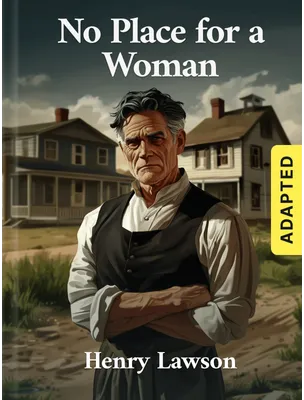
A tall thin man on a little horse. He had no beard, except for a small beard under his chin, and his long wavy, dark hair was turning grey; a square, strong-faced man, and he made me think of one picture of Gladstone, showing his full face, more than any other face I had seen. He had large reddish-brown eyes, set deep under heavy eyebrows, and with something of the blackfellow in them — the sort of eyes that will look hard at something on the horizon that no one else can see. He had a habit of talking to the horizon, too — more than to his friend; and he had a deep up-and-down wrinkle in his forehead that no smile could make smaller.
I got down and took out my pipe, and we sat on a log and talked for a while about the bush; and then, after a pause, he moved in an uncomfortable way, it seemed to me, and asked very suddenly, and in a different tone, if I was married. A strange question to ask a traveller; especially in my case, as I was little more than a boy then.
He talked again about old things and places where we had both been, and asked about men he knew, or had known — drovers and others — and whether they were still alive. Most of his questions went back to before my time; but some of the drovers, one or two overlanders he had been mates with then, had grown old in my time, and I knew them. I see now, though I didn’t then — and if I had, it would not have seemed strange from a bush point of view — that he didn’t ask for news, or seem interested in it.
Then after another uncomfortable pause, while he drew crosses in the dust with a stick, he asked me, in the same strange voice and without looking at me or looking up, if I knew anything about being a doctor — if I had ever studied it.
I asked him if anyone was sick at his place. He paused, and said “No.” Then I wanted to know why he had asked me that question, and he took so long to answer that I began to think he could not hear well, when, at last, he said something quietly about my face making him think of a young man he knew who had gone to Sydney to “study to be a doctor”. That might be true, and seemed natural enough; but why didn’t he ask me directly if I was the man he “knowed of”? Travellers do not like it when people do not speak directly in conversation.
He sat in silence for a long time, with his arms folded, and looking away without thinking over the very flat land of the big scrub that spread from the bottom of the ridge we were on to where a blue peak or two of far mountains showed above the bush on the horizon.
I stood up and put my smoking pipe away and stretched. Then he seemed to wake up. “Better come back to the little house and have a bit of dinner,” he said. “My wife will have it ready soon, and I’ll give you a handful of hay for the horses.”
The hay decided it. It was a dry season. I was surprised to hear of a wife, for I thought he was a man who lived alone — I had always heard so; but perhaps I had been wrong, and he had married lately; or had got a housekeeper. The farm was an odd-shaped open space in the bush, with a good many stumps in it, with a broken two-rail fence along the front, and logs and “dog-leg” the rest. It was about as lonely a place as I had seen, and I had seen some far-away, forgotten places where men lived alone. The hut was in the top corner, a two-roomed rough wooden hut, with a roof of wooden shingles, which must have been not common round there in the days when that hut was built. I was used to building in the bush, and saw that the place had been put up by a man who had a lot of life and hope ahead of him, and for someone else besides himself.
But there were two unfinished lean-to rooms built on to the back of the hut; the posts, floor beams, and wall beams had been well put up and fitted, and the slab walls were up, but the roof had never been put on. There was nothing but prickly weeds and nettles inside those walls, and an old wooden plough for bullocks and two yokes were going rotten across the back doorway. What was left of a straw stack, some hay under a bark shelter, a small iron plough, and an old stiff grey work horse with a coffin-shaped head, were all that I saw about the place.
But there was a small surprise for me inside, in the form of a clean white tablecloth on the rough slab table which stood on posts pushed into the ground. The cloth was rough, but it was a tablecloth — not an extra sheet put on to honor unexpected visitors — and perfectly clean. The tin plates, small tin cups, and jam tins that were used as sugar bowls and salt holders were polished until they shone. The walls and fireplace were painted white, the clay floor swept, and clean sheets of newspaper laid on the slab mantel shelf under the row of biscuit tins that held the food. I thought that his wife, or housekeeper, or whoever she was, was a clean and tidy woman in a house. I saw no woman; but on the sofa — a light wooden slatted one, with arms with bars at the ends — lay a woman’s dress on a lot of sheets of old, stained, and faded newspapers. He looked at it in a puzzled way, wrinkling his forehead, then took it up without thinking and folded it. I saw then that it was a riding skirt and jacket. He wrapped them in the newspapers and took them into the bedroom.
“The wife was going to visit down the creek this afternoon,” he said quickly and without looking at me, but bending down as if to have another look through the door at those far mountain tops. “I suppose she got tired of waiting, and went and took the daughter with her. But, never mind, the food is ready.” There was a camp-oven with a leg of lamb and potatoes cooking in it by the fire, and pots hanging over the fire. I noticed the pots had been cleaned, and the lids made shiny.
There seemed to be something strange about the whole thing, but then he and his wife might have had a little argument during the morning. I thought so during the meal, when the subject of women came up, and he said you never knew how to deal with a woman, and so on; but there was nothing in what he said that had to be about his wife or any woman in particular. For the rest he talked about old bush things, driving cattle, digging, and old bushranging — but never about things going on now and living men, unless any of the old friends he talked about happened to still be alive by chance. He was very restless in the house, and never took his hat off.
There was a dress and a woman’s old hat hanging on the wall near the door, but they looked as if they might have been hanging there for a very long time. There seemed something strange about the whole place — something missing; but then all far-away bush houses are haunted by that something missing, or, more likely, by the ghosts of the things that should have been there, but never were. As I rode down the track to the road I looked back and saw old Howlett hard at work in a hole around a big stump with his long-handled shovel. I had noticed that he moved and walked with a slight lean to the left, and put his hand once or twice to his lower back, and I thought it was back pain, or something like that.
Up in the Never Never I heard from a herder who had known Howlett that his wife had died in the first year, and so this unknown woman, if she was his wife, was, of course, his second wife. The herder seemed surprised and a bit amused at the thought of old Howlett getting married again.
I rode back that way five years later, from the Never Never. It was early in the morning — I had ridden since midnight. I didn’t think the old man would be awake and up; and, also, I wanted to get home, and see the old people, and the friends I’d left behind — and the girl. But I hadn’t gone far past the place where Howlett’s track met the road, when I looked back by chance, and saw him on a horse, stumbling down the track. I waited until he came up.
He was riding the old grey work horse this time, and it looked very worn out. I thought it would fall down at every step, and fall down like an old rotten hut in a strong wind. And the old man was not much better. I saw at once that he was a very sick man. His face was thin and tight, and he bent forward as if he was hurt. He got down stiffly and with difficulty, like a hurt man, and as soon as his feet touched the ground he grabbed my arm, or he would have fallen like a man who steps off a moving train. He leaned towards the side of the road, feeling blindly, in a way, for the ground, with his free hand, as I helped him down slowly. I got my blanket and cloth from the saddle that carried the packs to make him comfortable.
“Help me with my back against the tree,” he said. “I must sit up — it’s no use lying me down.” He sat with his hand holding his side, and breathed with pain. “Should I run up to the hut and get your wife?” I asked. “No.” He spoke in pain. “No!” Then, as if the words were forced out of him by a sudden pain: “She isn’t there.” I thought that she had left him.
“How long have you been sick? How long has this been happening?” He did not answer the question. I thought it was a bit of rheumatic fever, or something like that. “It’s gone into my back and sides now — the pain’s worse in my back,” he said after a moment.
I had once been friends with a man who died suddenly of a heart problem, while at work. He was washing a dish of dirt in the creek near the place we were working; he let the dish drop into the water, fell back, crying, “O, my back!” and died. And now I just felt that something was wrong with poor old Howlett’s heart. A man’s heart is in his back as well as in his arms and hands.
The old man had turned pale like a man who feels faint in a heat wave, and his arms fell loosely, and his hands moved helplessly with the knuckles in the dust. I felt myself turning white, too, and the sick, cold, empty feeling in my stomach, because I knew the signs. Bushmen are afraid of sickness and death. But after I had made him comfortable and given him a drink from the water bag the grey left his face, and he felt a bit better; he drew up his arms and folded them across his chest. He let his head rest back against the tree — his hat had fallen off, showing a wide, white forehead, much higher than I expected. He seemed to look at the bright blue line of the mountains, showing above the dark blue-green bush on the horizon.
Then he started to speak — paying no attention to me when I asked him if he felt better now — to talk in that strange, dreamy, far-away voice that makes you feel quiet. He told his story like a machine, in a dull, flat way — in the same words, as I think now, as he had often told it before; if not to others, then to the lonely bush. And he used the names of people and places that I had never heard of — just as if I knew them as well as he did.
“I didn’t want to bring her up the first year. It was no place for a woman. I wanted her to stay with her people and wait till I’d got the place a little more tidy. The Phipps family took a farm down the creek. I wanted her to wait and come up with them so she’d have some company — a woman to talk to. They came later, but they didn’t stay. It was no place for a woman. But Mary would come. She wouldn’t stay with her people down country. She wanted to be with me, and look after me, and work and help me.”
He repeated himself a lot — said the same thing over and over again sometimes. He was only mad about one thing. He’d stop talking and sit quiet for a while; then he’d notice me in a quick, half-scared way, and say sorry for giving me all that trouble, and thank me. “I’ll be all right soon. You’d better take the horses up to the hut and have some breakfast; you’ll find it by the fire. I’ll follow you, soon. The wife will be waiting an’——” He would stop, and be going again soon on the same track: —
“Her mother was coming to stay for a while at the end of the year, but her father hurt his leg. Then her married sister was coming, but one of the children got sick and there was a problem at home. I saw the doctor in the town — thirty miles from here — and arranged it with him. He was a drunk — I would have shot him after that. I arranged with a woman in the town to come and stay. I thought Mary was wrong about the time. She must have been a month or six weeks late. But I listened to her… Don’t argue with a woman. Don’t listen to a woman. Do the right thing. We should have had a woman like a mother to talk to us. But it was no place for a woman!”
He moved his head, as if from some old pain in his mind, against the tree trunk. “She suddenly became very ill one night, but it went away. It was a false alarm. I was going to ride somewhere, but she said to wait till daylight. Someone was sure to pass. She was a brave and sensible girl, but she was very afraid of being left alone. It was no place for a woman!”
“There was a black shepherd three or four miles away. I rode over while Mary was asleep, and sent the black boy into town. I would have shot him afterwards if I had caught him. The old black woman was dead the week before, or Mary would have been alright. She was tied up in a bunch with strips of blanket and animal skin, and put in a hole. So there wasn’t even a black woman near the place. It was no place for a woman!
“I was watching the road at daylight, and I was watching the road at evening. I went down in the low place and bent down to see the gap against the sky, so I could see if anyone was coming over… I would get on the horse and ride fast towards the town for five miles, but something would pull me back, and then I would hurry because I was afraid she would die before I got to the hut. I expected the doctor every five minutes.”
“It started about daylight the next morning. I ran backwards and forwards between the hut and the road like a crazy man. And no one came. I was running among the logs and stumps, and falling over them, when I saw a cloud of dust at sunrise. It was her mother and sister in the spring cart, and just catching up to them was the doctor in his small cart with the woman I had made a plan with in town. The mother and sister were staying in the town for the night, when they heard about the black boy. It took him a day to ride there. I would have shot him if I ever caught him after that. The doctor had been drunk. If I had had the gun and known she was gone I would have shot him in the small cart. They said she was dead. And the child was dead, too.”
“They said it was my fault, but I didn’t want her to come; it was not a place for a woman. I never saw them again after the funeral. I didn’t want to see them any more.”
He moved his head tiredly against the tree, and soon went on again in a softer voice — his eyes and voice were becoming more distant and dreamy and far away.
“About a month after — or a year, I lost count of the time long ago — she came back to me. At first she’d come in the night, then sometimes when I was at work — and she had the baby — it was a girl — in her arms. And after a while she came to stay all the time… I didn’t blame her for going away that time — it was no place for a woman… She was a good wife to me. She was a cheerful girl when I married her. The little girl grew up like her. I was going to send her down country to go to school — it was no place for a girl.
“But a month, or a year, ago, Mary left me, and took our daughter, and never came back until last night — this morning, I think it was. I thought at first it was the girl with her hair up, and her mother’s skirt on, to surprise her old dad. But it was Mary, my wife — as she was when I married her. She said she couldn’t stay, but she’d wait for me on the road; on — the road… ”
His arms fell, and his face went white. I got the water-bag. “Another time like that and you’ll be gone,” I thought, as he woke up again. Then I suddenly thought of a small hut that had been built, when I came that way last, ten or twelve miles along the road, towards the town. There was nothing else to do but to leave him and ride on for help, and a cart of some kind.
“You wait here till I come back,” I said. “I am going to get the doctor.” He woke up a little. “Better come up to the hut and get some food. The wife will be waiting...” He was confused again. “Will you wait while I take the horse down to the stream?” “Yes — I’ll wait by the road.” “Look!” I said, “I’ll leave the water-bag near. Don’t move till I come back.” “I won’t move — I’ll wait by the road,” he said.
I took the pack horse, which was the freshest and best, threw the pack saddle and bags into a bush, left the other horse to take care of itself, and started for the hut, leaving the old man with his back to the tree, his arms folded, and his eyes on the distance.
One of the men at the hut rode to get the doctor at once, while the other came back with me in a small cart. He told me that old Howlett’s wife had died in childbirth the first year on the farm — “she was a fine girl he’d heard!” He told me the story as the old man had told it, and in almost the same words, even saying it was his opinion that it was no place for a woman. “And he went off alone and worried over it until he went crazy.”
I knew the rest. He not only thought that his wife, or the ghost of his wife, had been with him all those years, but that the child had lived and grown up, and that the wife did the housework; which, of course, he had to do himself.
When we got to him his rough hands had dropped for the last time, and they were still. I only took one quick look at his face, but I was sure that he was looking at the blue edge of the hills on the far line of the bush.
Up at the hut the table was set like the first day I saw it, and breakfast was in the camp oven by the fire.