'The Mocking-Bird' was published in 1892.
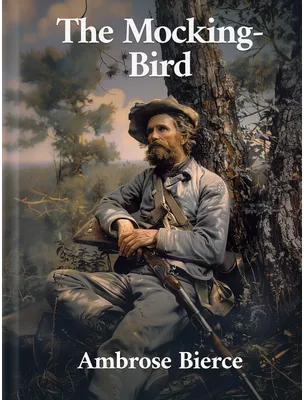
It was a calm Sunday afternoon in 1861. Private Grayrock of the Federal Army sat under a tall pine tree in a forest in Virginia. His rifle lay across his lap. His cap had slipped over his eyes, making him look like he was asleep. But Private Grayrock wasn't sleeping. He was troubled by what happened the night before...
In the haunting pages of "The Mocking-Bird," Ambrose Bierce invites readers into a world where the lines between reality and illusion blur. The story revolves around a young woman named Helen, whose life is forever changed by a mysterious bird that seems to echo her innermost thoughts and fears. As Helen grapples with her emotions and the challenges of her past, she finds herself drawn into a web of mystery and self-discovery.
The central theme of the tale explores the nature of perception and the impact of unspoken words. With every haunting note the mockingbird sings, Helen is compelled to confront her own truths and confront the shadows that linger in her heart. Bierce masterfully weaves a narrative that is both eerie and thought-provoking, encouraging readers to reflect on their own lives and the stories they tell themselves.
As the story unfolds, the tension between reality and the supernatural creates an atmosphere of suspense that keeps readers on the edge of their seats. Will Helen find the courage to face her fears, or will the mockingbird’s song lead her deeper into confusion? Dive into this captivating tale and discover the mysteries that lie within "The Mocking-Bird."
Full Name: Ambrose Gwinnett Bierce
Birthdate: June 24, 1842
Place of Birth: Meigs County, Ohio, USA
Date and Place of Death: Unknown, presumed dead after 1913, possibly in Mexico
Occupation: Author, journalist, and civil war veteran
Notable Works: "The Devil's Dictionary," "An Occurrence at Owl Creek Bridge," and "The Monk and the Hangman's Daughter."
Early Life: Ambrose Bierce was born into a large family and had a rough childhood. His parents were poor, and he had to work at a young age. He attended school briefly but was largely self-taught. His experiences shaped his view of life and death.
Literary Career: Bierce began his writing career as a journalist in the 1860s. He gained fame for his sharp wit and dark humor. His most famous work, "The Devil's Dictionary," is a satirical dictionary that offers clever definitions. He also wrote short stories that often explore themes of war, death, and the supernatural.
Personal Life: Bierce married Mary Ellen "Maggie" M. L. Bierce in 1869, and they had three children. However, their marriage was troubled, and they eventually separated. Bierce's later years were marked by mystery, as he disappeared in Mexico, leaving behind many unanswered questions about his life and fate.
Ambrose Bierce was an American writer, journalist, and Civil War veteran known for his dark humor and sharp wit.
'The Mocking-Bird' is a work of fiction that blends elements of realism and satire.
The main characters include a mockingbird, which serves as a symbol, and a few human characters that reflect societal issues.
The story explores themes of deception and social norms through the eyes of a mockingbird, revealing the hypocrisy of human behavior.
Key themes include the nature of truth, the absurdity of societal conventions, and the contrast between appearance and reality.
The mockingbird symbolizes imitation and the complexity of communication, reflecting how people often mimic behaviors and attitudes.
'The Mocking-Bird' received mixed reviews, with some praising its cleverness while others found its satire biting.
As of now, there are no widely known adaptations of 'The Mocking-Bird' into film or theater.
'The Mocking-Bird' has influenced discussions on social critique and remains a relevant commentary on human behavior and society.