'Metamorphoses' was written by Ovid around 8 AD, and it is a part of his larger work that includes multiple books.
[{"id":"para_1","index":0,"start":0,"offset":311,"words":1,"paraNum":"","lastModified":1752670005000,"semanticType":"title-book-title","voicework":"audio_file","blockId":"io_argus_syrinx_en-bl1sb","language":"en","wordsRange":{"start":33333333,"end":66666667},"paragraphVersion":25,"direction":"ltr","paragraph":"<h1 class=\"ilm-title\" id=\"para_1\" semantictype=\"title-book-title\" data-ilmid=\"io_argus_syrinx_en-bl1sb\" data-audio=\"1\" data-chapter=\"para_1\" data-words-count=\"1\" data-before=\"0\" data-ww=\"\"><span class=\"block-pb\"> <span class=\"block-pb is-animated\"></span> </span><span class=\"itm-wrap\">Metamorphoses</span></h1>","hasContent":true,"isFirst":true,"isLast":false},{"id":"para_2","index":1,"start":311,"offset":330,"words":2,"paraNum":"","lastModified":1754175328000,"semanticType":"title-subtitle","voicework":"audio_file","blockId":"io_argus_syrinx_en-blr7","language":"en","wordsRange":{"start":100000000,"end":103000000},"paragraphVersion":21,"direction":"ltr","paragraph":"<h1 class=\"ilm-title ilm-x-large ilm-subtitle\" id=\"para_2\" semantictype=\"title-subtitle\" data-ilmid=\"io_argus_syrinx_en-blr7\" data-audio=\"1\" data-chapter=\"para_2\" data-words-count=\"2\" data-before=\"1\" data-ww=\"\"><span class=\"block-pb\"> <span class=\"block-pb is-animated\"></span> </span><span class=\"itm-wrap\">Book 8<br></span></h1>","hasContent":true,"isFirst":false,"isLast":false},{"id":"para_3","index":2,"start":641,"offset":336,"words":3,"paraNum":"","lastModified":1754175346000,"semanticType":"title-author","voicework":"audio_file","blockId":"io_argus_syrinx_en-bl1hh","language":"en","wordsRange":{"start":203000000,"end":208000000},"paragraphVersion":16,"direction":"ltr","paragraph":"<h1 class=\"ilm-title ilm-author ilm-large\" id=\"para_3\" semantictype=\"title-author\" data-ilmid=\"io_argus_syrinx_en-bl1hh\" data-audio=\"1\" data-chapter=\"para_3\" data-words-count=\"3\" data-before=\"3\" data-ww=\"\"><span class=\"block-pb\"> <span class=\"block-pb is-animated\"></span> </span><span class=\"itm-wrap\">by<br>P. Ovidius Naso</span></h1>","hasContent":true,"isFirst":false,"isLast":false},{"id":"para_4","index":3,"start":977,"offset":146,"words":0,"paraNum":"","lastModified":1752218836000,"semanticType":"line","blockId":"io_argus_syrinx_en-bl2t","language":"en","wordsRange":{"start":308000000,"end":310000000},"paragraphVersion":11,"direction":"ltr","paragraph":"<hr class=\"ilm-hr ilm-small\" id=\"para_4\" semantictype=\"line\" data-ilmid=\"io_argus_syrinx_en-bl2t\" data-words-count=\"0\" data-before=\"6\" data-ww=\"\">","hasContent":true,"isFirst":false,"isLast":false},{"id":"para_5","index":4,"start":1123,"offset":1307,"words":0,"paraNum":"","lastModified":1755081810000,"semanticType":"illustration","blockId":"io_argus_syrinx_en-bl1sc","language":"en","wordsRange":{"start":343333333,"end":376666667},"paragraphVersion":17,"direction":"ltr","paragraph":"<div class=\"ilm-illustration\" id=\"para_5\" semantictype=\"illustration\" data-ilmid=\"io_argus_syrinx_en-bl1sc\" data-words-count=\"0\" data-before=\"6\" data-ww=\"\"><img width=\"600\" height=\"400\" data-src=\"ch0p0\" src=\"data:image/webp;base64,UklGRgIDAABXRUJQVlA4IPYCAADwDQCdASo8ACgAPm0qkEWkIqGYDAaoQAbEoAtRsOQsChPpbeznc2ap5Ufxxvp18tvjb8GrD4dsPsf38g4dcVqZ/KOejg9FQfWkNYZ/9QfSEGCOITeETGjP1HKNn2qw8Irqf/O1QZZiCcfUd15R8gXUyBJ1M4VJAAAA/vgJF/ITF2TGRvmbciwl6i7C6S1ud6/oNCcyZbxmVp3m/p3v++fKF9N7k8P/xgvLWM8vgrsYVbt65QnOhlXh8R/XR4WM1hEj+M7THMU63zFjciywIFN/R3+IjX2/aPQo1gAnRnDNWgB1Nbuw3c8ZfYskiWl78Vk+L0SMbAYLYmrZ7YKe+2Fa8nqAFwYCA22kYGf3k5CjfXMs10SwW5DpQwt8V0gW3oTtDKdMGLayqepkSV7L5BjUJzvE6CAQEAVG0/RIyJzZf2QXHYVRxHoXsZAh1kfpsPvqJ/HhV/+dXBhzkemOi3GtpjRI6hZhQ2NSjYu4mYRzLkprp2R/+A5O9lCSIMFtELhbxOf733J0uO18V1Ivct1jUgjUpCTO/N8659eNpmwSZV68MfQ3oq/02Px1RUxBhJIUpZNtpJ+TehpAJGK5gNBvI2rWEAXQlW+Nnjh1PXZkzAMPSmBnnkpwxWQi8oKkNjQrrp3nlxFDbBt3UF6XPXNU4l8w82he+JRm7B37CJ3E+uXWz4E9Lfa2YmHYHVOZvRabZp1zIC2SnrDQ5ku66FZhsEAoa2z5ZuYcRp7tfuC+tNaSAVeJ9/f5I+HVd1Mf7+vqR5FykAD2Muvj264DQXPFQMLfR6+BLLcovMr9Fw+2soHi3XTHTOvFGA9L6KUqtVYLBSkB/fy0roVEVB+j+5Mh9oOoToYtoRt6giCRElORoGKNftwu79745FNxoqJJXpLnQ4g09M1JSoBVALZa3xnnspLKJ+P7ES5nU6yfS4LT6iTbRJtN78Y+Pij7nAVX1gRtN/hVzRjsBbNu0TPoGsGrNGDAA/53mRS+KqT10xWfexzIp8AAAA==\" alt=\"Metamorphoses, Book 8\"></div>","hasContent":true,"isFirst":false,"isLast":false},{"id":"para_6","index":5,"start":2430,"offset":496,"words":3,"paraNum":"","lastModified":1754676971000,"semanticType":"header-chapter-header","voicework":"no_audio","blockId":"io_argus_syrinx_en-bl1hd","language":"en","wordsRange":{"start":410000000,"end":414000000},"paragraphVersion":22,"direction":"ltr","paragraph":"<h2 class=\"ilm-header ilm-h2 ilm-large\" id=\"para_6\" semantictype=\"header-chapter-header\" data-ilmid=\"io_argus_syrinx_en-bl1hd\" data-chapter=\"para_6\" data-words-count=\"3\" data-before=\"6\" data-ww=\"\"><span class=\"block-pb\"> <span class=\"block-pb is-animated\"></span> </span><span class=\"itm-wrap\"><span class=\"chapter-text\"><span class=\"chapter-number\"><span class=\"chapter-label\"></span><span class=\"chapter-value\"></span></span><span class=\"chapter-title\">Nisus et Scylla</span></span></span></h2>","hasContent":true,"isFirst":false,"isLast":false},{"id":"para_7","index":6,"start":2926,"offset":326,"words":4,"paraNum":"","lastModified":1752218836000,"semanticType":"header-subheader","voicework":"audio_file","blockId":"io_argus_syrinx_en-blr8","language":"en","wordsRange":{"start":514000000,"end":519000000},"paragraphVersion":10,"direction":"ltr","paragraph":"<h3 class=\"ilm-header ilm-h3\" id=\"para_7\" semantictype=\"header-subheader\" data-ilmid=\"io_argus_syrinx_en-blr8\" data-audio=\"1\" data-chapter=\"para_7\" data-words-count=\"4\" data-before=\"9\" data-ww=\"\"><span class=\"block-pb\"> <span class=\"block-pb is-animated\"></span> </span><span class=\"itm-wrap\">King Minos and Scylla</span></h3>","hasContent":true,"isFirst":false,"isLast":false},{"id":"para_8","index":7,"start":3252,"offset":640,"words":48,"paraNum":"1.1","lastModified":1752218836000,"semanticType":"par","voicework":"audio_file","blockId":"io_argus_syrinx_en-blra","language":"en","wordsRange":{"start":619000000,"end":675000000},"paragraphVersion":10,"direction":"ltr","paragraph":"<p id=\"para_8\" semantictype=\"par\" data-ilmid=\"io_argus_syrinx_en-blra\" data-audio=\"1\" data-words-count=\"48\" data-before=\"13\" data-ww=\"\"><span class=\"block-num\" data-id=\"1.1\"></span><span class=\"block-pb\"> <span class=\"block-pb is-animated\"></span> </span><span class=\"itm-wrap\">Now Lucifer unveiled the glorious day,<br>and as the session of the night dissolved,<br>the cool east wind declined, and vapors wreathed<br>the moistened valleys. Veering to the south<br>the welcome wind gave passage to the sons<br>of Aeacus, and wafted Cephalus<br>on his returning way, propitious; where<br>before the wonted hour, they entered port.</span></p>","hasContent":true,"isFirst":false,"isLast":false},{"id":"para_9","index":8,"start":3892,"offset":660,"words":53,"paraNum":"1.2","lastModified":1752218836000,"semanticType":"par","voicework":"audio_file","blockId":"io_argus_syrinx_en-blrb","language":"en","wordsRange":{"start":775000000,"end":836000000},"paragraphVersion":10,"direction":"ltr","paragraph":"<p id=\"para_9\" semantictype=\"par\" data-ilmid=\"io_argus_syrinx_en-blrb\" data-audio=\"1\" data-words-count=\"53\" data-before=\"61\" data-ww=\"\"><span class=\"block-num\" data-id=\"1.2\"></span><span class=\"block-pb\"> <span class=\"block-pb is-animated\"></span> </span><span class=\"itm-wrap\">King Minos, while the fair wind moved their ship,<br>was laying waste the land of <i>Megara.</i><br>He gathered a great army round the walls<br>built by Alcathous, where reigned in splendor<br>King Nisus — mighty and renowned in war —<br>upon the center of whose hoary head<br>a lock of purple hair was growing. — Its<br>proved virtue gave protection to his throne.</span></p>","hasContent":true,"isFirst":false,"isLast":false},{"id":"para_10","index":9,"start":4552,"offset":465,"words":27,"paraNum":"1.3","lastModified":1752218836000,"semanticType":"par","voicework":"audio_file","blockId":"io_argus_syrinx_en-blrc","language":"en","wordsRange":{"start":936000000,"end":967000000},"paragraphVersion":10,"direction":"ltr","paragraph":"<p id=\"para_10\" semantictype=\"par\" data-ilmid=\"io_argus_syrinx_en-blrc\" data-audio=\"1\" data-words-count=\"27\" data-before=\"114\" data-ww=\"\"><span class=\"block-num\" data-id=\"1.3\"></span><span class=\"block-pb\"> <span class=\"block-pb is-animated\"></span> </span><span class=\"itm-wrap\">Six times the horns of rising Phoebe grew,<br>and still the changing fortune of the war<br>was in suspense; so, Victory day by day<br>between them hovered on uncertain wings.</span></p>","hasContent":true,"isFirst":false,"isLast":false},{"id":"para_11","index":10,"start":5017,"offset":871,"words":86,"paraNum":"1.4","lastModified":1752218836000,"semanticType":"par","voicework":"audio_file","blockId":"io_argus_syrinx_en-blrd","language":"en","wordsRange":{"start":1067000000,"end":1165000000},"paragraphVersion":10,"direction":"ltr","paragraph":"<p id=\"para_11\" semantictype=\"par\" data-ilmid=\"io_argus_syrinx_en-blrd\" data-audio=\"1\" data-words-count=\"86\" data-before=\"141\" data-ww=\"\"><span class=\"block-num\" data-id=\"1.4\"></span><span class=\"block-pb\"> <span class=\"block-pb is-animated\"></span> </span><span class=\"itm-wrap\"> Within that city was a regal tower<br>on tuneful walls; where once Apollo laid<br>his golden harp; and in the throbbing stone<br>the sounds remained. And there, in times of peace<br>the daughter of king Nisus loved to mount<br>the walls and strike the sounding stone with pebbles:<br>so, when the war began, she often viewed<br>the dreadful contest from that height;<br>until, so long the hostile camp remained,<br> she had become acquainted with the names,<br>and knew the habits, horses and the arms<br>of many a chief, and could discern the signs<br>of their Cydonean quivers.</span></p>","hasContent":true,"isFirst":false,"isLast":false},{"id":"para_12","index":11,"start":5888,"offset":1063,"words":115,"paraNum":"1.5","lastModified":1752218836000,"semanticType":"par","voicework":"audio_file","blockId":"io_argus_syrinx_en-blre","language":"en","wordsRange":{"start":1265000000,"end":1396000000},"paragraphVersion":10,"direction":"ltr","paragraph":"<p id=\"para_12\" semantictype=\"par\" data-ilmid=\"io_argus_syrinx_en-blre\" data-audio=\"1\" data-words-count=\"115\" data-before=\"227\" data-ww=\"\"><span class=\"block-num\" data-id=\"1.5\"></span><span class=\"block-pb\"> <span class=\"block-pb is-animated\"></span> </span><span class=\"itm-wrap\"> More than all,<br>the features of King Minos were engraved<br>upon the tablets of her mind. And when<br>he wore his helmet, crested with gay plumes,<br>she deemed it glorious; when he held his shield<br>shining with gold, no other seemed so grand;<br>and when he poised to hurl the tough spear home,<br>she praised his skill and strength; and when he bent<br>his curving bow with arrow on the cord,<br> she pictured him as Phoebus taking aim, —<br>but when, arrayed in purple, and upon<br>the back of his white war horse, proudly decked<br>with richly broidered housings, he reined in<br>the nervous steed, and took his helmet off,<br>showing his fearless features, then the maid,<br>daughter of Nisus, could control herself<br>no longer; and a frenzy seized her mind.</span></p>","hasContent":true,"isFirst":false,"isLast":false},{"id":"para_13","index":12,"start":6951,"offset":664,"words":55,"paraNum":"1.6","lastModified":1752218836000,"semanticType":"par","voicework":"audio_file","blockId":"io_argus_syrinx_en-blrf","language":"en","wordsRange":{"start":1496000000,"end":1560000000},"paragraphVersion":10,"direction":"ltr","paragraph":"<p id=\"para_13\" semantictype=\"par\" data-ilmid=\"io_argus_syrinx_en-blrf\" data-audio=\"1\" data-words-count=\"55\" data-before=\"342\" data-ww=\"\"><span class=\"block-num\" data-id=\"1.6\"></span><span class=\"block-pb\"> <span class=\"block-pb is-animated\"></span> </span><span class=\"itm-wrap\">She called the javelin happy which he touched,<br>and blessed were the reins within his hand. <br>She had an impulse to direct her steps,<br>a tender virgin, through the hostile ranks,<br>or cast her body from the topmost towers<br>into the Gnossian camp. She had a wild<br>desire to open to the enemy<br>the heavy brass-bound gates, or anything<br>that Minos could desire.</span></p>","hasContent":true,"isFirst":false,"isLast":false},{"id":"para_14","index":13,"start":7615,"offset":659,"words":62,"paraNum":"1.7","lastModified":1752218836000,"semanticType":"par","voicework":"audio_file","blockId":"io_argus_syrinx_en-blrh","language":"en","wordsRange":{"start":1660000000,"end":1731000000},"paragraphVersion":10,"direction":"ltr","paragraph":"<p id=\"para_14\" semantictype=\"par\" data-ilmid=\"io_argus_syrinx_en-blrh\" data-audio=\"1\" data-words-count=\"62\" data-before=\"397\" data-ww=\"\"><span class=\"block-num\" data-id=\"1.7\"></span><span class=\"block-pb\"> <span class=\"block-pb is-animated\"></span> </span><span class=\"itm-wrap\">And as she sat<br>beholding the white tents, she cried, “Alas!<br>Should I rejoice or grieve to see this war?<br>I grieve that Minos is the enemy<br>of her who loves him; but unless the war<br>had brought him, how could he be known to me?<br>But should he take me for a hostage? That<br>might end the war — a pledge of peace, he might<br>keep me for his companion.</span></p>","hasContent":true,"isFirst":false,"isLast":false},{"id":"para_15","index":14,"start":8274,"offset":590,"words":46,"paraNum":"1.8","lastModified":1752218836000,"semanticType":"par","voicework":"audio_file","blockId":"io_argus_syrinx_en-blri","language":"en","wordsRange":{"start":1831000000,"end":1885000000},"paragraphVersion":10,"direction":"ltr","paragraph":"<p id=\"para_15\" semantictype=\"par\" data-ilmid=\"io_argus_syrinx_en-blri\" data-audio=\"1\" data-words-count=\"46\" data-before=\"459\" data-ww=\"\"><span class=\"block-num\" data-id=\"1.8\"></span><span class=\"block-pb\"> <span class=\"block-pb is-animated\"></span> </span><span class=\"itm-wrap\">“O, supreme<br>of mankind! she who bore you must have been<br>as beautiful as you are; ample cause<br>for Jove to lose his heart. O, happy hour!<br>If moving upon wings through yielding air,<br>I could alight within the hostile camp<br>in front of Minos, and declare to him<br>my name and passion!</span></p>","hasContent":true,"isFirst":false,"isLast":false},{"id":"para_16","index":15,"start":8864,"offset":702,"words":59,"paraNum":"1.9","lastModified":1754394061000,"semanticType":"par","voicework":"audio_file","blockId":"io_argus_syrinx_en-blrk","language":"en","wordsRange":{"start":1985000000,"end":2055000000},"paragraphVersion":16,"direction":"ltr","paragraph":"<p id=\"para_16\" semantictype=\"par\" data-ilmid=\"io_argus_syrinx_en-blrk\" data-audio=\"1\" data-words-count=\"59\" data-before=\"505\" data-ww=\"\"><span class=\"block-num\" data-id=\"1.9\"></span><span class=\"block-pb\"> <span class=\"block-pb is-animated\"></span> </span><span class=\"itm-wrap\">“Then would I implore<br>what dowry he could wish, and would provide<br>whatever he might ask, except alone<br>the city of my father. Perish all<br>my secret hopes before one act of mine<br>should offer treason to accomplish it.<br>And yet, the kindness of a conqueror<br>has often proved a blessing, manifest<br>to those who were defeated. Certainly<br>the war he carries on is justified<br>by his slain son.</span></p>","hasContent":true,"isFirst":false,"isLast":false},{"id":"para_17","index":16,"start":9566,"offset":625,"words":49,"paraNum":"1.10","lastModified":1752218836000,"semanticType":"par","voicework":"audio_file","blockId":"io_argus_syrinx_en-blrl","language":"en","wordsRange":{"start":2155000000,"end":2212000000},"paragraphVersion":10,"direction":"ltr","paragraph":"<p id=\"para_17\" semantictype=\"par\" data-ilmid=\"io_argus_syrinx_en-blrl\" data-audio=\"1\" data-words-count=\"49\" data-before=\"564\" data-ww=\"\"><span class=\"block-num\" data-id=\"1.10\"></span><span class=\"block-pb\"> <span class=\"block-pb is-animated\"></span> </span><span class=\"itm-wrap\">“He is a mighty king,<br>thrice strengthened in his cause. Undoubtedly<br>we shall be conquered, and, if such a fate<br>awaits our city, why should he by force<br>instead of my consuming love, prevail<br>to open the strong gates? Without delay<br>and dreadful slaughter, it is best for him<br>to conquer and decide this savage war.</span></p>","hasContent":true,"isFirst":false,"isLast":false},{"id":"para_18","index":17,"start":10191,"offset":495,"words":30,"paraNum":"1.11","lastModified":1752218836000,"semanticType":"par","voicework":"audio_file","blockId":"io_argus_syrinx_en-blrm","language":"en","wordsRange":{"start":2312000000,"end":2347000000},"paragraphVersion":10,"direction":"ltr","paragraph":"<p id=\"para_18\" semantictype=\"par\" data-ilmid=\"io_argus_syrinx_en-blrm\" data-audio=\"1\" data-words-count=\"30\" data-before=\"613\" data-ww=\"\"><span class=\"block-num\" data-id=\"1.11\"></span><span class=\"block-pb\"> <span class=\"block-pb is-animated\"></span> </span><span class=\"itm-wrap\">“Ah, Minos, how I fear the bitter fate<br>should any warrior hurl his cruel spear<br>and pierce you by mischance, for surely none<br>can be so hardened to transfix your breast<br>with purpose known.”</span></p>","hasContent":true,"isFirst":false,"isLast":false},{"id":"para_19","index":18,"start":10686,"offset":541,"words":40,"paraNum":"1.12","lastModified":1752218836000,"semanticType":"par","voicework":"audio_file","blockId":"io_argus_syrinx_en-blrn","language":"en","wordsRange":{"start":2447000000,"end":2494000000},"paragraphVersion":10,"direction":"ltr","paragraph":"<p id=\"para_19\" semantictype=\"par\" data-ilmid=\"io_argus_syrinx_en-blrn\" data-audio=\"1\" data-words-count=\"40\" data-before=\"643\" data-ww=\"\"><span class=\"block-num\" data-id=\"1.12\"></span><span class=\"block-pb\"> <span class=\"block-pb is-animated\"></span> </span><span class=\"itm-wrap\">Oh, let her love prevail<br>to open for his army the great gates.<br>Only the thought of it, has filled her soul;<br>she is determined to deliver up<br>her country as a dowry with herself,<br>and so decide the war! But what avails<br>this idle talk.</span></p>","hasContent":true,"isFirst":false,"isLast":false},{"id":"para_20","index":19,"start":11227,"offset":570,"words":44,"paraNum":"1.13","lastModified":1752218836000,"semanticType":"par","voicework":"audio_file","blockId":"io_argus_syrinx_en-blro","language":"en","wordsRange":{"start":2594000000,"end":2645000000},"paragraphVersion":10,"direction":"ltr","paragraph":"<p id=\"para_20\" semantictype=\"par\" data-ilmid=\"io_argus_syrinx_en-blro\" data-audio=\"1\" data-words-count=\"44\" data-before=\"683\" data-ww=\"\"><span class=\"block-num\" data-id=\"1.13\"></span><span class=\"block-pb\"> <span class=\"block-pb is-animated\"></span> </span><span class=\"itm-wrap\">“A guard surrounds the gates,<br>my father keeps the keys, and he alone<br>is my obstruction, and the innocent<br>account of my despair. Would to the Gods<br>I had no father! Is not man the God<br>of his own fortune, though his idle prayers<br>avail not to compel his destiny?</span></p>","hasContent":true,"isFirst":false,"isLast":false},{"id":"para_21","index":20,"start":11797,"offset":747,"words":69,"paraNum":"1.14","lastModified":1752218836000,"semanticType":"par","voicework":"audio_file","blockId":"io_argus_syrinx_en-blrp","language":"en","wordsRange":{"start":2745000000,"end":2823000000},"paragraphVersion":10,"direction":"ltr","paragraph":"<p id=\"para_21\" semantictype=\"par\" data-ilmid=\"io_argus_syrinx_en-blrp\" data-audio=\"1\" data-words-count=\"69\" data-before=\"727\" data-ww=\"\"><span class=\"block-num\" data-id=\"1.14\"></span><span class=\"block-pb\"> <span class=\"block-pb is-animated\"></span> </span><span class=\"itm-wrap\"> “Another woman crazed with passionate desires,<br>which now inflame me, would not hesitate,<br>but with a fierce abandon would destroy<br>whatever checked her passion. Who is there<br>with love to equal mine? I dare to go<br>through flames and swords; but swords and flames<br>are not now needed, for I only need<br>my royal father’s lock of purple hair.<br>More precious than fine gold, it has a power<br> to give my heart all that it may desire.”</span></p>","hasContent":true,"isFirst":false,"isLast":false},{"id":"para_22","index":21,"start":12544,"offset":661,"words":57,"paraNum":"1.15","lastModified":1752218836000,"semanticType":"par","voicework":"audio_file","blockId":"io_argus_syrinx_en-blrq","language":"en","wordsRange":{"start":2923000000,"end":2988000000},"paragraphVersion":10,"direction":"ltr","paragraph":"<p id=\"para_22\" semantictype=\"par\" data-ilmid=\"io_argus_syrinx_en-blrq\" data-audio=\"1\" data-words-count=\"57\" data-before=\"796\" data-ww=\"\"><span class=\"block-num\" data-id=\"1.15\"></span><span class=\"block-pb\"> <span class=\"block-pb is-animated\"></span> </span><span class=\"itm-wrap\">While Scylla said this, night that heals our cares<br>came on, and she grew bolder in the dark.<br>And now it is the late and silent hour<br>when slumber takes possession of the breast.<br>Outwearied with the cares of busy day;<br>then as her father slept, with stealthy tread<br>she entered his abode, and there despoiled,<br>and clipped his fatal lock of purple hair.</span></p>","hasContent":true,"isFirst":false,"isLast":false},{"id":"para_23","index":22,"start":13205,"offset":513,"words":32,"paraNum":"1.16","lastModified":1752218836000,"semanticType":"par","voicework":"audio_file","blockId":"io_argus_syrinx_en-blrr","language":"en","wordsRange":{"start":3088000000,"end":3125000000},"paragraphVersion":10,"direction":"ltr","paragraph":"<p id=\"para_23\" semantictype=\"par\" data-ilmid=\"io_argus_syrinx_en-blrr\" data-audio=\"1\" data-words-count=\"32\" data-before=\"853\" data-ww=\"\"><span class=\"block-num\" data-id=\"1.16\"></span><span class=\"block-pb\"> <span class=\"block-pb is-animated\"></span> </span><span class=\"itm-wrap\">Concealing in her bosom the sad prize<br>of crime degenerate, she at once went forth<br>a gate unguarded, and with shameless haste<br>sped through the hostile army to the tent<br>of Minos, whom, astonished, she addressed:</span></p>","hasContent":true,"isFirst":false,"isLast":false},{"id":"para_24","index":23,"start":13718,"offset":803,"words":85,"paraNum":"1.17","lastModified":1752218836000,"semanticType":"par","voicework":"audio_file","blockId":"io_argus_syrinx_en-blrs","language":"en","wordsRange":{"start":3225000000,"end":3321000000},"paragraphVersion":10,"direction":"ltr","paragraph":"<p id=\"para_24\" semantictype=\"par\" data-ilmid=\"io_argus_syrinx_en-blrs\" data-audio=\"1\" data-words-count=\"85\" data-before=\"885\" data-ww=\"\"><span class=\"block-num\" data-id=\"1.17\"></span><span class=\"block-pb\"> <span class=\"block-pb is-animated\"></span> </span><span class=\"itm-wrap\"> “Only my love has led me to this deed.<br>The daughter of King Nisus, I am called<br>the maiden Scylla. Unto you I come<br>and offer up a power that will prevail<br>against my country, and I stipulate<br>no recompense except yourself. Take then<br>this purple hair, a token of my love. —<br>Deem it not lightly as a lock of hair<br>held idly forth to you; it is in truth<br>my father’s life.” And as she spoke<br> she held out in her guilty hand the prize,<br>and begged him to accept it with her love.</span></p>","hasContent":true,"isFirst":false,"isLast":false},{"id":"para_25","index":24,"start":14521,"offset":697,"words":58,"paraNum":"1.18","lastModified":1752218836000,"semanticType":"par","voicework":"audio_file","blockId":"io_argus_syrinx_en-blrt","language":"en","wordsRange":{"start":3421000000,"end":3488000000},"paragraphVersion":10,"direction":"ltr","paragraph":"<p id=\"para_25\" semantictype=\"par\" data-ilmid=\"io_argus_syrinx_en-blrt\" data-audio=\"1\" data-words-count=\"58\" data-before=\"970\" data-ww=\"\"><span class=\"block-num\" data-id=\"1.18\"></span><span class=\"block-pb\"> <span class=\"block-pb is-animated\"></span> </span><span class=\"itm-wrap\">Shocked at the thought of such a heinous crime,<br>Minos refused, and said, “O execrable thing!<br>Despised abomination of our time!<br>May all the Gods forever banish you<br>from their wide universe, and may the earth<br>and the deep ocean be denied to you!<br>So great a monster shall not be allowed<br>to desecrate the sacred Isle of <i>Crete,</i><br>where <i>Jupiter</i> was born.” So Minos spoke.</span></p>","hasContent":true,"isFirst":false,"isLast":false},{"id":"para_26","index":25,"start":15218,"offset":609,"words":42,"paraNum":"1.19","lastModified":1752218836000,"semanticType":"par","voicework":"audio_file","blockId":"io_argus_syrinx_en-blru","language":"en","wordsRange":{"start":3588000000,"end":3637000000},"paragraphVersion":10,"direction":"ltr","paragraph":"<p id=\"para_26\" semantictype=\"par\" data-ilmid=\"io_argus_syrinx_en-blru\" data-audio=\"1\" data-words-count=\"42\" data-before=\"1028\" data-ww=\"\"><span class=\"block-num\" data-id=\"1.19\"></span><span class=\"block-pb\"> <span class=\"block-pb is-animated\"></span> </span><span class=\"itm-wrap\">Nevertheless he conquered <i>Megara,</i><br>(so aided by the damsel’s wicked deed)<br>and as a just and mighty king imposed<br>his own conditions on the vanquished land. <br>He ordered his great fleet to tarry not;<br>the hawsers were let loose, and the long oars<br>quickly propelled his brazen-pointed ships. —</span></p>","hasContent":true,"isFirst":false,"isLast":false},{"id":"para_27","index":26,"start":15827,"offset":610,"words":44,"paraNum":"1.20","lastModified":1752218836000,"semanticType":"par","voicework":"audio_file","blockId":"io_argus_syrinx_en-blrw","language":"en","wordsRange":{"start":3737000000,"end":3788000000},"paragraphVersion":10,"direction":"ltr","paragraph":"<p id=\"para_27\" semantictype=\"par\" data-ilmid=\"io_argus_syrinx_en-blrw\" data-audio=\"1\" data-words-count=\"44\" data-before=\"1070\" data-ww=\"\"><span class=\"block-num\" data-id=\"1.20\"></span><span class=\"block-pb\"> <span class=\"block-pb is-animated\"></span> </span><span class=\"itm-wrap\">When Scylla saw them launching forth,<br>observed them sailing on the mighty deep,<br>she called with vain entreaties; but at last,<br>aware the prince ignored her and refused<br>to recompense her wickedness, enraged,<br>and raving, she held up her impious hands,<br>her long hair streaming on the wind, — and said:</span></p>","hasContent":true,"isFirst":false,"isLast":false},{"id":"para_28","index":27,"start":16437,"offset":665,"words":57,"paraNum":"1.21","lastModified":1752218836000,"semanticType":"par","voicework":"audio_file","blockId":"io_argus_syrinx_en-blrx","language":"en","wordsRange":{"start":3888000000,"end":3954000000},"paragraphVersion":10,"direction":"ltr","paragraph":"<p id=\"para_28\" semantictype=\"par\" data-ilmid=\"io_argus_syrinx_en-blrx\" data-audio=\"1\" data-words-count=\"57\" data-before=\"1114\" data-ww=\"\"><span class=\"block-num\" data-id=\"1.21\"></span><span class=\"block-pb\"> <span class=\"block-pb is-animated\"></span> </span><span class=\"itm-wrap\">“Oh, wherefore have you flown, and left behind<br>the author of your glory. Oh, wretch! wretch<br>to whom I offered up my native land,<br>and sacrificed my father! Where have you<br>now flown, ungrateful man whose victory<br>is both my crime and virtue? And the gift<br>presented to you, and my passion,<br>have these not moved you? All my love and hope<br>in you alone!</span></p>","hasContent":true,"isFirst":false,"isLast":false},{"id":"para_29","index":28,"start":17102,"offset":708,"words":58,"paraNum":"1.22","lastModified":1752218836000,"semanticType":"par","voicework":"audio_file","blockId":"io_argus_syrinx_en-blry","language":"en","wordsRange":{"start":4054000000,"end":4122000000},"paragraphVersion":10,"direction":"ltr","paragraph":"<p id=\"para_29\" semantictype=\"par\" data-ilmid=\"io_argus_syrinx_en-blry\" data-audio=\"1\" data-words-count=\"58\" data-before=\"1171\" data-ww=\"\"><span class=\"block-num\" data-id=\"1.22\"></span><span class=\"block-pb\"> <span class=\"block-pb is-animated\"></span> </span><span class=\"itm-wrap\">“Forsaken by my prince,<br>shall I return to my defeated land?<br>If never ruined it would shut its walls<br>against me. — Shall I seek my father’s face<br>whom I delivered to all-conquering arms?<br>My fellow-citizens despise my name;<br>my friends and neighbors hate me; I have shut<br>the world against me, only in the hope<br>that <i>Crete</i> would surely welcome me; — and now,<br>he has forbidden me.</span></p>","hasContent":true,"isFirst":false,"isLast":false},{"id":"para_30","index":29,"start":17810,"offset":732,"words":67,"paraNum":"1.23","lastModified":1752218836000,"semanticType":"par","voicework":"audio_file","blockId":"io_argus_syrinx_en-blrz","language":"en","wordsRange":{"start":4222000000,"end":4299000000},"paragraphVersion":10,"direction":"ltr","paragraph":"<p id=\"para_30\" semantictype=\"par\" data-ilmid=\"io_argus_syrinx_en-blrz\" data-audio=\"1\" data-words-count=\"67\" data-before=\"1229\" data-ww=\"\"><span class=\"block-num\" data-id=\"1.23\"></span><span class=\"block-pb\"> <span class=\"block-pb is-animated\"></span> </span><span class=\"itm-wrap\"> “And is it so<br>I am requited by this thankless wretch!<br>Europa could not be your mother! Spawn<br>of cruel Syrtis! Savage cub of fierce<br>Armenian tigress; — or Charybdis, tossed<br>by the wild South-wind begot you! Can you be<br>the son of <i>Jupiter? </i>Your mother was<br>not ever tricked by the false semblance<br>of a bull. All that story of your birth<br>is false! You are the offspring of a bull<br> as fierce as you are!</span></p>","hasContent":true,"isFirst":false,"isLast":false},{"id":"para_31","index":30,"start":18542,"offset":660,"words":54,"paraNum":"1.24","lastModified":1752218836000,"semanticType":"par","voicework":"audio_file","blockId":"io_argus_syrinx_en-bls0","language":"en","wordsRange":{"start":4399000000,"end":4462000000},"paragraphVersion":10,"direction":"ltr","paragraph":"<p id=\"para_31\" semantictype=\"par\" data-ilmid=\"io_argus_syrinx_en-bls0\" data-audio=\"1\" data-words-count=\"54\" data-before=\"1296\" data-ww=\"\"><span class=\"block-num\" data-id=\"1.24\"></span><span class=\"block-pb\"> <span class=\"block-pb is-animated\"></span> </span><span class=\"itm-wrap\">“Let your vengeance fall<br>upon me, O my father Nisus, let<br>the ruined city I betrayed rejoice<br>at my misfortunes — richly merited —<br>destroy me, you whom I have ruined; — I<br>should perish for my crimes! But why should you,<br>who conquered by my crime, abandon me?<br>The treason to my father and my land<br>becomes an act of kindness in your cause.</span></p>","hasContent":true,"isFirst":false,"isLast":false},{"id":"para_32","index":31,"start":19202,"offset":544,"words":40,"paraNum":"1.25","lastModified":1752218836000,"semanticType":"par","voicework":"audio_file","blockId":"io_argus_syrinx_en-bls1","language":"en","wordsRange":{"start":4562000000,"end":4608000000},"paragraphVersion":10,"direction":"ltr","paragraph":"<p id=\"para_32\" semantictype=\"par\" data-ilmid=\"io_argus_syrinx_en-bls1\" data-audio=\"1\" data-words-count=\"40\" data-before=\"1350\" data-ww=\"\"><span class=\"block-num\" data-id=\"1.25\"></span><span class=\"block-pb\"> <span class=\"block-pb is-animated\"></span> </span><span class=\"itm-wrap\">“That woman is a worthy mate for you<br>who hid in wood deceived the raging bull,<br>and bore to him the infamy of <i>Crete.</i><br>I do not wonder that Pasiphae<br>preferred the bull to you, more savage than<br>the wildest beast. Alas, alas for me!</span></p>","hasContent":true,"isFirst":false,"isLast":false},{"id":"para_33","index":32,"start":19746,"offset":639,"words":54,"paraNum":"1.26","lastModified":1752218836000,"semanticType":"par","voicework":"audio_file","blockId":"io_argus_syrinx_en-bls2","language":"en","wordsRange":{"start":4708000000,"end":4770000000},"paragraphVersion":10,"direction":"ltr","paragraph":"<p id=\"para_33\" semantictype=\"par\" data-ilmid=\"io_argus_syrinx_en-bls2\" data-audio=\"1\" data-words-count=\"54\" data-before=\"1390\" data-ww=\"\"><span class=\"block-num\" data-id=\"1.26\"></span><span class=\"block-pb\"> <span class=\"block-pb is-animated\"></span> </span><span class=\"itm-wrap\">“Do my complaints reach your unwilling ears?<br>Or do the same winds waft away my words<br>that blow upon your ships, ungrateful man? —<br>Ah, wretched that I am, he takes delight<br>in hastening from me. The deep waves resound<br>as smitten by the oars, his ship departs;<br>and I am lost and even my native land<br>is fading from his sight.</span></p>","hasContent":true,"isFirst":false,"isLast":false},{"id":"para_34","index":33,"start":20385,"offset":539,"words":36,"paraNum":"1.27","lastModified":1752218836000,"semanticType":"par","voicework":"audio_file","blockId":"io_argus_syrinx_en-bls3","language":"en","wordsRange":{"start":4870000000,"end":4912000000},"paragraphVersion":10,"direction":"ltr","paragraph":"<p id=\"para_34\" semantictype=\"par\" data-ilmid=\"io_argus_syrinx_en-bls3\" data-audio=\"1\" data-words-count=\"36\" data-before=\"1444\" data-ww=\"\"><span class=\"block-num\" data-id=\"1.27\"></span><span class=\"block-pb\"> <span class=\"block-pb is-animated\"></span> </span><span class=\"itm-wrap\">“Oh heart of flint!<br>you shall not prosper in your cruelty,<br>and you shall not forget my sacrifice;<br>in spite of everything I follow you!<br>I’ll grasp the curving stern of your swift ship,<br>and I will follow through unending seas.”</span></p>","hasContent":true,"isFirst":false,"isLast":false},{"id":"para_35","index":34,"start":20924,"offset":481,"words":28,"paraNum":"1.28","lastModified":1752218836000,"semanticType":"par","voicework":"audio_file","blockId":"io_argus_syrinx_en-bls4","language":"en","wordsRange":{"start":5012000000,"end":5044000000},"paragraphVersion":10,"direction":"ltr","paragraph":"<p id=\"para_35\" semantictype=\"par\" data-ilmid=\"io_argus_syrinx_en-bls4\" data-audio=\"1\" data-words-count=\"28\" data-before=\"1480\" data-ww=\"\"><span class=\"block-num\" data-id=\"1.28\"></span><span class=\"block-pb\"> <span class=\"block-pb is-animated\"></span> </span><span class=\"itm-wrap\">And as she spoke, she leaped into the waves,<br>and followed the receding ships — for strength<br>from passion came to her. And soon she clung<br>unwelcome, to the sailing Gnossian ship.</span></p>","hasContent":true,"isFirst":false,"isLast":false},{"id":"para_36","index":35,"start":21405,"offset":878,"words":87,"paraNum":"1.29","lastModified":1754213633000,"semanticType":"par","voicework":"audio_file","blockId":"io_argus_syrinx_en-bls5","language":"en","wordsRange":{"start":5144000000,"end":5242000000},"paragraphVersion":16,"direction":"ltr","paragraph":"<p id=\"para_36\" semantictype=\"par\" data-ilmid=\"io_argus_syrinx_en-bls5\" data-audio=\"1\" data-words-count=\"87\" data-before=\"1508\" data-ww=\"\"><span class=\"block-num\" data-id=\"1.29\"></span><span class=\"block-pb\"> <span class=\"block-pb is-animated\"></span> </span><span class=\"itm-wrap\"> Meanwhile, the Gods had changed her father’s form<br>and now he hovered over the salt deep,<br>a hawk with tawny wings. So when he saw<br>his daughter clinging to the hostile ship<br>he would have torn her with his rending beak; —<br>he darted towards her through the yielding air.<br>In terror she let go, but as she fell<br>the light air held her from the ocean spray;<br>her feather-weight supported by the breeze;<br> she spread her wings, and changed into a bird.<br>They called her “Ciris” when she cut the wind,<br>and “Ciris” — cut-the-lock — remains her name.</span></p>","hasContent":true,"isFirst":false,"isLast":false},{"id":"para_37","index":36,"start":22283,"offset":151,"words":0,"paraNum":"","lastModified":1752218836000,"semanticType":"line","blockId":"io_argus_syrinx_en-bl1ma","language":"en","wordsRange":{"start":5342000000,"end":5344000000},"paragraphVersion":10,"direction":"ltr","paragraph":"<hr class=\"ilm-hr ilm-small\" id=\"para_37\" semantictype=\"line\" data-ilmid=\"io_argus_syrinx_en-bl1ma\" data-words-count=\"0\" data-before=\"1595\" data-ww=\"\">","hasContent":true,"isFirst":false,"isLast":false},{"id":"para_38","index":37,"start":22434,"offset":517,"words":3,"paraNum":"","lastModified":1754676984000,"semanticType":"header-chapter-header","voicework":"no_audio","blockId":"io_argus_syrinx_en-bls6","language":"en","wordsRange":{"start":5444000000,"end":5448000000},"paragraphVersion":13,"direction":"ltr","paragraph":"<h2 class=\"ilm-header ilm-h2 ilm-large\" id=\"para_38\" semantictype=\"header-chapter-header\" data-ilmid=\"io_argus_syrinx_en-bls6\" data-chapter=\"para_38\" data-words-count=\"3\" data-before=\"1595\" data-ww=\"\"><span class=\"block-pb\"> <span class=\"block-pb is-animated\"></span> </span><span class=\"itm-wrap\"><span class=\"chapter-text\"><span class=\"chapter-number\"><span class=\"chapter-label\"></span><span class=\"chapter-value\"></span></span><span class=\"chapter-title\">Labyrinthus.<br> Ariadnes Corona</span></span></span></h2>","hasContent":true,"isFirst":false,"isLast":false},{"id":"para_39","index":38,"start":22951,"offset":332,"words":4,"paraNum":"","lastModified":1752218836000,"semanticType":"header-subheader","voicework":"audio_file","blockId":"io_argus_syrinx_en-bls7","language":"en","wordsRange":{"start":5548000000,"end":5553000000},"paragraphVersion":10,"direction":"ltr","paragraph":"<h3 class=\"ilm-header ilm-h3\" id=\"para_39\" semantictype=\"header-subheader\" data-ilmid=\"io_argus_syrinx_en-bls7\" data-audio=\"1\" data-chapter=\"para_39\" data-words-count=\"4\" data-before=\"1598\" data-ww=\"\"><span class=\"block-pb\"> <span class=\"block-pb is-animated\"></span> </span><span class=\"itm-wrap\">Minos and the Minotaur</span></h3>","hasContent":true,"isFirst":false,"isLast":false},{"id":"para_40","index":39,"start":23283,"offset":511,"words":31,"paraNum":"2.1","lastModified":1752218836000,"semanticType":"par","voicework":"audio_file","blockId":"io_argus_syrinx_en-bls8","language":"en","wordsRange":{"start":5653000000,"end":5689000000},"paragraphVersion":10,"direction":"ltr","paragraph":"<p id=\"para_40\" semantictype=\"par\" data-ilmid=\"io_argus_syrinx_en-bls8\" data-audio=\"1\" data-words-count=\"31\" data-before=\"1602\" data-ww=\"\"><span class=\"block-num\" data-id=\"2.1\"></span><span class=\"block-pb\"> <span class=\"block-pb is-animated\"></span> </span><span class=\"itm-wrap\">King Minos, when he reached the land of <i>Crete</i><br>and left his ships, remembered he had made<br>a vow to <i>Jupiter, </i>and offered up<br>a hundred bulls. — The splendid spoils of war<br>adorned his palace. —</span></p>","hasContent":true,"isFirst":false,"isLast":false},{"id":"para_41","index":40,"start":23794,"offset":1093,"words":99,"paraNum":"2.2","lastModified":1752218836000,"semanticType":"par","voicework":"audio_file","blockId":"io_argus_syrinx_en-bls9","language":"en","wordsRange":{"start":5789000000,"end":5905000000},"paragraphVersion":10,"direction":"ltr","paragraph":"<p id=\"para_41\" semantictype=\"par\" data-ilmid=\"io_argus_syrinx_en-bls9\" data-audio=\"1\" data-words-count=\"99\" data-before=\"1633\" data-ww=\"\"><span class=\"block-num\" data-id=\"2.2\"></span><span class=\"block-pb\"> <span class=\"block-pb is-animated\"></span> </span><span class=\"itm-wrap\"> Now the infamous<br>reproach of <i>Crete</i> had grown, till it exposed<br>the double-natured shame. So, Minos, moved<br>to cover his disgrace, resolved to hide<br>the monster in a prison, and he built<br>with intricate design, by Daedalus<br>contrived, an architect of wonderful<br>ability, and famous. This he planned<br>of mazey wanderings that deceived the eyes,<br>and labyrinthic passages involved.<br> so sports the clear <i>Maeander, </i>in the fields<br>of <i>Phrygia</i> winding doubtful; back and forth<br>it meets itself, until the wandering stream<br>fatigued, impedes its wearied waters’ flow;<br>from source to sea, from sea to source involved.<br>So Daedalus contrived innumerous paths,<br>and windings vague, so intricate that he,<br>the architect, hardly could retrace his steps.</span></p>","hasContent":true,"isFirst":false,"isLast":false},{"id":"para_42","index":41,"start":24887,"offset":517,"words":31,"paraNum":"2.3","lastModified":1752218836000,"semanticType":"par","voicework":"audio_file","blockId":"io_argus_syrinx_en-blsa","language":"en","wordsRange":{"start":6005000000,"end":6041000000},"paragraphVersion":10,"direction":"ltr","paragraph":"<p id=\"para_42\" semantictype=\"par\" data-ilmid=\"io_argus_syrinx_en-blsa\" data-audio=\"1\" data-words-count=\"31\" data-before=\"1732\" data-ww=\"\"><span class=\"block-num\" data-id=\"2.3\"></span><span class=\"block-pb\"> <span class=\"block-pb is-animated\"></span> </span><span class=\"itm-wrap\">In this the Minotaur was long concealed,<br>and there devoured Athenian victims sent<br>three seasons, nine years each, till Theseus, son<br>of Aegeus, slew him and retraced his way,<br>finding the path by Ariadne’s thread.</span></p>","hasContent":true,"isFirst":false,"isLast":false},{"id":"para_43","index":42,"start":25404,"offset":848,"words":75,"paraNum":"2.4","lastModified":1752218836000,"semanticType":"par","voicework":"audio_file","blockId":"io_argus_syrinx_en-blsb","language":"en","wordsRange":{"start":6141000000,"end":6228000000},"paragraphVersion":10,"direction":"ltr","paragraph":"<p id=\"para_43\" semantictype=\"par\" data-ilmid=\"io_argus_syrinx_en-blsb\" data-audio=\"1\" data-words-count=\"75\" data-before=\"1763\" data-ww=\"\"><span class=\"block-num\" data-id=\"2.4\"></span><span class=\"block-pb\"> <span class=\"block-pb is-animated\"></span> </span><span class=\"itm-wrap\">Without delay the victor fled from <i>Crete,</i><br>together with the loving maid, and sailed<br>for Dia Isle of <i>Naxos, </i>where he left<br>the maid forlorn, abandoned. Her, in time,<br>lamenting and deserted, Bacchus found<br>and for his love immortalized her name. <br>He set in the dark heavens the bright crown<br>that rested on her brows. Through the soft air<br>it whirled, while all the sparkling jewels changed<br>to flashing fires, assuming in the sky<br>between the Serpent-holder and the Kneeler<br>the well-known shape of Ariadne’s Crown.</span></p>","hasContent":true,"isFirst":false,"isLast":false},{"id":"para_44","index":43,"start":26252,"offset":151,"words":0,"paraNum":"","lastModified":1752218836000,"semanticType":"line","blockId":"io_argus_syrinx_en-bl1m9","language":"en","wordsRange":{"start":6328000000,"end":6330000000},"paragraphVersion":10,"direction":"ltr","paragraph":"<hr class=\"ilm-hr ilm-small\" id=\"para_44\" semantictype=\"line\" data-ilmid=\"io_argus_syrinx_en-bl1m9\" data-words-count=\"0\" data-before=\"1838\" data-ww=\"\">","hasContent":true,"isFirst":false,"isLast":false},{"id":"para_45","index":44,"start":26403,"offset":515,"words":4,"paraNum":"","lastModified":1754677005000,"semanticType":"header-chapter-header","voicework":"no_audio","blockId":"io_argus_syrinx_en-blsd","language":"en","wordsRange":{"start":6430000000,"end":6435000000},"paragraphVersion":13,"direction":"ltr","paragraph":"<h2 class=\"ilm-header ilm-h2 ilm-large\" id=\"para_45\" semantictype=\"header-chapter-header\" data-ilmid=\"io_argus_syrinx_en-blsd\" data-chapter=\"para_45\" data-words-count=\"4\" data-before=\"1838\" data-ww=\"\"><span class=\"block-pb\"> <span class=\"block-pb is-animated\"></span> </span><span class=\"itm-wrap\"><span class=\"chapter-text\"><span class=\"chapter-number\"><span class=\"chapter-label\"></span><span class=\"chapter-value\"></span></span><span class=\"chapter-title\">Daedalus et Icarus.<br> Perdix</span></span></span></h2>","hasContent":true,"isFirst":false,"isLast":false},{"id":"para_46","index":45,"start":26918,"offset":329,"words":3,"paraNum":"","lastModified":1752218836000,"semanticType":"header-subheader","voicework":"audio_file","blockId":"io_argus_syrinx_en-blse","language":"en","wordsRange":{"start":6535000000,"end":6539000000},"paragraphVersion":10,"direction":"ltr","paragraph":"<h3 class=\"ilm-header ilm-h3\" id=\"para_46\" semantictype=\"header-subheader\" data-ilmid=\"io_argus_syrinx_en-blse\" data-audio=\"1\" data-chapter=\"para_46\" data-words-count=\"3\" data-before=\"1842\" data-ww=\"\"><span class=\"block-pb\"> <span class=\"block-pb is-animated\"></span> </span><span class=\"itm-wrap\">Daedalus and Icarus</span></h3>","hasContent":true,"isFirst":false,"isLast":false},{"id":"para_47","index":46,"start":27247,"offset":664,"words":55,"paraNum":"3.1","lastModified":1752218836000,"semanticType":"par","voicework":"audio_file","blockId":"io_argus_syrinx_en-blsf","language":"en","wordsRange":{"start":6639000000,"end":6702000000},"paragraphVersion":10,"direction":"ltr","paragraph":"<p id=\"para_47\" semantictype=\"par\" data-ilmid=\"io_argus_syrinx_en-blsf\" data-audio=\"1\" data-words-count=\"55\" data-before=\"1845\" data-ww=\"\"><span class=\"block-num\" data-id=\"3.1\"></span><span class=\"block-pb\"> <span class=\"block-pb is-animated\"></span> </span><span class=\"itm-wrap\">But Daedalus abhorred the Isle of <i>Crete —</i><br>and his long exile on that sea-girt shore,<br>increased the love of his own native place.<br>“Though Minos blocks escape by sea and land,”<br>He said, “The unconfined skies remain;<br>though Minos may be lord of all the world<br>his sceptre is not regnant of the air,<br>and by that untried way is our escape.”</span></p>","hasContent":true,"isFirst":false,"isLast":false},{"id":"para_48","index":47,"start":27911,"offset":667,"words":55,"paraNum":"3.2","lastModified":1752218836000,"semanticType":"par","voicework":"audio_file","blockId":"io_argus_syrinx_en-blsg","language":"en","wordsRange":{"start":6802000000,"end":6865000000},"paragraphVersion":10,"direction":"ltr","paragraph":"<p id=\"para_48\" semantictype=\"par\" data-ilmid=\"io_argus_syrinx_en-blsg\" data-audio=\"1\" data-words-count=\"55\" data-before=\"1900\" data-ww=\"\"><span class=\"block-num\" data-id=\"3.2\"></span><span class=\"block-pb\"> <span class=\"block-pb is-animated\"></span> </span><span class=\"itm-wrap\">This said, he turned his mind to arts unknown<br>and nature unrevealed. He fashioned quills<br>and feathers in due order — deftly formed<br>from small to large, as any rustic pipe<br>from straws’ unequal slants. He bound with thread<br>the middle feathers, and the lower fixed<br>with pliant wax; till so, in gentle curves<br>arranged, he bent them to the shape of birds.</span></p>","hasContent":true,"isFirst":false,"isLast":false},{"id":"para_49","index":48,"start":28578,"offset":582,"words":39,"paraNum":"3.3","lastModified":1752218836000,"semanticType":"par","voicework":"audio_file","blockId":"io_argus_syrinx_en-blsh","language":"en","wordsRange":{"start":6965000000,"end":7011000000},"paragraphVersion":10,"direction":"ltr","paragraph":"<p id=\"para_49\" semantictype=\"par\" data-ilmid=\"io_argus_syrinx_en-blsh\" data-audio=\"1\" data-words-count=\"39\" data-before=\"1955\" data-ww=\"\"><span class=\"block-num\" data-id=\"3.3\"></span><span class=\"block-pb\"> <span class=\"block-pb is-animated\"></span> </span><span class=\"itm-wrap\">While he was working, his son Icarus,<br>with smiling countenance and unaware<br>of danger to himself, perchance would chase<br>the feathers, ruffled by the shifting breeze,<br>or soften with his thumb the yellow wax,<br>and by his playfulness retard the work<br>his anxious father planned.</span></p>","hasContent":true,"isFirst":false,"isLast":false},{"id":"para_50","index":49,"start":29160,"offset":894,"words":92,"paraNum":"3.4","lastModified":1752218836000,"semanticType":"par","voicework":"audio_file","blockId":"io_argus_syrinx_en-blsi","language":"en","wordsRange":{"start":7111000000,"end":7216000000},"paragraphVersion":10,"direction":"ltr","paragraph":"<p id=\"para_50\" semantictype=\"par\" data-ilmid=\"io_argus_syrinx_en-blsi\" data-audio=\"1\" data-words-count=\"92\" data-before=\"1994\" data-ww=\"\"><span class=\"block-num\" data-id=\"3.4\"></span><span class=\"block-pb\"> <span class=\"block-pb is-animated\"></span> </span><span class=\"itm-wrap\"> But when at last<br>the father finished it, he poised himself,<br>and lightly floating in the winnowed air<br>waved his great feathered wings with bird-like ease.<br>And, likewise he had fashioned for his son<br>such wings; before they ventured in the air<br>he said, “My son, I caution you to keep<br>the middle way, for if your pinions dip<br>too low the waters may impede your flight;<br> and if they soar too high the sun may scorch them.<br>Fly midway. Gaze not at the boundless sky,<br>far Ursa Major and Bootes next.<br>Nor on Orion with his flashing brand,<br>but follow my safe guidance.”</span></p>","hasContent":true,"isFirst":false,"isLast":false},{"id":"para_51","index":50,"start":30054,"offset":783,"words":74,"paraNum":"3.5","lastModified":1752218836000,"semanticType":"par","voicework":"audio_file","blockId":"io_argus_syrinx_en-blsj","language":"en","wordsRange":{"start":7316000000,"end":7401000000},"paragraphVersion":10,"direction":"ltr","paragraph":"<p id=\"para_51\" semantictype=\"par\" data-ilmid=\"io_argus_syrinx_en-blsj\" data-audio=\"1\" data-words-count=\"74\" data-before=\"2086\" data-ww=\"\"><span class=\"block-num\" data-id=\"3.5\"></span><span class=\"block-pb\"> <span class=\"block-pb is-animated\"></span> </span><span class=\"itm-wrap\"> As he spoke<br>he fitted on his son the plumed wings<br>with trembling hands, while down his withered cheeks<br>the tears were falling. Then he gave his son<br>a last kiss, and upon his gliding wings<br>assumed a careful lead solicitous.<br>As when the bird leads forth her tender young,<br>from high-swung nest to try the yielding air;<br>so he prevailed on willing Icarus;<br>encouraged and instructed him in all<br> the fatal art; and as he waved his wings<br>looked backward on his son.</span></p>","hasContent":true,"isFirst":false,"isLast":false},{"id":"para_52","index":51,"start":30837,"offset":527,"words":34,"paraNum":"3.6","lastModified":1752218836000,"semanticType":"par","voicework":"audio_file","blockId":"io_argus_syrinx_en-blsk","language":"en","wordsRange":{"start":7501000000,"end":7541000000},"paragraphVersion":10,"direction":"ltr","paragraph":"<p id=\"para_52\" semantictype=\"par\" data-ilmid=\"io_argus_syrinx_en-blsk\" data-audio=\"1\" data-words-count=\"34\" data-before=\"2160\" data-ww=\"\"><span class=\"block-num\" data-id=\"3.6\"></span><span class=\"block-pb\"> <span class=\"block-pb is-animated\"></span> </span><span class=\"itm-wrap\">Beneath their flight,<br>the fisherman while casting his long rod,<br>or the tired shepherd leaning on his crook,<br>or the rough plowman as he raised his eyes,<br>astonished might observe them on the wing,<br>and worship them as Gods.</span></p>","hasContent":true,"isFirst":false,"isLast":false},{"id":"para_53","index":52,"start":31364,"offset":633,"words":46,"paraNum":"3.7","lastModified":1752218836000,"semanticType":"par","voicework":"audio_file","blockId":"io_argus_syrinx_en-blsl","language":"en","wordsRange":{"start":7641000000,"end":7694000000},"paragraphVersion":10,"direction":"ltr","paragraph":"<p id=\"para_53\" semantictype=\"par\" data-ilmid=\"io_argus_syrinx_en-blsl\" data-audio=\"1\" data-words-count=\"46\" data-before=\"2194\" data-ww=\"\"><span class=\"block-num\" data-id=\"3.7\"></span><span class=\"block-pb\"> <span class=\"block-pb is-animated\"></span> </span><span class=\"itm-wrap\"> Upon the left<br>they passed by <i>Samos, </i>Juno’s sacred isle;<br><i>Delos</i> and <i>Paros</i> too, were left behind;<br>and on the right Lebinthus and Calymne,<br>fruitful in honey. Proud of his success,<br>the foolish Icarus forsook his guide,<br>and, bold in vanity, began to soar,<br>rising upon his wings to touch the skies;<br></span></p>","hasContent":true,"isFirst":false,"isLast":false},{"id":"para_54","index":53,"start":31997,"offset":673,"words":59,"paraNum":"3.8","lastModified":1752218836000,"semanticType":"par","voicework":"audio_file","blockId":"io_argus_syrinx_en-bl1p9","language":"en","wordsRange":{"start":7794000000,"end":7860000000},"paragraphVersion":10,"direction":"ltr","paragraph":"<p id=\"para_54\" semantictype=\"par\" data-ilmid=\"io_argus_syrinx_en-bl1p9\" data-audio=\"1\" data-words-count=\"59\" data-before=\"2240\" data-ww=\"\"><span class=\"block-num\" data-id=\"3.8\"></span><span class=\"block-pb\"> <span class=\"block-pb is-animated\"></span> </span><span class=\"itm-wrap\">but as he neared the scorching sun, its heat<br> softened the fragrant wax that held his plumes;<br>and heat increasing melted the soft wax —<br>he waved his naked arms instead of wings,<br>with no more feathers to sustain his flight.<br>And as he called upon his father’s name<br>his voice was smothered in the dark blue sea,<br>now called Icarian from the dead boy’s name.</span></p>","hasContent":true,"isFirst":false,"isLast":false},{"id":"para_55","index":54,"start":32670,"offset":568,"words":44,"paraNum":"3.9","lastModified":1752218836000,"semanticType":"par","voicework":"audio_file","blockId":"io_argus_syrinx_en-blsm","language":"en","wordsRange":{"start":7960000000,"end":8010000000},"paragraphVersion":10,"direction":"ltr","paragraph":"<p id=\"para_55\" semantictype=\"par\" data-ilmid=\"io_argus_syrinx_en-blsm\" data-audio=\"1\" data-words-count=\"44\" data-before=\"2299\" data-ww=\"\"><span class=\"block-num\" data-id=\"3.9\"></span><span class=\"block-pb\"> <span class=\"block-pb is-animated\"></span> </span><span class=\"itm-wrap\">The unlucky father, not a father, called,<br>“Where are you, Icarus?” and “Where are you?<br>In what place shall I seek you, Icarus?”<br>He called again; and then he saw the wings<br>of his dear Icarus, floating on the waves;<br>and he began to rail and curse his art.</span></p>","hasContent":true,"isFirst":false,"isLast":false},{"id":"para_56","index":55,"start":33238,"offset":545,"words":36,"paraNum":"3.10","lastModified":1752218836000,"semanticType":"par","voicework":"audio_file","blockId":"io_argus_syrinx_en-blsn","language":"en","wordsRange":{"start":8110000000,"end":8152000000},"paragraphVersion":10,"direction":"ltr","paragraph":"<p id=\"para_56\" semantictype=\"par\" data-ilmid=\"io_argus_syrinx_en-blsn\" data-audio=\"1\" data-words-count=\"36\" data-before=\"2343\" data-ww=\"\"><span class=\"block-num\" data-id=\"3.10\"></span><span class=\"block-pb\"> <span class=\"block-pb is-animated\"></span> </span><span class=\"itm-wrap\">He found the body on an island shore,<br>now called <i>Icaria, </i>and at once prepared<br>to bury the unfortunate remains;<br>but while he labored a pert partridge near,<br>observed him from the covert of an oak,<br>and whistled his unnatural delight.</span></p>","hasContent":true,"isFirst":false,"isLast":false},{"id":"para_57","index":56,"start":33783,"offset":567,"words":44,"paraNum":"3.11","lastModified":1752218836000,"semanticType":"par","voicework":"audio_file","blockId":"io_argus_syrinx_en-blso","language":"en","wordsRange":{"start":8252000000,"end":8302000000},"paragraphVersion":10,"direction":"ltr","paragraph":"<p id=\"para_57\" semantictype=\"par\" data-ilmid=\"io_argus_syrinx_en-blso\" data-audio=\"1\" data-words-count=\"44\" data-before=\"2379\" data-ww=\"\"><span class=\"block-num\" data-id=\"3.11\"></span><span class=\"block-pb\"> <span class=\"block-pb is-animated\"></span> </span><span class=\"itm-wrap\">Know you the cause? ‘Twas then a single bird,<br>the first one of its kind. ‘Twas never seen<br>before the sister of Daedalus had brought<br>him Perdix, her dear son, to be his pupil.<br>And as the years went by the gifted youth<br>began to rival his instructor’s art.</span></p>","hasContent":true,"isFirst":false,"isLast":false},{"id":"para_58","index":57,"start":34350,"offset":746,"words":71,"paraNum":"3.12","lastModified":1752218836000,"semanticType":"par","voicework":"audio_file","blockId":"io_argus_syrinx_en-blsp","language":"en","wordsRange":{"start":8402000000,"end":8482000000},"paragraphVersion":10,"direction":"ltr","paragraph":"<p id=\"para_58\" semantictype=\"par\" data-ilmid=\"io_argus_syrinx_en-blsp\" data-audio=\"1\" data-words-count=\"71\" data-before=\"2423\" data-ww=\"\"><span class=\"block-num\" data-id=\"3.12\"></span><span class=\"block-pb\"> <span class=\"block-pb is-animated\"></span> </span><span class=\"itm-wrap\"> He took the jagged backbone of a fish,<br>and with it as a model made a saw,<br>with sharp teeth fashioned from a strip of iron.<br>And he was first to make two arms of iron,<br>smooth hinged upon the center, so that one<br>would make a pivot while the other, turned,<br>described a circle. Wherefore Daedalus<br>enraged and envious, sought to slay the youth<br>and cast him headlong from Minerva’s fane, —<br> then spread the rumor of an accident.</span></p>","hasContent":true,"isFirst":false,"isLast":false},{"id":"para_59","index":58,"start":35096,"offset":577,"words":44,"paraNum":"3.13","lastModified":1752218836000,"semanticType":"par","voicework":"audio_file","blockId":"io_argus_syrinx_en-blsq","language":"en","wordsRange":{"start":8582000000,"end":8633000000},"paragraphVersion":10,"direction":"ltr","paragraph":"<p id=\"para_59\" semantictype=\"par\" data-ilmid=\"io_argus_syrinx_en-blsq\" data-audio=\"1\" data-words-count=\"44\" data-before=\"2494\" data-ww=\"\"><span class=\"block-num\" data-id=\"3.13\"></span><span class=\"block-pb\"> <span class=\"block-pb is-animated\"></span> </span><span class=\"itm-wrap\">But Pallas, goddess of ingenious men,<br>saving the pupil changed him to a bird,<br>and in the middle of the air he flew<br>on feathered wings; and so his active mind —<br>and vigor of his genius were absorbed<br>into his wings and feet; although the name<br>of Perdix was retained.</span></p>","hasContent":true,"isFirst":false,"isLast":false},{"id":"para_60","index":59,"start":35673,"offset":482,"words":30,"paraNum":"3.14","lastModified":1752218836000,"semanticType":"par","voicework":"audio_file","blockId":"io_argus_syrinx_en-blsr","language":"en","wordsRange":{"start":8733000000,"end":8768000000},"paragraphVersion":10,"direction":"ltr","paragraph":"<p id=\"para_60\" semantictype=\"par\" data-ilmid=\"io_argus_syrinx_en-blsr\" data-audio=\"1\" data-words-count=\"30\" data-before=\"2538\" data-ww=\"\"><span class=\"block-num\" data-id=\"3.14\"></span><span class=\"block-pb\"> <span class=\"block-pb is-animated\"></span> </span><span class=\"itm-wrap\">The Partridge hides<br>in shaded places by the leafy trees<br>its nested eggs among the bush’s twigs;<br>nor does it seek to rise in lofty flight,<br>for it is mindful of its former fall.</span></p>","hasContent":true,"isFirst":false,"isLast":false}]
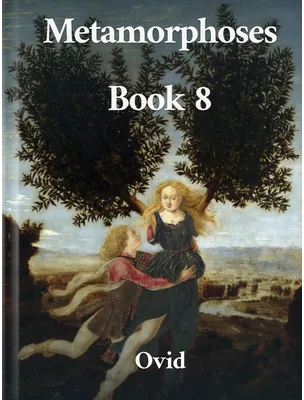
Book 8
by
P. Ovidius Naso

Nisus et Scylla
King Minos and Scylla
Now Lucifer unveiled the glorious day,
and as the session of the night dissolved,
the cool east wind declined, and vapors wreathed
the moistened valleys. Veering to the south
the welcome wind gave passage to the sons
of Aeacus, and wafted Cephalus
on his returning way, propitious; where
before the wonted hour, they entered port.
King Minos, while the fair wind moved their ship,
was laying waste the land of Megara.
He gathered a great army round the walls
built by Alcathous, where reigned in splendor
King Nisus — mighty and renowned in war —
upon the center of whose hoary head
a lock of purple hair was growing. — Its
proved virtue gave protection to his throne.
Six times the horns of rising Phoebe grew,
and still the changing fortune of the war
was in suspense; so, Victory day by day
between them hovered on uncertain wings.
Within that city was a regal tower
on tuneful walls; where once Apollo laid
his golden harp; and in the throbbing stone
the sounds remained. And there, in times of peace
the daughter of king Nisus loved to mount
the walls and strike the sounding stone with pebbles:
so, when the war began, she often viewed
the dreadful contest from that height;
until, so long the hostile camp remained,
she had become acquainted with the names,
and knew the habits, horses and the arms
of many a chief, and could discern the signs
of their Cydonean quivers.
More than all,
the features of King Minos were engraved
upon the tablets of her mind. And when
he wore his helmet, crested with gay plumes,
she deemed it glorious; when he held his shield
shining with gold, no other seemed so grand;
and when he poised to hurl the tough spear home,
she praised his skill and strength; and when he bent
his curving bow with arrow on the cord,
she pictured him as Phoebus taking aim, —
but when, arrayed in purple, and upon
the back of his white war horse, proudly decked
with richly broidered housings, he reined in
the nervous steed, and took his helmet off,
showing his fearless features, then the maid,
daughter of Nisus, could control herself
no longer; and a frenzy seized her mind.
She called the javelin happy which he touched,
and blessed were the reins within his hand.
She had an impulse to direct her steps,
a tender virgin, through the hostile ranks,
or cast her body from the topmost towers
into the Gnossian camp. She had a wild
desire to open to the enemy
the heavy brass-bound gates, or anything
that Minos could desire.
And as she sat
beholding the white tents, she cried, “Alas!
Should I rejoice or grieve to see this war?
I grieve that Minos is the enemy
of her who loves him; but unless the war
had brought him, how could he be known to me?
But should he take me for a hostage? That
might end the war — a pledge of peace, he might
keep me for his companion.
“O, supreme
of mankind! she who bore you must have been
as beautiful as you are; ample cause
for Jove to lose his heart. O, happy hour!
If moving upon wings through yielding air,
I could alight within the hostile camp
in front of Minos, and declare to him
my name and passion!
“Then would I implore
what dowry he could wish, and would provide
whatever he might ask, except alone
the city of my father. Perish all
my secret hopes before one act of mine
should offer treason to accomplish it.
And yet, the kindness of a conqueror
has often proved a blessing, manifest
to those who were defeated. Certainly
the war he carries on is justified
by his slain son.
“He is a mighty king,
thrice strengthened in his cause. Undoubtedly
we shall be conquered, and, if such a fate
awaits our city, why should he by force
instead of my consuming love, prevail
to open the strong gates? Without delay
and dreadful slaughter, it is best for him
to conquer and decide this savage war.
“Ah, Minos, how I fear the bitter fate
should any warrior hurl his cruel spear
and pierce you by mischance, for surely none
can be so hardened to transfix your breast
with purpose known.”
Oh, let her love prevail
to open for his army the great gates.
Only the thought of it, has filled her soul;
she is determined to deliver up
her country as a dowry with herself,
and so decide the war! But what avails
this idle talk.
“A guard surrounds the gates,
my father keeps the keys, and he alone
is my obstruction, and the innocent
account of my despair. Would to the Gods
I had no father! Is not man the God
of his own fortune, though his idle prayers
avail not to compel his destiny?
“Another woman crazed with passionate desires,
which now inflame me, would not hesitate,
but with a fierce abandon would destroy
whatever checked her passion. Who is there
with love to equal mine? I dare to go
through flames and swords; but swords and flames
are not now needed, for I only need
my royal father’s lock of purple hair.
More precious than fine gold, it has a power
to give my heart all that it may desire.”
While Scylla said this, night that heals our cares
came on, and she grew bolder in the dark.
And now it is the late and silent hour
when slumber takes possession of the breast.
Outwearied with the cares of busy day;
then as her father slept, with stealthy tread
she entered his abode, and there despoiled,
and clipped his fatal lock of purple hair.
Concealing in her bosom the sad prize
of crime degenerate, she at once went forth
a gate unguarded, and with shameless haste
sped through the hostile army to the tent
of Minos, whom, astonished, she addressed:
“Only my love has led me to this deed.
The daughter of King Nisus, I am called
the maiden Scylla. Unto you I come
and offer up a power that will prevail
against my country, and I stipulate
no recompense except yourself. Take then
this purple hair, a token of my love. —
Deem it not lightly as a lock of hair
held idly forth to you; it is in truth
my father’s life.” And as she spoke
she held out in her guilty hand the prize,
and begged him to accept it with her love.
Shocked at the thought of such a heinous crime,
Minos refused, and said, “O execrable thing!
Despised abomination of our time!
May all the Gods forever banish you
from their wide universe, and may the earth
and the deep ocean be denied to you!
So great a monster shall not be allowed
to desecrate the sacred Isle of Crete,
where Jupiter was born.” So Minos spoke.
Nevertheless he conquered Megara,
(so aided by the damsel’s wicked deed)
and as a just and mighty king imposed
his own conditions on the vanquished land.
He ordered his great fleet to tarry not;
the hawsers were let loose, and the long oars
quickly propelled his brazen-pointed ships. —
When Scylla saw them launching forth,
observed them sailing on the mighty deep,
she called with vain entreaties; but at last,
aware the prince ignored her and refused
to recompense her wickedness, enraged,
and raving, she held up her impious hands,
her long hair streaming on the wind, — and said:
“Oh, wherefore have you flown, and left behind
the author of your glory. Oh, wretch! wretch
to whom I offered up my native land,
and sacrificed my father! Where have you
now flown, ungrateful man whose victory
is both my crime and virtue? And the gift
presented to you, and my passion,
have these not moved you? All my love and hope
in you alone!
“Forsaken by my prince,
shall I return to my defeated land?
If never ruined it would shut its walls
against me. — Shall I seek my father’s face
whom I delivered to all-conquering arms?
My fellow-citizens despise my name;
my friends and neighbors hate me; I have shut
the world against me, only in the hope
that Crete would surely welcome me; — and now,
he has forbidden me.
“And is it so
I am requited by this thankless wretch!
Europa could not be your mother! Spawn
of cruel Syrtis! Savage cub of fierce
Armenian tigress; — or Charybdis, tossed
by the wild South-wind begot you! Can you be
the son of Jupiter? Your mother was
not ever tricked by the false semblance
of a bull. All that story of your birth
is false! You are the offspring of a bull
as fierce as you are!
“Let your vengeance fall
upon me, O my father Nisus, let
the ruined city I betrayed rejoice
at my misfortunes — richly merited —
destroy me, you whom I have ruined; — I
should perish for my crimes! But why should you,
who conquered by my crime, abandon me?
The treason to my father and my land
becomes an act of kindness in your cause.
“That woman is a worthy mate for you
who hid in wood deceived the raging bull,
and bore to him the infamy of Crete.
I do not wonder that Pasiphae
preferred the bull to you, more savage than
the wildest beast. Alas, alas for me!
“Do my complaints reach your unwilling ears?
Or do the same winds waft away my words
that blow upon your ships, ungrateful man? —
Ah, wretched that I am, he takes delight
in hastening from me. The deep waves resound
as smitten by the oars, his ship departs;
and I am lost and even my native land
is fading from his sight.
“Oh heart of flint!
you shall not prosper in your cruelty,
and you shall not forget my sacrifice;
in spite of everything I follow you!
I’ll grasp the curving stern of your swift ship,
and I will follow through unending seas.”
And as she spoke, she leaped into the waves,
and followed the receding ships — for strength
from passion came to her. And soon she clung
unwelcome, to the sailing Gnossian ship.
Meanwhile, the Gods had changed her father’s form
and now he hovered over the salt deep,
a hawk with tawny wings. So when he saw
his daughter clinging to the hostile ship
he would have torn her with his rending beak; —
he darted towards her through the yielding air.
In terror she let go, but as she fell
the light air held her from the ocean spray;
her feather-weight supported by the breeze;
she spread her wings, and changed into a bird.
They called her “Ciris” when she cut the wind,
and “Ciris” — cut-the-lock — remains her name.
Labyrinthus.
Ariadnes Corona
Minos and the Minotaur
King Minos, when he reached the land of Crete
and left his ships, remembered he had made
a vow to Jupiter, and offered up
a hundred bulls. — The splendid spoils of war
adorned his palace. —
Now the infamous
reproach of Crete had grown, till it exposed
the double-natured shame. So, Minos, moved
to cover his disgrace, resolved to hide
the monster in a prison, and he built
with intricate design, by Daedalus
contrived, an architect of wonderful
ability, and famous. This he planned
of mazey wanderings that deceived the eyes,
and labyrinthic passages involved.
so sports the clear Maeander, in the fields
of Phrygia winding doubtful; back and forth
it meets itself, until the wandering stream
fatigued, impedes its wearied waters’ flow;
from source to sea, from sea to source involved.
So Daedalus contrived innumerous paths,
and windings vague, so intricate that he,
the architect, hardly could retrace his steps.
In this the Minotaur was long concealed,
and there devoured Athenian victims sent
three seasons, nine years each, till Theseus, son
of Aegeus, slew him and retraced his way,
finding the path by Ariadne’s thread.
Without delay the victor fled from Crete,
together with the loving maid, and sailed
for Dia Isle of Naxos, where he left
the maid forlorn, abandoned. Her, in time,
lamenting and deserted, Bacchus found
and for his love immortalized her name.
He set in the dark heavens the bright crown
that rested on her brows. Through the soft air
it whirled, while all the sparkling jewels changed
to flashing fires, assuming in the sky
between the Serpent-holder and the Kneeler
the well-known shape of Ariadne’s Crown.
Daedalus et Icarus.
Perdix
Daedalus and Icarus
But Daedalus abhorred the Isle of Crete —
and his long exile on that sea-girt shore,
increased the love of his own native place.
“Though Minos blocks escape by sea and land,”
He said, “The unconfined skies remain;
though Minos may be lord of all the world
his sceptre is not regnant of the air,
and by that untried way is our escape.”
This said, he turned his mind to arts unknown
and nature unrevealed. He fashioned quills
and feathers in due order — deftly formed
from small to large, as any rustic pipe
from straws’ unequal slants. He bound with thread
the middle feathers, and the lower fixed
with pliant wax; till so, in gentle curves
arranged, he bent them to the shape of birds.
While he was working, his son Icarus,
with smiling countenance and unaware
of danger to himself, perchance would chase
the feathers, ruffled by the shifting breeze,
or soften with his thumb the yellow wax,
and by his playfulness retard the work
his anxious father planned.
But when at last
the father finished it, he poised himself,
and lightly floating in the winnowed air
waved his great feathered wings with bird-like ease.
And, likewise he had fashioned for his son
such wings; before they ventured in the air
he said, “My son, I caution you to keep
the middle way, for if your pinions dip
too low the waters may impede your flight;
and if they soar too high the sun may scorch them.
Fly midway. Gaze not at the boundless sky,
far Ursa Major and Bootes next.
Nor on Orion with his flashing brand,
but follow my safe guidance.”
As he spoke
he fitted on his son the plumed wings
with trembling hands, while down his withered cheeks
the tears were falling. Then he gave his son
a last kiss, and upon his gliding wings
assumed a careful lead solicitous.
As when the bird leads forth her tender young,
from high-swung nest to try the yielding air;
so he prevailed on willing Icarus;
encouraged and instructed him in all
the fatal art; and as he waved his wings
looked backward on his son.
Beneath their flight,
the fisherman while casting his long rod,
or the tired shepherd leaning on his crook,
or the rough plowman as he raised his eyes,
astonished might observe them on the wing,
and worship them as Gods.
Upon the left
they passed by Samos, Juno’s sacred isle;
Delos and Paros too, were left behind;
and on the right Lebinthus and Calymne,
fruitful in honey. Proud of his success,
the foolish Icarus forsook his guide,
and, bold in vanity, began to soar,
rising upon his wings to touch the skies;
but as he neared the scorching sun, its heat
softened the fragrant wax that held his plumes;
and heat increasing melted the soft wax —
he waved his naked arms instead of wings,
with no more feathers to sustain his flight.
And as he called upon his father’s name
his voice was smothered in the dark blue sea,
now called Icarian from the dead boy’s name.
The unlucky father, not a father, called,
“Where are you, Icarus?” and “Where are you?
In what place shall I seek you, Icarus?”
He called again; and then he saw the wings
of his dear Icarus, floating on the waves;
and he began to rail and curse his art.
He found the body on an island shore,
now called Icaria, and at once prepared
to bury the unfortunate remains;
but while he labored a pert partridge near,
observed him from the covert of an oak,
and whistled his unnatural delight.
Know you the cause? ‘Twas then a single bird,
the first one of its kind. ‘Twas never seen
before the sister of Daedalus had brought
him Perdix, her dear son, to be his pupil.
And as the years went by the gifted youth
began to rival his instructor’s art.
He took the jagged backbone of a fish,
and with it as a model made a saw,
with sharp teeth fashioned from a strip of iron.
And he was first to make two arms of iron,
smooth hinged upon the center, so that one
would make a pivot while the other, turned,
described a circle. Wherefore Daedalus
enraged and envious, sought to slay the youth
and cast him headlong from Minerva’s fane, —
then spread the rumor of an accident.
But Pallas, goddess of ingenious men,
saving the pupil changed him to a bird,
and in the middle of the air he flew
on feathered wings; and so his active mind —
and vigor of his genius were absorbed
into his wings and feet; although the name
of Perdix was retained.
The Partridge hides
in shaded places by the leafy trees
its nested eggs among the bush’s twigs;
nor does it seek to rise in lofty flight,
for it is mindful of its former fall.