'Metamorphoses, Book 11' is part of Ovid's larger work, 'Metamorphoses,' which was published around 8 AD. This epic poem consists of 15 books in total.
[{"id":"para_1","index":0,"start":0,"offset":304,"words":1,"paraNum":"","lastModified":1752666480000,"semanticType":"title-book-title","voicework":"audio_file","blockId":"callisto_en-bl1vn","language":"en","wordsRange":{"start":33333333,"end":66666667},"paragraphVersion":25,"direction":"ltr","paragraph":"<h1 class=\"ilm-title\" id=\"para_1\" semantictype=\"title-book-title\" data-ilmid=\"callisto_en-bl1vn\" data-audio=\"1\" data-chapter=\"para_1\" data-words-count=\"1\" data-before=\"0\" data-ww=\"\"><span class=\"block-pb\"> <span class=\"block-pb is-animated\"></span> </span><span class=\"itm-wrap\">Metamorphoses</span></h1>","hasContent":true,"isFirst":true,"isLast":false},{"id":"para_2","index":1,"start":304,"offset":321,"words":2,"paraNum":"","lastModified":1752666466000,"semanticType":"title-subtitle","voicework":"audio_file","blockId":"callisto_en-bl117","language":"en","wordsRange":{"start":100000000,"end":103000000},"paragraphVersion":15,"direction":"ltr","paragraph":"<h1 class=\"ilm-title ilm-x-large ilm-subtitle\" id=\"para_2\" semantictype=\"title-subtitle\" data-ilmid=\"callisto_en-bl117\" data-audio=\"1\" data-chapter=\"para_2\" data-words-count=\"2\" data-before=\"1\" data-ww=\"\"><span class=\"block-pb\"> <span class=\"block-pb is-animated\"></span> </span><span class=\"itm-wrap\">Book 11</span></h1>","hasContent":true,"isFirst":false,"isLast":false},{"id":"para_3","index":2,"start":625,"offset":329,"words":3,"paraNum":"","lastModified":1752219413000,"semanticType":"title-author","voicework":"audio_file","blockId":"callisto_en-bl1hh","language":"en","wordsRange":{"start":203000000,"end":208000000},"paragraphVersion":10,"direction":"ltr","paragraph":"<h1 class=\"ilm-title ilm-author ilm-large\" id=\"para_3\" semantictype=\"title-author\" data-ilmid=\"callisto_en-bl1hh\" data-audio=\"1\" data-chapter=\"para_3\" data-words-count=\"3\" data-before=\"3\" data-ww=\"\"><span class=\"block-pb\"> <span class=\"block-pb is-animated\"></span> </span><span class=\"itm-wrap\">by<br>P. Ovidius Naso</span></h1>","hasContent":true,"isFirst":false,"isLast":false},{"id":"para_4","index":3,"start":954,"offset":139,"words":0,"paraNum":"","lastModified":1752219413000,"semanticType":"line","blockId":"callisto_en-bl2t","language":"en","wordsRange":{"start":308000000,"end":310000000},"paragraphVersion":11,"direction":"ltr","paragraph":"<hr class=\"ilm-hr ilm-small\" id=\"para_4\" semantictype=\"line\" data-ilmid=\"callisto_en-bl2t\" data-words-count=\"0\" data-before=\"6\" data-ww=\"\">","hasContent":true,"isFirst":false,"isLast":false},{"id":"para_5","index":4,"start":1093,"offset":1073,"words":0,"paraNum":"","lastModified":1755083723000,"semanticType":"illustration","blockId":"callisto_en-bl1vo","language":"en","wordsRange":{"start":343333333,"end":376666667},"paragraphVersion":17,"direction":"ltr","paragraph":"<div class=\"ilm-illustration\" id=\"para_5\" semantictype=\"illustration\" data-ilmid=\"callisto_en-bl1vo\" data-words-count=\"0\" data-before=\"6\" data-ww=\"\"><img width=\"600\" height=\"400\" data-src=\"ch0p0\" src=\"data:image/webp;base64,UklGRlgCAABXRUJQVlA4IEwCAABQDQCdASo8ACgAPm0qkEYkIiGhMBgKqIANiWMAsR8OTUAAPm4TnpwDYK9v7xAw5hI2VWmHDJ1I6VtpILyDP79IYZfK02hmkVC1G/ff4Y7ISBqxhCyU1fgT/Af3wlCvfjdEa5CTvFNx3g6UDujcPmtbVq0AAP7wpov8gTLrEQuTQvWrlqZzuMNl0g7YQk4s7NrqT/44N+PV68jb43tRpJwdpGmc2jUU51t7clNTQGbYuuEUgOFTUlXaBsXaP+P9wc4vPhiMxEGpQXzfFtk8PoEjURp2DdVrB6ma2spKq51jMxhfaWKmOOF5IT0YIIMJRE3QM1YeGV6vNl2u+KKimfGiqIm7yf5biALGLQ+y6eSrx30tvwJLigCgWRERWYWuStTaHEh6QlRFHTmaG7ePTBwy49gVGTbR3GXFCir+91mc/60LuB6+ZIlMUbIjF/Wwcu5rKmi/C4q2D0wxH5Fgl2oQsDSPsvs4YqewQVptdl8VijJyNdhUt6cWfY2N0fya87xV9TKRitikfSaBQeqX/TM0dmT4CP0xOMdRYXPPCovuZ/iT/6Xl9Rp5fWpYeCi1AUXa+se1qajrxPRVPQIYxtudGHL3QxFVakiWztonFU/uAN9TQ3e55LGdvi07x8OrI6IYBiyhflXORjNqCY7n0HhEYRwHnLP5zQQXsreGaQlUn0k7rG4kuQE+yeTvkS+RqzvNjYFbc7MTTILPoj2cOfIOLqLIEopAHXezzv1+naw6a/U7vWGg+fA6eiEJEjrbO5EdZBFaRGd6w13IAAA=\" alt=\"Metamorphoses, Book 11\"></div>","hasContent":true,"isFirst":false,"isLast":false},{"id":"para_6","index":5,"start":2166,"offset":489,"words":2,"paraNum":"","lastModified":1754676433000,"semanticType":"header-chapter-header","voicework":"no_audio","blockId":"callisto_en-bl118","language":"en","wordsRange":{"start":410000000,"end":413000000},"paragraphVersion":14,"direction":"ltr","paragraph":"<h2 class=\"ilm-header ilm-h2 ilm-large\" id=\"para_6\" semantictype=\"header-chapter-header\" data-ilmid=\"callisto_en-bl118\" data-chapter=\"para_6\" data-words-count=\"2\" data-before=\"6\" data-ww=\"\"><span class=\"block-pb\"> <span class=\"block-pb is-animated\"></span> </span><span class=\"itm-wrap\"><span class=\"chapter-text\"><span class=\"chapter-number\"><span class=\"chapter-label\"></span><span class=\"chapter-value\"></span></span><span class=\"chapter-title\">Orphei Mors<br></span></span></span></h2>","hasContent":true,"isFirst":false,"isLast":false},{"id":"para_7","index":6,"start":2655,"offset":315,"words":3,"paraNum":"","lastModified":1752219413000,"semanticType":"header-subheader","voicework":"audio_file","blockId":"callisto_en-bl119","language":"en","wordsRange":{"start":513000000,"end":517000000},"paragraphVersion":10,"direction":"ltr","paragraph":"<h3 class=\"ilm-header ilm-h3\" id=\"para_7\" semantictype=\"header-subheader\" data-ilmid=\"callisto_en-bl119\" data-audio=\"1\" data-chapter=\"para_7\" data-words-count=\"3\" data-before=\"8\" data-ww=\"\"><span class=\"block-pb\"> <span class=\"block-pb is-animated\"></span> </span><span class=\"itm-wrap\">Death of Orpheus</span></h3>","hasContent":true,"isFirst":false,"isLast":false},{"id":"para_8","index":7,"start":2970,"offset":615,"words":45,"paraNum":"1.1","lastModified":1752219413000,"semanticType":"par","voicework":"audio_file","blockId":"callisto_en-bl11a","language":"en","wordsRange":{"start":617000000,"end":669000000},"paragraphVersion":10,"direction":"ltr","paragraph":"<p id=\"para_8\" semantictype=\"par\" data-ilmid=\"callisto_en-bl11a\" data-audio=\"1\" data-words-count=\"45\" data-before=\"11\" data-ww=\"\"><span class=\"block-num\" data-id=\"1.1\"></span><span class=\"block-pb\"> <span class=\"block-pb is-animated\"></span> </span><span class=\"itm-wrap\"> While with his songs, Orpheus, the bard of <i>Thrace,</i><br>allured the trees, the savage animals,<br>and even the insensate rocks, to follow him;<br>Ciconian matrons, with their raving breasts<br>concealed in skins of forest animals,<br>from the summit of a hill observed him there,<br>attuning love songs to a sounding harp.<br></span></p>","hasContent":true,"isFirst":false,"isLast":false},{"id":"para_9","index":8,"start":3585,"offset":623,"words":52,"paraNum":"1.2","lastModified":1752219413000,"semanticType":"par","voicework":"audio_file","blockId":"callisto_en-bl1ux","language":"en","wordsRange":{"start":769000000,"end":827000000},"paragraphVersion":10,"direction":"ltr","paragraph":"<p id=\"para_9\" semantictype=\"par\" data-ilmid=\"callisto_en-bl1ux\" data-audio=\"1\" data-words-count=\"52\" data-before=\"56\" data-ww=\"\"><span class=\"block-num\" data-id=\"1.2\"></span><span class=\"block-pb\"> <span class=\"block-pb is-animated\"></span> </span><span class=\"itm-wrap\">One of those women, as her tangled hair<br>was tossed upon the light breeze shouted, “See!<br> Here is the poet who has scorned our love!”<br>Then hurled her spear at the melodious mouth<br>of great Apollo’s bard: but the spear’s point,<br>trailing in flight a garland of fresh leaves,<br>made but a harmless bruise and wounded not.</span></p>","hasContent":true,"isFirst":false,"isLast":false},{"id":"para_10","index":9,"start":4208,"offset":489,"words":33,"paraNum":"1.3","lastModified":1752219413000,"semanticType":"par","voicework":"audio_file","blockId":"callisto_en-bl11b","language":"en","wordsRange":{"start":927000000,"end":965000000},"paragraphVersion":10,"direction":"ltr","paragraph":"<p id=\"para_10\" semantictype=\"par\" data-ilmid=\"callisto_en-bl11b\" data-audio=\"1\" data-words-count=\"33\" data-before=\"108\" data-ww=\"\"><span class=\"block-num\" data-id=\"1.3\"></span><span class=\"block-pb\"> <span class=\"block-pb is-animated\"></span> </span><span class=\"itm-wrap\">The weapon of another was a stone,<br>which in the very air was overpowered<br>by the true harmony of his voice and lyre,<br>and so disabled lay before his feet,<br>as asking pardon for that vain attempt.</span></p>","hasContent":true,"isFirst":false,"isLast":false},{"id":"para_11","index":10,"start":4697,"offset":810,"words":70,"paraNum":"1.4","lastModified":1752219413000,"semanticType":"par","voicework":"audio_file","blockId":"callisto_en-bl11c","language":"en","wordsRange":{"start":1065000000,"end":1145000000},"paragraphVersion":10,"direction":"ltr","paragraph":"<p id=\"para_11\" semantictype=\"par\" data-ilmid=\"callisto_en-bl11c\" data-audio=\"1\" data-words-count=\"70\" data-before=\"141\" data-ww=\"\"><span class=\"block-num\" data-id=\"1.4\"></span><span class=\"block-pb\"> <span class=\"block-pb is-animated\"></span> </span><span class=\"itm-wrap\"> The madness of such warfare then increased.<br>All moderation is entirely lost,<br>and a wild Fury overcomes the right. —<br>although their weapons would have lost all force,<br>subjected to the power of Orpheus’ harp,<br>the clamorous discord of their boxwood pipes,<br>the blaring of their horns, their tambourines<br>and clapping hands and Bacchanalian yells,<br>with hideous discords drowned his voice and harp. —<br> at last the stones that heard his song no more<br>fell crimson with the Thracian poet’s blood.</span></p>","hasContent":true,"isFirst":false,"isLast":false},{"id":"para_12","index":11,"start":5507,"offset":959,"words":94,"paraNum":"1.5","lastModified":1752219413000,"semanticType":"par","voicework":"audio_file","blockId":"callisto_en-bl11d","language":"en","wordsRange":{"start":1245000000,"end":1353000000},"paragraphVersion":10,"direction":"ltr","paragraph":"<p id=\"para_12\" semantictype=\"par\" data-ilmid=\"callisto_en-bl11d\" data-audio=\"1\" data-words-count=\"94\" data-before=\"211\" data-ww=\"\"><span class=\"block-num\" data-id=\"1.5\"></span><span class=\"block-pb\"> <span class=\"block-pb is-animated\"></span> </span><span class=\"itm-wrap\">Before his life was taken, the maenads turned<br>their threatening hands upon the many birds,<br>which still were charmed by Orpheus as he sang,<br>the serpents, and the company of beasts —<br>fabulous audience of that worshipped bard.<br>And then they turned on him their blood-stained hands:<br>and flocked together swiftly, as wild birds,<br>which, by some chance, may see the bird of night<br>beneath the sun. And as the savage dogs<br>rush on the doomed stag, loosed some bright fore-noon,<br>on blood-sand of the amphitheatre;<br>they rushed against the bard, with swift<br>hurled thyrsi which, adorned with emerald leaves<br>had not till then been used for cruelty.</span></p>","hasContent":true,"isFirst":false,"isLast":false},{"id":"para_13","index":12,"start":6466,"offset":887,"words":87,"paraNum":"1.6","lastModified":1752219413000,"semanticType":"par","voicework":"audio_file","blockId":"callisto_en-bl11e","language":"en","wordsRange":{"start":1453000000,"end":1552000000},"paragraphVersion":10,"direction":"ltr","paragraph":"<p id=\"para_13\" semantictype=\"par\" data-ilmid=\"callisto_en-bl11e\" data-audio=\"1\" data-words-count=\"87\" data-before=\"305\" data-ww=\"\"><span class=\"block-num\" data-id=\"1.6\"></span><span class=\"block-pb\"> <span class=\"block-pb is-animated\"></span> </span><span class=\"itm-wrap\">And some threw clods, and others branches torn<br>from trees; and others threw flint stones at him,<br>and, that no lack of weapons might restrain<br>their savage fury then, not far from there<br>by chance they found some oxen which turned up<br>the soil with ploughshares, and in fields nearby<br>were strong-armed peasants, who with eager sweat<br> worked for the harvest as they dug hard fields;<br>and all those peasants, when they saw the troop<br>of frantic women, ran away and left<br>their implements of labor strown upon<br>deserted fields — harrows and heavy rakes<br>and their long spades.</span></p>","hasContent":true,"isFirst":false,"isLast":false},{"id":"para_14","index":13,"start":7353,"offset":790,"words":67,"paraNum":"1.7","lastModified":1752219413000,"semanticType":"par","voicework":"audio_file","blockId":"callisto_en-bl11f","language":"en","wordsRange":{"start":1652000000,"end":1729000000},"paragraphVersion":10,"direction":"ltr","paragraph":"<p id=\"para_14\" semantictype=\"par\" data-ilmid=\"callisto_en-bl11f\" data-audio=\"1\" data-words-count=\"67\" data-before=\"392\" data-ww=\"\"><span class=\"block-num\" data-id=\"1.7\"></span><span class=\"block-pb\"> <span class=\"block-pb is-animated\"></span> </span><span class=\"itm-wrap\"> After the savage mob<br>had seized upon those implements, and torn<br>to pieces oxen armed with threatening horns,<br>they hastened to destroy the harmless bard,<br>devoted Orpheus; and with impious hate,<br>murdered him, while his out-stretched hands implored<br>their mercy — the first and only time his voice<br>had no persuasion. O great Jupiter!<br>Through those same lips which had controlled the rocks<br> and which had overcome ferocious beasts,<br>his life breathed forth, departed in the air.</span></p>","hasContent":true,"isFirst":false,"isLast":false},{"id":"para_15","index":14,"start":8143,"offset":671,"words":53,"paraNum":"1.8","lastModified":1752219413000,"semanticType":"par","voicework":"audio_file","blockId":"callisto_en-bl11g","language":"en","wordsRange":{"start":1829000000,"end":1890000000},"paragraphVersion":10,"direction":"ltr","paragraph":"<p id=\"para_15\" semantictype=\"par\" data-ilmid=\"callisto_en-bl11g\" data-audio=\"1\" data-words-count=\"53\" data-before=\"459\" data-ww=\"\"><span class=\"block-num\" data-id=\"1.8\"></span><span class=\"block-pb\"> <span class=\"block-pb is-animated\"></span> </span><span class=\"itm-wrap\">The mournful birds, the stricken animals,<br>the hard stones and the weeping woods, all these<br>that often had followed your inspiring voice,<br>bewailed your death; while trees dropped their green leaves,<br>mourning for you, as if they tore their hair.<br>They say sad rivers swelled with their own tears —<br>naiads and dryads with dishevelled hair<br>wore garments of dark color.</span></p>","hasContent":true,"isFirst":false,"isLast":false},{"id":"para_16","index":15,"start":8814,"offset":1062,"words":108,"paraNum":"1.9","lastModified":1754479201000,"semanticType":"par","voicework":"audio_file","blockId":"callisto_en-bl11h","language":"en","wordsRange":{"start":1990000000,"end":2114000000},"paragraphVersion":16,"direction":"ltr","paragraph":"<p id=\"para_16\" semantictype=\"par\" data-ilmid=\"callisto_en-bl11h\" data-audio=\"1\" data-words-count=\"108\" data-before=\"512\" data-ww=\"\"><span class=\"block-num\" data-id=\"1.9\"></span><span class=\"block-pb\"> <span class=\"block-pb is-animated\"></span> </span><span class=\"itm-wrap\"> His torn limbs<br>were scattered in strange places. <i>Hebrus</i> then<br>received his head and harp — and, wonderful!<br>While his loved harp was floating down the stream,<br>it mourned for him beyond my power to tell.<br>His tongue though lifeless, uttered a mournful sound<br>and mournfully the river’s banks replied:<br>onward borne by the river to the sea<br>they left their native stream and reached the shore<br> of <i>Lesbos</i> at <i>Methymna. </i>Instantly,<br>a furious serpent rose to attack the head<br>of Orpheus, cast up on that foreign sand —<br>the hair still wet with spray. Phoebus at last<br>appeared and saved the head from that attack:<br>before the serpent could inflict a sting,<br>he drove it off, and hardened its wide jaws<br>to rigid stone.</span></p>","hasContent":true,"isFirst":false,"isLast":false},{"id":"para_17","index":16,"start":9876,"offset":713,"words":60,"paraNum":"1.10","lastModified":1754479243000,"semanticType":"par","voicework":"audio_file","blockId":"callisto_en-bl11i","language":"en","wordsRange":{"start":2214000000,"end":2283000000},"paragraphVersion":16,"direction":"ltr","paragraph":"<p id=\"para_17\" semantictype=\"par\" data-ilmid=\"callisto_en-bl11i\" data-audio=\"1\" data-words-count=\"60\" data-before=\"620\" data-ww=\"\"><span class=\"block-num\" data-id=\"1.10\"></span><span class=\"block-pb\"> <span class=\"block-pb is-animated\"></span> </span><span class=\"itm-wrap\"> Meanwhile the fleeting shade<br>of Orpheus had descended under earth:<br>remembering now those regions that he saw<br>when there before, he sought Eurydice<br>through fields frequented by the blest; and when<br>he found her, folded her in eager arms.<br>Then lovingly they wandered side by side,<br>or he would follow when she chose to lead,<br>or at another time he walked in front,<br> looking back, safely, — at Eurydice.</span></p>","hasContent":true,"isFirst":false,"isLast":false},{"id":"para_18","index":17,"start":10589,"offset":581,"words":42,"paraNum":"1.11","lastModified":1752219413000,"semanticType":"par","voicework":"audio_file","blockId":"callisto_en-bl11j","language":"en","wordsRange":{"start":2383000000,"end":2432000000},"paragraphVersion":10,"direction":"ltr","paragraph":"<p id=\"para_18\" semantictype=\"par\" data-ilmid=\"callisto_en-bl11j\" data-audio=\"1\" data-words-count=\"42\" data-before=\"680\" data-ww=\"\"><span class=\"block-num\" data-id=\"1.11\"></span><span class=\"block-pb\"> <span class=\"block-pb is-animated\"></span> </span><span class=\"itm-wrap\">Bacchus would not permit the wickedness<br>of those who slaughtered Orpheus to remain<br>unpunished. Grieving for the loss of his<br>loved bard of sacred rites, at once he bound<br>with twisted roots the feet of everyone<br>of those Edonian women who had caused<br>the crime of Orpheus’ death.</span></p>","hasContent":true,"isFirst":false,"isLast":false},{"id":"para_19","index":18,"start":11170,"offset":689,"words":60,"paraNum":"1.12","lastModified":1752219413000,"semanticType":"par","voicework":"audio_file","blockId":"callisto_en-bl11k","language":"en","wordsRange":{"start":2532000000,"end":2601000000},"paragraphVersion":10,"direction":"ltr","paragraph":"<p id=\"para_19\" semantictype=\"par\" data-ilmid=\"callisto_en-bl11k\" data-audio=\"1\" data-words-count=\"60\" data-before=\"722\" data-ww=\"\"><span class=\"block-num\" data-id=\"1.12\"></span><span class=\"block-pb\"> <span class=\"block-pb is-animated\"></span> </span><span class=\"itm-wrap\"> Their toes grew long.<br>He thrust the sharp points in the solid earth.<br>As when a bird entangled in a snare,<br>hid by the cunning fowler, knows too late<br>that it is held, then vainly beats its wings,<br>and fluttering only makes more tight the noose<br>with every struggle; so each woman-fiend<br>whose feet were sinking in the soil, when she<br>attempted flight, was held by deepening roots.<br></span></p>","hasContent":true,"isFirst":false,"isLast":false},{"id":"para_20","index":19,"start":11859,"offset":749,"words":71,"paraNum":"1.13","lastModified":1752219413000,"semanticType":"par","voicework":"audio_file","blockId":"callisto_en-bl1uy","language":"en","wordsRange":{"start":2701000000,"end":2781000000},"paragraphVersion":10,"direction":"ltr","paragraph":"<p id=\"para_20\" semantictype=\"par\" data-ilmid=\"callisto_en-bl1uy\" data-audio=\"1\" data-words-count=\"71\" data-before=\"782\" data-ww=\"\"><span class=\"block-num\" data-id=\"1.13\"></span><span class=\"block-pb\"> <span class=\"block-pb is-animated\"></span> </span><span class=\"itm-wrap\"> And while she looks down where her toes and nails<br>and feet should be, she sees wood growing up<br>from them and covering all her graceful legs.<br>Full of delirious grief, endeavoring<br>to smite with right hand on her changing thigh,<br>she strikes on solid oak. Her tender breast<br>and shoulders are transformed to rigid oak.<br>You would declare that her extended arms<br>are real branches of a forest tree,<br> and such a thought would be the very truth.</span></p>","hasContent":true,"isFirst":false,"isLast":false},{"id":"para_21","index":20,"start":12608,"offset":143,"words":0,"paraNum":"","lastModified":1752219413000,"semanticType":"line","blockId":"callisto_en-bl1lt","language":"en","wordsRange":{"start":2881000000,"end":2883000000},"paragraphVersion":10,"direction":"ltr","paragraph":"<hr class=\"ilm-hr ilm-small\" id=\"para_21\" semantictype=\"line\" data-ilmid=\"callisto_en-bl1lt\" data-words-count=\"0\" data-before=\"853\" data-ww=\"\">","hasContent":true,"isFirst":false,"isLast":false},{"id":"para_22","index":21,"start":12751,"offset":494,"words":2,"paraNum":"","lastModified":1754676452000,"semanticType":"header-chapter-header","voicework":"no_audio","blockId":"callisto_en-bl11l","language":"en","wordsRange":{"start":2983000000,"end":2986000000},"paragraphVersion":13,"direction":"ltr","paragraph":"<h2 class=\"ilm-header ilm-h2 ilm-large\" id=\"para_22\" semantictype=\"header-chapter-header\" data-ilmid=\"callisto_en-bl11l\" data-chapter=\"para_22\" data-words-count=\"2\" data-before=\"853\" data-ww=\"\"><span class=\"block-pb\"> <span class=\"block-pb is-animated\"></span> </span><span class=\"itm-wrap\"><span class=\"chapter-text\"><span class=\"chapter-number\"><span class=\"chapter-label\"></span><span class=\"chapter-value\"></span></span><span class=\"chapter-title\">Midas Aureus<br></span></span></span></h2>","hasContent":true,"isFirst":false,"isLast":false},{"id":"para_23","index":22,"start":13245,"offset":320,"words":3,"paraNum":"","lastModified":1752219413000,"semanticType":"header-subheader","voicework":"audio_file","blockId":"callisto_en-bl11m","language":"en","wordsRange":{"start":3086000000,"end":3090000000},"paragraphVersion":10,"direction":"ltr","paragraph":"<h3 class=\"ilm-header ilm-h3\" id=\"para_23\" semantictype=\"header-subheader\" data-ilmid=\"callisto_en-bl11m\" data-audio=\"1\" data-chapter=\"para_23\" data-words-count=\"3\" data-before=\"855\" data-ww=\"\"><span class=\"block-pb\"> <span class=\"block-pb is-animated\"></span> </span><span class=\"itm-wrap\">Bacchus and Midas</span></h3>","hasContent":true,"isFirst":false,"isLast":false},{"id":"para_24","index":23,"start":13565,"offset":727,"words":65,"paraNum":"2.1","lastModified":1752219413000,"semanticType":"par","voicework":"audio_file","blockId":"callisto_en-bl11n","language":"en","wordsRange":{"start":3190000000,"end":3264000000},"paragraphVersion":10,"direction":"ltr","paragraph":"<p id=\"para_24\" semantictype=\"par\" data-ilmid=\"callisto_en-bl11n\" data-audio=\"1\" data-words-count=\"65\" data-before=\"858\" data-ww=\"\"><span class=\"block-num\" data-id=\"2.1\"></span><span class=\"block-pb\"> <span class=\"block-pb is-animated\"></span> </span><span class=\"itm-wrap\"> And not content with this, Bacchus resolved<br>to leave that land, and with a worthier train<br>went to the vineyards of his own Tmolus<br>and to Pactolus, though the river was<br>not golden, nor admired for precious sands.<br>His usual throng of Satyrs and of Bacchanals<br>surrounded him; but not Silenus, who<br>was then detained from him. The Phrygian folk<br>had captured him, as he was staggering, faint<br> with palsied age and wine. </span></p>","hasContent":true,"isFirst":false,"isLast":false},{"id":"para_25","index":24,"start":14292,"offset":654,"words":53,"paraNum":"2.2","lastModified":1752219413000,"semanticType":"par","voicework":"audio_file","blockId":"callisto_en-bl1vc","language":"en","wordsRange":{"start":3364000000,"end":3426000000},"paragraphVersion":10,"direction":"ltr","paragraph":"<p id=\"para_25\" semantictype=\"par\" data-ilmid=\"callisto_en-bl1vc\" data-audio=\"1\" data-words-count=\"53\" data-before=\"923\" data-ww=\"\"><span class=\"block-num\" data-id=\"2.2\"></span><span class=\"block-pb\"> <span class=\"block-pb is-animated\"></span> </span><span class=\"itm-wrap\">And after they<br>bound him in garlands, they led him to their king<br>Midas, to whom with the Cecropian<br>Eumolpus, Thracian Orpheus had shown all<br>the Bacchic rites. When Midas recognized<br>his old time friend Silenus, who had been<br>so often his companion in the rites<br>of Bacchus, he kept joyful festival,<br>with his old comrade, twice five days and nights.</span></p>","hasContent":true,"isFirst":false,"isLast":false},{"id":"para_26","index":25,"start":14946,"offset":711,"words":58,"paraNum":"2.3","lastModified":1754479465000,"semanticType":"par","voicework":"audio_file","blockId":"callisto_en-bl11o","language":"en","wordsRange":{"start":3526000000,"end":3594000000},"paragraphVersion":16,"direction":"ltr","paragraph":"<p id=\"para_26\" semantictype=\"par\" data-ilmid=\"callisto_en-bl11o\" data-audio=\"1\" data-words-count=\"58\" data-before=\"976\" data-ww=\"\"><span class=\"block-num\" data-id=\"2.3\"></span><span class=\"block-pb\"> <span class=\"block-pb is-animated\"></span> </span><span class=\"itm-wrap\"> Upon the eleventh day, when Lucifer<br>had dimmed the lofty multitude of stars,<br>King Midas and Silenus went from there<br>joyful together to the Lydian lands.<br>There Midas put Silenus carefully<br>under the care of his loved foster-child,<br>young Bacchus. He with great delight, because<br>he had his foster-father once again,<br>allowed the king to choose his own reward —<br>a welcome offer, but it led to harm.<br></span></p>","hasContent":true,"isFirst":false,"isLast":false},{"id":"para_27","index":26,"start":15657,"offset":684,"words":53,"paraNum":"2.4","lastModified":1752219413000,"semanticType":"par","voicework":"audio_file","blockId":"callisto_en-bl1uz","language":"en","wordsRange":{"start":3694000000,"end":3756000000},"paragraphVersion":10,"direction":"ltr","paragraph":"<p id=\"para_27\" semantictype=\"par\" data-ilmid=\"callisto_en-bl1uz\" data-audio=\"1\" data-words-count=\"53\" data-before=\"1034\" data-ww=\"\"><span class=\"block-num\" data-id=\"2.4\"></span><span class=\"block-pb\"> <span class=\"block-pb is-animated\"></span> </span><span class=\"itm-wrap\"> And Midas made this ill-advised reply:<br>“Cause whatsoever I shall touch to change<br>at once to yellow gold.” Bacchus agreed<br>to his unfortunate request, with grief<br>that Midas chose for harm and not for good.<br>The Berecynthian hero, king of <i>Phrygia,</i><br>with joy at his misfortune went away,<br>and instantly began to test the worth<br>of Bacchus’ word by touching everything.</span></p>","hasContent":true,"isFirst":false,"isLast":false},{"id":"para_28","index":27,"start":16341,"offset":1120,"words":133,"paraNum":"2.5","lastModified":1752219413000,"semanticType":"par","voicework":"audio_file","blockId":"callisto_en-bl11p","language":"en","wordsRange":{"start":3856000000,"end":4006000000},"paragraphVersion":10,"direction":"ltr","paragraph":"<p id=\"para_28\" semantictype=\"par\" data-ilmid=\"callisto_en-bl11p\" data-audio=\"1\" data-words-count=\"133\" data-before=\"1087\" data-ww=\"\"><span class=\"block-num\" data-id=\"2.5\"></span><span class=\"block-pb\"> <span class=\"block-pb is-animated\"></span> </span><span class=\"itm-wrap\"> Doubtful himself of his new power, he pulled<br>a twig down from a holm-oak, growing on<br>a low hung branch. The twig was turned to gold.<br>He lifted up a dark stone from the ground<br>and it turned pale with gold. He touched a clod<br>and by his potent touch the clod became<br>a mass of shining gold. He plucked some ripe,<br>dry spears of grain, and all that wheat he touched<br>was golden. Then he held an apple which<br> he gathered from a tree, and you would think<br>that the Hesperides had given it.<br>If he but touched a lofty door, at once<br>each door-post seemed to glisten. When he washed<br>his hands in liquid streams, the lustrous drops<br>upon his hands might have been those which once<br>astonished Danae. He could not now<br>conceive his large hopes in his grasping mind,<br>as he imagined everything of gold.</span></p>","hasContent":true,"isFirst":false,"isLast":false},{"id":"para_29","index":28,"start":17461,"offset":844,"words":88,"paraNum":"2.6","lastModified":1752219413000,"semanticType":"par","voicework":"audio_file","blockId":"callisto_en-bl11q","language":"en","wordsRange":{"start":4106000000,"end":4205000000},"paragraphVersion":10,"direction":"ltr","paragraph":"<p id=\"para_29\" semantictype=\"par\" data-ilmid=\"callisto_en-bl11q\" data-audio=\"1\" data-words-count=\"88\" data-before=\"1220\" data-ww=\"\"><span class=\"block-num\" data-id=\"2.6\"></span><span class=\"block-pb\"> <span class=\"block-pb is-animated\"></span> </span><span class=\"itm-wrap\"> And, while he was rejoicing in great wealth,<br>his servants set a table for his meal,<br>with many dainties and with needful bread:<br>but when he touched the gift of <i>Ceres</i> with<br>his right hand, instantly the gift of <i>Ceres</i><br>stiffened to gold; or if he tried to bite<br>with hungry teeth a tender bit of meat,<br>the dainty, as his teeth but touched it , shone<br>at once with yellow shreds and flakes of gold.<br> And wine, another gift of Bacchus, when<br>he mixed it in pure water, can be seen<br>in his astonished mouth as liquid gold.</span></p>","hasContent":true,"isFirst":false,"isLast":false},{"id":"para_30","index":29,"start":18305,"offset":788,"words":74,"paraNum":"2.7","lastModified":1752219413000,"semanticType":"par","voicework":"audio_file","blockId":"callisto_en-bl11r","language":"en","wordsRange":{"start":4305000000,"end":4389000000},"paragraphVersion":10,"direction":"ltr","paragraph":"<p id=\"para_30\" semantictype=\"par\" data-ilmid=\"callisto_en-bl11r\" data-audio=\"1\" data-words-count=\"74\" data-before=\"1308\" data-ww=\"\"><span class=\"block-num\" data-id=\"2.7\"></span><span class=\"block-pb\"> <span class=\"block-pb is-animated\"></span> </span><span class=\"itm-wrap\"> Confounded by his strange misfortune — rich<br>and wretched — he was anxious to escape<br>from his unhappy wealth. He hated all<br>he had so lately longed for. Plenty could<br>not lessen hunger and no remedy<br>relieved his dry, parched throat. The hated gold<br>tormented him no more than he deserved.<br>Lifting his hands and shining arms to heaven,<br>he moaned. “Oh pardon me, father Lenaeus!<br> I have done wrong, but pity me, I pray,<br>and save me from this curse that looked so fair.”</span></p>","hasContent":true,"isFirst":false,"isLast":false},{"id":"para_31","index":30,"start":19093,"offset":870,"words":84,"paraNum":"2.8","lastModified":1752219413000,"semanticType":"par","voicework":"audio_file","blockId":"callisto_en-bl11s","language":"en","wordsRange":{"start":4489000000,"end":4585000000},"paragraphVersion":10,"direction":"ltr","paragraph":"<p id=\"para_31\" semantictype=\"par\" data-ilmid=\"callisto_en-bl11s\" data-audio=\"1\" data-words-count=\"84\" data-before=\"1382\" data-ww=\"\"><span class=\"block-num\" data-id=\"2.8\"></span><span class=\"block-pb\"> <span class=\"block-pb is-animated\"></span> </span><span class=\"itm-wrap\">How patient are the gods! Bacchus forthwith,<br>because King Midas had confessed his fault,<br>restored him and annulled the promise given,<br>annulled the favor granted, and he said: <br>“That you may not be always cased in gold,<br>which you unhappily desired, depart<br>to the stream that flows by that great town of <i>Sardis</i><br>and upward trace its waters, as they glide<br>past Lydian heights, until you find their source.<br>Then, where the spring leaps out from mountain rock,<br>plunge head and body in the snowy foam.<br>At once the flood will take away your curse.”</span></p>","hasContent":true,"isFirst":false,"isLast":false},{"id":"para_32","index":31,"start":19963,"offset":646,"words":56,"paraNum":"2.9","lastModified":1752219413000,"semanticType":"par","voicework":"audio_file","blockId":"callisto_en-bl11u","language":"en","wordsRange":{"start":4685000000,"end":4749000000},"paragraphVersion":10,"direction":"ltr","paragraph":"<p id=\"para_32\" semantictype=\"par\" data-ilmid=\"callisto_en-bl11u\" data-audio=\"1\" data-words-count=\"56\" data-before=\"1466\" data-ww=\"\"><span class=\"block-num\" data-id=\"2.9\"></span><span class=\"block-pb\"> <span class=\"block-pb is-animated\"></span> </span><span class=\"itm-wrap\">King Midas did as he was told and plunged<br>beneath the water at the river’s source.<br>And the gold virtue granted by the god,<br>as it departed from his body, tinged<br>the stream with gold. And even to this hour<br>adjoining fields, touched by this ancient vein<br>of gold, are hardened where the river flows<br>and colored with the gold that Midas left.</span></p>","hasContent":true,"isFirst":false,"isLast":false},{"id":"para_33","index":32,"start":20609,"offset":144,"words":0,"paraNum":"","lastModified":1752219413000,"semanticType":"line","blockId":"callisto_en-bl1ls","language":"en","wordsRange":{"start":4849000000,"end":4851000000},"paragraphVersion":10,"direction":"ltr","paragraph":"<hr class=\"ilm-hr ilm-small\" id=\"para_33\" semantictype=\"line\" data-ilmid=\"callisto_en-bl1ls\" data-words-count=\"0\" data-before=\"1522\" data-ww=\"\">","hasContent":true,"isFirst":false,"isLast":false},{"id":"para_34","index":33,"start":20753,"offset":494,"words":2,"paraNum":"","lastModified":1754676464000,"semanticType":"header-chapter-header","voicework":"no_audio","blockId":"callisto_en-bl11v","language":"en","wordsRange":{"start":4951000000,"end":4954000000},"paragraphVersion":13,"direction":"ltr","paragraph":"<h2 class=\"ilm-header ilm-h2 ilm-large\" id=\"para_34\" semantictype=\"header-chapter-header\" data-ilmid=\"callisto_en-bl11v\" data-chapter=\"para_34\" data-words-count=\"2\" data-before=\"1522\" data-ww=\"\"><span class=\"block-pb\"> <span class=\"block-pb is-animated\"></span> </span><span class=\"itm-wrap\"><span class=\"chapter-text\"><span class=\"chapter-number\"><span class=\"chapter-label\"></span><span class=\"chapter-value\"></span></span><span class=\"chapter-title\">Midae Aures<br></span></span></span></h2>","hasContent":true,"isFirst":false,"isLast":false},{"id":"para_35","index":34,"start":21247,"offset":341,"words":7,"paraNum":"","lastModified":1752219413000,"semanticType":"header-subheader","voicework":"audio_file","blockId":"callisto_en-bl11w","language":"en","wordsRange":{"start":5054000000,"end":5062000000},"paragraphVersion":10,"direction":"ltr","paragraph":"<h3 class=\"ilm-header ilm-h3\" id=\"para_35\" semantictype=\"header-subheader\" data-ilmid=\"callisto_en-bl11w\" data-audio=\"1\" data-chapter=\"para_35\" data-words-count=\"7\" data-before=\"1524\" data-ww=\"\"><span class=\"block-pb\"> <span class=\"block-pb is-animated\"></span> </span><span class=\"itm-wrap\">The Musical Contest of Pan and Apollo</span></h3>","hasContent":true,"isFirst":false,"isLast":false},{"id":"para_36","index":35,"start":21588,"offset":509,"words":29,"paraNum":"3.1","lastModified":1752219413000,"semanticType":"par","voicework":"audio_file","blockId":"callisto_en-bl11x","language":"en","wordsRange":{"start":5162000000,"end":5196000000},"paragraphVersion":10,"direction":"ltr","paragraph":"<p id=\"para_36\" semantictype=\"par\" data-ilmid=\"callisto_en-bl11x\" data-audio=\"1\" data-words-count=\"29\" data-before=\"1531\" data-ww=\"\"><span class=\"block-num\" data-id=\"3.1\"></span><span class=\"block-pb\"> <span class=\"block-pb is-animated\"></span> </span><span class=\"itm-wrap\">Abhorring riches he inhabited<br>the woods and fields, and followed Pan who dwells<br>always in mountain-caves: but still obtuse<br>remained, from which his foolish mind again,<br>by an absurd decision, harmed his life.<br></span></p>","hasContent":true,"isFirst":false,"isLast":false},{"id":"para_37","index":36,"start":22097,"offset":893,"words":91,"paraNum":"3.2","lastModified":1752219413000,"semanticType":"par","voicework":"audio_file","blockId":"callisto_en-bl1v0","language":"en","wordsRange":{"start":5296000000,"end":5401000000},"paragraphVersion":10,"direction":"ltr","paragraph":"<p id=\"para_37\" semantictype=\"par\" data-ilmid=\"callisto_en-bl1v0\" data-audio=\"1\" data-words-count=\"91\" data-before=\"1560\" data-ww=\"\"><span class=\"block-num\" data-id=\"3.2\"></span><span class=\"block-pb\"> <span class=\"block-pb is-animated\"></span> </span><span class=\"itm-wrap\">He followed Pan up to the lofty mount<br>Tmolus, which from its great height looks far<br>across the sea. Steep and erect it stands<br>between great <i>Sardis</i> and the small Hypaepa. <br>While Pan was boasting there to mountain nymphs<br>of his great skill in music, and while he<br>was warbling a gay tune upon the reeds,<br>cemented with soft wax, in his conceit<br>he dared to boast to them how he despised<br>Apollo’s music when compared with his — . <br>At last to prove it, he agreed to stand<br>against Apollo in a contest which<br>it was agreed should be decided by<br>Tmolus as their umpire.</span></p>","hasContent":true,"isFirst":false,"isLast":false},{"id":"para_38","index":37,"start":22990,"offset":487,"words":30,"paraNum":"3.3","lastModified":1752219413000,"semanticType":"par","voicework":"audio_file","blockId":"callisto_en-bl11z","language":"en","wordsRange":{"start":5501000000,"end":5536000000},"paragraphVersion":10,"direction":"ltr","paragraph":"<p id=\"para_38\" semantictype=\"par\" data-ilmid=\"callisto_en-bl11z\" data-audio=\"1\" data-words-count=\"30\" data-before=\"1651\" data-ww=\"\"><span class=\"block-num\" data-id=\"3.3\"></span><span class=\"block-pb\"> <span class=\"block-pb is-animated\"></span> </span><span class=\"itm-wrap\">This old god<br>sat down on his own mountain, and first eased<br>his ears of many mountain growing trees,<br>oak leaves were wreathed upon his azure hair<br>and acorns from his hollow temples hung.<br></span></p>","hasContent":true,"isFirst":false,"isLast":false},{"id":"para_39","index":38,"start":23477,"offset":520,"words":34,"paraNum":"3.4","lastModified":1752219413000,"semanticType":"par","voicework":"audio_file","blockId":"callisto_en-bl120","language":"en","wordsRange":{"start":5636000000,"end":5675000000},"paragraphVersion":10,"direction":"ltr","paragraph":"<p id=\"para_39\" semantictype=\"par\" data-ilmid=\"callisto_en-bl120\" data-audio=\"1\" data-words-count=\"34\" data-before=\"1681\" data-ww=\"\"><span class=\"block-num\" data-id=\"3.4\"></span><span class=\"block-pb\"> <span class=\"block-pb is-animated\"></span> </span><span class=\"itm-wrap\">First to the Shepherd-god Tmolus spoke:<br>“My judgment shall be yours with no delay.”<br>Pan made some rustic sounds on his rough reeds,<br>delighting Midas with his uncouth notes;<br>for Midas chanced to be there when he played.</span></p>","hasContent":true,"isFirst":false,"isLast":false},{"id":"para_40","index":39,"start":23997,"offset":748,"words":64,"paraNum":"3.5","lastModified":1752219413000,"semanticType":"par","voicework":"audio_file","blockId":"callisto_en-bl121","language":"en","wordsRange":{"start":5775000000,"end":5848000000},"paragraphVersion":10,"direction":"ltr","paragraph":"<p id=\"para_40\" semantictype=\"par\" data-ilmid=\"callisto_en-bl121\" data-audio=\"1\" data-words-count=\"64\" data-before=\"1715\" data-ww=\"\"><span class=\"block-num\" data-id=\"3.5\"></span><span class=\"block-pb\"> <span class=\"block-pb is-animated\"></span> </span><span class=\"itm-wrap\"> When Pan had ceased, divine Tmolus turned<br>to Phoebus, and the forest likewise turned<br>just as he moved. Apollo’s golden locks<br>were richly wreathed with fresh Parnassian laurel;<br>his robe of Tyrian purple swept the ground;<br>his left hand held his lyre, adorned with gems<br>and Indian ivory. His right hand held<br>the plectrum — as an artist he stood there<br>before Tmolus, while his skilful thumb<br> touching the strings made charming melody.</span></p>","hasContent":true,"isFirst":false,"isLast":false},{"id":"para_41","index":40,"start":24745,"offset":543,"words":34,"paraNum":"3.6","lastModified":1754479915000,"semanticType":"par","voicework":"audio_file","blockId":"callisto_en-bl122","language":"en","wordsRange":{"start":5948000000,"end":5988000000},"paragraphVersion":16,"direction":"ltr","paragraph":"<p id=\"para_41\" semantictype=\"par\" data-ilmid=\"callisto_en-bl122\" data-audio=\"1\" data-words-count=\"34\" data-before=\"1779\" data-ww=\"\"><span class=\"block-num\" data-id=\"3.6\"></span><span class=\"block-pb\"> <span class=\"block-pb is-animated\"></span> </span><span class=\"itm-wrap\">Delighted with Apollo’s artful touch,<br>Tmolus ordered Pan to hold his reeds<br>excelled by beauty of Apollo’s lyre.<br>That judgment of the sacred mountain god<br>pleased all those present, all but Midas, who<br>blaming Tmolus called the award unjust.</span></p>","hasContent":true,"isFirst":false,"isLast":false},{"id":"para_42","index":41,"start":25288,"offset":587,"words":45,"paraNum":"3.7","lastModified":1752219413000,"semanticType":"par","voicework":"audio_file","blockId":"callisto_en-bl123","language":"en","wordsRange":{"start":6088000000,"end":6140000000},"paragraphVersion":10,"direction":"ltr","paragraph":"<p id=\"para_42\" semantictype=\"par\" data-ilmid=\"callisto_en-bl123\" data-audio=\"1\" data-words-count=\"45\" data-before=\"1813\" data-ww=\"\"><span class=\"block-num\" data-id=\"3.7\"></span><span class=\"block-pb\"> <span class=\"block-pb is-animated\"></span> </span><span class=\"itm-wrap\">The Delian god forbids his stupid ears<br>to hold their native human shape;<br>and, drawing them out to a hideous length,<br>he fills them with gray hairs, and makes them both<br>unsteady, wagging at the lower part:<br>still human, only this one part condemned,<br>Midas had ears of a slow-moving ass.</span></p>","hasContent":true,"isFirst":false,"isLast":false},{"id":"para_43","index":42,"start":25875,"offset":870,"words":97,"paraNum":"3.8","lastModified":1752219413000,"semanticType":"par","voicework":"audio_file","blockId":"callisto_en-bl124","language":"en","wordsRange":{"start":6240000000,"end":6349000000},"paragraphVersion":10,"direction":"ltr","paragraph":"<p id=\"para_43\" semantictype=\"par\" data-ilmid=\"callisto_en-bl124\" data-audio=\"1\" data-words-count=\"97\" data-before=\"1858\" data-ww=\"\"><span class=\"block-num\" data-id=\"3.8\"></span><span class=\"block-pb\"> <span class=\"block-pb is-animated\"></span> </span><span class=\"itm-wrap\"> Midas, careful to hide his long ears, wore<br>a purple turban over both, which hid<br>his foul disgrace from laughter. But one day<br>a servant, who was chosen to cut his hair<br>with steel, when it was long, saw his disgrace.<br>He did not dare reveal what he had seen,<br>but eager, to disclose the secret, dug<br>a shallow hole, and in a low voice told<br>what kind of ears were on his master’s head.<br> All this he whispered in the hollow earth<br>he dug, and then he buried all he said<br>by throwing back the loose earth in the hole<br>so everything was silent when he left.</span></p>","hasContent":true,"isFirst":false,"isLast":false},{"id":"para_44","index":43,"start":26745,"offset":606,"words":47,"paraNum":"3.9","lastModified":1752219413000,"semanticType":"par","voicework":"audio_file","blockId":"callisto_en-bl125","language":"en","wordsRange":{"start":6449000000,"end":6503000000},"paragraphVersion":10,"direction":"ltr","paragraph":"<p id=\"para_44\" semantictype=\"par\" data-ilmid=\"callisto_en-bl125\" data-audio=\"1\" data-words-count=\"47\" data-before=\"1955\" data-ww=\"\"><span class=\"block-num\" data-id=\"3.9\"></span><span class=\"block-pb\"> <span class=\"block-pb is-animated\"></span> </span><span class=\"itm-wrap\">A grove thick set with quivering reeds<br>began to grow there, and when it matured,<br>about twelve months after that servant left,<br>the grove betrayed its planter. For, moved by<br>a gentle South Wind, it repeated all<br>the words which he had whispered, and disclosed<br>from earth the secret of his master’s ears.</span></p>","hasContent":true,"isFirst":false,"isLast":false},{"id":"para_45","index":44,"start":27351,"offset":144,"words":0,"paraNum":"","lastModified":1752219413000,"semanticType":"line","blockId":"callisto_en-bl1lr","language":"en","wordsRange":{"start":6603000000,"end":6605000000},"paragraphVersion":10,"direction":"ltr","paragraph":"<hr class=\"ilm-hr ilm-small\" id=\"para_45\" semantictype=\"line\" data-ilmid=\"callisto_en-bl1lr\" data-words-count=\"0\" data-before=\"2002\" data-ww=\"\">","hasContent":true,"isFirst":false,"isLast":false},{"id":"para_46","index":45,"start":27495,"offset":496,"words":2,"paraNum":"","lastModified":1754676479000,"semanticType":"header-chapter-header","voicework":"no_audio","blockId":"callisto_en-bl126","language":"en","wordsRange":{"start":6705000000,"end":6708000000},"paragraphVersion":13,"direction":"ltr","paragraph":"<h2 class=\"ilm-header ilm-h2 ilm-large\" id=\"para_46\" semantictype=\"header-chapter-header\" data-ilmid=\"callisto_en-bl126\" data-chapter=\"para_46\" data-words-count=\"2\" data-before=\"2002\" data-ww=\"\"><span class=\"block-pb\"> <span class=\"block-pb is-animated\"></span> </span><span class=\"itm-wrap\"><span class=\"chapter-text\"><span class=\"chapter-number\"><span class=\"chapter-label\"></span><span class=\"chapter-value\"></span></span><span class=\"chapter-title\">Laomedon. Hesione</span></span></span></h2>","hasContent":true,"isFirst":false,"isLast":false},{"id":"para_47","index":46,"start":27991,"offset":311,"words":1,"paraNum":"","lastModified":1752219413000,"semanticType":"header-subheader","voicework":"audio_file","blockId":"callisto_en-bl127","language":"en","wordsRange":{"start":6808000000,"end":6810000000},"paragraphVersion":10,"direction":"ltr","paragraph":"<h3 class=\"ilm-header ilm-h3\" id=\"para_47\" semantictype=\"header-subheader\" data-ilmid=\"callisto_en-bl127\" data-audio=\"1\" data-chapter=\"para_47\" data-words-count=\"1\" data-before=\"2004\" data-ww=\"\"><span class=\"block-pb\"> <span class=\"block-pb is-animated\"></span> </span><span class=\"itm-wrap\">Hesione</span></h3>","hasContent":true,"isFirst":false,"isLast":false},{"id":"para_48","index":47,"start":28302,"offset":701,"words":53,"paraNum":"4.1","lastModified":1752219413000,"semanticType":"par","voicework":"audio_file","blockId":"callisto_en-bl128","language":"en","wordsRange":{"start":6910000000,"end":6973000000},"paragraphVersion":10,"direction":"ltr","paragraph":"<p id=\"para_48\" semantictype=\"par\" data-ilmid=\"callisto_en-bl128\" data-audio=\"1\" data-words-count=\"53\" data-before=\"2005\" data-ww=\"\"><span class=\"block-num\" data-id=\"4.1\"></span><span class=\"block-pb\"> <span class=\"block-pb is-animated\"></span> </span><span class=\"itm-wrap\"> His vengence now complete, <i>Latona’s</i> son<br>borne through the liquid air, departed from<br>Tmolus, and then rested on the land<br>of Laomedon, this side the narrow sea<br>dividing <i>Phrygia</i> from the land of <i>Thrace.</i><br>The promontory of Sigaeum right<br>and on the left Rhoetaeum loftily arose;<br>and at that place an ancient altar had<br>been dedicated to great Jove, the god<br>Panomphaean. </span></p>","hasContent":true,"isFirst":false,"isLast":false},{"id":"para_49","index":48,"start":29003,"offset":651,"words":52,"paraNum":"4.2","lastModified":1752219413000,"semanticType":"par","voicework":"audio_file","blockId":"callisto_en-bl1v2","language":"en","wordsRange":{"start":7073000000,"end":7134000000},"paragraphVersion":10,"direction":"ltr","paragraph":"<p id=\"para_49\" semantictype=\"par\" data-ilmid=\"callisto_en-bl1v2\" data-audio=\"1\" data-words-count=\"52\" data-before=\"2058\" data-ww=\"\"><span class=\"block-num\" data-id=\"4.2\"></span><span class=\"block-pb\"> <span class=\"block-pb is-animated\"></span> </span><span class=\"itm-wrap\">And near that place he saw<br>Laomedon, beginning then to build<br>the walls of famous <i>Troy. </i>He was convinced<br>the task exceeded all the power of man,<br>requiring great resource. Together with<br>the trident-bearing father of the deep,<br>he assumed a mortal form: and those two gods<br>agreed to labor for a sum of gold<br>and built the mighty wall. <br></span></p>","hasContent":true,"isFirst":false,"isLast":false},{"id":"para_50","index":49,"start":29654,"offset":547,"words":33,"paraNum":"4.3","lastModified":1752219413000,"semanticType":"par","voicework":"audio_file","blockId":"callisto_en-bl1vd","language":"en","wordsRange":{"start":7234000000,"end":7273000000},"paragraphVersion":10,"direction":"ltr","paragraph":"<p id=\"para_50\" semantictype=\"par\" data-ilmid=\"callisto_en-bl1vd\" data-audio=\"1\" data-words-count=\"33\" data-before=\"2110\" data-ww=\"\"><span class=\"block-num\" data-id=\"4.3\"></span><span class=\"block-pb\"> <span class=\"block-pb is-animated\"></span> </span><span class=\"itm-wrap\"> But that false king<br>refused all payment, adding perjury<br>to his false bargaining. Neptune, enraged,<br>said, “You shall not escape your punishment.”<br>And he drove all his waters high upon<br>the shores of <i>Troy — </i>built there through perfidy.</span></p>","hasContent":true,"isFirst":false,"isLast":false},{"id":"para_51","index":50,"start":30201,"offset":572,"words":39,"paraNum":"4.4","lastModified":1752219413000,"semanticType":"par","voicework":"audio_file","blockId":"callisto_en-bl129","language":"en","wordsRange":{"start":7373000000,"end":7419000000},"paragraphVersion":10,"direction":"ltr","paragraph":"<p id=\"para_51\" semantictype=\"par\" data-ilmid=\"callisto_en-bl129\" data-audio=\"1\" data-words-count=\"39\" data-before=\"2143\" data-ww=\"\"><span class=\"block-num\" data-id=\"4.4\"></span><span class=\"block-pb\"> <span class=\"block-pb is-animated\"></span> </span><span class=\"itm-wrap\"> The sad land seemed a sea: the hard-earned wealth<br>of all its farmers was destroyed<br>and overwhelmed by furious waves.<br>This awful punishment was not enough.<br>The daughter of the king was soon required<br>as food for a sea-monster — . Hesione<br>was chained to rugged rocks. </span></p>","hasContent":true,"isFirst":false,"isLast":false},{"id":"para_52","index":51,"start":30773,"offset":629,"words":45,"paraNum":"4.5","lastModified":1752219413000,"semanticType":"par","voicework":"audio_file","blockId":"callisto_en-bl1v3","language":"en","wordsRange":{"start":7519000000,"end":7572000000},"paragraphVersion":10,"direction":"ltr","paragraph":"<p id=\"para_52\" semantictype=\"par\" data-ilmid=\"callisto_en-bl1v3\" data-audio=\"1\" data-words-count=\"45\" data-before=\"2182\" data-ww=\"\"><span class=\"block-num\" data-id=\"4.5\"></span><span class=\"block-pb\"> <span class=\"block-pb is-animated\"></span> </span><span class=\"itm-wrap\">But Hercules<br>delivered from all harm the royal maid<br>and justly he demanded of the king,<br>her father, payment of the promised steeds;<br> but that perfidious king refused to keep<br>his promise. Hercules enraged, because<br>all payment was denied to him for his<br>great service, captured the twice-perjured walls<br>of conquered Troy. </span></p>","hasContent":true,"isFirst":false,"isLast":false},{"id":"para_53","index":52,"start":31402,"offset":607,"words":52,"paraNum":"4.6","lastModified":1752219413000,"semanticType":"par","voicework":"audio_file","blockId":"callisto_en-bl1ve","language":"en","wordsRange":{"start":7672000000,"end":7731000000},"paragraphVersion":10,"direction":"ltr","paragraph":"<p id=\"para_53\" semantictype=\"par\" data-ilmid=\"callisto_en-bl1ve\" data-audio=\"1\" data-words-count=\"52\" data-before=\"2227\" data-ww=\"\"><span class=\"block-num\" data-id=\"4.6\"></span><span class=\"block-pb\"> <span class=\"block-pb is-animated\"></span> </span><span class=\"itm-wrap\">And as a fair reward,<br>he gave to Telamon, who fought for him,<br>Hesione, loved daughter of that king.<br>For Peleus had a goddess as his bride<br>and he was prouder of his father-in-law<br> than of his grandsire. Since not he alone<br>was grandson of great Jove, but he alone<br>was honored with a goddess for a wife.</span></p>","hasContent":true,"isFirst":false,"isLast":false},{"id":"para_54","index":53,"start":32009,"offset":144,"words":0,"paraNum":"","lastModified":1752219414000,"semanticType":"line","blockId":"callisto_en-bl1lq","language":"en","wordsRange":{"start":7831000000,"end":7833000000},"paragraphVersion":10,"direction":"ltr","paragraph":"<hr class=\"ilm-hr ilm-small\" id=\"para_54\" semantictype=\"line\" data-ilmid=\"callisto_en-bl1lq\" data-words-count=\"0\" data-before=\"2279\" data-ww=\"\">","hasContent":true,"isFirst":false,"isLast":false},{"id":"para_55","index":54,"start":32153,"offset":499,"words":3,"paraNum":"","lastModified":1754676500000,"semanticType":"header-chapter-header","voicework":"no_audio","blockId":"callisto_en-bl12a","language":"en","wordsRange":{"start":7933000000,"end":7937000000},"paragraphVersion":13,"direction":"ltr","paragraph":"<h2 class=\"ilm-header ilm-h2 ilm-large\" id=\"para_55\" semantictype=\"header-chapter-header\" data-ilmid=\"callisto_en-bl12a\" data-chapter=\"para_55\" data-words-count=\"3\" data-before=\"2279\" data-ww=\"\"><span class=\"block-pb\"> <span class=\"block-pb is-animated\"></span> </span><span class=\"itm-wrap\"><span class=\"chapter-text\"><span class=\"chapter-number\"><span class=\"chapter-label\"></span><span class=\"chapter-value\"></span></span><span class=\"chapter-title\">Peleus et Thetis<br></span></span></span></h2>","hasContent":true,"isFirst":false,"isLast":false},{"id":"para_56","index":55,"start":32652,"offset":343,"words":6,"paraNum":"","lastModified":1752219414000,"semanticType":"header-subheader","voicework":"audio_file","blockId":"callisto_en-bl12b","language":"en","wordsRange":{"start":8037000000,"end":8044000000},"paragraphVersion":10,"direction":"ltr","paragraph":"<h3 class=\"ilm-header ilm-h3\" id=\"para_56\" semantictype=\"header-subheader\" data-ilmid=\"callisto_en-bl12b\" data-audio=\"1\" data-chapter=\"para_56\" data-words-count=\"6\" data-before=\"2282\" data-ww=\"\"><span class=\"block-pb\"> <span class=\"block-pb is-animated\"></span> </span><span class=\"itm-wrap\">Peleus and Thetis<br> Birth of Achilles</span></h3>","hasContent":true,"isFirst":false,"isLast":false},{"id":"para_57","index":56,"start":32995,"offset":781,"words":74,"paraNum":"5.1","lastModified":1752219414000,"semanticType":"par","voicework":"audio_file","blockId":"callisto_en-bl12c","language":"en","wordsRange":{"start":8144000000,"end":8228000000},"paragraphVersion":10,"direction":"ltr","paragraph":"<p id=\"para_57\" semantictype=\"par\" data-ilmid=\"callisto_en-bl12c\" data-audio=\"1\" data-words-count=\"74\" data-before=\"2288\" data-ww=\"\"><span class=\"block-num\" data-id=\"5.1\"></span><span class=\"block-pb\"> <span class=\"block-pb is-animated\"></span> </span><span class=\"itm-wrap\">To Thetis, aged Proteus once had said,<br>“Oh goddess of the waves, you shall conceive,<br>and you shall be the mother of a youth<br>who by heroic actions will surpass<br>the deeds of his own father, and your son<br>shall be superior to his father’s power.”<br>So <i>Jupiter, </i>although the flame of love<br>for Thetis burned his breast, would not embrace<br>the lovely daughter of the sea, and urged<br> his grandson Peleus, son of Aeacus,<br>to wed the green haired maid without delay.</span></p>","hasContent":true,"isFirst":false,"isLast":false},{"id":"para_58","index":57,"start":33776,"offset":623,"words":54,"paraNum":"5.2","lastModified":1754480288000,"semanticType":"par","voicework":"audio_file","blockId":"callisto_en-bl12d","language":"en","wordsRange":{"start":8328000000,"end":8390000000},"paragraphVersion":16,"direction":"ltr","paragraph":"<p id=\"para_58\" semantictype=\"par\" data-ilmid=\"callisto_en-bl12d\" data-audio=\"1\" data-words-count=\"54\" data-before=\"2362\" data-ww=\"\"><span class=\"block-num\" data-id=\"5.2\"></span><span class=\"block-pb\"> <span class=\"block-pb is-animated\"></span> </span><span class=\"itm-wrap\">There is a curved bay of Haemonia,<br>where like an arch, two bending arms<br>project out in the waves, as if to form<br>an harbor; but the water is not deep —<br>although enough to hide a shoal of sand.<br>It has a firm shore which will not retain<br>a foot’s impression, nor delay the step —<br>no seaweeds grow in that vicinity.</span></p>","hasContent":true,"isFirst":false,"isLast":false},{"id":"para_59","index":58,"start":34399,"offset":852,"words":87,"paraNum":"5.3","lastModified":1752219414000,"semanticType":"par","voicework":"audio_file","blockId":"callisto_en-bl12e","language":"en","wordsRange":{"start":8490000000,"end":8589000000},"paragraphVersion":10,"direction":"ltr","paragraph":"<p id=\"para_59\" semantictype=\"par\" data-ilmid=\"callisto_en-bl12e\" data-audio=\"1\" data-words-count=\"87\" data-before=\"2416\" data-ww=\"\"><span class=\"block-num\" data-id=\"5.3\"></span><span class=\"block-pb\"> <span class=\"block-pb is-animated\"></span> </span><span class=\"itm-wrap\"> There is a grove of myrtle near that place<br>thick-hung with berries, blended of twin shades.<br>A cave within the middle of that grove<br>is found, and whether it was formed by art<br>or nature is not known, although it seems<br>a work of art. There Thetis often went,<br>quite naked, seated on her dolphin, which<br>was harnessed. Peleus seized her there when she<br>was fast asleep: and after he had tried<br> to win her by entreaties, while she long<br>continued to resist him, he resolved<br>to conquer her by violence, and seized<br>her neck with both arms. </span></p>","hasContent":true,"isFirst":false,"isLast":false},{"id":"para_60","index":59,"start":35251,"offset":680,"words":67,"paraNum":"5.4","lastModified":1754480374000,"semanticType":"par","voicework":"audio_file","blockId":"callisto_en-bl1vf","language":"en","wordsRange":{"start":8689000000,"end":8764000000},"paragraphVersion":16,"direction":"ltr","paragraph":"<p id=\"para_60\" semantictype=\"par\" data-ilmid=\"callisto_en-bl1vf\" data-audio=\"1\" data-words-count=\"67\" data-before=\"2503\" data-ww=\"\"><span class=\"block-num\" data-id=\"5.4\"></span><span class=\"block-pb\"> <span class=\"block-pb is-animated\"></span> </span><span class=\"itm-wrap\">She resorted then<br>to all her usual arts, and often changed<br>her shape as it was known, so that he failed<br>in his attempt. At first she was a bird,<br>but while she seemed a bird he held her fast;<br>and then she changed herself to a large tree,<br> and Peleus clung with ardor to the tree;<br>her third disguise was as a spotted tigress,<br>which frightened him so that he lost his hold.</span></p>","hasContent":true,"isFirst":false,"isLast":false}]
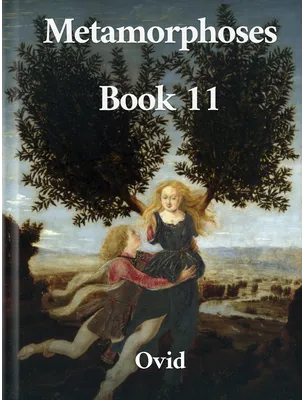
Book 11
by
P. Ovidius Naso

Orphei Mors
Death of Orpheus
While with his songs, Orpheus, the bard of Thrace,
allured the trees, the savage animals,
and even the insensate rocks, to follow him;
Ciconian matrons, with their raving breasts
concealed in skins of forest animals,
from the summit of a hill observed him there,
attuning love songs to a sounding harp.
One of those women, as her tangled hair
was tossed upon the light breeze shouted, “See!
Here is the poet who has scorned our love!”
Then hurled her spear at the melodious mouth
of great Apollo’s bard: but the spear’s point,
trailing in flight a garland of fresh leaves,
made but a harmless bruise and wounded not.
The weapon of another was a stone,
which in the very air was overpowered
by the true harmony of his voice and lyre,
and so disabled lay before his feet,
as asking pardon for that vain attempt.
The madness of such warfare then increased.
All moderation is entirely lost,
and a wild Fury overcomes the right. —
although their weapons would have lost all force,
subjected to the power of Orpheus’ harp,
the clamorous discord of their boxwood pipes,
the blaring of their horns, their tambourines
and clapping hands and Bacchanalian yells,
with hideous discords drowned his voice and harp. —
at last the stones that heard his song no more
fell crimson with the Thracian poet’s blood.
Before his life was taken, the maenads turned
their threatening hands upon the many birds,
which still were charmed by Orpheus as he sang,
the serpents, and the company of beasts —
fabulous audience of that worshipped bard.
And then they turned on him their blood-stained hands:
and flocked together swiftly, as wild birds,
which, by some chance, may see the bird of night
beneath the sun. And as the savage dogs
rush on the doomed stag, loosed some bright fore-noon,
on blood-sand of the amphitheatre;
they rushed against the bard, with swift
hurled thyrsi which, adorned with emerald leaves
had not till then been used for cruelty.
And some threw clods, and others branches torn
from trees; and others threw flint stones at him,
and, that no lack of weapons might restrain
their savage fury then, not far from there
by chance they found some oxen which turned up
the soil with ploughshares, and in fields nearby
were strong-armed peasants, who with eager sweat
worked for the harvest as they dug hard fields;
and all those peasants, when they saw the troop
of frantic women, ran away and left
their implements of labor strown upon
deserted fields — harrows and heavy rakes
and their long spades.
After the savage mob
had seized upon those implements, and torn
to pieces oxen armed with threatening horns,
they hastened to destroy the harmless bard,
devoted Orpheus; and with impious hate,
murdered him, while his out-stretched hands implored
their mercy — the first and only time his voice
had no persuasion. O great Jupiter!
Through those same lips which had controlled the rocks
and which had overcome ferocious beasts,
his life breathed forth, departed in the air.
The mournful birds, the stricken animals,
the hard stones and the weeping woods, all these
that often had followed your inspiring voice,
bewailed your death; while trees dropped their green leaves,
mourning for you, as if they tore their hair.
They say sad rivers swelled with their own tears —
naiads and dryads with dishevelled hair
wore garments of dark color.
His torn limbs
were scattered in strange places. Hebrus then
received his head and harp — and, wonderful!
While his loved harp was floating down the stream,
it mourned for him beyond my power to tell.
His tongue though lifeless, uttered a mournful sound
and mournfully the river’s banks replied:
onward borne by the river to the sea
they left their native stream and reached the shore
of Lesbos at Methymna. Instantly,
a furious serpent rose to attack the head
of Orpheus, cast up on that foreign sand —
the hair still wet with spray. Phoebus at last
appeared and saved the head from that attack:
before the serpent could inflict a sting,
he drove it off, and hardened its wide jaws
to rigid stone.
Meanwhile the fleeting shade
of Orpheus had descended under earth:
remembering now those regions that he saw
when there before, he sought Eurydice
through fields frequented by the blest; and when
he found her, folded her in eager arms.
Then lovingly they wandered side by side,
or he would follow when she chose to lead,
or at another time he walked in front,
looking back, safely, — at Eurydice.
Bacchus would not permit the wickedness
of those who slaughtered Orpheus to remain
unpunished. Grieving for the loss of his
loved bard of sacred rites, at once he bound
with twisted roots the feet of everyone
of those Edonian women who had caused
the crime of Orpheus’ death.
Their toes grew long.
He thrust the sharp points in the solid earth.
As when a bird entangled in a snare,
hid by the cunning fowler, knows too late
that it is held, then vainly beats its wings,
and fluttering only makes more tight the noose
with every struggle; so each woman-fiend
whose feet were sinking in the soil, when she
attempted flight, was held by deepening roots.
And while she looks down where her toes and nails
and feet should be, she sees wood growing up
from them and covering all her graceful legs.
Full of delirious grief, endeavoring
to smite with right hand on her changing thigh,
she strikes on solid oak. Her tender breast
and shoulders are transformed to rigid oak.
You would declare that her extended arms
are real branches of a forest tree,
and such a thought would be the very truth.
Midas Aureus
Bacchus and Midas
And not content with this, Bacchus resolved
to leave that land, and with a worthier train
went to the vineyards of his own Tmolus
and to Pactolus, though the river was
not golden, nor admired for precious sands.
His usual throng of Satyrs and of Bacchanals
surrounded him; but not Silenus, who
was then detained from him. The Phrygian folk
had captured him, as he was staggering, faint
with palsied age and wine.
And after they
bound him in garlands, they led him to their king
Midas, to whom with the Cecropian
Eumolpus, Thracian Orpheus had shown all
the Bacchic rites. When Midas recognized
his old time friend Silenus, who had been
so often his companion in the rites
of Bacchus, he kept joyful festival,
with his old comrade, twice five days and nights.
Upon the eleventh day, when Lucifer
had dimmed the lofty multitude of stars,
King Midas and Silenus went from there
joyful together to the Lydian lands.
There Midas put Silenus carefully
under the care of his loved foster-child,
young Bacchus. He with great delight, because
he had his foster-father once again,
allowed the king to choose his own reward —
a welcome offer, but it led to harm.
And Midas made this ill-advised reply:
“Cause whatsoever I shall touch to change
at once to yellow gold.” Bacchus agreed
to his unfortunate request, with grief
that Midas chose for harm and not for good.
The Berecynthian hero, king of Phrygia,
with joy at his misfortune went away,
and instantly began to test the worth
of Bacchus’ word by touching everything.
Doubtful himself of his new power, he pulled
a twig down from a holm-oak, growing on
a low hung branch. The twig was turned to gold.
He lifted up a dark stone from the ground
and it turned pale with gold. He touched a clod
and by his potent touch the clod became
a mass of shining gold. He plucked some ripe,
dry spears of grain, and all that wheat he touched
was golden. Then he held an apple which
he gathered from a tree, and you would think
that the Hesperides had given it.
If he but touched a lofty door, at once
each door-post seemed to glisten. When he washed
his hands in liquid streams, the lustrous drops
upon his hands might have been those which once
astonished Danae. He could not now
conceive his large hopes in his grasping mind,
as he imagined everything of gold.
And, while he was rejoicing in great wealth,
his servants set a table for his meal,
with many dainties and with needful bread:
but when he touched the gift of Ceres with
his right hand, instantly the gift of Ceres
stiffened to gold; or if he tried to bite
with hungry teeth a tender bit of meat,
the dainty, as his teeth but touched it , shone
at once with yellow shreds and flakes of gold.
And wine, another gift of Bacchus, when
he mixed it in pure water, can be seen
in his astonished mouth as liquid gold.
Confounded by his strange misfortune — rich
and wretched — he was anxious to escape
from his unhappy wealth. He hated all
he had so lately longed for. Plenty could
not lessen hunger and no remedy
relieved his dry, parched throat. The hated gold
tormented him no more than he deserved.
Lifting his hands and shining arms to heaven,
he moaned. “Oh pardon me, father Lenaeus!
I have done wrong, but pity me, I pray,
and save me from this curse that looked so fair.”
How patient are the gods! Bacchus forthwith,
because King Midas had confessed his fault,
restored him and annulled the promise given,
annulled the favor granted, and he said:
“That you may not be always cased in gold,
which you unhappily desired, depart
to the stream that flows by that great town of Sardis
and upward trace its waters, as they glide
past Lydian heights, until you find their source.
Then, where the spring leaps out from mountain rock,
plunge head and body in the snowy foam.
At once the flood will take away your curse.”
King Midas did as he was told and plunged
beneath the water at the river’s source.
And the gold virtue granted by the god,
as it departed from his body, tinged
the stream with gold. And even to this hour
adjoining fields, touched by this ancient vein
of gold, are hardened where the river flows
and colored with the gold that Midas left.
Midae Aures
The Musical Contest of Pan and Apollo
Abhorring riches he inhabited
the woods and fields, and followed Pan who dwells
always in mountain-caves: but still obtuse
remained, from which his foolish mind again,
by an absurd decision, harmed his life.
He followed Pan up to the lofty mount
Tmolus, which from its great height looks far
across the sea. Steep and erect it stands
between great Sardis and the small Hypaepa.
While Pan was boasting there to mountain nymphs
of his great skill in music, and while he
was warbling a gay tune upon the reeds,
cemented with soft wax, in his conceit
he dared to boast to them how he despised
Apollo’s music when compared with his — .
At last to prove it, he agreed to stand
against Apollo in a contest which
it was agreed should be decided by
Tmolus as their umpire.
This old god
sat down on his own mountain, and first eased
his ears of many mountain growing trees,
oak leaves were wreathed upon his azure hair
and acorns from his hollow temples hung.
First to the Shepherd-god Tmolus spoke:
“My judgment shall be yours with no delay.”
Pan made some rustic sounds on his rough reeds,
delighting Midas with his uncouth notes;
for Midas chanced to be there when he played.
When Pan had ceased, divine Tmolus turned
to Phoebus, and the forest likewise turned
just as he moved. Apollo’s golden locks
were richly wreathed with fresh Parnassian laurel;
his robe of Tyrian purple swept the ground;
his left hand held his lyre, adorned with gems
and Indian ivory. His right hand held
the plectrum — as an artist he stood there
before Tmolus, while his skilful thumb
touching the strings made charming melody.
Delighted with Apollo’s artful touch,
Tmolus ordered Pan to hold his reeds
excelled by beauty of Apollo’s lyre.
That judgment of the sacred mountain god
pleased all those present, all but Midas, who
blaming Tmolus called the award unjust.
The Delian god forbids his stupid ears
to hold their native human shape;
and, drawing them out to a hideous length,
he fills them with gray hairs, and makes them both
unsteady, wagging at the lower part:
still human, only this one part condemned,
Midas had ears of a slow-moving ass.
Midas, careful to hide his long ears, wore
a purple turban over both, which hid
his foul disgrace from laughter. But one day
a servant, who was chosen to cut his hair
with steel, when it was long, saw his disgrace.
He did not dare reveal what he had seen,
but eager, to disclose the secret, dug
a shallow hole, and in a low voice told
what kind of ears were on his master’s head.
All this he whispered in the hollow earth
he dug, and then he buried all he said
by throwing back the loose earth in the hole
so everything was silent when he left.
A grove thick set with quivering reeds
began to grow there, and when it matured,
about twelve months after that servant left,
the grove betrayed its planter. For, moved by
a gentle South Wind, it repeated all
the words which he had whispered, and disclosed
from earth the secret of his master’s ears.
Laomedon. Hesione
Hesione
His vengence now complete, Latona’s son
borne through the liquid air, departed from
Tmolus, and then rested on the land
of Laomedon, this side the narrow sea
dividing Phrygia from the land of Thrace.
The promontory of Sigaeum right
and on the left Rhoetaeum loftily arose;
and at that place an ancient altar had
been dedicated to great Jove, the god
Panomphaean.
And near that place he saw
Laomedon, beginning then to build
the walls of famous Troy. He was convinced
the task exceeded all the power of man,
requiring great resource. Together with
the trident-bearing father of the deep,
he assumed a mortal form: and those two gods
agreed to labor for a sum of gold
and built the mighty wall.
But that false king
refused all payment, adding perjury
to his false bargaining. Neptune, enraged,
said, “You shall not escape your punishment.”
And he drove all his waters high upon
the shores of Troy — built there through perfidy.
The sad land seemed a sea: the hard-earned wealth
of all its farmers was destroyed
and overwhelmed by furious waves.
This awful punishment was not enough.
The daughter of the king was soon required
as food for a sea-monster — . Hesione
was chained to rugged rocks.
But Hercules
delivered from all harm the royal maid
and justly he demanded of the king,
her father, payment of the promised steeds;
but that perfidious king refused to keep
his promise. Hercules enraged, because
all payment was denied to him for his
great service, captured the twice-perjured walls
of conquered Troy.
And as a fair reward,
he gave to Telamon, who fought for him,
Hesione, loved daughter of that king.
For Peleus had a goddess as his bride
and he was prouder of his father-in-law
than of his grandsire. Since not he alone
was grandson of great Jove, but he alone
was honored with a goddess for a wife.
Peleus et Thetis
Peleus and Thetis
Birth of Achilles
To Thetis, aged Proteus once had said,
“Oh goddess of the waves, you shall conceive,
and you shall be the mother of a youth
who by heroic actions will surpass
the deeds of his own father, and your son
shall be superior to his father’s power.”
So Jupiter, although the flame of love
for Thetis burned his breast, would not embrace
the lovely daughter of the sea, and urged
his grandson Peleus, son of Aeacus,
to wed the green haired maid without delay.
There is a curved bay of Haemonia,
where like an arch, two bending arms
project out in the waves, as if to form
an harbor; but the water is not deep —
although enough to hide a shoal of sand.
It has a firm shore which will not retain
a foot’s impression, nor delay the step —
no seaweeds grow in that vicinity.
There is a grove of myrtle near that place
thick-hung with berries, blended of twin shades.
A cave within the middle of that grove
is found, and whether it was formed by art
or nature is not known, although it seems
a work of art. There Thetis often went,
quite naked, seated on her dolphin, which
was harnessed. Peleus seized her there when she
was fast asleep: and after he had tried
to win her by entreaties, while she long
continued to resist him, he resolved
to conquer her by violence, and seized
her neck with both arms.
She resorted then
to all her usual arts, and often changed
her shape as it was known, so that he failed
in his attempt. At first she was a bird,
but while she seemed a bird he held her fast;
and then she changed herself to a large tree,
and Peleus clung with ardor to the tree;
her third disguise was as a spotted tigress,
which frightened him so that he lost his hold.