The book 'Living or Dead? (adapted)' was published in 2023.
[{"id":"para_1","index":0,"start":0,"offset":341,"words":3,"paraNum":"","lastModified":1771848566000,"semanticType":"title-book-title","voicework":"tts","blockId":"living_or_dead_short_story_ffa_1_en-blmm","language":"en","wordsRange":{"start":100000000,"end":104000000},"paragraphVersion":22,"direction":"ltr","paragraph":"<h1 class=\"ilm-title ilm-x-large\" id=\"para_1\" semantictype=\"title-book-title\" data-ilmid=\"living_or_dead_short_story_ffa_1_en-blmm\" data-audio=\"1\" data-chapter=\"para_1\" data-words-count=\"3\" data-before=\"0\" data-ww=\"\"><span class=\"block-pb\"> <span class=\"block-pb is-animated\"></span> </span><span class=\"itm-wrap\">Living or Dead?</span></h1>","hasContent":true,"isFirst":true,"isLast":false},{"id":"para_2","index":1,"start":341,"offset":334,"words":1,"paraNum":"","lastModified":1771848674000,"semanticType":"title-subtitle","voicework":"tts","blockId":"living_or_dead_short_story_ffa_1_en-bluu","language":"en","wordsRange":{"start":137333333,"end":170666667},"paragraphVersion":32,"direction":"ltr","paragraph":"<h1 class=\"ilm-title ilm-subtitle\" id=\"para_2\" semantictype=\"title-subtitle\" data-ilmid=\"living_or_dead_short_story_ffa_1_en-bluu\" data-audio=\"1\" data-chapter=\"para_2\" data-words-count=\"1\" data-before=\"3\" data-ww=\"\"><span class=\"block-pb\"> <span class=\"block-pb is-animated\"></span> </span><span class=\"itm-wrap\">[adapted]</span></h1>","hasContent":true,"isFirst":false,"isLast":false},{"id":"para_3","index":2,"start":675,"offset":371,"words":2,"paraNum":"","lastModified":1771849604000,"semanticType":"title-author","voicework":"tts","blockId":"living_or_dead_short_story_ffa_1_en-blur","language":"en","wordsRange":{"start":204000000,"end":208000000},"paragraphVersion":53,"direction":"ltr","paragraph":"<h1 class=\"ilm-title ilm-author ilm-large ilm-nopad\" id=\"para_3\" semantictype=\"title-author\" data-ilmid=\"living_or_dead_short_story_ffa_1_en-blur\" data-audio=\"1\" data-chapter=\"para_3\" data-words-count=\"2\" data-before=\"4\" data-ww=\"\"><span class=\"block-pb\"> <span class=\"block-pb is-animated\"></span> </span><span class=\"itm-wrap\">by <br>Rabindranath Tagore<br></span></h1>","hasContent":true,"isFirst":false,"isLast":false},{"id":"para_4","index":3,"start":1046,"offset":163,"words":0,"paraNum":"","lastModified":1659954999000,"semanticType":"line","blockId":"living_or_dead_short_story_ffa_1_en-blus","language":"en","wordsRange":{"start":308000000,"end":408000000},"paragraphVersion":11,"direction":"ltr","paragraph":"<hr class=\"ilm-hr ilm-small\" id=\"para_4\" semantictype=\"line\" data-ilmid=\"living_or_dead_short_story_ffa_1_en-blus\" data-words-count=\"0\" data-before=\"6\" data-ww=\"\">","hasContent":true,"isFirst":false,"isLast":false},{"id":"para_5","index":4,"start":1209,"offset":1279,"words":0,"paraNum":"","lastModified":1660727685000,"semanticType":"illustration","blockId":"living_or_dead_short_story_ffa_1_en-blut","language":"en","wordsRange":{"start":508000000,"end":608000000},"paragraphVersion":11,"direction":"ltr","paragraph":"<div class=\"ilm-illustration\" id=\"para_5\" semantictype=\"illustration\" data-ilmid=\"living_or_dead_short_story_ffa_1_en-blut\" data-words-count=\"0\" data-before=\"6\" data-ww=\"\"><img width=\"404\" height=\"512\" data-src=\"ch0p0\" src=\"data:image/webp;base64,UklGRt4CAABXRUJQVlA4INICAACwDACdASooADMAPm0ukkWkIqGWqzZIQAbEs4BdmidQq8+AzVPFH7TkHkq+F118/P0nc0LyUTvji2INfv7kJqToZ3WqvdH+jtYYAk29ebz0MRhfuZpq/CghDBB1rDgCnNZdGtYZ+ap0a3oyvto54AD+/fkfoVV0yds7X+VBYIf4fHAmuYZ3Sx7nL88nvMZs3Cthb3DSh6/2C9H6hJjWG6uyzBWnYTdajx36mCIErUGePZxplVR6mrHATza06iElG0/wia894hEfUbKLoURTfeui9D89kq+T0yqX1OCaoR896iNK1Yjbl/HQr2jpMhifVGt/lZKGLkAa8K+RehX4BvsdQ5dkR2I0aXSMDX9r9xLCLqBQOqVVDwCAmJtRbfPLawJHsOeFFyrnAcVFhnReoGBeghmZ8tpGsktqpSt5iRFHLL3B47qwUNPJQX1idAuVZ/w7E9sIt++ZngoVop0D1mPorlXirc2iBTp0ZtbOeUxwrWKHqwzO3BxWcww603bdgR9xm2RYP6IMgeTRvhcs+LzMnSogS1ACAH26pswdUMqV5bSeX+j7rz3lwrJa1LdX0AA6Txj/AUWviG8J4wWzBy72rj4Kup/+Gj1sQTtUhMpZSjQTmocjk7f0eYRlnTHQucGZd6LZP3AZCW0U+k9+sMPiqgX6gppvwPT9Hi4d59HpjyU09F0H5tm92bl1mAxgxr+rn72tm8wqjfRYgJEd7CyxZEz6KMyhM4dPqzK6EIpN6MzeY+HvRUI4Ky31tEWIIemXOyf2n09r/BDjwjNfDKLtB0xAq4NCsFBQOl51X59vnhwwy8jisccdgctvu/TNCCMON6RmYnWpNZyqOEPZwFjp8qwyhxuSzHm6bhKW3SSDnB8PxSx9si38ntKNpb8ZRBlqzNF7RUJ4QzW0Jq5aZAMejSN5+NE8txyI6/ySzttEdGWa5pk70eOzahv9wxwE1AAAAA==\" alt=\"Living or Dead? (adapted)\"></div>","hasContent":true,"isFirst":false,"isLast":false},{"id":"para_6","index":5,"start":2488,"offset":323,"words":1,"paraNum":"","lastModified":1771848650000,"semanticType":"header-subheader","voicework":"tts","blockId":"living_or_dead_short_story_ffa_1_en-blmn","language":"en","wordsRange":{"start":708000000,"end":710000000},"paragraphVersion":30,"direction":"ltr","paragraph":"<h3 class=\"ilm-header ilm-h3\" id=\"para_6\" semantictype=\"header-subheader\" data-ilmid=\"living_or_dead_short_story_ffa_1_en-blmn\" data-audio=\"1\" data-chapter=\"para_6\" data-words-count=\"1\" data-before=\"6\" data-ww=\"\"><span class=\"block-pb\"> <span class=\"block-pb is-animated\"></span> </span><span class=\"itm-wrap\">I</span></h3>","hasContent":true,"isFirst":false,"isLast":false},{"id":"para_7","index":6,"start":2811,"offset":1335,"words":186,"paraNum":"1","lastModified":1772355076000,"semanticType":"par","voicework":"tts","blockId":"living_or_dead_short_story_ffa_1_en-blmo","language":"en","wordsRange":{"start":810000000,"end":995000000},"paragraphVersion":43,"direction":"ltr","paragraph":"<p id=\"para_7\" semantictype=\"par\" data-ilmid=\"living_or_dead_short_story_ffa_1_en-blmo\" data-audio=\"1\" data-words-count=\"186\" data-before=\"7\" data-ww=\"\"><span class=\"block-num\" data-id=\"1\"></span><span class=\"block-pb\"> <span class=\"block-pb is-animated\"></span> </span><span class=\"itm-wrap\">The widow in the house of Saradasankar, the Ranihat landlord, had no relatives in her father’s family. One after another all had died. She also had no one in her husband’s family she could call her own, no husband and no son. The child of her brother-in-law Saradasankar was her favorite. For a long time after his birth, his mother had been very ill, and the widow, his aunt Kadambini, had looked after him. If a woman looks after another’s child, her love for him is even stronger because she has no right to him — no right from family, that is, but only the right of love. Love cannot prove its right by any paper that society accepts, and does not want to prove it; it only loves with twice the feeling its life’s unsure treasure. So all the widow’s held-back love went out towards this little child. One night in Sraban Kadambini died suddenly. For some reason her heart stopped beating. Everywhere else the world went on its way; only in this gentle little chest, hurt by love, the clock of time stopped for ever.</span></p>","hasContent":true,"isFirst":false,"isLast":false},{"id":"para_8","index":7,"start":4146,"offset":836,"words":101,"paraNum":"2","lastModified":1772355130000,"semanticType":"par","voicework":"tts","blockId":"living_or_dead_short_story_ffa_1_en-blmp","language":"en","wordsRange":{"start":1095000000,"end":1189000000},"paragraphVersion":45,"direction":"ltr","paragraph":"<p id=\"para_8\" semantictype=\"par\" data-ilmid=\"living_or_dead_short_story_ffa_1_en-blmp\" data-audio=\"1\" data-words-count=\"101\" data-before=\"193\" data-ww=\"\"><span class=\"block-num\" data-id=\"2\"></span><span class=\"block-pb\"> <span class=\"block-pb is-animated\"></span> </span><span class=\"itm-wrap\">So that they would not be troubled by the police, four of the landlord’s Brahmin servants took away the body, without ceremony, to be burned. The place for burning bodies of Ranihat was very far from the village. There was a hut beside a pond, a huge banyan tree near it, and nothing more. Before, a river ran through the ground, but now it was completely dried up, and part of the riverbed had been dug out to make a pond for funeral ceremonies. The people thought of the pond as part of the river and respected it in that way.</span></p>","hasContent":true,"isFirst":false,"isLast":false},{"id":"para_9","index":8,"start":4982,"offset":560,"words":52,"paraNum":"3","lastModified":1771847397000,"semanticType":"par","voicework":"tts","blockId":"living_or_dead_short_story_ffa_1_en-blmq","language":"en","wordsRange":{"start":1289000000,"end":1341000000},"paragraphVersion":28,"direction":"ltr","paragraph":"<p id=\"para_9\" semantictype=\"par\" data-ilmid=\"living_or_dead_short_story_ffa_1_en-blmq\" data-audio=\"1\" data-words-count=\"52\" data-before=\"294\" data-ww=\"\"><span class=\"block-num\" data-id=\"3\"></span><span class=\"block-pb\"> <span class=\"block-pb is-animated\"></span> </span><span class=\"itm-wrap\">After they took the body into the hut, the four men sat down to wait for the wood. The time seemed so long that two of the four got restless, and went to see why it did not come. With Nitai and Gurucharan gone, Bidhu and Banamali stayed to watch the body.</span></p>","hasContent":true,"isFirst":false,"isLast":false},{"id":"para_10","index":9,"start":5542,"offset":558,"words":52,"paraNum":"4","lastModified":1771849388000,"semanticType":"par","voicework":"tts","blockId":"living_or_dead_short_story_ffa_1_en-blmr","language":"en","wordsRange":{"start":1441000000,"end":1488000000},"paragraphVersion":31,"direction":"ltr","paragraph":"<p id=\"para_10\" semantictype=\"par\" data-ilmid=\"living_or_dead_short_story_ffa_1_en-blmr\" data-audio=\"1\" data-words-count=\"52\" data-before=\"346\" data-ww=\"\"><span class=\"block-num\" data-id=\"4\"></span><span class=\"block-pb\"> <span class=\"block-pb is-animated\"></span> </span><span class=\"itm-wrap\">It was a dark night of Sraban. Heavy clouds hung in a sky with no stars. The two men sat silent in the dark room. Their matches and lamp were of no use. The matches were wet, and would not light, no matter how hard they tried, and the lantern went out.</span></p>","hasContent":true,"isFirst":false,"isLast":false},{"id":"para_11","index":10,"start":6100,"offset":448,"words":28,"paraNum":"5","lastModified":1772355291000,"semanticType":"par","voicework":"tts","blockId":"living_or_dead_short_story_ffa_1_en-blms","language":"en","wordsRange":{"start":1588000000,"end":1613000000},"paragraphVersion":35,"direction":"ltr","paragraph":"<p id=\"para_11\" semantictype=\"par\" data-ilmid=\"living_or_dead_short_story_ffa_1_en-blms\" data-audio=\"1\" data-words-count=\"28\" data-before=\"398\" data-ww=\"\"><span class=\"block-num\" data-id=\"5\"></span><span class=\"block-pb\"> <span class=\"block-pb is-animated\"></span> </span><span class=\"itm-wrap\">After a long silence, someone said: “Brother, it would be good if we had a bowl of tobacco. We were in a hurry, so we didn’t bring any.”</span></p>","hasContent":true,"isFirst":false,"isLast":false},{"id":"para_12","index":11,"start":6548,"offset":364,"words":11,"paraNum":"6","lastModified":1772355306000,"semanticType":"par","voicework":"tts","blockId":"living_or_dead_short_story_ffa_1_en-blmt","language":"en","wordsRange":{"start":1713000000,"end":1725000000},"paragraphVersion":34,"direction":"ltr","paragraph":"<p id=\"para_12\" semantictype=\"par\" data-ilmid=\"living_or_dead_short_story_ffa_1_en-blmt\" data-audio=\"1\" data-words-count=\"11\" data-before=\"426\" data-ww=\"\"><span class=\"block-num\" data-id=\"6\"></span><span class=\"block-pb\"> <span class=\"block-pb is-animated\"></span> </span><span class=\"itm-wrap\">The other answered: “I can run and bring all we want.”</span></p>","hasContent":true,"isFirst":false,"isLast":false},{"id":"para_13","index":12,"start":6912,"offset":476,"words":29,"paraNum":"7","lastModified":1771848966000,"semanticType":"par","voicework":"tts","blockId":"living_or_dead_short_story_ffa_1_en-blmu","language":"en","wordsRange":{"start":1825000000,"end":1854000000},"paragraphVersion":28,"direction":"ltr","paragraph":"<p id=\"para_13\" semantictype=\"par\" data-ilmid=\"living_or_dead_short_story_ffa_1_en-blmu\" data-audio=\"1\" data-words-count=\"29\" data-before=\"437\" data-ww=\"\"><span class=\"block-num\" data-id=\"7\"></span><span class=\"block-pb\"> <span class=\"block-pb is-animated\"></span> </span><span class=\"itm-wrap\">Knowing why Banarnali wanted to go (From fear of ghosts, the burning-ground being thought haunted.), Bidhu said: “I guess! For now, I think I have to sit here alone!”</span></p>","hasContent":true,"isFirst":false,"isLast":false},{"id":"para_14","index":13,"start":7388,"offset":892,"words":111,"paraNum":"8","lastModified":1771849375000,"semanticType":"par","voicework":"tts","blockId":"living_or_dead_short_story_ffa_1_en-blmv","language":"en","wordsRange":{"start":1954000000,"end":2058000000},"paragraphVersion":28,"direction":"ltr","paragraph":"<p id=\"para_14\" semantictype=\"par\" data-ilmid=\"living_or_dead_short_story_ffa_1_en-blmv\" data-audio=\"1\" data-words-count=\"111\" data-before=\"466\" data-ww=\"\"><span class=\"block-num\" data-id=\"8\"></span><span class=\"block-pb\"> <span class=\"block-pb is-animated\"></span> </span><span class=\"itm-wrap\">The talk stopped again. Five minutes seemed like an hour. In their minds they cursed the two who had gone to get the wood, and they began to think that they were sitting and talking in some pleasant corner. There was no sound anywhere, except the constant noise of frogs and crickets from the pond. Then suddenly they thought that the bed shook a little, as if the dead body had turned onto its side. Bidhu and Banamali shook with fear, and began to say softly: “Ram, Ram.” They heard a deep sigh in the room. In a moment the watchers jumped out of the hut, and ran to the village.</span></p>","hasContent":true,"isFirst":false,"isLast":false},{"id":"para_15","index":14,"start":8280,"offset":747,"words":81,"paraNum":"9","lastModified":1771849403000,"semanticType":"par","voicework":"tts","blockId":"living_or_dead_short_story_ffa_1_en-blmw","language":"en","wordsRange":{"start":2158000000,"end":2242000000},"paragraphVersion":27,"direction":"ltr","paragraph":"<p id=\"para_15\" semantictype=\"par\" data-ilmid=\"living_or_dead_short_story_ffa_1_en-blmw\" data-audio=\"1\" data-words-count=\"81\" data-before=\"577\" data-ww=\"\"><span class=\"block-num\" data-id=\"9\"></span><span class=\"block-pb\"> <span class=\"block-pb is-animated\"></span> </span><span class=\"itm-wrap\">After running about three miles, they met their co-workers coming back with a lantern. In fact, they had gone to smoke, and did not know anything about the wood. But they said that a tree was cut down, and that, when it was cut into pieces, it would be brought right away. Then Bidhu and Banamali told them what happened in the hut. Nitai and Gurucharan laughed at the story, and shouted at Bidhu and Banamali angrily for leaving their work.</span></p>","hasContent":true,"isFirst":false,"isLast":false},{"id":"para_16","index":15,"start":9027,"offset":878,"words":110,"paraNum":"10","lastModified":1771849015000,"semanticType":"par","voicework":"tts","blockId":"living_or_dead_short_story_ffa_1_en-blmx","language":"en","wordsRange":{"start":2342000000,"end":2449000000},"paragraphVersion":28,"direction":"ltr","paragraph":"<p id=\"para_16\" semantictype=\"par\" data-ilmid=\"living_or_dead_short_story_ffa_1_en-blmx\" data-audio=\"1\" data-words-count=\"110\" data-before=\"658\" data-ww=\"\"><span class=\"block-num\" data-id=\"10\"></span><span class=\"block-pb\"> <span class=\"block-pb is-animated\"></span> </span><span class=\"itm-wrap\">Right away, all four went back to the hut. When they went in, they saw right away that the body was gone; nothing but an empty bed was left. They looked at each other. Could a jackal have taken it away? But there was no piece of clothing anywhere. When they went outside, they saw that in the mud that had gathered at the door of the hut there were a woman’s small footprints, fresh. Saradasankar was not a fool, and they could hardly make him believe this ghost story. So after much talking, the four decided that it would be best to say that the body had been burnt.</span></p>","hasContent":true,"isFirst":false,"isLast":false},{"id":"para_17","index":16,"start":9905,"offset":608,"words":59,"paraNum":"11","lastModified":1771850700000,"semanticType":"par","voicework":"tts","blockId":"living_or_dead_short_story_ffa_1_en-blmy","language":"en","wordsRange":{"start":2549000000,"end":2607000000},"paragraphVersion":34,"direction":"ltr","paragraph":"<p id=\"para_17\" semantictype=\"par\" data-ilmid=\"living_or_dead_short_story_ffa_1_en-blmy\" data-audio=\"1\" data-words-count=\"59\" data-before=\"768\" data-ww=\"\"><span class=\"block-num\" data-id=\"11\"></span><span class=\"block-pb\"> <span class=\"block-pb is-animated\"></span> </span><span class=\"itm-wrap\">Towards morning, when the men with the wood arrived they were told that, because of their delay, the work had been done without them; there had been some wood in the hut after all. No one was likely to say this was not true, because a dead body is not such a valuable thing that anyone would steal it.</span></p>","hasContent":true,"isFirst":false,"isLast":false},{"id":"para_18","index":17,"start":10513,"offset":328,"words":1,"paraNum":"","lastModified":1771848739000,"semanticType":"header-subheader","voicework":"tts","blockId":"living_or_dead_short_story_ffa_1_en-blmz","language":"en","wordsRange":{"start":2707000000,"end":2709000000},"paragraphVersion":33,"direction":"ltr","paragraph":"<h3 class=\"ilm-header ilm-h3\" id=\"para_18\" semantictype=\"header-subheader\" data-ilmid=\"living_or_dead_short_story_ffa_1_en-blmz\" data-audio=\"1\" data-chapter=\"para_18\" data-words-count=\"1\" data-before=\"827\" data-ww=\"\"><span class=\"block-pb\"> <span class=\"block-pb is-animated\"></span> </span><span class=\"itm-wrap\">II</span></h3>","hasContent":true,"isFirst":false,"isLast":false},{"id":"para_19","index":18,"start":10841,"offset":521,"words":41,"paraNum":"12","lastModified":1771849431000,"semanticType":"par","voicework":"tts","blockId":"living_or_dead_short_story_ffa_1_en-bln0","language":"en","wordsRange":{"start":2809000000,"end":2850000000},"paragraphVersion":28,"direction":"ltr","paragraph":"<p id=\"para_19\" semantictype=\"par\" data-ilmid=\"living_or_dead_short_story_ffa_1_en-bln0\" data-audio=\"1\" data-words-count=\"41\" data-before=\"828\" data-ww=\"\"><span class=\"block-num\" data-id=\"12\"></span><span class=\"block-pb\"> <span class=\"block-pb is-animated\"></span> </span><span class=\"itm-wrap\">Every one knows that, even when there is no sign, life is often still there, and may begin again in a body that seems dead. Kadambini was not dead; only the machine of her life had for some reason suddenly stopped.</span></p>","hasContent":true,"isFirst":false,"isLast":false},{"id":"para_20","index":19,"start":11362,"offset":979,"words":120,"paraNum":"13","lastModified":1771849477000,"semanticType":"par","voicework":"tts","blockId":"living_or_dead_short_story_ffa_1_en-bln1","language":"en","wordsRange":{"start":2950000000,"end":3067333333},"paragraphVersion":34,"direction":"ltr","paragraph":"<p id=\"para_20\" semantictype=\"par\" data-ilmid=\"living_or_dead_short_story_ffa_1_en-bln1\" data-audio=\"1\" data-words-count=\"120\" data-before=\"869\" data-ww=\"\"><span class=\"block-num\" data-id=\"13\"></span><span class=\"block-pb\"> <span class=\"block-pb is-animated\"></span> </span><span class=\"itm-wrap\">When she woke up, she saw thick darkness on all sides. She thought that she was not lying in her usual place. She called out “Sister,” but no answer came from the darkness. As she sat up, very scared, she remembered her death bed, the sudden pain in her chest, the start of a choking feeling. Her older sister-in-law was warming some milk for the child, when Kadambini felt faint, and fell on the bed, saying in a choking voice: “Sister, bring the child here. I am worried.” After that everything was black, as when an inkpot is spilled over an exercise book. Kadambini’s memory and mind, all the letters of the world’s book, in a moment became without shape.</span></p>","hasContent":true,"isFirst":false,"isLast":false},{"id":"para_21","index":20,"start":12341,"offset":1278,"words":181,"paraNum":"14","lastModified":1771849003000,"semanticType":"par","voicework":"tts","blockId":"living_or_dead_short_story_ffa_1_en-bluw","language":"en","wordsRange":{"start":3067666667,"end":3243000000},"paragraphVersion":17,"direction":"ltr","paragraph":"<p id=\"para_21\" semantictype=\"par\" data-ilmid=\"living_or_dead_short_story_ffa_1_en-bluw\" data-audio=\"1\" data-words-count=\"181\" data-before=\"989\" data-ww=\"\"><span class=\"block-num\" data-id=\"14\"></span><span class=\"block-pb\"> <span class=\"block-pb is-animated\"></span> </span><span class=\"itm-wrap\">The widow could not remember whether the child, in a sweet, loving voice, called her “Auntie,” as if for the last time, or not; she could not remember whether, as she left the world she knew to start death’s long, unknown journey, she had received a goodbye gift of love, love’s travel money for the silent place. At first, I think, she thought the lonely dark place was the House of Yama, where there is nothing to see, nothing to hear, nothing to do, only a watch that goes on forever. But when a cold, damp wind blew through the open door, and she heard the croaking of frogs, she remembered clearly and at once all the rains of her short life, and could feel that she belonged to the earth. Then came a flash of lightning, and she saw the pond, the banyan tree, the great plain, the far-away trees. She remembered how at full moon she had sometimes come to bathe in this pond, and how terrible death had seemed when she saw a dead body on the burning-ground.</span></p>","hasContent":true,"isFirst":false,"isLast":false},{"id":"para_22","index":21,"start":13619,"offset":1010,"words":132,"paraNum":"15","lastModified":1771849490000,"semanticType":"par","voicework":"tts","blockId":"living_or_dead_short_story_ffa_1_en-bln2","language":"en","wordsRange":{"start":3343000000,"end":3463000000},"paragraphVersion":31,"direction":"ltr","paragraph":"<p id=\"para_22\" semantictype=\"par\" data-ilmid=\"living_or_dead_short_story_ffa_1_en-bln2\" data-audio=\"1\" data-words-count=\"132\" data-before=\"1170\" data-ww=\"\"><span class=\"block-num\" data-id=\"15\"></span><span class=\"block-pb\"> <span class=\"block-pb is-animated\"></span> </span><span class=\"itm-wrap\">Her first thought was to return home. But then she thought: “I am dead. How can I return home? That would bring big trouble on them. I have left the world of the living; I am my own ghost!” If this was not so, she thought, how could she get out of Saradasankar’s well-guarded women’s rooms, and come to this far place for burning the dead at midnight? Also, if her funeral was not finished, where were the men who should burn her? Remembering the moment when she died in Saradasankar’s bright house, she now found herself alone in a far, empty, dark place for burning the dead. Surely she was not part of the world of living people! Surely she was a thing of fear, a bad sign, her own ghost!</span></p>","hasContent":true,"isFirst":false,"isLast":false},{"id":"para_23","index":22,"start":14629,"offset":645,"words":64,"paraNum":"16","lastModified":1772355353000,"semanticType":"par","voicework":"tts","blockId":"living_or_dead_short_story_ffa_1_en-bln3","language":"en","wordsRange":{"start":3563000000,"end":3629000000},"paragraphVersion":37,"direction":"ltr","paragraph":"<p id=\"para_23\" semantictype=\"par\" data-ilmid=\"living_or_dead_short_story_ffa_1_en-bln3\" data-audio=\"1\" data-words-count=\"64\" data-before=\"1302\" data-ww=\"\"><span class=\"block-num\" data-id=\"16\"></span><span class=\"block-pb\"> <span class=\"block-pb is-animated\"></span> </span><span class=\"itm-wrap\">At this thought, all the ties were broken which tied her to the world. She felt that she had great strength, endless freedom. She could do what she liked, go where she pleased. Mad with the excitement of this new idea, she rushed from the hut like a strong wind, and stood on the burning-ground. Every sign of shame or fear had left her.</span></p>","hasContent":true,"isFirst":false,"isLast":false},{"id":"para_24","index":23,"start":15274,"offset":493,"words":37,"paraNum":"17","lastModified":1772355397000,"semanticType":"par","voicework":"tts","blockId":"living_or_dead_short_story_ffa_1_en-bln4","language":"en","wordsRange":{"start":3729000000,"end":3762000000},"paragraphVersion":37,"direction":"ltr","paragraph":"<p id=\"para_24\" semantictype=\"par\" data-ilmid=\"living_or_dead_short_story_ffa_1_en-bln4\" data-audio=\"1\" data-words-count=\"37\" data-before=\"1366\" data-ww=\"\"><span class=\"block-num\" data-id=\"17\"></span><span class=\"block-pb\"> <span class=\"block-pb is-animated\"></span> </span><span class=\"itm-wrap\">But as she walked on and on, her feet grew tired, her body weak. The flat land went on without end; here and there were rice fields; sometimes she was standing in water up to her knees.</span></p>","hasContent":true,"isFirst":false,"isLast":false},{"id":"para_25","index":24,"start":15767,"offset":831,"words":102,"paraNum":"18","lastModified":1771849090000,"semanticType":"par","voicework":"tts","blockId":"living_or_dead_short_story_ffa_1_en-bln5","language":"en","wordsRange":{"start":3862000000,"end":3962000000},"paragraphVersion":30,"direction":"ltr","paragraph":"<p id=\"para_25\" semantictype=\"par\" data-ilmid=\"living_or_dead_short_story_ffa_1_en-bln5\" data-audio=\"1\" data-words-count=\"102\" data-before=\"1403\" data-ww=\"\"><span class=\"block-num\" data-id=\"18\"></span><span class=\"block-pb\"> <span class=\"block-pb is-animated\"></span> </span><span class=\"itm-wrap\">At the first light of morning she heard one or two birds call from the clumps of bamboo by the far-off houses. Then she felt great fear. She did not know what her new place was with the earth and with living people. As long as she had been on the plain, on the burning-ground, covered by the dark night of Sraban, she had not been afraid, one who lived in her own kingdom. In daylight the homes of people filled her with fear. Men and ghosts fear each other, for their groups live on different sides of the river of death.</span></p>","hasContent":true,"isFirst":false,"isLast":false},{"id":"para_26","index":25,"start":16598,"offset":330,"words":1,"paraNum":"","lastModified":1771848749000,"semanticType":"header-subheader","voicework":"tts","blockId":"living_or_dead_short_story_ffa_1_en-bln6","language":"en","wordsRange":{"start":4062000000,"end":4064000000},"paragraphVersion":22,"direction":"ltr","paragraph":"<h3 class=\"ilm-header ilm-h3\" id=\"para_26\" semantictype=\"header-subheader\" data-ilmid=\"living_or_dead_short_story_ffa_1_en-bln6\" data-audio=\"1\" data-chapter=\"para_26\" data-words-count=\"1\" data-before=\"1505\" data-ww=\"\"><span class=\"block-pb\"> <span class=\"block-pb is-animated\"></span> </span><span class=\"itm-wrap\">III</span></h3>","hasContent":true,"isFirst":false,"isLast":false},{"id":"para_27","index":26,"start":16928,"offset":710,"words":74,"paraNum":"19","lastModified":1772355369000,"semanticType":"par","voicework":"tts","blockId":"living_or_dead_short_story_ffa_1_en-bln7","language":"en","wordsRange":{"start":4164000000,"end":4239000000},"paragraphVersion":36,"direction":"ltr","paragraph":"<p id=\"para_27\" semantictype=\"par\" data-ilmid=\"living_or_dead_short_story_ffa_1_en-bln7\" data-audio=\"1\" data-words-count=\"74\" data-before=\"1506\" data-ww=\"\"><span class=\"block-num\" data-id=\"19\"></span><span class=\"block-pb\"> <span class=\"block-pb is-animated\"></span> </span><span class=\"itm-wrap\">Her clothes were covered in mud; strange thoughts and walking at night had made her look like a crazy woman; really, her appearance was such that people might have been afraid of her, and children might have thrown stones at her or run away. Luckily, the first to see her was a traveler. He came up and said: “Mother, you look like a decent woman. Where are you going, alone and dressed like this?”</span></p>","hasContent":true,"isFirst":false,"isLast":false},{"id":"para_28","index":27,"start":17638,"offset":511,"words":37,"paraNum":"20","lastModified":1771849507000,"semanticType":"par","voicework":"tts","blockId":"living_or_dead_short_story_ffa_1_en-bln8","language":"en","wordsRange":{"start":4339000000,"end":4378000000},"paragraphVersion":33,"direction":"ltr","paragraph":"<p id=\"para_28\" semantictype=\"par\" data-ilmid=\"living_or_dead_short_story_ffa_1_en-bln8\" data-audio=\"1\" data-words-count=\"37\" data-before=\"1580\" data-ww=\"\"><span class=\"block-num\" data-id=\"20\"></span><span class=\"block-pb\"> <span class=\"block-pb is-animated\"></span> </span><span class=\"itm-wrap\">Kadambini, not able to think clearly, looked at him in silence. She could not believe that she was still part of the world, that she looked like a proper woman, that a traveller was asking her questions.</span></p>","hasContent":true,"isFirst":false,"isLast":false},{"id":"para_29","index":28,"start":18149,"offset":393,"words":16,"paraNum":"21","lastModified":1772355381000,"semanticType":"par","voicework":"tts","blockId":"living_or_dead_short_story_ffa_1_en-bln9","language":"en","wordsRange":{"start":4478000000,"end":4495000000},"paragraphVersion":37,"direction":"ltr","paragraph":"<p id=\"para_29\" semantictype=\"par\" data-ilmid=\"living_or_dead_short_story_ffa_1_en-bln9\" data-audio=\"1\" data-words-count=\"16\" data-before=\"1617\" data-ww=\"\"><span class=\"block-num\" data-id=\"21\"></span><span class=\"block-pb\"> <span class=\"block-pb is-animated\"></span> </span><span class=\"itm-wrap\">Again the man said: “Come, mother, I will take you home. Tell me where you live.”</span></p>","hasContent":true,"isFirst":false,"isLast":false},{"id":"para_30","index":29,"start":18542,"offset":846,"words":94,"paraNum":"22","lastModified":1771849164000,"semanticType":"par","voicework":"tts","blockId":"living_or_dead_short_story_ffa_1_en-blna","language":"en","wordsRange":{"start":4595000000,"end":4694000000},"paragraphVersion":30,"direction":"ltr","paragraph":"<p id=\"para_30\" semantictype=\"par\" data-ilmid=\"living_or_dead_short_story_ffa_1_en-blna\" data-audio=\"1\" data-words-count=\"94\" data-before=\"1633\" data-ww=\"\"><span class=\"block-num\" data-id=\"22\"></span><span class=\"block-pb\"> <span class=\"block-pb is-animated\"></span> </span><span class=\"itm-wrap\">Kadambini thought. To go back to her father-in-law’s house would be silly, and she had no father’s house. Then she remembered her childhood friend. She had not seen Jogmaya since she was young, but sometimes they had sent letters to each other. Sometimes there had been arguments between them, which was natural, since Kadambini wanted to make it clear that her love for Jogmaya was very great, while her friend said that Kadambini did not love her back the same. They were both sure that, if they met once, they would never be apart.</span></p>","hasContent":true,"isFirst":false,"isLast":false},{"id":"para_31","index":30,"start":19388,"offset":392,"words":13,"paraNum":"23","lastModified":1771849205000,"semanticType":"par","voicework":"tts","blockId":"living_or_dead_short_story_ffa_1_en-blnb","language":"en","wordsRange":{"start":4794000000,"end":4808000000},"paragraphVersion":33,"direction":"ltr","paragraph":"<p id=\"para_31\" semantictype=\"par\" data-ilmid=\"living_or_dead_short_story_ffa_1_en-blnb\" data-audio=\"1\" data-words-count=\"13\" data-before=\"1727\" data-ww=\"\"><span class=\"block-num\" data-id=\"23\"></span><span class=\"block-pb\"> <span class=\"block-pb is-animated\"></span> </span><span class=\"itm-wrap\">Kadambini said to the traveller: “I will go to Sripati’s house at Nisindapur.”</span></p>","hasContent":true,"isFirst":false,"isLast":false},{"id":"para_32","index":31,"start":19780,"offset":571,"words":46,"paraNum":"24","lastModified":1772355427000,"semanticType":"par","voicework":"tts","blockId":"living_or_dead_short_story_ffa_1_en-blnc","language":"en","wordsRange":{"start":4908000000,"end":4953000000},"paragraphVersion":36,"direction":"ltr","paragraph":"<p id=\"para_32\" semantictype=\"par\" data-ilmid=\"living_or_dead_short_story_ffa_1_en-blnc\" data-audio=\"1\" data-words-count=\"46\" data-before=\"1740\" data-ww=\"\"><span class=\"block-num\" data-id=\"24\"></span><span class=\"block-pb\"> <span class=\"block-pb is-animated\"></span> </span><span class=\"itm-wrap\">As he was going to Calcutta, Nisindapur, though not near, was on the way. So he took Kadambini to Sripati’s house, and the friends met again. At first they did not recognise each other, but slowly each recognised the other’s face from when they were children.</span></p>","hasContent":true,"isFirst":false,"isLast":false},{"id":"para_33","index":32,"start":20351,"offset":481,"words":28,"paraNum":"25","lastModified":1771849548000,"semanticType":"par","voicework":"tts","blockId":"living_or_dead_short_story_ffa_1_en-blnd","language":"en","wordsRange":{"start":5053000000,"end":5082000000},"paragraphVersion":29,"direction":"ltr","paragraph":"<p id=\"para_33\" semantictype=\"par\" data-ilmid=\"living_or_dead_short_story_ffa_1_en-blnd\" data-audio=\"1\" data-words-count=\"28\" data-before=\"1786\" data-ww=\"\"><span class=\"block-num\" data-id=\"25\"></span><span class=\"block-pb\"> <span class=\"block-pb is-animated\"></span> </span><span class=\"itm-wrap\">“What luck!” said Jogmaya. “I never thought that I would see you again. But how did you come here, sister? Your father-in-law’s family surely didn’t let you go!”</span></p>","hasContent":true,"isFirst":false,"isLast":false},{"id":"para_34","index":33,"start":20832,"offset":470,"words":28,"paraNum":"26","lastModified":1772355441000,"semanticType":"par","voicework":"tts","blockId":"living_or_dead_short_story_ffa_1_en-blne","language":"en","wordsRange":{"start":5182000000,"end":5212000000},"paragraphVersion":37,"direction":"ltr","paragraph":"<p id=\"para_34\" semantictype=\"par\" data-ilmid=\"living_or_dead_short_story_ffa_1_en-blne\" data-audio=\"1\" data-words-count=\"28\" data-before=\"1814\" data-ww=\"\"><span class=\"block-num\" data-id=\"26\"></span><span class=\"block-pb\"> <span class=\"block-pb is-animated\"></span> </span><span class=\"itm-wrap\">Kadambini kept quiet, and finally said: “Sister, don’t ask about my father-in-law. Give me a small place, and treat me like a servant: I will do your work.”</span></p>","hasContent":true,"isFirst":false,"isLast":false},{"id":"para_35","index":34,"start":21302,"offset":428,"words":23,"paraNum":"27","lastModified":1771849176000,"semanticType":"par","voicework":"tts","blockId":"living_or_dead_short_story_ffa_1_en-blnf","language":"en","wordsRange":{"start":5312000000,"end":5336000000},"paragraphVersion":30,"direction":"ltr","paragraph":"<p id=\"para_35\" semantictype=\"par\" data-ilmid=\"living_or_dead_short_story_ffa_1_en-blnf\" data-audio=\"1\" data-words-count=\"23\" data-before=\"1842\" data-ww=\"\"><span class=\"block-num\" data-id=\"27\"></span><span class=\"block-pb\"> <span class=\"block-pb is-animated\"></span> </span><span class=\"itm-wrap\">“What?” said Jogmaya. “Keep you as a servant! Why, you are my best friend, you are my — ” and so on and so on.</span></p>","hasContent":true,"isFirst":false,"isLast":false},{"id":"para_36","index":35,"start":21730,"offset":690,"words":68,"paraNum":"28","lastModified":1771849763000,"semanticType":"par","voicework":"tts","blockId":"living_or_dead_short_story_ffa_1_en-blng","language":"en","wordsRange":{"start":5436000000,"end":5503000000},"paragraphVersion":33,"direction":"ltr","paragraph":"<p id=\"para_36\" semantictype=\"par\" data-ilmid=\"living_or_dead_short_story_ffa_1_en-blng\" data-audio=\"1\" data-words-count=\"68\" data-before=\"1865\" data-ww=\"\"><span class=\"block-num\" data-id=\"28\"></span><span class=\"block-pb\"> <span class=\"block-pb is-animated\"></span> </span><span class=\"itm-wrap\">Just then Sripati came in. Kadambini looked at him for some time, and then went out very slowly. She kept her head uncovered, and did not show any good manners or respect at all. Jogmaya, afraid that Sripati would think badly of her friend, began a long explanation. But Sripati, who quickly agreed to anything Jogmaya said, stopped her story, and left his wife worried in her mind.</span></p>","hasContent":true,"isFirst":false,"isLast":false},{"id":"para_37","index":36,"start":22420,"offset":764,"words":88,"paraNum":"29","lastModified":1771849495000,"semanticType":"par","voicework":"tts","blockId":"living_or_dead_short_story_ffa_1_en-blnh","language":"en","wordsRange":{"start":5603000000,"end":5688000000},"paragraphVersion":30,"direction":"ltr","paragraph":"<p id=\"para_37\" semantictype=\"par\" data-ilmid=\"living_or_dead_short_story_ffa_1_en-blnh\" data-audio=\"1\" data-words-count=\"88\" data-before=\"1933\" data-ww=\"\"><span class=\"block-num\" data-id=\"29\"></span><span class=\"block-pb\"> <span class=\"block-pb is-animated\"></span> </span><span class=\"itm-wrap\">Kadambini had come, but she was not close to her friend: death was between them. She could feel no closeness to others as long as her own life confused her and she could still think. Kadambini would look at Jogmaya, and think sadly. She would think: “She has her husband and her work, she lives in a world far away from mine. She shares love and duties with the people of the world; I am an empty shadow. She is among the living; I am in endless time.”</span></p>","hasContent":true,"isFirst":false,"isLast":false},{"id":"para_38","index":37,"start":23184,"offset":833,"words":96,"paraNum":"30","lastModified":1772355475000,"semanticType":"par","voicework":"tts","blockId":"living_or_dead_short_story_ffa_1_en-blni","language":"en","wordsRange":{"start":5788000000,"end":5884000000},"paragraphVersion":37,"direction":"ltr","paragraph":"<p id=\"para_38\" semantictype=\"par\" data-ilmid=\"living_or_dead_short_story_ffa_1_en-blni\" data-audio=\"1\" data-words-count=\"96\" data-before=\"2021\" data-ww=\"\"><span class=\"block-num\" data-id=\"30\"></span><span class=\"block-pb\"> <span class=\"block-pb is-animated\"></span> </span><span class=\"itm-wrap\">Jogmaya also felt worried, but could not explain why. Women do not like mystery, because, though not knowing may be turned into poetry, into bravery, into learning, it cannot be used in housework. So, when a woman cannot understand a thing, she either breaks it and forgets it, or she changes it into something new for her own use; if she cannot deal with it in one of these ways, she gets angry with it. The more Kadambini was lost in thought, the more impatient was Jogmaya with her, wondering what trouble was on her mind.</span></p>","hasContent":true,"isFirst":false,"isLast":false},{"id":"para_39","index":38,"start":24017,"offset":858,"words":102,"paraNum":"31","lastModified":1771849224000,"semanticType":"par","voicework":"tts","blockId":"living_or_dead_short_story_ffa_1_en-blnj","language":"en","wordsRange":{"start":5984000000,"end":6081000000},"paragraphVersion":33,"direction":"ltr","paragraph":"<p id=\"para_39\" semantictype=\"par\" data-ilmid=\"living_or_dead_short_story_ffa_1_en-blnj\" data-audio=\"1\" data-words-count=\"102\" data-before=\"2117\" data-ww=\"\"><span class=\"block-num\" data-id=\"31\"></span><span class=\"block-pb\"> <span class=\"block-pb is-animated\"></span> </span><span class=\"itm-wrap\">Then a new danger came. Kadambini was afraid of herself; yet she could not run away from herself. People who fear ghosts fear what is behind them; wherever they cannot see there is fear. But Kadambini’s main fear was inside herself, for she feared nothing outside. In the middle of the night, when alone in her room, she screamed; in the evening, when she saw her shadow in the light of the lamp, her whole body shook. Seeing how afraid she was, the rest of the house fell into a kind of fear. The servants and Jogmaya herself began to see ghosts.</span></p>","hasContent":true,"isFirst":false,"isLast":false},{"id":"para_40","index":39,"start":24875,"offset":470,"words":28,"paraNum":"32","lastModified":1772355487000,"semanticType":"par","voicework":"tts","blockId":"living_or_dead_short_story_ffa_1_en-blnk","language":"en","wordsRange":{"start":6181000000,"end":6210000000},"paragraphVersion":40,"direction":"ltr","paragraph":"<p id=\"para_40\" semantictype=\"par\" data-ilmid=\"living_or_dead_short_story_ffa_1_en-blnk\" data-audio=\"1\" data-words-count=\"28\" data-before=\"2219\" data-ww=\"\"><span class=\"block-num\" data-id=\"32\"></span><span class=\"block-pb\"> <span class=\"block-pb is-animated\"></span> </span><span class=\"itm-wrap\">One midnight, Kadambini came out from her bedroom crying, and cried out at Jogmaya’s door: “Sister, sister, let me lie at your feet! Do not leave me alone!”</span></p>","hasContent":true,"isFirst":false,"isLast":false},{"id":"para_41","index":40,"start":25345,"offset":515,"words":39,"paraNum":"33","lastModified":1771849715000,"semanticType":"par","voicework":"tts","blockId":"living_or_dead_short_story_ffa_1_en-blnl","language":"en","wordsRange":{"start":6310000000,"end":6350000000},"paragraphVersion":33,"direction":"ltr","paragraph":"<p id=\"para_41\" semantictype=\"par\" data-ilmid=\"living_or_dead_short_story_ffa_1_en-blnl\" data-audio=\"1\" data-words-count=\"39\" data-before=\"2247\" data-ww=\"\"><span class=\"block-num\" data-id=\"33\"></span><span class=\"block-pb\"> <span class=\"block-pb is-animated\"></span> </span><span class=\"itm-wrap\">Jogmaya’s anger was as strong as her fear. She wanted to make Kadambini leave the house at that very moment. The kind Sripati, after trying hard, was able to calm their guest, and put her in the next room.</span></p>","hasContent":true,"isFirst":false,"isLast":false},{"id":"para_42","index":41,"start":25860,"offset":694,"words":73,"paraNum":"34","lastModified":1771849133000,"semanticType":"par","voicework":"tts","blockId":"living_or_dead_short_story_ffa_1_en-blnm","language":"en","wordsRange":{"start":6450000000,"end":6522000000},"paragraphVersion":30,"direction":"ltr","paragraph":"<p id=\"para_42\" semantictype=\"par\" data-ilmid=\"living_or_dead_short_story_ffa_1_en-blnm\" data-audio=\"1\" data-words-count=\"73\" data-before=\"2286\" data-ww=\"\"><span class=\"block-num\" data-id=\"34\"></span><span class=\"block-pb\"> <span class=\"block-pb is-animated\"></span> </span><span class=\"itm-wrap\">Next day Sripati was suddenly called to his wife’s rooms. She began to scold him: “You, do you call yourself a man? A woman runs away from her father-in-law, and comes into your house; a month goes by, and you haven’t even said that she should leave, and I have not heard you complain even once. I would take it as a favour if you would explain yourself. You men are all alike.”</span></p>","hasContent":true,"isFirst":false,"isLast":false},{"id":"para_43","index":42,"start":26554,"offset":980,"words":123,"paraNum":"35","lastModified":1771849674000,"semanticType":"par","voicework":"tts","blockId":"living_or_dead_short_story_ffa_1_en-blnn","language":"en","wordsRange":{"start":6622000000,"end":6738000000},"paragraphVersion":30,"direction":"ltr","paragraph":"<p id=\"para_43\" semantictype=\"par\" data-ilmid=\"living_or_dead_short_story_ffa_1_en-blnn\" data-audio=\"1\" data-words-count=\"123\" data-before=\"2359\" data-ww=\"\"><span class=\"block-num\" data-id=\"35\"></span><span class=\"block-pb\"> <span class=\"block-pb is-animated\"></span> </span><span class=\"itm-wrap\">Men, as a group, have a natural liking for women in general, and women themselves blame them for this. Although Sripati was ready to touch Jogmaya’s body, and swear that his kind feeling toward the helpless but beautiful Kadambini was not at all greater than it should be, he could not prove it by his actions. He thought that her father-in-law’s family must have treated this sad widow very badly, if she could not bear it any longer, and was forced to come to him for help. Since she had no father or mother, how could he leave her? After saying this, he did not talk about it any more, because he did not want to upset Kadambini by asking her unpleasant questions.</span></p>","hasContent":true,"isFirst":false,"isLast":false},{"id":"para_44","index":43,"start":27534,"offset":565,"words":49,"paraNum":"36","lastModified":1771849251000,"semanticType":"par","voicework":"tts","blockId":"living_or_dead_short_story_ffa_1_en-blno","language":"en","wordsRange":{"start":6838000000,"end":6891000000},"paragraphVersion":30,"direction":"ltr","paragraph":"<p id=\"para_44\" semantictype=\"par\" data-ilmid=\"living_or_dead_short_story_ffa_1_en-blno\" data-audio=\"1\" data-words-count=\"49\" data-before=\"2482\" data-ww=\"\"><span class=\"block-num\" data-id=\"36\"></span><span class=\"block-pb\"> <span class=\"block-pb is-animated\"></span> </span><span class=\"itm-wrap\">His wife, then, tried other ways with her slow husband, until at last he saw that to keep peace he must send a message to Kadambini’s father-in-law. A letter, he thought, might not be good enough; so he decided to go to Ranihat, and act on what he learnt.</span></p>","hasContent":true,"isFirst":false,"isLast":false},{"id":"para_45","index":44,"start":28099,"offset":452,"words":26,"paraNum":"37","lastModified":1771849191000,"semanticType":"par","voicework":"tts","blockId":"living_or_dead_short_story_ffa_1_en-blnp","language":"en","wordsRange":{"start":6991000000,"end":7019000000},"paragraphVersion":29,"direction":"ltr","paragraph":"<p id=\"para_45\" semantictype=\"par\" data-ilmid=\"living_or_dead_short_story_ffa_1_en-blnp\" data-audio=\"1\" data-words-count=\"26\" data-before=\"2531\" data-ww=\"\"><span class=\"block-num\" data-id=\"37\"></span><span class=\"block-pb\"> <span class=\"block-pb is-animated\"></span> </span><span class=\"itm-wrap\">So Sripati went, and Jogmaya also said to Kadambini, “Friend, it does not seem right for you to stay here any longer. What will people say?”</span></p>","hasContent":true,"isFirst":false,"isLast":false},{"id":"para_46","index":45,"start":28551,"offset":396,"words":15,"paraNum":"38","lastModified":1772355516000,"semanticType":"par","voicework":"tts","blockId":"living_or_dead_short_story_ffa_1_en-blnq","language":"en","wordsRange":{"start":7119000000,"end":7134000000},"paragraphVersion":37,"direction":"ltr","paragraph":"<p id=\"para_46\" semantictype=\"par\" data-ilmid=\"living_or_dead_short_story_ffa_1_en-blnq\" data-audio=\"1\" data-words-count=\"15\" data-before=\"2557\" data-ww=\"\"><span class=\"block-num\" data-id=\"38\"></span><span class=\"block-pb\"> <span class=\"block-pb is-animated\"></span> </span><span class=\"itm-wrap\">Kadambini looked seriously at Jogmaya, and said: “What do I have to do with people?”</span></p>","hasContent":true,"isFirst":false,"isLast":false},{"id":"para_47","index":46,"start":28947,"offset":459,"words":27,"paraNum":"39","lastModified":1771849102000,"semanticType":"par","voicework":"tts","blockId":"living_or_dead_short_story_ffa_1_en-blnr","language":"en","wordsRange":{"start":7234000000,"end":7265000000},"paragraphVersion":33,"direction":"ltr","paragraph":"<p id=\"para_47\" semantictype=\"par\" data-ilmid=\"living_or_dead_short_story_ffa_1_en-blnr\" data-audio=\"1\" data-words-count=\"27\" data-before=\"2572\" data-ww=\"\"><span class=\"block-num\" data-id=\"39\"></span><span class=\"block-pb\"> <span class=\"block-pb is-animated\"></span> </span><span class=\"itm-wrap\">Jogmaya was very surprised. Then she said angrily: “If you do not care about people, we do. How can we explain keeping a woman from another house?”</span></p>","hasContent":true,"isFirst":false,"isLast":false},{"id":"para_48","index":47,"start":29406,"offset":370,"words":8,"paraNum":"40","lastModified":1771849116000,"semanticType":"par","voicework":"tts","blockId":"living_or_dead_short_story_ffa_1_en-blns","language":"en","wordsRange":{"start":7365000000,"end":7373000000},"paragraphVersion":30,"direction":"ltr","paragraph":"<p id=\"para_48\" semantictype=\"par\" data-ilmid=\"living_or_dead_short_story_ffa_1_en-blns\" data-audio=\"1\" data-words-count=\"8\" data-before=\"2599\" data-ww=\"\"><span class=\"block-num\" data-id=\"40\"></span><span class=\"block-pb\"> <span class=\"block-pb is-animated\"></span> </span><span class=\"itm-wrap\">Kadambini said: “Where is my husband’s father’s house?”</span></p>","hasContent":true,"isFirst":false,"isLast":false},{"id":"para_49","index":48,"start":29776,"offset":379,"words":11,"paraNum":"41","lastModified":1771849028000,"semanticType":"par","voicework":"tts","blockId":"living_or_dead_short_story_ffa_1_en-blnt","language":"en","wordsRange":{"start":7473000000,"end":7485000000},"paragraphVersion":30,"direction":"ltr","paragraph":"<p id=\"para_49\" semantictype=\"par\" data-ilmid=\"living_or_dead_short_story_ffa_1_en-blnt\" data-audio=\"1\" data-words-count=\"11\" data-before=\"2607\" data-ww=\"\"><span class=\"block-num\" data-id=\"41\"></span><span class=\"block-pb\"> <span class=\"block-pb is-animated\"></span> </span><span class=\"itm-wrap\">“Oh no!” thought Jogmaya. “What will the awful woman say next?”</span></p>","hasContent":true,"isFirst":false,"isLast":false},{"id":"para_50","index":49,"start":30155,"offset":533,"words":46,"paraNum":"42","lastModified":1771849792000,"semanticType":"par","voicework":"tts","blockId":"living_or_dead_short_story_ffa_1_en-blnu","language":"en","wordsRange":{"start":7585000000,"end":7634000000},"paragraphVersion":33,"direction":"ltr","paragraph":"<p id=\"para_50\" semantictype=\"par\" data-ilmid=\"living_or_dead_short_story_ffa_1_en-blnu\" data-audio=\"1\" data-words-count=\"46\" data-before=\"2618\" data-ww=\"\"><span class=\"block-num\" data-id=\"42\"></span><span class=\"block-pb\"> <span class=\"block-pb is-animated\"></span> </span><span class=\"itm-wrap\">Very slowly Kadambini said: “What do I have to do with you? Am I from the earth? You laugh, cry, love; each keeps his own; I only look. You are human, I am a shadow. I cannot understand why God has kept me in your world.”</span></p>","hasContent":true,"isFirst":false,"isLast":false},{"id":"para_51","index":50,"start":30688,"offset":501,"words":37,"paraNum":"43","lastModified":1772355532000,"semanticType":"par","voicework":"tts","blockId":"living_or_dead_short_story_ffa_1_en-blnv","language":"en","wordsRange":{"start":7734000000,"end":7770000000},"paragraphVersion":37,"direction":"ltr","paragraph":"<p id=\"para_51\" semantictype=\"par\" data-ilmid=\"living_or_dead_short_story_ffa_1_en-blnv\" data-audio=\"1\" data-words-count=\"37\" data-before=\"2664\" data-ww=\"\"><span class=\"block-num\" data-id=\"43\"></span><span class=\"block-pb\"> <span class=\"block-pb is-animated\"></span> </span><span class=\"itm-wrap\">Her look and speech were so strange that Jogmaya understood some of what she meant, though not all. She could not send her away or ask her any more questions, so she went away, deep in thought.</span></p>","hasContent":true,"isFirst":false,"isLast":false},{"id":"para_52","index":51,"start":31189,"offset":329,"words":1,"paraNum":"","lastModified":1771848689000,"semanticType":"header-subheader","voicework":"tts","blockId":"living_or_dead_short_story_ffa_1_en-blnw","language":"en","wordsRange":{"start":7870000000,"end":7872000000},"paragraphVersion":30,"direction":"ltr","paragraph":"<h3 class=\"ilm-header ilm-h3\" id=\"para_52\" semantictype=\"header-subheader\" data-ilmid=\"living_or_dead_short_story_ffa_1_en-blnw\" data-audio=\"1\" data-chapter=\"para_52\" data-words-count=\"1\" data-before=\"2701\" data-ww=\"\"><span class=\"block-pb\"> <span class=\"block-pb is-animated\"></span> </span><span class=\"itm-wrap\">IV</span></h3>","hasContent":true,"isFirst":false,"isLast":false},{"id":"para_53","index":52,"start":31518,"offset":498,"words":35,"paraNum":"44","lastModified":1772355546000,"semanticType":"par","voicework":"tts","blockId":"living_or_dead_short_story_ffa_1_en-blnx","language":"en","wordsRange":{"start":7972000000,"end":8007000000},"paragraphVersion":37,"direction":"ltr","paragraph":"<p id=\"para_53\" semantictype=\"par\" data-ilmid=\"living_or_dead_short_story_ffa_1_en-blnx\" data-audio=\"1\" data-words-count=\"35\" data-before=\"2702\" data-ww=\"\"><span class=\"block-num\" data-id=\"44\"></span><span class=\"block-pb\"> <span class=\"block-pb is-animated\"></span> </span><span class=\"itm-wrap\">It was nearly ten o’clock at night when Sripati came back from Ranihat. The earth was covered in heavy rain. It seemed that the heavy rain would never stop, that the night would never end.</span></p>","hasContent":true,"isFirst":false,"isLast":false},{"id":"para_54","index":53,"start":32016,"offset":333,"words":3,"paraNum":"45","lastModified":1772355763000,"semanticType":"par","voicework":"tts","blockId":"living_or_dead_short_story_ffa_1_en-blny","language":"en","wordsRange":{"start":8107000000,"end":8111000000},"paragraphVersion":44,"direction":"ltr","paragraph":"<p id=\"para_54\" semantictype=\"par\" data-ilmid=\"living_or_dead_short_story_ffa_1_en-blny\" data-audio=\"1\" data-words-count=\"3\" data-before=\"2737\" data-ww=\"\"><span class=\"block-num\" data-id=\"45\"></span><span class=\"block-pb\"> <span class=\"block-pb is-animated\"></span> </span><span class=\"itm-wrap\">Jogmaya asked: “Well?”</span></p>","hasContent":true,"isFirst":false,"isLast":false},{"id":"para_55","index":54,"start":32349,"offset":338,"words":5,"paraNum":"46","lastModified":1771850711000,"semanticType":"par","voicework":"tts","blockId":"living_or_dead_short_story_ffa_1_en-blnz","language":"en","wordsRange":{"start":8211000000,"end":8217000000},"paragraphVersion":36,"direction":"ltr","paragraph":"<p id=\"para_55\" semantictype=\"par\" data-ilmid=\"living_or_dead_short_story_ffa_1_en-blnz\" data-audio=\"1\" data-words-count=\"5\" data-before=\"2740\" data-ww=\"\"><span class=\"block-num\" data-id=\"46\"></span><span class=\"block-pb\"> <span class=\"block-pb is-animated\"></span> </span><span class=\"itm-wrap\">“I’ve lots to say, soon.”</span></p>","hasContent":true,"isFirst":false,"isLast":false},{"id":"para_56","index":55,"start":32687,"offset":429,"words":22,"paraNum":"47","lastModified":1772355560000,"semanticType":"par","voicework":"tts","blockId":"living_or_dead_short_story_ffa_1_en-blo0","language":"en","wordsRange":{"start":8317000000,"end":8340000000},"paragraphVersion":36,"direction":"ltr","paragraph":"<p id=\"para_56\" semantictype=\"par\" data-ilmid=\"living_or_dead_short_story_ffa_1_en-blo0\" data-audio=\"1\" data-words-count=\"22\" data-before=\"2745\" data-ww=\"\"><span class=\"block-num\" data-id=\"47\"></span><span class=\"block-pb\"> <span class=\"block-pb is-animated\"></span> </span><span class=\"itm-wrap\">After saying this, Sripati changed his clothes, and sat down to dinner; then he lay down to smoke. His mind was confused.</span></p>","hasContent":true,"isFirst":false,"isLast":false},{"id":"para_57","index":56,"start":33116,"offset":418,"words":22,"paraNum":"48","lastModified":1771849266000,"semanticType":"par","voicework":"tts","blockId":"living_or_dead_short_story_ffa_1_en-blo1","language":"en","wordsRange":{"start":8440000000,"end":8462000000},"paragraphVersion":33,"direction":"ltr","paragraph":"<p id=\"para_57\" semantictype=\"par\" data-ilmid=\"living_or_dead_short_story_ffa_1_en-blo1\" data-audio=\"1\" data-words-count=\"22\" data-before=\"2767\" data-ww=\"\"><span class=\"block-num\" data-id=\"48\"></span><span class=\"block-pb\"> <span class=\"block-pb is-animated\"></span> </span><span class=\"itm-wrap\">His wife held back her curiosity for a long time; then she came to his bed and asked: “What did you hear?”</span></p>","hasContent":true,"isFirst":false,"isLast":false},{"id":"para_58","index":57,"start":33534,"offset":351,"words":8,"paraNum":"49","lastModified":1771850662000,"semanticType":"par","voicework":"tts","blockId":"living_or_dead_short_story_ffa_1_en-blo2","language":"en","wordsRange":{"start":8562000000,"end":8570000000},"paragraphVersion":35,"direction":"ltr","paragraph":"<p id=\"para_58\" semantictype=\"par\" data-ilmid=\"living_or_dead_short_story_ffa_1_en-blo2\" data-audio=\"1\" data-words-count=\"8\" data-before=\"2789\" data-ww=\"\"><span class=\"block-num\" data-id=\"49\"></span><span class=\"block-pb\"> <span class=\"block-pb is-animated\"></span> </span><span class=\"itm-wrap\">“That you have for sure made a mistake.”</span></p>","hasContent":true,"isFirst":false,"isLast":false},{"id":"para_59","index":58,"start":33885,"offset":510,"words":38,"paraNum":"50","lastModified":1772355577000,"semanticType":"par","voicework":"tts","blockId":"living_or_dead_short_story_ffa_1_en-blo3","language":"en","wordsRange":{"start":8670000000,"end":8707000000},"paragraphVersion":40,"direction":"ltr","paragraph":"<p id=\"para_59\" semantictype=\"par\" data-ilmid=\"living_or_dead_short_story_ffa_1_en-blo3\" data-audio=\"1\" data-words-count=\"38\" data-before=\"2797\" data-ww=\"\"><span class=\"block-num\" data-id=\"50\"></span><span class=\"block-pb\"> <span class=\"block-pb is-animated\"></span> </span><span class=\"itm-wrap\">Jogmaya was annoyed. Women never make mistakes, or, if they do, a smart man never says anything about them; it is better to say it is his fault. Jogmaya said angrily: “May I be allowed to hear how?”</span></p>","hasContent":true,"isFirst":false,"isLast":false},{"id":"para_60","index":59,"start":34395,"offset":377,"words":11,"paraNum":"51","lastModified":1771849326000,"semanticType":"par","voicework":"tts","blockId":"living_or_dead_short_story_ffa_1_en-blo4","language":"en","wordsRange":{"start":8807000000,"end":8822000000},"paragraphVersion":30,"direction":"ltr","paragraph":"<p id=\"para_60\" semantictype=\"par\" data-ilmid=\"living_or_dead_short_story_ffa_1_en-blo4\" data-audio=\"1\" data-words-count=\"11\" data-before=\"2835\" data-ww=\"\"><span class=\"block-num\" data-id=\"51\"></span><span class=\"block-pb\"> <span class=\"block-pb is-animated\"></span> </span><span class=\"itm-wrap\">Sripati said: “The woman you brought home is not your Kadambini.”</span></p>","hasContent":true,"isFirst":false,"isLast":false}]
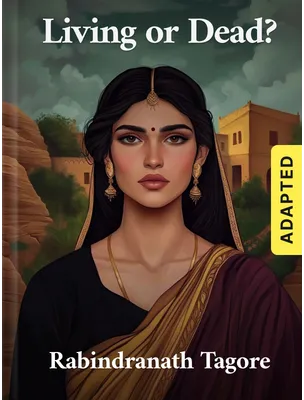
[adapted]
by
Rabindranath Tagore

I
The widow in the house of Saradasankar, the Ranihat landlord, had no relatives in her father’s family. One after another all had died. She also had no one in her husband’s family she could call her own, no husband and no son. The child of her brother-in-law Saradasankar was her favorite. For a long time after his birth, his mother had been very ill, and the widow, his aunt Kadambini, had looked after him. If a woman looks after another’s child, her love for him is even stronger because she has no right to him — no right from family, that is, but only the right of love. Love cannot prove its right by any paper that society accepts, and does not want to prove it; it only loves with twice the feeling its life’s unsure treasure. So all the widow’s held-back love went out towards this little child. One night in Sraban Kadambini died suddenly. For some reason her heart stopped beating. Everywhere else the world went on its way; only in this gentle little chest, hurt by love, the clock of time stopped for ever.
So that they would not be troubled by the police, four of the landlord’s Brahmin servants took away the body, without ceremony, to be burned. The place for burning bodies of Ranihat was very far from the village. There was a hut beside a pond, a huge banyan tree near it, and nothing more. Before, a river ran through the ground, but now it was completely dried up, and part of the riverbed had been dug out to make a pond for funeral ceremonies. The people thought of the pond as part of the river and respected it in that way.
After they took the body into the hut, the four men sat down to wait for the wood. The time seemed so long that two of the four got restless, and went to see why it did not come. With Nitai and Gurucharan gone, Bidhu and Banamali stayed to watch the body.
It was a dark night of Sraban. Heavy clouds hung in a sky with no stars. The two men sat silent in the dark room. Their matches and lamp were of no use. The matches were wet, and would not light, no matter how hard they tried, and the lantern went out.
After a long silence, someone said: “Brother, it would be good if we had a bowl of tobacco. We were in a hurry, so we didn’t bring any.”
The other answered: “I can run and bring all we want.”
Knowing why Banarnali wanted to go (From fear of ghosts, the burning-ground being thought haunted.), Bidhu said: “I guess! For now, I think I have to sit here alone!”
The talk stopped again. Five minutes seemed like an hour. In their minds they cursed the two who had gone to get the wood, and they began to think that they were sitting and talking in some pleasant corner. There was no sound anywhere, except the constant noise of frogs and crickets from the pond. Then suddenly they thought that the bed shook a little, as if the dead body had turned onto its side. Bidhu and Banamali shook with fear, and began to say softly: “Ram, Ram.” They heard a deep sigh in the room. In a moment the watchers jumped out of the hut, and ran to the village.
After running about three miles, they met their co-workers coming back with a lantern. In fact, they had gone to smoke, and did not know anything about the wood. But they said that a tree was cut down, and that, when it was cut into pieces, it would be brought right away. Then Bidhu and Banamali told them what happened in the hut. Nitai and Gurucharan laughed at the story, and shouted at Bidhu and Banamali angrily for leaving their work.
Right away, all four went back to the hut. When they went in, they saw right away that the body was gone; nothing but an empty bed was left. They looked at each other. Could a jackal have taken it away? But there was no piece of clothing anywhere. When they went outside, they saw that in the mud that had gathered at the door of the hut there were a woman’s small footprints, fresh. Saradasankar was not a fool, and they could hardly make him believe this ghost story. So after much talking, the four decided that it would be best to say that the body had been burnt.
Towards morning, when the men with the wood arrived they were told that, because of their delay, the work had been done without them; there had been some wood in the hut after all. No one was likely to say this was not true, because a dead body is not such a valuable thing that anyone would steal it.
II
Every one knows that, even when there is no sign, life is often still there, and may begin again in a body that seems dead. Kadambini was not dead; only the machine of her life had for some reason suddenly stopped.
When she woke up, she saw thick darkness on all sides. She thought that she was not lying in her usual place. She called out “Sister,” but no answer came from the darkness. As she sat up, very scared, she remembered her death bed, the sudden pain in her chest, the start of a choking feeling. Her older sister-in-law was warming some milk for the child, when Kadambini felt faint, and fell on the bed, saying in a choking voice: “Sister, bring the child here. I am worried.” After that everything was black, as when an inkpot is spilled over an exercise book. Kadambini’s memory and mind, all the letters of the world’s book, in a moment became without shape.
The widow could not remember whether the child, in a sweet, loving voice, called her “Auntie,” as if for the last time, or not; she could not remember whether, as she left the world she knew to start death’s long, unknown journey, she had received a goodbye gift of love, love’s travel money for the silent place. At first, I think, she thought the lonely dark place was the House of Yama, where there is nothing to see, nothing to hear, nothing to do, only a watch that goes on forever. But when a cold, damp wind blew through the open door, and she heard the croaking of frogs, she remembered clearly and at once all the rains of her short life, and could feel that she belonged to the earth. Then came a flash of lightning, and she saw the pond, the banyan tree, the great plain, the far-away trees. She remembered how at full moon she had sometimes come to bathe in this pond, and how terrible death had seemed when she saw a dead body on the burning-ground.
Her first thought was to return home. But then she thought: “I am dead. How can I return home? That would bring big trouble on them. I have left the world of the living; I am my own ghost!” If this was not so, she thought, how could she get out of Saradasankar’s well-guarded women’s rooms, and come to this far place for burning the dead at midnight? Also, if her funeral was not finished, where were the men who should burn her? Remembering the moment when she died in Saradasankar’s bright house, she now found herself alone in a far, empty, dark place for burning the dead. Surely she was not part of the world of living people! Surely she was a thing of fear, a bad sign, her own ghost!
At this thought, all the ties were broken which tied her to the world. She felt that she had great strength, endless freedom. She could do what she liked, go where she pleased. Mad with the excitement of this new idea, she rushed from the hut like a strong wind, and stood on the burning-ground. Every sign of shame or fear had left her.
But as she walked on and on, her feet grew tired, her body weak. The flat land went on without end; here and there were rice fields; sometimes she was standing in water up to her knees.
At the first light of morning she heard one or two birds call from the clumps of bamboo by the far-off houses. Then she felt great fear. She did not know what her new place was with the earth and with living people. As long as she had been on the plain, on the burning-ground, covered by the dark night of Sraban, she had not been afraid, one who lived in her own kingdom. In daylight the homes of people filled her with fear. Men and ghosts fear each other, for their groups live on different sides of the river of death.
III
Her clothes were covered in mud; strange thoughts and walking at night had made her look like a crazy woman; really, her appearance was such that people might have been afraid of her, and children might have thrown stones at her or run away. Luckily, the first to see her was a traveler. He came up and said: “Mother, you look like a decent woman. Where are you going, alone and dressed like this?”
Kadambini, not able to think clearly, looked at him in silence. She could not believe that she was still part of the world, that she looked like a proper woman, that a traveller was asking her questions.
Again the man said: “Come, mother, I will take you home. Tell me where you live.”
Kadambini thought. To go back to her father-in-law’s house would be silly, and she had no father’s house. Then she remembered her childhood friend. She had not seen Jogmaya since she was young, but sometimes they had sent letters to each other. Sometimes there had been arguments between them, which was natural, since Kadambini wanted to make it clear that her love for Jogmaya was very great, while her friend said that Kadambini did not love her back the same. They were both sure that, if they met once, they would never be apart.
Kadambini said to the traveller: “I will go to Sripati’s house at Nisindapur.”
As he was going to Calcutta, Nisindapur, though not near, was on the way. So he took Kadambini to Sripati’s house, and the friends met again. At first they did not recognise each other, but slowly each recognised the other’s face from when they were children.
“What luck!” said Jogmaya. “I never thought that I would see you again. But how did you come here, sister? Your father-in-law’s family surely didn’t let you go!”
Kadambini kept quiet, and finally said: “Sister, don’t ask about my father-in-law. Give me a small place, and treat me like a servant: I will do your work.”
“What?” said Jogmaya. “Keep you as a servant! Why, you are my best friend, you are my — ” and so on and so on.
Just then Sripati came in. Kadambini looked at him for some time, and then went out very slowly. She kept her head uncovered, and did not show any good manners or respect at all. Jogmaya, afraid that Sripati would think badly of her friend, began a long explanation. But Sripati, who quickly agreed to anything Jogmaya said, stopped her story, and left his wife worried in her mind.
Kadambini had come, but she was not close to her friend: death was between them. She could feel no closeness to others as long as her own life confused her and she could still think. Kadambini would look at Jogmaya, and think sadly. She would think: “She has her husband and her work, she lives in a world far away from mine. She shares love and duties with the people of the world; I am an empty shadow. She is among the living; I am in endless time.”
Jogmaya also felt worried, but could not explain why. Women do not like mystery, because, though not knowing may be turned into poetry, into bravery, into learning, it cannot be used in housework. So, when a woman cannot understand a thing, she either breaks it and forgets it, or she changes it into something new for her own use; if she cannot deal with it in one of these ways, she gets angry with it. The more Kadambini was lost in thought, the more impatient was Jogmaya with her, wondering what trouble was on her mind.
Then a new danger came. Kadambini was afraid of herself; yet she could not run away from herself. People who fear ghosts fear what is behind them; wherever they cannot see there is fear. But Kadambini’s main fear was inside herself, for she feared nothing outside. In the middle of the night, when alone in her room, she screamed; in the evening, when she saw her shadow in the light of the lamp, her whole body shook. Seeing how afraid she was, the rest of the house fell into a kind of fear. The servants and Jogmaya herself began to see ghosts.
One midnight, Kadambini came out from her bedroom crying, and cried out at Jogmaya’s door: “Sister, sister, let me lie at your feet! Do not leave me alone!”
Jogmaya’s anger was as strong as her fear. She wanted to make Kadambini leave the house at that very moment. The kind Sripati, after trying hard, was able to calm their guest, and put her in the next room.
Next day Sripati was suddenly called to his wife’s rooms. She began to scold him: “You, do you call yourself a man? A woman runs away from her father-in-law, and comes into your house; a month goes by, and you haven’t even said that she should leave, and I have not heard you complain even once. I would take it as a favour if you would explain yourself. You men are all alike.”
Men, as a group, have a natural liking for women in general, and women themselves blame them for this. Although Sripati was ready to touch Jogmaya’s body, and swear that his kind feeling toward the helpless but beautiful Kadambini was not at all greater than it should be, he could not prove it by his actions. He thought that her father-in-law’s family must have treated this sad widow very badly, if she could not bear it any longer, and was forced to come to him for help. Since she had no father or mother, how could he leave her? After saying this, he did not talk about it any more, because he did not want to upset Kadambini by asking her unpleasant questions.
His wife, then, tried other ways with her slow husband, until at last he saw that to keep peace he must send a message to Kadambini’s father-in-law. A letter, he thought, might not be good enough; so he decided to go to Ranihat, and act on what he learnt.
So Sripati went, and Jogmaya also said to Kadambini, “Friend, it does not seem right for you to stay here any longer. What will people say?”
Kadambini looked seriously at Jogmaya, and said: “What do I have to do with people?”
Jogmaya was very surprised. Then she said angrily: “If you do not care about people, we do. How can we explain keeping a woman from another house?”
Kadambini said: “Where is my husband’s father’s house?”
“Oh no!” thought Jogmaya. “What will the awful woman say next?”
Very slowly Kadambini said: “What do I have to do with you? Am I from the earth? You laugh, cry, love; each keeps his own; I only look. You are human, I am a shadow. I cannot understand why God has kept me in your world.”
Her look and speech were so strange that Jogmaya understood some of what she meant, though not all. She could not send her away or ask her any more questions, so she went away, deep in thought.
IV
It was nearly ten o’clock at night when Sripati came back from Ranihat. The earth was covered in heavy rain. It seemed that the heavy rain would never stop, that the night would never end.
Jogmaya asked: “Well?”
“I’ve lots to say, soon.”
After saying this, Sripati changed his clothes, and sat down to dinner; then he lay down to smoke. His mind was confused.
His wife held back her curiosity for a long time; then she came to his bed and asked: “What did you hear?”
“That you have for sure made a mistake.”
Jogmaya was annoyed. Women never make mistakes, or, if they do, a smart man never says anything about them; it is better to say it is his fault. Jogmaya said angrily: “May I be allowed to hear how?”
Sripati said: “The woman you brought home is not your Kadambini.”