'The Time Machine' was first published in 1895. The adapted versions have been released in various formats since then.
[{"id":"para_1","index":0,"start":0,"offset":330,"words":3,"paraNum":"","lastModified":1772024840000,"semanticType":"title-book-title","voicework":"tts","blockId":"time_machine_adapted_en-bl2s","language":"en","wordsRange":{"start":100000000,"end":104000000},"paragraphVersion":47,"direction":"ltr","paragraph":"<h1 class=\"ilm-title ilm-x-large\" id=\"para_1\" semantictype=\"title-book-title\" data-ilmid=\"time_machine_adapted_en-bl2s\" data-audio=\"1\" data-chapter=\"para_1\" data-words-count=\"3\" data-before=\"0\" data-ww=\"\"><span class=\"block-pb\"> <span class=\"block-pb is-animated\"></span> </span><span class=\"itm-wrap\">The Time Machine</span></h1>","hasContent":true,"isFirst":true,"isLast":false},{"id":"para_2","index":1,"start":330,"offset":322,"words":1,"paraNum":"","lastModified":1772024826000,"semanticType":"title-subtitle","voicework":"tts","blockId":"time_machine_adapted_en-blc7","language":"en","wordsRange":{"start":137333333,"end":170666667},"paragraphVersion":42,"direction":"ltr","paragraph":"<h1 class=\"ilm-title ilm-subtitle\" id=\"para_2\" semantictype=\"title-subtitle\" data-ilmid=\"time_machine_adapted_en-blc7\" data-audio=\"1\" data-chapter=\"para_2\" data-words-count=\"1\" data-before=\"3\" data-ww=\"\"><span class=\"block-pb\"> <span class=\"block-pb is-animated\"></span> </span><span class=\"itm-wrap\">[adapted]</span></h1>","hasContent":true,"isFirst":false,"isLast":false},{"id":"para_3","index":2,"start":652,"offset":347,"words":3,"paraNum":"","lastModified":1772025298000,"semanticType":"title-author","voicework":"tts","blockId":"time_machine_adapted_en-bl2t","language":"en","wordsRange":{"start":204000000,"end":209000000},"paragraphVersion":54,"direction":"ltr","paragraph":"<h1 class=\"ilm-title ilm-author ilm-large ilm-nopad\" id=\"para_3\" semantictype=\"title-author\" data-ilmid=\"time_machine_adapted_en-bl2t\" data-audio=\"1\" data-chapter=\"para_3\" data-words-count=\"3\" data-before=\"4\" data-ww=\"\"><span class=\"block-pb\"> <span class=\"block-pb is-animated\"></span> </span><span class=\"itm-wrap\">by <br>H. G. Wells</span></h1>","hasContent":true,"isFirst":false,"isLast":false},{"id":"para_4","index":3,"start":999,"offset":151,"words":0,"paraNum":"","lastModified":1772015707000,"semanticType":"line","blockId":"time_machine_adapted_en-blc6","language":"en","wordsRange":{"start":242333333,"end":275666667},"paragraphVersion":40,"direction":"ltr","paragraph":"<hr class=\"ilm-hr ilm-small\" id=\"para_4\" semantictype=\"line\" data-ilmid=\"time_machine_adapted_en-blc6\" data-words-count=\"0\" data-before=\"7\" data-ww=\"\">","hasContent":true,"isFirst":false,"isLast":false},{"id":"para_5","index":4,"start":1150,"offset":1572,"words":0,"paraNum":"","lastModified":1772184102000,"semanticType":"illustration","blockId":"time_machine_adapted_en-blcp","language":"en","wordsRange":{"start":286777778,"end":297888889},"paragraphVersion":15,"direction":"ltr","paragraph":"<div class=\"ilm-illustration\" id=\"para_5\" semantictype=\"illustration\" data-ilmid=\"time_machine_adapted_en-blcp\" data-words-count=\"0\" data-before=\"7\" data-ww=\"\"><img width=\"600\" height=\"400\" data-src=\"ch0p0\" src=\"data:image/webp;base64,UklGRsQDAABXRUJQVlA4ILgDAAAwEQCdASo8ACgAPm0skUakIiGhMBVaqIANiWQAqSdfCVyHbN2DAru3H53Pz6N9A3oefQcv4XjMFkpOL3F8i9kvGpeQx9uh4jjB/i73LxC0KBezf6nEVNj1Iey/NUdrfxuDKqJ8a4hpWR+xG+4UAm20PgUWYqb2u76Yq0+Y4T4TCbFT41zVE2wSc4BMO2WNoKlwAAD+/zLRGVa8GE8u2ZOAaeH/9FqKzvXwpKjwHSHIXsjgVkfIk8CTt8O7iXcaQvoz8ScFZAikMd52scQEnLinb7HvdiySOBTlSTSFg4Ff9hRoWCgPdEKQva16g7BF3hPeKeJ5WxHVcjW+A/rsX7Qa9octosJEjd4Ci5qbU6sYrb5GHORSrZH6PrJVafJ5mY2xiMQDdKzcIm34DP5lTHYTU/iiXll7pffJy/CcLbg89oN5j/LFKT+l6j+q5ccPznOa7ClTbCHus++TmFzS7ynXkVU9d3cWlJm1kG5rm7BuOLAwmfqHQRPVYEsPCA384F568f4uvTA9NEtQjvwzueKuySxaAMLjMvibCYNk4DA/8hadNgsrU8qDzaNN6JRKngF1uHHjCkXOpG/NMufo05w8X7j/m4Mgf803T4eEqvpwJMrKVxrguVT4OsFAZTh3IELFOO45GrQWF0sNNUqnG1i9ZCToPUjujhQT19gAlvwM4pFPgOHQWxvMmNyi+cP09QqCU9GDgh1/jH2mogs8YbsGeQnWIwshsPfsL6/HDS1020vyn8skoTK3jpJdaCMQYcXaMcDrk28lkIeFTRp5w0/y6nhp/Ru5Uuy1LzSSyr83Sn5G8lp7UtrfNuD9TgTHZq6KUR69ZDYS1I9/PQ5uhd3HxQlpgNlk7/JqLfp0wTRJCxVsc16qF5ruhqOvvuWt1WURfSL6nNzpdKmvBI7WVEPzZKKracrYhyKEQwRpiJ3O+njqdxCCEMHSQ/t96ndZ4wmB/W6SShgRDNzdO9kLV20nP3QjMwP7AMI2zjWC1nxv/EuzEPBgorr1ZY1z0SQuvBSS/uca6skP2ywUSwxItVAKbcj9BsyzdJM6vSzLc75usfaZV5iNUtF1R+lDOimeMRbKxdK8c5/A5FGUX+ozB86gBPeflm+v3q64Ai5L+cBjYw7fWJbq40TxNOXyiN6Nq2O2zxmySkWVUfgowz9emEaTS+FyKsAmrTqxRzYI3as5rfm1tGaQq4NoeAUMgUxIxEe2WwCg/h0cE+AdCimts9a0XPi+fb3Okx69GmAZzdSmAUduLaynwAAA\" alt=\"The Time Machine (adapted)\"></div>","hasContent":true,"isFirst":false,"isLast":false},{"id":"para_6","index":5,"start":2722,"offset":548,"words":2,"paraNum":"","lastModified":1772025134000,"semanticType":"header-chapter-header","voicework":"tts","blockId":"time_machine_adapted_en-bl2u","language":"en","wordsRange":{"start":309000000,"end":313000000},"paragraphVersion":59,"direction":"ltr","paragraph":"<h2 class=\"ilm-header ilm-h2 ilm-large\" id=\"para_6\" semantictype=\"header-chapter-header\" data-ilmid=\"time_machine_adapted_en-bl2u\" data-audio=\"1\" data-chapter=\"para_6\" data-words-count=\"2\" data-before=\"7\" data-ww=\"\"><span class=\"block-pb\"> <span class=\"block-pb is-animated\"></span> </span><span class=\"itm-wrap\"><span class=\"chapter-text\"><span class=\"chapter-number\"><span class=\"chapter-label\"></span><span class=\"chapter-value\"></span></span><span class=\"chapter-title\"><b>Chapter </b><b>1 </b><b><br>Introduction </b></span></span></span></h2>","hasContent":true,"isFirst":false,"isLast":false},{"id":"para_7","index":6,"start":3270,"offset":469,"words":32,"paraNum":"1.1","lastModified":1772023435000,"semanticType":"par","voicework":"tts","blockId":"time_machine_adapted_en-bl2v","language":"en","wordsRange":{"start":413000000,"end":446000000},"paragraphVersion":42,"direction":"ltr","paragraph":"<p id=\"para_7\" semantictype=\"par\" data-ilmid=\"time_machine_adapted_en-bl2v\" data-audio=\"1\" data-words-count=\"32\" data-before=\"9\" data-ww=\"\"><span class=\"block-num\" data-id=\"1.1\"></span><span class=\"block-pb\"> <span class=\"block-pb is-animated\"></span> </span><span class=\"itm-wrap\">The Time Traveller was talking to us after dinner. We sat in comfortable chairs in his warm room. The fire was burning, and the lights were soft. He looked excited and serious.</span></p>","hasContent":true,"isFirst":false,"isLast":false},{"id":"para_8","index":7,"start":3739,"offset":423,"words":19,"paraNum":"1.2","lastModified":1772023388000,"semanticType":"par","voicework":"tts","blockId":"time_machine_adapted_en-bl2w","language":"en","wordsRange":{"start":546000000,"end":566000000},"paragraphVersion":42,"direction":"ltr","paragraph":"<p id=\"para_8\" semantictype=\"par\" data-ilmid=\"time_machine_adapted_en-bl2w\" data-audio=\"1\" data-words-count=\"19\" data-before=\"41\" data-ww=\"\"><span class=\"block-num\" data-id=\"1.2\"></span><span class=\"block-pb\"> <span class=\"block-pb is-animated\"></span> </span><span class=\"itm-wrap\">“You must listen carefully,” he said. “Some ideas you learned at school are not completely right. For example, geometry.”</span></p>","hasContent":true,"isFirst":false,"isLast":false},{"id":"para_9","index":8,"start":4162,"offset":386,"words":16,"paraNum":"1.3","lastModified":1772023288000,"semanticType":"par","voicework":"tts","blockId":"time_machine_adapted_en-bl2x","language":"en","wordsRange":{"start":666000000,"end":683000000},"paragraphVersion":42,"direction":"ltr","paragraph":"<p id=\"para_9\" semantictype=\"par\" data-ilmid=\"time_machine_adapted_en-bl2x\" data-audio=\"1\" data-words-count=\"16\" data-before=\"60\" data-ww=\"\"><span class=\"block-num\" data-id=\"1.3\"></span><span class=\"block-pb\"> <span class=\"block-pb is-animated\"></span> </span><span class=\"itm-wrap\">Filby, a man with red hair who liked to argue, said, “That sounds difficult to believe.”</span></p>","hasContent":true,"isFirst":false,"isLast":false},{"id":"para_10","index":9,"start":4548,"offset":500,"words":34,"paraNum":"1.4","lastModified":1772023463000,"semanticType":"par","voicework":"tts","blockId":"time_machine_adapted_en-bl2y","language":"en","wordsRange":{"start":783000000,"end":818000000},"paragraphVersion":42,"direction":"ltr","paragraph":"<p id=\"para_10\" semantictype=\"par\" data-ilmid=\"time_machine_adapted_en-bl2y\" data-audio=\"1\" data-words-count=\"34\" data-before=\"76\" data-ww=\"\"><span class=\"block-num\" data-id=\"1.4\"></span><span class=\"block-pb\"> <span class=\"block-pb is-animated\"></span> </span><span class=\"itm-wrap\">The Time Traveller smiled. “I will explain. A mathematical line has no thickness. A mathematical plane has no thickness either. These things do not really exist in the real world. They are only ideas.”</span></p>","hasContent":true,"isFirst":false,"isLast":false},{"id":"para_11","index":10,"start":5048,"offset":319,"words":3,"paraNum":"1.5","lastModified":1772023281000,"semanticType":"par","voicework":"tts","blockId":"time_machine_adapted_en-bl2z","language":"en","wordsRange":{"start":918000000,"end":922000000},"paragraphVersion":42,"direction":"ltr","paragraph":"<p id=\"para_11\" semantictype=\"par\" data-ilmid=\"time_machine_adapted_en-bl2z\" data-audio=\"1\" data-words-count=\"3\" data-before=\"110\" data-ww=\"\"><span class=\"block-num\" data-id=\"1.5\"></span><span class=\"block-pb\"> <span class=\"block-pb is-animated\"></span> </span><span class=\"itm-wrap\">The Psychologist agreed.</span></p>","hasContent":true,"isFirst":false,"isLast":false},{"id":"para_12","index":11,"start":5367,"offset":564,"words":44,"paraNum":"1.6","lastModified":1772023344000,"semanticType":"par","voicework":"tts","blockId":"time_machine_adapted_en-bl30","language":"en","wordsRange":{"start":1022000000,"end":1067000000},"paragraphVersion":42,"direction":"ltr","paragraph":"<p id=\"para_12\" semantictype=\"par\" data-ilmid=\"time_machine_adapted_en-bl30\" data-audio=\"1\" data-words-count=\"44\" data-before=\"113\" data-ww=\"\"><span class=\"block-num\" data-id=\"1.6\"></span><span class=\"block-pb\"> <span class=\"block-pb is-animated\"></span> </span><span class=\"itm-wrap\">The Time Traveller continued, “We say that objects have three dimensions: length, breadth, and thickness. But that is not complete. Every real thing also has Duration. Duration means it exists in Time. So there are four dimensions: three of Space and one of Time.”</span></p>","hasContent":true,"isFirst":false,"isLast":false},{"id":"para_13","index":12,"start":5931,"offset":322,"words":5,"paraNum":"1.7","lastModified":1772023400000,"semanticType":"par","voicework":"tts","blockId":"time_machine_adapted_en-bl31","language":"en","wordsRange":{"start":1167000000,"end":1173000000},"paragraphVersion":42,"direction":"ltr","paragraph":"<p id=\"para_13\" semantictype=\"par\" data-ilmid=\"time_machine_adapted_en-bl31\" data-audio=\"1\" data-words-count=\"5\" data-before=\"157\" data-ww=\"\"><span class=\"block-num\" data-id=\"1.7\"></span><span class=\"block-pb\"> <span class=\"block-pb is-animated\"></span> </span><span class=\"itm-wrap\">Some of us looked confused.</span></p>","hasContent":true,"isFirst":false,"isLast":false},{"id":"para_14","index":13,"start":6253,"offset":458,"words":31,"paraNum":"1.8","lastModified":1772023312000,"semanticType":"par","voicework":"tts","blockId":"time_machine_adapted_en-bl32","language":"en","wordsRange":{"start":1273000000,"end":1305000000},"paragraphVersion":42,"direction":"ltr","paragraph":"<p id=\"para_14\" semantictype=\"par\" data-ilmid=\"time_machine_adapted_en-bl32\" data-audio=\"1\" data-words-count=\"31\" data-before=\"162\" data-ww=\"\"><span class=\"block-num\" data-id=\"1.8\"></span><span class=\"block-pb\"> <span class=\"block-pb is-animated\"></span> </span><span class=\"itm-wrap\">He explained more. “We move through Time from the day we are born to the day we die. We think Time is different from Space. But it is just another dimension.”</span></p>","hasContent":true,"isFirst":false,"isLast":false},{"id":"para_15","index":14,"start":6711,"offset":382,"words":14,"paraNum":"1.9","lastModified":1772023346000,"semanticType":"par","voicework":"tts","blockId":"time_machine_adapted_en-bl33","language":"en","wordsRange":{"start":1405000000,"end":1420000000},"paragraphVersion":42,"direction":"ltr","paragraph":"<p id=\"para_15\" semantictype=\"par\" data-ilmid=\"time_machine_adapted_en-bl33\" data-audio=\"1\" data-words-count=\"14\" data-before=\"193\" data-ww=\"\"><span class=\"block-num\" data-id=\"1.9\"></span><span class=\"block-pb\"> <span class=\"block-pb is-animated\"></span> </span><span class=\"itm-wrap\">The Provincial Mayor tried to understand. Slowly, he said, “Yes… I think I see.”</span></p>","hasContent":true,"isFirst":false,"isLast":false},{"id":"para_16","index":15,"start":7093,"offset":488,"words":33,"paraNum":"1.10","lastModified":1772023432000,"semanticType":"par","voicework":"tts","blockId":"time_machine_adapted_en-bl34","language":"en","wordsRange":{"start":1520000000,"end":1554000000},"paragraphVersion":50,"direction":"ltr","paragraph":"<p id=\"para_16\" semantictype=\"par\" data-ilmid=\"time_machine_adapted_en-bl34\" data-audio=\"1\" data-words-count=\"33\" data-before=\"207\" data-ww=\"\"><span class=\"block-num\" data-id=\"1.10\"></span><span class=\"block-pb\"> <span class=\"block-pb is-animated\"></span> </span><span class=\"itm-wrap\">The Time Traveller went on. “Look at a man at eight years old, then at fifteen, seventeen, and twenty-three. These are only parts of the same person. The whole person exists across Time.”</span></p>","hasContent":true,"isFirst":false,"isLast":false},{"id":"para_17","index":16,"start":7581,"offset":456,"words":28,"paraNum":"1.11","lastModified":1772025321000,"semanticType":"par","voicework":"tts","blockId":"time_machine_adapted_en-bl35","language":"en","wordsRange":{"start":1654000000,"end":1683000000},"paragraphVersion":53,"direction":"ltr","paragraph":"<p id=\"para_17\" semantictype=\"par\" data-ilmid=\"time_machine_adapted_en-bl35\" data-audio=\"1\" data-words-count=\"28\" data-before=\"240\" data-ww=\"\"><span class=\"block-num\" data-id=\"1.11\"></span><span class=\"block-pb\"> <span class=\"block-pb is-animated\"></span> </span><span class=\"itm-wrap\">He showed us a simple example. “Look at this weather chart. The line shows how air pressure changes. The line moves across Time. Time is like a direction.”</span></p>","hasContent":true,"isFirst":false,"isLast":false},{"id":"para_18","index":17,"start":8037,"offset":399,"words":21,"paraNum":"1.12","lastModified":1772025367000,"semanticType":"par","voicework":"tts","blockId":"time_machine_adapted_en-bl36","language":"en","wordsRange":{"start":1783000000,"end":1805000000},"paragraphVersion":42,"direction":"ltr","paragraph":"<p id=\"para_18\" semantictype=\"par\" data-ilmid=\"time_machine_adapted_en-bl36\" data-audio=\"1\" data-words-count=\"21\" data-before=\"268\" data-ww=\"\"><span class=\"block-num\" data-id=\"1.12\"></span><span class=\"block-pb\"> <span class=\"block-pb is-animated\"></span> </span><span class=\"itm-wrap\">The Medical Man asked, “If Time is like Space, why can we not move in Time like we move in Space?”</span></p>","hasContent":true,"isFirst":false,"isLast":false},{"id":"para_19","index":18,"start":8436,"offset":463,"words":31,"paraNum":"1.13","lastModified":1772025397000,"semanticType":"par","voicework":"tts","blockId":"time_machine_adapted_en-bl37","language":"en","wordsRange":{"start":1905000000,"end":1937000000},"paragraphVersion":46,"direction":"ltr","paragraph":"<p id=\"para_19\" semantictype=\"par\" data-ilmid=\"time_machine_adapted_en-bl37\" data-audio=\"1\" data-words-count=\"31\" data-before=\"289\" data-ww=\"\"><span class=\"block-num\" data-id=\"1.13\"></span><span class=\"block-pb\"> <span class=\"block-pb is-animated\"></span> </span><span class=\"itm-wrap\">The Time Traveller said, “Are you sure we can move freely in Space? We can move left and right, forward and back. But moving up is harder. Gravity pulls us down.”</span></p>","hasContent":true,"isFirst":false,"isLast":false},{"id":"para_20","index":19,"start":8899,"offset":343,"words":7,"paraNum":"1.14","lastModified":1772026071000,"semanticType":"par","voicework":"tts","blockId":"time_machine_adapted_en-bl38","language":"en","wordsRange":{"start":2037000000,"end":2045000000},"paragraphVersion":42,"direction":"ltr","paragraph":"<p id=\"para_20\" semantictype=\"par\" data-ilmid=\"time_machine_adapted_en-bl38\" data-audio=\"1\" data-words-count=\"7\" data-before=\"320\" data-ww=\"\"><span class=\"block-num\" data-id=\"1.14\"></span><span class=\"block-pb\"> <span class=\"block-pb is-animated\"></span> </span><span class=\"itm-wrap\">“There are balloons,” said the Medical Man.</span></p>","hasContent":true,"isFirst":false,"isLast":false},{"id":"para_21","index":20,"start":9242,"offset":500,"words":36,"paraNum":"1.15","lastModified":1772025608000,"semanticType":"par","voicework":"tts","blockId":"time_machine_adapted_en-bl39","language":"en","wordsRange":{"start":2145000000,"end":2182000000},"paragraphVersion":42,"direction":"ltr","paragraph":"<p id=\"para_21\" semantictype=\"par\" data-ilmid=\"time_machine_adapted_en-bl39\" data-audio=\"1\" data-words-count=\"36\" data-before=\"327\" data-ww=\"\"><span class=\"block-num\" data-id=\"1.15\"></span><span class=\"block-pb\"> <span class=\"block-pb is-animated\"></span> </span><span class=\"itm-wrap\">“Yes,” said the Time Traveller. “People learned to go up with balloons. So why can we not learn to move in Time? Our minds already move through Time. We remember the past. We imagine the future.”</span></p>","hasContent":true,"isFirst":false,"isLast":false},{"id":"para_22","index":21,"start":9742,"offset":362,"words":10,"paraNum":"1.16","lastModified":1772025516000,"semanticType":"par","voicework":"tts","blockId":"time_machine_adapted_en-bl3a","language":"en","wordsRange":{"start":2282000000,"end":2293000000},"paragraphVersion":42,"direction":"ltr","paragraph":"<p id=\"para_22\" semantictype=\"par\" data-ilmid=\"time_machine_adapted_en-bl3a\" data-audio=\"1\" data-words-count=\"10\" data-before=\"363\" data-ww=\"\"><span class=\"block-num\" data-id=\"1.16\"></span><span class=\"block-pb\"> <span class=\"block-pb is-animated\"></span> </span><span class=\"itm-wrap\">“But we cannot really travel in Time,” said the Psychologist.</span></p>","hasContent":true,"isFirst":false,"isLast":false},{"id":"para_23","index":22,"start":10104,"offset":396,"words":17,"paraNum":"1.17","lastModified":1772025591000,"semanticType":"par","voicework":"tts","blockId":"time_machine_adapted_en-bl3b","language":"en","wordsRange":{"start":2393000000,"end":2411000000},"paragraphVersion":42,"direction":"ltr","paragraph":"<p id=\"para_23\" semantictype=\"par\" data-ilmid=\"time_machine_adapted_en-bl3b\" data-audio=\"1\" data-words-count=\"17\" data-before=\"373\" data-ww=\"\"><span class=\"block-num\" data-id=\"1.17\"></span><span class=\"block-pb\"> <span class=\"block-pb is-animated\"></span> </span><span class=\"itm-wrap\">“That is where you are wrong,” said the Time Traveller. “I have been working on a machine.”</span></p>","hasContent":true,"isFirst":false,"isLast":false},{"id":"para_24","index":23,"start":10500,"offset":351,"words":9,"paraNum":"1.18","lastModified":1772026116000,"semanticType":"par","voicework":"tts","blockId":"time_machine_adapted_en-bl3c","language":"en","wordsRange":{"start":2511000000,"end":2521000000},"paragraphVersion":42,"direction":"ltr","paragraph":"<p id=\"para_24\" semantictype=\"par\" data-ilmid=\"time_machine_adapted_en-bl3c\" data-audio=\"1\" data-words-count=\"9\" data-before=\"390\" data-ww=\"\"><span class=\"block-num\" data-id=\"1.18\"></span><span class=\"block-pb\"> <span class=\"block-pb is-animated\"></span> </span><span class=\"itm-wrap\">“To travel through Time?” asked the Very Young Man.</span></p>","hasContent":true,"isFirst":false,"isLast":false},{"id":"para_25","index":24,"start":10851,"offset":353,"words":11,"paraNum":"1.19","lastModified":1772025501000,"semanticType":"par","voicework":"tts","blockId":"time_machine_adapted_en-bl3d","language":"en","wordsRange":{"start":2621000000,"end":2633000000},"paragraphVersion":42,"direction":"ltr","paragraph":"<p id=\"para_25\" semantictype=\"par\" data-ilmid=\"time_machine_adapted_en-bl3d\" data-audio=\"1\" data-words-count=\"11\" data-before=\"399\" data-ww=\"\"><span class=\"block-num\" data-id=\"1.19\"></span><span class=\"block-pb\"> <span class=\"block-pb is-animated\"></span> </span><span class=\"itm-wrap\">“Yes. A machine that can move in Space and in Time.”</span></p>","hasContent":true,"isFirst":false,"isLast":false},{"id":"para_26","index":25,"start":11204,"offset":334,"words":7,"paraNum":"1.20","lastModified":1772025576000,"semanticType":"par","voicework":"tts","blockId":"time_machine_adapted_en-bl3e","language":"en","wordsRange":{"start":2733000000,"end":2741000000},"paragraphVersion":42,"direction":"ltr","paragraph":"<p id=\"para_26\" semantictype=\"par\" data-ilmid=\"time_machine_adapted_en-bl3e\" data-audio=\"1\" data-words-count=\"7\" data-before=\"410\" data-ww=\"\"><span class=\"block-num\" data-id=\"1.20\"></span><span class=\"block-pb\"> <span class=\"block-pb is-animated\"></span> </span><span class=\"itm-wrap\">Filby laughed. He did not believe him.</span></p>","hasContent":true,"isFirst":false,"isLast":false},{"id":"para_27","index":26,"start":11538,"offset":344,"words":8,"paraNum":"1.21","lastModified":1772026131000,"semanticType":"par","voicework":"tts","blockId":"time_machine_adapted_en-bl3f","language":"en","wordsRange":{"start":2841000000,"end":2850000000},"paragraphVersion":42,"direction":"ltr","paragraph":"<p id=\"para_27\" semantictype=\"par\" data-ilmid=\"time_machine_adapted_en-bl3f\" data-audio=\"1\" data-words-count=\"8\" data-before=\"417\" data-ww=\"\"><span class=\"block-num\" data-id=\"1.21\"></span><span class=\"block-pb\"> <span class=\"block-pb is-animated\"></span> </span><span class=\"itm-wrap\">“I have tested it,” said the Time Traveller.</span></p>","hasContent":true,"isFirst":false,"isLast":false},{"id":"para_28","index":27,"start":11882,"offset":536,"words":37,"paraNum":"1.22","lastModified":1772026148000,"semanticType":"par","voicework":"tts","blockId":"time_machine_adapted_en-bl3g","language":"en","wordsRange":{"start":2950000000,"end":2988000000},"paragraphVersion":42,"direction":"ltr","paragraph":"<p id=\"para_28\" semantictype=\"par\" data-ilmid=\"time_machine_adapted_en-bl3g\" data-audio=\"1\" data-words-count=\"37\" data-before=\"425\" data-ww=\"\"><span class=\"block-num\" data-id=\"1.22\"></span><span class=\"block-pb\"> <span class=\"block-pb is-animated\"></span> </span><span class=\"itm-wrap\">We began to imagine the possibilities.<br> “A historian could check past events,” said the Psychologist.<br> “We could learn Greek from Homer,” said the Very Young Man.<br> “We could go to the future and become rich,” he added.</span></p>","hasContent":true,"isFirst":false,"isLast":false},{"id":"para_29","index":28,"start":12418,"offset":356,"words":11,"paraNum":"1.23","lastModified":1772026097000,"semanticType":"par","voicework":"tts","blockId":"time_machine_adapted_en-bl3h","language":"en","wordsRange":{"start":3088000000,"end":3100000000},"paragraphVersion":41,"direction":"ltr","paragraph":"<p id=\"para_29\" semantictype=\"par\" data-ilmid=\"time_machine_adapted_en-bl3h\" data-audio=\"1\" data-words-count=\"11\" data-before=\"462\" data-ww=\"\"><span class=\"block-num\" data-id=\"1.23\"></span><span class=\"block-pb\"> <span class=\"block-pb is-animated\"></span> </span><span class=\"itm-wrap\">Some of us thought the idea was crazy. Others were curious.</span></p>","hasContent":true,"isFirst":false,"isLast":false},{"id":"para_30","index":29,"start":12774,"offset":352,"words":8,"paraNum":"1.24","lastModified":1772025547000,"semanticType":"par","voicework":"tts","blockId":"time_machine_adapted_en-bl3i","language":"en","wordsRange":{"start":3200000000,"end":3209000000},"paragraphVersion":42,"direction":"ltr","paragraph":"<p id=\"para_30\" semantictype=\"par\" data-ilmid=\"time_machine_adapted_en-bl3i\" data-audio=\"1\" data-words-count=\"8\" data-before=\"473\" data-ww=\"\"><span class=\"block-num\" data-id=\"1.24\"></span><span class=\"block-pb\"> <span class=\"block-pb is-animated\"></span> </span><span class=\"itm-wrap\">“Let us see this experiment,” said the Psychologist.</span></p>","hasContent":true,"isFirst":false,"isLast":false},{"id":"para_31","index":30,"start":13126,"offset":432,"words":26,"paraNum":"1.25","lastModified":1772026102000,"semanticType":"par","voicework":"tts","blockId":"time_machine_adapted_en-bl3j","language":"en","wordsRange":{"start":3309000000,"end":3336000000},"paragraphVersion":42,"direction":"ltr","paragraph":"<p id=\"para_31\" semantictype=\"par\" data-ilmid=\"time_machine_adapted_en-bl3j\" data-audio=\"1\" data-words-count=\"26\" data-before=\"481\" data-ww=\"\"><span class=\"block-num\" data-id=\"1.25\"></span><span class=\"block-pb\"> <span class=\"block-pb is-animated\"></span> </span><span class=\"itm-wrap\">The Time Traveller smiled. He put his hands in his pockets and slowly left the room. We heard him walk down the hall to his laboratory.</span></p>","hasContent":true,"isFirst":false,"isLast":false},{"id":"para_32","index":31,"start":13558,"offset":455,"words":28,"paraNum":"1.26","lastModified":1772025621000,"semanticType":"par","voicework":"tts","blockId":"time_machine_adapted_en-bl3k","language":"en","wordsRange":{"start":3436000000,"end":3465000000},"paragraphVersion":43,"direction":"ltr","paragraph":"<p id=\"para_32\" semantictype=\"par\" data-ilmid=\"time_machine_adapted_en-bl3k\" data-audio=\"1\" data-words-count=\"28\" data-before=\"507\" data-ww=\"\"><span class=\"block-num\" data-id=\"1.26\"></span><span class=\"block-pb\"> <span class=\"block-pb is-animated\"></span> </span><span class=\"itm-wrap\">We looked at each other. “I wonder what he will show us,” said the Psychologist. Maybe it was only a trick, we thought. Soon, the Time Traveller returned.</span></p>","hasContent":true,"isFirst":false,"isLast":false},{"id":"para_33","index":32,"start":14013,"offset":154,"words":0,"paraNum":"","lastModified":1772017143000,"semanticType":"line","blockId":"time_machine_adapted_en-blc8","language":"en","wordsRange":{"start":3498333333,"end":3531666667},"paragraphVersion":33,"direction":"ltr","paragraph":"<hr class=\"ilm-hr ilm-small\" id=\"para_33\" semantictype=\"line\" data-ilmid=\"time_machine_adapted_en-blc8\" data-words-count=\"0\" data-before=\"535\" data-ww=\"\">","hasContent":true,"isFirst":false,"isLast":false},{"id":"para_34","index":33,"start":14167,"offset":558,"words":3,"paraNum":"","lastModified":1772025149000,"semanticType":"header-chapter-header","voicework":"tts","blockId":"time_machine_adapted_en-bl3l","language":"en","wordsRange":{"start":3565000000,"end":3570000000},"paragraphVersion":61,"direction":"ltr","paragraph":"<h2 class=\"ilm-header ilm-h2 ilm-large\" id=\"para_34\" semantictype=\"header-chapter-header\" data-ilmid=\"time_machine_adapted_en-bl3l\" data-audio=\"1\" data-chapter=\"para_34\" data-words-count=\"3\" data-before=\"535\" data-ww=\"\"><span class=\"block-pb\"> <span class=\"block-pb is-animated\"></span> </span><span class=\"itm-wrap\"><span class=\"chapter-text\"><span class=\"chapter-number\"><span class=\"chapter-label\"></span><span class=\"chapter-value\"></span></span><span class=\"chapter-title\"><b>Chapter </b><b>2 </b><b><br>The </b><b>Machine </b></span></span></span></h2>","hasContent":true,"isFirst":false,"isLast":false},{"id":"para_35","index":34,"start":14725,"offset":494,"words":40,"paraNum":"2.1","lastModified":1772025637000,"semanticType":"par","voicework":"tts","blockId":"time_machine_adapted_en-bl3m","language":"en","wordsRange":{"start":3670000000,"end":3711000000},"paragraphVersion":48,"direction":"ltr","paragraph":"<p id=\"para_35\" semantictype=\"par\" data-ilmid=\"time_machine_adapted_en-bl3m\" data-audio=\"1\" data-words-count=\"40\" data-before=\"538\" data-ww=\"\"><span class=\"block-num\" data-id=\"2.1\"></span><span class=\"block-pb\"> <span class=\"block-pb is-animated\"></span> </span><span class=\"itm-wrap\">The Time Traveller came back into the room. In his hand, he held a small machine. It was shiny and made of metal. It was not bigger than a small clock. It had small parts of ivory and clear crystal.</span></p>","hasContent":true,"isFirst":false,"isLast":false},{"id":"para_36","index":35,"start":15219,"offset":506,"words":42,"paraNum":"2.2","lastModified":1772026205000,"semanticType":"par","voicework":"tts","blockId":"time_machine_adapted_en-bl3n","language":"en","wordsRange":{"start":3811000000,"end":3854000000},"paragraphVersion":48,"direction":"ltr","paragraph":"<p id=\"para_36\" semantictype=\"par\" data-ilmid=\"time_machine_adapted_en-bl3n\" data-audio=\"1\" data-words-count=\"42\" data-before=\"578\" data-ww=\"\"><span class=\"block-num\" data-id=\"2.2\"></span><span class=\"block-pb\"> <span class=\"block-pb is-animated\"></span> </span><span class=\"itm-wrap\">He put a small table near the fire and placed the machine on it. A bright lamp shone directly on the model. The room was very well lit. We all watched carefully. It did not seem possible that he could trick us.</span></p>","hasContent":true,"isFirst":false,"isLast":false},{"id":"para_37","index":36,"start":15725,"offset":396,"words":19,"paraNum":"2.3","lastModified":1772025651000,"semanticType":"par","voicework":"tts","blockId":"time_machine_adapted_en-bl3o","language":"en","wordsRange":{"start":3954000000,"end":3974000000},"paragraphVersion":48,"direction":"ltr","paragraph":"<p id=\"para_37\" semantictype=\"par\" data-ilmid=\"time_machine_adapted_en-bl3o\" data-audio=\"1\" data-words-count=\"19\" data-before=\"620\" data-ww=\"\"><span class=\"block-num\" data-id=\"2.3\"></span><span class=\"block-pb\"> <span class=\"block-pb is-animated\"></span> </span><span class=\"itm-wrap\">“This is only a model,” he said. “It is my plan for a machine that can travel through Time.”</span></p>","hasContent":true,"isFirst":false,"isLast":false},{"id":"para_38","index":37,"start":16121,"offset":437,"words":28,"paraNum":"2.4","lastModified":1772026177000,"semanticType":"par","voicework":"tts","blockId":"time_machine_adapted_en-bl3p","language":"en","wordsRange":{"start":4074000000,"end":4103000000},"paragraphVersion":48,"direction":"ltr","paragraph":"<p id=\"para_38\" semantictype=\"par\" data-ilmid=\"time_machine_adapted_en-bl3p\" data-audio=\"1\" data-words-count=\"28\" data-before=\"639\" data-ww=\"\"><span class=\"block-num\" data-id=\"2.4\"></span><span class=\"block-pb\"> <span class=\"block-pb is-animated\"></span> </span><span class=\"itm-wrap\">He showed us two small levers. “If I push this lever, the machine will move into the future. If I push the other one, it will move back.”</span></p>","hasContent":true,"isFirst":false,"isLast":false},{"id":"para_39","index":38,"start":16558,"offset":372,"words":13,"paraNum":"2.5","lastModified":1772025667000,"semanticType":"par","voicework":"tts","blockId":"time_machine_adapted_en-bl3q","language":"en","wordsRange":{"start":4203000000,"end":4217000000},"paragraphVersion":48,"direction":"ltr","paragraph":"<p id=\"para_39\" semantictype=\"par\" data-ilmid=\"time_machine_adapted_en-bl3q\" data-audio=\"1\" data-words-count=\"13\" data-before=\"667\" data-ww=\"\"><span class=\"block-num\" data-id=\"2.5\"></span><span class=\"block-pb\"> <span class=\"block-pb is-animated\"></span> </span><span class=\"itm-wrap\">The Medical Man looked at it closely. “It is beautifully made,” he said.</span></p>","hasContent":true,"isFirst":false,"isLast":false},{"id":"para_40","index":39,"start":16930,"offset":360,"words":11,"paraNum":"2.6","lastModified":1772025696000,"semanticType":"par","voicework":"tts","blockId":"time_machine_adapted_en-bl3r","language":"en","wordsRange":{"start":4317000000,"end":4329000000},"paragraphVersion":48,"direction":"ltr","paragraph":"<p id=\"para_40\" semantictype=\"par\" data-ilmid=\"time_machine_adapted_en-bl3r\" data-audio=\"1\" data-words-count=\"11\" data-before=\"680\" data-ww=\"\"><span class=\"block-num\" data-id=\"2.6\"></span><span class=\"block-pb\"> <span class=\"block-pb is-animated\"></span> </span><span class=\"itm-wrap\">“It took me two years to build,” the Time Traveller replied.</span></p>","hasContent":true,"isFirst":false,"isLast":false},{"id":"para_41","index":40,"start":17290,"offset":445,"words":27,"paraNum":"2.7","lastModified":1772026207000,"semanticType":"par","voicework":"tts","blockId":"time_machine_adapted_en-bl3s","language":"en","wordsRange":{"start":4429000000,"end":4457000000},"paragraphVersion":48,"direction":"ltr","paragraph":"<p id=\"para_41\" semantictype=\"par\" data-ilmid=\"time_machine_adapted_en-bl3s\" data-audio=\"1\" data-words-count=\"27\" data-before=\"691\" data-ww=\"\"><span class=\"block-num\" data-id=\"2.7\"></span><span class=\"block-pb\"> <span class=\"block-pb is-animated\"></span> </span><span class=\"itm-wrap\">He continued, “In a moment, the machine will disappear. It will travel through Time. Look carefully. I do not want you to think this is a trick.”</span></p>","hasContent":true,"isFirst":false,"isLast":false},{"id":"para_42","index":41,"start":17735,"offset":364,"words":12,"paraNum":"2.8","lastModified":1772025681000,"semanticType":"par","voicework":"tts","blockId":"time_machine_adapted_en-bl3t","language":"en","wordsRange":{"start":4557000000,"end":4570000000},"paragraphVersion":48,"direction":"ltr","paragraph":"<p id=\"para_42\" semantictype=\"par\" data-ilmid=\"time_machine_adapted_en-bl3t\" data-audio=\"1\" data-words-count=\"12\" data-before=\"718\" data-ww=\"\"><span class=\"block-num\" data-id=\"2.8\"></span><span class=\"block-pb\"> <span class=\"block-pb is-animated\"></span> </span><span class=\"itm-wrap\">We were silent. The Psychologist was about to speak, but he stopped.</span></p>","hasContent":true,"isFirst":false,"isLast":false},{"id":"para_43","index":42,"start":18099,"offset":431,"words":22,"paraNum":"2.9","lastModified":1772026221000,"semanticType":"par","voicework":"tts","blockId":"time_machine_adapted_en-bl3u","language":"en","wordsRange":{"start":4670000000,"end":4693000000},"paragraphVersion":48,"direction":"ltr","paragraph":"<p id=\"para_43\" semantictype=\"par\" data-ilmid=\"time_machine_adapted_en-bl3u\" data-audio=\"1\" data-words-count=\"22\" data-before=\"730\" data-ww=\"\"><span class=\"block-num\" data-id=\"2.9\"></span><span class=\"block-pb\"> <span class=\"block-pb is-animated\"></span> </span><span class=\"itm-wrap\">Suddenly, the Time Traveller said, “No. You press the lever.” He took the Psychologist’s hand and guided his finger to the lever.</span></p>","hasContent":true,"isFirst":false,"isLast":false},{"id":"para_44","index":43,"start":18530,"offset":371,"words":14,"paraNum":"2.10","lastModified":1772026171000,"semanticType":"par","voicework":"tts","blockId":"time_machine_adapted_en-bl3v","language":"en","wordsRange":{"start":4793000000,"end":4808000000},"paragraphVersion":48,"direction":"ltr","paragraph":"<p id=\"para_44\" semantictype=\"par\" data-ilmid=\"time_machine_adapted_en-bl3v\" data-audio=\"1\" data-words-count=\"14\" data-before=\"752\" data-ww=\"\"><span class=\"block-num\" data-id=\"2.10\"></span><span class=\"block-pb\"> <span class=\"block-pb is-animated\"></span> </span><span class=\"itm-wrap\">The Psychologist pushed it. We all saw the lever move. There was no trick.</span></p>","hasContent":true,"isFirst":false,"isLast":false},{"id":"para_45","index":44,"start":18901,"offset":478,"words":34,"paraNum":"2.11","lastModified":1772026252000,"semanticType":"par","voicework":"tts","blockId":"time_machine_adapted_en-bl3w","language":"en","wordsRange":{"start":4908000000,"end":4943000000},"paragraphVersion":48,"direction":"ltr","paragraph":"<p id=\"para_45\" semantictype=\"par\" data-ilmid=\"time_machine_adapted_en-bl3w\" data-audio=\"1\" data-words-count=\"34\" data-before=\"766\" data-ww=\"\"><span class=\"block-num\" data-id=\"2.11\"></span><span class=\"block-pb\"> <span class=\"block-pb is-animated\"></span> </span><span class=\"itm-wrap\">A small wind moved the lamp flame. One candle went out. The little machine began to spin. It became unclear, like a shadow. For a second, we could still see it. Then it disappeared.</span></p>","hasContent":true,"isFirst":false,"isLast":false},{"id":"para_46","index":45,"start":19379,"offset":472,"words":30,"paraNum":"2.12","lastModified":1772025771000,"semanticType":"par","voicework":"tts","blockId":"time_machine_adapted_en-bl3x","language":"en","wordsRange":{"start":5043000000,"end":5074000000},"paragraphVersion":48,"direction":"ltr","paragraph":"<p id=\"para_46\" semantictype=\"par\" data-ilmid=\"time_machine_adapted_en-bl3x\" data-audio=\"1\" data-words-count=\"30\" data-before=\"800\" data-ww=\"\"><span class=\"block-num\" data-id=\"2.12\"></span><span class=\"block-pb\"> <span class=\"block-pb is-animated\"></span> </span><span class=\"itm-wrap\">The table was empty. We sat in silence. Filby swore in surprise. The Psychologist quickly looked under the table. The Time Traveller laughed and calmly began to fill his pipe.</span></p>","hasContent":true,"isFirst":false,"isLast":false},{"id":"para_47","index":46,"start":19851,"offset":407,"words":16,"paraNum":"2.13","lastModified":1772026236000,"semanticType":"par","voicework":"tts","blockId":"time_machine_adapted_en-bl3y","language":"en","wordsRange":{"start":5174000000,"end":5191000000},"paragraphVersion":48,"direction":"ltr","paragraph":"<p id=\"para_47\" semantictype=\"par\" data-ilmid=\"time_machine_adapted_en-bl3y\" data-audio=\"1\" data-words-count=\"16\" data-before=\"830\" data-ww=\"\"><span class=\"block-num\" data-id=\"2.13\"></span><span class=\"block-pb\"> <span class=\"block-pb is-animated\"></span> </span><span class=\"itm-wrap\">“Are you serious?” asked the Medical Man. “Do you really believe that machine travelled through Time?”</span></p>","hasContent":true,"isFirst":false,"isLast":false},{"id":"para_48","index":47,"start":20258,"offset":427,"words":22,"paraNum":"2.14","lastModified":1772025801000,"semanticType":"par","voicework":"tts","blockId":"time_machine_adapted_en-bl3z","language":"en","wordsRange":{"start":5291000000,"end":5314000000},"paragraphVersion":48,"direction":"ltr","paragraph":"<p id=\"para_48\" semantictype=\"par\" data-ilmid=\"time_machine_adapted_en-bl3z\" data-audio=\"1\" data-words-count=\"22\" data-before=\"846\" data-ww=\"\"><span class=\"block-num\" data-id=\"2.14\"></span><span class=\"block-pb\"> <span class=\"block-pb is-animated\"></span> </span><span class=\"itm-wrap\">“Yes,” said the Time Traveller. “And I have a larger machine in my laboratory. When it is finished, I will travel myself.”</span></p>","hasContent":true,"isFirst":false,"isLast":false},{"id":"para_49","index":48,"start":20685,"offset":354,"words":11,"paraNum":"2.15","lastModified":1772026295000,"semanticType":"par","voicework":"tts","blockId":"time_machine_adapted_en-bl40","language":"en","wordsRange":{"start":5414000000,"end":5426000000},"paragraphVersion":48,"direction":"ltr","paragraph":"<p id=\"para_49\" semantictype=\"par\" data-ilmid=\"time_machine_adapted_en-bl40\" data-audio=\"1\" data-words-count=\"11\" data-before=\"868\" data-ww=\"\"><span class=\"block-num\" data-id=\"2.15\"></span><span class=\"block-pb\"> <span class=\"block-pb is-animated\"></span> </span><span class=\"itm-wrap\">“Did it go into the future or the past?” asked Filby.</span></p>","hasContent":true,"isFirst":false,"isLast":false},{"id":"para_50","index":49,"start":21039,"offset":341,"words":8,"paraNum":"2.16","lastModified":1772025740000,"semanticType":"par","voicework":"tts","blockId":"time_machine_adapted_en-bl41","language":"en","wordsRange":{"start":5526000000,"end":5535000000},"paragraphVersion":48,"direction":"ltr","paragraph":"<p id=\"para_50\" semantictype=\"par\" data-ilmid=\"time_machine_adapted_en-bl41\" data-audio=\"1\" data-words-count=\"8\" data-before=\"879\" data-ww=\"\"><span class=\"block-num\" data-id=\"2.16\"></span><span class=\"block-pb\"> <span class=\"block-pb is-animated\"></span> </span><span class=\"itm-wrap\">“I am not sure,” said the Time Traveller.</span></p>","hasContent":true,"isFirst":false,"isLast":false},{"id":"para_51","index":50,"start":21380,"offset":400,"words":18,"paraNum":"2.17","lastModified":1772025756000,"semanticType":"par","voicework":"tts","blockId":"time_machine_adapted_en-bl42","language":"en","wordsRange":{"start":5635000000,"end":5654000000},"paragraphVersion":48,"direction":"ltr","paragraph":"<p id=\"para_51\" semantictype=\"par\" data-ilmid=\"time_machine_adapted_en-bl42\" data-audio=\"1\" data-words-count=\"18\" data-before=\"887\" data-ww=\"\"><span class=\"block-num\" data-id=\"2.17\"></span><span class=\"block-pb\"> <span class=\"block-pb is-animated\"></span> </span><span class=\"itm-wrap\">The Psychologist thought for a moment. “If it went anywhere, maybe it went into the past,” he said.</span></p>","hasContent":true,"isFirst":false,"isLast":false},{"id":"para_52","index":51,"start":21780,"offset":332,"words":5,"paraNum":"2.18","lastModified":1772026310000,"semanticType":"par","voicework":"tts","blockId":"time_machine_adapted_en-bl43","language":"en","wordsRange":{"start":5754000000,"end":5760000000},"paragraphVersion":48,"direction":"ltr","paragraph":"<p id=\"para_52\" semantictype=\"par\" data-ilmid=\"time_machine_adapted_en-bl43\" data-audio=\"1\" data-words-count=\"5\" data-before=\"905\" data-ww=\"\"><span class=\"block-num\" data-id=\"2.18\"></span><span class=\"block-pb\"> <span class=\"block-pb is-animated\"></span> </span><span class=\"itm-wrap\">“Why?” asked the Time Traveller.</span></p>","hasContent":true,"isFirst":false,"isLast":false},{"id":"para_53","index":52,"start":22112,"offset":415,"words":22,"paraNum":"2.19","lastModified":1772025726000,"semanticType":"par","voicework":"tts","blockId":"time_machine_adapted_en-bl44","language":"en","wordsRange":{"start":5860000000,"end":5883000000},"paragraphVersion":48,"direction":"ltr","paragraph":"<p id=\"para_53\" semantictype=\"par\" data-ilmid=\"time_machine_adapted_en-bl44\" data-audio=\"1\" data-words-count=\"22\" data-before=\"910\" data-ww=\"\"><span class=\"block-num\" data-id=\"2.19\"></span><span class=\"block-pb\"> <span class=\"block-pb is-animated\"></span> </span><span class=\"itm-wrap\">“If it went into the future, it would still be here now. It would have to pass through this moment,” he explained.</span></p>","hasContent":true,"isFirst":false,"isLast":false},{"id":"para_54","index":53,"start":22527,"offset":381,"words":16,"paraNum":"2.20","lastModified":1772026326000,"semanticType":"par","voicework":"tts","blockId":"time_machine_adapted_en-bl45","language":"en","wordsRange":{"start":5983000000,"end":6000000000},"paragraphVersion":48,"direction":"ltr","paragraph":"<p id=\"para_54\" semantictype=\"par\" data-ilmid=\"time_machine_adapted_en-bl45\" data-audio=\"1\" data-words-count=\"16\" data-before=\"932\" data-ww=\"\"><span class=\"block-num\" data-id=\"2.20\"></span><span class=\"block-pb\"> <span class=\"block-pb is-animated\"></span> </span><span class=\"itm-wrap\">“But if it went into the past,” I said, “we would have seen it here before.”</span></p>","hasContent":true,"isFirst":false,"isLast":false},{"id":"para_55","index":54,"start":22908,"offset":356,"words":8,"paraNum":"2.21","lastModified":1772026266000,"semanticType":"par","voicework":"tts","blockId":"time_machine_adapted_en-bl46","language":"en","wordsRange":{"start":6100000000,"end":6109000000},"paragraphVersion":48,"direction":"ltr","paragraph":"<p id=\"para_55\" semantictype=\"par\" data-ilmid=\"time_machine_adapted_en-bl46\" data-audio=\"1\" data-words-count=\"8\" data-before=\"948\" data-ww=\"\"><span class=\"block-num\" data-id=\"2.21\"></span><span class=\"block-pb\"> <span class=\"block-pb is-animated\"></span> </span><span class=\"itm-wrap\">The Provincial Mayor said, “Those are serious problems.”</span></p>","hasContent":true,"isFirst":false,"isLast":false},{"id":"para_56","index":55,"start":23264,"offset":529,"words":41,"paraNum":"2.22","lastModified":1772025713000,"semanticType":"par","voicework":"tts","blockId":"time_machine_adapted_en-bl47","language":"en","wordsRange":{"start":6209000000,"end":6251000000},"paragraphVersion":48,"direction":"ltr","paragraph":"<p id=\"para_56\" semantictype=\"par\" data-ilmid=\"time_machine_adapted_en-bl47\" data-audio=\"1\" data-words-count=\"41\" data-before=\"956\" data-ww=\"\"><span class=\"block-num\" data-id=\"2.22\"></span><span class=\"block-pb\"> <span class=\"block-pb is-animated\"></span> </span><span class=\"itm-wrap\">The Time Traveller shook his head. “Not really. If the machine is moving very fast through Time, we cannot see it. When something moves very fast, like a wheel or a bullet, we cannot see it clearly. It becomes almost invisible.”</span></p>","hasContent":true,"isFirst":false,"isLast":false},{"id":"para_57","index":56,"start":23793,"offset":471,"words":32,"paraNum":"2.23","lastModified":1772026281000,"semanticType":"par","voicework":"tts","blockId":"time_machine_adapted_en-bl48","language":"en","wordsRange":{"start":6351000000,"end":6384000000},"paragraphVersion":48,"direction":"ltr","paragraph":"<p id=\"para_57\" semantictype=\"par\" data-ilmid=\"time_machine_adapted_en-bl48\" data-audio=\"1\" data-words-count=\"32\" data-before=\"997\" data-ww=\"\"><span class=\"block-num\" data-id=\"2.23\"></span><span class=\"block-pb\"> <span class=\"block-pb is-animated\"></span> </span><span class=\"itm-wrap\">The Psychologist agreed. “Yes, that makes sense. If it moves much faster than we do in Time, we cannot see it.” He moved his hand through the empty space above the table.</span></p>","hasContent":true,"isFirst":false,"isLast":false},{"id":"para_58","index":57,"start":24264,"offset":389,"words":14,"paraNum":"2.24","lastModified":1772026341000,"semanticType":"par","voicework":"tts","blockId":"time_machine_adapted_en-bl49","language":"en","wordsRange":{"start":6484000000,"end":6499000000},"paragraphVersion":48,"direction":"ltr","paragraph":"<p id=\"para_58\" semantictype=\"par\" data-ilmid=\"time_machine_adapted_en-bl49\" data-audio=\"1\" data-words-count=\"14\" data-before=\"1029\" data-ww=\"\"><span class=\"block-num\" data-id=\"2.24\"></span><span class=\"block-pb\"> <span class=\"block-pb is-animated\"></span> </span><span class=\"itm-wrap\">The Medical Man said, “It sounds possible now. But tomorrow, we may think differently.”</span></p>","hasContent":true,"isFirst":false,"isLast":false},{"id":"para_59","index":58,"start":24653,"offset":374,"words":13,"paraNum":"2.25","lastModified":1772025786000,"semanticType":"par","voicework":"tts","blockId":"time_machine_adapted_en-bl4a","language":"en","wordsRange":{"start":6599000000,"end":6613000000},"paragraphVersion":48,"direction":"ltr","paragraph":"<p id=\"para_59\" semantictype=\"par\" data-ilmid=\"time_machine_adapted_en-bl4a\" data-audio=\"1\" data-words-count=\"13\" data-before=\"1043\" data-ww=\"\"><span class=\"block-num\" data-id=\"2.25\"></span><span class=\"block-pb\"> <span class=\"block-pb is-animated\"></span> </span><span class=\"itm-wrap\">“Would you like to see the real Time Machine?” asked the Time Traveller.</span></p>","hasContent":true,"isFirst":false,"isLast":false},{"id":"para_60","index":59,"start":25027,"offset":565,"words":50,"paraNum":"2.26","lastModified":1772026372000,"semanticType":"par","voicework":"tts","blockId":"time_machine_adapted_en-bl4b","language":"en","wordsRange":{"start":6713000000,"end":6764000000},"paragraphVersion":48,"direction":"ltr","paragraph":"<p id=\"para_60\" semantictype=\"par\" data-ilmid=\"time_machine_adapted_en-bl4b\" data-audio=\"1\" data-words-count=\"50\" data-before=\"1056\" data-ww=\"\"><span class=\"block-num\" data-id=\"2.26\"></span><span class=\"block-pb\"> <span class=\"block-pb is-animated\"></span> </span><span class=\"itm-wrap\">He took the lamp and led us down a long, cold hallway to his laboratory. Inside, we saw a larger machine. It looked like the small model, but much bigger. It was made of metal, ivory, and crystal. Some parts were still unfinished. Papers with drawings lay on a table.</span></p>","hasContent":true,"isFirst":false,"isLast":false},{"id":"para_61","index":60,"start":25592,"offset":395,"words":16,"paraNum":"2.27","lastModified":1772026356000,"semanticType":"par","voicework":"tts","blockId":"time_machine_adapted_en-bl4c","language":"en","wordsRange":{"start":6864000000,"end":6881000000},"paragraphVersion":48,"direction":"ltr","paragraph":"<p id=\"para_61\" semantictype=\"par\" data-ilmid=\"time_machine_adapted_en-bl4c\" data-audio=\"1\" data-words-count=\"16\" data-before=\"1106\" data-ww=\"\"><span class=\"block-num\" data-id=\"2.27\"></span><span class=\"block-pb\"> <span class=\"block-pb is-animated\"></span> </span><span class=\"itm-wrap\">The Medical Man looked at him carefully. “Are you serious about this? Is this another trick?”</span></p>","hasContent":true,"isFirst":false,"isLast":false},{"id":"para_62","index":61,"start":25987,"offset":496,"words":38,"paraNum":"2.28","lastModified":1772025543000,"semanticType":"par","voicework":"tts","blockId":"time_machine_adapted_en-bl4d","language":"en","wordsRange":{"start":6981000000,"end":7020000000},"paragraphVersion":49,"direction":"ltr","paragraph":"<p id=\"para_62\" semantictype=\"par\" data-ilmid=\"time_machine_adapted_en-bl4d\" data-audio=\"1\" data-words-count=\"38\" data-before=\"1122\" data-ww=\"\"><span class=\"block-num\" data-id=\"2.28\"></span><span class=\"block-pb\"> <span class=\"block-pb is-animated\"></span> </span><span class=\"itm-wrap\">The Time Traveller held up the lamp. “I am completely serious. I will use this machine to explore Time.” We did not know what to think. I looked at Filby. He looked back at me and slowly winked.</span></p>","hasContent":true,"isFirst":false,"isLast":false},{"id":"para_63","index":62,"start":26483,"offset":155,"words":0,"paraNum":"","lastModified":1772017408000,"semanticType":"line","blockId":"time_machine_adapted_en-blc9","language":"en","wordsRange":{"start":7053333333,"end":7086666667},"paragraphVersion":32,"direction":"ltr","paragraph":"<hr class=\"ilm-hr ilm-small\" id=\"para_63\" semantictype=\"line\" data-ilmid=\"time_machine_adapted_en-blc9\" data-words-count=\"0\" data-before=\"1160\" data-ww=\"\">","hasContent":true,"isFirst":false,"isLast":false},{"id":"para_64","index":63,"start":26638,"offset":588,"words":5,"paraNum":"","lastModified":1772025164000,"semanticType":"header-chapter-header","voicework":"tts","blockId":"time_machine_adapted_en-bl4e","language":"en","wordsRange":{"start":7120000000,"end":7127000000},"paragraphVersion":67,"direction":"ltr","paragraph":"<h2 class=\"ilm-header ilm-h2 ilm-large\" id=\"para_64\" semantictype=\"header-chapter-header\" data-ilmid=\"time_machine_adapted_en-bl4e\" data-audio=\"1\" data-chapter=\"para_64\" data-words-count=\"5\" data-before=\"1160\" data-ww=\"\"><span class=\"block-pb\"> <span class=\"block-pb is-animated\"></span> </span><span class=\"itm-wrap\"><span class=\"chapter-text\"><span class=\"chapter-number\"><span class=\"chapter-label\"></span><span class=\"chapter-value\"></span></span><span class=\"chapter-title\"><b>Chapter </b><b>3 </b><b><br>The </b><b>Time </b><b>Traveller </b><b>Returns </b></span></span></span></h2>","hasContent":true,"isFirst":false,"isLast":false},{"id":"para_65","index":64,"start":27226,"offset":500,"words":36,"paraNum":"3.1","lastModified":1772025877000,"semanticType":"par","voicework":"tts","blockId":"time_machine_adapted_en-bl4f","language":"en","wordsRange":{"start":7227000000,"end":7264000000},"paragraphVersion":54,"direction":"ltr","paragraph":"<p id=\"para_65\" semantictype=\"par\" data-ilmid=\"time_machine_adapted_en-bl4f\" data-audio=\"1\" data-words-count=\"36\" data-before=\"1165\" data-ww=\"\"><span class=\"block-num\" data-id=\"3.1\"></span><span class=\"block-pb\"> <span class=\"block-pb is-animated\"></span> </span><span class=\"itm-wrap\">At that time, none of us truly believed in the Time Machine. The Time Traveller was very intelligent, but sometimes too clever. We often felt he was hiding something. It was hard to trust him completely.</span></p>","hasContent":true,"isFirst":false,"isLast":false},{"id":"para_66","index":65,"start":27726,"offset":537,"words":45,"paraNum":"3.2","lastModified":1772025817000,"semanticType":"par","voicework":"tts","blockId":"time_machine_adapted_en-bl4g","language":"en","wordsRange":{"start":7364000000,"end":7410000000},"paragraphVersion":54,"direction":"ltr","paragraph":"<p id=\"para_66\" semantictype=\"par\" data-ilmid=\"time_machine_adapted_en-bl4g\" data-audio=\"1\" data-words-count=\"45\" data-before=\"1201\" data-ww=\"\"><span class=\"block-num\" data-id=\"3.2\"></span><span class=\"block-pb\"> <span class=\"block-pb is-animated\"></span> </span><span class=\"itm-wrap\">During the week after we saw the small machine disappear, we did not talk much about it. Still, we thought about it. I spoke with the Medical Man about the model. He had seen something similar before, but he could not explain how it worked.</span></p>","hasContent":true,"isFirst":false,"isLast":false},{"id":"para_67","index":66,"start":28263,"offset":461,"words":29,"paraNum":"3.3","lastModified":1772026402000,"semanticType":"par","voicework":"tts","blockId":"time_machine_adapted_en-bl4h","language":"en","wordsRange":{"start":7510000000,"end":7540000000},"paragraphVersion":54,"direction":"ltr","paragraph":"<p id=\"para_67\" semantictype=\"par\" data-ilmid=\"time_machine_adapted_en-bl4h\" data-audio=\"1\" data-words-count=\"29\" data-before=\"1246\" data-ww=\"\"><span class=\"block-num\" data-id=\"3.3\"></span><span class=\"block-pb\"> <span class=\"block-pb is-animated\"></span> </span><span class=\"itm-wrap\">The next Thursday, I went again to the Time Traveller’s house in Richmond. I arrived late. Several men were already there. The Time Traveller was not in the room.</span></p>","hasContent":true,"isFirst":false,"isLast":false},{"id":"para_68","index":67,"start":28724,"offset":463,"words":33,"paraNum":"3.4","lastModified":1772026416000,"semanticType":"par","voicework":"tts","blockId":"time_machine_adapted_en-bl4i","language":"en","wordsRange":{"start":7640000000,"end":7674000000},"paragraphVersion":54,"direction":"ltr","paragraph":"<p id=\"para_68\" semantictype=\"par\" data-ilmid=\"time_machine_adapted_en-bl4i\" data-audio=\"1\" data-words-count=\"33\" data-before=\"1275\" data-ww=\"\"><span class=\"block-num\" data-id=\"3.4\"></span><span class=\"block-pb\"> <span class=\"block-pb is-animated\"></span> </span><span class=\"itm-wrap\">The Medical Man looked at his watch. “It is half past seven,” he said. “He told me in this note to start dinner if he is late. He will explain when he comes.”</span></p>","hasContent":true,"isFirst":false,"isLast":false},{"id":"para_69","index":68,"start":29187,"offset":327,"words":6,"paraNum":"3.5","lastModified":1772026431000,"semanticType":"par","voicework":"tts","blockId":"time_machine_adapted_en-bl4j","language":"en","wordsRange":{"start":7774000000,"end":7781000000},"paragraphVersion":54,"direction":"ltr","paragraph":"<p id=\"para_69\" semantictype=\"par\" data-ilmid=\"time_machine_adapted_en-bl4j\" data-audio=\"1\" data-words-count=\"6\" data-before=\"1308\" data-ww=\"\"><span class=\"block-num\" data-id=\"3.5\"></span><span class=\"block-pb\"> <span class=\"block-pb is-animated\"></span> </span><span class=\"itm-wrap\">So we began dinner without him.</span></p>","hasContent":true,"isFirst":false,"isLast":false},{"id":"para_70","index":69,"start":29514,"offset":579,"words":47,"paraNum":"3.6","lastModified":1772026449000,"semanticType":"par","voicework":"tts","blockId":"time_machine_adapted_en-bl4k","language":"en","wordsRange":{"start":7881000000,"end":7929000000},"paragraphVersion":54,"direction":"ltr","paragraph":"<p id=\"para_70\" semantictype=\"par\" data-ilmid=\"time_machine_adapted_en-bl4k\" data-audio=\"1\" data-words-count=\"47\" data-before=\"1314\" data-ww=\"\"><span class=\"block-num\" data-id=\"3.6\"></span><span class=\"block-pb\"> <span class=\"block-pb is-animated\"></span> </span><span class=\"itm-wrap\">The Psychologist and I were the only ones who had seen the experiment the week before. The others listened with interest when we mentioned time travel. The Psychologist was explaining the small machine when the door slowly opened. I saw the Time Traveller first. He looked terrible.</span></p>","hasContent":true,"isFirst":false,"isLast":false},{"id":"para_71","index":70,"start":30093,"offset":568,"words":52,"paraNum":"3.7","lastModified":1772025863000,"semanticType":"par","voicework":"tts","blockId":"time_machine_adapted_en-bl4l","language":"en","wordsRange":{"start":8029000000,"end":8082000000},"paragraphVersion":54,"direction":"ltr","paragraph":"<p id=\"para_71\" semantictype=\"par\" data-ilmid=\"time_machine_adapted_en-bl4l\" data-audio=\"1\" data-words-count=\"52\" data-before=\"1361\" data-ww=\"\"><span class=\"block-num\" data-id=\"3.7\"></span><span class=\"block-pb\"> <span class=\"block-pb is-animated\"></span> </span><span class=\"itm-wrap\">His clothes were dirty and covered with dust. There were green stains on his sleeves. His hair was messy and seemed more grey. His face was very pale. He had a half-healed cut on his chin. He looked tired and in pain. He walked with difficulty, like a man with sore feet.</span></p>","hasContent":true,"isFirst":false,"isLast":false},{"id":"para_72","index":71,"start":30661,"offset":419,"words":26,"paraNum":"3.8","lastModified":1772026387000,"semanticType":"par","voicework":"tts","blockId":"time_machine_adapted_en-bl4m","language":"en","wordsRange":{"start":8182000000,"end":8209000000},"paragraphVersion":54,"direction":"ltr","paragraph":"<p id=\"para_72\" semantictype=\"par\" data-ilmid=\"time_machine_adapted_en-bl4m\" data-audio=\"1\" data-words-count=\"26\" data-before=\"1413\" data-ww=\"\"><span class=\"block-num\" data-id=\"3.8\"></span><span class=\"block-pb\"> <span class=\"block-pb is-animated\"></span> </span><span class=\"itm-wrap\">He did not speak at first. He came to the table and asked for wine. He drank it quickly. Some color came back to his face.</span></p>","hasContent":true,"isFirst":false,"isLast":false},{"id":"para_73","index":72,"start":31080,"offset":346,"words":8,"paraNum":"3.9","lastModified":1772025846000,"semanticType":"par","voicework":"tts","blockId":"time_machine_adapted_en-bl4n","language":"en","wordsRange":{"start":8309000000,"end":8318000000},"paragraphVersion":54,"direction":"ltr","paragraph":"<p id=\"para_73\" semantictype=\"par\" data-ilmid=\"time_machine_adapted_en-bl4n\" data-audio=\"1\" data-words-count=\"8\" data-before=\"1439\" data-ww=\"\"><span class=\"block-num\" data-id=\"3.9\"></span><span class=\"block-pb\"> <span class=\"block-pb is-animated\"></span> </span><span class=\"itm-wrap\">“What happened to you?” asked the Medical Man.</span></p>","hasContent":true,"isFirst":false,"isLast":false},{"id":"para_74","index":73,"start":31426,"offset":469,"words":33,"paraNum":"3.10","lastModified":1772025832000,"semanticType":"par","voicework":"tts","blockId":"time_machine_adapted_en-bl4o","language":"en","wordsRange":{"start":8418000000,"end":8452000000},"paragraphVersion":54,"direction":"ltr","paragraph":"<p id=\"para_74\" semantictype=\"par\" data-ilmid=\"time_machine_adapted_en-bl4o\" data-audio=\"1\" data-words-count=\"33\" data-before=\"1447\" data-ww=\"\"><span class=\"block-num\" data-id=\"3.10\"></span><span class=\"block-pb\"> <span class=\"block-pb is-animated\"></span> </span><span class=\"itm-wrap\">“Do not worry,” he said slowly. “I am all right. I will wash and change my clothes. Then I will come back and explain. Please save me some meat. I am very hungry.”</span></p>","hasContent":true,"isFirst":false,"isLast":false},{"id":"para_75","index":74,"start":31895,"offset":441,"words":31,"paraNum":"3.11","lastModified":1772026477000,"semanticType":"par","voicework":"tts","blockId":"time_machine_adapted_en-bl4p","language":"en","wordsRange":{"start":8552000000,"end":8584000000},"paragraphVersion":54,"direction":"ltr","paragraph":"<p id=\"para_75\" semantictype=\"par\" data-ilmid=\"time_machine_adapted_en-bl4p\" data-audio=\"1\" data-words-count=\"31\" data-before=\"1480\" data-ww=\"\"><span class=\"block-num\" data-id=\"3.11\"></span><span class=\"block-pb\"> <span class=\"block-pb is-animated\"></span> </span><span class=\"itm-wrap\">As he walked out, I saw that he wore only old, torn socks on his feet. They were stained with blood. For a moment, we did not know what to say.</span></p>","hasContent":true,"isFirst":false,"isLast":false},{"id":"para_76","index":75,"start":32336,"offset":429,"words":24,"paraNum":"3.12","lastModified":1772025907000,"semanticType":"par","voicework":"tts","blockId":"time_machine_adapted_en-bl4q","language":"en","wordsRange":{"start":8684000000,"end":8709000000},"paragraphVersion":53,"direction":"ltr","paragraph":"<p id=\"para_76\" semantictype=\"par\" data-ilmid=\"time_machine_adapted_en-bl4q\" data-audio=\"1\" data-words-count=\"24\" data-before=\"1511\" data-ww=\"\"><span class=\"block-num\" data-id=\"3.12\"></span><span class=\"block-pb\"> <span class=\"block-pb is-animated\"></span> </span><span class=\"itm-wrap\">The Editor began to joke. Some of the others laughed and did not believe the story about time travel. They thought it was nonsense.</span></p>","hasContent":true,"isFirst":false,"isLast":false},{"id":"para_77","index":76,"start":32765,"offset":430,"words":21,"paraNum":"3.13","lastModified":1772025985000,"semanticType":"par","voicework":"tts","blockId":"time_machine_adapted_en-bl4r","language":"en","wordsRange":{"start":8809000000,"end":8831000000},"paragraphVersion":54,"direction":"ltr","paragraph":"<p id=\"para_77\" semantictype=\"par\" data-ilmid=\"time_machine_adapted_en-bl4r\" data-audio=\"1\" data-words-count=\"21\" data-before=\"1535\" data-ww=\"\"><span class=\"block-num\" data-id=\"3.13\"></span><span class=\"block-pb\"> <span class=\"block-pb is-animated\"></span> </span><span class=\"itm-wrap\">Soon the Time Traveller returned. Now he wore clean evening clothes. Only his tired face showed that something unusual had happened.</span></p>","hasContent":true,"isFirst":false,"isLast":false},{"id":"para_78","index":77,"start":33195,"offset":352,"words":10,"paraNum":"3.14","lastModified":1772026521000,"semanticType":"par","voicework":"tts","blockId":"time_machine_adapted_en-bl4s","language":"en","wordsRange":{"start":8931000000,"end":8942000000},"paragraphVersion":54,"direction":"ltr","paragraph":"<p id=\"para_78\" semantictype=\"par\" data-ilmid=\"time_machine_adapted_en-bl4s\" data-audio=\"1\" data-words-count=\"10\" data-before=\"1556\" data-ww=\"\"><span class=\"block-num\" data-id=\"3.14\"></span><span class=\"block-pb\"> <span class=\"block-pb is-animated\"></span> </span><span class=\"itm-wrap\">“Tell us the story!” said the Editor with a laugh.</span></p>","hasContent":true,"isFirst":false,"isLast":false},{"id":"para_79","index":78,"start":33547,"offset":383,"words":15,"paraNum":"3.15","lastModified":1772026506000,"semanticType":"par","voicework":"tts","blockId":"time_machine_adapted_en-bl4t","language":"en","wordsRange":{"start":9042000000,"end":9058000000},"paragraphVersion":54,"direction":"ltr","paragraph":"<p id=\"para_79\" semantictype=\"par\" data-ilmid=\"time_machine_adapted_en-bl4t\" data-audio=\"1\" data-words-count=\"15\" data-before=\"1566\" data-ww=\"\"><span class=\"block-num\" data-id=\"3.15\"></span><span class=\"block-pb\"> <span class=\"block-pb is-animated\"></span> </span><span class=\"itm-wrap\">“First I need food,” said the Time Traveller. “I will not speak until I eat.”</span></p>","hasContent":true,"isFirst":false,"isLast":false},{"id":"para_80","index":79,"start":33930,"offset":342,"words":7,"paraNum":"3.16","lastModified":1772026461000,"semanticType":"par","voicework":"tts","blockId":"time_machine_adapted_en-bl4u","language":"en","wordsRange":{"start":9158000000,"end":9166000000},"paragraphVersion":54,"direction":"ltr","paragraph":"<p id=\"para_80\" semantictype=\"par\" data-ilmid=\"time_machine_adapted_en-bl4u\" data-audio=\"1\" data-words-count=\"7\" data-before=\"1581\" data-ww=\"\"><span class=\"block-num\" data-id=\"3.16\"></span><span class=\"block-pb\"> <span class=\"block-pb is-animated\"></span> </span><span class=\"itm-wrap\">“Have you been time travelling?” I asked.</span></p>","hasContent":true,"isFirst":false,"isLast":false},{"id":"para_81","index":80,"start":34272,"offset":330,"words":5,"paraNum":"3.17","lastModified":1772025936000,"semanticType":"par","voicework":"tts","blockId":"time_machine_adapted_en-bl4v","language":"en","wordsRange":{"start":9266000000,"end":9272000000},"paragraphVersion":54,"direction":"ltr","paragraph":"<p id=\"para_81\" semantictype=\"par\" data-ilmid=\"time_machine_adapted_en-bl4v\" data-audio=\"1\" data-words-count=\"5\" data-before=\"1588\" data-ww=\"\"><span class=\"block-num\" data-id=\"3.17\"></span><span class=\"block-pb\"> <span class=\"block-pb is-animated\"></span> </span><span class=\"itm-wrap\">“Yes,” he said, while eating.</span></p>","hasContent":true,"isFirst":false,"isLast":false},{"id":"para_82","index":81,"start":34602,"offset":523,"words":38,"paraNum":"3.18","lastModified":1772026493000,"semanticType":"par","voicework":"tts","blockId":"time_machine_adapted_en-bl4w","language":"en","wordsRange":{"start":9372000000,"end":9411000000},"paragraphVersion":54,"direction":"ltr","paragraph":"<p id=\"para_82\" semantictype=\"par\" data-ilmid=\"time_machine_adapted_en-bl4w\" data-audio=\"1\" data-words-count=\"38\" data-before=\"1593\" data-ww=\"\"><span class=\"block-num\" data-id=\"3.18\"></span><span class=\"block-pb\"> <span class=\"block-pb is-animated\"></span> </span><span class=\"itm-wrap\">The dinner felt strange and uncomfortable. He ate like a very hungry man. The others watched him closely. At last, he finished his meal. “I must apologize,” he said. “I was starving. I have had an amazing experience.”</span></p>","hasContent":true,"isFirst":false,"isLast":false},{"id":"para_83","index":82,"start":35125,"offset":401,"words":21,"paraNum":"3.19","lastModified":1772025891000,"semanticType":"par","voicework":"tts","blockId":"time_machine_adapted_en-bl4x","language":"en","wordsRange":{"start":9511000000,"end":9533000000},"paragraphVersion":54,"direction":"ltr","paragraph":"<p id=\"para_83\" semantictype=\"par\" data-ilmid=\"time_machine_adapted_en-bl4x\" data-audio=\"1\" data-words-count=\"21\" data-before=\"1631\" data-ww=\"\"><span class=\"block-num\" data-id=\"3.19\"></span><span class=\"block-pb\"> <span class=\"block-pb is-animated\"></span> </span><span class=\"itm-wrap\">He stood up. “Let us go to the smoking-room. It is too long a story to tell here.” We followed him.</span></p>","hasContent":true,"isFirst":false,"isLast":false},{"id":"para_84","index":83,"start":35526,"offset":623,"words":62,"paraNum":"3.20","lastModified":1772025924000,"semanticType":"par","voicework":"tts","blockId":"time_machine_adapted_en-bl4y","language":"en","wordsRange":{"start":9633000000,"end":9696000000},"paragraphVersion":54,"direction":"ltr","paragraph":"<p id=\"para_84\" semantictype=\"par\" data-ilmid=\"time_machine_adapted_en-bl4y\" data-audio=\"1\" data-words-count=\"62\" data-before=\"1652\" data-ww=\"\"><span class=\"block-num\" data-id=\"3.20\"></span><span class=\"block-pb\"> <span class=\"block-pb is-animated\"></span> </span><span class=\"itm-wrap\">He sat down and looked at us. “I will tell you everything,” he said. “But do not interrupt me. Much of it will sound impossible. Still, it is true. Since four o’clock today, I have lived eight days. I am very tired, but I will not sleep until I tell you what happened. Do you agree not to interrupt?” We all agreed.</span></p>","hasContent":true,"isFirst":false,"isLast":false},{"id":"para_85","index":84,"start":36149,"offset":503,"words":40,"paraNum":"3.21","lastModified":1772025970000,"semanticType":"par","voicework":"tts","blockId":"time_machine_adapted_en-bl4z","language":"en","wordsRange":{"start":9796000000,"end":9837000000},"paragraphVersion":55,"direction":"ltr","paragraph":"<p id=\"para_85\" semantictype=\"par\" data-ilmid=\"time_machine_adapted_en-bl4z\" data-audio=\"1\" data-words-count=\"40\" data-before=\"1714\" data-ww=\"\"><span class=\"block-num\" data-id=\"3.21\"></span><span class=\"block-pb\"> <span class=\"block-pb is-animated\"></span> </span><span class=\"itm-wrap\">He leaned back in his chair and began his story. At first, he spoke like a tired man. Then, slowly, he became more alive and serious. We stopped looking at each other and watched only his face as he spoke.</span></p>","hasContent":true,"isFirst":false,"isLast":false},{"id":"para_86","index":85,"start":36652,"offset":155,"words":0,"paraNum":"","lastModified":1772017595000,"semanticType":"line","blockId":"time_machine_adapted_en-blca","language":"en","wordsRange":{"start":9870333333,"end":9903666667},"paragraphVersion":31,"direction":"ltr","paragraph":"<hr class=\"ilm-hr ilm-small\" id=\"para_86\" semantictype=\"line\" data-ilmid=\"time_machine_adapted_en-blca\" data-words-count=\"0\" data-before=\"1754\" data-ww=\"\">","hasContent":true,"isFirst":false,"isLast":false},{"id":"para_87","index":86,"start":36807,"offset":563,"words":3,"paraNum":"","lastModified":1772025179000,"semanticType":"header-chapter-header","voicework":"tts","blockId":"time_machine_adapted_en-bl50","language":"en","wordsRange":{"start":9937000000,"end":9942000000},"paragraphVersion":73,"direction":"ltr","paragraph":"<h2 class=\"ilm-header ilm-h2 ilm-large\" id=\"para_87\" semantictype=\"header-chapter-header\" data-ilmid=\"time_machine_adapted_en-bl50\" data-audio=\"1\" data-chapter=\"para_87\" data-words-count=\"3\" data-before=\"1754\" data-ww=\"\"><span class=\"block-pb\"> <span class=\"block-pb is-animated\"></span> </span><span class=\"itm-wrap\"><span class=\"chapter-text\"><span class=\"chapter-number\"><span class=\"chapter-label\"></span><span class=\"chapter-value\"></span></span><span class=\"chapter-title\"><b>Chapter </b><b>4 </b><b><br>Time </b><b>Travelling </b></span></span></span></h2>","hasContent":true,"isFirst":false,"isLast":false},{"id":"para_88","index":87,"start":37370,"offset":331,"words":6,"paraNum":"4.1","lastModified":1772025996000,"semanticType":"par","voicework":"tts","blockId":"time_machine_adapted_en-bl51","language":"en","wordsRange":{"start":10042000000,"end":10049000000},"paragraphVersion":66,"direction":"ltr","paragraph":"<p id=\"para_88\" semantictype=\"par\" data-ilmid=\"time_machine_adapted_en-bl51\" data-audio=\"1\" data-words-count=\"6\" data-before=\"1757\" data-ww=\"\"><span class=\"block-num\" data-id=\"4.1\"></span><span class=\"block-pb\"> <span class=\"block-pb is-animated\"></span> </span><span class=\"itm-wrap\">The Time Traveller began his story.</span></p>","hasContent":true,"isFirst":false,"isLast":false},{"id":"para_89","index":88,"start":37701,"offset":469,"words":34,"paraNum":"4.2","lastModified":1772025562000,"semanticType":"par","voicework":"tts","blockId":"time_machine_adapted_en-bl52","language":"en","wordsRange":{"start":10149000000,"end":10184000000},"paragraphVersion":60,"direction":"ltr","paragraph":"<p id=\"para_89\" semantictype=\"par\" data-ilmid=\"time_machine_adapted_en-bl52\" data-audio=\"1\" data-words-count=\"34\" data-before=\"1763\" data-ww=\"\"><span class=\"block-num\" data-id=\"4.2\"></span><span class=\"block-pb\"> <span class=\"block-pb is-animated\"></span> </span><span class=\"itm-wrap\">“I told you about the Time Machine last week. This morning at ten o’clock, it was finally ready. I checked every screw and put oil on the parts. Then I sat on the seat.</span></p>","hasContent":true,"isFirst":false,"isLast":false},{"id":"para_90","index":89,"start":38170,"offset":495,"words":36,"paraNum":"4.3","lastModified":1772026598000,"semanticType":"par","voicework":"tts","blockId":"time_machine_adapted_en-bl53","language":"en","wordsRange":{"start":10284000000,"end":10321000000},"paragraphVersion":60,"direction":"ltr","paragraph":"<p id=\"para_90\" semantictype=\"par\" data-ilmid=\"time_machine_adapted_en-bl53\" data-audio=\"1\" data-words-count=\"36\" data-before=\"1797\" data-ww=\"\"><span class=\"block-num\" data-id=\"4.3\"></span><span class=\"block-pb\"> <span class=\"block-pb is-animated\"></span> </span><span class=\"itm-wrap\">“I felt nervous, like a man before doing something very dangerous. I held the starting lever in one hand and the stopping lever in the other. I pushed the first lever, and then quickly the second.</span></p>","hasContent":true,"isFirst":false,"isLast":false},{"id":"para_91","index":90,"start":38665,"offset":539,"words":43,"paraNum":"4.4","lastModified":1772026012000,"semanticType":"par","voicework":"tts","blockId":"time_machine_adapted_en-bl54","language":"en","wordsRange":{"start":10421000000,"end":10465000000},"paragraphVersion":60,"direction":"ltr","paragraph":"<p id=\"para_91\" semantictype=\"par\" data-ilmid=\"time_machine_adapted_en-bl54\" data-audio=\"1\" data-words-count=\"43\" data-before=\"1833\" data-ww=\"\"><span class=\"block-num\" data-id=\"4.4\"></span><span class=\"block-pb\"> <span class=\"block-pb is-animated\"></span> </span><span class=\"itm-wrap\">“At first, nothing seemed different. The laboratory looked the same. I thought maybe nothing had happened. Then I looked at the clock. Before, it was just after ten. Now it was half past three. So I pushed the lever again, harder this time.</span></p>","hasContent":true,"isFirst":false,"isLast":false},{"id":"para_92","index":91,"start":39204,"offset":630,"words":60,"paraNum":"4.5","lastModified":1772026597000,"semanticType":"par","voicework":"tts","blockId":"time_machine_adapted_en-bl55","language":"en","wordsRange":{"start":10565000000,"end":10626000000},"paragraphVersion":60,"direction":"ltr","paragraph":"<p id=\"para_92\" semantictype=\"par\" data-ilmid=\"time_machine_adapted_en-bl55\" data-audio=\"1\" data-words-count=\"60\" data-before=\"1876\" data-ww=\"\"><span class=\"block-num\" data-id=\"4.5\"></span><span class=\"block-pb\"> <span class=\"block-pb is-animated\"></span> </span><span class=\"itm-wrap\">“The room became unclear and dark. The housekeeper came into the room, but she moved very fast, like a flash. Then night came suddenly. After that, day and night changed again and again, faster and faster. I cannot fully describe the feeling. It was very unpleasant. I felt like I was falling very fast. I was afraid I would crash.</span></p>","hasContent":true,"isFirst":false,"isLast":false},{"id":"para_93","index":92,"start":39834,"offset":522,"words":42,"paraNum":"4.6","lastModified":1772025984000,"semanticType":"par","voicework":"tts","blockId":"time_machine_adapted_en-bl56","language":"en","wordsRange":{"start":10726000000,"end":10769000000},"paragraphVersion":60,"direction":"ltr","paragraph":"<p id=\"para_93\" semantictype=\"par\" data-ilmid=\"time_machine_adapted_en-bl56\" data-audio=\"1\" data-words-count=\"42\" data-before=\"1936\" data-ww=\"\"><span class=\"block-num\" data-id=\"4.6\"></span><span class=\"block-pb\"> <span class=\"block-pb is-animated\"></span> </span><span class=\"itm-wrap\">“The sun moved quickly across the sky. Days passed in seconds. The moon changed shape again and again. Soon, day and night mixed together into a grey light. The sky became deep blue. The sun looked like a long line of fire.</span></p>","hasContent":true,"isFirst":false,"isLast":false},{"id":"para_94","index":93,"start":40356,"offset":544,"words":42,"paraNum":"4.7","lastModified":1772026538000,"semanticType":"par","voicework":"tts","blockId":"time_machine_adapted_en-bl57","language":"en","wordsRange":{"start":10869000000,"end":10912000000},"paragraphVersion":60,"direction":"ltr","paragraph":"<p id=\"para_94\" semantictype=\"par\" data-ilmid=\"time_machine_adapted_en-bl57\" data-audio=\"1\" data-words-count=\"42\" data-before=\"1978\" data-ww=\"\"><span class=\"block-num\" data-id=\"4.7\"></span><span class=\"block-pb\"> <span class=\"block-pb is-animated\"></span> </span><span class=\"itm-wrap\">“The landscape changed before my eyes. Trees grew and disappeared like smoke. Great buildings rose up and then vanished. Snow covered the earth and then melted. Spring came and went in moments. I was moving forward more than a year every minute.</span></p>","hasContent":true,"isFirst":false,"isLast":false}]
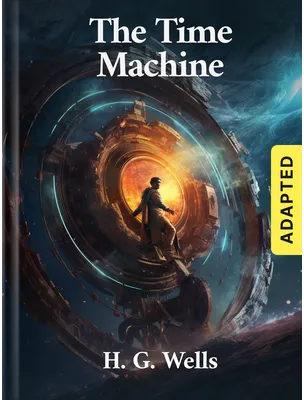
[adapted]
by
H. G. Wells

Chapter 1
Introduction
The Time Traveller was talking to us after dinner. We sat in comfortable chairs in his warm room. The fire was burning, and the lights were soft. He looked excited and serious.
“You must listen carefully,” he said. “Some ideas you learned at school are not completely right. For example, geometry.”
Filby, a man with red hair who liked to argue, said, “That sounds difficult to believe.”
The Time Traveller smiled. “I will explain. A mathematical line has no thickness. A mathematical plane has no thickness either. These things do not really exist in the real world. They are only ideas.”
The Psychologist agreed.
The Time Traveller continued, “We say that objects have three dimensions: length, breadth, and thickness. But that is not complete. Every real thing also has Duration. Duration means it exists in Time. So there are four dimensions: three of Space and one of Time.”
Some of us looked confused.
He explained more. “We move through Time from the day we are born to the day we die. We think Time is different from Space. But it is just another dimension.”
The Provincial Mayor tried to understand. Slowly, he said, “Yes… I think I see.”
The Time Traveller went on. “Look at a man at eight years old, then at fifteen, seventeen, and twenty-three. These are only parts of the same person. The whole person exists across Time.”
He showed us a simple example. “Look at this weather chart. The line shows how air pressure changes. The line moves across Time. Time is like a direction.”
The Medical Man asked, “If Time is like Space, why can we not move in Time like we move in Space?”
The Time Traveller said, “Are you sure we can move freely in Space? We can move left and right, forward and back. But moving up is harder. Gravity pulls us down.”
“There are balloons,” said the Medical Man.
“Yes,” said the Time Traveller. “People learned to go up with balloons. So why can we not learn to move in Time? Our minds already move through Time. We remember the past. We imagine the future.”
“But we cannot really travel in Time,” said the Psychologist.
“That is where you are wrong,” said the Time Traveller. “I have been working on a machine.”
“To travel through Time?” asked the Very Young Man.
“Yes. A machine that can move in Space and in Time.”
Filby laughed. He did not believe him.
“I have tested it,” said the Time Traveller.
We began to imagine the possibilities.
“A historian could check past events,” said the Psychologist.
“We could learn Greek from Homer,” said the Very Young Man.
“We could go to the future and become rich,” he added.
Some of us thought the idea was crazy. Others were curious.
“Let us see this experiment,” said the Psychologist.
The Time Traveller smiled. He put his hands in his pockets and slowly left the room. We heard him walk down the hall to his laboratory.
We looked at each other. “I wonder what he will show us,” said the Psychologist. Maybe it was only a trick, we thought. Soon, the Time Traveller returned.
Chapter 2
The Machine
The Time Traveller came back into the room. In his hand, he held a small machine. It was shiny and made of metal. It was not bigger than a small clock. It had small parts of ivory and clear crystal.
He put a small table near the fire and placed the machine on it. A bright lamp shone directly on the model. The room was very well lit. We all watched carefully. It did not seem possible that he could trick us.
“This is only a model,” he said. “It is my plan for a machine that can travel through Time.”
He showed us two small levers. “If I push this lever, the machine will move into the future. If I push the other one, it will move back.”
The Medical Man looked at it closely. “It is beautifully made,” he said.
“It took me two years to build,” the Time Traveller replied.
He continued, “In a moment, the machine will disappear. It will travel through Time. Look carefully. I do not want you to think this is a trick.”
We were silent. The Psychologist was about to speak, but he stopped.
Suddenly, the Time Traveller said, “No. You press the lever.” He took the Psychologist’s hand and guided his finger to the lever.
The Psychologist pushed it. We all saw the lever move. There was no trick.
A small wind moved the lamp flame. One candle went out. The little machine began to spin. It became unclear, like a shadow. For a second, we could still see it. Then it disappeared.
The table was empty. We sat in silence. Filby swore in surprise. The Psychologist quickly looked under the table. The Time Traveller laughed and calmly began to fill his pipe.
“Are you serious?” asked the Medical Man. “Do you really believe that machine travelled through Time?”
“Yes,” said the Time Traveller. “And I have a larger machine in my laboratory. When it is finished, I will travel myself.”
“Did it go into the future or the past?” asked Filby.
“I am not sure,” said the Time Traveller.
The Psychologist thought for a moment. “If it went anywhere, maybe it went into the past,” he said.
“Why?” asked the Time Traveller.
“If it went into the future, it would still be here now. It would have to pass through this moment,” he explained.
“But if it went into the past,” I said, “we would have seen it here before.”
The Provincial Mayor said, “Those are serious problems.”
The Time Traveller shook his head. “Not really. If the machine is moving very fast through Time, we cannot see it. When something moves very fast, like a wheel or a bullet, we cannot see it clearly. It becomes almost invisible.”
The Psychologist agreed. “Yes, that makes sense. If it moves much faster than we do in Time, we cannot see it.” He moved his hand through the empty space above the table.
The Medical Man said, “It sounds possible now. But tomorrow, we may think differently.”
“Would you like to see the real Time Machine?” asked the Time Traveller.
He took the lamp and led us down a long, cold hallway to his laboratory. Inside, we saw a larger machine. It looked like the small model, but much bigger. It was made of metal, ivory, and crystal. Some parts were still unfinished. Papers with drawings lay on a table.
The Medical Man looked at him carefully. “Are you serious about this? Is this another trick?”
The Time Traveller held up the lamp. “I am completely serious. I will use this machine to explore Time.” We did not know what to think. I looked at Filby. He looked back at me and slowly winked.
Chapter 3
The Time Traveller Returns
At that time, none of us truly believed in the Time Machine. The Time Traveller was very intelligent, but sometimes too clever. We often felt he was hiding something. It was hard to trust him completely.
During the week after we saw the small machine disappear, we did not talk much about it. Still, we thought about it. I spoke with the Medical Man about the model. He had seen something similar before, but he could not explain how it worked.
The next Thursday, I went again to the Time Traveller’s house in Richmond. I arrived late. Several men were already there. The Time Traveller was not in the room.
The Medical Man looked at his watch. “It is half past seven,” he said. “He told me in this note to start dinner if he is late. He will explain when he comes.”
So we began dinner without him.
The Psychologist and I were the only ones who had seen the experiment the week before. The others listened with interest when we mentioned time travel. The Psychologist was explaining the small machine when the door slowly opened. I saw the Time Traveller first. He looked terrible.
His clothes were dirty and covered with dust. There were green stains on his sleeves. His hair was messy and seemed more grey. His face was very pale. He had a half-healed cut on his chin. He looked tired and in pain. He walked with difficulty, like a man with sore feet.
He did not speak at first. He came to the table and asked for wine. He drank it quickly. Some color came back to his face.
“What happened to you?” asked the Medical Man.
“Do not worry,” he said slowly. “I am all right. I will wash and change my clothes. Then I will come back and explain. Please save me some meat. I am very hungry.”
As he walked out, I saw that he wore only old, torn socks on his feet. They were stained with blood. For a moment, we did not know what to say.
The Editor began to joke. Some of the others laughed and did not believe the story about time travel. They thought it was nonsense.
Soon the Time Traveller returned. Now he wore clean evening clothes. Only his tired face showed that something unusual had happened.
“Tell us the story!” said the Editor with a laugh.
“First I need food,” said the Time Traveller. “I will not speak until I eat.”
“Have you been time travelling?” I asked.
“Yes,” he said, while eating.
The dinner felt strange and uncomfortable. He ate like a very hungry man. The others watched him closely. At last, he finished his meal. “I must apologize,” he said. “I was starving. I have had an amazing experience.”
He stood up. “Let us go to the smoking-room. It is too long a story to tell here.” We followed him.
He sat down and looked at us. “I will tell you everything,” he said. “But do not interrupt me. Much of it will sound impossible. Still, it is true. Since four o’clock today, I have lived eight days. I am very tired, but I will not sleep until I tell you what happened. Do you agree not to interrupt?” We all agreed.
He leaned back in his chair and began his story. At first, he spoke like a tired man. Then, slowly, he became more alive and serious. We stopped looking at each other and watched only his face as he spoke.
Chapter 4
Time Travelling
The Time Traveller began his story.
“I told you about the Time Machine last week. This morning at ten o’clock, it was finally ready. I checked every screw and put oil on the parts. Then I sat on the seat.
“I felt nervous, like a man before doing something very dangerous. I held the starting lever in one hand and the stopping lever in the other. I pushed the first lever, and then quickly the second.
“At first, nothing seemed different. The laboratory looked the same. I thought maybe nothing had happened. Then I looked at the clock. Before, it was just after ten. Now it was half past three. So I pushed the lever again, harder this time.
“The room became unclear and dark. The housekeeper came into the room, but she moved very fast, like a flash. Then night came suddenly. After that, day and night changed again and again, faster and faster. I cannot fully describe the feeling. It was very unpleasant. I felt like I was falling very fast. I was afraid I would crash.
“The sun moved quickly across the sky. Days passed in seconds. The moon changed shape again and again. Soon, day and night mixed together into a grey light. The sky became deep blue. The sun looked like a long line of fire.
“The landscape changed before my eyes. Trees grew and disappeared like smoke. Great buildings rose up and then vanished. Snow covered the earth and then melted. Spring came and went in moments. I was moving forward more than a year every minute.