'Ligeia' was first published in 1838 in a collection called 'Tales of the Grotesque and Arabesque'.
[{"id":"para_1","index":0,"start":0,"offset":324,"words":1,"paraNum":"","lastModified":1764755423000,"semanticType":"title-book-title","voicework":"tts","blockId":"ligeia_short_story_ffa_1_en-bl2s","language":"en","wordsRange":{"start":100000000,"end":102000000},"paragraphVersion":38,"direction":"ltr","paragraph":"<h1 class=\"ilm-title ilm-x-large\" id=\"para_1\" semantictype=\"title-book-title\" data-ilmid=\"ligeia_short_story_ffa_1_en-bl2s\" data-audio=\"1\" data-chapter=\"para_1\" data-words-count=\"1\" data-before=\"0\" data-ww=\"\"><span class=\"block-pb\"> <span class=\"block-pb is-animated\"></span> </span><span class=\"itm-wrap\">Ligeia</span></h1>","hasContent":true,"isFirst":true,"isLast":false},{"id":"para_2","index":1,"start":324,"offset":326,"words":1,"paraNum":"","lastModified":1764755454000,"semanticType":"title-subtitle","voicework":"tts","blockId":"ligeia_short_story_ffa_1_en-bl4e","language":"en","wordsRange":{"start":135333333,"end":168666667},"paragraphVersion":29,"direction":"ltr","paragraph":"<h1 class=\"ilm-title ilm-subtitle\" id=\"para_2\" semantictype=\"title-subtitle\" data-ilmid=\"ligeia_short_story_ffa_1_en-bl4e\" data-audio=\"1\" data-chapter=\"para_2\" data-words-count=\"1\" data-before=\"1\" data-ww=\"\"><span class=\"block-pb\"> <span class=\"block-pb is-animated\"></span> </span><span class=\"itm-wrap\">[adapted]</span></h1>","hasContent":true,"isFirst":false,"isLast":false},{"id":"para_3","index":2,"start":650,"offset":355,"words":3,"paraNum":"","lastModified":1764755580000,"semanticType":"title-author","voicework":"tts","blockId":"ligeia_short_story_ffa_1_en-bl2t","language":"en","wordsRange":{"start":202000000,"end":207000000},"paragraphVersion":50,"direction":"ltr","paragraph":"<h1 class=\"ilm-title ilm-author ilm-large ilm-nopad\" id=\"para_3\" semantictype=\"title-author\" data-ilmid=\"ligeia_short_story_ffa_1_en-bl2t\" data-audio=\"1\" data-chapter=\"para_3\" data-words-count=\"3\" data-before=\"2\" data-ww=\"\"><span class=\"block-pb\"> <span class=\"block-pb is-animated\"></span> </span><span class=\"itm-wrap\">by <br>Edgar Allan Poe</span></h1>","hasContent":true,"isFirst":false,"isLast":false},{"id":"para_4","index":3,"start":1005,"offset":155,"words":0,"paraNum":"","lastModified":1710761620000,"semanticType":"line","blockId":"ligeia_short_story_ffa_1_en-bl2u","language":"en","wordsRange":{"start":307000000,"end":407000000},"paragraphVersion":29,"direction":"ltr","paragraph":"<hr class=\"ilm-hr ilm-small\" id=\"para_4\" semantictype=\"line\" data-ilmid=\"ligeia_short_story_ffa_1_en-bl2u\" data-words-count=\"0\" data-before=\"5\" data-ww=\"\">","hasContent":true,"isFirst":false,"isLast":false},{"id":"para_5","index":4,"start":1160,"offset":1566,"words":0,"paraNum":"","lastModified":1710316807000,"semanticType":"illustration","blockId":"ligeia_short_story_ffa_1_en-bl2v","language":"en","wordsRange":{"start":507000000,"end":607000000},"paragraphVersion":29,"direction":"ltr","paragraph":"<div class=\"ilm-illustration\" id=\"para_5\" semantictype=\"illustration\" data-ilmid=\"ligeia_short_story_ffa_1_en-bl2v\" data-words-count=\"0\" data-before=\"5\" data-ww=\"\"><img width=\"600\" height=\"343\" data-src=\"ch0p0\" src=\"data:image/webp;base64,UklGRsIDAABXRUJQVlA4ILYDAADQEACdASo8ACIAPm0skUYkIqGhKqwAgA2JYwC+e/cGeELvrnnbuAgUDOt694+rRf+b8YLoG+BxC97DMo/xn/A9VTOp9YewUaHDVo6uUEPXBWBtUgYdsNPqUEhzllapwnn5fu2GRP/bdvsCS/xESv6RO8ZST4PXVLXEBdo9ck4RgKtKRNfq/jWo87LDjLxLgAD+/pnO5Bx7LrE1i791/umZPdg09fF/3PieYxQa6vsVut+cWEHQYf7zrsmpnMz+ztxtbeY8CV5xUR5PpD0qNgFP7qAyGYbH0ypdYHLVRrzbeDA+Kkqo6NeguxDBx4n7spdiij0tbGn+6j879kVjcowMUoIH3sV8TtEHuzRbdDxyfxS1o0rlAS6/PlZt4USeVTQNmh+eYvXP4PI1DHj2dPPWl89uY+/jiz2VZFtq0csQkJQJqaAnHNC9KEgmRtLxREXeV2KLwVvx9BGFGoYU3GJNqP7zr30ICZJYzrE08XgDsFp8RRjrnS63o7aeYLileGCGIONtXqEwjuSzTLPsaRybI7NVslbd2P4XUBTKUCzrg5B0uqZZ+hfBNtbkvc/Nswuz0MN4peOOHpv3f+J+ZOpwKwjtcPL1BryfqY9QszAraxpJk4nqkO3fzM1J6soVuiZtkLkt1Gaft97mAB1xn+CEs2dzJSepyd1gHvzgnUu9PUz8LcUltYGLNd24L93Vt/sdn+7FOI6RglzzI4axEP9CIHg3GA0tT1zkSmx/yolISdvw6slRyQXAurSq1+XuAWsaG0ELIlIk0vlAfnZWPNBNOLB8bEVHUrJNbm8JNh7a5U8n0clmNejH50iVKqrtpptNfztiX9i+IDUUD4IPmYMeQLn7UWNXmoNDn3UMY0dpFgVdRvaOa4xveINR1rQS7KZoMw1oxOGeHH+/u6T1qCuriOsio4qPsowEnX/AGDO/Ja1K/dnKBPc7ZkiKA9SqRNWE3zFTo6cLrN93tDI1i0DzHk9RBAXmM+8cUQYnYAr7EbzY/vNu9qXTiVeWq4QEfzhJkRqNZiSa2xlnK7aKUVMwNZ+nd0Wy3u5hUF4tOW1pcmVoeCUKd6pHC8Hsi8kUA03O7z3NArJt/iY4bPvbsMbK5uKmNegt3e+docmgzlb8inVWWcj699p8Xx//Uc+DCKW1k639U8om9rwe19/L0P94LMXfhDpnLra0pxrpgVgmtbkUoBNuP5zor94d4/kHhPt210/u21bP8/2M3ESVKR9Zioj1pQ1G13Llh32/1Bw3AAwXAAAAAA==\" alt=\"Ligeia (adapted)\"></div>","hasContent":true,"isFirst":false,"isLast":false},{"id":"para_6","index":5,"start":2726,"offset":566,"words":55,"paraNum":"","lastModified":1764754549000,"semanticType":"par","voicework":"tts","blockId":"ligeia_short_story_ffa_1_en-bl2w","language":"en","wordsRange":{"start":707000000,"end":762000000},"paragraphVersion":40,"direction":"ltr","paragraph":"<p class=\"ilm-blockquote\" id=\"para_6\" semantictype=\"par\" data-ilmid=\"ligeia_short_story_ffa_1_en-bl2w\" data-audio=\"1\" data-words-count=\"55\" data-before=\"5\" data-ww=\"\"><span class=\"block-pb\"> <span class=\"block-pb is-animated\"></span> </span><span class=\"itm-wrap\">And the will lies there, which does not die. Who knows the secrets of the will, with its strength? For God is only a great will, filling all things because of its strong aim. Man does not give himself to the angels, nor to death completely, except only through the weakness of his weak will.</span></p>","hasContent":true,"isFirst":false,"isLast":false},{"id":"para_7","index":6,"start":3292,"offset":314,"words":2,"paraNum":"","lastModified":1764755439000,"semanticType":"par","voicework":"tts","blockId":"ligeia_short_story_ffa_1_en-bl2x","language":"en","wordsRange":{"start":862000000,"end":865000000},"paragraphVersion":41,"direction":"ltr","paragraph":"<p class=\"ilm-right ilm-signature\" id=\"para_7\" semantictype=\"par\" data-ilmid=\"ligeia_short_story_ffa_1_en-bl2x\" data-audio=\"1\" data-words-count=\"2\" data-before=\"60\" data-ww=\"\"><span class=\"block-pb\"> <span class=\"block-pb is-animated\"></span> </span><span class=\"itm-wrap\"><i>Joseph </i><i>Glanvill.</i></span></p>","hasContent":true,"isFirst":false,"isLast":false},{"id":"para_8","index":7,"start":3606,"offset":1251,"words":177,"paraNum":"1","lastModified":1764755342000,"semanticType":"par","voicework":"tts","blockId":"ligeia_short_story_ffa_1_en-bl2y","language":"en","wordsRange":{"start":965000000,"end":1143000000},"paragraphVersion":44,"direction":"ltr","paragraph":"<p id=\"para_8\" semantictype=\"par\" data-ilmid=\"ligeia_short_story_ffa_1_en-bl2y\" data-audio=\"1\" data-words-count=\"177\" data-before=\"62\" data-ww=\"\"><span class=\"block-num\" data-id=\"1\"></span><span class=\"block-pb\"> <span class=\"block-pb is-animated\"></span> </span><span class=\"itm-wrap\">I cannot, for my life, remember how, when, or even exactly where, I first met the lady Ligeia. Many years have since passed, and my memory is weak because of much suffering. Or, maybe, I cannot now remember these things, because, in fact, the character of my beloved, her great learning, her unusual yet calm kind of beauty, and the exciting and charming beauty of her low, musical way of speaking, made their way into my heart by steps so steady and quiet, that they have gone unnoticed and unknown. Yet I believe that I met her first and most often in some large, old, falling-apart city near the Rhine. About her family—I have surely heard her speak. That it is from a very ancient time cannot be doubted. Ligeia! Ligeia! Buried in studies of a kind more than anything else made to dull the feelings of the outside world, it is by that sweet word alone—by Ligeia—that I bring before my eyes in imagination the image of her who is no longer here.</span></p>","hasContent":true,"isFirst":false,"isLast":false},{"id":"para_9","index":8,"start":4857,"offset":1103,"words":153,"paraNum":"2","lastModified":1764755539000,"semanticType":"par","voicework":"tts","blockId":"ligeia_short_story_ffa_1_en-bl3m","language":"en","wordsRange":{"start":1243000000,"end":1394000000},"paragraphVersion":44,"direction":"ltr","paragraph":"<p id=\"para_9\" semantictype=\"par\" data-ilmid=\"ligeia_short_story_ffa_1_en-bl3m\" data-audio=\"1\" data-words-count=\"153\" data-before=\"239\" data-ww=\"\"><span class=\"block-num\" data-id=\"2\"></span><span class=\"block-pb\"> <span class=\"block-pb is-animated\"></span> </span><span class=\"itm-wrap\">And now, while I write, a memory suddenly comes to me that I have never known the father’s name of her who was my friend and my promised bride, and who became the partner of my studies, and finally the wife of my heart. Was it a playful request from my Ligeia? or was it a test of how strong my love was, that I should ask no questions about this point? or was it rather a whim of my own—a wildly romantic offering at the altar of the deepest love? I only dimly remember the fact itself—no wonder that I have completely forgotten the events which began it or went with it? And, indeed, if ever that spirit who is called Romance—if ever she, the pale and the misty-winged Ashtophet of Egypt that worshiped idols, watched, as they say, over unlucky marriages, then most surely she watched over mine.</span></p>","hasContent":true,"isFirst":false,"isLast":false},{"id":"para_10","index":9,"start":5960,"offset":1013,"words":136,"paraNum":"3","lastModified":1764755569000,"semanticType":"par","voicework":"tts","blockId":"ligeia_short_story_ffa_1_en-bl2z","language":"en","wordsRange":{"start":1494000000,"end":1627333333},"paragraphVersion":52,"direction":"ltr","paragraph":"<p id=\"para_10\" semantictype=\"par\" data-ilmid=\"ligeia_short_story_ffa_1_en-bl2z\" data-audio=\"1\" data-words-count=\"136\" data-before=\"392\" data-ww=\"\"><span class=\"block-num\" data-id=\"3\"></span><span class=\"block-pb\"> <span class=\"block-pb is-animated\"></span> </span><span class=\"itm-wrap\">There is one dear topic, however, on which my memory does not fail me. It is the person of Ligeia. In height she was tall, somewhat thin, and, in her later days, even very thin. I would try in vain to describe the greatness, the quiet ease, of her way, or the hard-to-understand lightness and spring of her step. She came and left like a shadow. I never knew when she came into my closed study, except by the dear music of her low sweet voice, as she put her cold white hand upon my shoulder. In beauty of face no young woman ever equaled her. It was the glow of an opium dream— a light and spirit-lifting vision more wildly holy than the dreams which floated around the sleeping souls of the daughters of Delos.</span></p>","hasContent":true,"isFirst":false,"isLast":false},{"id":"para_11","index":10,"start":6973,"offset":942,"words":110,"paraNum":"4","lastModified":1764756319000,"semanticType":"par","voicework":"tts","blockId":"ligeia_short_story_ffa_1_en-bl3v","language":"en","wordsRange":{"start":1627666667,"end":1731000000},"paragraphVersion":50,"direction":"ltr","paragraph":"<p id=\"para_11\" semantictype=\"par\" data-ilmid=\"ligeia_short_story_ffa_1_en-bl3v\" data-audio=\"1\" data-words-count=\"110\" data-before=\"528\" data-ww=\"\"><span class=\"block-num\" data-id=\"4\"></span><span class=\"block-pb\"> <span class=\"block-pb is-animated\"></span> </span><span class=\"itm-wrap\">Yet her features were not of that regular pattern which we have been wrongly taught to admire in the classical works of the ancient people. “There is no great beauty,” says Bacon, Lord Verulam, speaking truly of all the <i>kinds</i> of beauty, “without some <i>strangeness</i> in how the parts fit together.” Yet, although I saw that the features of Ligeia were not regular in the classic way—although I felt that her beauty was indeed “great,” and felt that there was much of “strangeness” in it, yet I have tried without success to find what was not regular and to find where my own feeling of “the strange” came from.</span></p>","hasContent":true,"isFirst":false,"isLast":false},{"id":"para_12","index":11,"start":7915,"offset":961,"words":119,"paraNum":"5","lastModified":1764755478000,"semanticType":"par","voicework":"tts","blockId":"ligeia_short_story_ffa_1_en-bl3n","language":"en","wordsRange":{"start":1831000000,"end":1947333333},"paragraphVersion":51,"direction":"ltr","paragraph":"<p id=\"para_12\" semantictype=\"par\" data-ilmid=\"ligeia_short_story_ffa_1_en-bl3n\" data-audio=\"1\" data-words-count=\"119\" data-before=\"638\" data-ww=\"\"><span class=\"block-num\" data-id=\"5\"></span><span class=\"block-pb\"> <span class=\"block-pb is-animated\"></span> </span><span class=\"itm-wrap\">I looked at the shape of the high and pale forehead—it was perfect—how cold that word really is when used for a beauty so divine!—the skin like the purest ivory, the great size and calm, the gentle rise of the parts above the temples; and then the very black, the shiny, the rich and naturally curling hair, showing the full force of the word from Homer, “hyacinthine!” I looked at the fine lines of the nose—and only in the beautiful medals of the Hebrews had I seen a similar perfection. There were the same very smooth surface, the same hardly noticeable bend toward the eagle-like shape, the same smoothly curved nostrils showing the free spirit.</span></p>","hasContent":true,"isFirst":false,"isLast":false},{"id":"para_13","index":12,"start":8876,"offset":993,"words":130,"paraNum":"6","lastModified":1764755492000,"semanticType":"par","voicework":"tts","blockId":"ligeia_short_story_ffa_1_en-bl3w","language":"en","wordsRange":{"start":1947666667,"end":2074000000},"paragraphVersion":40,"direction":"ltr","paragraph":"<p id=\"para_13\" semantictype=\"par\" data-ilmid=\"ligeia_short_story_ffa_1_en-bl3w\" data-audio=\"1\" data-words-count=\"130\" data-before=\"757\" data-ww=\"\"><span class=\"block-num\" data-id=\"6\"></span><span class=\"block-pb\"> <span class=\"block-pb is-animated\"></span> </span><span class=\"itm-wrap\">I looked at the sweet mouth. Here was truly the victory of all things from heaven—the beautiful curve of the short upper lip—the soft, full sleep of the lower lip—the dimples that played, and the color that spoke—the teeth shining back, with a brightness almost shocking, every ray of the holy light that fell on them in her calm and quiet, yet most joyfully bright of all smiles. I looked closely at the shape of the chin—and here, too, I found the gentle width, the softness and the greatness, the fullness and the spirit, of the Greek—the outline which the god Apollo showed only in a dream, to Cleomenes, the son of the Athenian. And then I looked into the large eyes of Ligeia.</span></p>","hasContent":true,"isFirst":false,"isLast":false},{"id":"para_14","index":13,"start":9869,"offset":1111,"words":154,"paraNum":"7","lastModified":1764755555000,"semanticType":"par","voicework":"tts","blockId":"ligeia_short_story_ffa_1_en-bl30","language":"en","wordsRange":{"start":2174000000,"end":2325333333},"paragraphVersion":53,"direction":"ltr","paragraph":"<p id=\"para_14\" semantictype=\"par\" data-ilmid=\"ligeia_short_story_ffa_1_en-bl30\" data-audio=\"1\" data-words-count=\"154\" data-before=\"887\" data-ww=\"\"><span class=\"block-num\" data-id=\"7\"></span><span class=\"block-pb\"> <span class=\"block-pb is-animated\"></span> </span><span class=\"itm-wrap\">For eyes we have no examples in the very old times. It may also be that the secret that Lord Verulam mentions was in the eyes of my beloved. They were, I must believe, much larger than the usual eyes of our own people. They were even fuller than the fullest of the gazelle eyes of the tribe of the valley of Nourjahad. Yet it was only at times—in moments of great excitement—that this special quality became more than a little clear to see in Ligeia. And at such moments was her beauty—in my hot imagination thus it seemed perhaps—the beauty of beings either above or apart from the earth—the beauty of the famous Houri of the Turk. The color of the eyes was the brightest black, and, far over them, hung jet-black lashes that were very long. The eyebrows, a little uneven in shape, had the same color.</span></p>","hasContent":true,"isFirst":false,"isLast":false},{"id":"para_15","index":14,"start":10980,"offset":1092,"words":146,"paraNum":"8","lastModified":1764758841000,"semanticType":"par","voicework":"tts","blockId":"ligeia_short_story_ffa_1_en-bl3x","language":"en","wordsRange":{"start":2325666667,"end":2469000000},"paragraphVersion":42,"direction":"ltr","paragraph":"<p id=\"para_15\" semantictype=\"par\" data-ilmid=\"ligeia_short_story_ffa_1_en-bl3x\" data-audio=\"1\" data-words-count=\"146\" data-before=\"1041\" data-ww=\"\"><span class=\"block-num\" data-id=\"8\"></span><span class=\"block-pb\"> <span class=\"block-pb is-animated\"></span> </span><span class=\"itm-wrap\">The “strangeness,” however, which I found in the eyes, was something different from the shape, or the color, or the brightness of the face, and must, after all, come from the <i>expression.</i> Ah, a word with no meaning! behind whose wide space of mere sound we hide how little we know of so much of the spirit. The expression of the eyes of Ligeia! How for long hours have I thought about it! How have I, through the whole of a midsummer night, tried to understand it! What was it—that something deeper than the well of Democritus—which lay far within the pupils of my beloved? What was it? I was filled with a strong desire to find out. Those eyes! those large, those shining, those holy eyes! they became to me twin stars of Leda, and I to them the most faithful of star-watchers.</span></p>","hasContent":true,"isFirst":false,"isLast":false},{"id":"para_16","index":15,"start":12072,"offset":969,"words":116,"paraNum":"9","lastModified":1764758866000,"semanticType":"par","voicework":"tts","blockId":"ligeia_short_story_ffa_1_en-bl31","language":"en","wordsRange":{"start":2569000000,"end":2683333333},"paragraphVersion":58,"direction":"ltr","paragraph":"<p id=\"para_16\" semantictype=\"par\" data-ilmid=\"ligeia_short_story_ffa_1_en-bl31\" data-audio=\"1\" data-words-count=\"116\" data-before=\"1187\" data-ww=\"\"><span class=\"block-num\" data-id=\"9\"></span><span class=\"block-pb\"> <span class=\"block-pb is-animated\"></span> </span><span class=\"itm-wrap\">There is no point, among the many hard-to-understand strange things of the study of the mind, more exciting than the fact—never, I believe, taught in schools—that, in our tries to remember something long forgotten, we often find ourselves <i>on </i><i>the </i><i>very </i><i>edge</i> of remembering, but in the end not able to remember. And thus how often, in my careful look at Ligeia’s eyes, have I felt the full meaning of their look coming near—felt it coming near—yet not quite be mine—and so at last go away completely! And (strange, oh strangest mystery of all!) I found, in the most common things in the world, a circle of similarities to that look.</span></p>","hasContent":true,"isFirst":false,"isLast":false},{"id":"para_17","index":16,"start":13041,"offset":905,"words":120,"paraNum":"10","lastModified":1764756032000,"semanticType":"par","voicework":"tts","blockId":"ligeia_short_story_ffa_1_en-bl3y","language":"en","wordsRange":{"start":2683666667,"end":2800000000},"paragraphVersion":38,"direction":"ltr","paragraph":"<p id=\"para_17\" semantictype=\"par\" data-ilmid=\"ligeia_short_story_ffa_1_en-bl3y\" data-audio=\"1\" data-words-count=\"120\" data-before=\"1303\" data-ww=\"\"><span class=\"block-num\" data-id=\"10\"></span><span class=\"block-pb\"> <span class=\"block-pb is-animated\"></span> </span><span class=\"itm-wrap\">I mean to say that, after the time when Ligeia’s beauty entered my spirit, living there as in a holy place, I got, from many things in the real world, a feeling like the one I always felt around me and inside me, from her large and bright eyes. Yet I still could not describe that feeling, or explain it, or even see it clearly. I recognized it, let me repeat, sometimes in the looking at a quickly growing vine—in the watching of a moth, a butterfly, a cocoon, a stream of running water. I have felt it in the ocean; in the falling of a shooting star. I have felt it in the looks of very old people.</span></p>","hasContent":true,"isFirst":false,"isLast":false},{"id":"para_18","index":17,"start":13946,"offset":1079,"words":146,"paraNum":"11","lastModified":1764756231000,"semanticType":"par","voicework":"tts","blockId":"ligeia_short_story_ffa_1_en-bl3o","language":"en","wordsRange":{"start":2900000000,"end":3048000000},"paragraphVersion":53,"direction":"ltr","paragraph":"<p id=\"para_18\" semantictype=\"par\" data-ilmid=\"ligeia_short_story_ffa_1_en-bl3o\" data-audio=\"1\" data-words-count=\"146\" data-before=\"1423\" data-ww=\"\"><span class=\"block-num\" data-id=\"11\"></span><span class=\"block-pb\"> <span class=\"block-pb is-animated\"></span> </span><span class=\"itm-wrap\">And there are one or two stars in the sky—(one especially, a star of the sixth brightness, double and changing, found near the large star in Lyra,) when I look at it with a telescope, I have felt it. I have been filled with it by some sounds from stringed instruments, and often by parts of books. Among many other times, I well remember something in a book of Joseph Glanvill, which (perhaps only from its old style—who can say?) never failed to give me the feeling: “And the will lies there, which does not die. Who knows the mysteries of the will, with its strength? For God is only a great will filling all things by the nature of its strong focus. Man does not give himself to the angels, nor to death completely, except only through the weakness of his weak will.”</span></p>","hasContent":true,"isFirst":false,"isLast":false},{"id":"para_19","index":18,"start":15025,"offset":1175,"words":162,"paraNum":"12","lastModified":1764756216000,"semanticType":"par","voicework":"tts","blockId":"ligeia_short_story_ffa_1_en-bl32","language":"en","wordsRange":{"start":3148000000,"end":3308000000},"paragraphVersion":52,"direction":"ltr","paragraph":"<p id=\"para_19\" semantictype=\"par\" data-ilmid=\"ligeia_short_story_ffa_1_en-bl32\" data-audio=\"1\" data-words-count=\"162\" data-before=\"1569\" data-ww=\"\"><span class=\"block-num\" data-id=\"12\"></span><span class=\"block-pb\"> <span class=\"block-pb is-animated\"></span> </span><span class=\"itm-wrap\">Many years, and later thinking, have let me find, indeed, some distant link between this passage in the English moral writer and a part of the character of Ligeia. A strong force in thought, action, or speech, was perhaps, in her, a result, or at least a sign, of that huge will which, during our long time together, did not give other and more direct proof of its existence. Of all the women whom I have ever known, she, the calm on the outside, the always calm Ligeia, was the most strongly a victim of the wild vultures of harsh passion. And of such passion I could not judge, except by the wonderful widening of those eyes which at once so pleased and scared me—by the almost magical music, change, clearness, and calm of her very low voice—and by the fierce energy (made doubly strong by contrast with her way of speaking,) of the wild words which she usually said.</span></p>","hasContent":true,"isFirst":false,"isLast":false},{"id":"para_20","index":19,"start":16200,"offset":993,"words":131,"paraNum":"13","lastModified":1764758883000,"semanticType":"par","voicework":"tts","blockId":"ligeia_short_story_ffa_1_en-bl33","language":"en","wordsRange":{"start":3408000000,"end":3542333333},"paragraphVersion":58,"direction":"ltr","paragraph":"<p id=\"para_20\" semantictype=\"par\" data-ilmid=\"ligeia_short_story_ffa_1_en-bl33\" data-audio=\"1\" data-words-count=\"131\" data-before=\"1731\" data-ww=\"\"><span class=\"block-num\" data-id=\"13\"></span><span class=\"block-pb\"> <span class=\"block-pb is-animated\"></span> </span><span class=\"itm-wrap\">I have spoken of the knowledge of Ligeia: it was very great—such as I have never known in a woman. She was very skilled in the classical languages, and as far as I knew the modern languages of Europe, I never found her wrong. Indeed, on any subject of the most admired, because simply the most difficult, of the praised learning of the school, have I ever found Ligeia wrong? How strange—how thrilling, this one point in my wife’s nature has made me notice it, only at this late time! I said her knowledge was such as I have never known in a woman—but where lives the man who has gone through, and successfully, <i>all</i> the wide fields of moral, physical, and mathematical science?</span></p>","hasContent":true,"isFirst":false,"isLast":false},{"id":"para_21","index":20,"start":17193,"offset":989,"words":131,"paraNum":"14","lastModified":1764758960000,"semanticType":"par","voicework":"tts","blockId":"ligeia_short_story_ffa_1_en-bl3z","language":"en","wordsRange":{"start":3542666667,"end":3673000000},"paragraphVersion":40,"direction":"ltr","paragraph":"<p id=\"para_21\" semantictype=\"par\" data-ilmid=\"ligeia_short_story_ffa_1_en-bl3z\" data-audio=\"1\" data-words-count=\"131\" data-before=\"1862\" data-ww=\"\"><span class=\"block-num\" data-id=\"14\"></span><span class=\"block-pb\"> <span class=\"block-pb is-animated\"></span> </span><span class=\"itm-wrap\">I did not see then what I now clearly see, that the learning of Ligeia was huge, was amazing; yet I knew enough of her very great skill to let her guide me, with child-like trust, through the confusing world of deep ideas and study at which I was very busy during the earlier years of our marriage. With how great a victory—with how bright a delight—with how much of all that is light in hope—did I <i>feel,</i> as she leaned over me in studies that few people wanted—still fewer knew—that lovely view slowly opening before me, down whose long, beautiful, and never used path, I might at last pass onward to the goal of a wisdom so heavenly precious that it had to be forbidden!</span></p>","hasContent":true,"isFirst":false,"isLast":false},{"id":"para_22","index":21,"start":18182,"offset":1200,"words":168,"paraNum":"15","lastModified":1764756053000,"semanticType":"par","voicework":"tts","blockId":"ligeia_short_story_ffa_1_en-bl34","language":"en","wordsRange":{"start":3773000000,"end":3938000000},"paragraphVersion":55,"direction":"ltr","paragraph":"<p id=\"para_22\" semantictype=\"par\" data-ilmid=\"ligeia_short_story_ffa_1_en-bl34\" data-audio=\"1\" data-words-count=\"168\" data-before=\"1993\" data-ww=\"\"><span class=\"block-num\" data-id=\"15\"></span><span class=\"block-pb\"> <span class=\"block-pb is-animated\"></span> </span><span class=\"itm-wrap\">How strong, then, must have been the sadness with which, after some years, I saw my good hopes grow wings and fly away! Without Ligeia I was only like a child feeling in the dark. Her presence, her readings alone, made very bright and clear the many mysteries of the deep ideas in which we lived. Without the bright shine of her eyes, letters, softly shining and golden, became duller than heavy lead. And now those eyes shone less and less often upon the pages over which I looked closely. Ligeia grew ill. The wild eyes burned with a too—too bright light; the pale fingers took on the clear, wax-like color of the grave; and the blue veins on the high forehead rose and fell quickly with the waves of the most gentle feeling. I saw that she must die—and I struggled very hard in spirit with the dark Azrael. And the struggles of the loving wife were, to my surprise, even stronger than my own.</span></p>","hasContent":true,"isFirst":false,"isLast":false},{"id":"para_23","index":22,"start":19382,"offset":1118,"words":154,"paraNum":"16","lastModified":1764758991000,"semanticType":"par","voicework":"tts","blockId":"ligeia_short_story_ffa_1_en-bl3p","language":"en","wordsRange":{"start":4038000000,"end":4196000000},"paragraphVersion":57,"direction":"ltr","paragraph":"<p id=\"para_23\" semantictype=\"par\" data-ilmid=\"ligeia_short_story_ffa_1_en-bl3p\" data-audio=\"1\" data-words-count=\"154\" data-before=\"2161\" data-ww=\"\"><span class=\"block-num\" data-id=\"16\"></span><span class=\"block-pb\"> <span class=\"block-pb is-animated\"></span> </span><span class=\"itm-wrap\">There had been much in her strict nature to make me believe that, to her, death would have come without its fears; but not so. Words cannot give any true idea of how strongly she fought the Shadow. I groaned in pain at the sad sight. I would have tried to calm—I would have tried to reason; but, in the strength of her wild desire for life—for life—<i>but</i> for life—comfort and reason were both the greatest foolishness. Yet not until the last moment, in the middle of the hardest struggles of her wild spirit, was the outer calm of her manner shaken. Her voice grew more gentle—grew more low—yet I would not wish to talk about the strange meaning of the quietly spoken words. My brain spun as I listened, amazed, to a music more than human—to ideas and hopes which human life had never before known.</span></p>","hasContent":true,"isFirst":false,"isLast":false},{"id":"para_24","index":23,"start":20500,"offset":1290,"words":199,"paraNum":"17","lastModified":1764756248000,"semanticType":"par","voicework":"tts","blockId":"ligeia_short_story_ffa_1_en-bl35","language":"en","wordsRange":{"start":4296000000,"end":4481000000},"paragraphVersion":54,"direction":"ltr","paragraph":"<p id=\"para_24\" semantictype=\"par\" data-ilmid=\"ligeia_short_story_ffa_1_en-bl35\" data-audio=\"1\" data-words-count=\"199\" data-before=\"2315\" data-ww=\"\"><span class=\"block-num\" data-id=\"17\"></span><span class=\"block-pb\"> <span class=\"block-pb is-animated\"></span> </span><span class=\"itm-wrap\">That she loved me I should not have had any doubt; and I might easily have known that, in a heart like hers, love would have been no ordinary feeling. But only in death was I fully aware of the strength of her love. For long hours, holding my hand, she would pour out before me the overflow of a heart whose more than passionate love was like worship. How had I deserved to be so blessed by such true words?—how had I deserved to be so cursed with the taking away of the one I loved in the hour when she made them? But on this subject I cannot bear to talk much. Let me say only, that in Ligeia’s more than womanly giving up of herself to a love, alas! all not deserved, all given to me though I was not worthy, I at last understood the reason of her longing, with such a wildly strong desire, for the life that was now going away so fast. It is this wild longing—it is this eager force of desire for life—but for life—that I have no power to describe—no words able to express.</span></p>","hasContent":true,"isFirst":false,"isLast":false},{"id":"para_25","index":24,"start":21790,"offset":490,"words":37,"paraNum":"18","lastModified":1764755815000,"semanticType":"par","voicework":"tts","blockId":"ligeia_short_story_ffa_1_en-bl36","language":"en","wordsRange":{"start":4581000000,"end":4617000000},"paragraphVersion":57,"direction":"ltr","paragraph":"<p id=\"para_25\" semantictype=\"par\" data-ilmid=\"ligeia_short_story_ffa_1_en-bl36\" data-audio=\"1\" data-words-count=\"37\" data-before=\"2514\" data-ww=\"\"><span class=\"block-num\" data-id=\"18\"></span><span class=\"block-pb\"> <span class=\"block-pb is-animated\"></span> </span><span class=\"itm-wrap\">At midnight of the night when she left, calling me, firmly, to her side, she told me to repeat some lines of a poem written by herself not many days before. I obeyed her. They were these:—</span></p>","hasContent":true,"isFirst":false,"isLast":false},{"id":"para_26","index":25,"start":22280,"offset":599,"words":50,"paraNum":"19","lastModified":1764928316000,"semanticType":"par","voicework":"tts","blockId":"ligeia_short_story_ffa_1_en-bl37","language":"en","wordsRange":{"start":4717000000,"end":4760333333},"paragraphVersion":89,"direction":"ltr","paragraph":"<p class=\"ilm-center ilm-verse\" id=\"para_26\" semantictype=\"par\" data-ilmid=\"ligeia_short_story_ffa_1_en-bl37\" data-audio=\"1\" data-words-count=\"50\" data-before=\"2551\" data-ww=\"\"><span class=\"block-num\" data-id=\"19\"></span><span class=\"block-pb\"> <span class=\"block-pb is-animated\"></span> </span><span class=\"itm-wrap\">Look! it is a big party night<br>In the lonely later years!<br>A crowd of angels, with wings, dressed bright<br>In veils, and drowned in tears,<br>Sit in a theater, to see<br>A play of hopes and fears,<br>While the band breathes in short beats<br>The music of the years.</span></p>","hasContent":true,"isFirst":false,"isLast":false},{"id":"para_27","index":26,"start":22879,"offset":596,"words":47,"paraNum":"20","lastModified":1765149737000,"semanticType":"par","voicework":"tts","blockId":"ligeia_short_story_ffa_1_en-bl40","language":"en","wordsRange":{"start":4760666667,"end":4805333333},"paragraphVersion":72,"direction":"ltr","paragraph":"<p class=\"ilm-center ilm-verse\" id=\"para_27\" semantictype=\"par\" data-ilmid=\"ligeia_short_story_ffa_1_en-bl40\" data-audio=\"1\" data-words-count=\"47\" data-before=\"2601\" data-ww=\"\"><span class=\"block-num\" data-id=\"20\"></span><span class=\"block-pb\"> <span class=\"block-pb is-animated\"></span> </span><span class=\"itm-wrap\">Mimes, in the shape of God on high,<br>Mutter and mumble low,<br>And here and there they fly;<br>They are just puppets, who come and go<br>At the orders of great shapeless things<br>That move the scenes to and fro,<br>Flapping from their condor wings<br>Invisible Wo!</span></p>","hasContent":true,"isFirst":false,"isLast":false},{"id":"para_28","index":27,"start":23475,"offset":601,"words":50,"paraNum":"21","lastModified":1765149737000,"semanticType":"par","voicework":"tts","blockId":"ligeia_short_story_ffa_1_en-bl41","language":"en","wordsRange":{"start":4805666667,"end":4855333333},"paragraphVersion":63,"direction":"ltr","paragraph":"<p class=\"ilm-center ilm-verse\" id=\"para_28\" semantictype=\"par\" data-ilmid=\"ligeia_short_story_ffa_1_en-bl41\" data-audio=\"1\" data-words-count=\"50\" data-before=\"2648\" data-ww=\"\"><span class=\"block-num\" data-id=\"21\"></span><span class=\"block-pb\"> <span class=\"block-pb is-animated\"></span> </span><span class=\"itm-wrap\">That mixed-up play! Oh, be sure<br>It will not be forgot!<br>With its ghost chased forever,<br>By a crowd that catches it not,<br>Through a circle that always turns back in<br>To the same spot;<br>And much of Madness, and more of Sin,<br>And horror, the heart of the plot!</span></p>","hasContent":true,"isFirst":false,"isLast":false},{"id":"para_29","index":28,"start":24076,"offset":621,"words":49,"paraNum":"22","lastModified":1765149737000,"semanticType":"par","voicework":"tts","blockId":"ligeia_short_story_ffa_1_en-bl42","language":"en","wordsRange":{"start":4855666667,"end":4898333333},"paragraphVersion":65,"direction":"ltr","paragraph":"<p class=\"ilm-center ilm-verse\" id=\"para_29\" semantictype=\"par\" data-ilmid=\"ligeia_short_story_ffa_1_en-bl42\" data-audio=\"1\" data-words-count=\"49\" data-before=\"2698\" data-ww=\"\"><span class=\"block-num\" data-id=\"22\"></span><span class=\"block-pb\"> <span class=\"block-pb is-animated\"></span> </span><span class=\"itm-wrap\">But look, in the make-believe show<br>A crawling shape comes in so slow!<br>A blood-red thing that twists from out<br>The quiet stage, with none about!<br>It twists!—it twists!—with deadly pains<br>The actors become its food,<br>And angels cry at pest fangs,<br>All dipped in human blood.</span></p>","hasContent":true,"isFirst":false,"isLast":false},{"id":"para_30","index":29,"start":24697,"offset":616,"words":49,"paraNum":"23","lastModified":1765149737000,"semanticType":"par","voicework":"tts","blockId":"ligeia_short_story_ffa_1_en-bl43","language":"en","wordsRange":{"start":4898666667,"end":4947000000},"paragraphVersion":82,"direction":"ltr","paragraph":"<p class=\"ilm-center ilm-verse\" id=\"para_30\" semantictype=\"par\" data-ilmid=\"ligeia_short_story_ffa_1_en-bl43\" data-audio=\"1\" data-words-count=\"49\" data-before=\"2747\" data-ww=\"\"><span class=\"block-num\" data-id=\"23\"></span><span class=\"block-pb\"> <span class=\"block-pb is-animated\"></span> </span><span class=\"itm-wrap\">Out—out go the lights—out all! <br>And over each shaking form, <br>The curtain, a funeral shawl, <br>Comes down fast, like a storm— <br>And the angels, all pale and wan, <br>Rise up, show, and inform <br>That the play is the sad show, “Man,” <br>And its hero, the winning Worm.</span></p>","hasContent":true,"isFirst":false,"isLast":false},{"id":"para_31","index":30,"start":25313,"offset":778,"words":81,"paraNum":"24","lastModified":1765149737000,"semanticType":"par","voicework":"tts","blockId":"ligeia_short_story_ffa_1_en-bl38","language":"en","wordsRange":{"start":5047000000,"end":5132000000},"paragraphVersion":75,"direction":"ltr","paragraph":"<p id=\"para_31\" semantictype=\"par\" data-ilmid=\"ligeia_short_story_ffa_1_en-bl38\" data-audio=\"1\" data-words-count=\"81\" data-before=\"2796\" data-ww=\"\"><span class=\"block-num\" data-id=\"24\"></span><span class=\"block-pb\"> <span class=\"block-pb is-animated\"></span> </span><span class=\"itm-wrap\">“O God!” half screamed Ligeia, jumping to her feet and raising her arms high with a sudden, shaking movement, as I finished these lines—“O God! O Holy Father!—will these things always be so?—will this conqueror not be beaten even once? Are we not part of You? Who—who knows the secrets of the will with its strength? Man does not give himself to the angels, <i>nor </i><i>to </i><i>death </i><i>completely,</i> except only through the weakness of his weak will.”</span></p>","hasContent":true,"isFirst":false,"isLast":false},{"id":"para_32","index":31,"start":26091,"offset":818,"words":74,"paraNum":"25","lastModified":1765149737000,"semanticType":"par","voicework":"tts","blockId":"ligeia_short_story_ffa_1_en-bl39","language":"en","wordsRange":{"start":5232000000,"end":5311000000},"paragraphVersion":69,"direction":"ltr","paragraph":"<p id=\"para_32\" semantictype=\"par\" data-ilmid=\"ligeia_short_story_ffa_1_en-bl39\" data-audio=\"1\" data-words-count=\"74\" data-before=\"2877\" data-ww=\"\"><span class=\"block-num\" data-id=\"25\"></span><span class=\"block-pb\"> <span class=\"block-pb is-animated\"></span> </span><span class=\"itm-wrap\">And now, as if tired from emotion, she let her white arms fall, and went back sadly to her deathbed. And as she breathed her last sighs, a low whisper came with them from her lips. I put my ear close to them, and heard again the last words of the part from Glanvill: <i>“Man </i><i>does </i><i>not </i><i>give </i><i>in </i><i>to </i><i>the </i><i>angels, </i><i>or </i><i>to </i><i>death </i><i>completely, </i><i>except </i><i>through </i><i>the </i><i>weakness </i><i>of </i><i>his </i><i>weak </i><i>will.”</i></span></p>","hasContent":true,"isFirst":false,"isLast":false},{"id":"para_33","index":32,"start":26909,"offset":767,"words":89,"paraNum":"26","lastModified":1765149737000,"semanticType":"par","voicework":"tts","blockId":"ligeia_short_story_ffa_1_en-bl3a","language":"en","wordsRange":{"start":5411000000,"end":5504333333},"paragraphVersion":70,"direction":"ltr","paragraph":"<p id=\"para_33\" semantictype=\"par\" data-ilmid=\"ligeia_short_story_ffa_1_en-bl3a\" data-audio=\"1\" data-words-count=\"89\" data-before=\"2951\" data-ww=\"\"><span class=\"block-num\" data-id=\"26\"></span><span class=\"block-pb\"> <span class=\"block-pb is-animated\"></span> </span><span class=\"itm-wrap\">She died: and I, crushed down into the dust with sorrow, could no longer stand the lonely emptiness of my home in the dark and ruined city by the Rhine. I had plenty of what the world calls money. Ligeia had brought me far more, very far more, than usually comes to people. After a few months, so, of tired wandering with no purpose, I bought, and repaired a little, an abbey, which I will not name, in one of the wildest and least visited parts of beautiful England.</span></p>","hasContent":true,"isFirst":false,"isLast":false},{"id":"para_34","index":33,"start":27676,"offset":922,"words":117,"paraNum":"27","lastModified":1765149737000,"semanticType":"par","voicework":"tts","blockId":"ligeia_short_story_ffa_1_en-bl44","language":"en","wordsRange":{"start":5504666667,"end":5619000000},"paragraphVersion":36,"direction":"ltr","paragraph":"<p id=\"para_34\" semantictype=\"par\" data-ilmid=\"ligeia_short_story_ffa_1_en-bl44\" data-audio=\"1\" data-words-count=\"117\" data-before=\"3040\" data-ww=\"\"><span class=\"block-num\" data-id=\"27\"></span><span class=\"block-pb\"> <span class=\"block-pb is-animated\"></span> </span><span class=\"itm-wrap\">The dark and sad greatness of the building, the almost wild look of the land, the many sad and very old memories linked with both, went well with the feelings of complete loneliness which had driven me into that far and unfriendly part of the country. Yet although the outside of the abbey, with its green growth hanging about it, changed very little, I gave in, with a child-like stubbornness, and perhaps with a weak hope of easing my sadness, to a show of more than royal richness inside. For such foolish things, even in childhood, I had got a taste, and now they came back to me as if I were old and weak with grief.</span></p>","hasContent":true,"isFirst":false,"isLast":false},{"id":"para_35","index":34,"start":28598,"offset":927,"words":115,"paraNum":"28","lastModified":1765149737000,"semanticType":"par","voicework":"tts","blockId":"ligeia_short_story_ffa_1_en-bl3q","language":"en","wordsRange":{"start":5719000000,"end":5835000000},"paragraphVersion":76,"direction":"ltr","paragraph":"<p id=\"para_35\" semantictype=\"par\" data-ilmid=\"ligeia_short_story_ffa_1_en-bl3q\" data-audio=\"1\" data-words-count=\"115\" data-before=\"3157\" data-ww=\"\"><span class=\"block-num\" data-id=\"28\"></span><span class=\"block-pb\"> <span class=\"block-pb is-animated\"></span> </span><span class=\"itm-wrap\">Sadly, I feel how much early madness could have been seen in the beautiful and strange curtains, in the serious carvings from Egypt, in the wild decorations near the ceiling and furniture, in the crazy patterns of the carpets of thick gold! I had become a slave to opium, and my work and my orders were colored by my dreams. But I must not stop to tell these foolish things in detail. Let me speak only of that one room, always cursed, where, in a moment of mental confusion, I led from the altar as my wife—as the one who followed the not forgotten Ligeia—the fair-haired and blue-eyed Lady Rowena Trevanion, of Tremaine.</span></p>","hasContent":true,"isFirst":false,"isLast":false},{"id":"para_36","index":35,"start":29525,"offset":1159,"words":166,"paraNum":"29","lastModified":1765149737000,"semanticType":"par","voicework":"tts","blockId":"ligeia_short_story_ffa_1_en-bl3b","language":"en","wordsRange":{"start":5935000000,"end":6100333333},"paragraphVersion":72,"direction":"ltr","paragraph":"<p id=\"para_36\" semantictype=\"par\" data-ilmid=\"ligeia_short_story_ffa_1_en-bl3b\" data-audio=\"1\" data-words-count=\"166\" data-before=\"3272\" data-ww=\"\"><span class=\"block-num\" data-id=\"29\"></span><span class=\"block-pb\"> <span class=\"block-pb is-animated\"></span> </span><span class=\"itm-wrap\">There is no single part of the design and decoration of that wedding room that is not now clearly before me. Where were the hearts of the proud family of the bride, when, because of a hunger for money, they let pass the door of a room so decorated, a young woman and a daughter so loved? I have said, that I remember well the details of the room—yet I am sadly forgetful about important things; and here there was no plan, no order, in the strange display, to stay in the memory. The room was in a high tower of the castle-like abbey, was five-sided in shape, and very large. Taking up the whole south side of the five-sided room was the only window—a very big sheet of unbroken glass from Venice—a single pane, and colored a dull gray, so that the light of either the sun or moon, shining through it, fell with a scary pale shine on the things inside.</span></p>","hasContent":true,"isFirst":false,"isLast":false},{"id":"para_37","index":36,"start":30684,"offset":882,"words":105,"paraNum":"30","lastModified":1765149737000,"semanticType":"par","voicework":"tts","blockId":"ligeia_short_story_ffa_1_en-bl45","language":"en","wordsRange":{"start":6100666667,"end":6206000000},"paragraphVersion":35,"direction":"ltr","paragraph":"<p id=\"para_37\" semantictype=\"par\" data-ilmid=\"ligeia_short_story_ffa_1_en-bl45\" data-audio=\"1\" data-words-count=\"105\" data-before=\"3438\" data-ww=\"\"><span class=\"block-num\" data-id=\"30\"></span><span class=\"block-pb\"> <span class=\"block-pb is-animated\"></span> </span><span class=\"itm-wrap\">Over the top part of this huge window, spread the trellis work of an old vine, which climbed up the thick walls of the tower. The ceiling, of dark-looking oak, was very high, arched, and richly carved with the wildest and most strange examples of a half-Gothic, half-Druid design. From the most central space of this sad arched ceiling, hung, by a single gold chain with long links, a huge incense burner of the same metal, Arabic in pattern, and with many holes so made that there twisted in and out of them, as if given a snake-like life, a constant stream of many-colored fires.</span></p>","hasContent":true,"isFirst":false,"isLast":false},{"id":"para_38","index":37,"start":31566,"offset":1150,"words":161,"paraNum":"31","lastModified":1765149737000,"semanticType":"par","voicework":"tts","blockId":"ligeia_short_story_ffa_1_en-bl3c","language":"en","wordsRange":{"start":6306000000,"end":6461000000},"paragraphVersion":71,"direction":"ltr","paragraph":"<p id=\"para_38\" semantictype=\"par\" data-ilmid=\"ligeia_short_story_ffa_1_en-bl3c\" data-audio=\"1\" data-words-count=\"161\" data-before=\"3543\" data-ww=\"\"><span class=\"block-num\" data-id=\"31\"></span><span class=\"block-pb\"> <span class=\"block-pb is-animated\"></span> </span><span class=\"itm-wrap\">A few low seats and golden candle holders, in an Eastern style, were in different places around; and there was the couch, too—the bridal couch—of an Indian style, and low, and carved from solid ebony, with a canopy above, like a funeral cloth. In each of the corners of the room stood upright a huge stone coffin of black granite, from the tombs of the kings near Luxor, with their old lids full of very ancient carvings. But in the hangings of the room was, alas! the main fancy of all. The high walls, gigantic in height—even too tall—were hung from top to bottom, in great folds, with a heavy and solid-looking tapestry—tapestry of a material which was also used as a carpet on the floor, as a cover for the low seats and the ebony bed, as a canopy for the bed, and as the beautiful folds of the curtains which partly shaded the window.</span></p>","hasContent":true,"isFirst":false,"isLast":false},{"id":"para_39","index":38,"start":32716,"offset":1174,"words":162,"paraNum":"32","lastModified":1765149737000,"semanticType":"par","voicework":"tts","blockId":"ligeia_short_story_ffa_1_en-bl3r","language":"en","wordsRange":{"start":6561000000,"end":6731000000},"paragraphVersion":70,"direction":"ltr","paragraph":"<p id=\"para_39\" semantictype=\"par\" data-ilmid=\"ligeia_short_story_ffa_1_en-bl3r\" data-audio=\"1\" data-words-count=\"162\" data-before=\"3704\" data-ww=\"\"><span class=\"block-num\" data-id=\"32\"></span><span class=\"block-pb\"> <span class=\"block-pb is-animated\"></span> </span><span class=\"itm-wrap\">The cloth was very rich, made of gold. It was spotted all over, at uneven spaces, with curved designs, about a foot across, and made on the cloth in patterns of the darkest black. But these figures had the real form of the curved style only when looked at from one angle. By a trick now common, and going back to very old times, they were made to change in look. To one entering the room, they looked like simple monsters; but when he came closer, this look slowly went away; and, step by step, as the visiter changed his place in the room, he found himself surrounded by a never-ending series of the horrible shapes which belong to the old beliefs of the Norman, or rise in the guilty dreams of the monk. The ghost-like effect was greatly increased by the man-made bringing in of a strong, steady wind behind the curtains—giving an ugly and uneasy movement to the whole.</span></p>","hasContent":true,"isFirst":false,"isLast":false},{"id":"para_40","index":39,"start":33890,"offset":820,"words":98,"paraNum":"33","lastModified":1765149737000,"semanticType":"par","voicework":"tts","blockId":"ligeia_short_story_ffa_1_en-bl3d","language":"en","wordsRange":{"start":6831000000,"end":6931333333},"paragraphVersion":74,"direction":"ltr","paragraph":"<p id=\"para_40\" semantictype=\"par\" data-ilmid=\"ligeia_short_story_ffa_1_en-bl3d\" data-audio=\"1\" data-words-count=\"98\" data-before=\"3866\" data-ww=\"\"><span class=\"block-num\" data-id=\"33\"></span><span class=\"block-pb\"> <span class=\"block-pb is-animated\"></span> </span><span class=\"itm-wrap\">In halls like these—in a wedding bedroom like this—I passed, with the Lady of Tremaine, the dark hours of the first month of our marriage—passed them with little worry. That my wife was afraid of the angry moods of my temper—that she avoided me, and loved me very little—I could not help seeing; but it gave me more pleasure than not. I hated her with a hatred more like a demon’s than a man’s. My memory went back, (oh, with what strong regret!) to Ligeia, the loved, the great, the beautiful, the buried.</span></p>","hasContent":true,"isFirst":false,"isLast":false},{"id":"para_41","index":40,"start":34710,"offset":933,"words":120,"paraNum":"34","lastModified":1765149737000,"semanticType":"par","voicework":"tts","blockId":"ligeia_short_story_ffa_1_en-bl46","language":"en","wordsRange":{"start":6931666667,"end":7050000000},"paragraphVersion":37,"direction":"ltr","paragraph":"<p id=\"para_41\" semantictype=\"par\" data-ilmid=\"ligeia_short_story_ffa_1_en-bl46\" data-audio=\"1\" data-words-count=\"120\" data-before=\"3964\" data-ww=\"\"><span class=\"block-num\" data-id=\"34\"></span><span class=\"block-pb\"> <span class=\"block-pb is-animated\"></span> </span><span class=\"itm-wrap\">I enjoyed memories of her pure heart, of her wisdom, of her high, her spirit-like nature, of her passionate, her adoring love. Now, then, did my spirit fully and freely burn with more than all the fires of her own. In the excitement of my opium dreams, (for I was usually chained by the drug,) I would call her name out loud, during the silence of the night, or in the quiet hidden places of the valleys by day, as if, through the wild eagerness, the serious passion, the burning heat of my longing for the one who had gone, I could bring her back to the path she had left—ah, <i>could </i><i>it</i> be for ever?—upon the earth.</span></p>","hasContent":true,"isFirst":false,"isLast":false},{"id":"para_42","index":41,"start":35643,"offset":961,"words":117,"paraNum":"35","lastModified":1765149737000,"semanticType":"par","voicework":"tts","blockId":"ligeia_short_story_ffa_1_en-bl3e","language":"en","wordsRange":{"start":7150000000,"end":7264333333},"paragraphVersion":77,"direction":"ltr","paragraph":"<p id=\"para_42\" semantictype=\"par\" data-ilmid=\"ligeia_short_story_ffa_1_en-bl3e\" data-audio=\"1\" data-words-count=\"117\" data-before=\"4084\" data-ww=\"\"><span class=\"block-num\" data-id=\"35\"></span><span class=\"block-pb\"> <span class=\"block-pb is-animated\"></span> </span><span class=\"itm-wrap\">About the beginning of the second month of the marriage, the Lady Rowena became suddenly sick, from which she got better slowly. The fever which burned her, made her nights restless; and in her troubled state of half-sleep, she spoke of sounds, and of movements, in and around the room of the tower, which I thought had no cause except in the illness of her imagination, or perhaps in the strange, ghostly effects of the room itself. She became at last better—finally, well. Yet only a short time passed, before a second more serious illness again put her upon a bed of suffering; and from this attack her body, at all times weak, never completely recovered.</span></p>","hasContent":true,"isFirst":false,"isLast":false},{"id":"para_43","index":42,"start":36604,"offset":910,"words":110,"paraNum":"36","lastModified":1765149737000,"semanticType":"par","voicework":"tts","blockId":"ligeia_short_story_ffa_1_en-bl47","language":"en","wordsRange":{"start":7264666667,"end":7369000000},"paragraphVersion":33,"direction":"ltr","paragraph":"<p id=\"para_43\" semantictype=\"par\" data-ilmid=\"ligeia_short_story_ffa_1_en-bl47\" data-audio=\"1\" data-words-count=\"110\" data-before=\"4201\" data-ww=\"\"><span class=\"block-num\" data-id=\"36\"></span><span class=\"block-pb\"> <span class=\"block-pb is-animated\"></span> </span><span class=\"itm-wrap\">Her illnesses were, after this time, of a frightening kind, and of more frightening return, resisting both the skill and the great efforts of her doctors. With the increase of the long-lasting disease, which had, it seemed, taken too strong a hold upon her body to be cured by human means, I could not help but notice a similar increase in the nervous irritation of her nature, and in how easily small causes of fear excited her. She spoke again, and now more often and again and again, of the sounds—of the soft sounds—and of the strange movements among the wall hangings, of which she had spoken before.</span></p>","hasContent":true,"isFirst":false,"isLast":false},{"id":"para_44","index":43,"start":37514,"offset":1120,"words":151,"paraNum":"37","lastModified":1765149737000,"semanticType":"par","voicework":"tts","blockId":"ligeia_short_story_ffa_1_en-bl3f","language":"en","wordsRange":{"start":7469000000,"end":7620333333},"paragraphVersion":85,"direction":"ltr","paragraph":"<p id=\"para_44\" semantictype=\"par\" data-ilmid=\"ligeia_short_story_ffa_1_en-bl3f\" data-audio=\"1\" data-words-count=\"151\" data-before=\"4311\" data-ww=\"\"><span class=\"block-num\" data-id=\"37\"></span><span class=\"block-pb\"> <span class=\"block-pb is-animated\"></span> </span><span class=\"itm-wrap\">One night, near the end of September, she pushed this upsetting subject with more than usual force to my attention. She had just woken from a troubled sleep, and I had been watching, with feelings half of worry, half of unclear fear, the movements of her very thin face. I sat by the side of her black bed, on one of the ottomans from India. She partly rose, and spoke, in a serious low whisper, of sounds that she <i>then</i> heard, but that I could not hear—of movements that she <i>then</i> saw, but that I could not see. The wind was blowing quickly behind the curtains, and I wanted to show her (what, let me admit it, I could not <i>fully</i> believe) that those almost unclear breaths, and those very gentle changes of the figures on the wall, were only the natural effects of that usual rushing of the wind.</span></p>","hasContent":true,"isFirst":false,"isLast":false},{"id":"para_45","index":44,"start":38634,"offset":1012,"words":135,"paraNum":"38","lastModified":1765149737000,"semanticType":"par","voicework":"tts","blockId":"ligeia_short_story_ffa_1_en-bl48","language":"en","wordsRange":{"start":7620666667,"end":7753000000},"paragraphVersion":32,"direction":"ltr","paragraph":"<p id=\"para_45\" semantictype=\"par\" data-ilmid=\"ligeia_short_story_ffa_1_en-bl48\" data-audio=\"1\" data-words-count=\"135\" data-before=\"4462\" data-ww=\"\"><span class=\"block-num\" data-id=\"38\"></span><span class=\"block-pb\"> <span class=\"block-pb is-animated\"></span> </span><span class=\"itm-wrap\">But a very pale color spreading over her face had shown me that my efforts to calm her would be useless. She seemed to be fainting, and no helpers were near enough to hear. I remembered where a bottle of light wine had been left, which had been ordered by her doctors, and hurried across the room to get it. But, as I stepped under the light of the incense burner, two shocking things caught my attention. I felt that some real, though invisible, thing had passed lightly by my body; and I saw that there was on the golden carpet, in the very middle of the rich light coming from the incense burner, a shadow—a faint, unclear shadow of an angel-like look—such as might be imagined for the shadow of a ghost.</span></p>","hasContent":true,"isFirst":false,"isLast":false},{"id":"para_46","index":45,"start":39646,"offset":1298,"words":200,"paraNum":"39","lastModified":1765149737000,"semanticType":"par","voicework":"tts","blockId":"ligeia_short_story_ffa_1_en-bl3s","language":"en","wordsRange":{"start":7853000000,"end":8055000000},"paragraphVersion":77,"direction":"ltr","paragraph":"<p id=\"para_46\" semantictype=\"par\" data-ilmid=\"ligeia_short_story_ffa_1_en-bl3s\" data-audio=\"1\" data-words-count=\"200\" data-before=\"4597\" data-ww=\"\"><span class=\"block-num\" data-id=\"39\"></span><span class=\"block-pb\"> <span class=\"block-pb is-animated\"></span> </span><span class=\"itm-wrap\">But I was wild with the excitement of a very large dose of opium, and paid little attention to these things, nor did I speak of them to Rowena. Having found the wine, I crossed the room again, and poured out a cupful, which I held to the lips of the fainting lady. She had now partly recovered, however, and took the cup herself, while I sat down on a low seat near me, with my eyes fixed on her. It was then that I clearly noticed a soft footstep on the carpet, and near the couch; and a second later, as Rowena was raising the wine to her lips, I saw, or may have dreamed that I saw, fall into the cup, as if from some hidden source in the air of the room, three or four large drops of a bright and ruby-colored liquid. If I saw this—not so Rowena. She swallowed the wine without hesitation, and I did not speak to her about a thing which must, after all, I thought, have been only the suggestion of a strong imagination, made too active by the fear of the lady, by the opium, and by the hour.</span></p>","hasContent":true,"isFirst":false,"isLast":false},{"id":"para_47","index":46,"start":40944,"offset":891,"words":114,"paraNum":"40","lastModified":1765149737000,"semanticType":"par","voicework":"tts","blockId":"ligeia_short_story_ffa_1_en-bl3g","language":"en","wordsRange":{"start":8155000000,"end":8266333333},"paragraphVersion":80,"direction":"ltr","paragraph":"<p id=\"para_47\" semantictype=\"par\" data-ilmid=\"ligeia_short_story_ffa_1_en-bl3g\" data-audio=\"1\" data-words-count=\"114\" data-before=\"4797\" data-ww=\"\"><span class=\"block-num\" data-id=\"40\"></span><span class=\"block-pb\"> <span class=\"block-pb is-animated\"></span> </span><span class=\"itm-wrap\">Yet I cannot hide it from my own mind that, right after the fall of the red drops, a fast change for the worse happened in my wife’s illness; so that, on the third night after that, the hands of her servants prepared her for the grave, and on the fourth, I sat alone, with her covered body, in that strange room where I had made her my wife.—Wild visions, made by opium, moved like shadows before me. I looked with an uneasy eye at the coffins in the corners of the room, at the changing shapes of the curtains, and at the twisting of the many-colored fires in the incense burner above.</span></p>","hasContent":true,"isFirst":false,"isLast":false},{"id":"para_48","index":47,"start":41835,"offset":914,"words":121,"paraNum":"41","lastModified":1765149737000,"semanticType":"par","voicework":"tts","blockId":"ligeia_short_story_ffa_1_en-bl49","language":"en","wordsRange":{"start":8266666667,"end":8389000000},"paragraphVersion":31,"direction":"ltr","paragraph":"<p id=\"para_48\" semantictype=\"par\" data-ilmid=\"ligeia_short_story_ffa_1_en-bl49\" data-audio=\"1\" data-words-count=\"121\" data-before=\"4911\" data-ww=\"\"><span class=\"block-num\" data-id=\"41\"></span><span class=\"block-pb\"> <span class=\"block-pb is-animated\"></span> </span><span class=\"itm-wrap\">My eyes then moved, as I remembered what happened on an earlier night, to the spot under the bright light of the incense burner where I had seen the faint signs of the shadow. However, it was no longer there; and breathing more freely, I looked at the pale and stiff figure on the bed. Then a thousand memories of Ligeia rushed upon me—and then came back to my heart, with the wild force of a flood, all of that great sorrow with which I had looked at her wrapped like this. The night went on; and still, with a heart full of bitter thoughts of the one only and most loved, I kept looking at the body of Rowena.</span></p>","hasContent":true,"isFirst":false,"isLast":false},{"id":"para_49","index":48,"start":42749,"offset":913,"words":119,"paraNum":"42","lastModified":1765149737000,"semanticType":"par","voicework":"tts","blockId":"ligeia_short_story_ffa_1_en-bl3h","language":"en","wordsRange":{"start":8489000000,"end":8600333333},"paragraphVersion":86,"direction":"ltr","paragraph":"<p id=\"para_49\" semantictype=\"par\" data-ilmid=\"ligeia_short_story_ffa_1_en-bl3h\" data-audio=\"1\" data-words-count=\"119\" data-before=\"5032\" data-ww=\"\"><span class=\"block-num\" data-id=\"42\"></span><span class=\"block-pb\"> <span class=\"block-pb is-animated\"></span> </span><span class=\"itm-wrap\">It might have been midnight, or perhaps earlier, or later, for I had paid no attention to time, when a sob, low, gentle, but very clear, surprised me out of my daydream. I <i>felt</i> that it came from the black bed—the bed of death. I listened in great fear of ghosts—but the sound did not come again. I strained my eyes to see any movement in the dead body—but there was not the slightest movement that I could see. Yet I could not have been mistaken. I <i>ha</i>d heard the noise, even if it was very weak, and my spirit woke up inside me. I firmly and without stopping kept my eyes fixed upon the body.</span></p>","hasContent":true,"isFirst":false,"isLast":false},{"id":"para_50","index":49,"start":43662,"offset":795,"words":93,"paraNum":"43","lastModified":1765149737000,"semanticType":"par","voicework":"tts","blockId":"ligeia_short_story_ffa_1_en-bl4a","language":"en","wordsRange":{"start":8600666667,"end":8691000000},"paragraphVersion":30,"direction":"ltr","paragraph":"<p id=\"para_50\" semantictype=\"par\" data-ilmid=\"ligeia_short_story_ffa_1_en-bl4a\" data-audio=\"1\" data-words-count=\"93\" data-before=\"5151\" data-ww=\"\"><span class=\"block-num\" data-id=\"43\"></span><span class=\"block-pb\"> <span class=\"block-pb is-animated\"></span> </span><span class=\"itm-wrap\">Many minutes passed before anything happened that could help explain the mystery. At last it became clear that a slight, a very weak, and hardly noticeable hint of color had come into the cheeks, and along the sunken small veins of the eyelids. In a kind of horror and awe that I could not put into words, for which the language of people has no strong enough words, I felt my heart stop beating, my limbs grew stiff where I sat. Yet a sense of duty finally worked to bring back my self-control.</span></p>","hasContent":true,"isFirst":false,"isLast":false},{"id":"para_51","index":50,"start":44457,"offset":1289,"words":183,"paraNum":"44","lastModified":1765149737000,"semanticType":"par","voicework":"tts","blockId":"ligeia_short_story_ffa_1_en-bl3t","language":"en","wordsRange":{"start":8791000000,"end":8971000000},"paragraphVersion":81,"direction":"ltr","paragraph":"<p id=\"para_51\" semantictype=\"par\" data-ilmid=\"ligeia_short_story_ffa_1_en-bl3t\" data-audio=\"1\" data-words-count=\"183\" data-before=\"5244\" data-ww=\"\"><span class=\"block-num\" data-id=\"44\"></span><span class=\"block-pb\"> <span class=\"block-pb is-animated\"></span> </span><span class=\"itm-wrap\">I no longer doubted that we had been too quick in our preparations—that Rowena still lived. It was necessary to act at once; yet the turret was completely separate from the part of the abbey lived in by the servants—there were none near enough to call—I had no way of calling them to help me without leaving the room for many minutes—and this I did not dare to do. I therefore struggled alone in my efforts to call back the spirit still hovering. In a short time it was certain, however, that she had fallen back again; the color disappeared from both eyelid and cheek, leaving a paleness even more than that of marble; the lips became even more shrivelled and pinched up in the terrible expression of death; a repulsive dampness and coldness quickly spread over the surface of the body; and all the usual hard stiffness came at once. I fell back with a shiver upon the couch from which I had been so suddenly awakened, and again gave myself up to strong waking visions of Ligeia.</span></p>","hasContent":true,"isFirst":false,"isLast":false},{"id":"para_52","index":51,"start":45746,"offset":950,"words":127,"paraNum":"45","lastModified":1765149737000,"semanticType":"par","voicework":"tts","blockId":"ligeia_short_story_ffa_1_en-bl3i","language":"en","wordsRange":{"start":9071000000,"end":9192333333},"paragraphVersion":84,"direction":"ltr","paragraph":"<p id=\"para_52\" semantictype=\"par\" data-ilmid=\"ligeia_short_story_ffa_1_en-bl3i\" data-audio=\"1\" data-words-count=\"127\" data-before=\"5427\" data-ww=\"\"><span class=\"block-num\" data-id=\"45\"></span><span class=\"block-pb\"> <span class=\"block-pb is-animated\"></span> </span><span class=\"itm-wrap\">An hour passed like this, when (could it be possible?) I, for the second time, noticed some faint sound coming from the area of the bed. I listened—in extreme fear. The sound came again—it was a sigh. Rushing to the dead body, I saw—clearly saw—a slight shake on the lips. In a minute afterward they relaxed, showing a bright line of the white teeth. Great surprise now fought in my heart with the deep awe which had until now ruled there alone. I felt that my sight grew dim, that my mind wandered; and it was only by a strong effort that I at last managed to make myself brave for the task which duty had once more pointed out in this way.</span></p>","hasContent":true,"isFirst":false,"isLast":false},{"id":"para_53","index":52,"start":46696,"offset":1004,"words":133,"paraNum":"46","lastModified":1765149737000,"semanticType":"par","voicework":"tts","blockId":"ligeia_short_story_ffa_1_en-bl4b","language":"en","wordsRange":{"start":9192666667,"end":9320000000},"paragraphVersion":29,"direction":"ltr","paragraph":"<p id=\"para_53\" semantictype=\"par\" data-ilmid=\"ligeia_short_story_ffa_1_en-bl4b\" data-audio=\"1\" data-words-count=\"133\" data-before=\"5554\" data-ww=\"\"><span class=\"block-num\" data-id=\"46\"></span><span class=\"block-pb\"> <span class=\"block-pb is-animated\"></span> </span><span class=\"itm-wrap\">There was now a small glow on the forehead and on the cheek and throat; a noticeable warmth spread through the whole body; there was even a weak beat in the heart. The lady lived; and with even stronger desire I set myself to the task of bringing her back. I rubbed and bathed the sides of the head and the hands, and used every effort that my experience, and much medical reading, could suggest. But it was useless. Suddenly, the color left, the heartbeat stopped, the lips took again the look of the dead, and, in a moment afterward, the whole body took on the icy cold, the pale color, the hard stiffness, the sunken shape, and all the horrible marks of one that has been, for many days, in the tomb.</span></p>","hasContent":true,"isFirst":false,"isLast":false},{"id":"para_54","index":53,"start":47700,"offset":947,"words":130,"paraNum":"47","lastModified":1765149737000,"semanticType":"par","voicework":"tts","blockId":"ligeia_short_story_ffa_1_en-bl3j","language":"en","wordsRange":{"start":9420000000,"end":9545000000},"paragraphVersion":86,"direction":"ltr","paragraph":"<p id=\"para_54\" semantictype=\"par\" data-ilmid=\"ligeia_short_story_ffa_1_en-bl3j\" data-audio=\"1\" data-words-count=\"130\" data-before=\"5687\" data-ww=\"\"><span class=\"block-num\" data-id=\"47\"></span><span class=\"block-pb\"> <span class=\"block-pb is-animated\"></span> </span><span class=\"itm-wrap\">And again I sunk into dreams of Ligeia—and again, (what wonder that I shiver while I write?) <i>again</i> there reached my ears a low sob from the place of the black bed. But why shall I tell in detail the awful horrors of that night? Why shall I stop to tell how, time after time, until near the time of the gray dawn, this ugly play of coming back to life was repeated; how each terrible fall back was only into a harder and, it seemed, more hopeless death; how each pain showed the look of a fight with some unseen enemy; and how each fight was followed by I do not know what wild change in the look of the dead body? Let me hurry to an end.</span></p>","hasContent":true,"isFirst":false,"isLast":false},{"id":"para_55","index":54,"start":48647,"offset":772,"words":82,"paraNum":"48","lastModified":1765149737000,"semanticType":"par","voicework":"tts","blockId":"ligeia_short_story_ffa_1_en-bl3k","language":"en","wordsRange":{"start":9645000000,"end":9731333333},"paragraphVersion":86,"direction":"ltr","paragraph":"<p id=\"para_55\" semantictype=\"par\" data-ilmid=\"ligeia_short_story_ffa_1_en-bl3k\" data-audio=\"1\" data-words-count=\"82\" data-before=\"5817\" data-ww=\"\"><span class=\"block-num\" data-id=\"48\"></span><span class=\"block-pb\"> <span class=\"block-pb is-animated\"></span> </span><span class=\"itm-wrap\">Most of the fearful night had passed, and she who had been dead, once again stirred—and now more strongly than before, although waking from a death more terrible in its complete hopelessness than any. I had long stopped struggling or moving, and stayed sitting stiffly on the ottoman, a helpless victim to a rush of strong emotions, of which extreme awe was perhaps the least terrible, the least strong. The dead body, I repeat, moved, and now more strongly than before.</span></p>","hasContent":true,"isFirst":false,"isLast":false},{"id":"para_56","index":55,"start":49419,"offset":904,"words":109,"paraNum":"49","lastModified":1765149737000,"semanticType":"par","voicework":"tts","blockId":"ligeia_short_story_ffa_1_en-bl4c","language":"en","wordsRange":{"start":9731666667,"end":9843000000},"paragraphVersion":28,"direction":"ltr","paragraph":"<p id=\"para_56\" semantictype=\"par\" data-ilmid=\"ligeia_short_story_ffa_1_en-bl4c\" data-audio=\"1\" data-words-count=\"109\" data-before=\"5899\" data-ww=\"\"><span class=\"block-num\" data-id=\"49\"></span><span class=\"block-pb\"> <span class=\"block-pb is-animated\"></span> </span><span class=\"itm-wrap\">The colors of life came back with unusual energy into the face—the arms and legs relaxed—and, except that the eyelids were still shut tight, and that the bandages and grave clothes still gave a deathly look to the body, I might have dreamed that Rowena had indeed shaken off, completely, the chains of Death. But if this idea was not, even then, fully accepted, I could at least no longer doubt, when, getting up from the bed, stumbling, with weak steps, with closed eyes, and like someone confused in a dream, the thing that was wrapped moved forward boldly and clearly into the middle of the room.</span></p>","hasContent":true,"isFirst":false,"isLast":false},{"id":"para_57","index":56,"start":50323,"offset":1073,"words":143,"paraNum":"50","lastModified":1765149737000,"semanticType":"par","voicework":"tts","blockId":"ligeia_short_story_ffa_1_en-bl3l","language":"en","wordsRange":{"start":9943000000,"end":10077333333},"paragraphVersion":95,"direction":"ltr","paragraph":"<p id=\"para_57\" semantictype=\"par\" data-ilmid=\"ligeia_short_story_ffa_1_en-bl3l\" data-audio=\"1\" data-words-count=\"143\" data-before=\"6008\" data-ww=\"\"><span class=\"block-num\" data-id=\"50\"></span><span class=\"block-pb\"> <span class=\"block-pb is-animated\"></span> </span><span class=\"itm-wrap\">I did not tremble—I did not move—for many thoughts I could not tell, linked with the look, the height, the manner of the figure, rushing quickly through my brain, had frozen me—had turned me to stone. I did not move—but looked at the ghost. There was a wild disorder in my thoughts—a trouble I could not calm. Could it really be the <i>living</i> Rowena who faced me? Could it really be Rowena at <i>all</i>—the fair-haired, the blue-eyed Lady Rowena Trevanion of Tremaine? Why, <i>why</i> should I doubt it? The bandage lay heavy around the mouth—but then might it not be the mouth of the living Lady of Tremaine? And the cheeks—there were the roses as in her best time of life—yes, these might really be the fair cheeks of the living Lady of Tremaine.</span></p>","hasContent":true,"isFirst":false,"isLast":false},{"id":"para_58","index":57,"start":51396,"offset":1195,"words":142,"paraNum":"51","lastModified":1765149737000,"semanticType":"par","voicework":"tts","blockId":"ligeia_short_story_ffa_1_en-bl4d","language":"en","wordsRange":{"start":10077666667,"end":10212000000},"paragraphVersion":53,"direction":"ltr","paragraph":"<p id=\"para_58\" semantictype=\"par\" data-ilmid=\"ligeia_short_story_ffa_1_en-bl4d\" data-audio=\"1\" data-words-count=\"142\" data-before=\"6151\" data-ww=\"\"><span class=\"block-num\" data-id=\"51\"></span><span class=\"block-pb\"> <span class=\"block-pb is-animated\"></span> </span><span class=\"itm-wrap\">And the chin, with its dimples, as when she was well, could it not be hers?—but <i>had </i><i>she </i><i>then </i><i>grown </i><i>taller </i><i>since </i><i>her </i><i>illness?</i> What terrible madness came over me with that thought? With one jump, I had reached her feet! Pulling back from my touch, she let fall from her head, loosened, the horrible grave wrappings which had held it, and there poured out, into the rushing air of the room, huge masses of long and messy hair; <i>it </i><i>was </i><i>blacker </i><i>than </i><i>the </i><i>wings </i><i>of </i><i>a </i><i>raven </i><i>at </i><i>midnight!</i> And now <i>the </i><i>eyes</i> of the figure that stood before me slowly opened. “Here then, at least,” I screamed out loud, “can I never—can I never be wrong— these are the large, and the black, and the wild eyes, of my lost love—of the Lady—of the Lady Ligeia.”</span></p>","hasContent":true,"isFirst":false,"isLast":false},{"id":"para_59","index":58,"start":52591,"offset":159,"words":0,"paraNum":"","lastModified":1710762717000,"semanticType":"line","blockId":"ligeia_short_story_ffa_1_en-bl3u","language":"en","wordsRange":{"start":10312000000,"end":10412000000},"paragraphVersion":30,"direction":"ltr","paragraph":"<hr class=\"ilm-hr ilm-small\" id=\"para_59\" semantictype=\"line\" data-ilmid=\"ligeia_short_story_ffa_1_en-bl3u\" data-words-count=\"0\" data-before=\"6293\" data-ww=\"\">","hasContent":true,"isFirst":false,"isLast":true}]
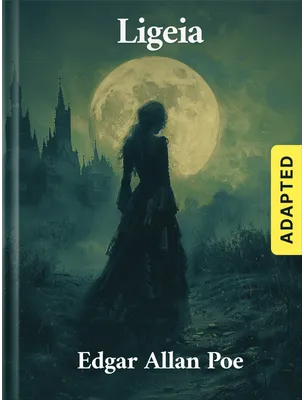
[adapted]
by
Edgar Allan Poe

And the will lies there, which does not die. Who knows the secrets of the will, with its strength? For God is only a great will, filling all things because of its strong aim. Man does not give himself to the angels, nor to death completely, except only through the weakness of his weak will.
Joseph Glanvill.
I cannot, for my life, remember how, when, or even exactly where, I first met the lady Ligeia. Many years have since passed, and my memory is weak because of much suffering. Or, maybe, I cannot now remember these things, because, in fact, the character of my beloved, her great learning, her unusual yet calm kind of beauty, and the exciting and charming beauty of her low, musical way of speaking, made their way into my heart by steps so steady and quiet, that they have gone unnoticed and unknown. Yet I believe that I met her first and most often in some large, old, falling-apart city near the Rhine. About her family—I have surely heard her speak. That it is from a very ancient time cannot be doubted. Ligeia! Ligeia! Buried in studies of a kind more than anything else made to dull the feelings of the outside world, it is by that sweet word alone—by Ligeia—that I bring before my eyes in imagination the image of her who is no longer here.
And now, while I write, a memory suddenly comes to me that I have never known the father’s name of her who was my friend and my promised bride, and who became the partner of my studies, and finally the wife of my heart. Was it a playful request from my Ligeia? or was it a test of how strong my love was, that I should ask no questions about this point? or was it rather a whim of my own—a wildly romantic offering at the altar of the deepest love? I only dimly remember the fact itself—no wonder that I have completely forgotten the events which began it or went with it? And, indeed, if ever that spirit who is called Romance—if ever she, the pale and the misty-winged Ashtophet of Egypt that worshiped idols, watched, as they say, over unlucky marriages, then most surely she watched over mine.
There is one dear topic, however, on which my memory does not fail me. It is the person of Ligeia. In height she was tall, somewhat thin, and, in her later days, even very thin. I would try in vain to describe the greatness, the quiet ease, of her way, or the hard-to-understand lightness and spring of her step. She came and left like a shadow. I never knew when she came into my closed study, except by the dear music of her low sweet voice, as she put her cold white hand upon my shoulder. In beauty of face no young woman ever equaled her. It was the glow of an opium dream— a light and spirit-lifting vision more wildly holy than the dreams which floated around the sleeping souls of the daughters of Delos.
Yet her features were not of that regular pattern which we have been wrongly taught to admire in the classical works of the ancient people. “There is no great beauty,” says Bacon, Lord Verulam, speaking truly of all the kinds of beauty, “without some strangeness in how the parts fit together.” Yet, although I saw that the features of Ligeia were not regular in the classic way—although I felt that her beauty was indeed “great,” and felt that there was much of “strangeness” in it, yet I have tried without success to find what was not regular and to find where my own feeling of “the strange” came from.
I looked at the shape of the high and pale forehead—it was perfect—how cold that word really is when used for a beauty so divine!—the skin like the purest ivory, the great size and calm, the gentle rise of the parts above the temples; and then the very black, the shiny, the rich and naturally curling hair, showing the full force of the word from Homer, “hyacinthine!” I looked at the fine lines of the nose—and only in the beautiful medals of the Hebrews had I seen a similar perfection. There were the same very smooth surface, the same hardly noticeable bend toward the eagle-like shape, the same smoothly curved nostrils showing the free spirit.
I looked at the sweet mouth. Here was truly the victory of all things from heaven—the beautiful curve of the short upper lip—the soft, full sleep of the lower lip—the dimples that played, and the color that spoke—the teeth shining back, with a brightness almost shocking, every ray of the holy light that fell on them in her calm and quiet, yet most joyfully bright of all smiles. I looked closely at the shape of the chin—and here, too, I found the gentle width, the softness and the greatness, the fullness and the spirit, of the Greek—the outline which the god Apollo showed only in a dream, to Cleomenes, the son of the Athenian. And then I looked into the large eyes of Ligeia.
For eyes we have no examples in the very old times. It may also be that the secret that Lord Verulam mentions was in the eyes of my beloved. They were, I must believe, much larger than the usual eyes of our own people. They were even fuller than the fullest of the gazelle eyes of the tribe of the valley of Nourjahad. Yet it was only at times—in moments of great excitement—that this special quality became more than a little clear to see in Ligeia. And at such moments was her beauty—in my hot imagination thus it seemed perhaps—the beauty of beings either above or apart from the earth—the beauty of the famous Houri of the Turk. The color of the eyes was the brightest black, and, far over them, hung jet-black lashes that were very long. The eyebrows, a little uneven in shape, had the same color.
The “strangeness,” however, which I found in the eyes, was something different from the shape, or the color, or the brightness of the face, and must, after all, come from the expression. Ah, a word with no meaning! behind whose wide space of mere sound we hide how little we know of so much of the spirit. The expression of the eyes of Ligeia! How for long hours have I thought about it! How have I, through the whole of a midsummer night, tried to understand it! What was it—that something deeper than the well of Democritus—which lay far within the pupils of my beloved? What was it? I was filled with a strong desire to find out. Those eyes! those large, those shining, those holy eyes! they became to me twin stars of Leda, and I to them the most faithful of star-watchers.
There is no point, among the many hard-to-understand strange things of the study of the mind, more exciting than the fact—never, I believe, taught in schools—that, in our tries to remember something long forgotten, we often find ourselves on the very edge of remembering, but in the end not able to remember. And thus how often, in my careful look at Ligeia’s eyes, have I felt the full meaning of their look coming near—felt it coming near—yet not quite be mine—and so at last go away completely! And (strange, oh strangest mystery of all!) I found, in the most common things in the world, a circle of similarities to that look.
I mean to say that, after the time when Ligeia’s beauty entered my spirit, living there as in a holy place, I got, from many things in the real world, a feeling like the one I always felt around me and inside me, from her large and bright eyes. Yet I still could not describe that feeling, or explain it, or even see it clearly. I recognized it, let me repeat, sometimes in the looking at a quickly growing vine—in the watching of a moth, a butterfly, a cocoon, a stream of running water. I have felt it in the ocean; in the falling of a shooting star. I have felt it in the looks of very old people.
And there are one or two stars in the sky—(one especially, a star of the sixth brightness, double and changing, found near the large star in Lyra,) when I look at it with a telescope, I have felt it. I have been filled with it by some sounds from stringed instruments, and often by parts of books. Among many other times, I well remember something in a book of Joseph Glanvill, which (perhaps only from its old style—who can say?) never failed to give me the feeling: “And the will lies there, which does not die. Who knows the mysteries of the will, with its strength? For God is only a great will filling all things by the nature of its strong focus. Man does not give himself to the angels, nor to death completely, except only through the weakness of his weak will.”
Many years, and later thinking, have let me find, indeed, some distant link between this passage in the English moral writer and a part of the character of Ligeia. A strong force in thought, action, or speech, was perhaps, in her, a result, or at least a sign, of that huge will which, during our long time together, did not give other and more direct proof of its existence. Of all the women whom I have ever known, she, the calm on the outside, the always calm Ligeia, was the most strongly a victim of the wild vultures of harsh passion. And of such passion I could not judge, except by the wonderful widening of those eyes which at once so pleased and scared me—by the almost magical music, change, clearness, and calm of her very low voice—and by the fierce energy (made doubly strong by contrast with her way of speaking,) of the wild words which she usually said.
I have spoken of the knowledge of Ligeia: it was very great—such as I have never known in a woman. She was very skilled in the classical languages, and as far as I knew the modern languages of Europe, I never found her wrong. Indeed, on any subject of the most admired, because simply the most difficult, of the praised learning of the school, have I ever found Ligeia wrong? How strange—how thrilling, this one point in my wife’s nature has made me notice it, only at this late time! I said her knowledge was such as I have never known in a woman—but where lives the man who has gone through, and successfully, all the wide fields of moral, physical, and mathematical science?
I did not see then what I now clearly see, that the learning of Ligeia was huge, was amazing; yet I knew enough of her very great skill to let her guide me, with child-like trust, through the confusing world of deep ideas and study at which I was very busy during the earlier years of our marriage. With how great a victory—with how bright a delight—with how much of all that is light in hope—did I feel, as she leaned over me in studies that few people wanted—still fewer knew—that lovely view slowly opening before me, down whose long, beautiful, and never used path, I might at last pass onward to the goal of a wisdom so heavenly precious that it had to be forbidden!
How strong, then, must have been the sadness with which, after some years, I saw my good hopes grow wings and fly away! Without Ligeia I was only like a child feeling in the dark. Her presence, her readings alone, made very bright and clear the many mysteries of the deep ideas in which we lived. Without the bright shine of her eyes, letters, softly shining and golden, became duller than heavy lead. And now those eyes shone less and less often upon the pages over which I looked closely. Ligeia grew ill. The wild eyes burned with a too—too bright light; the pale fingers took on the clear, wax-like color of the grave; and the blue veins on the high forehead rose and fell quickly with the waves of the most gentle feeling. I saw that she must die—and I struggled very hard in spirit with the dark Azrael. And the struggles of the loving wife were, to my surprise, even stronger than my own.
There had been much in her strict nature to make me believe that, to her, death would have come without its fears; but not so. Words cannot give any true idea of how strongly she fought the Shadow. I groaned in pain at the sad sight. I would have tried to calm—I would have tried to reason; but, in the strength of her wild desire for life—for life—but for life—comfort and reason were both the greatest foolishness. Yet not until the last moment, in the middle of the hardest struggles of her wild spirit, was the outer calm of her manner shaken. Her voice grew more gentle—grew more low—yet I would not wish to talk about the strange meaning of the quietly spoken words. My brain spun as I listened, amazed, to a music more than human—to ideas and hopes which human life had never before known.
That she loved me I should not have had any doubt; and I might easily have known that, in a heart like hers, love would have been no ordinary feeling. But only in death was I fully aware of the strength of her love. For long hours, holding my hand, she would pour out before me the overflow of a heart whose more than passionate love was like worship. How had I deserved to be so blessed by such true words?—how had I deserved to be so cursed with the taking away of the one I loved in the hour when she made them? But on this subject I cannot bear to talk much. Let me say only, that in Ligeia’s more than womanly giving up of herself to a love, alas! all not deserved, all given to me though I was not worthy, I at last understood the reason of her longing, with such a wildly strong desire, for the life that was now going away so fast. It is this wild longing—it is this eager force of desire for life—but for life—that I have no power to describe—no words able to express.
At midnight of the night when she left, calling me, firmly, to her side, she told me to repeat some lines of a poem written by herself not many days before. I obeyed her. They were these:—
Look! it is a big party night
In the lonely later years!
A crowd of angels, with wings, dressed bright
In veils, and drowned in tears,
Sit in a theater, to see
A play of hopes and fears,
While the band breathes in short beats
The music of the years.
Mimes, in the shape of God on high,
Mutter and mumble low,
And here and there they fly;
They are just puppets, who come and go
At the orders of great shapeless things
That move the scenes to and fro,
Flapping from their condor wings
Invisible Wo!
That mixed-up play! Oh, be sure
It will not be forgot!
With its ghost chased forever,
By a crowd that catches it not,
Through a circle that always turns back in
To the same spot;
And much of Madness, and more of Sin,
And horror, the heart of the plot!
But look, in the make-believe show
A crawling shape comes in so slow!
A blood-red thing that twists from out
The quiet stage, with none about!
It twists!—it twists!—with deadly pains
The actors become its food,
And angels cry at pest fangs,
All dipped in human blood.
Out—out go the lights—out all!
And over each shaking form,
The curtain, a funeral shawl,
Comes down fast, like a storm—
And the angels, all pale and wan,
Rise up, show, and inform
That the play is the sad show, “Man,”
And its hero, the winning Worm.
“O God!” half screamed Ligeia, jumping to her feet and raising her arms high with a sudden, shaking movement, as I finished these lines—“O God! O Holy Father!—will these things always be so?—will this conqueror not be beaten even once? Are we not part of You? Who—who knows the secrets of the will with its strength? Man does not give himself to the angels, nor to death completely, except only through the weakness of his weak will.”
And now, as if tired from emotion, she let her white arms fall, and went back sadly to her deathbed. And as she breathed her last sighs, a low whisper came with them from her lips. I put my ear close to them, and heard again the last words of the part from Glanvill: “Man does not give in to the angels, or to death completely, except through the weakness of his weak will.”
She died: and I, crushed down into the dust with sorrow, could no longer stand the lonely emptiness of my home in the dark and ruined city by the Rhine. I had plenty of what the world calls money. Ligeia had brought me far more, very far more, than usually comes to people. After a few months, so, of tired wandering with no purpose, I bought, and repaired a little, an abbey, which I will not name, in one of the wildest and least visited parts of beautiful England.
The dark and sad greatness of the building, the almost wild look of the land, the many sad and very old memories linked with both, went well with the feelings of complete loneliness which had driven me into that far and unfriendly part of the country. Yet although the outside of the abbey, with its green growth hanging about it, changed very little, I gave in, with a child-like stubbornness, and perhaps with a weak hope of easing my sadness, to a show of more than royal richness inside. For such foolish things, even in childhood, I had got a taste, and now they came back to me as if I were old and weak with grief.
Sadly, I feel how much early madness could have been seen in the beautiful and strange curtains, in the serious carvings from Egypt, in the wild decorations near the ceiling and furniture, in the crazy patterns of the carpets of thick gold! I had become a slave to opium, and my work and my orders were colored by my dreams. But I must not stop to tell these foolish things in detail. Let me speak only of that one room, always cursed, where, in a moment of mental confusion, I led from the altar as my wife—as the one who followed the not forgotten Ligeia—the fair-haired and blue-eyed Lady Rowena Trevanion, of Tremaine.
There is no single part of the design and decoration of that wedding room that is not now clearly before me. Where were the hearts of the proud family of the bride, when, because of a hunger for money, they let pass the door of a room so decorated, a young woman and a daughter so loved? I have said, that I remember well the details of the room—yet I am sadly forgetful about important things; and here there was no plan, no order, in the strange display, to stay in the memory. The room was in a high tower of the castle-like abbey, was five-sided in shape, and very large. Taking up the whole south side of the five-sided room was the only window—a very big sheet of unbroken glass from Venice—a single pane, and colored a dull gray, so that the light of either the sun or moon, shining through it, fell with a scary pale shine on the things inside.
Over the top part of this huge window, spread the trellis work of an old vine, which climbed up the thick walls of the tower. The ceiling, of dark-looking oak, was very high, arched, and richly carved with the wildest and most strange examples of a half-Gothic, half-Druid design. From the most central space of this sad arched ceiling, hung, by a single gold chain with long links, a huge incense burner of the same metal, Arabic in pattern, and with many holes so made that there twisted in and out of them, as if given a snake-like life, a constant stream of many-colored fires.
A few low seats and golden candle holders, in an Eastern style, were in different places around; and there was the couch, too—the bridal couch—of an Indian style, and low, and carved from solid ebony, with a canopy above, like a funeral cloth. In each of the corners of the room stood upright a huge stone coffin of black granite, from the tombs of the kings near Luxor, with their old lids full of very ancient carvings. But in the hangings of the room was, alas! the main fancy of all. The high walls, gigantic in height—even too tall—were hung from top to bottom, in great folds, with a heavy and solid-looking tapestry—tapestry of a material which was also used as a carpet on the floor, as a cover for the low seats and the ebony bed, as a canopy for the bed, and as the beautiful folds of the curtains which partly shaded the window.
The cloth was very rich, made of gold. It was spotted all over, at uneven spaces, with curved designs, about a foot across, and made on the cloth in patterns of the darkest black. But these figures had the real form of the curved style only when looked at from one angle. By a trick now common, and going back to very old times, they were made to change in look. To one entering the room, they looked like simple monsters; but when he came closer, this look slowly went away; and, step by step, as the visiter changed his place in the room, he found himself surrounded by a never-ending series of the horrible shapes which belong to the old beliefs of the Norman, or rise in the guilty dreams of the monk. The ghost-like effect was greatly increased by the man-made bringing in of a strong, steady wind behind the curtains—giving an ugly and uneasy movement to the whole.
In halls like these—in a wedding bedroom like this—I passed, with the Lady of Tremaine, the dark hours of the first month of our marriage—passed them with little worry. That my wife was afraid of the angry moods of my temper—that she avoided me, and loved me very little—I could not help seeing; but it gave me more pleasure than not. I hated her with a hatred more like a demon’s than a man’s. My memory went back, (oh, with what strong regret!) to Ligeia, the loved, the great, the beautiful, the buried.
I enjoyed memories of her pure heart, of her wisdom, of her high, her spirit-like nature, of her passionate, her adoring love. Now, then, did my spirit fully and freely burn with more than all the fires of her own. In the excitement of my opium dreams, (for I was usually chained by the drug,) I would call her name out loud, during the silence of the night, or in the quiet hidden places of the valleys by day, as if, through the wild eagerness, the serious passion, the burning heat of my longing for the one who had gone, I could bring her back to the path she had left—ah, could it be for ever?—upon the earth.
About the beginning of the second month of the marriage, the Lady Rowena became suddenly sick, from which she got better slowly. The fever which burned her, made her nights restless; and in her troubled state of half-sleep, she spoke of sounds, and of movements, in and around the room of the tower, which I thought had no cause except in the illness of her imagination, or perhaps in the strange, ghostly effects of the room itself. She became at last better—finally, well. Yet only a short time passed, before a second more serious illness again put her upon a bed of suffering; and from this attack her body, at all times weak, never completely recovered.
Her illnesses were, after this time, of a frightening kind, and of more frightening return, resisting both the skill and the great efforts of her doctors. With the increase of the long-lasting disease, which had, it seemed, taken too strong a hold upon her body to be cured by human means, I could not help but notice a similar increase in the nervous irritation of her nature, and in how easily small causes of fear excited her. She spoke again, and now more often and again and again, of the sounds—of the soft sounds—and of the strange movements among the wall hangings, of which she had spoken before.
One night, near the end of September, she pushed this upsetting subject with more than usual force to my attention. She had just woken from a troubled sleep, and I had been watching, with feelings half of worry, half of unclear fear, the movements of her very thin face. I sat by the side of her black bed, on one of the ottomans from India. She partly rose, and spoke, in a serious low whisper, of sounds that she then heard, but that I could not hear—of movements that she then saw, but that I could not see. The wind was blowing quickly behind the curtains, and I wanted to show her (what, let me admit it, I could not fully believe) that those almost unclear breaths, and those very gentle changes of the figures on the wall, were only the natural effects of that usual rushing of the wind.
But a very pale color spreading over her face had shown me that my efforts to calm her would be useless. She seemed to be fainting, and no helpers were near enough to hear. I remembered where a bottle of light wine had been left, which had been ordered by her doctors, and hurried across the room to get it. But, as I stepped under the light of the incense burner, two shocking things caught my attention. I felt that some real, though invisible, thing had passed lightly by my body; and I saw that there was on the golden carpet, in the very middle of the rich light coming from the incense burner, a shadow—a faint, unclear shadow of an angel-like look—such as might be imagined for the shadow of a ghost.
But I was wild with the excitement of a very large dose of opium, and paid little attention to these things, nor did I speak of them to Rowena. Having found the wine, I crossed the room again, and poured out a cupful, which I held to the lips of the fainting lady. She had now partly recovered, however, and took the cup herself, while I sat down on a low seat near me, with my eyes fixed on her. It was then that I clearly noticed a soft footstep on the carpet, and near the couch; and a second later, as Rowena was raising the wine to her lips, I saw, or may have dreamed that I saw, fall into the cup, as if from some hidden source in the air of the room, three or four large drops of a bright and ruby-colored liquid. If I saw this—not so Rowena. She swallowed the wine without hesitation, and I did not speak to her about a thing which must, after all, I thought, have been only the suggestion of a strong imagination, made too active by the fear of the lady, by the opium, and by the hour.
Yet I cannot hide it from my own mind that, right after the fall of the red drops, a fast change for the worse happened in my wife’s illness; so that, on the third night after that, the hands of her servants prepared her for the grave, and on the fourth, I sat alone, with her covered body, in that strange room where I had made her my wife.—Wild visions, made by opium, moved like shadows before me. I looked with an uneasy eye at the coffins in the corners of the room, at the changing shapes of the curtains, and at the twisting of the many-colored fires in the incense burner above.
My eyes then moved, as I remembered what happened on an earlier night, to the spot under the bright light of the incense burner where I had seen the faint signs of the shadow. However, it was no longer there; and breathing more freely, I looked at the pale and stiff figure on the bed. Then a thousand memories of Ligeia rushed upon me—and then came back to my heart, with the wild force of a flood, all of that great sorrow with which I had looked at her wrapped like this. The night went on; and still, with a heart full of bitter thoughts of the one only and most loved, I kept looking at the body of Rowena.
It might have been midnight, or perhaps earlier, or later, for I had paid no attention to time, when a sob, low, gentle, but very clear, surprised me out of my daydream. I felt that it came from the black bed—the bed of death. I listened in great fear of ghosts—but the sound did not come again. I strained my eyes to see any movement in the dead body—but there was not the slightest movement that I could see. Yet I could not have been mistaken. I had heard the noise, even if it was very weak, and my spirit woke up inside me. I firmly and without stopping kept my eyes fixed upon the body.
Many minutes passed before anything happened that could help explain the mystery. At last it became clear that a slight, a very weak, and hardly noticeable hint of color had come into the cheeks, and along the sunken small veins of the eyelids. In a kind of horror and awe that I could not put into words, for which the language of people has no strong enough words, I felt my heart stop beating, my limbs grew stiff where I sat. Yet a sense of duty finally worked to bring back my self-control.
I no longer doubted that we had been too quick in our preparations—that Rowena still lived. It was necessary to act at once; yet the turret was completely separate from the part of the abbey lived in by the servants—there were none near enough to call—I had no way of calling them to help me without leaving the room for many minutes—and this I did not dare to do. I therefore struggled alone in my efforts to call back the spirit still hovering. In a short time it was certain, however, that she had fallen back again; the color disappeared from both eyelid and cheek, leaving a paleness even more than that of marble; the lips became even more shrivelled and pinched up in the terrible expression of death; a repulsive dampness and coldness quickly spread over the surface of the body; and all the usual hard stiffness came at once. I fell back with a shiver upon the couch from which I had been so suddenly awakened, and again gave myself up to strong waking visions of Ligeia.
An hour passed like this, when (could it be possible?) I, for the second time, noticed some faint sound coming from the area of the bed. I listened—in extreme fear. The sound came again—it was a sigh. Rushing to the dead body, I saw—clearly saw—a slight shake on the lips. In a minute afterward they relaxed, showing a bright line of the white teeth. Great surprise now fought in my heart with the deep awe which had until now ruled there alone. I felt that my sight grew dim, that my mind wandered; and it was only by a strong effort that I at last managed to make myself brave for the task which duty had once more pointed out in this way.
There was now a small glow on the forehead and on the cheek and throat; a noticeable warmth spread through the whole body; there was even a weak beat in the heart. The lady lived; and with even stronger desire I set myself to the task of bringing her back. I rubbed and bathed the sides of the head and the hands, and used every effort that my experience, and much medical reading, could suggest. But it was useless. Suddenly, the color left, the heartbeat stopped, the lips took again the look of the dead, and, in a moment afterward, the whole body took on the icy cold, the pale color, the hard stiffness, the sunken shape, and all the horrible marks of one that has been, for many days, in the tomb.
And again I sunk into dreams of Ligeia—and again, (what wonder that I shiver while I write?) again there reached my ears a low sob from the place of the black bed. But why shall I tell in detail the awful horrors of that night? Why shall I stop to tell how, time after time, until near the time of the gray dawn, this ugly play of coming back to life was repeated; how each terrible fall back was only into a harder and, it seemed, more hopeless death; how each pain showed the look of a fight with some unseen enemy; and how each fight was followed by I do not know what wild change in the look of the dead body? Let me hurry to an end.
Most of the fearful night had passed, and she who had been dead, once again stirred—and now more strongly than before, although waking from a death more terrible in its complete hopelessness than any. I had long stopped struggling or moving, and stayed sitting stiffly on the ottoman, a helpless victim to a rush of strong emotions, of which extreme awe was perhaps the least terrible, the least strong. The dead body, I repeat, moved, and now more strongly than before.
The colors of life came back with unusual energy into the face—the arms and legs relaxed—and, except that the eyelids were still shut tight, and that the bandages and grave clothes still gave a deathly look to the body, I might have dreamed that Rowena had indeed shaken off, completely, the chains of Death. But if this idea was not, even then, fully accepted, I could at least no longer doubt, when, getting up from the bed, stumbling, with weak steps, with closed eyes, and like someone confused in a dream, the thing that was wrapped moved forward boldly and clearly into the middle of the room.
I did not tremble—I did not move—for many thoughts I could not tell, linked with the look, the height, the manner of the figure, rushing quickly through my brain, had frozen me—had turned me to stone. I did not move—but looked at the ghost. There was a wild disorder in my thoughts—a trouble I could not calm. Could it really be the living Rowena who faced me? Could it really be Rowena at all—the fair-haired, the blue-eyed Lady Rowena Trevanion of Tremaine? Why, why should I doubt it? The bandage lay heavy around the mouth—but then might it not be the mouth of the living Lady of Tremaine? And the cheeks—there were the roses as in her best time of life—yes, these might really be the fair cheeks of the living Lady of Tremaine.
And the chin, with its dimples, as when she was well, could it not be hers?—but had she then grown taller since her illness? What terrible madness came over me with that thought? With one jump, I had reached her feet! Pulling back from my touch, she let fall from her head, loosened, the horrible grave wrappings which had held it, and there poured out, into the rushing air of the room, huge masses of long and messy hair; it was blacker than the wings of a raven at midnight! And now the eyes of the figure that stood before me slowly opened. “Here then, at least,” I screamed out loud, “can I never—can I never be wrong— these are the large, and the black, and the wild eyes, of my lost love—of the Lady—of the Lady Ligeia.”