This volume was published posthumously in 1837, based on Hegel's lectures from the early 19th century.
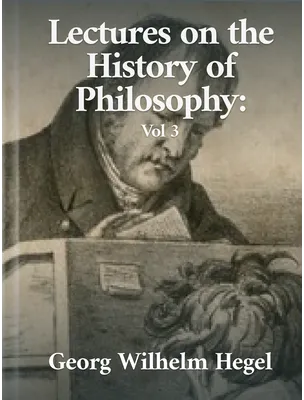
Georg Wilhelm Friedrich Hegel was a German philosopher. He is considered one of the most important figures in German idealism and one of the founding figures of Western philosophy, with his influence extending to the entire range of contemporary philosophical issues, from aesthetics to ontology and politics, both in the analytic and continental tradition.
In the thought-provoking pages of "Lectures on the History of Philosophy: Volume Three," renowned philosopher Georg Wilhelm Hegel invites readers on an intellectual journey through the evolution of philosophical ideas. This volume delves into the intricate lives and theories of great thinkers, weaving together their contributions to the fabric of human understanding. Hegel himself serves as both guide and interpreter, shedding light on the complex relationships between these philosophical giants.
As he traverses the landscape of ideas, Hegel explores central themes of freedom, consciousness, and the unfolding nature of reality. The conflict arises as differing philosophies clash, revealing the tensions between reason and tradition, individuality and universality. With each lecture, readers are encouraged to ponder their own beliefs while grappling with the profound questions that have shaped our intellectual heritage.
Whether you are a seasoned philosophy enthusiast or a curious newcomer, this volume promises to engage your mind and stir your imagination. Hegel's insightful commentary and rich historical context create a captivating narrative that not only informs but also inspires a deeper appreciation for the power of thought.
Full Name: Georg Wilhelm Friedrich Hegel
Birthdate: August 27, 1770
Place of Birth: Stuttgart, Germany
Date and Place of Death: November 14, 1831, in Berlin, Germany
Occupation: Philosopher, university professor
Notable Works: Some of Hegel's famous works include "The Phenomenology of Spirit," "The Science of Logic," and "The Philosophy of Right."
Early Life: Hegel was born into a middle-class family. He was educated at the Stuttgart Gymnasium and later attended the University of Tübingen, where he studied theology, philosophy, and the classics.
Literary Career: Hegel began his career as a private tutor before becoming a professor. His philosophical ideas focused on the development of self-consciousness and the importance of history. He became a major figure in German idealism and influenced many areas of thought, including politics and art.
Personal Life: Hegel married in 1804 and had three children. He was known for his intense work ethic and often engaged in deep philosophical discussions. Hegel's ideas were sometimes complex, but he aimed to explain the world in a systematic way.
Hegel was a German philosopher known for his contributions to idealism and his influence on modern philosophy.
The book is a philosophical text, specifically focusing on the history of philosophy.
As a philosophical work, there are no characters. Instead, Hegel discusses various philosophers and their ideas.
This volume primarily covers the development of philosophy from the Renaissance to the late 18th century.
Major themes include the evolution of philosophical thought, the relationship between reality and thought, and the nature of freedom.
Yes, Hegel often uses concepts as symbols to represent larger philosophical ideas and movements.
The book has been influential but also controversial, with some praising Hegel's insights while others critique his complexity.
There are no direct adaptations, but Hegel's ideas have influenced many works in philosophy, literature, and art.
Hegel's philosophy has significantly shaped modern thought, impacting existentialism, Marxism, and various political theories.