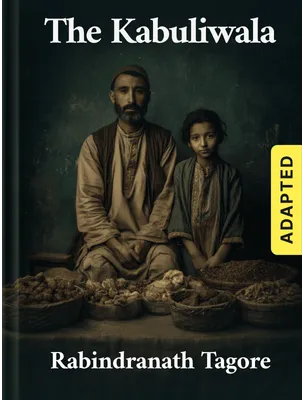
The Kabuliwala (adapted)
Category: Short Stories
Level 3.43 0:22 h 10.6 mb
A man from Afghanistan, called the Kabuliwala, comes to Calcutta to sell goods. There, he meets a little girl named Mini. Even though they are very different, they become good friends. They talk, laugh, and enjoy each other’s company. One day, something happens that changes the Kabuliwala’s life. After some time, he returns and meets Mini again, but things are no longer the same... This is an adapted version of the story, simplified to A2 level.

The Kabuliwala

[adapted]

(The Fruitseller from Kabul)

by
Rabindranath Tagore


The Kabuliwala (adapted)

My five year old daughter Mini cannot live without talking. I really believe that in all her life she has not spent a minute being quiet. Her mother is often annoyed at this, and would try to stop her talking, but I would not. To see Mini quiet is not natural, and I cannot stand it for long. And so my own talk with her is always lively.

One morning, for example, when I was in the middle of chapter seventeen of my new book, my little Mini came into the room, and, putting her hand in mine, said: “Father! Ramdayal the doorkeeper calls a crow a krow! He doesn’t know anything, does he?”

Before I could explain to her about different languages in the world, she had already started talking about another subject. “What do you think, Father? Bhola says there is an elephant in the clouds, blowing water out of his trunk, and that is why it rains!” And then, starting again quickly, while I sat still getting ready to answer this last question, “Father! What is Mother to you?”

“My dear little sister in the law!” I said quietly without thinking to myself, but with a serious face managed to answer: “Go and play with Bhola, Mini! I am busy!”

The window of my room looks out on the road. The child had sat down at my feet near my table, and was playing quietly, tapping on her knees. I was hard at work on my seventeenth chapter, where Protrap Singh, the hero, had just held Kanchanlata, the heroine, in his arms, and was about to run away with her by the third-floor window of the castle, when all of a sudden Mini stopped her play, and ran to the window, shouting, “A Kabuliwala! a Kabuliwala!” Sure enough, in the street below there was a Kabuliwala, walking slowly along. He wore the loose, dirty clothes of his people, with a tall turban; there was a bag on his back, and he carried boxes of grapes in his hand.

I do not know what my daughter felt when she saw this man, but she started to call him loudly. “Ah!” I thought, “he will come in, and I will never finish my seventeenth chapter!”

At that moment the Kabuliwala turned and looked up at the child. When she saw this, very afraid, she ran to her mother for safety, and was gone. She believed that inside the bag that the big man carried, there were maybe two or three other children like her. The seller at the same time came in through my door, and said hello to me with a smile.

So unsafe was the position of my hero and my heroine, that my first thought was to stop and buy something, because the man had been called. I bought a few small things, and a conversation started about Abdulrahman, the Russians, the English, and the Frontier Policy. As he was about to leave, he asked: “And where is the little girl, sir?”

And I, thinking that Mini must stop being afraid for no reason, told them to bring her out.

She stood by my chair, and looked at the Kabuliwala and his bag. He offered her nuts and raisins, but she did not want them, and only held on to me even tighter, with all her worries growing. This was their first meeting.

One morning, but not many days later, as I was leaving the house, I was surprised to see Mini, sitting on a bench near the door, laughing and talking, with the great Kabuliwala sitting at her feet. In all her life, it seemed, my small daughter had never found such a patient listener, except her father. And already the corner of her little sari was filled with almonds and raisins, a gift from her visitor.

“Why did you give her those?” I said, and taking out an eight-anna coin, I handed it to him.
The man accepted the money without complaint, and slipped it into his pocket.

Sadly, when I came back an hour later, I saw that the unlucky coin had caused twice as much trouble as it was worth! For the Kabuliwala had given it to Mini, and her mother, seeing the bright round thing, had rushed at the child, saying: “Where did you get that eight-anna bit?”

“The Kabuliwala gave it to me,” said Mini happily.
“The Kabuliwala gave it to you!” cried her mother, very surprised. “Oh, Mini! how could you take it from him?”

I, coming in at that moment, saved her from something bad that was about to happen, and started to ask my own questions. It was not the first or second time, I found, that the two had met. The Kabuliwala had taken away the child’s first fear by giving her nuts and almonds, and the two were now great friends. They had many funny little jokes, which made them laugh a lot.

Sitting in front of him and looking down at his huge body with all her little pride, Mini would laugh, her face full of smiles, and begin: “O Kabuliwala, Kabuliwala, what have you got in your bag?”

And he would reply, in a voice through his nose, like a man from the mountains: “An elephant!” Not much reason to laugh, perhaps; but how they both enjoyed the joke! And for me, this child’s talk with a grown-up man always had in it something strangely interesting.
Then the Kabuliwala, so he would not be left out, would take his turn: “Well, little one, and when are you going to the father-in-law’s house?”

Now most small Bengali girls have heard long ago about the father-in-law’s house; but we, being a little modern, had not told these things to our child, and Mini at this question must have been a little confused. But she did not show it, and politely answered: “Are you going there?”

Among men of the Kabuliwala’s class, however, it is well known that the words father-in-law’s house have two meanings. It is a polite word for jail, the place where we are well cared for, and we do not have to pay anything. In this way the strong peddler would understand my daughter’s question. “Ah,” he would say, shaking his fist at a policeman he could not see, “I will beat my father-in-law!”
Hearing this, and imagining the poor embarrassed relative, Mini would begin to laugh loudly, in which her strong friend would join.

These were autumn mornings, the very time of year when kings of long ago went out to make war; and I, never moving from my little corner in Calcutta, would let my mind travel over the whole world. At the very name of another country, my heart would long for it, and at the sight of a foreigner in the streets, I would start to dream many dreams, — the mountains, the valleys, and the forests of his distant home, with his small house in its place, and the free and independent life of far-away wild places. Perhaps the scenes of travel appear before me by themselves, and come and go in my imagination even more clearly, because I live such a dull, quiet life, that a call to travel would come to me like a bolt of lightning.

When I was with this Kabuliwala, I was at once taken to the foot of dry mountain peaks, with narrow little passes twisting in and out among their very high sides. I could see the line of camels carrying the goods, and the group of turbaned merchants, carrying some of their strange old guns, and some of their spears, traveling down toward the plains. I could see — but at some point Mini’s mother would interrupt, begging me to “be careful of that man.”

Sadly, Mini’s mother is a very shy and fearful woman. Whenever she hears a noise in the street, or sees people coming to the house, she always thinks that they are either thieves, or drunk people, or snakes, or tigers, or malaria or cockroaches, or caterpillars, or an English sailor. Even after many years, she still cannot stop being so afraid. So she had many doubts about the Kabuliwala, and used to beg me to watch him carefully.

I tried to make her less afraid by laughing softly, but then she would turn to me with a serious face, and ask me serious questions. Were children never taken away? Was it, then, not true that there were slaves in Kabul? Was it so very strange that this big man could carry away a tiny child?

I said strongly that, though not impossible, it was very unlikely. But this was not enough, and her fear continued. As it was not clear, however, it did not seem right to not let the man in the house, and the friendship went on without stopping.

Once a year in the middle of January, Rahman, the Kabuliwala, used to go back to his country, and as the time came near he would be very busy, going from house to house to collect the money people owed him. This year, though, he could always find time to come and see Mini. It would have seemed to a stranger that there was some secret plan between the two, for when he could not come in the morning, he would appear in the evening.

Even to me it was a little surprising now and then, in the corner of a dark room, to suddenly see this tall man in loose clothes, carrying many bags; but when Mini would run in smiling, with her, “O! Kabuliwala! Kabuliwala!” and the two friends, so different in age, would go back to their old laughter and their old jokes, I felt better.

One morning, a few days before he had decided to go, I was checking my printed pages in my study room. It was cold weather. Through the window the sunlight touched my feet, and the little warmth felt very good. It was almost eight o’clock, and the early walkers were returning home, with their heads covered. Suddenly, I heard a loud noise in the street, and, looking out, saw Rahman being taken away, tied, between two policemen, and behind them a crowd of curious boys.

There were blood stains on the clothes of the Kabuliwala, and one of the police had a knife. I hurried out, stopped them, and asked what had happened. From one person a little, from another a little, I learned that a neighbour owed the seller money for a Rampuri shawl, but had lied and said he had not bought it, and that during the argument, Rahman had hit him.

Now, in his great excitement, the prisoner began calling his enemy many bad names, when suddenly, in a veranda of my house, my little Mini appeared, with her usual shout: “O Kabuliwala! Kabuliwala!” Rahman’s face lit up as he turned to her. He had no bag under his arm today, so she could not talk about the elephant with him. So at once she went to the next question: “Are you going to the father-in-law’s house?” Rahman laughed and said: “Just where I am going, little one!” Then, seeing that the answer did not make the child smile, he held up his tied hands. “By Ali!” he said, “I would have beaten that old father-in-law, but my hands are tied!”

Because he was accused of trying to kill someone, Rahman was sent to prison for some years.

Time passed, and we did not remember him. We did our usual work in the usual place, and we almost never thought about the once-free mountain man spending his years in prison. Even my cheerful Mini, I am ashamed to say, forgot her old friend. New friends filled her life. As she grew older, she spent more of her time with girls. She spent so much time with them that she no longer came, as she used to do, to her father’s room. I hardly spoke with her.

Many years had passed. It was autumn again, and we had made plans for our Mini’s wedding. It would happen during the Puja Holidays. With Durga going back to Kailas, the light of our home would also leave for her husband’s house, and leave her father’s in the shadow.

The morning was bright. After the rains, there was a feeling of being washed clean in the air, and the sun-rays looked like pure gold. They were so bright that they gave a beautiful glow even to the dirty brick walls of our Calcutta lanes. Since early dawn to-day the wedding-pipes had been playing, and at each beat my own heart beat fast. The sad sound of the tune, Bhairavi, seemed to make my pain stronger at the coming separation. My Mini was to be married to-night.

From early morning, noise and busy activity had filled the house. In the courtyard the cloth roof had to be hung on its bamboo poles; the big hanging lights with their tinkling sound must be hung in each room and verandah. There was a lot of hurry and excitement. I was sitting in my study, looking through the accounts, when someone came in, bowed politely, and stood before me. It was Rahman the Kabuliwala. At first I did not recognise him. He had no bag, nor the long hair, nor the same energy that he used to have. But he smiled, and I knew him again.

“When did you come, Rahman?” I asked him.
“Last evening,” he said, “I was let out of jail.”

The words hit my ears hard. I had never before talked with someone who had hurt another person, and I felt afraid inside, when I understood this, for I felt that the day would have been luckier if he had not come.

“There are ceremonies happening,” I said, “and I am busy. Could you maybe come another day?”

Right away he turned to leave; but as he reached the door he paused, and said: “May I see the little one, sir, for a moment?” He believed that Mini was still the same. He had imagined her running to him as she used to, calling “O Kabuliwala! Kabuliwala!” He had also imagined that they would laugh and talk together, just like before. In fact, to remember the old days he had brought, carefully wrapped in paper, a few almonds and raisins and grapes, got somehow from a man from his own country, because his own little money was gone.

I said again: “There is a special event in the house, and you cannot see anyone today.”

The man looked sad. He looked sadly at me for a moment, said “Good morning,” and went out. I felt a little sorry, and wanted to call him back, but I found he was coming back by himself. He came close to me, holding out his gifts, and said: “I brought these few things, sir, for the little one. Will you give them to her?”

I took them and was going to pay him, but he held my hand and said: “You are very kind, sir! Please remember me. Do not give me money! — You have a little girl, I also have one like her in my own home. I think of her, and bring fruit to your child, not to make money for myself.”

Saying this, he put his hand inside his big loose robe, and brought out a small and dirty piece of paper. With great care he opened it, and made it flat with both hands on my table. It had the print of a little hand. Not a photograph. Not a drawing. The print of a hand covered with ink, pressed flat on the paper. This touch from his own little daughter had always been in his heart, as he had come year after year to Calcutta, to sell his goods in the streets.

Tears came to my eyes. I forgot that he was a poor Kabuli fruit-seller, while I was — but no, what was I more than him? He also was a father. That handprint of his little Parbati in her faraway mountain home reminded me of my own little Mini.

I called for Mini at once from the inner room. There were many difficulties, but I would not listen. Dressed in the red silk of her wedding day, with the sandal paste on her forehead, and dressed like a young bride, Mini came, and stood shyly before me.

The Kabuliwala looked a little surprised at the sight. He could not bring back their old friendship. At last he smiled and said: “Little one, are you going to your father-in-law’s house?”
But Mini now understood the meaning of the word “father-in-law,” and she could not reply to him as before. She felt her face go red at the question, and stood before him with her bride-like face looking down.

I remembered the day when the Kabuliwala and my Mini had first met, and I felt sad. When she had gone, Rahman let out a big sigh, and sat down on the floor. He suddenly thought that his daughter too must have grown up in this long time, and that he would have to make friends with her again. Surely he would not find her as he knew her before. And besides, who knew what might have happened to her in these eight years?

The wedding pipes played, and the soft autumn sun shone around us. But Rahman sat in the little street in Calcutta, and saw before him the bare mountains of Afghanistan. I took out a banknote, and gave it to him, saying: “Go back to your own daughter, Rahman, in your own country, and I hope the happiness of your meeting brings good luck to my child!”

After giving this present, I had to cut down some of the celebrations. I could not have the electric lights I had planned, or the military band, and the women of the house were very sad about it. But to me the wedding feast was even happier because I thought that in a faraway land a father who had been away for a long time met his only child again.


WholeReader. Empty coverWholeReader. Book is closedWholeReader. FilterWholeReader. Compilation cover