The book was published in 1906.
[{"id":"para_1","index":0,"start":0,"offset":316,"words":5,"paraNum":"","lastModified":1671848063000,"semanticType":"title-book-title","voicework":"no_audio","blockId":"geronimos_story_ffa_en-bl2t","language":"en","wordsRange":{"start":203000000,"end":205000000},"paragraphVersion":48,"direction":"ltr","paragraph":"<h1 class=\"ilm-title\" id=\"para_1\" semantictype=\"title-book-title\" data-ilmid=\"geronimos_story_ffa_en-bl2t\" data-chapter=\"para_1\" data-words-count=\"5\" data-before=\"0\" data-ww=\"\"><span class=\"block-pb\"> <span class=\"block-pb is-animated\"></span> </span><span class=\"itm-wrap\">Geronimo’s Story of His Life</span></h1>","hasContent":true,"isFirst":true,"isLast":false},{"id":"para_2","index":1,"start":316,"offset":347,"words":5,"paraNum":"","lastModified":1672579172000,"semanticType":"title-author","voicework":"no_audio","blockId":"geronimos_story_ffa_en-bl2v","language":"en","wordsRange":{"start":410000000,"end":416000000},"paragraphVersion":61,"direction":"ltr","paragraph":"<h1 class=\"ilm-title ilm-author ilm-nopad ilm-x-large\" id=\"para_2\" semantictype=\"title-author\" data-ilmid=\"geronimos_story_ffa_en-bl2v\" data-chapter=\"para_2\" data-words-count=\"5\" data-before=\"5\" data-ww=\"\"><span class=\"block-pb\"> <span class=\"block-pb is-animated\"></span> </span><span class=\"itm-wrap\">by<br>Geronimo and S. M. Barrett</span></h1>","hasContent":true,"isFirst":false,"isLast":false},{"id":"para_3","index":2,"start":663,"offset":151,"words":0,"paraNum":"","lastModified":1663247335000,"semanticType":"line","blockId":"geronimos_story_ffa_en-bl30","language":"en","wordsRange":{"start":934000000,"end":936000000},"paragraphVersion":39,"direction":"ltr","paragraph":"<hr class=\"ilm-hr ilm-small\" id=\"para_3\" semantictype=\"line\" data-ilmid=\"geronimos_story_ffa_en-bl30\" data-words-count=\"0\" data-before=\"10\" data-ww=\"\">","hasContent":true,"isFirst":false,"isLast":false},{"id":"para_4","index":3,"start":814,"offset":1555,"words":2,"paraNum":"","lastModified":1673014254000,"semanticType":"illustration","blockId":"geronimos_story_ffa_en-bl31","language":"en","wordsRange":{"start":1036000000,"end":1038000000},"paragraphVersion":59,"direction":"ltr","paragraph":"<p id=\"para_4\" data-words-count=\"2\" class=\"ilm-illustration\" data-ilmid=\"geronimos_story_ffa_en-bl31\" ilm-block=\"\" ilm-display=\"\"><span class=\"block-pb\"> <span class=\"block-pb is-animated\"></span> </span><span class=\"itm-wrap\"><img width=\"388\" height=\"600\" data-src=\"ch0p0\" src=\"data:image/webp;base64,UklGRogDAABXRUJQVlA4IHwDAACQEACdASonADwAPm0yk0akIyGhKrgLAIANiWkAE8+4oOZH0jHXbT9Qvs7/RcQstI5Pwv6UfQA/Q3oi59/rH2C+lUEq2VsD9lunSiv+YcQqg83eonMQ3eUPZsAM6NhhD/KNqbM5QjAZAP+95dAb9fSeD2s1h0xsYV4/4bGJqNIKfuVaB7oEJZWylwQTPMAA/vOoM+5VZrax1TfxPqBlWxW2b6FDe3Rc2So7bMXPG+Rwc+9nJA+DDpZBUN88PYRkbU6G3LiTgRtIKMHO/NLycmXNhNI/xXI5GyHkUnb5CIskKUocyVAHr/Y8v26Z2lHHjVPgSZqrf69rLHPicF8W9enq2hcbiRu0xWFTVJK04ctjflXyP5Fch6SuoJ7p42SK7CNdyMcUqnZ1faLCvP4ibNsWvODH6xmwhyNSnSt5pvyRz3ZEahR8mu6QvJjt7UXHI/TMPBQisIzNXFx9UDClt6lw4+EVWOcEWRGiPWinYvY8IZ/YiFBhgHrlRLMv2fY2BMRlmWmFVPhvRwjPGYXHHzQ5+pOj+w+5GhhLBfA44ZhQn/7OH+j9XPm+5CiUB9rb40HcJkUeZ8e4KG6X5ZQz/Rf+G3N8M+8sEaKvPuYsSRam1hb1r3vOVX/URqT456w2aWG7XjE+kKr7lWDVmdyM3Vn7vVwc0vP2vHQKnsHTzalFV0ygTKcL8wJ19CBLnn/2Y2mPzPpBmzoovp99YUgbN2PLXNDsX+42j6SYXiIuT0PL8ZMwUCyIXbx2E5I2YenfVQrK3G96GcAfDq+A8ZAWJKAxHN2Lng8eJuakY/mgBit22zcQsn2rh6dirHkY+C8YOz8siCq3Tc3Swr72AQmVzGdOOps5+pb2RnzH3hiSNegVZA/phx+UfU4e8SEf2OqadWZJynJ2QPaT6DfOwgJh+1FJaPVklVbhYMytfuFb96JShKUMbxpDAe2CRLjnlcXgumRb4T/oZQrhSkBrZ1OroAig1px/HtypVy38Z57bRXPTgXJnNMX0PPHfQ+Aam+LyKCMDDN/8THzlVcP3tuWfZbvy8Wqh/+cmon+HUCcGYYNxv4MFJb9lpg177uh8plICH5ZmdxGYrT4PMX5KsDJReepFSQOS5H1GwEheuA2Kt4hAUcEEa+A9ivPP86ri54Z9dbBz5Q2zo7EvhK1drttwFHQIPW8MEGEtgylCugAA\" alt=\"Geronimo\">Geronimo </span></p>","hasContent":true,"isFirst":false,"isLast":false},{"id":"para_5","index":4,"start":2369,"offset":151,"words":0,"paraNum":"","lastModified":1663247335000,"semanticType":"line","blockId":"geronimos_story_ffa_en-bl33","language":"en","wordsRange":{"start":1240000000,"end":1242000000},"paragraphVersion":46,"direction":"ltr","paragraph":"<hr class=\"ilm-hr ilm-small\" id=\"para_5\" semantictype=\"line\" data-ilmid=\"geronimos_story_ffa_en-bl33\" data-words-count=\"0\" data-before=\"12\" data-ww=\"\">","hasContent":true,"isFirst":false,"isLast":false},{"id":"para_6","index":5,"start":2520,"offset":305,"words":1,"paraNum":"","lastModified":1671848288000,"semanticType":"header-subheader","voicework":"no_audio","blockId":"geronimos_story_ffa_en-bl3b","language":"en","wordsRange":{"start":2069000000,"end":2071000000},"paragraphVersion":53,"direction":"ltr","paragraph":"<h3 class=\"ilm-header ilm-h3\" id=\"para_6\" semantictype=\"header-subheader\" data-ilmid=\"geronimos_story_ffa_en-bl3b\" data-chapter=\"para_6\" data-words-count=\"1\" data-before=\"12\" data-ww=\"\"><span class=\"block-pb\"> <span class=\"block-pb is-animated\"></span> </span><span class=\"itm-wrap\">Dedicatory</span></h3>","hasContent":true,"isFirst":false,"isLast":false},{"id":"para_7","index":6,"start":2825,"offset":628,"words":66,"paraNum":"d.1","lastModified":1671848269000,"semanticType":"par","voicework":"no_audio","blockId":"geronimos_story_ffa_en-bl3c","language":"en","wordsRange":{"start":2171000000,"end":2238000000},"paragraphVersion":45,"direction":"ltr","paragraph":"<p id=\"para_7\" semantictype=\"par\" data-ilmid=\"geronimos_story_ffa_en-bl3c\" data-words-count=\"66\" data-before=\"13\" data-ww=\"\"><span class=\"block-num\" data-id=\"d.1\"></span><span class=\"block-pb\"> <span class=\"block-pb is-animated\"></span> </span><span class=\"itm-wrap\">Because he has given me permission to tell my story; because he has read that story and knows I try to speak the truth; because I believe that he is fair-minded and will cause my people to receive justice in the future; and because he is chief of a great people, I dedicate this story of my life to Theodore Roosevelt, President of the United States.</span></p>","hasContent":true,"isFirst":false,"isLast":false},{"id":"para_8","index":7,"start":3453,"offset":273,"words":1,"paraNum":"","lastModified":1671848329000,"semanticType":"par","voicework":"no_audio","blockId":"geronimos_story_ffa_en-bl3d","language":"en","wordsRange":{"start":2338000000,"end":2340000000},"paragraphVersion":49,"direction":"ltr","paragraph":"<p class=\"ilm-right ilm-signature\" id=\"para_8\" semantictype=\"par\" data-ilmid=\"geronimos_story_ffa_en-bl3d\" data-words-count=\"1\" data-before=\"79\" data-ww=\"\"><span class=\"block-pb\"> <span class=\"block-pb is-animated\"></span> </span><span class=\"itm-wrap\">Geronimo.</span></p>","hasContent":true,"isFirst":false,"isLast":false},{"id":"para_9","index":8,"start":3726,"offset":151,"words":0,"paraNum":"","lastModified":1663247335000,"semanticType":"line","blockId":"geronimos_story_ffa_en-bl3e","language":"en","wordsRange":{"start":2440000000,"end":2442000000},"paragraphVersion":39,"direction":"ltr","paragraph":"<hr class=\"ilm-hr ilm-small\" id=\"para_9\" semantictype=\"line\" data-ilmid=\"geronimos_story_ffa_en-bl3e\" data-words-count=\"0\" data-before=\"80\" data-ww=\"\">","hasContent":true,"isFirst":false,"isLast":false},{"id":"para_10","index":9,"start":3877,"offset":304,"words":1,"paraNum":"","lastModified":1672579184000,"semanticType":"header-subheader","voicework":"no_audio","blockId":"geronimos_story_ffa_en-bl3g","language":"en","wordsRange":{"start":2645000000,"end":2647000000},"paragraphVersion":61,"direction":"ltr","paragraph":"<h3 class=\"ilm-header ilm-h3\" id=\"para_10\" semantictype=\"header-subheader\" data-ilmid=\"geronimos_story_ffa_en-bl3g\" data-chapter=\"para_10\" data-words-count=\"1\" data-before=\"80\" data-ww=\"\"><span class=\"block-pb\"> <span class=\"block-pb is-animated\"></span> </span><span class=\"itm-wrap\">Preface</span></h3>","hasContent":true,"isFirst":false,"isLast":false},{"id":"para_11","index":10,"start":4181,"offset":616,"words":60,"paraNum":"p.1","lastModified":1671848345000,"semanticType":"par","voicework":"no_audio","blockId":"geronimos_story_ffa_en-bl3h","language":"en","wordsRange":{"start":2747000000,"end":2807000000},"paragraphVersion":47,"direction":"ltr","paragraph":"<p id=\"para_11\" semantictype=\"par\" data-ilmid=\"geronimos_story_ffa_en-bl3h\" data-words-count=\"60\" data-before=\"81\" data-ww=\"\"><span class=\"block-num\" data-id=\"p.1\"></span><span class=\"block-pb\"> <span class=\"block-pb is-animated\"></span> </span><span class=\"itm-wrap\">The initial idea of the compilation of this work was to give the reading public an authentic record of the private life of the Apache Indians, and to extend to Geronimo as a prisoner of war the courtesy due any captive, <i>i. </i><i>e.</i>, the right to state the causes which impelled him in his opposition to our civilization and laws.</span></p>","hasContent":true,"isFirst":false,"isLast":false},{"id":"para_12","index":11,"start":4797,"offset":468,"words":27,"paraNum":"p.2","lastModified":1671848345000,"semanticType":"par","voicework":"no_audio","blockId":"geronimos_story_ffa_en-bl3i","language":"en","wordsRange":{"start":2907000000,"end":2935000000},"paragraphVersion":47,"direction":"ltr","paragraph":"<p id=\"para_12\" semantictype=\"par\" data-ilmid=\"geronimos_story_ffa_en-bl3i\" data-words-count=\"27\" data-before=\"141\" data-ww=\"\"><span class=\"block-num\" data-id=\"p.2\"></span><span class=\"block-pb\"> <span class=\"block-pb is-animated\"></span> </span><span class=\"itm-wrap\">If the Indians’ cause has been properly presented, the captives’ defense clearly stated, and the general store of information regarding vanishing types increased, I shall be satisfied.</span></p>","hasContent":true,"isFirst":false,"isLast":false},{"id":"para_13","index":12,"start":5265,"offset":475,"words":30,"paraNum":"p.3","lastModified":1671848345000,"semanticType":"par","voicework":"no_audio","blockId":"geronimos_story_ffa_en-bl3j","language":"en","wordsRange":{"start":3035000000,"end":3066000000},"paragraphVersion":48,"direction":"ltr","paragraph":"<p id=\"para_13\" semantictype=\"par\" data-ilmid=\"geronimos_story_ffa_en-bl3j\" data-words-count=\"30\" data-before=\"168\" data-ww=\"\"><span class=\"block-num\" data-id=\"p.3\"></span><span class=\"block-pb\"> <span class=\"block-pb is-animated\"></span> </span><span class=\"itm-wrap\">I desire to acknowledge valuable suggestions from Maj. Charles Taylor, Fort Sill, Oklahoma; Dr. J. M. Greenwood, Kansas City, Missouri, and President David R. Boyd, of the University of Oklahoma.</span></p>","hasContent":true,"isFirst":false,"isLast":false},{"id":"para_14","index":13,"start":5740,"offset":442,"words":26,"paraNum":"p.4","lastModified":1671848417000,"semanticType":"par","voicework":"no_audio","blockId":"geronimos_story_ffa_en-bl3l","language":"en","wordsRange":{"start":3269000000,"end":3296000000},"paragraphVersion":50,"direction":"ltr","paragraph":"<p id=\"para_14\" semantictype=\"par\" data-ilmid=\"geronimos_story_ffa_en-bl3l\" data-words-count=\"26\" data-before=\"198\" data-ww=\"\"><span class=\"block-num\" data-id=\"p.4\"></span><span class=\"block-pb\"> <span class=\"block-pb is-animated\"></span> </span><span class=\"itm-wrap\">I especially desire in this connection to say that without the kindly advice and assistance of President Theodore Roosevelt this book could not have been written.</span></p>","hasContent":true,"isFirst":false,"isLast":false},{"id":"para_15","index":14,"start":6182,"offset":266,"words":1,"paraNum":"","lastModified":1671848436000,"semanticType":"par","voicework":"no_audio","blockId":"geronimos_story_ffa_en-bl3m","language":"en","wordsRange":{"start":3396000000,"end":3398000000},"paragraphVersion":53,"direction":"ltr","paragraph":"<p class=\"ilm-center\" id=\"para_15\" semantictype=\"par\" data-ilmid=\"geronimos_story_ffa_en-bl3m\" data-words-count=\"1\" data-before=\"224\" data-ww=\"\"><span class=\"block-pb\"> <span class=\"block-pb is-animated\"></span> </span><span class=\"itm-wrap\">Respectfully,</span></p>","hasContent":true,"isFirst":false,"isLast":false},{"id":"para_16","index":15,"start":6448,"offset":280,"words":3,"paraNum":"","lastModified":1671848432000,"semanticType":"par","voicework":"no_audio","blockId":"geronimos_story_ffa_en-bl3n","language":"en","wordsRange":{"start":3498000000,"end":3502000000},"paragraphVersion":55,"direction":"ltr","paragraph":"<p class=\"ilm-right ilm-signature\" id=\"para_16\" semantictype=\"par\" data-ilmid=\"geronimos_story_ffa_en-bl3n\" data-words-count=\"3\" data-before=\"225\" data-ww=\"\"><span class=\"block-pb\"> <span class=\"block-pb is-animated\"></span> </span><span class=\"itm-wrap\">S. M. Barrett.</span></p>","hasContent":true,"isFirst":false,"isLast":false},{"id":"para_17","index":16,"start":6728,"offset":292,"words":5,"paraNum":"","lastModified":1671848455000,"semanticType":"par","voicework":"no_audio","blockId":"geronimos_story_ffa_en-bl3o","language":"en","wordsRange":{"start":3602000000,"end":3608000000},"paragraphVersion":55,"direction":"ltr","paragraph":"<p id=\"para_17\" semantictype=\"par\" data-ilmid=\"geronimos_story_ffa_en-bl3o\" data-words-count=\"5\" data-before=\"228\" data-ww=\"\"><span class=\"block-pb\"> <span class=\"block-pb is-animated\"></span> </span><span class=\"itm-wrap\">Lawton, Oklahoma.<br><i>August </i><i>14, </i><i>1906</i>.</span></p>","hasContent":true,"isFirst":false,"isLast":false},{"id":"para_18","index":17,"start":7020,"offset":153,"words":0,"paraNum":"","lastModified":1663247335000,"semanticType":"line","blockId":"geronimos_story_ffa_en-bl3p","language":"en","wordsRange":{"start":3708000000,"end":3710000000},"paragraphVersion":38,"direction":"ltr","paragraph":"<hr class=\"ilm-hr ilm-small\" id=\"para_18\" semantictype=\"line\" data-ilmid=\"geronimos_story_ffa_en-bl3p\" data-words-count=\"0\" data-before=\"233\" data-ww=\"\">","hasContent":true,"isFirst":false,"isLast":false},{"id":"para_19","index":18,"start":7173,"offset":1598,"words":6,"paraNum":"","lastModified":1672996233000,"semanticType":"illustration","blockId":"geronimos_story_ffa_en-bl3q","language":"en","wordsRange":{"start":3810000000,"end":3816000000},"paragraphVersion":62,"direction":"ltr","paragraph":"<p id=\"para_19\" data-words-count=\"6\" class=\"ilm-illustration\" data-ilmid=\"geronimos_story_ffa_en-bl3q\" ilm-block=\"\" ilm-display=\"\"><span class=\"block-pb\"> <span class=\"block-pb is-animated\"></span> </span><span class=\"itm-wrap\"><img width=\"600\" height=\"393\" data-src=\"ch2p1\" src=\"data:image/webp;base64,UklGRpQDAABXRUJQVlA4IIgDAAAwEACdASo8ACcAPm0yk0ckIyGhKrgJAIANiWkAE9zYo+W325IBOD+k4bRx9nqMBuM7wHjN+ejUJ6UyWwuEmvtS2FWAoBVU85ss0ulc7sPKi4BF12cta85Q9RTGbxlZCxjbYsJE3xNfe4Ntrgrc138E1aWItUtPeZvxCcrgdMRdc8XITjR0vU9BNMAA/v7Fk+3DZGaUlTdGHMqm5TJfj2nJBWevZpl4sscbMqvVfdRVtLhdrKaFd0/7qUEc676GV6socCAY4saCUg/0EpGN+0smNDD92sGnP3kqmJ38lxjeD9+pF2eLXvApKKYsd4JrM6hWDg038T48DajYKdmOsNmrVT3I3jAOIErbWRtZXRJbYx7X4LLMa5la4QngYeTWd4EdtvaUCL+o0BLSHPtz37aOT2o09Ps4c4TC93EEIF+7DJtfEkZ21yxEaFKycOYuniEZTR0YgHuAgyYHHy3ZzSo+fWT+TDih8ifkLsTwh9DAlBwNEXhOSB1CN+JtWgfLqgAaXkeU3WKQXrITNbcu96c/fX5eitnquwMEflqYLjL8HGHPUC+ByVH+eWvblUoTYLgZTtszgBM5wdyCWB29BTheCl2/VsrzIzkzDHDxJTXyCpFqxu2GNXJTEAc4EFfkn+6d/BWMOuHZ3o+ol2PM+i+arnnbDrPnvpPTn120Zoh5gpZIfEAEdEYUY+QGix/oeRvep0U6MuSmVErfzFXU89axGvpOA9EerZsfX9Vwlg+Hh63AZiaPn7Vn9Xdd/pJxLCCsZYvo9XRbmlHbEPUfB6FAIe6XnmpvuhR4C/536AAMNNpMlAXhreGrMeqQDruJHjL+MNWL9sQ96BBdDXNVnKrpDiYHvLv1VAxm4E5pGDXBO+tnj3WDs78STphaDgtXvSQ3xIijya2VG5L7w2U0evRWoT/serNO+rVpFuuUmz+QxjuMvQwGap+0PpoubVpj/rxWmPp5Hfi7CSS34ap/RpcydjdqeZvJ5w6fVgrV1qo/ww0Qj1QlaTx9g2IX4TydRY3UE31LiZyPorHVO+TZS2H33TT7Rn9+qWzhr1A11h+M1kxmM05zSAoSVGO/a2g4GyxBJ+NTQnPQIXFCrQNyHQVFMNEEEMjRhz1H2M1tE8CQPESnNeAg+mM7puhACJqWJl7rk6IVp5wfwBqhPpSu/sWFrBV3eh8obiIffh8s5MW7JKBfPXuf0AAA\" alt=\"How the book was made\">How the book was made </span></p>","hasContent":true,"isFirst":false,"isLast":false},{"id":"para_20","index":19,"start":8771,"offset":153,"words":0,"paraNum":"","lastModified":1663247335000,"semanticType":"line","blockId":"geronimos_story_ffa_en-bl3s","language":"en","wordsRange":{"start":4022000000,"end":4024000000},"paragraphVersion":47,"direction":"ltr","paragraph":"<hr class=\"ilm-hr ilm-small\" id=\"para_20\" semantictype=\"line\" data-ilmid=\"geronimos_story_ffa_en-bl3s\" data-words-count=\"0\" data-before=\"239\" data-ww=\"\">","hasContent":true,"isFirst":false,"isLast":false},{"id":"para_21","index":20,"start":8924,"offset":310,"words":1,"paraNum":"","lastModified":1672579197000,"semanticType":"header-subheader","voicework":"no_audio","blockId":"geronimos_story_ffa_en-bl41","language":"en","wordsRange":{"start":5225000000,"end":5227000000},"paragraphVersion":70,"direction":"ltr","paragraph":"<h3 class=\"ilm-header ilm-h3\" id=\"para_21\" semantictype=\"header-subheader\" data-ilmid=\"geronimos_story_ffa_en-bl41\" data-chapter=\"para_21\" data-words-count=\"1\" data-before=\"239\" data-ww=\"\"><span class=\"block-pb\"> <span class=\"block-pb is-animated\"></span> </span><span class=\"itm-wrap\">Introductory</span></h3>","hasContent":true,"isFirst":false,"isLast":false},{"id":"para_22","index":21,"start":9234,"offset":752,"words":92,"paraNum":"i.1","lastModified":1671848643000,"semanticType":"par","voicework":"no_audio","blockId":"geronimos_story_ffa_en-bl42","language":"en","wordsRange":{"start":5327000000,"end":5420000000},"paragraphVersion":55,"direction":"ltr","paragraph":"<p id=\"para_22\" semantictype=\"par\" data-ilmid=\"geronimos_story_ffa_en-bl42\" data-words-count=\"92\" data-before=\"240\" data-ww=\"\"><span class=\"block-num\" data-id=\"i.1\"></span><span class=\"block-pb\"> <span class=\"block-pb is-animated\"></span> </span><span class=\"itm-wrap\">I first met Geronimo in the summer of 1904, when I acted for him as interpreter of English into Spanish, and vice versa, in selling a war bonnet. After that he always had a pleasant word for me when we met, but never entered into a general conversation with me until he learned that I had once been wounded by a Mexican. As soon as he was told of this, he came to see me and expressed freely his opinion of the average Mexican, and his aversion to all Mexicans in general.</span></p>","hasContent":true,"isFirst":false,"isLast":false},{"id":"para_23","index":22,"start":9986,"offset":417,"words":26,"paraNum":"i.2","lastModified":1671848643000,"semanticType":"par","voicework":"no_audio","blockId":"geronimos_story_ffa_en-bl43","language":"en","wordsRange":{"start":5520000000,"end":5547000000},"paragraphVersion":55,"direction":"ltr","paragraph":"<p id=\"para_23\" semantictype=\"par\" data-ilmid=\"geronimos_story_ffa_en-bl43\" data-words-count=\"26\" data-before=\"332\" data-ww=\"\"><span class=\"block-num\" data-id=\"i.2\"></span><span class=\"block-pb\"> <span class=\"block-pb is-animated\"></span> </span><span class=\"itm-wrap\">I invited him to visit me again, which he did, and upon his invitation, I visited him at his tepee in the Fort Sill Military reservation.</span></p>","hasContent":true,"isFirst":false,"isLast":false},{"id":"para_24","index":23,"start":10403,"offset":835,"words":98,"paraNum":"i.3","lastModified":1671858370000,"semanticType":"par","voicework":"no_audio","blockId":"geronimos_story_ffa_en-bl44","language":"en","wordsRange":{"start":5647000000,"end":5748000000},"paragraphVersion":66,"direction":"ltr","paragraph":"<p id=\"para_24\" semantictype=\"par\" data-ilmid=\"geronimos_story_ffa_en-bl44\" data-words-count=\"98\" data-before=\"358\" data-ww=\"\"><span class=\"block-num\" data-id=\"i.3\"></span><span class=\"block-pb\"> <span class=\"block-pb is-animated\"></span> </span><span class=\"itm-wrap\">In the summer of 1905 Dr. J. M. Greenwood, superintendent of schools at Kansas City, Missouri, visited me, and I took him to see the chief. Geronimo was quite formal and reserved until Dr. Greenwood said, “I am a friend of General Howard, whom I have heard speak of you.” “Come,” said Geronimo, and led the way to a shade, had seats brought for us, put on his war bonnet, and served watermelon <i>à </i><i>l’Apache</i> (cut in big chunks), while he talked freely and cheerfully. When we left he gave us a pressing invitation to visit him again.</span></p>","hasContent":true,"isFirst":false,"isLast":false},{"id":"para_25","index":24,"start":11238,"offset":1126,"words":150,"paraNum":"i.4","lastModified":1671858370000,"semanticType":"par","voicework":"no_audio","blockId":"geronimos_story_ffa_en-bl45","language":"en","wordsRange":{"start":5848000000,"end":6001000000},"paragraphVersion":65,"direction":"ltr","paragraph":"<p id=\"para_25\" semantictype=\"par\" data-ilmid=\"geronimos_story_ffa_en-bl45\" data-words-count=\"150\" data-before=\"456\" data-ww=\"\"><span class=\"block-num\" data-id=\"i.4\"></span><span class=\"block-pb\"> <span class=\"block-pb is-animated\"></span> </span><span class=\"itm-wrap\">In a few days the old chief came to see me and asked about “my father.” I said “you mean the old gentleman from Kansas City — he has returned to his home.” “He is you father?” said Geronimo. “No,” I said, “my father died twenty-five years ago, Dr. Greenwood is only my friend.” After a moment’s silence the old Indian spoke again, this time in a tone of voice intended to carry conviction, or at least to allow no further discussion. “Your natural father is dead, this man has been your friend and adviser from youth. By adoption <i>he </i><i>is </i><i>your </i><i>father</i>. Tell him he is welcome to come to my home at any time.” It was of no use to explain any more, for the old man had determined not to understand my relation to Dr. Greenwood except in accordance with Indian customs, and I let the matter drop.</span></p>","hasContent":true,"isFirst":false,"isLast":false},{"id":"para_26","index":25,"start":12364,"offset":2125,"words":332,"paraNum":"i.5","lastModified":1671858370000,"semanticType":"par","voicework":"no_audio","blockId":"geronimos_story_ffa_en-bl46","language":"en","wordsRange":{"start":6101000000,"end":6438000000},"paragraphVersion":65,"direction":"ltr","paragraph":"<p id=\"para_26\" semantictype=\"par\" data-ilmid=\"geronimos_story_ffa_en-bl46\" data-words-count=\"332\" data-before=\"606\" data-ww=\"\"><span class=\"block-num\" data-id=\"i.5\"></span><span class=\"block-pb\"> <span class=\"block-pb is-animated\"></span> </span><span class=\"itm-wrap\">In the latter part of that summer I asked the old chief to allow me to publish some of the things he had told me, but he objected, saying, however, that if I would pay him, and if the officers in charge did not object, he would tell me the whole story of his life. I immediately called at the fort (Fort Sill) and asked the officer in charge, Lieutenant Purington, for permission to write the life of Geronimo. I was promptly informed that the privilege would not be granted. Lieutenant Purington explained to me the many depredations committed by Geronimo and his warriors, and the enormous cost of subduing the Apaches, adding that the old Apache deserved to be hanged rather than spoiled by so much attention from civilians. A suggestion from me that our government had paid many soldiers and officers to go to Arizona and kill Geronimo and the Apaches, and that they did not seem to know how to do it, did not prove very gratifying to the pride of the regular army officer, and I decided to seek elsewhere for permission. Accordingly I wrote to President Roosevelt that here was an old Indian who had been held a prisoner of war for twenty years and had never been given a chance to tell his side of the story, and asked that Geronimo be granted permission to tell for publication, in his own way, the story of his life, and that he be guaranteed that the publication of his story would not affect unfavorably the Apache prisoners of war. By return mail I received word that the authority had been granted. In a few days I received word from Fort Sill that the President had ordered the officer in charge to grant permission as requested. An interview was requested that I might receive the instructions of the War Department. When I went to Fort Sill the officer in command handed me the following brief, which constituted my instructions:</span></p>","hasContent":true,"isFirst":false,"isLast":false},{"id":"para_27","index":26,"start":14489,"offset":286,"words":5,"paraNum":"","lastModified":1671848792000,"semanticType":"par","voicework":"no_audio","blockId":"geronimos_story_ffa_en-bl47","language":"en","wordsRange":{"start":6538000000,"end":6544000000},"paragraphVersion":59,"direction":"ltr","paragraph":"<p class=\"ilm-right\" id=\"para_27\" semantictype=\"par\" data-ilmid=\"geronimos_story_ffa_en-bl47\" data-words-count=\"5\" data-before=\"938\" data-ww=\"\"><span class=\"block-pb\"> <span class=\"block-pb is-animated\"></span> </span><span class=\"itm-wrap\">Lawton, Oklahoma, Aug. 12th, 1905.</span></p>","hasContent":true,"isFirst":false,"isLast":false},{"id":"para_28","index":27,"start":14775,"offset":309,"words":3,"paraNum":"","lastModified":1672579213000,"semanticType":"par","voicework":"no_audio","blockId":"geronimos_story_ffa_en-bl48","language":"en","wordsRange":{"start":6644000000,"end":6648000000},"paragraphVersion":82,"direction":"ltr","paragraph":"<p class=\"ilm-blockquote\" id=\"para_28\" semantictype=\"par\" data-ilmid=\"geronimos_story_ffa_en-bl48\" data-words-count=\"3\" data-before=\"943\" data-ww=\"\"><span class=\"block-pb\"> <span class=\"block-pb is-animated\"></span> </span><span class=\"itm-wrap\"><i>Geronimo, — </i><i>Apache </i><i>Chief — </i></span></p>","hasContent":true,"isFirst":false,"isLast":false},{"id":"para_29","index":28,"start":15084,"offset":300,"words":5,"paraNum":"","lastModified":1672579213000,"semanticType":"par","voicework":"no_audio","blockId":"geronimos_story_ffa_en-bl49","language":"en","wordsRange":{"start":6748000000,"end":6754000000},"paragraphVersion":88,"direction":"ltr","paragraph":"<p class=\"ilm-blockquote\" id=\"para_29\" semantictype=\"par\" data-ilmid=\"geronimos_story_ffa_en-bl49\" data-words-count=\"5\" data-before=\"946\" data-ww=\"\"><span class=\"block-pb\"> <span class=\"block-pb is-animated\"></span> </span><span class=\"itm-wrap\">S. M. Barrett, <i>Supt. </i><i>Schools</i>.</span></p>","hasContent":true,"isFirst":false,"isLast":false},{"id":"para_30","index":29,"start":15384,"offset":544,"words":49,"paraNum":"i.6","lastModified":1672579212000,"semanticType":"par","voicework":"no_audio","blockId":"geronimos_story_ffa_en-bl4a","language":"en","wordsRange":{"start":6854000000,"end":6904000000},"paragraphVersion":73,"direction":"ltr","paragraph":"<p id=\"para_30\" semantictype=\"par\" data-ilmid=\"geronimos_story_ffa_en-bl4a\" data-words-count=\"49\" data-before=\"951\" data-ww=\"\"><span class=\"block-num\" data-id=\"i.6\"></span><span class=\"block-pb\"> <span class=\"block-pb is-animated\"></span> </span><span class=\"itm-wrap\">Letter to the President stating that above-mentioned desires to tell his life story that it may be published, and requests permission to tell it in his own way, and also desires assurance that what he has to say will in no way work a hardship for the Apache tribe.</span></p>","hasContent":true,"isFirst":false,"isLast":false},{"id":"para_31","index":30,"start":15928,"offset":154,"words":0,"paraNum":"","lastModified":1663247335000,"semanticType":"line","blockId":"geronimos_story_ffa_en-bl4b","language":"en","wordsRange":{"start":7004000000,"end":7006000000},"paragraphVersion":38,"direction":"ltr","paragraph":"<hr class=\"ilm-hr ilm-small\" id=\"para_31\" semantictype=\"line\" data-ilmid=\"geronimos_story_ffa_en-bl4b\" data-words-count=\"0\" data-before=\"1000\" data-ww=\"\">","hasContent":true,"isFirst":false,"isLast":false},{"id":"para_32","index":31,"start":16082,"offset":284,"words":2,"paraNum":"","lastModified":1672579225000,"semanticType":"par","voicework":"no_audio","blockId":"geronimos_story_ffa_en-bl4c","language":"en","wordsRange":{"start":7106000000,"end":7109000000},"paragraphVersion":81,"direction":"ltr","paragraph":"<p class=\"ilm-center\" id=\"para_32\" semantictype=\"par\" data-ilmid=\"geronimos_story_ffa_en-bl4c\" data-words-count=\"2\" data-before=\"1000\" data-ww=\"\"><span class=\"block-pb\"> <span class=\"block-pb is-animated\"></span> </span><span class=\"itm-wrap\"><i>1st </i><i>Endorsement.</i></span></p>","hasContent":true,"isFirst":false,"isLast":false},{"id":"para_33","index":32,"start":16366,"offset":340,"words":8,"paraNum":"","lastModified":1672579227000,"semanticType":"par","voicework":"no_audio","blockId":"geronimos_story_ffa_en-bl4d","language":"en","wordsRange":{"start":7209000000,"end":7220000000},"paragraphVersion":81,"direction":"ltr","paragraph":"<p class=\"ilm-right\" id=\"para_33\" semantictype=\"par\" data-ilmid=\"geronimos_story_ffa_en-bl4d\" data-words-count=\"8\" data-before=\"1002\" data-ww=\"\"><span class=\"block-pb\"> <span class=\"block-pb is-animated\"></span> </span><span class=\"itm-wrap\">War Department,<br>The Military Secretary’s Office,<br>Washington, August 25th, 1905.</span></p>","hasContent":true,"isFirst":false,"isLast":false},{"id":"para_34","index":33,"start":16706,"offset":510,"words":35,"paraNum":"i.7","lastModified":1672579225000,"semanticType":"par","voicework":"no_audio","blockId":"geronimos_story_ffa_en-bl4e","language":"en","wordsRange":{"start":7320000000,"end":7358000000},"paragraphVersion":77,"direction":"ltr","paragraph":"<p id=\"para_34\" semantictype=\"par\" data-ilmid=\"geronimos_story_ffa_en-bl4e\" data-words-count=\"35\" data-before=\"1010\" data-ww=\"\"><span class=\"block-num\" data-id=\"i.7\"></span><span class=\"block-pb\"> <span class=\"block-pb is-animated\"></span> </span><span class=\"itm-wrap\">Respectfully referred, by direction of the Acting Chief of Staff, through headquarters, Department of Texas, to the Officer In Charge of the Apache prisoners of war at Fort Sill, Oklahoma Territory, for remark and recommendation.</span></p>","hasContent":true,"isFirst":false,"isLast":false},{"id":"para_35","index":34,"start":17216,"offset":296,"words":5,"paraNum":"","lastModified":1672579233000,"semanticType":"par","voicework":"no_audio","blockId":"geronimos_story_ffa_en-bl4f","language":"en","wordsRange":{"start":7458000000,"end":7465000000},"paragraphVersion":82,"direction":"ltr","paragraph":"<p class=\"ilm-right\" id=\"para_35\" semantictype=\"par\" data-ilmid=\"geronimos_story_ffa_en-bl4f\" data-words-count=\"5\" data-before=\"1045\" data-ww=\"\"><span class=\"block-pb\"> <span class=\"block-pb is-animated\"></span> </span><span class=\"itm-wrap\">(Signed) E. F. Ladd,<br>Military Secretary.</span></p>","hasContent":true,"isFirst":false,"isLast":false},{"id":"para_36","index":35,"start":17512,"offset":154,"words":0,"paraNum":"","lastModified":1663247335000,"semanticType":"line","blockId":"geronimos_story_ffa_en-bl4g","language":"en","wordsRange":{"start":7565000000,"end":7567000000},"paragraphVersion":38,"direction":"ltr","paragraph":"<hr class=\"ilm-hr ilm-small\" id=\"para_36\" semantictype=\"line\" data-ilmid=\"geronimos_story_ffa_en-bl4g\" data-words-count=\"0\" data-before=\"1050\" data-ww=\"\">","hasContent":true,"isFirst":false,"isLast":false},{"id":"para_37","index":36,"start":17666,"offset":283,"words":2,"paraNum":"","lastModified":1672579251000,"semanticType":"par","voicework":"no_audio","blockId":"geronimos_story_ffa_en-bl4h","language":"en","wordsRange":{"start":7667000000,"end":7670000000},"paragraphVersion":83,"direction":"ltr","paragraph":"<p class=\"ilm-center\" id=\"para_37\" semantictype=\"par\" data-ilmid=\"geronimos_story_ffa_en-bl4h\" data-words-count=\"2\" data-before=\"1050\" data-ww=\"\"><span class=\"block-pb\"> <span class=\"block-pb is-animated\"></span> </span><span class=\"itm-wrap\"><i>2d </i><i>Endorsement.</i></span></p>","hasContent":true,"isFirst":false,"isLast":false},{"id":"para_38","index":37,"start":17949,"offset":356,"words":10,"paraNum":"","lastModified":1672579251000,"semanticType":"par","voicework":"no_audio","blockId":"geronimos_story_ffa_en-bl4i","language":"en","wordsRange":{"start":7770000000,"end":7783000000},"paragraphVersion":83,"direction":"ltr","paragraph":"<p class=\"ilm-right\" id=\"para_38\" semantictype=\"par\" data-ilmid=\"geronimos_story_ffa_en-bl4i\" data-words-count=\"10\" data-before=\"1052\" data-ww=\"\"><span class=\"block-pb\"> <span class=\"block-pb is-animated\"></span> </span><span class=\"itm-wrap\">Headquarters Department of Texas,<br>Military Secretary’s Office,<br>San Antonio, August 29th, 1905.</span></p>","hasContent":true,"isFirst":false,"isLast":false},{"id":"para_39","index":38,"start":18305,"offset":431,"words":22,"paraNum":"i.8","lastModified":1672579250000,"semanticType":"par","voicework":"no_audio","blockId":"geronimos_story_ffa_en-bl4j","language":"en","wordsRange":{"start":7883000000,"end":7906000000},"paragraphVersion":79,"direction":"ltr","paragraph":"<p id=\"para_39\" semantictype=\"par\" data-ilmid=\"geronimos_story_ffa_en-bl4j\" data-words-count=\"22\" data-before=\"1062\" data-ww=\"\"><span class=\"block-num\" data-id=\"i.8\"></span><span class=\"block-pb\"> <span class=\"block-pb is-animated\"></span> </span><span class=\"itm-wrap\">Respectfully transmitted to 1st Lieut. George A. Purington, 8th Cavalry, In Charge of Apache prisoners. (Thro’ Commanding Officer, Fort Sill, O. T.)</span></p>","hasContent":true,"isFirst":false,"isLast":false},{"id":"para_40","index":39,"start":18736,"offset":271,"words":6,"paraNum":"","lastModified":1672579264000,"semanticType":"par","voicework":"no_audio","blockId":"geronimos_story_ffa_en-bl4k","language":"en","wordsRange":{"start":8006000000,"end":8013000000},"paragraphVersion":82,"direction":"ltr","paragraph":"<p id=\"para_40\" semantictype=\"par\" data-ilmid=\"geronimos_story_ffa_en-bl4k\" data-words-count=\"6\" data-before=\"1084\" data-ww=\"\"><span class=\"block-pb\"> <span class=\"block-pb is-animated\"></span> </span><span class=\"itm-wrap\">By Command of Brigadier General Lee.</span></p>","hasContent":true,"isFirst":false,"isLast":false},{"id":"para_41","index":40,"start":19007,"offset":332,"words":8,"paraNum":"","lastModified":1672579266000,"semanticType":"par","voicework":"no_audio","blockId":"geronimos_story_ffa_en-bl4l","language":"en","wordsRange":{"start":8113000000,"end":8124000000},"paragraphVersion":84,"direction":"ltr","paragraph":"<p class=\"ilm-right\" id=\"para_41\" semantictype=\"par\" data-ilmid=\"geronimos_story_ffa_en-bl4l\" data-words-count=\"8\" data-before=\"1090\" data-ww=\"\"><span class=\"block-pb\"> <span class=\"block-pb is-animated\"></span> </span><span class=\"itm-wrap\">(Signed) C. D. Roberts,<br>Captain, 7th Infantry,<br>Acting Military Secretary.</span></p>","hasContent":true,"isFirst":false,"isLast":false},{"id":"para_42","index":41,"start":19339,"offset":154,"words":0,"paraNum":"","lastModified":1663247335000,"semanticType":"line","blockId":"geronimos_story_ffa_en-bl4m","language":"en","wordsRange":{"start":8224000000,"end":8226000000},"paragraphVersion":37,"direction":"ltr","paragraph":"<hr class=\"ilm-hr ilm-small\" id=\"para_42\" semantictype=\"line\" data-ilmid=\"geronimos_story_ffa_en-bl4m\" data-words-count=\"0\" data-before=\"1098\" data-ww=\"\">","hasContent":true,"isFirst":false,"isLast":false},{"id":"para_43","index":42,"start":19493,"offset":283,"words":2,"paraNum":"","lastModified":1672579273000,"semanticType":"par","voicework":"no_audio","blockId":"geronimos_story_ffa_en-bl4n","language":"en","wordsRange":{"start":8326000000,"end":8329000000},"paragraphVersion":85,"direction":"ltr","paragraph":"<p class=\"ilm-center\" id=\"para_43\" semantictype=\"par\" data-ilmid=\"geronimos_story_ffa_en-bl4n\" data-words-count=\"2\" data-before=\"1098\" data-ww=\"\"><span class=\"block-pb\"> <span class=\"block-pb is-animated\"></span> </span><span class=\"itm-wrap\"><i>3d </i><i>Endorsement.</i></span></p>","hasContent":true,"isFirst":false,"isLast":false},{"id":"para_44","index":43,"start":19776,"offset":287,"words":7,"paraNum":"","lastModified":1672579279000,"semanticType":"par","voicework":"no_audio","blockId":"geronimos_story_ffa_en-bl4o","language":"en","wordsRange":{"start":8429000000,"end":8437000000},"paragraphVersion":86,"direction":"ltr","paragraph":"<p class=\"ilm-right\" id=\"para_44\" semantictype=\"par\" data-ilmid=\"geronimos_story_ffa_en-bl4o\" data-words-count=\"7\" data-before=\"1100\" data-ww=\"\"><span class=\"block-pb\"> <span class=\"block-pb is-animated\"></span> </span><span class=\"itm-wrap\">Fort Sill, O. T., Aug. 31st, 1905.</span></p>","hasContent":true,"isFirst":false,"isLast":false},{"id":"para_45","index":44,"start":20063,"offset":423,"words":22,"paraNum":"i.9","lastModified":1672579278000,"semanticType":"par","voicework":"no_audio","blockId":"geronimos_story_ffa_en-bl4p","language":"en","wordsRange":{"start":8537000000,"end":8560000000},"paragraphVersion":85,"direction":"ltr","paragraph":"<p id=\"para_45\" semantictype=\"par\" data-ilmid=\"geronimos_story_ffa_en-bl4p\" data-words-count=\"22\" data-before=\"1107\" data-ww=\"\"><span class=\"block-num\" data-id=\"i.9\"></span><span class=\"block-pb\"> <span class=\"block-pb is-animated\"></span> </span><span class=\"itm-wrap\">Respectfully referred to 1st Lieut. G. A. Purington, 8th Cavalry, Officer in Charge of Apache prisoners of war, for remark and recommendation.</span></p>","hasContent":true,"isFirst":false,"isLast":false},{"id":"para_46","index":45,"start":20486,"offset":260,"words":5,"paraNum":"","lastModified":1672579296000,"semanticType":"par","voicework":"no_audio","blockId":"geronimos_story_ffa_en-bl4q","language":"en","wordsRange":{"start":8660000000,"end":8666000000},"paragraphVersion":87,"direction":"ltr","paragraph":"<p id=\"para_46\" semantictype=\"par\" data-ilmid=\"geronimos_story_ffa_en-bl4q\" data-words-count=\"5\" data-before=\"1129\" data-ww=\"\"><span class=\"block-pb\"> <span class=\"block-pb is-animated\"></span> </span><span class=\"itm-wrap\">By Order of Captain Dade.</span></p>","hasContent":true,"isFirst":false,"isLast":false},{"id":"para_47","index":46,"start":20746,"offset":336,"words":9,"paraNum":"","lastModified":1672579297000,"semanticType":"par","voicework":"no_audio","blockId":"geronimos_story_ffa_en-bl4r","language":"en","wordsRange":{"start":8766000000,"end":8777000000},"paragraphVersion":90,"direction":"ltr","paragraph":"<p class=\"ilm-right\" id=\"para_47\" semantictype=\"par\" data-ilmid=\"geronimos_story_ffa_en-bl4r\" data-words-count=\"9\" data-before=\"1134\" data-ww=\"\"><span class=\"block-pb\"> <span class=\"block-pb is-animated\"></span> </span><span class=\"itm-wrap\">(Signed) James Longstreet,<br>1st. Lieut & Sqdn. Adjt., 13th Cavalry. Adjutant.</span></p>","hasContent":true,"isFirst":false,"isLast":false},{"id":"para_48","index":47,"start":21082,"offset":154,"words":0,"paraNum":"","lastModified":1663247335000,"semanticType":"line","blockId":"geronimos_story_ffa_en-bl4t","language":"en","wordsRange":{"start":8980000000,"end":8982000000},"paragraphVersion":39,"direction":"ltr","paragraph":"<hr class=\"ilm-hr ilm-small\" id=\"para_48\" semantictype=\"line\" data-ilmid=\"geronimos_story_ffa_en-bl4t\" data-words-count=\"0\" data-before=\"1143\" data-ww=\"\">","hasContent":true,"isFirst":false,"isLast":false},{"id":"para_49","index":48,"start":21236,"offset":284,"words":2,"paraNum":"","lastModified":1672579310000,"semanticType":"par","voicework":"no_audio","blockId":"geronimos_story_ffa_en-bl4u","language":"en","wordsRange":{"start":9082000000,"end":9085000000},"paragraphVersion":90,"direction":"ltr","paragraph":"<p class=\"ilm-center\" id=\"para_49\" semantictype=\"par\" data-ilmid=\"geronimos_story_ffa_en-bl4u\" data-words-count=\"2\" data-before=\"1143\" data-ww=\"\"><span class=\"block-pb\"> <span class=\"block-pb is-animated\"></span> </span><span class=\"itm-wrap\"><i>4th </i><i>Endorsement.</i></span></p>","hasContent":true,"isFirst":false,"isLast":false},{"id":"para_50","index":49,"start":21520,"offset":286,"words":7,"paraNum":"","lastModified":1672579311000,"semanticType":"par","voicework":"no_audio","blockId":"geronimos_story_ffa_en-bl4v","language":"en","wordsRange":{"start":9185000000,"end":9193000000},"paragraphVersion":82,"direction":"ltr","paragraph":"<p class=\"ilm-right\" id=\"para_50\" semantictype=\"par\" data-ilmid=\"geronimos_story_ffa_en-bl4v\" data-words-count=\"7\" data-before=\"1145\" data-ww=\"\"><span class=\"block-pb\"> <span class=\"block-pb is-animated\"></span> </span><span class=\"itm-wrap\">Fort Sill, O. T., Sept. 2d, 1905.</span></p>","hasContent":true,"isFirst":false,"isLast":false},{"id":"para_51","index":50,"start":21806,"offset":534,"words":45,"paraNum":"i.10","lastModified":1672579309000,"semanticType":"par","voicework":"no_audio","blockId":"geronimos_story_ffa_en-bl4w","language":"en","wordsRange":{"start":9293000000,"end":9339000000},"paragraphVersion":83,"direction":"ltr","paragraph":"<p id=\"para_51\" semantictype=\"par\" data-ilmid=\"geronimos_story_ffa_en-bl4w\" data-words-count=\"45\" data-before=\"1152\" data-ww=\"\"><span class=\"block-num\" data-id=\"i.10\"></span><span class=\"block-pb\"> <span class=\"block-pb is-animated\"></span> </span><span class=\"itm-wrap\">Respectfully returned to the Adjutant, Fort Sill, O. T. I can see no objection to Geronimo telling the story of his past life, providing he tells the truth. I would recommend that Mr. S. M. Barrett be held responsible for what is written and published.</span></p>","hasContent":true,"isFirst":false,"isLast":false},{"id":"para_52","index":51,"start":22340,"offset":350,"words":13,"paraNum":"","lastModified":1672579324000,"semanticType":"par","voicework":"no_audio","blockId":"geronimos_story_ffa_en-bl4x","language":"en","wordsRange":{"start":9439000000,"end":9455000000},"paragraphVersion":92,"direction":"ltr","paragraph":"<p class=\"ilm-right\" id=\"para_52\" semantictype=\"par\" data-ilmid=\"geronimos_story_ffa_en-bl4x\" data-words-count=\"13\" data-before=\"1197\" data-ww=\"\"><span class=\"block-pb\"> <span class=\"block-pb is-animated\"></span> </span><span class=\"itm-wrap\">(Signed) Geo. A. Purington,<br>1st. Lieut. 8th Cavalry,<br>In Charge of Apache prisoners of war.</span></p>","hasContent":true,"isFirst":false,"isLast":false},{"id":"para_53","index":52,"start":22690,"offset":154,"words":0,"paraNum":"","lastModified":1663247335000,"semanticType":"line","blockId":"geronimos_story_ffa_en-bl4y","language":"en","wordsRange":{"start":9555000000,"end":9557000000},"paragraphVersion":38,"direction":"ltr","paragraph":"<hr class=\"ilm-hr ilm-small\" id=\"para_53\" semantictype=\"line\" data-ilmid=\"geronimos_story_ffa_en-bl4y\" data-words-count=\"0\" data-before=\"1210\" data-ww=\"\">","hasContent":true,"isFirst":false,"isLast":false},{"id":"para_54","index":53,"start":22844,"offset":284,"words":2,"paraNum":"","lastModified":1672579333000,"semanticType":"par","voicework":"no_audio","blockId":"geronimos_story_ffa_en-bl4z","language":"en","wordsRange":{"start":9657000000,"end":9660000000},"paragraphVersion":93,"direction":"ltr","paragraph":"<p class=\"ilm-center\" id=\"para_54\" semantictype=\"par\" data-ilmid=\"geronimos_story_ffa_en-bl4z\" data-words-count=\"2\" data-before=\"1210\" data-ww=\"\"><span class=\"block-pb\"> <span class=\"block-pb is-animated\"></span> </span><span class=\"itm-wrap\"><i>5th </i><i>Endorsement.</i></span></p>","hasContent":true,"isFirst":false,"isLast":false},{"id":"para_55","index":54,"start":23128,"offset":287,"words":7,"paraNum":"","lastModified":1672579338000,"semanticType":"par","voicework":"no_audio","blockId":"geronimos_story_ffa_en-bl50","language":"en","wordsRange":{"start":9760000000,"end":9768000000},"paragraphVersion":92,"direction":"ltr","paragraph":"<p class=\"ilm-right\" id=\"para_55\" semantictype=\"par\" data-ilmid=\"geronimos_story_ffa_en-bl50\" data-words-count=\"7\" data-before=\"1212\" data-ww=\"\"><span class=\"block-pb\"> <span class=\"block-pb is-animated\"></span> </span><span class=\"itm-wrap\">Fort Sill, O. T., Sept. 4th, 1905.</span></p>","hasContent":true,"isFirst":false,"isLast":false},{"id":"para_56","index":55,"start":23415,"offset":545,"words":40,"paraNum":"i.11","lastModified":1672579329000,"semanticType":"par","voicework":"no_audio","blockId":"geronimos_story_ffa_en-bl51","language":"en","wordsRange":{"start":9868000000,"end":9909000000},"paragraphVersion":95,"direction":"ltr","paragraph":"<p id=\"para_56\" semantictype=\"par\" data-ilmid=\"geronimos_story_ffa_en-bl51\" data-words-count=\"40\" data-before=\"1219\" data-ww=\"\"><span class=\"block-num\" data-id=\"i.11\"></span><span class=\"block-pb\"> <span class=\"block-pb is-animated\"></span> </span><span class=\"itm-wrap\">Respectfully returned to the Military Secretary, Dept. of Texas, San Antonio, Texas, inviting attention to 4th endorsement hereon. It is recommended that the manuscript be submitted before publication to Lieut. Purington, who can pass upon the truth of the story.</span></p>","hasContent":true,"isFirst":false,"isLast":false},{"id":"para_57","index":56,"start":23960,"offset":311,"words":7,"paraNum":"","lastModified":1672579349000,"semanticType":"par","voicework":"no_audio","blockId":"geronimos_story_ffa_en-bl52","language":"en","wordsRange":{"start":10009000000,"end":10018000000},"paragraphVersion":93,"direction":"ltr","paragraph":"<p class=\"ilm-right\" id=\"para_57\" semantictype=\"par\" data-ilmid=\"geronimos_story_ffa_en-bl52\" data-words-count=\"7\" data-before=\"1259\" data-ww=\"\"><span class=\"block-pb\"> <span class=\"block-pb is-animated\"></span> </span><span class=\"itm-wrap\">(Signed) A. L. Dade,<br>Captain, 13th Cavalry, Commanding.</span></p>","hasContent":true,"isFirst":false,"isLast":false},{"id":"para_58","index":57,"start":24271,"offset":154,"words":0,"paraNum":"","lastModified":1663247335000,"semanticType":"line","blockId":"geronimos_story_ffa_en-bl53","language":"en","wordsRange":{"start":10118000000,"end":10120000000},"paragraphVersion":38,"direction":"ltr","paragraph":"<hr class=\"ilm-hr ilm-small\" id=\"para_58\" semantictype=\"line\" data-ilmid=\"geronimos_story_ffa_en-bl53\" data-words-count=\"0\" data-before=\"1266\" data-ww=\"\">","hasContent":true,"isFirst":false,"isLast":false},{"id":"para_59","index":58,"start":24425,"offset":284,"words":2,"paraNum":"","lastModified":1672579359000,"semanticType":"par","voicework":"no_audio","blockId":"geronimos_story_ffa_en-bl54","language":"en","wordsRange":{"start":10220000000,"end":10223000000},"paragraphVersion":94,"direction":"ltr","paragraph":"<p class=\"ilm-center\" id=\"para_59\" semantictype=\"par\" data-ilmid=\"geronimos_story_ffa_en-bl54\" data-words-count=\"2\" data-before=\"1266\" data-ww=\"\"><span class=\"block-pb\"> <span class=\"block-pb is-animated\"></span> </span><span class=\"itm-wrap\"><i>6th </i><i>Endorsement.</i></span></p>","hasContent":true,"isFirst":false,"isLast":false},{"id":"para_60","index":59,"start":24709,"offset":318,"words":8,"paraNum":"","lastModified":1672579360000,"semanticType":"par","voicework":"no_audio","blockId":"geronimos_story_ffa_en-bl55","language":"en","wordsRange":{"start":10323000000,"end":10333000000},"paragraphVersion":93,"direction":"ltr","paragraph":"<p class=\"ilm-right\" id=\"para_60\" semantictype=\"par\" data-ilmid=\"geronimos_story_ffa_en-bl55\" data-words-count=\"8\" data-before=\"1268\" data-ww=\"\"><span class=\"block-pb\"> <span class=\"block-pb is-animated\"></span> </span><span class=\"itm-wrap\">Headquarters Dept. of Texas,<br>San Antonio, September 8th, 1905.</span></p>","hasContent":true,"isFirst":false,"isLast":false}]
by
Geronimo and S. M. Barrett
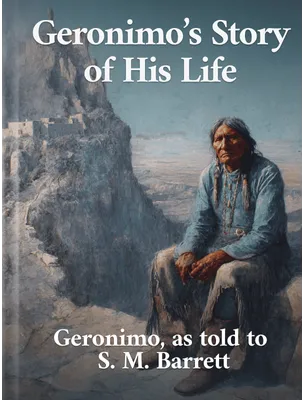
 Geronimo
Dedicatory
Because he has given me permission to tell my story; because he has read that story and knows I try to speak the truth; because I believe that he is fair-minded and will cause my people to receive justice in the future; and because he is chief of a great people, I dedicate this story of my life to Theodore Roosevelt, President of the United States.
Geronimo.
Preface
The initial idea of the compilation of this work was to give the reading public an authentic record of the private life of the Apache Indians, and to extend to Geronimo as a prisoner of war the courtesy due any captive, i. e., the right to state the causes which impelled him in his opposition to our civilization and laws.
If the Indians’ cause has been properly presented, the captives’ defense clearly stated, and the general store of information regarding vanishing types increased, I shall be satisfied.
I desire to acknowledge valuable suggestions from Maj. Charles Taylor, Fort Sill, Oklahoma; Dr. J. M. Greenwood, Kansas City, Missouri, and President David R. Boyd, of the University of Oklahoma.
I especially desire in this connection to say that without the kindly advice and assistance of President Theodore Roosevelt this book could not have been written.
Respectfully,
S. M. Barrett.
Lawton, Oklahoma.
August 14, 1906.
 How the book was made
Introductory
I first met Geronimo in the summer of 1904, when I acted for him as interpreter of English into Spanish, and vice versa, in selling a war bonnet. After that he always had a pleasant word for me when we met, but never entered into a general conversation with me until he learned that I had once been wounded by a Mexican. As soon as he was told of this, he came to see me and expressed freely his opinion of the average Mexican, and his aversion to all Mexicans in general.
I invited him to visit me again, which he did, and upon his invitation, I visited him at his tepee in the Fort Sill Military reservation.
In the summer of 1905 Dr. J. M. Greenwood, superintendent of schools at Kansas City, Missouri, visited me, and I took him to see the chief. Geronimo was quite formal and reserved until Dr. Greenwood said, “I am a friend of General Howard, whom I have heard speak of you.” “Come,” said Geronimo, and led the way to a shade, had seats brought for us, put on his war bonnet, and served watermelon à l’Apache (cut in big chunks), while he talked freely and cheerfully. When we left he gave us a pressing invitation to visit him again.
In a few days the old chief came to see me and asked about “my father.” I said “you mean the old gentleman from Kansas City — he has returned to his home.” “He is you father?” said Geronimo. “No,” I said, “my father died twenty-five years ago, Dr. Greenwood is only my friend.” After a moment’s silence the old Indian spoke again, this time in a tone of voice intended to carry conviction, or at least to allow no further discussion. “Your natural father is dead, this man has been your friend and adviser from youth. By adoption he is your father. Tell him he is welcome to come to my home at any time.” It was of no use to explain any more, for the old man had determined not to understand my relation to Dr. Greenwood except in accordance with Indian customs, and I let the matter drop.
In the latter part of that summer I asked the old chief to allow me to publish some of the things he had told me, but he objected, saying, however, that if I would pay him, and if the officers in charge did not object, he would tell me the whole story of his life. I immediately called at the fort (Fort Sill) and asked the officer in charge, Lieutenant Purington, for permission to write the life of Geronimo. I was promptly informed that the privilege would not be granted. Lieutenant Purington explained to me the many depredations committed by Geronimo and his warriors, and the enormous cost of subduing the Apaches, adding that the old Apache deserved to be hanged rather than spoiled by so much attention from civilians. A suggestion from me that our government had paid many soldiers and officers to go to Arizona and kill Geronimo and the Apaches, and that they did not seem to know how to do it, did not prove very gratifying to the pride of the regular army officer, and I decided to seek elsewhere for permission. Accordingly I wrote to President Roosevelt that here was an old Indian who had been held a prisoner of war for twenty years and had never been given a chance to tell his side of the story, and asked that Geronimo be granted permission to tell for publication, in his own way, the story of his life, and that he be guaranteed that the publication of his story would not affect unfavorably the Apache prisoners of war. By return mail I received word that the authority had been granted. In a few days I received word from Fort Sill that the President had ordered the officer in charge to grant permission as requested. An interview was requested that I might receive the instructions of the War Department. When I went to Fort Sill the officer in command handed me the following brief, which constituted my instructions:
Lawton, Oklahoma, Aug. 12th, 1905.
Geronimo, — Apache Chief —
S. M. Barrett, Supt. Schools.
Letter to the President stating that above-mentioned desires to tell his life story that it may be published, and requests permission to tell it in his own way, and also desires assurance that what he has to say will in no way work a hardship for the Apache tribe.
1st Endorsement.
War Department,
The Military Secretary’s Office,
Washington, August 25th, 1905.
Respectfully referred, by direction of the Acting Chief of Staff, through headquarters, Department of Texas, to the Officer In Charge of the Apache prisoners of war at Fort Sill, Oklahoma Territory, for remark and recommendation.
(Signed) E. F. Ladd,
Military Secretary.
2d Endorsement.
Headquarters Department of Texas,
Military Secretary’s Office,
San Antonio, August 29th, 1905.
Respectfully transmitted to 1st Lieut. George A. Purington, 8th Cavalry, In Charge of Apache prisoners. (Thro’ Commanding Officer, Fort Sill, O. T.)
By Command of Brigadier General Lee.
(Signed) C. D. Roberts,
Captain, 7th Infantry,
Acting Military Secretary.
3d Endorsement.
Fort Sill, O. T., Aug. 31st, 1905.
Respectfully referred to 1st Lieut. G. A. Purington, 8th Cavalry, Officer in Charge of Apache prisoners of war, for remark and recommendation.
By Order of Captain Dade.
(Signed) James Longstreet,
1st. Lieut & Sqdn. Adjt., 13th Cavalry. Adjutant.
4th Endorsement.
Fort Sill, O. T., Sept. 2d, 1905.
Respectfully returned to the Adjutant, Fort Sill, O. T. I can see no objection to Geronimo telling the story of his past life, providing he tells the truth. I would recommend that Mr. S. M. Barrett be held responsible for what is written and published.
(Signed) Geo. A. Purington,
1st. Lieut. 8th Cavalry,
In Charge of Apache prisoners of war.
5th Endorsement.
Fort Sill, O. T., Sept. 4th, 1905.
Respectfully returned to the Military Secretary, Dept. of Texas, San Antonio, Texas, inviting attention to 4th endorsement hereon. It is recommended that the manuscript be submitted before publication to Lieut. Purington, who can pass upon the truth of the story.
(Signed) A. L. Dade,
Captain, 13th Cavalry, Commanding.
6th Endorsement.
Headquarters Dept. of Texas,
San Antonio, September 8th, 1905.