The book was published in 1899.
[{"id":"para_1","index":0,"start":0,"offset":339,"words":6,"paraNum":"","lastModified":1634282320000,"semanticType":"title-book-title","voicework":"no_audio","blockId":"the_future_of_the_american_negro_ffa_en-bl2u","language":"en","wordsRange":{"start":325000000,"end":332000000},"paragraphVersion":36,"direction":"ltr","paragraph":"<h1 class=\"ilm-title\" id=\"para_1\" semantictype=\"title-book-title\" data-ilmid=\"the_future_of_the_american_negro_ffa_en-bl2u\" data-chapter=\"para_1\" data-words-count=\"6\" data-before=\"0\" data-ww=\"\"><span class=\"block-pb\"> <span class=\"block-pb is-animated\"></span> </span><span class=\"itm-wrap\">The Future of the American Negro<br></span></h1>","hasContent":true,"isFirst":true,"isLast":false},{"id":"para_2","index":1,"start":339,"offset":358,"words":3,"paraNum":"","lastModified":1660531800000,"semanticType":"title-author","voicework":"no_audio","blockId":"the_future_of_the_american_negro_ffa_en-bl2v","language":"en","wordsRange":{"start":432000000,"end":436000000},"paragraphVersion":52,"direction":"ltr","paragraph":"<h1 class=\"ilm-title ilm-author ilm-x-large ilm-nopad\" id=\"para_2\" semantictype=\"title-author\" data-ilmid=\"the_future_of_the_american_negro_ffa_en-bl2v\" data-chapter=\"para_2\" data-words-count=\"3\" data-before=\"6\" data-ww=\"\"><span class=\"block-pb\"> <span class=\"block-pb is-animated\"></span> </span><span class=\"itm-wrap\">by<br>Booker T. Washington</span></h1>","hasContent":true,"isFirst":false,"isLast":false},{"id":"para_3","index":2,"start":697,"offset":167,"words":0,"paraNum":"","lastModified":1634282803000,"semanticType":"line","blockId":"the_future_of_the_american_negro_ffa_en-blbw","language":"en","wordsRange":{"start":469333333,"end":502666667},"paragraphVersion":40,"direction":"ltr","paragraph":"<hr class=\"ilm-hr ilm-small\" id=\"para_3\" semantictype=\"line\" data-ilmid=\"the_future_of_the_american_negro_ffa_en-blbw\" data-words-count=\"0\" data-before=\"9\" data-ww=\"\">","hasContent":true,"isFirst":false,"isLast":false},{"id":"para_4","index":3,"start":864,"offset":1146,"words":0,"paraNum":"","lastModified":1660743837000,"semanticType":"illustration","blockId":"the_future_of_the_american_negro_ffa_en-bl2w","language":"en","wordsRange":{"start":536000000,"end":538000000},"paragraphVersion":55,"direction":"ltr","paragraph":"<div class=\"ilm-illustration\" id=\"para_4\" semantictype=\"illustration\" data-ilmid=\"the_future_of_the_american_negro_ffa_en-bl2w\" data-words-count=\"0\" data-before=\"9\" data-ww=\"\"><img width=\"362\" height=\"512\" data-src=\"ch0p0\" src=\"data:image/webp;base64,UklGRnQCAABXRUJQVlA4IGgCAABQDACdASokADMAPm0ulUckIiIhKBqqqIANiUAYBALhJlbfi9XToLBpPlGaPtlz1RnpfC91BVONHP2skrpe2fd8UA4Hk0prJ8S4G+035IXHFe7y4MypbkAcigU2PUQub5GpM49+4FY+4cGn4AD4RkKi+/Uv+38vKePN4XLpu40n3XNmGVoUW6F144P87seVGl7RoS7Mx5GiOT4tm27YjA59NAQPJUmITOIw/VJZSue1Tkkg1SyO8xsOAa53rCcgevSENe7xzlY4eulKScmhtjSs+JorXUJkA1ROFUhqG/1twvndbJayMrlbIBwQAdfThjFMz0jnHmvy0imdAEwj0PPDMEGTY5HcCulE1MPBpOlPjn22m9Xq/YedY3pjkW47REf7f0SFzmoY/3PLGbs7sa7ekWPbYkindqdpUj94r77itRHSPnd5n9wqVuidMKWjzjAYBHhCxlCFsd0YMToMxQr9vviEfUzz4C1VKCwagQcboyCnWxIPFyG6gF1ph8WtuBG4AABgmKYxIO12E9ibMhRrcxt9m3B/+BGewdcesok5VNa8SmCCIOrzIFYNsaV+6f2yWnfhLwZCJIN+9qRVTOhnpB+6tfPWYz1ugnQbUj+zH74mSk5AaKnywi7n39wzE/Okq4S9PJdgciq75q97nWqPNL6TfHt/EfJR4kVabF2GEFAMEKkcWg+SuQpng/rbRo2cT+YfNyDki2ySnam8Wl/RGh1noHaal9LnDt312LC9zbKvqdJxrb5BFwgfjtfcXXtaCXanEtg4vjclSQwpu9bYcLvMQtRkDe4EzUEJxQsqftgUoAH86AAA\" alt=\"The Future of the American Negro\"></div>","hasContent":true,"isFirst":false,"isLast":false},{"id":"para_5","index":4,"start":2010,"offset":332,"words":1,"paraNum":"","lastModified":1660532235000,"semanticType":"header-subheader","voicework":"no_audio","blockId":"the_future_of_the_american_negro_ffa_en-bl36","language":"en","wordsRange":{"start":1592000000,"end":1594000000},"paragraphVersion":56,"direction":"ltr","paragraph":"<h3 class=\"ilm-header ilm-h3 ilm-large\" id=\"para_5\" semantictype=\"header-subheader\" data-ilmid=\"the_future_of_the_american_negro_ffa_en-bl36\" data-chapter=\"para_5\" data-words-count=\"1\" data-before=\"9\" data-ww=\"\"><span class=\"block-pb\"> <span class=\"block-pb is-animated\"></span> </span><span class=\"itm-wrap\">Preface<br></span></h3>","hasContent":true,"isFirst":false,"isLast":false},{"id":"para_6","index":5,"start":2342,"offset":992,"words":56,"paraNum":"p.1","lastModified":1634282839000,"semanticType":"par","voicework":"no_audio","blockId":"the_future_of_the_american_negro_ffa_en-bl37","language":"en","wordsRange":{"start":1694000000,"end":1751000000},"paragraphVersion":37,"direction":"ltr","paragraph":"<p id=\"para_6\" semantictype=\"par\" data-ilmid=\"the_future_of_the_american_negro_ffa_en-bl37\" data-words-count=\"56\" data-before=\"10\" data-ww=\"\"><span class=\"block-num\" data-id=\"p.1\"></span><span class=\"block-pb\"> <span class=\"block-pb is-animated\"></span> </span><span class=\"itm-wrap\"><i>In </i><i>giving </i><i>this </i><i>volume </i><i>to </i><i>the </i><i>public, </i><i>I </i><i>deem </i><i>it </i><i>fair </i><i>to </i><i>say </i><i>that </i><i>I </i><i>have </i><i>yielded </i><i>to </i><i>the </i><i>oft-repeated </i><i>requests </i><i>that </i><i>I </i><i>put </i><i>in </i><i>some </i><i>more </i><i>definite </i><i>and </i><i>permanent </i><i>form </i><i>the </i><i>ideas </i><i>regarding </i><i>the </i><i>Negro </i><i>and </i><i>his </i><i>future </i><i>which </i><i>I </i><i>have </i><i>expressed </i><i>many </i><i>times </i><i>on </i><i>the </i><i>public </i><i>platform </i><i>and </i><i>through </i><i>the </i><i>public </i><i>press </i><i>and </i><i>magazines.</i></span></p>","hasContent":true,"isFirst":false,"isLast":false},{"id":"para_7","index":6,"start":3334,"offset":800,"words":37,"paraNum":"p.2","lastModified":1634282839000,"semanticType":"par","voicework":"no_audio","blockId":"the_future_of_the_american_negro_ffa_en-bl38","language":"en","wordsRange":{"start":1851000000,"end":1889000000},"paragraphVersion":37,"direction":"ltr","paragraph":"<p id=\"para_7\" semantictype=\"par\" data-ilmid=\"the_future_of_the_american_negro_ffa_en-bl38\" data-words-count=\"37\" data-before=\"66\" data-ww=\"\"><span class=\"block-num\" data-id=\"p.2\"></span><span class=\"block-pb\"> <span class=\"block-pb is-animated\"></span> </span><span class=\"itm-wrap\"><i>I </i><i>make </i><i>grateful </i><i>acknowledgment </i><i>to </i><i>the </i><i>“Atlantic </i><i>Monthly” </i><i>and </i><i>“Appleton’s </i><i>Popular </i><i>Science </i><i>Monthly” </i><i>for </i><i>their </i><i>kindness </i><i>in </i><i>granting </i><i>permission </i><i>for </i><i>the </i><i>use </i><i>of </i><i>some </i><i>part </i><i>of </i><i>articles </i><i>which </i><i>I </i><i>have </i><i>at </i><i>various </i><i>times </i><i>contributed </i><i>to </i><i>their </i><i>columns.</i></span></p>","hasContent":true,"isFirst":false,"isLast":false},{"id":"para_8","index":7,"start":4134,"offset":303,"words":3,"paraNum":"","lastModified":1634282897000,"semanticType":"par","voicework":"no_audio","blockId":"the_future_of_the_american_negro_ffa_en-bl39","language":"en","wordsRange":{"start":1989000000,"end":1993000000},"paragraphVersion":43,"direction":"ltr","paragraph":"<p class=\"ilm-right ilm-signature\" id=\"para_8\" semantictype=\"par\" data-ilmid=\"the_future_of_the_american_negro_ffa_en-bl39\" data-words-count=\"3\" data-before=\"103\" data-ww=\"\"><span class=\"block-pb\"> <span class=\"block-pb is-animated\"></span> </span><span class=\"itm-wrap\">BOOKER T. WASHINGTON.</span></p>","hasContent":true,"isFirst":false,"isLast":false},{"id":"para_9","index":8,"start":4437,"offset":380,"words":10,"paraNum":"","lastModified":1634569752000,"semanticType":"par","voicework":"no_audio","blockId":"the_future_of_the_american_negro_ffa_en-bl3a","language":"en","wordsRange":{"start":2093000000,"end":2104000000},"paragraphVersion":65,"direction":"ltr","paragraph":"<p class=\"ilm-smallcaps ilm-verse\" id=\"para_9\" semantictype=\"par\" data-ilmid=\"the_future_of_the_american_negro_ffa_en-bl3a\" data-words-count=\"10\" data-before=\"106\" data-ww=\"\"><span class=\"block-pb\"> <span class=\"block-pb is-animated\"></span> </span><span class=\"itm-wrap\">Tuskegee Normal and Industrial Institute, <br> Tuskegee, Ala., October 1, 1899.</span></p>","hasContent":true,"isFirst":false,"isLast":false},{"id":"para_10","index":9,"start":4817,"offset":170,"words":0,"paraNum":"","lastModified":1632312246000,"semanticType":"line","blockId":"the_future_of_the_american_negro_ffa_en-bl3b","language":"en","wordsRange":{"start":2204000000,"end":2206000000},"paragraphVersion":52,"direction":"ltr","paragraph":"<hr class=\"ilm-hr ilm-small\" id=\"para_10\" semantictype=\"line\" data-ilmid=\"the_future_of_the_american_negro_ffa_en-bl3b\" data-words-count=\"0\" data-before=\"116\" data-ww=\"\">","hasContent":true,"isFirst":false,"isLast":false},{"id":"para_11","index":10,"start":4987,"offset":518,"words":2,"paraNum":"","lastModified":1634283123000,"semanticType":"header-chapter-header","voicework":"no_audio","blockId":"the_future_of_the_american_negro_ffa_en-bl3w","language":"en","wordsRange":{"start":4884000000,"end":4887000000},"paragraphVersion":51,"direction":"ltr","paragraph":"<h2 class=\"ilm-header ilm-h2 ilm-large\" id=\"para_11\" semantictype=\"header-chapter-header\" data-ilmid=\"the_future_of_the_american_negro_ffa_en-bl3w\" data-chapter=\"para_11\" data-words-count=\"2\" data-before=\"116\" data-ww=\"\"><span class=\"block-pb\"> <span class=\"block-pb is-animated\"></span> </span><span class=\"itm-wrap\"><span class=\"chapter-text\"><span class=\"chapter-number\"><span class=\"chapter-label\"></span><span class=\"chapter-value\"></span></span><span class=\"chapter-title\">Chapter I<br></span></span></span></h2>","hasContent":true,"isFirst":false,"isLast":false},{"id":"para_12","index":11,"start":5505,"offset":1764,"words":259,"paraNum":"1.1","lastModified":1634537631000,"semanticType":"par","voicework":"no_audio","blockId":"the_future_of_the_american_negro_ffa_en-bl3x","language":"en","wordsRange":{"start":4987000000,"end":5249000000},"paragraphVersion":43,"direction":"ltr","paragraph":"<p id=\"para_12\" semantictype=\"par\" data-ilmid=\"the_future_of_the_american_negro_ffa_en-bl3x\" data-words-count=\"259\" data-before=\"118\" data-ww=\"\"><span class=\"block-num\" data-id=\"1.1\"></span><span class=\"block-pb\"> <span class=\"block-pb is-animated\"></span> </span><span class=\"itm-wrap\">In this volume I shall not attempt to give the origin and history of the Negro race either in Africa or in America. My attempt is to deal only with conditions that now exist and bear a relation to the Negro in America and that are likely to exist in the future. In discussing the Negro, it is always to be borne in mind that, unlike all the other inhabitants of America, he came here without his own consent; in fact, was compelled to leave his own country and become a part of another through physical force. It should also be borne in mind, in our efforts to change and improve the present condition of the Negro, that we are dealing with a race which had little necessity to labour in its native country. After being brought to America, the Negroes were forced to labour for about 250 years under circumstances which were calculated not to <span data-pg=\"4\"></span> inspire them with love and respect for labour. This constitutes a part of the reason why I insist that it is necessary to emphasise the matter of industrial education as a means of giving the black man the foundation of a civilisation upon which he will grow and prosper. When I speak of industrial education, however, I wish it always understood that I mean, as did General Armstrong, the founder of the Hampton Institute, for thorough academic and religious training to go side by side with industrial training. Mere training of the hand without the culture of brain and heart would mean little.</span></p>","hasContent":true,"isFirst":false,"isLast":false},{"id":"para_13","index":12,"start":7269,"offset":1260,"words":166,"paraNum":"1.2","lastModified":1634537631000,"semanticType":"par","voicework":"no_audio","blockId":"the_future_of_the_american_negro_ffa_en-bl3y","language":"en","wordsRange":{"start":5349000000,"end":5518000000},"paragraphVersion":43,"direction":"ltr","paragraph":"<p id=\"para_13\" semantictype=\"par\" data-ilmid=\"the_future_of_the_american_negro_ffa_en-bl3y\" data-words-count=\"166\" data-before=\"377\" data-ww=\"\"><span class=\"block-num\" data-id=\"1.2\"></span><span class=\"block-pb\"> <span class=\"block-pb is-animated\"></span> </span><span class=\"itm-wrap\">The first slaves were brought into this country by the Dutch in 1619, and were landed at Jamestown, Virginia. The first cargo consisted of twenty. The census taken in 1890 shows that these twenty slaves had increased to 7,638,360. About 6,353,341 of this <span data-pg=\"5\"></span> number were residing in the Southern States, and 1,283,029 were scattered throughout the Northern and Western States. I think I am pretty safe in predicting that the census to be taken in 1900 will show that there are not far from ten millions of people of African descent in the United States. The great majority of these, of course, reside in the Southern States. The problem is how to make these millions of Negroes self-supporting, intelligent, economical and valuable citizens, as well as how to bring about proper relations between them and the white citizens among whom they live. This is the question upon which I shall try to throw some light in the chapters which follow.</span></p>","hasContent":true,"isFirst":false,"isLast":false},{"id":"para_14","index":13,"start":8529,"offset":2636,"words":411,"paraNum":"1.3","lastModified":1634537631000,"semanticType":"par","voicework":"no_audio","blockId":"the_future_of_the_american_negro_ffa_en-bl3z","language":"en","wordsRange":{"start":5618000000,"end":6036000000},"paragraphVersion":45,"direction":"ltr","paragraph":"<p id=\"para_14\" semantictype=\"par\" data-ilmid=\"the_future_of_the_american_negro_ffa_en-bl3z\" data-words-count=\"411\" data-before=\"543\" data-ww=\"\"><span class=\"block-num\" data-id=\"1.3\"></span><span class=\"block-pb\"> <span class=\"block-pb is-animated\"></span> </span><span class=\"itm-wrap\">When the Negroes were first brought to America, they were owned by white people in all sections of this country, as is well known, — in the New England, the Middle, and in the Southern States. <span data-pg=\"6\"></span> It was soon found, however, that slave labour was not remunerative in the Northern States, and for that reason by far the greater proportion of the slaves were held in the Southern States, where their labour in raising cotton, rice, and sugar-cane was more productive. The growth of the slave population in America was constant and rapid. Beginning, as I have stated, with fourteen, in 1619, the number increased at such a rate that the total number of Negroes in America in 1800 was 1,001,463. This number increased by 1860 to 3,950,000. A few people predicted that freedom would result disastrously to the Negro, as far as numerical increase was concerned; but so far the census figures have failed to bear out this prediction. On the other hand, the census of 1890 shows that the Negro population had increased from 3,950,000 in 1860 to 7,638,260 twenty-five years after the war. It is my opinion that the <span data-pg=\"7\"></span> rate of increase in the future will be still greater than it has been from the close of the war of the Rebellion up to the present time, for the reason that the very sudden changes which took place in the life of the Negro, because of having his freedom, plunged him into many excesses that were detrimental to his physical well-being. Of course, freedom found him unprepared in clothing, in shelter and in knowledge of how to care for his body. During slavery the slave mother had little control of her own children, and did not therefore have the practice and experience of rearing children in a suitable manner. Now that the Negro is being taught in thousands of schools how to take care of his body, and in thousands of homes mothers are learning how to control their children, I believe that the rate of increase, as I have stated, will be still greater than it has been in the past. In too many cases the Negro had the idea that freedom <span data-pg=\"8\"></span> meant merely license to do as he pleased, to work or not to work; but this erroneous idea is more and more disappearing, by reason of the education in the right direction which the Negro is constantly receiving.</span></p>","hasContent":true,"isFirst":false,"isLast":false},{"id":"para_15","index":14,"start":11165,"offset":1550,"words":219,"paraNum":"1.4","lastModified":1634537631000,"semanticType":"par","voicework":"no_audio","blockId":"the_future_of_the_american_negro_ffa_en-bl40","language":"en","wordsRange":{"start":6136000000,"end":6358000000},"paragraphVersion":43,"direction":"ltr","paragraph":"<p id=\"para_15\" semantictype=\"par\" data-ilmid=\"the_future_of_the_american_negro_ffa_en-bl40\" data-words-count=\"219\" data-before=\"954\" data-ww=\"\"><span class=\"block-num\" data-id=\"1.4\"></span><span class=\"block-pb\"> <span class=\"block-pb is-animated\"></span> </span><span class=\"itm-wrap\">During the four years that the Civil War lasted, the greater proportion of the Negroes remained in the South, and worked faithfully for the support of their masters’ families, who, as a general rule, were away in the war. The self-control which the Negro exhibited during the war marks, it seems to me, one of the most important chapters in the history of the race. Notwithstanding he knew that his master was away from home, fighting a battle which, if successful, would result in his continued enslavement, yet he worked faithfully for the support of the master’s family. If the Negro had yielded to the temptation and suggestion to use the torch or dagger in an attempt to destroy his <span data-pg=\"9\"></span> master’s property and family, the result would have been that the war would have been ended quickly; for the master would have returned from the battlefield to protect and defend his property and family. But the Negro to the last was faithful to the trust that had been thrust upon him, and during the four years of war in which the male members of the family were absent from their homes there is not a single instance recorded where he in any way attempted to outrage the family of the master or in any way to injure his property.</span></p>","hasContent":true,"isFirst":false,"isLast":false},{"id":"para_16","index":15,"start":12715,"offset":732,"words":78,"paraNum":"1.5","lastModified":1634537631000,"semanticType":"par","voicework":"no_audio","blockId":"the_future_of_the_american_negro_ffa_en-bl41","language":"en","wordsRange":{"start":6458000000,"end":6539000000},"paragraphVersion":43,"direction":"ltr","paragraph":"<p id=\"para_16\" semantictype=\"par\" data-ilmid=\"the_future_of_the_american_negro_ffa_en-bl41\" data-words-count=\"78\" data-before=\"1173\" data-ww=\"\"><span class=\"block-num\" data-id=\"1.5\"></span><span class=\"block-pb\"> <span class=\"block-pb is-animated\"></span> </span><span class=\"itm-wrap\">Not only is this true, but all through the years of preparation for the war and during the war itself the Negro showed himself to be an uncompromising friend to the Union. In fact, of all the charges brought against him, there is scarcely a single instance where one has been charged with being a traitor to his country. This has been true whether <span data-pg=\"10\"></span> he has been in a state of slavery or in a state of freedom.</span></p>","hasContent":true,"isFirst":false,"isLast":false},{"id":"para_17","index":16,"start":13447,"offset":1579,"words":212,"paraNum":"1.6","lastModified":1634537631000,"semanticType":"par","voicework":"no_audio","blockId":"the_future_of_the_american_negro_ffa_en-bl42","language":"en","wordsRange":{"start":6639000000,"end":6854000000},"paragraphVersion":43,"direction":"ltr","paragraph":"<p id=\"para_17\" semantictype=\"par\" data-ilmid=\"the_future_of_the_american_negro_ffa_en-bl42\" data-words-count=\"212\" data-before=\"1251\" data-ww=\"\"><span class=\"block-num\" data-id=\"1.6\"></span><span class=\"block-pb\"> <span class=\"block-pb is-animated\"></span> </span><span class=\"itm-wrap\">From 1865 to 1876 constituted what perhaps may be termed the days of Reconstruction. This was the period when the Southern States which had withdrawn from the Union were making an effort to reinstate themselves and to establish a permanent system of State government. At the close of the war both the Southern white man and the Negro found themselves in the midst of poverty. The ex-master returned from the war to find his slave property gone, his farms and other industries in a state of collapse, and the whole industrial or economic system upon which he had depended for years entirely disorganised. As we review calmly and dispassionately the period of reconstruction, we must use a great deal of sympathy and generosity. The weak point, to my mind, in the reconstruction era was that no strong force was brought to bear in the <span data-pg=\"11\"></span> direction of preparing the Negro to become an intelligent, reliable citizen and voter. The main effort seems to have been in the direction of controlling his vote for the time being, regardless of future interests. I hardly believe that any race of people with similar preparation and similar surroundings would have acted more wisely or very differently from the way the Negro acted during the period of reconstruction.</span></p>","hasContent":true,"isFirst":false,"isLast":false},{"id":"para_18","index":17,"start":15026,"offset":3288,"words":502,"paraNum":"1.7","lastModified":1634537631000,"semanticType":"par","voicework":"no_audio","blockId":"the_future_of_the_american_negro_ffa_en-bl43","language":"en","wordsRange":{"start":6954000000,"end":7463000000},"paragraphVersion":43,"direction":"ltr","paragraph":"<p id=\"para_18\" semantictype=\"par\" data-ilmid=\"the_future_of_the_american_negro_ffa_en-bl43\" data-words-count=\"502\" data-before=\"1463\" data-ww=\"\"><span class=\"block-num\" data-id=\"1.7\"></span><span class=\"block-pb\"> <span class=\"block-pb is-animated\"></span> </span><span class=\"itm-wrap\">Without experience, without preparation, and in most cases without ordinary intelligence, he was encouraged to leave the field and shop and enter politics. That under such circumstances he should have made mistakes is very natural. I do not believe that the Negro was so much at fault for entering so largely into politics, and for the mistakes that were made in too many cases, as were the unscrupulous white leaders who got the Negro’s confidence <span data-pg=\"12\"></span> and controlled his vote to further their own ends, regardless, in many cases, of the permanent welfare of the Negro. I have always considered it unfortunate that the Southern white man did not make more of an effort during the period of reconstruction to get the confidence and sympathy of the Negro, and thus have been able to keep him in close touch and sympathy in politics. It was also unfortunate that the Negro was so completely alienated from the Southern white man in all political matters. I think it would have been better for all concerned if, immediately after the close of the war, an educational and property qualification for the exercise of the franchise had been prescribed that would have applied fairly and squarely to both races, and, also, if, in educating the Negro, greater stress had been put upon training him along the lines of industry for which his services were in the greatest demand in the South. <span data-pg=\"13\"></span> In a word, too much stress was placed upon the mere matter of voting and holding political office rather than upon the preparation for the highest citizenship. In saying what I have, I do not mean to convey the impression that the whole period of reconstruction was barren of fruitful results. While it is not a very encouraging chapter in the history of our country, I believe that this period did serve to point out many weak points in our effort to elevate the Negro, and that we are now taking advantage of the mistakes that were made. The period of reconstruction served at least to show the world that with proper preparation and with a sufficient foundation the Negro possesses the elements out of which men of the highest character and usefulness can be developed. I might name several characters who were brought before the world by reason of the reconstruction period. I give one as an example <span data-pg=\"14\"></span> of others: Hon. Blanche K. Bruce, who had been a slave, but who held many honourable positions in the State of Mississippi, including an election to the United States Senate, where he served a full term; later he was twice appointed Register of the United States Treasury. In all these positions Mr. Bruce gave the greatest satisfaction, and not a single whisper of dishonesty or incompetency has ever been heard against him. During the period of his public life he was brought into active and daily contact with Northern and Southern white people, all of whom speak of him in the highest measure of respect and confidence.</span></p>","hasContent":true,"isFirst":false,"isLast":false},{"id":"para_19","index":18,"start":18314,"offset":712,"words":68,"paraNum":"1.8","lastModified":1634537631000,"semanticType":"par","voicework":"no_audio","blockId":"the_future_of_the_american_negro_ffa_en-bl44","language":"en","wordsRange":{"start":7563000000,"end":7634000000},"paragraphVersion":44,"direction":"ltr","paragraph":"<p id=\"para_19\" semantictype=\"par\" data-ilmid=\"the_future_of_the_american_negro_ffa_en-bl44\" data-words-count=\"68\" data-before=\"1965\" data-ww=\"\"><span class=\"block-num\" data-id=\"1.8\"></span><span class=\"block-pb\"> <span class=\"block-pb is-animated\"></span> </span><span class=\"itm-wrap\">What the Negro wants and what the country wants to do is to take advantage of all the lessons that were taught during the days of reconstruction, and apply these lessons bravely, honestly, in laying the foundation upon which the Negro can stand in the future and <span data-pg=\"15\"></span> make himself a useful, honourable, and desirable citizen, whether he has his residence in the North, the South, or the West.</span></p>","hasContent":true,"isFirst":false,"isLast":false},{"id":"para_20","index":19,"start":19026,"offset":171,"words":0,"paraNum":"","lastModified":1634283297000,"semanticType":"line","blockId":"the_future_of_the_american_negro_ffa_en-bl46","language":"en","wordsRange":{"start":7836000000,"end":7839000000},"paragraphVersion":48,"direction":"ltr","paragraph":"<hr class=\"ilm-hr ilm-small\" id=\"para_20\" semantictype=\"line\" data-ilmid=\"the_future_of_the_american_negro_ffa_en-bl46\" data-words-count=\"0\" data-before=\"2033\" data-ww=\"\">","hasContent":true,"isFirst":false,"isLast":false},{"id":"para_21","index":20,"start":19197,"offset":520,"words":2,"paraNum":"","lastModified":1634283321000,"semanticType":"header-chapter-header","voicework":"no_audio","blockId":"the_future_of_the_american_negro_ffa_en-bl47","language":"en","wordsRange":{"start":7939000000,"end":7942000000},"paragraphVersion":50,"direction":"ltr","paragraph":"<h2 class=\"ilm-header ilm-h2 ilm-large\" id=\"para_21\" semantictype=\"header-chapter-header\" data-ilmid=\"the_future_of_the_american_negro_ffa_en-bl47\" data-chapter=\"para_21\" data-words-count=\"2\" data-before=\"2033\" data-ww=\"\"><span class=\"block-pb\"> <span class=\"block-pb is-animated\"></span> </span><span class=\"itm-wrap\"><span class=\"chapter-text\"><span class=\"chapter-number\"><span class=\"chapter-label\"></span><span class=\"chapter-value\"></span></span><span class=\"chapter-title\">Chapter II<br></span></span></span></h2>","hasContent":true,"isFirst":false,"isLast":false},{"id":"para_22","index":21,"start":19717,"offset":1004,"words":129,"paraNum":"2.1","lastModified":1634283021000,"semanticType":"par","voicework":"no_audio","blockId":"the_future_of_the_american_negro_ffa_en-bl48","language":"en","wordsRange":{"start":8042000000,"end":8171000000},"paragraphVersion":39,"direction":"ltr","paragraph":"<p id=\"para_22\" semantictype=\"par\" data-ilmid=\"the_future_of_the_american_negro_ffa_en-bl48\" data-words-count=\"129\" data-before=\"2035\" data-ww=\"\"><span class=\"block-num\" data-id=\"2.1\"></span><span class=\"block-pb\"> <span class=\"block-pb is-animated\"></span> </span><span class=\"itm-wrap\">In order that the reader may understand me and why I lay so much stress upon the importance of pushing the doctrine of industrial education for the Negro, it is necessary, first of all, to review the condition of affairs at the present time in the Southern States. For years I have had something of an opportunity to study the Negro at first-hand; and I feel that I know him pretty well, — him and his needs, his failures and his successes, his desires and the likelihood of their fulfilment. I have studied him and his relations with his white neighbours, and striven to find how these relations may be made more conducive to the general peace and welfare both of the South and of the country at large.</span></p>","hasContent":true,"isFirst":false,"isLast":false},{"id":"para_23","index":22,"start":20721,"offset":1675,"words":239,"paraNum":"2.2","lastModified":1634283351000,"semanticType":"par","voicework":"no_audio","blockId":"the_future_of_the_american_negro_ffa_en-bl49","language":"en","wordsRange":{"start":8271000000,"end":8515000000},"paragraphVersion":41,"direction":"ltr","paragraph":"<p id=\"para_23\" semantictype=\"par\" data-ilmid=\"the_future_of_the_american_negro_ffa_en-bl49\" data-words-count=\"239\" data-before=\"2164\" data-ww=\"\"><span class=\"block-num\" data-id=\"2.2\"></span><span class=\"block-pb\"> <span class=\"block-pb is-animated\"></span> </span><span class=\"itm-wrap\">In the Southern part of the United States there are twenty-two millions of people who are bound to the fifty millions of the North by ties which neither <span data-pg=\"17\"></span> can tear asunder if they would. The most intelligent in a New York community has his intelligence darkened by the ignorance of a fellow-citizen in the Mississippi bottoms. The most wealthy in New York City would be more wealthy but for the poverty of a fellow-being in the Carolina rice swamps. The most moral and religious men in Massachusetts have their religion and morality modified by the degradation of the man in the South whose religion is a mere matter of form or of emotionalism. The vote of the man in Maine that is cast for the highest and purest form of government is largely neutralised by the vote of the man in Louisiana whose ballot is stolen or cast in ignorance. Therefore, when the South is ignorant, the North is ignorant; when the South is poor, the North is poor; when the South commits crime, the nation commits crime. For the citizens of the North there is <span data-pg=\"18\"></span> no escape; they must help raise the character of the civilisation in the South, or theirs will be lowered. No member of the white race in any part of the country can harm the weakest or meanest member of the black race without the proudest and bluest blood of the nation being degraded.</span></p>","hasContent":true,"isFirst":false,"isLast":false},{"id":"para_24","index":23,"start":22396,"offset":2771,"words":430,"paraNum":"2.3","lastModified":1634283377000,"semanticType":"par","voicework":"no_audio","blockId":"the_future_of_the_american_negro_ffa_en-bl4a","language":"en","wordsRange":{"start":8615000000,"end":9050000000},"paragraphVersion":41,"direction":"ltr","paragraph":"<p id=\"para_24\" semantictype=\"par\" data-ilmid=\"the_future_of_the_american_negro_ffa_en-bl4a\" data-words-count=\"430\" data-before=\"2403\" data-ww=\"\"><span class=\"block-num\" data-id=\"2.3\"></span><span class=\"block-pb\"> <span class=\"block-pb is-animated\"></span> </span><span class=\"itm-wrap\">It seems to me that there never was a time in the history of the country when those interested in education should the more earnestly consider to what extent the mere acquiring of the ability to read and write, the mere acquisition of a knowledge of literature and science, makes men producers, lovers of labour, independent, honest, unselfish, and, above all, good. Call education by what name you please, if it fails to bring about these results among the masses, it falls short of its highest end. The science, the art, the literature, that fails to reach down and bring the humblest up to the enjoyment of the fullest <span data-pg=\"19\"></span> blessings of our government, is weak, no matter how costly the buildings or apparatus used or how modern the methods of instruction employed. The study of arithmetic that does not result in making men conscientious in receiving and counting the ballots of their fellow-men is faulty. The study of art that does not result in making the strong less willing to oppress the weak means little. How I wish that from the most cultured and highly endowed university in the great North to the humblest log cabin school-house in Alabama, we could burn, as it were, into the hearts and heads of all that usefulness, that service to our brother, is the supreme end of education. Putting the thought more directly as it applies to conditions in the South, can you make the intelligence of the North affect the South in the same ratio that the ignorance of the South affects the North? Let us take a not improbable case: A great national case <span data-pg=\"20\"></span> is to be decided, one that involves peace or war, the honour or dishonour of our nation, — yea, the very existence of the government. The North and West are divided. There are five million votes to be cast in the South; and, of this number, one-half are ignorant. Not only are one-half the voters ignorant; but, because of the ignorant votes they cast, corruption and dishonesty in a dozen forms have crept into the exercise of the political franchise to such an extent that the conscience of the intelligent class is seared in its attempts to defeat the will of the ignorant voters. Here, then, you have on the one hand an ignorant vote, on the other an intelligent vote minus a conscience. The time may not be far off when to this kind of jury we shall have to look for the votes which shall decide in a large measure the destiny of our democratic institutions.</span></p>","hasContent":true,"isFirst":false,"isLast":false},{"id":"para_25","index":24,"start":25167,"offset":533,"words":38,"paraNum":"2.4","lastModified":1634283388000,"semanticType":"par","voicework":"no_audio","blockId":"the_future_of_the_american_negro_ffa_en-bl4b","language":"en","wordsRange":{"start":9150000000,"end":9191000000},"paragraphVersion":41,"direction":"ltr","paragraph":"<p id=\"para_25\" semantictype=\"par\" data-ilmid=\"the_future_of_the_american_negro_ffa_en-bl4b\" data-words-count=\"38\" data-before=\"2833\" data-ww=\"\"><span class=\"block-num\" data-id=\"2.4\"></span><span class=\"block-pb\"> <span class=\"block-pb is-animated\"></span> </span><span class=\"itm-wrap\">When a great national calamity stares <span data-pg=\"21\"></span> us in the face, we are, I fear, too much given to depending on a short “campaign of education” to do on the hustings what should have been accomplished in the school.</span></p>","hasContent":true,"isFirst":false,"isLast":false},{"id":"para_26","index":25,"start":25700,"offset":699,"words":74,"paraNum":"2.5","lastModified":1634283021000,"semanticType":"par","voicework":"no_audio","blockId":"the_future_of_the_american_negro_ffa_en-bl4c","language":"en","wordsRange":{"start":9291000000,"end":9366000000},"paragraphVersion":39,"direction":"ltr","paragraph":"<p id=\"para_26\" semantictype=\"par\" data-ilmid=\"the_future_of_the_american_negro_ffa_en-bl4c\" data-words-count=\"74\" data-before=\"2871\" data-ww=\"\"><span class=\"block-num\" data-id=\"2.5\"></span><span class=\"block-pb\"> <span class=\"block-pb is-animated\"></span> </span><span class=\"itm-wrap\">With this idea in view, let us examine with more care the condition of civilisation in the South, and the work to be done there before all classes will be fit for the high duties of citizenship. In reference to the Negro race, I am confronted with some embarrassment at the outset, because of the various and conflicting opinions as to what is to be its final place in our economic and political life.</span></p>","hasContent":true,"isFirst":false,"isLast":false},{"id":"para_27","index":26,"start":26399,"offset":1272,"words":177,"paraNum":"2.6","lastModified":1634283396000,"semanticType":"par","voicework":"no_audio","blockId":"the_future_of_the_american_negro_ffa_en-bl4d","language":"en","wordsRange":{"start":9466000000,"end":9646000000},"paragraphVersion":41,"direction":"ltr","paragraph":"<p id=\"para_27\" semantictype=\"par\" data-ilmid=\"the_future_of_the_american_negro_ffa_en-bl4d\" data-words-count=\"177\" data-before=\"2945\" data-ww=\"\"><span class=\"block-num\" data-id=\"2.6\"></span><span class=\"block-pb\"> <span class=\"block-pb is-animated\"></span> </span><span class=\"itm-wrap\">Within the last thirty years — and, I might add, within the last three months, — it has been proven by eminent authority that the Negro is increasing in numbers so fast that it is only a question of a few years before he will far outnumber the white race in the South, and it has also been proven that the <span data-pg=\"22\"></span> Negro is fast dying out, and it is only a question of a few years before he will have completely disappeared. It has also been proven that education helps the Negro and that education hurts him, that he is fast leaving the South and taking up his residence in the North and West, and that his tendency is to drift toward the low lands of the Mississippi bottoms. It has been proven that education unfits the Negro for work and that education makes him more valuable as a labourer, that he is our greatest criminal and that he is our most law-abiding citizen. In the midst of these conflicting opinions, it is hard to hit upon the truth.</span></p>","hasContent":true,"isFirst":false,"isLast":false},{"id":"para_28","index":27,"start":27671,"offset":1905,"words":278,"paraNum":"2.7","lastModified":1634283411000,"semanticType":"par","voicework":"no_audio","blockId":"the_future_of_the_american_negro_ffa_en-bl4e","language":"en","wordsRange":{"start":9746000000,"end":10029000000},"paragraphVersion":41,"direction":"ltr","paragraph":"<p id=\"para_28\" semantictype=\"par\" data-ilmid=\"the_future_of_the_american_negro_ffa_en-bl4e\" data-words-count=\"278\" data-before=\"3122\" data-ww=\"\"><span class=\"block-num\" data-id=\"2.7\"></span><span class=\"block-pb\"> <span class=\"block-pb is-animated\"></span> </span><span class=\"itm-wrap\">But, also, in the midst of this confusion, there are a few things of which I am certain, — things which furnish a basis for thought and action. I know that whether the Negroes are increasing or decreasing, whether they are growing better or worse, whether they <span data-pg=\"23\"></span> are valuable or valueless, that a few years ago some fourteen of them were brought into this country, and that now those fourteen are nearly ten millions. I know that, whether in slavery or freedom, they have always been loyal to the Stars and Stripes, that no school-house has been opened for them that has not been filled, that the 2,000,000 ballots that they have the right to cast are as potent for weal or woe as an equal number cast by the wisest and most influential men in America. I know that wherever Negro life touches the life of the nation it helps or it hinders, that wherever the life of the white race touches the black it makes it stronger or weaker. Further, I know that almost every other race that has tried to look the white man in the face has disappeared. I know, despite all the conflicting opinions, and with a full knowledge of all the Negroes’ weaknesses, that only a few centuries ago they went <span data-pg=\"24\"></span> into slavery in this country pagans, that they came out Christians; they went into slavery as so much property, they came out American citizens; they went into slavery without a language, they came out speaking the proud Anglo-Saxon tongue; they went into slavery with the chains clanking about their wrists, they came out with the American ballot in their hands.</span></p>","hasContent":true,"isFirst":false,"isLast":false},{"id":"para_29","index":28,"start":29576,"offset":1076,"words":138,"paraNum":"2.8","lastModified":1634283419000,"semanticType":"par","voicework":"no_audio","blockId":"the_future_of_the_american_negro_ffa_en-bl4f","language":"en","wordsRange":{"start":10129000000,"end":10270000000},"paragraphVersion":41,"direction":"ltr","paragraph":"<p id=\"para_29\" semantictype=\"par\" data-ilmid=\"the_future_of_the_american_negro_ffa_en-bl4f\" data-words-count=\"138\" data-before=\"3400\" data-ww=\"\"><span class=\"block-num\" data-id=\"2.8\"></span><span class=\"block-pb\"> <span class=\"block-pb is-animated\"></span> </span><span class=\"itm-wrap\">I submit it to the candid and sober judgment of all men, if a race that is capable of such a test, such a transformation, is not worth saving and making a part, in reality as well as in name, of our democratic government. That the Negro may be fitted for the fullest enjoyment of the privileges and responsibilities of our citizenship, it is important that the nation be honest and candid with him, whether honesty and candour for the time being pleases or displeases him. It is with an ignorant race as it is with a child: it craves at first the <span data-pg=\"25\"></span> superficial, the ornamental signs of progress rather than the reality. The ignorant race is tempted to jump, at one bound, to the position that it has required years of hard struggle for others to reach.</span></p>","hasContent":true,"isFirst":false,"isLast":false},{"id":"para_30","index":29,"start":30652,"offset":1563,"words":228,"paraNum":"2.9","lastModified":1634283432000,"semanticType":"par","voicework":"no_audio","blockId":"the_future_of_the_american_negro_ffa_en-bl4g","language":"en","wordsRange":{"start":10370000000,"end":10601000000},"paragraphVersion":41,"direction":"ltr","paragraph":"<p id=\"para_30\" semantictype=\"par\" data-ilmid=\"the_future_of_the_american_negro_ffa_en-bl4g\" data-words-count=\"228\" data-before=\"3538\" data-ww=\"\"><span class=\"block-num\" data-id=\"2.9\"></span><span class=\"block-pb\"> <span class=\"block-pb is-animated\"></span> </span><span class=\"itm-wrap\">It seems to me that, as a general thing, the temptation in the past in educational and missionary work has been to do for the new people that which was done a thousand years ago, or that which is being done for a people a thousand miles away, without making a careful study of the needs and conditions of the people whom it is designed to help. The temptation is to run all people through a certain educational mould, regardless of the condition of the subject or the end to be accomplished. This has been the case too often in the South in the past, I am sure. Men have tried to use, with these simple people just freed from slavery and with no past, no inherited traditions <span data-pg=\"26\"></span> of learning, the same methods of education which they have used in New England, with all its inherited traditions and desires. The Negro is behind the white man because he has not had the same chance, and not from any inherent difference in his nature and desires. What the race accomplishes in these first fifty years of freedom will at the end of these years, in a large measure, constitute its past. It is, indeed, a responsibility that rests upon this nation, — the foundation laying for a people of its past, present, and future at one and the same time.</span></p>","hasContent":true,"isFirst":false,"isLast":false},{"id":"para_31","index":30,"start":32215,"offset":1641,"words":222,"paraNum":"2.10","lastModified":1634283444000,"semanticType":"par","voicework":"no_audio","blockId":"the_future_of_the_american_negro_ffa_en-bl4h","language":"en","wordsRange":{"start":10701000000,"end":10928000000},"paragraphVersion":41,"direction":"ltr","paragraph":"<p id=\"para_31\" semantictype=\"par\" data-ilmid=\"the_future_of_the_american_negro_ffa_en-bl4h\" data-words-count=\"222\" data-before=\"3766\" data-ww=\"\"><span class=\"block-num\" data-id=\"2.10\"></span><span class=\"block-pb\"> <span class=\"block-pb is-animated\"></span> </span><span class=\"itm-wrap\">One of the weakest points in connection with the present development of the race is that so many get the idea that the mere filling of the head with a knowledge of mathematics, the sciences, and literature, means success in life. Let it be understood, in every corner of the South, among the Negro youth at least, that knowledge will benefit little except as it is harnessed, <span data-pg=\"27\"></span> except as its power is pointed in a direction that will bear upon the present needs and condition of the race. There is in the heads of the Negro youth of the South enough general and floating knowledge of chemistry, of botany, of zoölogy, of geology, of mechanics, of electricity, of mathematics, to reconstruct and develop a large part of the agricultural, mechanical, and domestic life of the race. But how much of it is brought to a focus along lines of practical work? In cities of the South like Atlanta, how many coloured mechanical engineers are there? or how many machinists? how many civil engineers? how many architects? how many house decorators? In the whole State of Georgia, where eighty per cent. of the coloured people depend upon agriculture, how many men are there who are well grounded in the principles and practices of scientific farming? or dairy work? or fruit culture? or floriculture? <span data-pg=\"28\"></span></span></p>","hasContent":true,"isFirst":false,"isLast":false},{"id":"para_32","index":31,"start":33856,"offset":1525,"words":219,"paraNum":"2.11","lastModified":1634283467000,"semanticType":"par","voicework":"no_audio","blockId":"the_future_of_the_american_negro_ffa_en-bl4i","language":"en","wordsRange":{"start":11028000000,"end":11250000000},"paragraphVersion":41,"direction":"ltr","paragraph":"<p id=\"para_32\" semantictype=\"par\" data-ilmid=\"the_future_of_the_american_negro_ffa_en-bl4i\" data-words-count=\"219\" data-before=\"3988\" data-ww=\"\"><span class=\"block-num\" data-id=\"2.11\"></span><span class=\"block-pb\"> <span class=\"block-pb is-animated\"></span> </span><span class=\"itm-wrap\">For example, not very long ago I had a conversation with a young coloured man who is a graduate of one of the prominent universities of this country. The father of this man is comparatively ignorant, but by hard work and the exercise of common sense he has become the owner of two thousand acres of land. He owns more than a score of horses, cows, and mules and swine in large numbers, and is considered a prosperous farmer. In college the son of this farmer has studied chemistry, botany, zoölogy, surveying, and political economy. In my conversation I asked this young man how many acres his father cultivated in cotton and how many in corn. With a far-off gaze up into the heavens he answered that he did not know. When I asked him the classification of the soils on his father’s farm, he did not know. He did not know how many horses or cows his father owned nor of what breeds they were, and seemed surprised <span data-pg=\"29\"></span> that he should be asked such questions. It never seemed to have entered his mind that on his father’s farm was the place to make his chemistry, his mathematics, and his literature penetrate and reflect itself in every acre of land, every bushel of corn, every cow, and every pig.</span></p>","hasContent":true,"isFirst":false,"isLast":false},{"id":"para_33","index":32,"start":35381,"offset":678,"words":66,"paraNum":"2.12","lastModified":1634283021000,"semanticType":"par","voicework":"no_audio","blockId":"the_future_of_the_american_negro_ffa_en-bl4j","language":"en","wordsRange":{"start":11350000000,"end":11417000000},"paragraphVersion":39,"direction":"ltr","paragraph":"<p id=\"para_33\" semantictype=\"par\" data-ilmid=\"the_future_of_the_american_negro_ffa_en-bl4j\" data-words-count=\"66\" data-before=\"4207\" data-ww=\"\"><span class=\"block-num\" data-id=\"2.12\"></span><span class=\"block-pb\"> <span class=\"block-pb is-animated\"></span> </span><span class=\"itm-wrap\">Let me give other examples of this mistaken sort of education. When a mere boy, I saw a young coloured man, who had spent several years in school, sitting in a common cabin in the South, studying a French grammar. I noted the poverty, the untidiness, the want of system and thrift, that existed about the cabin, notwithstanding his knowledge of French and other academic studies.</span></p>","hasContent":true,"isFirst":false,"isLast":false},{"id":"para_34","index":33,"start":36059,"offset":1376,"words":185,"paraNum":"2.13","lastModified":1634283490000,"semanticType":"par","voicework":"no_audio","blockId":"the_future_of_the_american_negro_ffa_en-bl4k","language":"en","wordsRange":{"start":11517000000,"end":11705000000},"paragraphVersion":41,"direction":"ltr","paragraph":"<p id=\"para_34\" semantictype=\"par\" data-ilmid=\"the_future_of_the_american_negro_ffa_en-bl4k\" data-words-count=\"185\" data-before=\"4273\" data-ww=\"\"><span class=\"block-num\" data-id=\"2.13\"></span><span class=\"block-pb\"> <span class=\"block-pb is-animated\"></span> </span><span class=\"itm-wrap\">Again, not long ago I saw a coloured minister preparing his Sunday sermon just as the New England minister prepares his sermon. But this coloured minister was in a broken-down, leaky, rented log cabin, with weeds in the yard, <span data-pg=\"30\"></span> surrounded by evidences of poverty, filth, and want of thrift. This minister had spent some time in school studying theology. How much better it would have been to have had this minister taught the dignity of labour, taught theoretical and practical farming in connection with his theology, so that he could have added to his meagre salary, and set an example for his people in the matter of living in a decent house, and having a knowledge of correct farming! In a word, this minister should have been taught that his condition, and that of his people, was not that of a New England community; and he should have been so trained as to meet the actual needs and conditions of the coloured people in this community, so that a foundation might be laid that would, in the future, make a community like New England communities.</span></p>","hasContent":true,"isFirst":false,"isLast":false},{"id":"para_35","index":34,"start":37435,"offset":1409,"words":197,"paraNum":"2.14","lastModified":1634283498000,"semanticType":"par","voicework":"no_audio","blockId":"the_future_of_the_american_negro_ffa_en-bl4l","language":"en","wordsRange":{"start":11805000000,"end":12007000000},"paragraphVersion":41,"direction":"ltr","paragraph":"<p id=\"para_35\" semantictype=\"par\" data-ilmid=\"the_future_of_the_american_negro_ffa_en-bl4l\" data-words-count=\"197\" data-before=\"4458\" data-ww=\"\"><span class=\"block-num\" data-id=\"2.14\"></span><span class=\"block-pb\"> <span class=\"block-pb is-animated\"></span> </span><span class=\"itm-wrap\">Since the Civil War, no one object has been more misunderstood than that <span data-pg=\"31\"></span> of the object and value of industrial education for the Negro. To begin with, it must be borne in mind that the condition that existed in the South immediately after the war, and that now exists, is a peculiar one, without a parallel in history. This being true, it seems to me that the wise and honest thing to do is to make a study of the actual condition and environment of the Negro, and do that which is best for him, regardless of whether the same thing has been done for another race in exactly the same way. There are those among the white race and those among the black race who assert, with a good deal of earnestness, that there is no difference between the white man and the black man in this country. This sounds very pleasant and tickles the fancy; but, when the test of hard, cold logic is applied to it, it must be acknowledged that there is a difference, — not an inherent one, not a racial one, but a difference <span data-pg=\"32\"></span> growing out of unequal opportunities in the past.</span></p>","hasContent":true,"isFirst":false,"isLast":false},{"id":"para_36","index":35,"start":38844,"offset":473,"words":33,"paraNum":"2.15","lastModified":1634283021000,"semanticType":"par","voicework":"no_audio","blockId":"the_future_of_the_american_negro_ffa_en-bl4m","language":"en","wordsRange":{"start":12107000000,"end":12141000000},"paragraphVersion":39,"direction":"ltr","paragraph":"<p id=\"para_36\" semantictype=\"par\" data-ilmid=\"the_future_of_the_american_negro_ffa_en-bl4m\" data-words-count=\"33\" data-before=\"4655\" data-ww=\"\"><span class=\"block-num\" data-id=\"2.15\"></span><span class=\"block-pb\"> <span class=\"block-pb is-animated\"></span> </span><span class=\"itm-wrap\">If I may be permitted to criticise the educational work that has been done in the South, I would say that the weak point has been in the failure to recognise this difference.</span></p>","hasContent":true,"isFirst":false,"isLast":false},{"id":"para_37","index":36,"start":39317,"offset":2356,"words":344,"paraNum":"2.16","lastModified":1634283530000,"semanticType":"par","voicework":"no_audio","blockId":"the_future_of_the_american_negro_ffa_en-bl4n","language":"en","wordsRange":{"start":12241000000,"end":12590000000},"paragraphVersion":41,"direction":"ltr","paragraph":"<p id=\"para_37\" semantictype=\"par\" data-ilmid=\"the_future_of_the_american_negro_ffa_en-bl4n\" data-words-count=\"344\" data-before=\"4688\" data-ww=\"\"><span class=\"block-num\" data-id=\"2.16\"></span><span class=\"block-pb\"> <span class=\"block-pb is-animated\"></span> </span><span class=\"itm-wrap\">Negro education, immediately after the war in most cases, was begun too nearly at the point where New England education had ended. Let me illustrate. One of the saddest sights I ever saw was the placing of a three hundred dollar rosewood piano in a country school in the South that was located in the midst of the “Black Belt.” Am I arguing against the teaching of instrumental music to the Negroes in that community? Not at all; only I should have deferred those music lessons about twenty-five years. There are numbers of such pianos in thousands of New England homes. But behind the piano in the New England home there are <span data-pg=\"33\"></span> one hundred years of toil, sacrifice, and economy; there is the small manufacturing industry, started several years ago by hand power, now grown into a great business; there is ownership in land, a comfortable home, free from debt, and a bank account. In this “Black Belt” community where this piano went, four-fifths of the people owned no land, many lived in rented one-room cabins, many were in debt for food supplies, many mortgaged their crops for the food on which to live, and not one had a bank account. In this case, how much wiser it would have been to have taught the girls in this community sewing, intelligent and economical cooking, housekeeping, something of dairying and horticulture? The boys should have been taught something of farming in connection with their common-school education, instead of awakening in them a desire for a musical instrument which resulted in their parents going into debt <span data-pg=\"34\"></span> for a third-rate piano or organ before a home was purchased. Industrial lessons would have awakened, in this community, a desire for homes, and would have given the people the ability to free themselves from industrial slavery to the extent that most of them would have soon purchased homes. After the home and the necessaries of life were supplied could come the piano. One piano lesson in a home of one’s own is worth twenty in a rented log cabin.</span></p>","hasContent":true,"isFirst":false,"isLast":false},{"id":"para_38","index":37,"start":41673,"offset":856,"words":96,"paraNum":"2.17","lastModified":1634283537000,"semanticType":"par","voicework":"no_audio","blockId":"the_future_of_the_american_negro_ffa_en-bl4o","language":"en","wordsRange":{"start":12690000000,"end":12789000000},"paragraphVersion":41,"direction":"ltr","paragraph":"<p id=\"para_38\" semantictype=\"par\" data-ilmid=\"the_future_of_the_american_negro_ffa_en-bl4o\" data-words-count=\"96\" data-before=\"5032\" data-ww=\"\"><span class=\"block-num\" data-id=\"2.17\"></span><span class=\"block-pb\"> <span class=\"block-pb is-animated\"></span> </span><span class=\"itm-wrap\">All that I have just written, and the various examples illustrating it, show the present helpless condition of my people in the South, — how fearfully they lack the primary training for good living and good citizenship, how much they stand in need of a solid foundation on which to build their future success. I believe, as I have many times said in my various addresses in the North and in the South, that the main reason for the existence of this curious state of <span data-pg=\"35\"></span> affairs is the lack of practical training in the ways of life.</span></p>","hasContent":true,"isFirst":false,"isLast":false},{"id":"para_39","index":38,"start":42529,"offset":1615,"words":240,"paraNum":"2.18","lastModified":1634283548000,"semanticType":"par","voicework":"no_audio","blockId":"the_future_of_the_american_negro_ffa_en-bl4p","language":"en","wordsRange":{"start":12889000000,"end":13132000000},"paragraphVersion":41,"direction":"ltr","paragraph":"<p id=\"para_39\" semantictype=\"par\" data-ilmid=\"the_future_of_the_american_negro_ffa_en-bl4p\" data-words-count=\"240\" data-before=\"5128\" data-ww=\"\"><span class=\"block-num\" data-id=\"2.18\"></span><span class=\"block-pb\"> <span class=\"block-pb is-animated\"></span> </span><span class=\"itm-wrap\">There is, too, a great lack of money with which to carry on the educational work in the South. I was in a county in a Southern State not long ago where there are some thirty thousand coloured people and about seven thousand whites. In this county not a single public school for Negroes had been open that year longer than three months, not a single coloured teacher had been paid more than $15 per month for his teaching. Not one of these schools was taught in a building that was worthy of the name of school-house. In this county the State or public authorities do not own a single dollar’s worth of school property, — not a school-house, a blackboard, or a piece of crayon. Each coloured child had had spent on him that year for his education about fifty cents, while each child in New York or Massachusetts had had spent on him that year for <span data-pg=\"36\"></span> education not far from $20. And yet each citizen of this county is expected to share the burdens and privileges of our democratic form of government just as intelligently and conscientiously as the citizens of New York or Boston. A vote in this county means as much to the nation as a vote in the city of Boston. Crime in this county is as truly an arrow aimed at the heart of the government as a crime committed in the streets of Boston.</span></p>","hasContent":true,"isFirst":false,"isLast":false},{"id":"para_40","index":39,"start":44144,"offset":1540,"words":203,"paraNum":"2.19","lastModified":1634283562000,"semanticType":"par","voicework":"no_audio","blockId":"the_future_of_the_american_negro_ffa_en-bl4q","language":"en","wordsRange":{"start":13232000000,"end":13438000000},"paragraphVersion":41,"direction":"ltr","paragraph":"<p id=\"para_40\" semantictype=\"par\" data-ilmid=\"the_future_of_the_american_negro_ffa_en-bl4q\" data-words-count=\"203\" data-before=\"5368\" data-ww=\"\"><span class=\"block-num\" data-id=\"2.19\"></span><span class=\"block-pb\"> <span class=\"block-pb is-animated\"></span> </span><span class=\"itm-wrap\">A single school-house built this year in a town near Boston to shelter about three hundred pupils cost more for building alone than is spent yearly for the education, including buildings, apparatus, teachers, for the whole coloured school population of Alabama. The Commissioner of Education for the State of Georgia not long ago reported to the State legislature that in that State there were two hundred thousand children that had entered no school the <span data-pg=\"37\"></span> year past and one hundred thousand more who were at school but a few days, making practically three hundred thousand children between six and eighteen years of age that are growing up in ignorance in one Southern State alone. The same report stated that outside of the cities and towns, while the average number of school-houses in a county was sixty, all of these sixty school-houses were worth in lump less than $2,000, and the report further added that many of the school-houses in Georgia were not fit for horse stables. I am glad to say, however, that vast improvement over this condition is being made in Georgia under the inspired leadership of State Commissioner Glenn, and in Alabama under the no less zealous leadership of Commissioner Abercrombie.</span></p>","hasContent":true,"isFirst":false,"isLast":false},{"id":"para_41","index":40,"start":45684,"offset":437,"words":18,"paraNum":"2.20","lastModified":1634283570000,"semanticType":"par","voicework":"no_audio","blockId":"the_future_of_the_american_negro_ffa_en-bl4r","language":"en","wordsRange":{"start":13538000000,"end":13559000000},"paragraphVersion":41,"direction":"ltr","paragraph":"<p id=\"para_41\" semantictype=\"par\" data-ilmid=\"the_future_of_the_american_negro_ffa_en-bl4r\" data-words-count=\"18\" data-before=\"5571\" data-ww=\"\"><span class=\"block-num\" data-id=\"2.20\"></span><span class=\"block-pb\"> <span class=\"block-pb is-animated\"></span> </span><span class=\"itm-wrap\">These illustrations, so far as they concern the Gulf States, are not exceptional cases; nor are they overdrawn. <span data-pg=\"38\"></span></span></p>","hasContent":true,"isFirst":false,"isLast":false},{"id":"para_42","index":41,"start":46121,"offset":753,"words":83,"paraNum":"2.21","lastModified":1634283021000,"semanticType":"par","voicework":"no_audio","blockId":"the_future_of_the_american_negro_ffa_en-bl4s","language":"en","wordsRange":{"start":13659000000,"end":13743000000},"paragraphVersion":39,"direction":"ltr","paragraph":"<p id=\"para_42\" semantictype=\"par\" data-ilmid=\"the_future_of_the_american_negro_ffa_en-bl4s\" data-words-count=\"83\" data-before=\"5589\" data-ww=\"\"><span class=\"block-num\" data-id=\"2.21\"></span><span class=\"block-pb\"> <span class=\"block-pb is-animated\"></span> </span><span class=\"itm-wrap\">Until there is industrial independence, it is hardly possible to have good living and a pure ballot in the country districts. In these States it is safe to say that not more than one black man in twenty owns the land he cultivates. Where so large a proportion of a people are dependent, live in other people’s houses, eat other people’s food, and wear clothes they have not paid for, it is pretty hard to expect them to live fairly and vote honestly.</span></p>","hasContent":true,"isFirst":false,"isLast":false},{"id":"para_43","index":42,"start":46874,"offset":929,"words":124,"paraNum":"2.22","lastModified":1634283654000,"semanticType":"par","voicework":"no_audio","blockId":"the_future_of_the_american_negro_ffa_en-bl4t","language":"en","wordsRange":{"start":13843000000,"end":13970000000},"paragraphVersion":41,"direction":"ltr","paragraph":"<p id=\"para_43\" semantictype=\"par\" data-ilmid=\"the_future_of_the_american_negro_ffa_en-bl4t\" data-words-count=\"124\" data-before=\"5672\" data-ww=\"\"><span class=\"block-num\" data-id=\"2.22\"></span><span class=\"block-pb\"> <span class=\"block-pb is-animated\"></span> </span><span class=\"itm-wrap\">I have thus far referred mainly to the Negro race. But there is another side. The longer I live and the more I study the question, the more I am convinced that it is not so much a problem as to what the white man will do with the Negro as what the Negro will do with the white man and his civilisation. In considering this side of the subject, I thank God that I have grown to the point where I can sympathise with a white man as much as I <span data-pg=\"39\"></span> can sympathise with a black man. I have grown to the point where I can sympathise with a Southern white man as much as I can sympathise with a Northern white man.</span></p>","hasContent":true,"isFirst":false,"isLast":false},{"id":"para_44","index":43,"start":47803,"offset":2048,"words":285,"paraNum":"2.23","lastModified":1634283675000,"semanticType":"par","voicework":"no_audio","blockId":"the_future_of_the_american_negro_ffa_en-bl4u","language":"en","wordsRange":{"start":14070000000,"end":14360000000},"paragraphVersion":41,"direction":"ltr","paragraph":"<p id=\"para_44\" semantictype=\"par\" data-ilmid=\"the_future_of_the_american_negro_ffa_en-bl4u\" data-words-count=\"285\" data-before=\"5796\" data-ww=\"\"><span class=\"block-num\" data-id=\"2.23\"></span><span class=\"block-pb\"> <span class=\"block-pb is-animated\"></span> </span><span class=\"itm-wrap\">As bearing upon the future of our civilisation, I ask of the North what of their white brethren in the South, — those who have suffered and are still suffering the consequences of American slavery, for which both North and South were responsible? Those of the great and prosperous North still owe to their less fortunate brethren of the Caucasian race in the South, not less than to themselves, a serious and uncompleted duty. What was the task the North asked the South to perform? Returning to their destitute homes after years of war to face blasted hopes, devastation, a shattered industrial system, they asked them to add to their own burdens that of preparing in education, politics, and economics, in a few short years, for <span data-pg=\"40\"></span> citizenship, four millions of former slaves. That the South, staggering under the burden, made blunders, and that in a measure there has been disappointment, no one need be surprised. The educators, the statesmen, the philanthropists, have imperfectly comprehended their duty toward the millions of poor whites in the South who were buffeted for two hundred years between slavery and freedom, between civilisation and degradation, who were disregarded by both master and slave. It needs no prophet to tell the character of our future civilisation when the poor white boy in the country districts of the South receives one dollar’s worth of education and the boy of the same class in the North twenty dollars’ worth, when one never enters a reading-room or library and the other has reading-rooms and libraries in every ward and town, when one hears lectures and sermons once in two months and the other can hear a <span data-pg=\"41\"></span> lecture or a sermon every day in the year.</span></p>","hasContent":true,"isFirst":false,"isLast":false},{"id":"para_45","index":44,"start":49851,"offset":848,"words":97,"paraNum":"2.24","lastModified":1634283689000,"semanticType":"par","voicework":"no_audio","blockId":"the_future_of_the_american_negro_ffa_en-bl4v","language":"en","wordsRange":{"start":14460000000,"end":14763000000},"paragraphVersion":45,"direction":"ltr","paragraph":"<p id=\"para_45\" semantictype=\"par\" data-ilmid=\"the_future_of_the_american_negro_ffa_en-bl4v\" data-words-count=\"97\" data-before=\"6081\" data-ww=\"\"><span class=\"block-num\" data-id=\"2.24\"></span><span class=\"block-pb\"> <span class=\"block-pb is-animated\"></span> </span><span class=\"itm-wrap\">The time has come, it seems to me, when in this matter we should rise above party or race or sectionalism into the region of duty of man to man, of citizen to citizen, of Christian to Christian; and if the Negro, who has been oppressed and denied his rights in a Christian land, can help the whites of the North and South to rise, can be the inspiration of their rising, into this atmosphere of generous Christian brotherhood and self-forgetfulness, he will see in it a recompense for all that he has suffered in the past. <span data-pg=\"42\"></span></span></p>","hasContent":true,"isFirst":false,"isLast":false},{"id":"para_46","index":45,"start":50699,"offset":171,"words":0,"paraNum":"","lastModified":1634283707000,"semanticType":"line","blockId":"the_future_of_the_american_negro_ffa_en-blbx","language":"en","wordsRange":{"start":14796333333,"end":14829666667},"paragraphVersion":39,"direction":"ltr","paragraph":"<hr class=\"ilm-hr ilm-small\" id=\"para_46\" semantictype=\"line\" data-ilmid=\"the_future_of_the_american_negro_ffa_en-blbx\" data-words-count=\"0\" data-before=\"6178\" data-ww=\"\">","hasContent":true,"isFirst":false,"isLast":false},{"id":"para_47","index":46,"start":50870,"offset":521,"words":2,"paraNum":"","lastModified":1634283722000,"semanticType":"header-chapter-header","voicework":"no_audio","blockId":"the_future_of_the_american_negro_ffa_en-bl4y","language":"en","wordsRange":{"start":14863000000,"end":14866000000},"paragraphVersion":52,"direction":"ltr","paragraph":"<h2 class=\"ilm-header ilm-h2 ilm-large\" id=\"para_47\" semantictype=\"header-chapter-header\" data-ilmid=\"the_future_of_the_american_negro_ffa_en-bl4y\" data-chapter=\"para_47\" data-words-count=\"2\" data-before=\"6178\" data-ww=\"\"><span class=\"block-pb\"> <span class=\"block-pb is-animated\"></span> </span><span class=\"itm-wrap\"><span class=\"chapter-text\"><span class=\"chapter-number\"><span class=\"chapter-label\"></span><span class=\"chapter-value\"></span></span><span class=\"chapter-title\">Chapter III<br></span></span></span></h2>","hasContent":true,"isFirst":false,"isLast":false},{"id":"para_48","index":47,"start":51391,"offset":703,"words":73,"paraNum":"3.1","lastModified":1634283021000,"semanticType":"par","voicework":"no_audio","blockId":"the_future_of_the_american_negro_ffa_en-bl4z","language":"en","wordsRange":{"start":14966000000,"end":15039000000},"paragraphVersion":39,"direction":"ltr","paragraph":"<p id=\"para_48\" semantictype=\"par\" data-ilmid=\"the_future_of_the_american_negro_ffa_en-bl4z\" data-words-count=\"73\" data-before=\"6180\" data-ww=\"\"><span class=\"block-num\" data-id=\"3.1\"></span><span class=\"block-pb\"> <span class=\"block-pb is-animated\"></span> </span><span class=\"itm-wrap\">In the heart of the Black Belt of the South in <i>ante-bellum</i> days there was a large estate, with palatial mansion, surrounded by a beautiful grove, in which grew flowers and shrubbery of every description. Magnificent specimens of animal life grazed in the fields, and in grain and all manner of plant growth this estate was a model. In a word, it was the highest type of the product of slave labor.</span></p>","hasContent":true,"isFirst":false,"isLast":false},{"id":"para_49","index":48,"start":52094,"offset":2871,"words":425,"paraNum":"3.2","lastModified":1634283761000,"semanticType":"par","voicework":"no_audio","blockId":"the_future_of_the_american_negro_ffa_en-bl50","language":"en","wordsRange":{"start":15139000000,"end":15571000000},"paragraphVersion":41,"direction":"ltr","paragraph":"<p id=\"para_49\" semantictype=\"par\" data-ilmid=\"the_future_of_the_american_negro_ffa_en-bl50\" data-words-count=\"425\" data-before=\"6253\" data-ww=\"\"><span class=\"block-num\" data-id=\"3.2\"></span><span class=\"block-pb\"> <span class=\"block-pb is-animated\"></span> </span><span class=\"itm-wrap\">Then came the long years of war, then freedom, then the trying years of reconstruction. The master returned from the war to find the faithful slaves who had been the bulwark of this household in possession of their freedom. Then there began that social and industrial revolution in the South which it is hard for any who was not really a part of it to appreciate or understand. Gradually, day by day, this ex-master began <span data-pg=\"43\"></span> to realise, with a feeling almost indescribable, to what an extent he and his family had grown to be dependent upon the activity and faithfulness of his slaves; began to appreciate to what an extent slavery had sapped his sinews of strength and independence, how his dependence upon slave labour had deprived him and his offspring of the benefit of technical and industrial training, and, worst of all, had unconsciously led him to see in labour drudgery and degradation instead of beauty, dignity, and civilising power. At first there was a halt in this man’s life. He cursed the North and he cursed the Negro. Then there was despair, almost utter hopelessness, over his weak and childlike condition. The temptation was to forget all in drink, and to this temptation there was a gradual yielding. With the loss of physical vigour came the loss of mental grasp and pride in surroundings. There was <span data-pg=\"44\"></span> the falling off of a piece of plaster from the walls of the house which was not replaced, then another and still another. Gradually, the window-panes began to disappear, then the door-knobs. Touches of paint and whitewash, which once helped to give life, were no more to be seen. The hinges disappeared from the gate, then a board from the fence, then others in quick succession. Weeds and unmown grass covered the once well-kept lawn. Sometimes there were servants for domestic duties, and sometimes there were none. In the absence of servants the unsatisfactory condition of the food told that it was being prepared by hands unschooled to such duties. As the years passed by, debts accumulated in every direction. The education of the children was neglected. Lower and lower sank the industrial, financial, and spiritual condition of the household. For the first time the awful truth of Scripture, “Whatsoever a man <span data-pg=\"45\"></span> soweth, that shall he also reap,” seemed to dawn upon him with a reality that it is hard for mortal to appreciate. Within a few months the whole mistake of slavery seemed to have concentrated itself upon this household. And this was one of many.</span></p>","hasContent":true,"isFirst":false,"isLast":false},{"id":"para_50","index":49,"start":54965,"offset":1679,"words":244,"paraNum":"3.3","lastModified":1634283867000,"semanticType":"par","voicework":"no_audio","blockId":"the_future_of_the_american_negro_ffa_en-bl51","language":"en","wordsRange":{"start":15671000000,"end":15918000000},"paragraphVersion":41,"direction":"ltr","paragraph":"<p id=\"para_50\" semantictype=\"par\" data-ilmid=\"the_future_of_the_american_negro_ffa_en-bl51\" data-words-count=\"244\" data-before=\"6678\" data-ww=\"\"><span class=\"block-num\" data-id=\"3.3\"></span><span class=\"block-pb\"> <span class=\"block-pb is-animated\"></span> </span><span class=\"itm-wrap\">We have seen how the ending of slavery and the beginning of freedom produced not only a shock, but a stand-still, and in many cases a collapse, that lasted several years in the life of many white men. If the sudden change thus affected the white man, should this not teach us that we should have more sympathy than has been shown in many cases with the Negro in connection with his new and changed life? That they made many mistakes, plunged into excesses, undertook responsibilities for which they were not fitted, in many cases took liberty to mean license, is not to be wondered at. It is my opinion that the next forty years are going <span data-pg=\"46\"></span> to show by many per cent. a higher degree of progress in the life of the Negro along all lines than has been shown during the first thirty years of his life. Certainly, the first thirty years of the Negro’s life was one of experiment; and consequently, under such conditions, he was not able to settle down to real, earnest, hard common sense efforts to better his condition. While this was true in a great many cases, on the other hand a large proportion of the race, even from the first, saw what was needed for their new life, and began to settle down to lead an industrious, frugal existence, and to educate their children and in every way prepare themselves for the responsibilities of American citizenship.</span></p>","hasContent":true,"isFirst":false,"isLast":false},{"id":"para_51","index":50,"start":56644,"offset":886,"words":99,"paraNum":"3.4","lastModified":1634283875000,"semanticType":"par","voicework":"no_audio","blockId":"the_future_of_the_american_negro_ffa_en-bl52","language":"en","wordsRange":{"start":16018000000,"end":16120000000},"paragraphVersion":41,"direction":"ltr","paragraph":"<p id=\"para_51\" semantictype=\"par\" data-ilmid=\"the_future_of_the_american_negro_ffa_en-bl52\" data-words-count=\"99\" data-before=\"6922\" data-ww=\"\"><span class=\"block-num\" data-id=\"3.4\"></span><span class=\"block-pb\"> <span class=\"block-pb is-animated\"></span> </span><span class=\"itm-wrap\">The wonder is that the Negro has made as few mistakes as he has, when we consider all the surrounding circumstances. Columns of figures have been gleaned from the census reports within <span data-pg=\"47\"></span> the last quarter of a century to show the great amount of crime committed by the Negro in excess of that committed by other races. No one will deny the fact that the proportion of crime by the present generation of Negroes is seriously large, but I believe that any other race with the Negro’s history and present environment would have shown about the same criminal record.</span></p>","hasContent":true,"isFirst":false,"isLast":false},{"id":"para_52","index":51,"start":57530,"offset":1269,"words":164,"paraNum":"3.5","lastModified":1634283884000,"semanticType":"par","voicework":"no_audio","blockId":"the_future_of_the_american_negro_ffa_en-bl53","language":"en","wordsRange":{"start":16220000000,"end":16387000000},"paragraphVersion":41,"direction":"ltr","paragraph":"<p id=\"para_52\" semantictype=\"par\" data-ilmid=\"the_future_of_the_american_negro_ffa_en-bl53\" data-words-count=\"164\" data-before=\"7021\" data-ww=\"\"><span class=\"block-num\" data-id=\"3.5\"></span><span class=\"block-pb\"> <span class=\"block-pb is-animated\"></span> </span><span class=\"itm-wrap\">Another consideration which we must always bear in mind in considering the Negro is that he had practically no home life in slavery; that is, the mother and father did not have the responsibility, and consequently the experience, of training their own children. The matter of child training was left to the master and mistress. Consequently, it has only been within the last thirty years that the Negro parents have had the actual responsibility and experience of training their own children. That <span data-pg=\"48\"></span> they have made some mistakes in thus training them is not to be wondered at. Many families scattered over all parts of the United States have not yet been able to bring themselves together. When the Negro parents shall have had thirty or forty additional years in which to found homes and get experience in the training of their children, I believe that we will find that the amount of crime will be considerably less than it is now shown to be.</span></p>","hasContent":true,"isFirst":false,"isLast":false},{"id":"para_53","index":52,"start":58799,"offset":516,"words":41,"paraNum":"3.6","lastModified":1634283021000,"semanticType":"par","voicework":"no_audio","blockId":"the_future_of_the_american_negro_ffa_en-bl54","language":"en","wordsRange":{"start":16487000000,"end":16529000000},"paragraphVersion":39,"direction":"ltr","paragraph":"<p id=\"para_53\" semantictype=\"par\" data-ilmid=\"the_future_of_the_american_negro_ffa_en-bl54\" data-words-count=\"41\" data-before=\"7185\" data-ww=\"\"><span class=\"block-num\" data-id=\"3.6\"></span><span class=\"block-pb\"> <span class=\"block-pb is-animated\"></span> </span><span class=\"itm-wrap\">In too large a measure the Negro race began its development at the wrong end, simply because neither white nor black understood the case; and no wonder, for there had never been such a case in the history of the world.</span></p>","hasContent":true,"isFirst":false,"isLast":false},{"id":"para_54","index":53,"start":59315,"offset":553,"words":40,"paraNum":"3.7","lastModified":1634283893000,"semanticType":"par","voicework":"no_audio","blockId":"the_future_of_the_american_negro_ffa_en-bl55","language":"en","wordsRange":{"start":16629000000,"end":16672000000},"paragraphVersion":41,"direction":"ltr","paragraph":"<p id=\"para_54\" semantictype=\"par\" data-ilmid=\"the_future_of_the_american_negro_ffa_en-bl55\" data-words-count=\"40\" data-before=\"7226\" data-ww=\"\"><span class=\"block-num\" data-id=\"3.7\"></span><span class=\"block-pb\"> <span class=\"block-pb is-animated\"></span> </span><span class=\"itm-wrap\">To show where this primary mistake has led in its evil results, I wish to produce some examples showing plainly how prone we have been to make our education formal, superficial, instead of making it meet the needs of conditions. <span data-pg=\"49\"></span></span></p>","hasContent":true,"isFirst":false,"isLast":false},{"id":"para_55","index":54,"start":59868,"offset":1599,"words":206,"paraNum":"3.8","lastModified":1634283906000,"semanticType":"par","voicework":"no_audio","blockId":"the_future_of_the_american_negro_ffa_en-bl56","language":"en","wordsRange":{"start":16772000000,"end":16981000000},"paragraphVersion":41,"direction":"ltr","paragraph":"<p id=\"para_55\" semantictype=\"par\" data-ilmid=\"the_future_of_the_american_negro_ffa_en-bl56\" data-words-count=\"206\" data-before=\"7266\" data-ww=\"\"><span class=\"block-num\" data-id=\"3.8\"></span><span class=\"block-pb\"> <span class=\"block-pb is-animated\"></span> </span><span class=\"itm-wrap\">In order to emphasise the matter more fully, I repeat, at least eighty per cent. of the coloured people in the South are found in the rural districts, and they are dependent on agriculture in some form for their support. Notwithstanding that we have practically a whole race dependent upon agriculture, and notwithstanding that thirty years have passed since our freedom, aside from what has been done at Hampton and Tuskegee and one or two other institutions, but very little has been attempted by State or philanthropy in the way of educating the race in this one industry upon which its very existence depends. Boys have been taken from the farms and educated in law, theology, Hebrew and Greek, — educated in everything else except the very subject that they should know most about. I question whether among all the educated coloured people in the United States you can find six, if we except <span data-pg=\"50\"></span> those from the institutions named, who have received anything like a thorough training in agriculture. It would have seemed that, since self-support, industrial independence, is the first condition for lifting up any race, that education in theoretical and practical agriculture, horticulture, dairying, and stock-raising, should have occupied the first place in our system.</span></p>","hasContent":true,"isFirst":false,"isLast":false},{"id":"para_56","index":55,"start":61467,"offset":1438,"words":206,"paraNum":"3.9","lastModified":1634283914000,"semanticType":"par","voicework":"no_audio","blockId":"the_future_of_the_american_negro_ffa_en-bl57","language":"en","wordsRange":{"start":17081000000,"end":17290000000},"paragraphVersion":41,"direction":"ltr","paragraph":"<p id=\"para_56\" semantictype=\"par\" data-ilmid=\"the_future_of_the_american_negro_ffa_en-bl57\" data-words-count=\"206\" data-before=\"7472\" data-ww=\"\"><span class=\"block-num\" data-id=\"3.9\"></span><span class=\"block-pb\"> <span class=\"block-pb is-animated\"></span> </span><span class=\"itm-wrap\">Some time ago, when we decided to make tailoring a part of our training at the Tuskegee Institute, I was amazed to find that it was almost impossible to find in the whole country an educated coloured man who could teach the making of clothing. We could find them by the score who could teach astronomy, theology, grammar, or Latin, but almost none who could instruct in the making of clothing, something that has to be used by every one of us every day in the year. How often has my heart been made to sink as I have gone through <span data-pg=\"51\"></span> the South and into the homes of people, and found women who could converse intelligently on Grecian history, who had studied geometry, could analyse the most complex sentences, and yet could not analyse the poorly cooked and still more poorly served corn bread and fat meat that they and their families were eating three times a day! It is little trouble to find girls who can locate Pekin or the Desert of Sahara on an artificial globe, but seldom can you find one who can locate on an actual dinner table the proper place for the carving knife and fork or the meat and vegetables.</span></p>","hasContent":true,"isFirst":false,"isLast":false},{"id":"para_57","index":56,"start":62905,"offset":1426,"words":199,"paraNum":"3.10","lastModified":1634283936000,"semanticType":"par","voicework":"no_audio","blockId":"the_future_of_the_american_negro_ffa_en-bl58","language":"en","wordsRange":{"start":17390000000,"end":17592000000},"paragraphVersion":41,"direction":"ltr","paragraph":"<p id=\"para_57\" semantictype=\"par\" data-ilmid=\"the_future_of_the_american_negro_ffa_en-bl58\" data-words-count=\"199\" data-before=\"7678\" data-ww=\"\"><span class=\"block-num\" data-id=\"3.10\"></span><span class=\"block-pb\"> <span class=\"block-pb is-animated\"></span> </span><span class=\"itm-wrap\">A short time ago, in one of the Southern cities, a coloured man died who had received training as a skilled mechanic during the days of slavery. Later by his skill and industry he built up a great business as a house contractor and builder. In this same city there are 35,000 coloured people, among <span data-pg=\"52\"></span> them young men who have been well educated in the languages and in literature; but not a single one could be found who had been so trained in mechanical and architectural drawing that he could carry on the business which this ex-slave had built up, and so it was soon scattered to the wind. Aside from the work done in the institutions that I have mentioned, you can find almost no coloured men who have been trained in the principles of architecture, notwithstanding the fact that a vast majority of our race are without homes. Here, then, are the three prime conditions for growth, for civilisation, — food, clothing, shelter; and yet we have been the slaves of forms and customs to such an extent that we have failed in a large measure to look matters squarely in the face and meet actual needs.</span></p>","hasContent":true,"isFirst":false,"isLast":false},{"id":"para_58","index":57,"start":64331,"offset":1263,"words":156,"paraNum":"3.11","lastModified":1634283953000,"semanticType":"par","voicework":"no_audio","blockId":"the_future_of_the_american_negro_ffa_en-bl59","language":"en","wordsRange":{"start":17692000000,"end":17851000000},"paragraphVersion":41,"direction":"ltr","paragraph":"<p id=\"para_58\" semantictype=\"par\" data-ilmid=\"the_future_of_the_american_negro_ffa_en-bl59\" data-words-count=\"156\" data-before=\"7877\" data-ww=\"\"><span class=\"block-num\" data-id=\"3.11\"></span><span class=\"block-pb\"> <span class=\"block-pb is-animated\"></span> </span><span class=\"itm-wrap\">It may well be asked by one who has not carefully considered the matter: “What has become of all those skilled <span data-pg=\"53\"></span> farm-hands that used to be on the old plantations? Where are those wonderful cooks we hear about, where those exquisitely trained house servants, those cabinet makers, and the jacks-of-all-trades that were the pride of the South?” This is easily answered, — they are mostly dead. The survivors are too old to work. “But did they not train their children?” is the natural question. Alas! the answer is “no.” Their skill was so commonplace to them, and to their former masters, that neither thought of it as being a hard-earned or desirable accomplishment: it was natural, like breathing. Their children would have it as a matter of course. What their children needed was education. So they went out into the world, the ambitious ones, and got education, and forgot the necessity of the ordinary training to live.</span></p>","hasContent":true,"isFirst":false,"isLast":false},{"id":"para_59","index":58,"start":65594,"offset":2727,"words":402,"paraNum":"3.12","lastModified":1634283975000,"semanticType":"par","voicework":"no_audio","blockId":"the_future_of_the_american_negro_ffa_en-bl5a","language":"en","wordsRange":{"start":17951000000,"end":18360000000},"paragraphVersion":41,"direction":"ltr","paragraph":"<p id=\"para_59\" semantictype=\"par\" data-ilmid=\"the_future_of_the_american_negro_ffa_en-bl5a\" data-words-count=\"402\" data-before=\"8033\" data-ww=\"\"><span class=\"block-num\" data-id=\"3.12\"></span><span class=\"block-pb\"> <span class=\"block-pb is-animated\"></span> </span><span class=\"itm-wrap\">God for two hundred and fifty years, in my opinion, prepared the way for the <span data-pg=\"54\"></span> redemption of the Negro through industrial development. First, he made the Southern white man do business with the Negro for two hundred and fifty years in a way that no one else has done business with him. If a Southern white man wanted a house or a bridge built, he consulted a Negro mechanic about the plan and about the actual building of the house or bridge. If he wanted a suit of clothes or a pair of shoes made, it was to the Negro tailor or shoemaker that he talked. Secondly, every large slave plantation in the South was, in a limited sense, an industrial school. On these plantations there were scores of young coloured men and women who were constantly being trained, not alone as common farmers, but as carpenters, blacksmiths, wheelwrights, plasterers, brick masons, engineers, bridge-builders, cooks, dressmakers, housekeepers, etc. I would be the last to apologise for the curse of <span data-pg=\"55\"></span> slavery; but I am simply stating facts. This training was crude and was given for selfish purposes, and did not answer the highest ends, because there was the absence of brain training in connection with that of the hand. Nevertheless, this business contact with the Southern white man, and the industrial training received on these plantations, put the Negro at the close of the war into possession of all the common and skilled labour in the South. For nearly twenty years after the war, except in one or two cases, the value of the industrial training given by the Negroes’ former masters on the plantations and elsewhere was overlooked. Negro men and women were educated in literature, mathematics, and the sciences, with no thought of what had taken place on these plantations for two and a half centuries. After twenty years, those who were trained as mechanics, etc., during slavery began to disappear by <span data-pg=\"56\"></span> death; and gradually we awoke to the fact that we had no one to take their places. We had scores of young men learned in Greek, but few in carpentry or mechanical or architectural drawing. We had trained many in Latin, but almost none as engineers, bridge-builders, and machinists. Numbers were taken from the farm and educated, but were educated in everything else except agriculture. Hence they had no sympathy with farm life, and did not return to it.</span></p>","hasContent":true,"isFirst":false,"isLast":false},{"id":"para_60","index":59,"start":68321,"offset":960,"words":120,"paraNum":"3.13","lastModified":1634283983000,"semanticType":"par","voicework":"no_audio","blockId":"the_future_of_the_american_negro_ffa_en-bl5b","language":"en","wordsRange":{"start":18460000000,"end":18583000000},"paragraphVersion":41,"direction":"ltr","paragraph":"<p id=\"para_60\" semantictype=\"par\" data-ilmid=\"the_future_of_the_american_negro_ffa_en-bl5b\" data-words-count=\"120\" data-before=\"8435\" data-ww=\"\"><span class=\"block-num\" data-id=\"3.13\"></span><span class=\"block-pb\"> <span class=\"block-pb is-animated\"></span> </span><span class=\"itm-wrap\">This last that I have been saying is practically a repetition of what I have said in the preceding paragraph; but, to emphasise it, — and this point is one of the most important I wish to impress on the reader, — it is well to repeat, to say the same thing twice. Oh, if only more who had the shaping of the education of the Negro could have, thirty years ago, realised, and made others realise, where the forgetting of the years of manual training and the sudden acquiring <span data-pg=\"57\"></span> of education were going to lead the Negro race, what a saving it would have been! How much less my race would have had to answer for, as well as the white!</span></p>","hasContent":true,"isFirst":false,"isLast":false}]
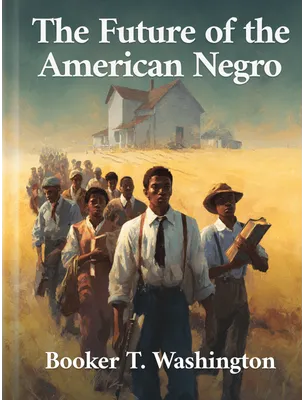
The Future of the American Negro
by
Booker T. Washington

Preface
In giving this volume to the public, I deem it fair to say that I have yielded to the oft-repeated requests that I put in some more definite and permanent form the ideas regarding the Negro and his future which I have expressed many times on the public platform and through the public press and magazines.
I make grateful acknowledgment to the “Atlantic Monthly” and “Appleton’s Popular Science Monthly” for their kindness in granting permission for the use of some part of articles which I have at various times contributed to their columns.
BOOKER T. WASHINGTON.
Tuskegee Normal and Industrial Institute,
Tuskegee, Ala., October 1, 1899.
Chapter I
In this volume I shall not attempt to give the origin and history of the Negro race either in Africa or in America. My attempt is to deal only with conditions that now exist and bear a relation to the Negro in America and that are likely to exist in the future. In discussing the Negro, it is always to be borne in mind that, unlike all the other inhabitants of America, he came here without his own consent; in fact, was compelled to leave his own country and become a part of another through physical force. It should also be borne in mind, in our efforts to change and improve the present condition of the Negro, that we are dealing with a race which had little necessity to labour in its native country. After being brought to America, the Negroes were forced to labour for about 250 years under circumstances which were calculated not to inspire them with love and respect for labour. This constitutes a part of the reason why I insist that it is necessary to emphasise the matter of industrial education as a means of giving the black man the foundation of a civilisation upon which he will grow and prosper. When I speak of industrial education, however, I wish it always understood that I mean, as did General Armstrong, the founder of the Hampton Institute, for thorough academic and religious training to go side by side with industrial training. Mere training of the hand without the culture of brain and heart would mean little.
The first slaves were brought into this country by the Dutch in 1619, and were landed at Jamestown, Virginia. The first cargo consisted of twenty. The census taken in 1890 shows that these twenty slaves had increased to 7,638,360. About 6,353,341 of this number were residing in the Southern States, and 1,283,029 were scattered throughout the Northern and Western States. I think I am pretty safe in predicting that the census to be taken in 1900 will show that there are not far from ten millions of people of African descent in the United States. The great majority of these, of course, reside in the Southern States. The problem is how to make these millions of Negroes self-supporting, intelligent, economical and valuable citizens, as well as how to bring about proper relations between them and the white citizens among whom they live. This is the question upon which I shall try to throw some light in the chapters which follow.
When the Negroes were first brought to America, they were owned by white people in all sections of this country, as is well known, — in the New England, the Middle, and in the Southern States. It was soon found, however, that slave labour was not remunerative in the Northern States, and for that reason by far the greater proportion of the slaves were held in the Southern States, where their labour in raising cotton, rice, and sugar-cane was more productive. The growth of the slave population in America was constant and rapid. Beginning, as I have stated, with fourteen, in 1619, the number increased at such a rate that the total number of Negroes in America in 1800 was 1,001,463. This number increased by 1860 to 3,950,000. A few people predicted that freedom would result disastrously to the Negro, as far as numerical increase was concerned; but so far the census figures have failed to bear out this prediction. On the other hand, the census of 1890 shows that the Negro population had increased from 3,950,000 in 1860 to 7,638,260 twenty-five years after the war. It is my opinion that the rate of increase in the future will be still greater than it has been from the close of the war of the Rebellion up to the present time, for the reason that the very sudden changes which took place in the life of the Negro, because of having his freedom, plunged him into many excesses that were detrimental to his physical well-being. Of course, freedom found him unprepared in clothing, in shelter and in knowledge of how to care for his body. During slavery the slave mother had little control of her own children, and did not therefore have the practice and experience of rearing children in a suitable manner. Now that the Negro is being taught in thousands of schools how to take care of his body, and in thousands of homes mothers are learning how to control their children, I believe that the rate of increase, as I have stated, will be still greater than it has been in the past. In too many cases the Negro had the idea that freedom meant merely license to do as he pleased, to work or not to work; but this erroneous idea is more and more disappearing, by reason of the education in the right direction which the Negro is constantly receiving.
During the four years that the Civil War lasted, the greater proportion of the Negroes remained in the South, and worked faithfully for the support of their masters’ families, who, as a general rule, were away in the war. The self-control which the Negro exhibited during the war marks, it seems to me, one of the most important chapters in the history of the race. Notwithstanding he knew that his master was away from home, fighting a battle which, if successful, would result in his continued enslavement, yet he worked faithfully for the support of the master’s family. If the Negro had yielded to the temptation and suggestion to use the torch or dagger in an attempt to destroy his master’s property and family, the result would have been that the war would have been ended quickly; for the master would have returned from the battlefield to protect and defend his property and family. But the Negro to the last was faithful to the trust that had been thrust upon him, and during the four years of war in which the male members of the family were absent from their homes there is not a single instance recorded where he in any way attempted to outrage the family of the master or in any way to injure his property.
Not only is this true, but all through the years of preparation for the war and during the war itself the Negro showed himself to be an uncompromising friend to the Union. In fact, of all the charges brought against him, there is scarcely a single instance where one has been charged with being a traitor to his country. This has been true whether he has been in a state of slavery or in a state of freedom.
From 1865 to 1876 constituted what perhaps may be termed the days of Reconstruction. This was the period when the Southern States which had withdrawn from the Union were making an effort to reinstate themselves and to establish a permanent system of State government. At the close of the war both the Southern white man and the Negro found themselves in the midst of poverty. The ex-master returned from the war to find his slave property gone, his farms and other industries in a state of collapse, and the whole industrial or economic system upon which he had depended for years entirely disorganised. As we review calmly and dispassionately the period of reconstruction, we must use a great deal of sympathy and generosity. The weak point, to my mind, in the reconstruction era was that no strong force was brought to bear in the direction of preparing the Negro to become an intelligent, reliable citizen and voter. The main effort seems to have been in the direction of controlling his vote for the time being, regardless of future interests. I hardly believe that any race of people with similar preparation and similar surroundings would have acted more wisely or very differently from the way the Negro acted during the period of reconstruction.
Without experience, without preparation, and in most cases without ordinary intelligence, he was encouraged to leave the field and shop and enter politics. That under such circumstances he should have made mistakes is very natural. I do not believe that the Negro was so much at fault for entering so largely into politics, and for the mistakes that were made in too many cases, as were the unscrupulous white leaders who got the Negro’s confidence and controlled his vote to further their own ends, regardless, in many cases, of the permanent welfare of the Negro. I have always considered it unfortunate that the Southern white man did not make more of an effort during the period of reconstruction to get the confidence and sympathy of the Negro, and thus have been able to keep him in close touch and sympathy in politics. It was also unfortunate that the Negro was so completely alienated from the Southern white man in all political matters. I think it would have been better for all concerned if, immediately after the close of the war, an educational and property qualification for the exercise of the franchise had been prescribed that would have applied fairly and squarely to both races, and, also, if, in educating the Negro, greater stress had been put upon training him along the lines of industry for which his services were in the greatest demand in the South. In a word, too much stress was placed upon the mere matter of voting and holding political office rather than upon the preparation for the highest citizenship. In saying what I have, I do not mean to convey the impression that the whole period of reconstruction was barren of fruitful results. While it is not a very encouraging chapter in the history of our country, I believe that this period did serve to point out many weak points in our effort to elevate the Negro, and that we are now taking advantage of the mistakes that were made. The period of reconstruction served at least to show the world that with proper preparation and with a sufficient foundation the Negro possesses the elements out of which men of the highest character and usefulness can be developed. I might name several characters who were brought before the world by reason of the reconstruction period. I give one as an example of others: Hon. Blanche K. Bruce, who had been a slave, but who held many honourable positions in the State of Mississippi, including an election to the United States Senate, where he served a full term; later he was twice appointed Register of the United States Treasury. In all these positions Mr. Bruce gave the greatest satisfaction, and not a single whisper of dishonesty or incompetency has ever been heard against him. During the period of his public life he was brought into active and daily contact with Northern and Southern white people, all of whom speak of him in the highest measure of respect and confidence.
What the Negro wants and what the country wants to do is to take advantage of all the lessons that were taught during the days of reconstruction, and apply these lessons bravely, honestly, in laying the foundation upon which the Negro can stand in the future and make himself a useful, honourable, and desirable citizen, whether he has his residence in the North, the South, or the West.
Chapter II
In order that the reader may understand me and why I lay so much stress upon the importance of pushing the doctrine of industrial education for the Negro, it is necessary, first of all, to review the condition of affairs at the present time in the Southern States. For years I have had something of an opportunity to study the Negro at first-hand; and I feel that I know him pretty well, — him and his needs, his failures and his successes, his desires and the likelihood of their fulfilment. I have studied him and his relations with his white neighbours, and striven to find how these relations may be made more conducive to the general peace and welfare both of the South and of the country at large.
In the Southern part of the United States there are twenty-two millions of people who are bound to the fifty millions of the North by ties which neither can tear asunder if they would. The most intelligent in a New York community has his intelligence darkened by the ignorance of a fellow-citizen in the Mississippi bottoms. The most wealthy in New York City would be more wealthy but for the poverty of a fellow-being in the Carolina rice swamps. The most moral and religious men in Massachusetts have their religion and morality modified by the degradation of the man in the South whose religion is a mere matter of form or of emotionalism. The vote of the man in Maine that is cast for the highest and purest form of government is largely neutralised by the vote of the man in Louisiana whose ballot is stolen or cast in ignorance. Therefore, when the South is ignorant, the North is ignorant; when the South is poor, the North is poor; when the South commits crime, the nation commits crime. For the citizens of the North there is no escape; they must help raise the character of the civilisation in the South, or theirs will be lowered. No member of the white race in any part of the country can harm the weakest or meanest member of the black race without the proudest and bluest blood of the nation being degraded.
It seems to me that there never was a time in the history of the country when those interested in education should the more earnestly consider to what extent the mere acquiring of the ability to read and write, the mere acquisition of a knowledge of literature and science, makes men producers, lovers of labour, independent, honest, unselfish, and, above all, good. Call education by what name you please, if it fails to bring about these results among the masses, it falls short of its highest end. The science, the art, the literature, that fails to reach down and bring the humblest up to the enjoyment of the fullest blessings of our government, is weak, no matter how costly the buildings or apparatus used or how modern the methods of instruction employed. The study of arithmetic that does not result in making men conscientious in receiving and counting the ballots of their fellow-men is faulty. The study of art that does not result in making the strong less willing to oppress the weak means little. How I wish that from the most cultured and highly endowed university in the great North to the humblest log cabin school-house in Alabama, we could burn, as it were, into the hearts and heads of all that usefulness, that service to our brother, is the supreme end of education. Putting the thought more directly as it applies to conditions in the South, can you make the intelligence of the North affect the South in the same ratio that the ignorance of the South affects the North? Let us take a not improbable case: A great national case is to be decided, one that involves peace or war, the honour or dishonour of our nation, — yea, the very existence of the government. The North and West are divided. There are five million votes to be cast in the South; and, of this number, one-half are ignorant. Not only are one-half the voters ignorant; but, because of the ignorant votes they cast, corruption and dishonesty in a dozen forms have crept into the exercise of the political franchise to such an extent that the conscience of the intelligent class is seared in its attempts to defeat the will of the ignorant voters. Here, then, you have on the one hand an ignorant vote, on the other an intelligent vote minus a conscience. The time may not be far off when to this kind of jury we shall have to look for the votes which shall decide in a large measure the destiny of our democratic institutions.
When a great national calamity stares us in the face, we are, I fear, too much given to depending on a short “campaign of education” to do on the hustings what should have been accomplished in the school.
With this idea in view, let us examine with more care the condition of civilisation in the South, and the work to be done there before all classes will be fit for the high duties of citizenship. In reference to the Negro race, I am confronted with some embarrassment at the outset, because of the various and conflicting opinions as to what is to be its final place in our economic and political life.
Within the last thirty years — and, I might add, within the last three months, — it has been proven by eminent authority that the Negro is increasing in numbers so fast that it is only a question of a few years before he will far outnumber the white race in the South, and it has also been proven that the Negro is fast dying out, and it is only a question of a few years before he will have completely disappeared. It has also been proven that education helps the Negro and that education hurts him, that he is fast leaving the South and taking up his residence in the North and West, and that his tendency is to drift toward the low lands of the Mississippi bottoms. It has been proven that education unfits the Negro for work and that education makes him more valuable as a labourer, that he is our greatest criminal and that he is our most law-abiding citizen. In the midst of these conflicting opinions, it is hard to hit upon the truth.
But, also, in the midst of this confusion, there are a few things of which I am certain, — things which furnish a basis for thought and action. I know that whether the Negroes are increasing or decreasing, whether they are growing better or worse, whether they are valuable or valueless, that a few years ago some fourteen of them were brought into this country, and that now those fourteen are nearly ten millions. I know that, whether in slavery or freedom, they have always been loyal to the Stars and Stripes, that no school-house has been opened for them that has not been filled, that the 2,000,000 ballots that they have the right to cast are as potent for weal or woe as an equal number cast by the wisest and most influential men in America. I know that wherever Negro life touches the life of the nation it helps or it hinders, that wherever the life of the white race touches the black it makes it stronger or weaker. Further, I know that almost every other race that has tried to look the white man in the face has disappeared. I know, despite all the conflicting opinions, and with a full knowledge of all the Negroes’ weaknesses, that only a few centuries ago they went into slavery in this country pagans, that they came out Christians; they went into slavery as so much property, they came out American citizens; they went into slavery without a language, they came out speaking the proud Anglo-Saxon tongue; they went into slavery with the chains clanking about their wrists, they came out with the American ballot in their hands.
I submit it to the candid and sober judgment of all men, if a race that is capable of such a test, such a transformation, is not worth saving and making a part, in reality as well as in name, of our democratic government. That the Negro may be fitted for the fullest enjoyment of the privileges and responsibilities of our citizenship, it is important that the nation be honest and candid with him, whether honesty and candour for the time being pleases or displeases him. It is with an ignorant race as it is with a child: it craves at first the superficial, the ornamental signs of progress rather than the reality. The ignorant race is tempted to jump, at one bound, to the position that it has required years of hard struggle for others to reach.
It seems to me that, as a general thing, the temptation in the past in educational and missionary work has been to do for the new people that which was done a thousand years ago, or that which is being done for a people a thousand miles away, without making a careful study of the needs and conditions of the people whom it is designed to help. The temptation is to run all people through a certain educational mould, regardless of the condition of the subject or the end to be accomplished. This has been the case too often in the South in the past, I am sure. Men have tried to use, with these simple people just freed from slavery and with no past, no inherited traditions of learning, the same methods of education which they have used in New England, with all its inherited traditions and desires. The Negro is behind the white man because he has not had the same chance, and not from any inherent difference in his nature and desires. What the race accomplishes in these first fifty years of freedom will at the end of these years, in a large measure, constitute its past. It is, indeed, a responsibility that rests upon this nation, — the foundation laying for a people of its past, present, and future at one and the same time.
One of the weakest points in connection with the present development of the race is that so many get the idea that the mere filling of the head with a knowledge of mathematics, the sciences, and literature, means success in life. Let it be understood, in every corner of the South, among the Negro youth at least, that knowledge will benefit little except as it is harnessed, except as its power is pointed in a direction that will bear upon the present needs and condition of the race. There is in the heads of the Negro youth of the South enough general and floating knowledge of chemistry, of botany, of zoölogy, of geology, of mechanics, of electricity, of mathematics, to reconstruct and develop a large part of the agricultural, mechanical, and domestic life of the race. But how much of it is brought to a focus along lines of practical work? In cities of the South like Atlanta, how many coloured mechanical engineers are there? or how many machinists? how many civil engineers? how many architects? how many house decorators? In the whole State of Georgia, where eighty per cent. of the coloured people depend upon agriculture, how many men are there who are well grounded in the principles and practices of scientific farming? or dairy work? or fruit culture? or floriculture?
For example, not very long ago I had a conversation with a young coloured man who is a graduate of one of the prominent universities of this country. The father of this man is comparatively ignorant, but by hard work and the exercise of common sense he has become the owner of two thousand acres of land. He owns more than a score of horses, cows, and mules and swine in large numbers, and is considered a prosperous farmer. In college the son of this farmer has studied chemistry, botany, zoölogy, surveying, and political economy. In my conversation I asked this young man how many acres his father cultivated in cotton and how many in corn. With a far-off gaze up into the heavens he answered that he did not know. When I asked him the classification of the soils on his father’s farm, he did not know. He did not know how many horses or cows his father owned nor of what breeds they were, and seemed surprised that he should be asked such questions. It never seemed to have entered his mind that on his father’s farm was the place to make his chemistry, his mathematics, and his literature penetrate and reflect itself in every acre of land, every bushel of corn, every cow, and every pig.
Let me give other examples of this mistaken sort of education. When a mere boy, I saw a young coloured man, who had spent several years in school, sitting in a common cabin in the South, studying a French grammar. I noted the poverty, the untidiness, the want of system and thrift, that existed about the cabin, notwithstanding his knowledge of French and other academic studies.
Again, not long ago I saw a coloured minister preparing his Sunday sermon just as the New England minister prepares his sermon. But this coloured minister was in a broken-down, leaky, rented log cabin, with weeds in the yard, surrounded by evidences of poverty, filth, and want of thrift. This minister had spent some time in school studying theology. How much better it would have been to have had this minister taught the dignity of labour, taught theoretical and practical farming in connection with his theology, so that he could have added to his meagre salary, and set an example for his people in the matter of living in a decent house, and having a knowledge of correct farming! In a word, this minister should have been taught that his condition, and that of his people, was not that of a New England community; and he should have been so trained as to meet the actual needs and conditions of the coloured people in this community, so that a foundation might be laid that would, in the future, make a community like New England communities.
Since the Civil War, no one object has been more misunderstood than that of the object and value of industrial education for the Negro. To begin with, it must be borne in mind that the condition that existed in the South immediately after the war, and that now exists, is a peculiar one, without a parallel in history. This being true, it seems to me that the wise and honest thing to do is to make a study of the actual condition and environment of the Negro, and do that which is best for him, regardless of whether the same thing has been done for another race in exactly the same way. There are those among the white race and those among the black race who assert, with a good deal of earnestness, that there is no difference between the white man and the black man in this country. This sounds very pleasant and tickles the fancy; but, when the test of hard, cold logic is applied to it, it must be acknowledged that there is a difference, — not an inherent one, not a racial one, but a difference growing out of unequal opportunities in the past.
If I may be permitted to criticise the educational work that has been done in the South, I would say that the weak point has been in the failure to recognise this difference.
Negro education, immediately after the war in most cases, was begun too nearly at the point where New England education had ended. Let me illustrate. One of the saddest sights I ever saw was the placing of a three hundred dollar rosewood piano in a country school in the South that was located in the midst of the “Black Belt.” Am I arguing against the teaching of instrumental music to the Negroes in that community? Not at all; only I should have deferred those music lessons about twenty-five years. There are numbers of such pianos in thousands of New England homes. But behind the piano in the New England home there are one hundred years of toil, sacrifice, and economy; there is the small manufacturing industry, started several years ago by hand power, now grown into a great business; there is ownership in land, a comfortable home, free from debt, and a bank account. In this “Black Belt” community where this piano went, four-fifths of the people owned no land, many lived in rented one-room cabins, many were in debt for food supplies, many mortgaged their crops for the food on which to live, and not one had a bank account. In this case, how much wiser it would have been to have taught the girls in this community sewing, intelligent and economical cooking, housekeeping, something of dairying and horticulture? The boys should have been taught something of farming in connection with their common-school education, instead of awakening in them a desire for a musical instrument which resulted in their parents going into debt for a third-rate piano or organ before a home was purchased. Industrial lessons would have awakened, in this community, a desire for homes, and would have given the people the ability to free themselves from industrial slavery to the extent that most of them would have soon purchased homes. After the home and the necessaries of life were supplied could come the piano. One piano lesson in a home of one’s own is worth twenty in a rented log cabin.
All that I have just written, and the various examples illustrating it, show the present helpless condition of my people in the South, — how fearfully they lack the primary training for good living and good citizenship, how much they stand in need of a solid foundation on which to build their future success. I believe, as I have many times said in my various addresses in the North and in the South, that the main reason for the existence of this curious state of affairs is the lack of practical training in the ways of life.
There is, too, a great lack of money with which to carry on the educational work in the South. I was in a county in a Southern State not long ago where there are some thirty thousand coloured people and about seven thousand whites. In this county not a single public school for Negroes had been open that year longer than three months, not a single coloured teacher had been paid more than $15 per month for his teaching. Not one of these schools was taught in a building that was worthy of the name of school-house. In this county the State or public authorities do not own a single dollar’s worth of school property, — not a school-house, a blackboard, or a piece of crayon. Each coloured child had had spent on him that year for his education about fifty cents, while each child in New York or Massachusetts had had spent on him that year for education not far from $20. And yet each citizen of this county is expected to share the burdens and privileges of our democratic form of government just as intelligently and conscientiously as the citizens of New York or Boston. A vote in this county means as much to the nation as a vote in the city of Boston. Crime in this county is as truly an arrow aimed at the heart of the government as a crime committed in the streets of Boston.
A single school-house built this year in a town near Boston to shelter about three hundred pupils cost more for building alone than is spent yearly for the education, including buildings, apparatus, teachers, for the whole coloured school population of Alabama. The Commissioner of Education for the State of Georgia not long ago reported to the State legislature that in that State there were two hundred thousand children that had entered no school the year past and one hundred thousand more who were at school but a few days, making practically three hundred thousand children between six and eighteen years of age that are growing up in ignorance in one Southern State alone. The same report stated that outside of the cities and towns, while the average number of school-houses in a county was sixty, all of these sixty school-houses were worth in lump less than $2,000, and the report further added that many of the school-houses in Georgia were not fit for horse stables. I am glad to say, however, that vast improvement over this condition is being made in Georgia under the inspired leadership of State Commissioner Glenn, and in Alabama under the no less zealous leadership of Commissioner Abercrombie.
These illustrations, so far as they concern the Gulf States, are not exceptional cases; nor are they overdrawn.
Until there is industrial independence, it is hardly possible to have good living and a pure ballot in the country districts. In these States it is safe to say that not more than one black man in twenty owns the land he cultivates. Where so large a proportion of a people are dependent, live in other people’s houses, eat other people’s food, and wear clothes they have not paid for, it is pretty hard to expect them to live fairly and vote honestly.
I have thus far referred mainly to the Negro race. But there is another side. The longer I live and the more I study the question, the more I am convinced that it is not so much a problem as to what the white man will do with the Negro as what the Negro will do with the white man and his civilisation. In considering this side of the subject, I thank God that I have grown to the point where I can sympathise with a white man as much as I can sympathise with a black man. I have grown to the point where I can sympathise with a Southern white man as much as I can sympathise with a Northern white man.
As bearing upon the future of our civilisation, I ask of the North what of their white brethren in the South, — those who have suffered and are still suffering the consequences of American slavery, for which both North and South were responsible? Those of the great and prosperous North still owe to their less fortunate brethren of the Caucasian race in the South, not less than to themselves, a serious and uncompleted duty. What was the task the North asked the South to perform? Returning to their destitute homes after years of war to face blasted hopes, devastation, a shattered industrial system, they asked them to add to their own burdens that of preparing in education, politics, and economics, in a few short years, for citizenship, four millions of former slaves. That the South, staggering under the burden, made blunders, and that in a measure there has been disappointment, no one need be surprised. The educators, the statesmen, the philanthropists, have imperfectly comprehended their duty toward the millions of poor whites in the South who were buffeted for two hundred years between slavery and freedom, between civilisation and degradation, who were disregarded by both master and slave. It needs no prophet to tell the character of our future civilisation when the poor white boy in the country districts of the South receives one dollar’s worth of education and the boy of the same class in the North twenty dollars’ worth, when one never enters a reading-room or library and the other has reading-rooms and libraries in every ward and town, when one hears lectures and sermons once in two months and the other can hear a lecture or a sermon every day in the year.
The time has come, it seems to me, when in this matter we should rise above party or race or sectionalism into the region of duty of man to man, of citizen to citizen, of Christian to Christian; and if the Negro, who has been oppressed and denied his rights in a Christian land, can help the whites of the North and South to rise, can be the inspiration of their rising, into this atmosphere of generous Christian brotherhood and self-forgetfulness, he will see in it a recompense for all that he has suffered in the past.
Chapter III
In the heart of the Black Belt of the South in ante-bellum days there was a large estate, with palatial mansion, surrounded by a beautiful grove, in which grew flowers and shrubbery of every description. Magnificent specimens of animal life grazed in the fields, and in grain and all manner of plant growth this estate was a model. In a word, it was the highest type of the product of slave labor.
Then came the long years of war, then freedom, then the trying years of reconstruction. The master returned from the war to find the faithful slaves who had been the bulwark of this household in possession of their freedom. Then there began that social and industrial revolution in the South which it is hard for any who was not really a part of it to appreciate or understand. Gradually, day by day, this ex-master began to realise, with a feeling almost indescribable, to what an extent he and his family had grown to be dependent upon the activity and faithfulness of his slaves; began to appreciate to what an extent slavery had sapped his sinews of strength and independence, how his dependence upon slave labour had deprived him and his offspring of the benefit of technical and industrial training, and, worst of all, had unconsciously led him to see in labour drudgery and degradation instead of beauty, dignity, and civilising power. At first there was a halt in this man’s life. He cursed the North and he cursed the Negro. Then there was despair, almost utter hopelessness, over his weak and childlike condition. The temptation was to forget all in drink, and to this temptation there was a gradual yielding. With the loss of physical vigour came the loss of mental grasp and pride in surroundings. There was the falling off of a piece of plaster from the walls of the house which was not replaced, then another and still another. Gradually, the window-panes began to disappear, then the door-knobs. Touches of paint and whitewash, which once helped to give life, were no more to be seen. The hinges disappeared from the gate, then a board from the fence, then others in quick succession. Weeds and unmown grass covered the once well-kept lawn. Sometimes there were servants for domestic duties, and sometimes there were none. In the absence of servants the unsatisfactory condition of the food told that it was being prepared by hands unschooled to such duties. As the years passed by, debts accumulated in every direction. The education of the children was neglected. Lower and lower sank the industrial, financial, and spiritual condition of the household. For the first time the awful truth of Scripture, “Whatsoever a man soweth, that shall he also reap,” seemed to dawn upon him with a reality that it is hard for mortal to appreciate. Within a few months the whole mistake of slavery seemed to have concentrated itself upon this household. And this was one of many.
We have seen how the ending of slavery and the beginning of freedom produced not only a shock, but a stand-still, and in many cases a collapse, that lasted several years in the life of many white men. If the sudden change thus affected the white man, should this not teach us that we should have more sympathy than has been shown in many cases with the Negro in connection with his new and changed life? That they made many mistakes, plunged into excesses, undertook responsibilities for which they were not fitted, in many cases took liberty to mean license, is not to be wondered at. It is my opinion that the next forty years are going to show by many per cent. a higher degree of progress in the life of the Negro along all lines than has been shown during the first thirty years of his life. Certainly, the first thirty years of the Negro’s life was one of experiment; and consequently, under such conditions, he was not able to settle down to real, earnest, hard common sense efforts to better his condition. While this was true in a great many cases, on the other hand a large proportion of the race, even from the first, saw what was needed for their new life, and began to settle down to lead an industrious, frugal existence, and to educate their children and in every way prepare themselves for the responsibilities of American citizenship.
The wonder is that the Negro has made as few mistakes as he has, when we consider all the surrounding circumstances. Columns of figures have been gleaned from the census reports within the last quarter of a century to show the great amount of crime committed by the Negro in excess of that committed by other races. No one will deny the fact that the proportion of crime by the present generation of Negroes is seriously large, but I believe that any other race with the Negro’s history and present environment would have shown about the same criminal record.
Another consideration which we must always bear in mind in considering the Negro is that he had practically no home life in slavery; that is, the mother and father did not have the responsibility, and consequently the experience, of training their own children. The matter of child training was left to the master and mistress. Consequently, it has only been within the last thirty years that the Negro parents have had the actual responsibility and experience of training their own children. That they have made some mistakes in thus training them is not to be wondered at. Many families scattered over all parts of the United States have not yet been able to bring themselves together. When the Negro parents shall have had thirty or forty additional years in which to found homes and get experience in the training of their children, I believe that we will find that the amount of crime will be considerably less than it is now shown to be.
In too large a measure the Negro race began its development at the wrong end, simply because neither white nor black understood the case; and no wonder, for there had never been such a case in the history of the world.
To show where this primary mistake has led in its evil results, I wish to produce some examples showing plainly how prone we have been to make our education formal, superficial, instead of making it meet the needs of conditions.
In order to emphasise the matter more fully, I repeat, at least eighty per cent. of the coloured people in the South are found in the rural districts, and they are dependent on agriculture in some form for their support. Notwithstanding that we have practically a whole race dependent upon agriculture, and notwithstanding that thirty years have passed since our freedom, aside from what has been done at Hampton and Tuskegee and one or two other institutions, but very little has been attempted by State or philanthropy in the way of educating the race in this one industry upon which its very existence depends. Boys have been taken from the farms and educated in law, theology, Hebrew and Greek, — educated in everything else except the very subject that they should know most about. I question whether among all the educated coloured people in the United States you can find six, if we except those from the institutions named, who have received anything like a thorough training in agriculture. It would have seemed that, since self-support, industrial independence, is the first condition for lifting up any race, that education in theoretical and practical agriculture, horticulture, dairying, and stock-raising, should have occupied the first place in our system.
Some time ago, when we decided to make tailoring a part of our training at the Tuskegee Institute, I was amazed to find that it was almost impossible to find in the whole country an educated coloured man who could teach the making of clothing. We could find them by the score who could teach astronomy, theology, grammar, or Latin, but almost none who could instruct in the making of clothing, something that has to be used by every one of us every day in the year. How often has my heart been made to sink as I have gone through the South and into the homes of people, and found women who could converse intelligently on Grecian history, who had studied geometry, could analyse the most complex sentences, and yet could not analyse the poorly cooked and still more poorly served corn bread and fat meat that they and their families were eating three times a day! It is little trouble to find girls who can locate Pekin or the Desert of Sahara on an artificial globe, but seldom can you find one who can locate on an actual dinner table the proper place for the carving knife and fork or the meat and vegetables.
A short time ago, in one of the Southern cities, a coloured man died who had received training as a skilled mechanic during the days of slavery. Later by his skill and industry he built up a great business as a house contractor and builder. In this same city there are 35,000 coloured people, among them young men who have been well educated in the languages and in literature; but not a single one could be found who had been so trained in mechanical and architectural drawing that he could carry on the business which this ex-slave had built up, and so it was soon scattered to the wind. Aside from the work done in the institutions that I have mentioned, you can find almost no coloured men who have been trained in the principles of architecture, notwithstanding the fact that a vast majority of our race are without homes. Here, then, are the three prime conditions for growth, for civilisation, — food, clothing, shelter; and yet we have been the slaves of forms and customs to such an extent that we have failed in a large measure to look matters squarely in the face and meet actual needs.
It may well be asked by one who has not carefully considered the matter: “What has become of all those skilled farm-hands that used to be on the old plantations? Where are those wonderful cooks we hear about, where those exquisitely trained house servants, those cabinet makers, and the jacks-of-all-trades that were the pride of the South?” This is easily answered, — they are mostly dead. The survivors are too old to work. “But did they not train their children?” is the natural question. Alas! the answer is “no.” Their skill was so commonplace to them, and to their former masters, that neither thought of it as being a hard-earned or desirable accomplishment: it was natural, like breathing. Their children would have it as a matter of course. What their children needed was education. So they went out into the world, the ambitious ones, and got education, and forgot the necessity of the ordinary training to live.
God for two hundred and fifty years, in my opinion, prepared the way for the redemption of the Negro through industrial development. First, he made the Southern white man do business with the Negro for two hundred and fifty years in a way that no one else has done business with him. If a Southern white man wanted a house or a bridge built, he consulted a Negro mechanic about the plan and about the actual building of the house or bridge. If he wanted a suit of clothes or a pair of shoes made, it was to the Negro tailor or shoemaker that he talked. Secondly, every large slave plantation in the South was, in a limited sense, an industrial school. On these plantations there were scores of young coloured men and women who were constantly being trained, not alone as common farmers, but as carpenters, blacksmiths, wheelwrights, plasterers, brick masons, engineers, bridge-builders, cooks, dressmakers, housekeepers, etc. I would be the last to apologise for the curse of slavery; but I am simply stating facts. This training was crude and was given for selfish purposes, and did not answer the highest ends, because there was the absence of brain training in connection with that of the hand. Nevertheless, this business contact with the Southern white man, and the industrial training received on these plantations, put the Negro at the close of the war into possession of all the common and skilled labour in the South. For nearly twenty years after the war, except in one or two cases, the value of the industrial training given by the Negroes’ former masters on the plantations and elsewhere was overlooked. Negro men and women were educated in literature, mathematics, and the sciences, with no thought of what had taken place on these plantations for two and a half centuries. After twenty years, those who were trained as mechanics, etc., during slavery began to disappear by death; and gradually we awoke to the fact that we had no one to take their places. We had scores of young men learned in Greek, but few in carpentry or mechanical or architectural drawing. We had trained many in Latin, but almost none as engineers, bridge-builders, and machinists. Numbers were taken from the farm and educated, but were educated in everything else except agriculture. Hence they had no sympathy with farm life, and did not return to it.
This last that I have been saying is practically a repetition of what I have said in the preceding paragraph; but, to emphasise it, — and this point is one of the most important I wish to impress on the reader, — it is well to repeat, to say the same thing twice. Oh, if only more who had the shaping of the education of the Negro could have, thirty years ago, realised, and made others realise, where the forgetting of the years of manual training and the sudden acquiring of education were going to lead the Negro race, what a saving it would have been! How much less my race would have had to answer for, as well as the white!