'An Experiment in Misery' was first published in 1896.
[{"id":"para_1","index":0,"start":0,"offset":352,"words":4,"paraNum":"","lastModified":1762261883000,"semanticType":"title-book-title","voicework":"tts","blockId":"an_experiment_in_misery_short_story_en-bly5","language":"en","wordsRange":{"start":100000000,"end":105000000},"paragraphVersion":26,"direction":"ltr","paragraph":"<h1 class=\"ilm-title ilm-x-large\" id=\"para_1\" semantictype=\"title-book-title\" data-ilmid=\"an_experiment_in_misery_short_story_en-bly5\" data-audio=\"1\" data-chapter=\"para_1\" data-words-count=\"4\" data-before=\"0\" data-ww=\"\"><span class=\"block-pb\"> <span class=\"block-pb is-animated\"></span> </span><span class=\"itm-wrap\">An Experiment in Misery</span></h1>","hasContent":true,"isFirst":true,"isLast":false},{"id":"para_2","index":1,"start":352,"offset":338,"words":1,"paraNum":"","lastModified":1762262852000,"semanticType":"title-subtitle","voicework":"tts","blockId":"an_experiment_in_misery_short_story_en-bl10o","language":"en","wordsRange":{"start":138333333,"end":171666667},"paragraphVersion":41,"direction":"ltr","paragraph":"<h1 class=\"ilm-title ilm-subtitle\" id=\"para_2\" semantictype=\"title-subtitle\" data-ilmid=\"an_experiment_in_misery_short_story_en-bl10o\" data-audio=\"1\" data-chapter=\"para_2\" data-words-count=\"1\" data-before=\"4\" data-ww=\"\"><span class=\"block-pb\"> <span class=\"block-pb is-animated\"></span> </span><span class=\"itm-wrap\">[adapted]</span></h1>","hasContent":true,"isFirst":false,"isLast":false},{"id":"para_3","index":2,"start":690,"offset":369,"words":2,"paraNum":"","lastModified":1762262883000,"semanticType":"title-author","voicework":"tts","blockId":"an_experiment_in_misery_short_story_en-bl10k","language":"en","wordsRange":{"start":205000000,"end":209000000},"paragraphVersion":39,"direction":"ltr","paragraph":"<h1 class=\"ilm-title ilm-author ilm-large ilm-nopad\" id=\"para_3\" semantictype=\"title-author\" data-ilmid=\"an_experiment_in_misery_short_story_en-bl10k\" data-audio=\"1\" data-chapter=\"para_3\" data-words-count=\"2\" data-before=\"5\" data-ww=\"\"><span class=\"block-pb\"> <span class=\"block-pb is-animated\"></span> </span><span class=\"itm-wrap\">by <br>Stephen Crane<br></span></h1>","hasContent":true,"isFirst":false,"isLast":false},{"id":"para_4","index":3,"start":1059,"offset":167,"words":0,"paraNum":"","lastModified":1681508165000,"semanticType":"line","blockId":"an_experiment_in_misery_short_story_en-bl10l","language":"en","wordsRange":{"start":309000000,"end":409000000},"paragraphVersion":14,"direction":"ltr","paragraph":"<hr class=\"ilm-hr ilm-small\" id=\"para_4\" semantictype=\"line\" data-ilmid=\"an_experiment_in_misery_short_story_en-bl10l\" data-words-count=\"0\" data-before=\"7\" data-ww=\"\">","hasContent":true,"isFirst":false,"isLast":false},{"id":"para_5","index":4,"start":1226,"offset":1315,"words":0,"paraNum":"","lastModified":1762259189000,"semanticType":"illustration","blockId":"an_experiment_in_misery_short_story_en-bl10n","language":"en","wordsRange":{"start":509000000,"end":609000000},"paragraphVersion":23,"direction":"ltr","paragraph":"<div class=\"ilm-illustration\" id=\"para_5\" semantictype=\"illustration\" data-ilmid=\"an_experiment_in_misery_short_story_en-bl10n\" data-words-count=\"0\" data-before=\"7\" data-ww=\"\"><img width=\"600\" height=\"400\" data-src=\"ch0p0\" src=\"data:image/webp;base64,UklGRvACAABXRUJQVlA4IOQCAAAQDgCdASo8ACgAPm00lUikIqIhIqrogA2JZQCuT1j+T8l/xfgr5PQAxp9rctLTctGjD6arDZYWUjXs6UYAmwECy77DZrR652tU0wtsSADnv/LQj4SmmaQqOgIBYEgjg9s4S/d4CDJg9P7xpQzLLGzGvCODaGlp6oQAAP75uyzIbbJnmBVfvSgJTPX+EGuNj0n3ikXAcfpRfYLB0h84YAgSfvpsf9655Hqs7LV+uQzYe6H1SRhLtal9mXx1Q8f4/LdOt9+uyBiIJpbCZs3PubyY46cLN0+xBRIlL1FwKBEISzHE5V92mCPoHJ6r+/UGawto4MqQlKb43jTGHSk7hd8VltPCSUF/v84DvXd7UW1LuEleDnRknZYLOoPVsGwVMKQ97ioXNtl1JDCCT83XIITJXoWcgTWg9FSbpdvnWMwoqCYm4j9xI/RwEyLDEvnSwTlVeJYO7rH/cwWOVa7o+V7T1nI6J/NiVqUHpfo+dBGTTDLEBG2Jewvhp9uQDLm5WiT/m35UhZeuc3m9oNlplYdjZHiuKauVSr+P1ezEt6WCvAMCEA7iS0afi+vtK3s/5ls4eq3rJtch8ccmFXtyFeH+y98TAoHaAhthEB+YmfW1oGIB/9AYVnVDvAOV5RDh6T6UoMUE5so8eDkY/OB3tg4oejzeswMg6wlCz/GJdBbRyrH8fe7LM0FEcVfi15KdPcZj2PDkIX3zDto/FZY3Kpoaia7tnZa8us4a0/jshujJuuMWQsGmVWDI8aUS6feuYKqiwLI2G94ETCN3PH5O0Yu+UkL4Trhj3BwAOZOyagRHZmxETPaZmlgWKiIuJvLwPxx0+wC049gJhqQy8/8Y2HsKdJbPe8rYJMan3CwiybYq/tc5P2IeZ/GyjE2lnUUfyjMkCV4g+pAej/uE+i/SvAPzf1rjhEYT8RH8SujxyXcBhSbTQ3CSF7MtedsFkf8+RJxqyD1fC/2MWv5J86ZxLQAG4wAAAA==\" alt=\"An Experiment in Misery (adapted)\"></div>","hasContent":true,"isFirst":false,"isLast":false},{"id":"para_6","index":5,"start":2541,"offset":401,"words":5,"paraNum":"","lastModified":1762261868000,"semanticType":"header-sub-subheader","voicework":"tts","blockId":"an_experiment_in_misery_short_story_en-bly6","language":"en","wordsRange":{"start":709000000,"end":715000000},"paragraphVersion":22,"direction":"ltr","paragraph":"<h4 class=\"ilm-header ilm-center ilm-h4\" id=\"para_6\" semantictype=\"header-sub-subheader\" data-ilmid=\"an_experiment_in_misery_short_story_en-bly6\" data-audio=\"1\" data-chapter=\"para_6\" data-words-count=\"5\" data-before=\"7\" data-ww=\"\"><span class=\"block-pb\"> <span class=\"block-pb is-animated\"></span> </span><span class=\"itm-wrap\"><b>(From </b><b>the </b><b>Press, </b><b>New </b><b>York)</b></span></h4>","hasContent":true,"isFirst":false,"isLast":false},{"id":"para_7","index":6,"start":2942,"offset":1047,"words":144,"paraNum":"1","lastModified":1762435372000,"semanticType":"par","voicework":"tts","blockId":"an_experiment_in_misery_short_story_en-bly7","language":"en","wordsRange":{"start":815000000,"end":958333333},"paragraphVersion":40,"direction":"ltr","paragraph":"<p id=\"para_7\" semantictype=\"par\" data-ilmid=\"an_experiment_in_misery_short_story_en-bly7\" data-audio=\"1\" data-words-count=\"144\" data-before=\"12\" data-ww=\"\"><span class=\"block-num\" data-id=\"1\"></span><span class=\"block-pb\"> <span class=\"block-pb is-animated\"></span> </span><span class=\"itm-wrap\">It was late at night, and a light rain was falling softly, causing the pavements to shine with colors of steel gray and blue and yellow in the rays of the many lights. A youth was walking slowly, without joy, with his hands buried deep in his trouser pockets, towards the downtown places where beds can be rented for small coins. He was dressed in an old and torn suit, and his derby hat had a dust-covered top and a torn brim. He was going out to eat as the wanderer may eat, and sleep as the homeless sleep. By the time he had reached City Hall Park he was so completely covered with yells of “bum” and “hobo,” and with many bad names that small boys had called him from time to time, that he was in a state of very deep sadness.</span></p>","hasContent":true,"isFirst":false,"isLast":false},{"id":"para_8","index":7,"start":3989,"offset":860,"words":101,"paraNum":"2","lastModified":1762435372000,"semanticType":"par","voicework":"tts","blockId":"an_experiment_in_misery_short_story_en-bl10q","language":"en","wordsRange":{"start":958666667,"end":1058000000},"paragraphVersion":27,"direction":"ltr","paragraph":"<p id=\"para_8\" semantictype=\"par\" data-ilmid=\"an_experiment_in_misery_short_story_en-bl10q\" data-audio=\"1\" data-words-count=\"101\" data-before=\"156\" data-ww=\"\"><span class=\"block-num\" data-id=\"2\"></span><span class=\"block-pb\"> <span class=\"block-pb is-animated\"></span> </span><span class=\"itm-wrap\">The light rain soaked the old velvet collar of his coat, and as the wet cloth pressed against his neck, he felt that there could no longer be joy in life. He looked about him searching for the worst outcast so that they too might share troubles, but the lights gave a shaky light over rows and circles of empty benches that looked wet and shiny, showing patches of wet grass behind them. It seemed that their usual crowds had run away on this night to better things. There were only groups of well-dressed Brooklyn people who went towards the bridge.</span></p>","hasContent":true,"isFirst":false,"isLast":false},{"id":"para_9","index":8,"start":4849,"offset":808,"words":97,"paraNum":"3","lastModified":1762435372000,"semanticType":"par","voicework":"tts","blockId":"an_experiment_in_misery_short_story_en-bly8","language":"en","wordsRange":{"start":1158000000,"end":1258000000},"paragraphVersion":49,"direction":"ltr","paragraph":"<p id=\"para_9\" semantictype=\"par\" data-ilmid=\"an_experiment_in_misery_short_story_en-bly8\" data-audio=\"1\" data-words-count=\"97\" data-before=\"257\" data-ww=\"\"><span class=\"block-num\" data-id=\"3\"></span><span class=\"block-pb\"> <span class=\"block-pb is-animated\"></span> </span><span class=\"itm-wrap\">The young man hung around for a while and then walked slowly down Park Row. In the sudden drop in how well the crowd was dressed he felt better, and as if he was finally in his own place. He began to see rags that matched his rags. In Chatham Square there were men with no purpose scattered in front of bars and small hotels, standing sadly, patiently, making one think a little of how chickens stand in a storm. He stood with these men, and turned slowly to watch the moving life of the big street. </span></p>","hasContent":true,"isFirst":false,"isLast":false},{"id":"para_10","index":9,"start":5657,"offset":1039,"words":132,"paraNum":"4","lastModified":1762435372000,"semanticType":"par","voicework":"tts","blockId":"an_experiment_in_misery_short_story_en-bly9","language":"en","wordsRange":{"start":1358000000,"end":1485000000},"paragraphVersion":37,"direction":"ltr","paragraph":"<p id=\"para_10\" semantictype=\"par\" data-ilmid=\"an_experiment_in_misery_short_story_en-bly9\" data-audio=\"1\" data-words-count=\"132\" data-before=\"354\" data-ww=\"\"><span class=\"block-num\" data-id=\"4\"></span><span class=\"block-pb\"> <span class=\"block-pb is-animated\"></span> </span><span class=\"itm-wrap\">Through the fog of the cold and stormy night, the cable cars went in a quiet line, large cars shining with red and brass, moving with strong power, calm and unstoppable, dangerous and dark, breaking the quiet only by the loud harsh cry of the gong. Two rivers of people moved along the side walks, splashed with black mud, which made each shoe leave a mark like a scar. Overhead, elevated trains, with a high harsh grinding of the wheels, stopped at the station, which, on its leg-like posts, seemed to look like some huge kind of crab sitting over the street. The short heavy puffings of the engines could be heard. Down an alley there were dark curtains of purple and black, on which street lamps dimly shone like sewn flowers.</span></p>","hasContent":true,"isFirst":false,"isLast":false},{"id":"para_11","index":10,"start":6696,"offset":730,"words":75,"paraNum":"5","lastModified":1762435372000,"semanticType":"par","voicework":"tts","blockId":"an_experiment_in_misery_short_story_en-blyb","language":"en","wordsRange":{"start":1585000000,"end":1655000000},"paragraphVersion":37,"direction":"ltr","paragraph":"<p id=\"para_11\" semantictype=\"par\" data-ilmid=\"an_experiment_in_misery_short_story_en-blyb\" data-audio=\"1\" data-words-count=\"75\" data-before=\"486\" data-ww=\"\"><span class=\"block-num\" data-id=\"5\"></span><span class=\"block-pb\"> <span class=\"block-pb is-animated\"></span> </span><span class=\"itm-wrap\">A bar stood with a very hungry look on a corner. A sign leaning against the front of the doorpost said “Free hot soup tonight!” The swing doors, snapping back and forth like very hungry lips, made satisfied smacks as the bar stuffed itself with fat men, eating with amazing and endless hunger, smiling in some way that is hard to describe as the men came from all directions like sacrifices to a strange superstition.</span></p>","hasContent":true,"isFirst":false,"isLast":false},{"id":"para_12","index":11,"start":7426,"offset":540,"words":48,"paraNum":"6","lastModified":1762435372000,"semanticType":"par","voicework":"tts","blockId":"an_experiment_in_misery_short_story_en-blyc","language":"en","wordsRange":{"start":1755000000,"end":1800000000},"paragraphVersion":37,"direction":"ltr","paragraph":"<p id=\"para_12\" semantictype=\"par\" data-ilmid=\"an_experiment_in_misery_short_story_en-blyc\" data-audio=\"1\" data-words-count=\"48\" data-before=\"561\" data-ww=\"\"><span class=\"block-num\" data-id=\"6\"></span><span class=\"block-pb\"> <span class=\"block-pb is-animated\"></span> </span><span class=\"itm-wrap\">Caught by the nice sign the young man let himself be pulled in. A bartender placed a large glass of dark and strong beer on the bar. Its very big shape rose up until the foam on top was above the top of the young man’s brown hat.</span></p>","hasContent":true,"isFirst":false,"isLast":false},{"id":"para_13","index":12,"start":7966,"offset":685,"words":69,"paraNum":"7","lastModified":1762435372000,"semanticType":"par","voicework":"tts","blockId":"an_experiment_in_misery_short_story_en-blyd","language":"en","wordsRange":{"start":1900000000,"end":1965333333},"paragraphVersion":66,"direction":"ltr","paragraph":"<p id=\"para_13\" semantictype=\"par\" data-ilmid=\"an_experiment_in_misery_short_story_en-blyd\" data-audio=\"1\" data-words-count=\"69\" data-before=\"609\" data-ww=\"\"><span class=\"block-num\" data-id=\"7\"></span><span class=\"block-pb\"> <span class=\"block-pb is-animated\"></span> </span><span class=\"itm-wrap\">“Soup over there, gents,” said the bartender in a friendly way. A little yellow man in rags and the young man grabbed their glasses and went quickly toward a lunch counter, where a man with oily but big whiskers scooped kindly from a kettle until he had given his two beggars a soup that was steaming hot, and in it there were small floating bits that seemed like chicken.</span></p>","hasContent":true,"isFirst":false,"isLast":false},{"id":"para_14","index":13,"start":8651,"offset":770,"words":83,"paraNum":"8","lastModified":1762435372000,"semanticType":"par","voicework":"tts","blockId":"an_experiment_in_misery_short_story_en-bl10r","language":"en","wordsRange":{"start":1965666667,"end":2049000000},"paragraphVersion":23,"direction":"ltr","paragraph":"<p id=\"para_14\" semantictype=\"par\" data-ilmid=\"an_experiment_in_misery_short_story_en-bl10r\" data-audio=\"1\" data-words-count=\"83\" data-before=\"678\" data-ww=\"\"><span class=\"block-num\" data-id=\"8\"></span><span class=\"block-pb\"> <span class=\"block-pb is-animated\"></span> </span><span class=\"itm-wrap\">The young man, drinking his soup slowly, felt the friendliness shown by the warmth of the soup, and he smiled at the man with oily but thick whiskers, who was in charge like a priest behind an altar. “Have some more, gents?” he asked the two sad-looking figures before him. The little yellow man accepted with a quick gesture, but the youth shook his head and went out, following a man whose very shabby look showed that he knew about cheap lodging houses.</span></p>","hasContent":true,"isFirst":false,"isLast":false},{"id":"para_15","index":14,"start":9421,"offset":404,"words":17,"paraNum":"9","lastModified":1762435372000,"semanticType":"par","voicework":"tts","blockId":"an_experiment_in_misery_short_story_en-blyf","language":"en","wordsRange":{"start":2149000000,"end":2167000000},"paragraphVersion":40,"direction":"ltr","paragraph":"<p id=\"para_15\" semantictype=\"par\" data-ilmid=\"an_experiment_in_misery_short_story_en-blyf\" data-audio=\"1\" data-words-count=\"17\" data-before=\"761\" data-ww=\"\"><span class=\"block-num\" data-id=\"9\"></span><span class=\"block-pb\"> <span class=\"block-pb is-animated\"></span> </span><span class=\"itm-wrap\">On the sidewalk he stopped the poor-looking man. “Say, do you know a cheap place to sleep?”</span></p>","hasContent":true,"isFirst":false,"isLast":false},{"id":"para_16","index":15,"start":9825,"offset":461,"words":27,"paraNum":"10","lastModified":1762435372000,"semanticType":"par","voicework":"tts","blockId":"an_experiment_in_misery_short_story_en-blyg","language":"en","wordsRange":{"start":2267000000,"end":2296000000},"paragraphVersion":39,"direction":"ltr","paragraph":"<p id=\"para_16\" semantictype=\"par\" data-ilmid=\"an_experiment_in_misery_short_story_en-blyg\" data-audio=\"1\" data-words-count=\"27\" data-before=\"778\" data-ww=\"\"><span class=\"block-num\" data-id=\"10\"></span><span class=\"block-pb\"> <span class=\"block-pb is-animated\"></span> </span><span class=\"itm-wrap\">The other stopped for a moment, looking to the side. Finally he nodded toward the street, “I sleep up there,” he said, “when I have the money.”</span></p>","hasContent":true,"isFirst":false,"isLast":false},{"id":"para_17","index":16,"start":10286,"offset":324,"words":2,"paraNum":"11","lastModified":1762435372000,"semanticType":"par","voicework":"tts","blockId":"an_experiment_in_misery_short_story_en-blyh","language":"en","wordsRange":{"start":2396000000,"end":2399000000},"paragraphVersion":39,"direction":"ltr","paragraph":"<p id=\"para_17\" semantictype=\"par\" data-ilmid=\"an_experiment_in_misery_short_story_en-blyh\" data-audio=\"1\" data-words-count=\"2\" data-before=\"805\" data-ww=\"\"><span class=\"block-num\" data-id=\"11\"></span><span class=\"block-pb\"> <span class=\"block-pb is-animated\"></span> </span><span class=\"itm-wrap\">“How much?”</span></p>","hasContent":true,"isFirst":false,"isLast":false},{"id":"para_18","index":17,"start":10610,"offset":325,"words":2,"paraNum":"12","lastModified":1762435372000,"semanticType":"par","voicework":"tts","blockId":"an_experiment_in_misery_short_story_en-blyi","language":"en","wordsRange":{"start":2499000000,"end":2502000000},"paragraphVersion":39,"direction":"ltr","paragraph":"<p id=\"para_18\" semantictype=\"par\" data-ilmid=\"an_experiment_in_misery_short_story_en-blyi\" data-audio=\"1\" data-words-count=\"2\" data-before=\"807\" data-ww=\"\"><span class=\"block-num\" data-id=\"12\"></span><span class=\"block-pb\"> <span class=\"block-pb is-animated\"></span> </span><span class=\"itm-wrap\">“Ten cents.”</span></p>","hasContent":true,"isFirst":false,"isLast":false},{"id":"para_19","index":18,"start":10935,"offset":382,"words":12,"paraNum":"13","lastModified":1762435372000,"semanticType":"par","voicework":"tts","blockId":"an_experiment_in_misery_short_story_en-blyj","language":"en","wordsRange":{"start":2602000000,"end":2615000000},"paragraphVersion":39,"direction":"ltr","paragraph":"<p id=\"para_19\" semantictype=\"par\" data-ilmid=\"an_experiment_in_misery_short_story_en-blyj\" data-audio=\"1\" data-words-count=\"12\" data-before=\"809\" data-ww=\"\"><span class=\"block-num\" data-id=\"13\"></span><span class=\"block-pb\"> <span class=\"block-pb is-animated\"></span> </span><span class=\"itm-wrap\">The young man shook his head sadly. “That’s too expensive for me.”</span></p>","hasContent":true,"isFirst":false,"isLast":false},{"id":"para_20","index":19,"start":11317,"offset":712,"words":81,"paraNum":"14","lastModified":1762435372000,"semanticType":"par","voicework":"tts","blockId":"an_experiment_in_misery_short_story_en-blyk","language":"en","wordsRange":{"start":2715000000,"end":2790000000},"paragraphVersion":39,"direction":"ltr","paragraph":"<p id=\"para_20\" semantictype=\"par\" data-ilmid=\"an_experiment_in_misery_short_story_en-blyk\" data-audio=\"1\" data-words-count=\"81\" data-before=\"821\" data-ww=\"\"><span class=\"block-num\" data-id=\"14\"></span><span class=\"block-pb\"> <span class=\"block-pb is-animated\"></span> </span><span class=\"itm-wrap\">At that moment a staggering man in strange clothes came toward the two. His head was a mess of bushy hair and a beard, and from it his eyes looked out with a guilty sideways look. On a close look it was possible to see the cruel lines of a mouth that looked as if its lips had just closed with pleasure over some soft and sad small piece of food. He looked like a killer soaked in crimes done clumsily.</span></p>","hasContent":true,"isFirst":false,"isLast":false},{"id":"para_21","index":20,"start":12029,"offset":477,"words":34,"paraNum":"15","lastModified":1762435372000,"semanticType":"par","voicework":"tts","blockId":"an_experiment_in_misery_short_story_en-blyl","language":"en","wordsRange":{"start":2890000000,"end":2924000000},"paragraphVersion":39,"direction":"ltr","paragraph":"<p id=\"para_21\" semantictype=\"par\" data-ilmid=\"an_experiment_in_misery_short_story_en-blyl\" data-audio=\"1\" data-words-count=\"34\" data-before=\"902\" data-ww=\"\"><span class=\"block-num\" data-id=\"15\"></span><span class=\"block-pb\"> <span class=\"block-pb is-animated\"></span> </span><span class=\"itm-wrap\">But at this time his voice was set to the soft, begging sound of a friendly puppy. He looked at the men with begging eyes, and began to sing a little song for charity.</span></p>","hasContent":true,"isFirst":false,"isLast":false},{"id":"para_22","index":21,"start":12506,"offset":600,"words":58,"paraNum":"16","lastModified":1762435372000,"semanticType":"par","voicework":"tts","blockId":"an_experiment_in_misery_short_story_en-blym","language":"en","wordsRange":{"start":3024000000,"end":3085000000},"paragraphVersion":39,"direction":"ltr","paragraph":"<p id=\"para_22\" semantictype=\"par\" data-ilmid=\"an_experiment_in_misery_short_story_en-blym\" data-audio=\"1\" data-words-count=\"58\" data-before=\"936\" data-ww=\"\"><span class=\"block-num\" data-id=\"16\"></span><span class=\"block-pb\"> <span class=\"block-pb is-animated\"></span> </span><span class=\"itm-wrap\">“Say, gents, can’t you give a poor man a couple of cents to get a bed. I have five, and if I get another two I get a bed. Now, honestly, gents, can’t you just give me two cents to get a bed? Now, you know how a respectable gentleman feels when he’s having bad luck, and I — —”</span></p>","hasContent":true,"isFirst":false,"isLast":false},{"id":"para_23","index":22,"start":13106,"offset":455,"words":28,"paraNum":"17","lastModified":1762435372000,"semanticType":"par","voicework":"tts","blockId":"an_experiment_in_misery_short_story_en-blyn","language":"en","wordsRange":{"start":3185000000,"end":3208000000},"paragraphVersion":45,"direction":"ltr","paragraph":"<p id=\"para_23\" semantictype=\"par\" data-ilmid=\"an_experiment_in_misery_short_story_en-blyn\" data-audio=\"1\" data-words-count=\"28\" data-before=\"994\" data-ww=\"\"><span class=\"block-num\" data-id=\"17\"></span><span class=\"block-pb\"> <span class=\"block-pb is-animated\"></span> </span><span class=\"itm-wrap\">The dirty man, staring with a calm face at a train that made a loud noise above, interrupted in a voice with no feeling — “Ah, go to hell!”</span></p>","hasContent":true,"isFirst":false,"isLast":false},{"id":"para_24","index":23,"start":13561,"offset":484,"words":31,"paraNum":"18","lastModified":1762435372000,"semanticType":"par","voicework":"tts","blockId":"an_experiment_in_misery_short_story_en-blyp","language":"en","wordsRange":{"start":3308000000,"end":3339000000},"paragraphVersion":39,"direction":"ltr","paragraph":"<p id=\"para_24\" semantictype=\"par\" data-ilmid=\"an_experiment_in_misery_short_story_en-blyp\" data-audio=\"1\" data-words-count=\"31\" data-before=\"1022\" data-ww=\"\"><span class=\"block-num\" data-id=\"18\"></span><span class=\"block-pb\"> <span class=\"block-pb is-animated\"></span> </span><span class=\"itm-wrap\">But the young man spoke to the praying killer in a surprised and questioning voice. “Say, you must be crazy! Why don’t you hit someone who looks like they have money?”</span></p>","hasContent":true,"isFirst":false,"isLast":false},{"id":"para_25","index":24,"start":14045,"offset":566,"words":47,"paraNum":"19","lastModified":1762435372000,"semanticType":"par","voicework":"tts","blockId":"an_experiment_in_misery_short_story_en-blyq","language":"en","wordsRange":{"start":3439000000,"end":3477000000},"paragraphVersion":39,"direction":"ltr","paragraph":"<p id=\"para_25\" semantictype=\"par\" data-ilmid=\"an_experiment_in_misery_short_story_en-blyq\" data-audio=\"1\" data-words-count=\"47\" data-before=\"1053\" data-ww=\"\"><span class=\"block-num\" data-id=\"19\"></span><span class=\"block-pb\"> <span class=\"block-pb is-animated\"></span> </span><span class=\"itm-wrap\">The killer, stumbling around on his shaky legs, and from time to time brushing away things that were not there in front of his nose, began a long explanation about the feelings and thoughts in the situation. It was so deep that it could not be understood.</span></p>","hasContent":true,"isFirst":false,"isLast":false},{"id":"para_26","index":25,"start":14611,"offset":379,"words":13,"paraNum":"20","lastModified":1762435372000,"semanticType":"par","voicework":"tts","blockId":"an_experiment_in_misery_short_story_en-blyr","language":"en","wordsRange":{"start":3577000000,"end":3590000000},"paragraphVersion":39,"direction":"ltr","paragraph":"<p id=\"para_26\" semantictype=\"par\" data-ilmid=\"an_experiment_in_misery_short_story_en-blyr\" data-audio=\"1\" data-words-count=\"13\" data-before=\"1100\" data-ww=\"\"><span class=\"block-num\" data-id=\"20\"></span><span class=\"block-pb\"> <span class=\"block-pb is-animated\"></span> </span><span class=\"itm-wrap\">When he had finished talking about it, the young man said to him —</span></p>","hasContent":true,"isFirst":false,"isLast":false},{"id":"para_27","index":26,"start":14990,"offset":343,"words":5,"paraNum":"21","lastModified":1762435372000,"semanticType":"par","voicework":"tts","blockId":"an_experiment_in_misery_short_story_en-blys","language":"en","wordsRange":{"start":3690000000,"end":3696000000},"paragraphVersion":39,"direction":"ltr","paragraph":"<p id=\"para_27\" semantictype=\"par\" data-ilmid=\"an_experiment_in_misery_short_story_en-blys\" data-audio=\"1\" data-words-count=\"5\" data-before=\"1113\" data-ww=\"\"><span class=\"block-num\" data-id=\"21\"></span><span class=\"block-pb\"> <span class=\"block-pb is-animated\"></span> </span><span class=\"itm-wrap\">“Let’s see the five cents.”</span></p>","hasContent":true,"isFirst":false,"isLast":false},{"id":"para_28","index":27,"start":15333,"offset":558,"words":47,"paraNum":"22","lastModified":1762435372000,"semanticType":"par","voicework":"tts","blockId":"an_experiment_in_misery_short_story_en-blyt","language":"en","wordsRange":{"start":3796000000,"end":3847000000},"paragraphVersion":45,"direction":"ltr","paragraph":"<p id=\"para_28\" semantictype=\"par\" data-ilmid=\"an_experiment_in_misery_short_story_en-blyt\" data-audio=\"1\" data-words-count=\"47\" data-before=\"1118\" data-ww=\"\"><span class=\"block-num\" data-id=\"22\"></span><span class=\"block-pb\"> <span class=\"block-pb is-animated\"></span> </span><span class=\"itm-wrap\">The killer had a sad, drunk look at these words, not trusting him. With a very hurt look he began to search in his clothes, his red hands shaking. Soon he said in a voice of great sadness, as if he had been tricked — “There’s on’y four.”</span></p>","hasContent":true,"isFirst":false,"isLast":false},{"id":"para_29","index":28,"start":15891,"offset":463,"words":29,"paraNum":"23","lastModified":1762435372000,"semanticType":"par","voicework":"tts","blockId":"an_experiment_in_misery_short_story_en-blyu","language":"en","wordsRange":{"start":3947000000,"end":3974000000},"paragraphVersion":38,"direction":"ltr","paragraph":"<p id=\"para_29\" semantictype=\"par\" data-ilmid=\"an_experiment_in_misery_short_story_en-blyu\" data-audio=\"1\" data-words-count=\"29\" data-before=\"1165\" data-ww=\"\"><span class=\"block-num\" data-id=\"23\"></span><span class=\"block-pb\"> <span class=\"block-pb is-animated\"></span> </span><span class=\"itm-wrap\">“Four,” said the young man, thinking. “Well, look here, I am new here, and if you will take me to your cheap place I will find the other three.”</span></p>","hasContent":true,"isFirst":false,"isLast":false},{"id":"para_30","index":29,"start":16354,"offset":486,"words":33,"paraNum":"24","lastModified":1762435372000,"semanticType":"par","voicework":"tts","blockId":"an_experiment_in_misery_short_story_en-blyv","language":"en","wordsRange":{"start":4074000000,"end":4106000000},"paragraphVersion":38,"direction":"ltr","paragraph":"<p id=\"para_30\" semantictype=\"par\" data-ilmid=\"an_experiment_in_misery_short_story_en-blyv\" data-audio=\"1\" data-words-count=\"33\" data-before=\"1194\" data-ww=\"\"><span class=\"block-num\" data-id=\"24\"></span><span class=\"block-pb\"> <span class=\"block-pb is-animated\"></span> </span><span class=\"itm-wrap\">The killer’s face became at once bright with joy. His beard shook with the many feelings he said he had. He grabbed the young man’s hand in a rush of joy and friendliness.</span></p>","hasContent":true,"isFirst":false,"isLast":false},{"id":"para_31","index":30,"start":16840,"offset":638,"words":64,"paraNum":"25","lastModified":1762435372000,"semanticType":"par","voicework":"tts","blockId":"an_experiment_in_misery_short_story_en-blyw","language":"en","wordsRange":{"start":4206000000,"end":4267000000},"paragraphVersion":45,"direction":"ltr","paragraph":"<p id=\"para_31\" semantictype=\"par\" data-ilmid=\"an_experiment_in_misery_short_story_en-blyw\" data-audio=\"1\" data-words-count=\"64\" data-before=\"1227\" data-ww=\"\"><span class=\"block-num\" data-id=\"25\"></span><span class=\"block-pb\"> <span class=\"block-pb is-animated\"></span> </span><span class=\"itm-wrap\">“By God,” he cried, “if you’ll do that, by God, I’d say you were a very good man, I would, and I’d remember you all my life, I would, by God, and if I ever got a chance I’d do the same for you” — he spoke in a drunk, serious way, — “by God, I’d treat you fair, I would, and I’d always remember you.”</span></p>","hasContent":true,"isFirst":false,"isLast":false},{"id":"para_32","index":31,"start":17478,"offset":478,"words":30,"paraNum":"26","lastModified":1762435372000,"semanticType":"par","voicework":"tts","blockId":"an_experiment_in_misery_short_story_en-blyy","language":"en","wordsRange":{"start":4367000000,"end":4395000000},"paragraphVersion":45,"direction":"ltr","paragraph":"<p id=\"para_32\" semantictype=\"par\" data-ilmid=\"an_experiment_in_misery_short_story_en-blyy\" data-audio=\"1\" data-words-count=\"30\" data-before=\"1291\" data-ww=\"\"><span class=\"block-num\" data-id=\"26\"></span><span class=\"block-pb\"> <span class=\"block-pb is-animated\"></span> </span><span class=\"itm-wrap\">The young man stepped back, looking at the killer with a cold look. “Oh, that’s all right,” he said. “You show me the place — that’s all you have to do.”</span></p>","hasContent":true,"isFirst":false,"isLast":false},{"id":"para_33","index":32,"start":17956,"offset":748,"words":84,"paraNum":"27","lastModified":1762435372000,"semanticType":"par","voicework":"tts","blockId":"an_experiment_in_misery_short_story_en-blyz","language":"en","wordsRange":{"start":4495000000,"end":4569000000},"paragraphVersion":39,"direction":"ltr","paragraph":"<p id=\"para_33\" semantictype=\"par\" data-ilmid=\"an_experiment_in_misery_short_story_en-blyz\" data-audio=\"1\" data-words-count=\"84\" data-before=\"1321\" data-ww=\"\"><span class=\"block-num\" data-id=\"27\"></span><span class=\"block-pb\"> <span class=\"block-pb is-animated\"></span> </span><span class=\"itm-wrap\">The man, waving his hands to show thanks, led the young man along a dark street. Finally he stopped before a little dusty door. He raised his hand in a serious way. “Look here,” he said, and there was a look of deep and old wisdom on his face, “I’ve brought you here, and that’s my part, isn’t it? If the place isn’t right for you, you don’t need to get mad at me, do you? There won’t be any bad feeling, will there?”</span></p>","hasContent":true,"isFirst":false,"isLast":false},{"id":"para_34","index":33,"start":18704,"offset":339,"words":5,"paraNum":"28","lastModified":1762435372000,"semanticType":"par","voicework":"tts","blockId":"an_experiment_in_misery_short_story_en-blz0","language":"en","wordsRange":{"start":4669000000,"end":4675000000},"paragraphVersion":38,"direction":"ltr","paragraph":"<p id=\"para_34\" semantictype=\"par\" data-ilmid=\"an_experiment_in_misery_short_story_en-blz0\" data-audio=\"1\" data-words-count=\"5\" data-before=\"1405\" data-ww=\"\"><span class=\"block-num\" data-id=\"28\"></span><span class=\"block-pb\"> <span class=\"block-pb is-animated\"></span> </span><span class=\"itm-wrap\">“No,” said the young man.</span></p>","hasContent":true,"isFirst":false,"isLast":false},{"id":"para_35","index":34,"start":19043,"offset":627,"words":63,"paraNum":"29","lastModified":1762435372000,"semanticType":"par","voicework":"tts","blockId":"an_experiment_in_misery_short_story_en-blz1","language":"en","wordsRange":{"start":4775000000,"end":4840000000},"paragraphVersion":39,"direction":"ltr","paragraph":"<p id=\"para_35\" semantictype=\"par\" data-ilmid=\"an_experiment_in_misery_short_story_en-blz1\" data-audio=\"1\" data-words-count=\"63\" data-before=\"1410\" data-ww=\"\"><span class=\"block-num\" data-id=\"29\"></span><span class=\"block-pb\"> <span class=\"block-pb is-animated\"></span> </span><span class=\"itm-wrap\">The killer waved his arm sadly, and led the way up the steep stairs. On the way the young man gave the killer three pennies. At the top a man with kind-looking glasses looked at them through a hole in a board. He took their money, wrote some names in a book, and quickly was leading the two men along a dark hallway.</span></p>","hasContent":true,"isFirst":false,"isLast":false},{"id":"para_36","index":35,"start":19670,"offset":742,"words":76,"paraNum":"30","lastModified":1762435372000,"semanticType":"par","voicework":"tts","blockId":"an_experiment_in_misery_short_story_en-blz2","language":"en","wordsRange":{"start":4940000000,"end":5018000000},"paragraphVersion":39,"direction":"ltr","paragraph":"<p id=\"para_36\" semantictype=\"par\" data-ilmid=\"an_experiment_in_misery_short_story_en-blz2\" data-audio=\"1\" data-words-count=\"76\" data-before=\"1473\" data-ww=\"\"><span class=\"block-num\" data-id=\"30\"></span><span class=\"block-pb\"> <span class=\"block-pb is-animated\"></span> </span><span class=\"itm-wrap\">Soon after the start of this trip the young man felt very afraid, because from the dark and hidden places of the building there suddenly came to his nose strange and awful smells, that attacked him like deadly diseases with wings. They seemed to be from human bodies tightly packed in rooms; the breaths from a hundred pairs of stinking lips; the smells from a thousand past wild parties; the sign of a thousand present sufferings.</span></p>","hasContent":true,"isFirst":false,"isLast":false},{"id":"para_37","index":36,"start":20412,"offset":473,"words":30,"paraNum":"31","lastModified":1762435372000,"semanticType":"par","voicework":"tts","blockId":"an_experiment_in_misery_short_story_en-blz3","language":"en","wordsRange":{"start":5118000000,"end":5151000000},"paragraphVersion":38,"direction":"ltr","paragraph":"<p id=\"para_37\" semantictype=\"par\" data-ilmid=\"an_experiment_in_misery_short_story_en-blz3\" data-audio=\"1\" data-words-count=\"30\" data-before=\"1549\" data-ww=\"\"><span class=\"block-num\" data-id=\"31\"></span><span class=\"block-pb\"> <span class=\"block-pb is-animated\"></span> </span><span class=\"itm-wrap\">A man, naked except for a small brown undershirt, was walking sleepily down the hallway. He rubbed his eyes, and, letting out a huge yawn, asked what time it was.</span></p>","hasContent":true,"isFirst":false,"isLast":false},{"id":"para_38","index":37,"start":20885,"offset":330,"words":3,"paraNum":"32","lastModified":1762435372000,"semanticType":"par","voicework":"tts","blockId":"an_experiment_in_misery_short_story_en-blz4","language":"en","wordsRange":{"start":5251000000,"end":5254000000},"paragraphVersion":39,"direction":"ltr","paragraph":"<p id=\"para_38\" semantictype=\"par\" data-ilmid=\"an_experiment_in_misery_short_story_en-blz4\" data-audio=\"1\" data-words-count=\"3\" data-before=\"1579\" data-ww=\"\"><span class=\"block-num\" data-id=\"32\"></span><span class=\"block-pb\"> <span class=\"block-pb is-animated\"></span> </span><span class=\"itm-wrap\">“Half past one.”</span></p>","hasContent":true,"isFirst":false,"isLast":false},{"id":"para_39","index":38,"start":21215,"offset":594,"words":57,"paraNum":"33","lastModified":1762435372000,"semanticType":"par","voicework":"tts","blockId":"an_experiment_in_misery_short_story_en-blz5","language":"en","wordsRange":{"start":5354000000,"end":5410000000},"paragraphVersion":39,"direction":"ltr","paragraph":"<p id=\"para_39\" semantictype=\"par\" data-ilmid=\"an_experiment_in_misery_short_story_en-blz5\" data-audio=\"1\" data-words-count=\"57\" data-before=\"1582\" data-ww=\"\"><span class=\"block-num\" data-id=\"33\"></span><span class=\"block-pb\"> <span class=\"block-pb is-animated\"></span> </span><span class=\"itm-wrap\">The man yawned again. He opened a door, and for a moment his body was seen against the black, dark inside. The three men came to this door, and when it was opened again the very bad smells rushed out like monsters, so that the young man had to fight as if against a very strong wind.</span></p>","hasContent":true,"isFirst":false,"isLast":false},{"id":"para_40","index":39,"start":21809,"offset":692,"words":73,"paraNum":"34","lastModified":1762435372000,"semanticType":"par","voicework":"tts","blockId":"an_experiment_in_misery_short_story_en-blz6","language":"en","wordsRange":{"start":5510000000,"end":5582000000},"paragraphVersion":39,"direction":"ltr","paragraph":"<p id=\"para_40\" semantictype=\"par\" data-ilmid=\"an_experiment_in_misery_short_story_en-blz6\" data-audio=\"1\" data-words-count=\"73\" data-before=\"1639\" data-ww=\"\"><span class=\"block-num\" data-id=\"34\"></span><span class=\"block-pb\"> <span class=\"block-pb is-animated\"></span> </span><span class=\"itm-wrap\">It was some time before the youth’s eyes were used to the deep darkness inside, but the man with kind-looking glasses led him carefully, stopping only a moment to put the limp killer on a small bed. He took the youth to a small bed that was quietly by the window, and showing him a tall cupboard for clothes that stood near the head with the scary look of a gravestone, left him.</span></p>","hasContent":true,"isFirst":false,"isLast":false},{"id":"para_41","index":40,"start":22501,"offset":822,"words":99,"paraNum":"35","lastModified":1762435372000,"semanticType":"par","voicework":"tts","blockId":"an_experiment_in_misery_short_story_en-blz7","language":"en","wordsRange":{"start":5682000000,"end":5776000000},"paragraphVersion":39,"direction":"ltr","paragraph":"<p id=\"para_41\" semantictype=\"par\" data-ilmid=\"an_experiment_in_misery_short_story_en-blz7\" data-audio=\"1\" data-words-count=\"99\" data-before=\"1712\" data-ww=\"\"><span class=\"block-num\" data-id=\"35\"></span><span class=\"block-pb\"> <span class=\"block-pb is-animated\"></span> </span><span class=\"itm-wrap\">The young man sat on his small bed and looked around him. There was a gas lamp in a far part of the room that burned a small, flickering, orange flame. It made many messy shadows in all parts of the place, except where, right around it, there was a little grey mist. As the young man’s eyes got used to the darkness, he could see on the small beds that were all over the floor the bodies of men lying spread out, lying in silence like death, or breathing hard and snoring with great effort, like stabbed fish.</span></p>","hasContent":true,"isFirst":false,"isLast":false},{"id":"para_42","index":41,"start":23323,"offset":659,"words":68,"paraNum":"36","lastModified":1762435372000,"semanticType":"par","voicework":"tts","blockId":"an_experiment_in_misery_short_story_en-blz8","language":"en","wordsRange":{"start":5876000000,"end":5944333333},"paragraphVersion":42,"direction":"ltr","paragraph":"<p id=\"para_42\" semantictype=\"par\" data-ilmid=\"an_experiment_in_misery_short_story_en-blz8\" data-audio=\"1\" data-words-count=\"68\" data-before=\"1811\" data-ww=\"\"><span class=\"block-num\" data-id=\"36\"></span><span class=\"block-pb\"> <span class=\"block-pb is-animated\"></span> </span><span class=\"itm-wrap\">The youth locked his hat and his shoes in the locker near him, and then lay down with an old and familiar coat around his shoulders. A blanket he handed carefully, pulling it over part of the coat. The small bed was covered with leather, and as cold as melting snow. The youth had to shiver for some time on this thing, which was like a flat stone.</span></p>","hasContent":true,"isFirst":false,"isLast":false},{"id":"para_43","index":42,"start":23982,"offset":680,"words":78,"paraNum":"37","lastModified":1762435372000,"semanticType":"par","voicework":"tts","blockId":"an_experiment_in_misery_short_story_en-bl10s","language":"en","wordsRange":{"start":5944666667,"end":6020000000},"paragraphVersion":21,"direction":"ltr","paragraph":"<p id=\"para_43\" semantictype=\"par\" data-ilmid=\"an_experiment_in_misery_short_story_en-bl10s\" data-audio=\"1\" data-words-count=\"78\" data-before=\"1879\" data-ww=\"\"><span class=\"block-num\" data-id=\"37\"></span><span class=\"block-pb\"> <span class=\"block-pb is-animated\"></span> </span><span class=\"itm-wrap\">Soon, though, his chill gave him peace, and during this time of rest from it he turned his head to look at his friend the assassin, whom he could barely see where he lay spread out on a cot in the careless way of a man full of drink. He was snoring very loudly. His wet hair and beard shone a little, and his red nose shone with a soft light like a red light in a fog.</span></p>","hasContent":true,"isFirst":false,"isLast":false},{"id":"para_44","index":43,"start":24662,"offset":998,"words":130,"paraNum":"38","lastModified":1762435372000,"semanticType":"par","voicework":"tts","blockId":"an_experiment_in_misery_short_story_en-blz9","language":"en","wordsRange":{"start":6120000000,"end":6246000000},"paragraphVersion":42,"direction":"ltr","paragraph":"<p id=\"para_44\" semantictype=\"par\" data-ilmid=\"an_experiment_in_misery_short_story_en-blz9\" data-audio=\"1\" data-words-count=\"130\" data-before=\"1957\" data-ww=\"\"><span class=\"block-num\" data-id=\"38\"></span><span class=\"block-pb\"> <span class=\"block-pb is-animated\"></span> </span><span class=\"itm-wrap\">Within reach of the young man’s hand was a man who lay with yellow chest and shoulders bare to the cold air. One arm hung over the side of the bed, and the fingers lay straight upon the wet cement floor of the room. Under the very dark eyebrows, the man’s eyes could be seen through the partly opened eyelids. To the young man it seemed that he and this person like a dead body were exchanging a long stare, and that the other threatened him with his eyes. He drew back, watching his neighbour from the shadows of the edge of his blanket. The man did not move once through the night, but lay in this stillness like death, like a body stretched out waiting for the surgeon’s knife.</span></p>","hasContent":true,"isFirst":false,"isLast":false},{"id":"para_45","index":44,"start":25660,"offset":706,"words":69,"paraNum":"39","lastModified":1762435372000,"semanticType":"par","voicework":"tts","blockId":"an_experiment_in_misery_short_story_en-blza","language":"en","wordsRange":{"start":6346000000,"end":6412000000},"paragraphVersion":41,"direction":"ltr","paragraph":"<p id=\"para_45\" semantictype=\"par\" data-ilmid=\"an_experiment_in_misery_short_story_en-blza\" data-audio=\"1\" data-words-count=\"69\" data-before=\"2087\" data-ww=\"\"><span class=\"block-num\" data-id=\"39\"></span><span class=\"block-pb\"> <span class=\"block-pb is-animated\"></span> </span><span class=\"itm-wrap\">And all through the room could be seen the brownish colors of bare skin, arms and legs pushed into the darkness, sticking out beyond the beds; raised knees, arms hanging long and thin over the bed edges. For the most part they were like statues, carved, dead. With the strange lockers standing all about like gravestones, there was a strange feeling of a graveyard where bodies were just thrown.</span></p>","hasContent":true,"isFirst":false,"isLast":false},{"id":"para_46","index":45,"start":26366,"offset":706,"words":72,"paraNum":"40","lastModified":1762435372000,"semanticType":"par","voicework":"tts","blockId":"an_experiment_in_misery_short_story_en-blzb","language":"en","wordsRange":{"start":6512000000,"end":6585000000},"paragraphVersion":40,"direction":"ltr","paragraph":"<p id=\"para_46\" semantictype=\"par\" data-ilmid=\"an_experiment_in_misery_short_story_en-blzb\" data-audio=\"1\" data-words-count=\"72\" data-before=\"2156\" data-ww=\"\"><span class=\"block-num\" data-id=\"40\"></span><span class=\"block-pb\"> <span class=\"block-pb is-animated\"></span> </span><span class=\"itm-wrap\">Yet sometimes limbs could be seen wildly tossing in strange nightmare moves, with deep cries, grunts, curses. And there was one man off in a dark corner, who in his dreams was troubled by some terrible thing, for all of a sudden he began to make long cries that sounded almost like yells from a dog, echoing sadly and strangely through this cold place of gravestones where men lay like the dead.</span></p>","hasContent":true,"isFirst":false,"isLast":false},{"id":"para_47","index":46,"start":27072,"offset":866,"words":111,"paraNum":"41","lastModified":1762435372000,"semanticType":"par","voicework":"tts","blockId":"an_experiment_in_misery_short_story_en-blzc","language":"en","wordsRange":{"start":6685000000,"end":6784333333},"paragraphVersion":45,"direction":"ltr","paragraph":"<p id=\"para_47\" semantictype=\"par\" data-ilmid=\"an_experiment_in_misery_short_story_en-blzc\" data-audio=\"1\" data-words-count=\"111\" data-before=\"2228\" data-ww=\"\"><span class=\"block-num\" data-id=\"41\"></span><span class=\"block-pb\"> <span class=\"block-pb is-animated\"></span> </span><span class=\"itm-wrap\">The sound in its high, sharp beginnings, that turned to final sad moans, showed a red and dark tragedy of the endless possibilities of the man’s dreams. But to the youth these were not only the screams of a man hurt by visions: they were an expression of the meaning of the room and its people in it. It was to him the protest of the poor man who feels the touch of the uncaring stone wheels, and who then cries with a clear voice that is not personal, with a strength that is not from him, giving a voice to the cry of a whole part, a class, a people.</span></p>","hasContent":true,"isFirst":false,"isLast":false},{"id":"para_48","index":47,"start":27938,"offset":680,"words":68,"paraNum":"42","lastModified":1762435372000,"semanticType":"par","voicework":"tts","blockId":"an_experiment_in_misery_short_story_en-bl10t","language":"en","wordsRange":{"start":6784666667,"end":6850000000},"paragraphVersion":20,"direction":"ltr","paragraph":"<p id=\"para_48\" semantictype=\"par\" data-ilmid=\"an_experiment_in_misery_short_story_en-bl10t\" data-audio=\"1\" data-words-count=\"68\" data-before=\"2339\" data-ww=\"\"><span class=\"block-num\" data-id=\"42\"></span><span class=\"block-pb\"> <span class=\"block-pb is-animated\"></span> </span><span class=\"itm-wrap\">This, going into the young man’s mind, and mixing with his thoughts of the very big and dark shadows that, like strong black fingers, curled around the naked bodies, made the young man so that he did not sleep, but lay making the life stories for these men from his small experience. At times the fellow in the corner cried out in a twisting pain of his imagination.</span></p>","hasContent":true,"isFirst":false,"isLast":false},{"id":"para_49","index":48,"start":28618,"offset":852,"words":103,"paraNum":"43","lastModified":1762435372000,"semanticType":"par","voicework":"tts","blockId":"an_experiment_in_misery_short_story_en-blzd","language":"en","wordsRange":{"start":6950000000,"end":7050000000},"paragraphVersion":47,"direction":"ltr","paragraph":"<p id=\"para_49\" semantictype=\"par\" data-ilmid=\"an_experiment_in_misery_short_story_en-blzd\" data-audio=\"1\" data-words-count=\"103\" data-before=\"2407\" data-ww=\"\"><span class=\"block-num\" data-id=\"43\"></span><span class=\"block-pb\"> <span class=\"block-pb is-animated\"></span> </span><span class=\"itm-wrap\">Finally a long sharp point of grey light went through the dusty glass panes of the window. Outside, the young man could see roofs dull white in the dawn. The point of light turned yellow and grew brighter, until the golden rays of the morning sun came in strong and bright. They touched with bright colour the shape of a small fat man, who snored in a jerky way. His round and shiny bald head glowed suddenly with the bravery of a medal. He sat up, blinked at the sun, swore angrily, and pulled his blanket over the fancy shine of his head.</span></p>","hasContent":true,"isFirst":false,"isLast":false},{"id":"para_50","index":49,"start":29470,"offset":629,"words":59,"paraNum":"44","lastModified":1762435372000,"semanticType":"par","voicework":"tts","blockId":"an_experiment_in_misery_short_story_en-blze","language":"en","wordsRange":{"start":7150000000,"end":7212000000},"paragraphVersion":43,"direction":"ltr","paragraph":"<p id=\"para_50\" semantictype=\"par\" data-ilmid=\"an_experiment_in_misery_short_story_en-blze\" data-audio=\"1\" data-words-count=\"59\" data-before=\"2510\" data-ww=\"\"><span class=\"block-num\" data-id=\"44\"></span><span class=\"block-pb\"> <span class=\"block-pb is-animated\"></span> </span><span class=\"itm-wrap\">The young man happily watched the shadows being chased away by the bright rays of the sun, and soon he slept. When he awoke he heard the killer’s voice raised in brave curses. He lifted his head, and he saw his friend sitting on the side of the bed, scratching his neck with long fingernails that scraped like files.</span></p>","hasContent":true,"isFirst":false,"isLast":false},{"id":"para_51","index":50,"start":30099,"offset":421,"words":20,"paraNum":"45","lastModified":1762435372000,"semanticType":"par","voicework":"tts","blockId":"an_experiment_in_misery_short_story_en-blzf","language":"en","wordsRange":{"start":7312000000,"end":7332000000},"paragraphVersion":43,"direction":"ltr","paragraph":"<p id=\"para_51\" semantictype=\"par\" data-ilmid=\"an_experiment_in_misery_short_story_en-blzf\" data-audio=\"1\" data-words-count=\"20\" data-before=\"2569\" data-ww=\"\"><span class=\"block-num\" data-id=\"45\"></span><span class=\"block-pb\"> <span class=\"block-pb is-animated\"></span> </span><span class=\"itm-wrap\">“Hully Jee, this is a new kind. They’ve got can openers on their feet.” He continued in an angry speech.</span></p>","hasContent":true,"isFirst":false,"isLast":false},{"id":"para_52","index":51,"start":30520,"offset":643,"words":63,"paraNum":"46","lastModified":1762435372000,"semanticType":"par","voicework":"tts","blockId":"an_experiment_in_misery_short_story_en-blzg","language":"en","wordsRange":{"start":7432000000,"end":7495000000},"paragraphVersion":43,"direction":"ltr","paragraph":"<p id=\"para_52\" semantictype=\"par\" data-ilmid=\"an_experiment_in_misery_short_story_en-blzg\" data-audio=\"1\" data-words-count=\"63\" data-before=\"2589\" data-ww=\"\"><span class=\"block-num\" data-id=\"46\"></span><span class=\"block-pb\"> <span class=\"block-pb is-animated\"></span> </span><span class=\"itm-wrap\">The young man quickly unlocked his closet and took out his shoes and hat. As he sat on the side of the bed tying his shoes, he looked around and saw that daylight had made the room more ordinary and not interesting. The men, whose faces seemed blank, calm, or far away, were busy getting dressed, while a lot of joking talk started.</span></p>","hasContent":true,"isFirst":false,"isLast":false},{"id":"para_53","index":52,"start":31163,"offset":596,"words":51,"paraNum":"47","lastModified":1762435372000,"semanticType":"par","voicework":"tts","blockId":"an_experiment_in_misery_short_story_en-blzh","language":"en","wordsRange":{"start":7595000000,"end":7646000000},"paragraphVersion":43,"direction":"ltr","paragraph":"<p id=\"para_53\" semantictype=\"par\" data-ilmid=\"an_experiment_in_misery_short_story_en-blzh\" data-audio=\"1\" data-words-count=\"51\" data-before=\"2652\" data-ww=\"\"><span class=\"block-num\" data-id=\"47\"></span><span class=\"block-pb\"> <span class=\"block-pb is-animated\"></span> </span><span class=\"itm-wrap\">A few were walking around naked without worry. Here and there were strong men, whose skin looked clear and red. They took great poses, standing tall like leaders. When they had dressed in their clumsy clothes there was a very big change. They then showed bumps and faults of all kinds.</span></p>","hasContent":true,"isFirst":false,"isLast":false},{"id":"para_54","index":53,"start":31759,"offset":696,"words":72,"paraNum":"48","lastModified":1762435372000,"semanticType":"par","voicework":"tts","blockId":"an_experiment_in_misery_short_story_en-blzi","language":"en","wordsRange":{"start":7746000000,"end":7813000000},"paragraphVersion":42,"direction":"ltr","paragraph":"<p id=\"para_54\" semantictype=\"par\" data-ilmid=\"an_experiment_in_misery_short_story_en-blzi\" data-audio=\"1\" data-words-count=\"72\" data-before=\"2703\" data-ww=\"\"><span class=\"block-num\" data-id=\"48\"></span><span class=\"block-pb\"> <span class=\"block-pb is-animated\"></span> </span><span class=\"itm-wrap\">There were others who had many body problems. Shoulders were slanted, bent, pulled this way and that way. And easy to notice among these other men was the little fat man, who had refused to let his head be made fine. His chubby body, built like a pear, moved quickly back and forth, while he swore loudly like a market woman. It seemed that some piece of his clothing had gone missing.</span></p>","hasContent":true,"isFirst":false,"isLast":false},{"id":"para_55","index":54,"start":32455,"offset":676,"words":65,"paraNum":"49","lastModified":1762435372000,"semanticType":"par","voicework":"tts","blockId":"an_experiment_in_misery_short_story_en-blzj","language":"en","wordsRange":{"start":7913000000,"end":7980000000},"paragraphVersion":43,"direction":"ltr","paragraph":"<p id=\"para_55\" semantictype=\"par\" data-ilmid=\"an_experiment_in_misery_short_story_en-blzj\" data-audio=\"1\" data-words-count=\"65\" data-before=\"2775\" data-ww=\"\"><span class=\"block-num\" data-id=\"49\"></span><span class=\"block-pb\"> <span class=\"block-pb is-animated\"></span> </span><span class=\"itm-wrap\">The young man dressed quickly, and went to his friend the killer. At first the latter looked confused when he saw the young man. This face seemed to be calling to him through the clouds of his memory. He scratched his neck and thought. At last he grinned, a broad smile gradually spreading until his face was a round light. “Hello, Willie,” he cried cheerfully.</span></p>","hasContent":true,"isFirst":false,"isLast":false},{"id":"para_56","index":55,"start":33131,"offset":371,"words":10,"paraNum":"50","lastModified":1762435372000,"semanticType":"par","voicework":"tts","blockId":"an_experiment_in_misery_short_story_en-blzk","language":"en","wordsRange":{"start":8080000000,"end":8091000000},"paragraphVersion":46,"direction":"ltr","paragraph":"<p id=\"para_56\" semantictype=\"par\" data-ilmid=\"an_experiment_in_misery_short_story_en-blzk\" data-audio=\"1\" data-words-count=\"10\" data-before=\"2840\" data-ww=\"\"><span class=\"block-num\" data-id=\"50\"></span><span class=\"block-pb\"> <span class=\"block-pb is-animated\"></span> </span><span class=\"itm-wrap\">“Hello,” said the young man. “Are you ready to fly?”</span></p>","hasContent":true,"isFirst":false,"isLast":false},{"id":"para_57","index":56,"start":33502,"offset":399,"words":14,"paraNum":"51","lastModified":1762435372000,"semanticType":"par","voicework":"tts","blockId":"an_experiment_in_misery_short_story_en-blzl","language":"en","wordsRange":{"start":8191000000,"end":8205000000},"paragraphVersion":43,"direction":"ltr","paragraph":"<p id=\"para_57\" semantictype=\"par\" data-ilmid=\"an_experiment_in_misery_short_story_en-blzl\" data-audio=\"1\" data-words-count=\"14\" data-before=\"2850\" data-ww=\"\"><span class=\"block-num\" data-id=\"51\"></span><span class=\"block-pb\"> <span class=\"block-pb is-animated\"></span> </span><span class=\"itm-wrap\">“Sure.” The killer tied his shoe carefully with some string and came walking slowly.</span></p>","hasContent":true,"isFirst":false,"isLast":false},{"id":"para_58","index":57,"start":33901,"offset":498,"words":34,"paraNum":"52","lastModified":1762435372000,"semanticType":"par","voicework":"tts","blockId":"an_experiment_in_misery_short_story_en-blzm","language":"en","wordsRange":{"start":8305000000,"end":8340000000},"paragraphVersion":43,"direction":"ltr","paragraph":"<p id=\"para_58\" semantictype=\"par\" data-ilmid=\"an_experiment_in_misery_short_story_en-blzm\" data-audio=\"1\" data-words-count=\"34\" data-before=\"2864\" data-ww=\"\"><span class=\"block-num\" data-id=\"52\"></span><span class=\"block-pb\"> <span class=\"block-pb is-animated\"></span> </span><span class=\"itm-wrap\">When he reached the street the young man felt no quick relief from bad smells. He had forgotten all about them, and had been breathing normally, and with no feeling of discomfort or pain.</span></p>","hasContent":true,"isFirst":false,"isLast":false},{"id":"para_59","index":58,"start":34399,"offset":556,"words":42,"paraNum":"53","lastModified":1762435372000,"semanticType":"par","voicework":"tts","blockId":"an_experiment_in_misery_short_story_en-blzn","language":"en","wordsRange":{"start":8440000000,"end":8483000000},"paragraphVersion":43,"direction":"ltr","paragraph":"<p id=\"para_59\" semantictype=\"par\" data-ilmid=\"an_experiment_in_misery_short_story_en-blzn\" data-audio=\"1\" data-words-count=\"42\" data-before=\"2898\" data-ww=\"\"><span class=\"block-num\" data-id=\"53\"></span><span class=\"block-pb\"> <span class=\"block-pb is-animated\"></span> </span><span class=\"itm-wrap\">He was thinking of these things as he walked along the street, when he was suddenly surprised by feeling the killer’s hand, shaking with excitement, grabbing his arm, and when the killer spoke, his voice started to shake from very great worry.</span></p>","hasContent":true,"isFirst":false,"isLast":false},{"id":"para_60","index":59,"start":34955,"offset":410,"words":18,"paraNum":"54","lastModified":1762435372000,"semanticType":"par","voicework":"tts","blockId":"an_experiment_in_misery_short_story_en-blzo","language":"en","wordsRange":{"start":8583000000,"end":8603000000},"paragraphVersion":43,"direction":"ltr","paragraph":"<p id=\"para_60\" semantictype=\"par\" data-ilmid=\"an_experiment_in_misery_short_story_en-blzo\" data-audio=\"1\" data-words-count=\"18\" data-before=\"2940\" data-ww=\"\"><span class=\"block-num\" data-id=\"54\"></span><span class=\"block-pb\"> <span class=\"block-pb is-animated\"></span> </span><span class=\"itm-wrap\">“I’ll be very surprised if there wasn’t a man with a nightshirt on up there in that place.”</span></p>","hasContent":true,"isFirst":false,"isLast":false}]
[adapted]
by
Stephen Crane

(From the Press, New York)
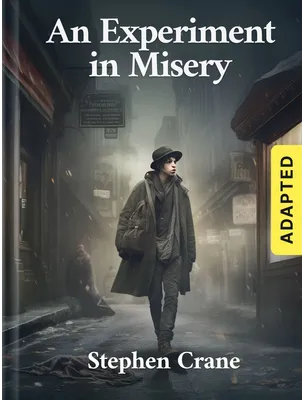
It was late at night, and a light rain was falling softly, causing the pavements to shine with colors of steel gray and blue and yellow in the rays of the many lights. A youth was walking slowly, without joy, with his hands buried deep in his trouser pockets, towards the downtown places where beds can be rented for small coins. He was dressed in an old and torn suit, and his derby hat had a dust-covered top and a torn brim. He was going out to eat as the wanderer may eat, and sleep as the homeless sleep. By the time he had reached City Hall Park he was so completely covered with yells of “bum” and “hobo,” and with many bad names that small boys had called him from time to time, that he was in a state of very deep sadness.
The light rain soaked the old velvet collar of his coat, and as the wet cloth pressed against his neck, he felt that there could no longer be joy in life. He looked about him searching for the worst outcast so that they too might share troubles, but the lights gave a shaky light over rows and circles of empty benches that looked wet and shiny, showing patches of wet grass behind them. It seemed that their usual crowds had run away on this night to better things. There were only groups of well-dressed Brooklyn people who went towards the bridge.
The young man hung around for a while and then walked slowly down Park Row. In the sudden drop in how well the crowd was dressed he felt better, and as if he was finally in his own place. He began to see rags that matched his rags. In Chatham Square there were men with no purpose scattered in front of bars and small hotels, standing sadly, patiently, making one think a little of how chickens stand in a storm. He stood with these men, and turned slowly to watch the moving life of the big street.
Through the fog of the cold and stormy night, the cable cars went in a quiet line, large cars shining with red and brass, moving with strong power, calm and unstoppable, dangerous and dark, breaking the quiet only by the loud harsh cry of the gong. Two rivers of people moved along the side walks, splashed with black mud, which made each shoe leave a mark like a scar. Overhead, elevated trains, with a high harsh grinding of the wheels, stopped at the station, which, on its leg-like posts, seemed to look like some huge kind of crab sitting over the street. The short heavy puffings of the engines could be heard. Down an alley there were dark curtains of purple and black, on which street lamps dimly shone like sewn flowers.
A bar stood with a very hungry look on a corner. A sign leaning against the front of the doorpost said “Free hot soup tonight!” The swing doors, snapping back and forth like very hungry lips, made satisfied smacks as the bar stuffed itself with fat men, eating with amazing and endless hunger, smiling in some way that is hard to describe as the men came from all directions like sacrifices to a strange superstition.
Caught by the nice sign the young man let himself be pulled in. A bartender placed a large glass of dark and strong beer on the bar. Its very big shape rose up until the foam on top was above the top of the young man’s brown hat.
“Soup over there, gents,” said the bartender in a friendly way. A little yellow man in rags and the young man grabbed their glasses and went quickly toward a lunch counter, where a man with oily but big whiskers scooped kindly from a kettle until he had given his two beggars a soup that was steaming hot, and in it there were small floating bits that seemed like chicken.
The young man, drinking his soup slowly, felt the friendliness shown by the warmth of the soup, and he smiled at the man with oily but thick whiskers, who was in charge like a priest behind an altar. “Have some more, gents?” he asked the two sad-looking figures before him. The little yellow man accepted with a quick gesture, but the youth shook his head and went out, following a man whose very shabby look showed that he knew about cheap lodging houses.
On the sidewalk he stopped the poor-looking man. “Say, do you know a cheap place to sleep?”
The other stopped for a moment, looking to the side. Finally he nodded toward the street, “I sleep up there,” he said, “when I have the money.”
“How much?”
“Ten cents.”
The young man shook his head sadly. “That’s too expensive for me.”
At that moment a staggering man in strange clothes came toward the two. His head was a mess of bushy hair and a beard, and from it his eyes looked out with a guilty sideways look. On a close look it was possible to see the cruel lines of a mouth that looked as if its lips had just closed with pleasure over some soft and sad small piece of food. He looked like a killer soaked in crimes done clumsily.
But at this time his voice was set to the soft, begging sound of a friendly puppy. He looked at the men with begging eyes, and began to sing a little song for charity.
“Say, gents, can’t you give a poor man a couple of cents to get a bed. I have five, and if I get another two I get a bed. Now, honestly, gents, can’t you just give me two cents to get a bed? Now, you know how a respectable gentleman feels when he’s having bad luck, and I — —”
The dirty man, staring with a calm face at a train that made a loud noise above, interrupted in a voice with no feeling — “Ah, go to hell!”
But the young man spoke to the praying killer in a surprised and questioning voice. “Say, you must be crazy! Why don’t you hit someone who looks like they have money?”
The killer, stumbling around on his shaky legs, and from time to time brushing away things that were not there in front of his nose, began a long explanation about the feelings and thoughts in the situation. It was so deep that it could not be understood.
When he had finished talking about it, the young man said to him —
“Let’s see the five cents.”
The killer had a sad, drunk look at these words, not trusting him. With a very hurt look he began to search in his clothes, his red hands shaking. Soon he said in a voice of great sadness, as if he had been tricked — “There’s on’y four.”
“Four,” said the young man, thinking. “Well, look here, I am new here, and if you will take me to your cheap place I will find the other three.”
The killer’s face became at once bright with joy. His beard shook with the many feelings he said he had. He grabbed the young man’s hand in a rush of joy and friendliness.
“By God,” he cried, “if you’ll do that, by God, I’d say you were a very good man, I would, and I’d remember you all my life, I would, by God, and if I ever got a chance I’d do the same for you” — he spoke in a drunk, serious way, — “by God, I’d treat you fair, I would, and I’d always remember you.”
The young man stepped back, looking at the killer with a cold look. “Oh, that’s all right,” he said. “You show me the place — that’s all you have to do.”
The man, waving his hands to show thanks, led the young man along a dark street. Finally he stopped before a little dusty door. He raised his hand in a serious way. “Look here,” he said, and there was a look of deep and old wisdom on his face, “I’ve brought you here, and that’s my part, isn’t it? If the place isn’t right for you, you don’t need to get mad at me, do you? There won’t be any bad feeling, will there?”
“No,” said the young man.
The killer waved his arm sadly, and led the way up the steep stairs. On the way the young man gave the killer three pennies. At the top a man with kind-looking glasses looked at them through a hole in a board. He took their money, wrote some names in a book, and quickly was leading the two men along a dark hallway.
Soon after the start of this trip the young man felt very afraid, because from the dark and hidden places of the building there suddenly came to his nose strange and awful smells, that attacked him like deadly diseases with wings. They seemed to be from human bodies tightly packed in rooms; the breaths from a hundred pairs of stinking lips; the smells from a thousand past wild parties; the sign of a thousand present sufferings.
A man, naked except for a small brown undershirt, was walking sleepily down the hallway. He rubbed his eyes, and, letting out a huge yawn, asked what time it was.
“Half past one.”
The man yawned again. He opened a door, and for a moment his body was seen against the black, dark inside. The three men came to this door, and when it was opened again the very bad smells rushed out like monsters, so that the young man had to fight as if against a very strong wind.
It was some time before the youth’s eyes were used to the deep darkness inside, but the man with kind-looking glasses led him carefully, stopping only a moment to put the limp killer on a small bed. He took the youth to a small bed that was quietly by the window, and showing him a tall cupboard for clothes that stood near the head with the scary look of a gravestone, left him.
The young man sat on his small bed and looked around him. There was a gas lamp in a far part of the room that burned a small, flickering, orange flame. It made many messy shadows in all parts of the place, except where, right around it, there was a little grey mist. As the young man’s eyes got used to the darkness, he could see on the small beds that were all over the floor the bodies of men lying spread out, lying in silence like death, or breathing hard and snoring with great effort, like stabbed fish.
The youth locked his hat and his shoes in the locker near him, and then lay down with an old and familiar coat around his shoulders. A blanket he handed carefully, pulling it over part of the coat. The small bed was covered with leather, and as cold as melting snow. The youth had to shiver for some time on this thing, which was like a flat stone.
Soon, though, his chill gave him peace, and during this time of rest from it he turned his head to look at his friend the assassin, whom he could barely see where he lay spread out on a cot in the careless way of a man full of drink. He was snoring very loudly. His wet hair and beard shone a little, and his red nose shone with a soft light like a red light in a fog.
Within reach of the young man’s hand was a man who lay with yellow chest and shoulders bare to the cold air. One arm hung over the side of the bed, and the fingers lay straight upon the wet cement floor of the room. Under the very dark eyebrows, the man’s eyes could be seen through the partly opened eyelids. To the young man it seemed that he and this person like a dead body were exchanging a long stare, and that the other threatened him with his eyes. He drew back, watching his neighbour from the shadows of the edge of his blanket. The man did not move once through the night, but lay in this stillness like death, like a body stretched out waiting for the surgeon’s knife.
And all through the room could be seen the brownish colors of bare skin, arms and legs pushed into the darkness, sticking out beyond the beds; raised knees, arms hanging long and thin over the bed edges. For the most part they were like statues, carved, dead. With the strange lockers standing all about like gravestones, there was a strange feeling of a graveyard where bodies were just thrown.
Yet sometimes limbs could be seen wildly tossing in strange nightmare moves, with deep cries, grunts, curses. And there was one man off in a dark corner, who in his dreams was troubled by some terrible thing, for all of a sudden he began to make long cries that sounded almost like yells from a dog, echoing sadly and strangely through this cold place of gravestones where men lay like the dead.
The sound in its high, sharp beginnings, that turned to final sad moans, showed a red and dark tragedy of the endless possibilities of the man’s dreams. But to the youth these were not only the screams of a man hurt by visions: they were an expression of the meaning of the room and its people in it. It was to him the protest of the poor man who feels the touch of the uncaring stone wheels, and who then cries with a clear voice that is not personal, with a strength that is not from him, giving a voice to the cry of a whole part, a class, a people.
This, going into the young man’s mind, and mixing with his thoughts of the very big and dark shadows that, like strong black fingers, curled around the naked bodies, made the young man so that he did not sleep, but lay making the life stories for these men from his small experience. At times the fellow in the corner cried out in a twisting pain of his imagination.
Finally a long sharp point of grey light went through the dusty glass panes of the window. Outside, the young man could see roofs dull white in the dawn. The point of light turned yellow and grew brighter, until the golden rays of the morning sun came in strong and bright. They touched with bright colour the shape of a small fat man, who snored in a jerky way. His round and shiny bald head glowed suddenly with the bravery of a medal. He sat up, blinked at the sun, swore angrily, and pulled his blanket over the fancy shine of his head.
The young man happily watched the shadows being chased away by the bright rays of the sun, and soon he slept. When he awoke he heard the killer’s voice raised in brave curses. He lifted his head, and he saw his friend sitting on the side of the bed, scratching his neck with long fingernails that scraped like files.
“Hully Jee, this is a new kind. They’ve got can openers on their feet.” He continued in an angry speech.
The young man quickly unlocked his closet and took out his shoes and hat. As he sat on the side of the bed tying his shoes, he looked around and saw that daylight had made the room more ordinary and not interesting. The men, whose faces seemed blank, calm, or far away, were busy getting dressed, while a lot of joking talk started.
A few were walking around naked without worry. Here and there were strong men, whose skin looked clear and red. They took great poses, standing tall like leaders. When they had dressed in their clumsy clothes there was a very big change. They then showed bumps and faults of all kinds.
There were others who had many body problems. Shoulders were slanted, bent, pulled this way and that way. And easy to notice among these other men was the little fat man, who had refused to let his head be made fine. His chubby body, built like a pear, moved quickly back and forth, while he swore loudly like a market woman. It seemed that some piece of his clothing had gone missing.
The young man dressed quickly, and went to his friend the killer. At first the latter looked confused when he saw the young man. This face seemed to be calling to him through the clouds of his memory. He scratched his neck and thought. At last he grinned, a broad smile gradually spreading until his face was a round light. “Hello, Willie,” he cried cheerfully.
“Hello,” said the young man. “Are you ready to fly?”
“Sure.” The killer tied his shoe carefully with some string and came walking slowly.
When he reached the street the young man felt no quick relief from bad smells. He had forgotten all about them, and had been breathing normally, and with no feeling of discomfort or pain.
He was thinking of these things as he walked along the street, when he was suddenly surprised by feeling the killer’s hand, shaking with excitement, grabbing his arm, and when the killer spoke, his voice started to shake from very great worry.
“I’ll be very surprised if there wasn’t a man with a nightshirt on up there in that place.”