The book was published in 2022 as an adapted version of Stephen Crane's original works.
[{"id":"para_1","index":0,"start":0,"offset":348,"words":4,"paraNum":"","lastModified":1761047363000,"semanticType":"title-book-title","voicework":"tts","blockId":"the_death_and_the_child_short_story_en-blve","language":"en","wordsRange":{"start":100000000,"end":105000000},"paragraphVersion":23,"direction":"ltr","paragraph":"<h1 class=\"ilm-title ilm-x-large\" id=\"para_1\" semantictype=\"title-book-title\" data-ilmid=\"the_death_and_the_child_short_story_en-blve\" data-audio=\"1\" data-chapter=\"para_1\" data-words-count=\"4\" data-before=\"0\" data-ww=\"\"><span class=\"block-pb\"> <span class=\"block-pb is-animated\"></span> </span><span class=\"itm-wrap\">Death and the Child</span></h1>","hasContent":true,"isFirst":true,"isLast":false},{"id":"para_2","index":1,"start":348,"offset":337,"words":1,"paraNum":"","lastModified":1761047348000,"semanticType":"title-subtitle","voicework":"tts","blockId":"the_death_and_the_child_short_story_en-blyf","language":"en","wordsRange":{"start":138333333,"end":171666667},"paragraphVersion":35,"direction":"ltr","paragraph":"<h1 class=\"ilm-title ilm-subtitle\" id=\"para_2\" semantictype=\"title-subtitle\" data-ilmid=\"the_death_and_the_child_short_story_en-blyf\" data-audio=\"1\" data-chapter=\"para_2\" data-words-count=\"1\" data-before=\"4\" data-ww=\"\"><span class=\"block-pb\"> <span class=\"block-pb is-animated\"></span> </span><span class=\"itm-wrap\">[adapted]</span></h1>","hasContent":true,"isFirst":false,"isLast":false},{"id":"para_3","index":2,"start":685,"offset":364,"words":2,"paraNum":"","lastModified":1761047489000,"semanticType":"title-author","voicework":"tts","blockId":"the_death_and_the_child_short_story_en-bly1","language":"en","wordsRange":{"start":205000000,"end":209000000},"paragraphVersion":36,"direction":"ltr","paragraph":"<h1 class=\"ilm-title ilm-author ilm-large ilm-nopad\" id=\"para_3\" semantictype=\"title-author\" data-ilmid=\"the_death_and_the_child_short_story_en-bly1\" data-audio=\"1\" data-chapter=\"para_3\" data-words-count=\"2\" data-before=\"5\" data-ww=\"\"><span class=\"block-pb\"> <span class=\"block-pb is-animated\"></span> </span><span class=\"itm-wrap\">by <br>Stephen Crane</span></h1>","hasContent":true,"isFirst":false,"isLast":false},{"id":"para_4","index":3,"start":1049,"offset":166,"words":0,"paraNum":"","lastModified":1681647110000,"semanticType":"line","blockId":"the_death_and_the_child_short_story_en-bly2","language":"en","wordsRange":{"start":309000000,"end":409000000},"paragraphVersion":11,"direction":"ltr","paragraph":"<hr class=\"ilm-hr ilm-small\" id=\"para_4\" semantictype=\"line\" data-ilmid=\"the_death_and_the_child_short_story_en-bly2\" data-words-count=\"0\" data-before=\"7\" data-ww=\"\">","hasContent":true,"isFirst":false,"isLast":false},{"id":"para_5","index":4,"start":1215,"offset":1398,"words":0,"paraNum":"","lastModified":1761042179000,"semanticType":"illustration","blockId":"the_death_and_the_child_short_story_en-blye","language":"en","wordsRange":{"start":509000000,"end":609000000},"paragraphVersion":20,"direction":"ltr","paragraph":"<div class=\"ilm-illustration\" id=\"para_5\" semantictype=\"illustration\" data-ilmid=\"the_death_and_the_child_short_story_en-blye\" data-words-count=\"0\" data-before=\"7\" data-ww=\"\"><img width=\"600\" height=\"400\" data-src=\"ch0p0\" src=\"data:image/webp;base64,UklGRjQDAABXRUJQVlA4ICgDAABQDwCdASo8ACgAPm0wk0ekIqGhKrQLAIANiWQAnTKEh9SP7+Y3fvjdy0ClaXSkrwvuHfplqMFeOPw78Mewwkrni2EHqtv8eDPF00NWyzpG3uh8ZafkG78IPiIdyZRZEBjXhcOkbQ6Cdb20ZpsFYH0KeMWjjLaCWyjBpvvcqvWc/zf+AAD+/ZT1h9tuJuyugNK1e3Zil2lx/S6lEFqgxCe0yidpwDjgl0OdYDMDLdTYpoOv2nyEHd6x0wdNiyCLXFXZBNJoJEF/6SR6yDQeh9Wwjya4ZY0p0MGmeD8MrLVWvzpsGFOCC+xf4dk7oYC7u/GaVGLk08KMNSfnVs0cMMD/qOj0Iy/mMyKN66m6CjKmAOS2h0oxw3Ldk4fq/1+XQxEUv3S2AdzHboKXt5GDust9nfOJj74vwidUWM7oOMPyK6HS3hyVwZjcNZrDmT2O5M1r4QWFp41227wmzd8Tdr2/IHOxzhwtxeLzfkq9sTwonLT7vGSsEx8kboaq+BVSSVk69zug+TAnIPtZAjbFV0ACuGDAGLGfn9Gi7n06OATtlLsIA4JHesM/nrntPs1PxncVAUdBAV7VoOgA3v6EnJ/ZPW7MIwFuGAaP8YKGQqrslKfUIDdQiFz4l0C5NJgwYz2/p1dchK0ucMPrbFpxpSJbqWALqQnMHWm25yrTsQrSC06JwIDCQrPpi5/lqGDQtdERfOE5dsm6BwsXJqkv0k/Co/NopYz+SwTNAurAT/3X1TkipfNNGTLq/0CCwGiIDuU3DuEBNRn+sqgDzMteuGqPS3TQ5KBkr/TuUzzeKLmPuV0oseE98b1mxO1JiRWBuY523X+Y7Y8MH0KyUIcFBnBG+zIStdt+uz8H1r9q/9WPsAKCbWBz6N8FuT5HzfTnkgpvlHV+wC1hKv4RanE4u1b181fqsZgpNXF/DEt//QnRWKZmq3DmUPHKch0sEETxAohAqA6qsKb1J4V01NzypmhDQcE5I9dnnpf9ZtBa6ubBzqdaE4yDlN0WwAxl1A/gfk+N1xaw8JaT01JkYjzd+i0YZSnyUHu7I0+MpwD7lzXBisWuysiaN3AA\" alt=\"Death and the Child (adapted)\"></div>","hasContent":true,"isFirst":false,"isLast":false},{"id":"para_6","index":5,"start":2613,"offset":516,"words":1,"paraNum":"","lastModified":1761047432000,"semanticType":"header-chapter-header","voicework":"tts","blockId":"the_death_and_the_child_short_story_en-blvf","language":"en","wordsRange":{"start":709000000,"end":711000000},"paragraphVersion":29,"direction":"ltr","paragraph":"<h2 class=\"ilm-header ilm-h2 ilm-large\" id=\"para_6\" semantictype=\"header-chapter-header\" data-ilmid=\"the_death_and_the_child_short_story_en-blvf\" data-audio=\"1\" data-chapter=\"para_6\" data-words-count=\"1\" data-before=\"7\" data-ww=\"\"><span class=\"block-pb\"> <span class=\"block-pb is-animated\"></span> </span><span class=\"itm-wrap\"><span class=\"chapter-text\"><span class=\"chapter-number\"><span class=\"chapter-label\"></span><span class=\"chapter-value\"></span></span><span class=\"chapter-title\">I</span></span></span></h2>","hasContent":true,"isFirst":false,"isLast":false},{"id":"para_7","index":6,"start":3129,"offset":1510,"words":222,"paraNum":"1.1","lastModified":1762439240000,"semanticType":"par","voicework":"tts","blockId":"the_death_and_the_child_short_story_en-blvg","language":"en","wordsRange":{"start":811000000,"end":1028000000},"paragraphVersion":24,"direction":"ltr","paragraph":"<p id=\"para_7\" semantictype=\"par\" data-ilmid=\"the_death_and_the_child_short_story_en-blvg\" data-audio=\"1\" data-words-count=\"222\" data-before=\"8\" data-ww=\"\"><span class=\"block-num\" data-id=\"1.1\"></span><span class=\"block-pb\"> <span class=\"block-pb is-animated\"></span> </span><span class=\"itm-wrap\">The villagers who were going down the mountain trail were so afraid that they seemed to forget how to count. The cattle and the huge round bundles seemed enough to the crowd if now there were two each time where there had been three. This brown stream kept going with a constant loss of things and animals. A goat fell behind to look at the dry grass and its owner, shouting, hitting his donkeys, went far ahead. A young horse, suddenly afraid, ran, stumbling, up the hillside. The waste was always very great and always without a name, not noticed. It was as if fear was a river, and this crowd had simply been caught in the flood, man tumbling over beast, beast over man, as helpless in it as the logs that fall and push hard through the deep valleys in a place where people cut wood. It was a sudden flood that might burn the face of the tall quiet mountain; it might draw a pale line across the land, this downpour of fear with a thousand homes floating in the stream — men, women, babies, animals. From it there came a constant noise of voices, high, broken, and sometimes choking, like men who are drowning. Many made hand signs, showing their pain in the air with fingers that turned quickly.</span></p>","hasContent":true,"isFirst":false,"isLast":false},{"id":"para_8","index":7,"start":4639,"offset":1469,"words":222,"paraNum":"1.2","lastModified":1762439240000,"semanticType":"par","voicework":"tts","blockId":"the_death_and_the_child_short_story_en-blvh","language":"en","wordsRange":{"start":1128000000,"end":1348000000},"paragraphVersion":23,"direction":"ltr","paragraph":"<p id=\"para_8\" semantictype=\"par\" data-ilmid=\"the_death_and_the_child_short_story_en-blvh\" data-audio=\"1\" data-words-count=\"222\" data-before=\"230\" data-ww=\"\"><span class=\"block-num\" data-id=\"1.2\"></span><span class=\"block-pb\"> <span class=\"block-pb is-animated\"></span> </span><span class=\"itm-wrap\">The blue bay with its pointed ships and the white town lay below them, distant, flat, calm. There was upon this view a peace that a bird knows when high in the air it looks over the world, a great calm thing moving quietly toward the end of the mystery. Here on the high place one felt the whole world coldly showing the pain in ten thousand minds. The sky was an arch of deep blue. Even to the mountains lifting their great shapes from the valley, this wild rush of the people who fled was too small. The sea, the sky, and the hills combined in their greatness to call this suffering unimportant. Then too it sometimes happened that a face seen as it passed in the crowd showed the feeling of them all and even more. One saw then a woman who seemed to think like the sky above the clouds. When a child cried it cried always because of some nearby bad thing, some discomfort of a pack saddle or roughness of an arm around it. In the sad music of this escape there were often notes of not caring. Into these worried faces, one felt that needles could be pushed without getting a scream. The trail twisted here and there as the sheep had wanted when making it.</span></p>","hasContent":true,"isFirst":false,"isLast":false},{"id":"para_9","index":8,"start":6108,"offset":915,"words":113,"paraNum":"1.3","lastModified":1762439240000,"semanticType":"par","voicework":"tts","blockId":"the_death_and_the_child_short_story_en-blvi","language":"en","wordsRange":{"start":1448000000,"end":1558000000},"paragraphVersion":24,"direction":"ltr","paragraph":"<p id=\"para_9\" semantictype=\"par\" data-ilmid=\"the_death_and_the_child_short_story_en-blvi\" data-audio=\"1\" data-words-count=\"113\" data-before=\"452\" data-ww=\"\"><span class=\"block-num\" data-id=\"1.3\"></span><span class=\"block-pb\"> <span class=\"block-pb is-animated\"></span> </span><span class=\"itm-wrap\">Although this crowd seemed to show that all people were running away in one direction — with every tie cut that binds us to the ground — a young man was walking quickly up the mountain, hurrying to a side of the path from time to time to avoid some especially wide rush of people and cattle. He looked at everything in worry and pity. Often he called warnings to crazy people who were running away, and at other times he shared strange looks with the calm ones. They seemed to him to have only the looks of so many big rocks rolling down the hill. He showed wonder and amazement with his sorry looks.</span></p>","hasContent":true,"isFirst":false,"isLast":false},{"id":"para_10","index":9,"start":7023,"offset":1348,"words":202,"paraNum":"1.4","lastModified":1762439240000,"semanticType":"par","voicework":"tts","blockId":"the_death_and_the_child_short_story_en-blvj","language":"en","wordsRange":{"start":1658000000,"end":1862000000},"paragraphVersion":24,"direction":"ltr","paragraph":"<p id=\"para_10\" semantictype=\"par\" data-ilmid=\"the_death_and_the_child_short_story_en-blvj\" data-audio=\"1\" data-words-count=\"202\" data-before=\"565\" data-ww=\"\"><span class=\"block-num\" data-id=\"1.4\"></span><span class=\"block-pb\"> <span class=\"block-pb is-animated\"></span> </span><span class=\"itm-wrap\">Turning once toward the back, he saw a man wearing the uniform of an infantry lieutenant marching the same way. He waited then, without knowing it, very happy at the chance to put into words the feeling which before had only been shown in the flash of eyes and the sensitive movements of his flexible mouth. He spoke to the officer in fast French, waving his arms wildly, and often pointing with a dramatic finger. “Ah, this is too cruel, too cruel, too cruel. Isn’t it? I did not think it would be as bad as this. I did not think — God’s mercy — I did not think at all. And yet I am a Greek. Or at least my father was a Greek. I did not come here to fight. I am really a reporter, you see? I was to write for an Italian newspaper. I have been educated in Italy. I have spent nearly all my life in Italy. At the schools and universities! I knew nothing of war! I was a student — a student. I came here only because my father was a Greek, and because of him I thought of Greece — I loved Greece. But I did not dream — ”</span></p>","hasContent":true,"isFirst":false,"isLast":false},{"id":"para_11","index":10,"start":8371,"offset":697,"words":72,"paraNum":"1.5","lastModified":1762439240000,"semanticType":"par","voicework":"tts","blockId":"the_death_and_the_child_short_story_en-blvl","language":"en","wordsRange":{"start":1962000000,"end":2024000000},"paragraphVersion":24,"direction":"ltr","paragraph":"<p id=\"para_11\" semantictype=\"par\" data-ilmid=\"the_death_and_the_child_short_story_en-blvl\" data-audio=\"1\" data-words-count=\"72\" data-before=\"767\" data-ww=\"\"><span class=\"block-num\" data-id=\"1.5\"></span><span class=\"block-pb\"> <span class=\"block-pb is-animated\"></span> </span><span class=\"itm-wrap\">He paused, breathing heavily. His eyes shone with that soft wetness that sometimes comes to the look of a young woman. Eager, full of strong feeling, deeply moved, his first words, while facing the line of people running away, had been a clear statement of himself, his personal connection to people, the land, life. All through it he had kept the strong pride of an actor in a tragedy.</span></p>","hasContent":true,"isFirst":false,"isLast":false},{"id":"para_12","index":11,"start":9068,"offset":494,"words":33,"paraNum":"1.6","lastModified":1762439240000,"semanticType":"par","voicework":"tts","blockId":"the_death_and_the_child_short_story_en-blvm","language":"en","wordsRange":{"start":2124000000,"end":2156000000},"paragraphVersion":24,"direction":"ltr","paragraph":"<p id=\"para_12\" semantictype=\"par\" data-ilmid=\"the_death_and_the_child_short_story_en-blvm\" data-audio=\"1\" data-words-count=\"33\" data-before=\"839\" data-ww=\"\"><span class=\"block-num\" data-id=\"1.6\"></span><span class=\"block-pb\"> <span class=\"block-pb is-animated\"></span> </span><span class=\"itm-wrap\">The officer’s way at once gave in to this shout. “Yes,” he said, polite but sad, “these poor people! These poor people! I do not know what will happen to these poor people.”</span></p>","hasContent":true,"isFirst":false,"isLast":false},{"id":"para_13","index":12,"start":9562,"offset":595,"words":58,"paraNum":"1.7","lastModified":1762439240000,"semanticType":"par","voicework":"tts","blockId":"the_death_and_the_child_short_story_en-blvn","language":"en","wordsRange":{"start":2256000000,"end":2314000000},"paragraphVersion":47,"direction":"ltr","paragraph":"<p id=\"para_13\" semantictype=\"par\" data-ilmid=\"the_death_and_the_child_short_story_en-blvn\" data-audio=\"1\" data-words-count=\"58\" data-before=\"872\" data-ww=\"\"><span class=\"block-num\" data-id=\"1.7\"></span><span class=\"block-pb\"> <span class=\"block-pb is-animated\"></span> </span><span class=\"itm-wrap\">The young man spoke loudly again. “I did not dream — I did not dream that it would be like this! This is too cruel! Too cruel! Now I want to be a soldier. Now I want to fight. Now I want to fight for my father’s land.” He made a big movement with his hand into the north-west.</span></p>","hasContent":true,"isFirst":false,"isLast":false},{"id":"para_14","index":13,"start":10157,"offset":751,"words":82,"paraNum":"1.8","lastModified":1762439240000,"semanticType":"par","voicework":"tts","blockId":"the_death_and_the_child_short_story_en-blvo","language":"en","wordsRange":{"start":2414000000,"end":2494000000},"paragraphVersion":24,"direction":"ltr","paragraph":"<p id=\"para_14\" semantictype=\"par\" data-ilmid=\"the_death_and_the_child_short_story_en-blvo\" data-audio=\"1\" data-words-count=\"82\" data-before=\"930\" data-ww=\"\"><span class=\"block-num\" data-id=\"1.8\"></span><span class=\"block-pb\"> <span class=\"block-pb is-animated\"></span> </span><span class=\"itm-wrap\">The officer was also a young man, but he was very tanned and steady. Above his high military collar of dark red cloth with one silver star on it, there was a face, stern, quiet, and confident, accepting fate, afraid only of what people think. His clothes were covered with dust; the only bright spot was the bright red of the collar. At the loud cries of his friend he smiled as if to himself, while keeping his eyes looking straight ahead.</span></p>","hasContent":true,"isFirst":false,"isLast":false},{"id":"para_15","index":14,"start":10908,"offset":1166,"words":165,"paraNum":"1.9","lastModified":1762439240000,"semanticType":"par","voicework":"tts","blockId":"the_death_and_the_child_short_story_en-blvp","language":"en","wordsRange":{"start":2594000000,"end":2744000000},"paragraphVersion":24,"direction":"ltr","paragraph":"<p id=\"para_15\" semantictype=\"par\" data-ilmid=\"the_death_and_the_child_short_story_en-blvp\" data-audio=\"1\" data-words-count=\"165\" data-before=\"1012\" data-ww=\"\"><span class=\"block-num\" data-id=\"1.9\"></span><span class=\"block-pb\"> <span class=\"block-pb is-animated\"></span> </span><span class=\"itm-wrap\">From a land toward which their faces were turned came a steady boom of big guns. It was sounding in regular beats like the ticking of a huge clock, a clock that was counting the seconds in the lives of the stars, and men had time to die between the ticks. Serious, like a warning, and that could not be stopped, the great seconds rang over the hills as if God stood before this clock face with the horizon all around it. The soldier and the reporter found themselves silent. The latter especially was in a great sadness, as if he had decided, whether he wanted to or not, to swing to the bottom of the deep pit where secrets of his kind live, and had learned before that all to be met there was cruelty and no hope. A strap of his bright new leather leggings came loose, and he bent over it slowly, seriously, like one bending over the grave of a child.</span></p>","hasContent":true,"isFirst":false,"isLast":false},{"id":"para_16","index":15,"start":12074,"offset":678,"words":65,"paraNum":"1.10","lastModified":1762439240000,"semanticType":"par","voicework":"tts","blockId":"the_death_and_the_child_short_story_en-blvq","language":"en","wordsRange":{"start":2844000000,"end":2912000000},"paragraphVersion":24,"direction":"ltr","paragraph":"<p id=\"para_16\" semantictype=\"par\" data-ilmid=\"the_death_and_the_child_short_story_en-blvq\" data-audio=\"1\" data-words-count=\"65\" data-before=\"1177\" data-ww=\"\"><span class=\"block-num\" data-id=\"1.10\"></span><span class=\"block-pb\"> <span class=\"block-pb is-animated\"></span> </span><span class=\"itm-wrap\">Then suddenly, the echoes mixed until one could not tell one explosion from another, and into the noise came the slow sound of gunfire. Instantly, for some reason of rhythm, the noise was annoying, silly, childlike. This loud noise was childish. It made the nerves complain, to protest against this loud noise which was as useless as the noise of a boy with a drum.</span></p>","hasContent":true,"isFirst":false,"isLast":false},{"id":"para_17","index":16,"start":12752,"offset":521,"words":38,"paraNum":"1.11","lastModified":1762439240000,"semanticType":"par","voicework":"tts","blockId":"the_death_and_the_child_short_story_en-blvr","language":"en","wordsRange":{"start":3012000000,"end":3052000000},"paragraphVersion":27,"direction":"ltr","paragraph":"<p id=\"para_17\" semantictype=\"par\" data-ilmid=\"the_death_and_the_child_short_story_en-blvr\" data-audio=\"1\" data-words-count=\"38\" data-before=\"1242\" data-ww=\"\"><span class=\"block-num\" data-id=\"1.11\"></span><span class=\"block-pb\"> <span class=\"block-pb is-animated\"></span> </span><span class=\"itm-wrap\">The officer lifted his finger and pointed. He spoke in an annoyed voice, as if he blamed the other man personally for the noise. “Well, there!” he said. “If you want war, you now have a great chance.”</span></p>","hasContent":true,"isFirst":false,"isLast":false},{"id":"para_18","index":17,"start":13273,"offset":718,"words":84,"paraNum":"1.12","lastModified":1762439240000,"semanticType":"par","voicework":"tts","blockId":"the_death_and_the_child_short_story_en-blvs","language":"en","wordsRange":{"start":3152000000,"end":3238000000},"paragraphVersion":167,"direction":"ltr","paragraph":"<p id=\"para_18\" semantictype=\"par\" data-ilmid=\"the_death_and_the_child_short_story_en-blvs\" data-audio=\"1\" data-words-count=\"84\" data-before=\"1280\" data-ww=\"\"><span class=\"block-num\" data-id=\"1.12\"></span><span class=\"block-pb\"> <span class=\"block-pb is-animated\"></span> </span><span class=\"itm-wrap\">The reporter stood on his toes. He tapped his chest with sad pride. “Yes! There is war! There is the war I want to join. I will jump in. I am a Greek, a Greek, you understand. I want to fight for my country. You know the way. Lead me. I volunteer.” Suddenly he had an idea; he took a case from his pocket, and taking out a card gave it to the officer with a bow. “My name is Peza,” he said simply.</span></p>","hasContent":true,"isFirst":false,"isLast":false},{"id":"para_19","index":18,"start":13991,"offset":667,"words":68,"paraNum":"1.13","lastModified":1762439240000,"semanticType":"par","voicework":"tts","blockId":"the_death_and_the_child_short_story_en-blvt","language":"en","wordsRange":{"start":3338000000,"end":3405000000},"paragraphVersion":36,"direction":"ltr","paragraph":"<p id=\"para_19\" semantictype=\"par\" data-ilmid=\"the_death_and_the_child_short_story_en-blvt\" data-audio=\"1\" data-words-count=\"68\" data-before=\"1364\" data-ww=\"\"><span class=\"block-num\" data-id=\"1.13\"></span><span class=\"block-pb\"> <span class=\"block-pb is-animated\"></span> </span><span class=\"itm-wrap\">A strange smile came over the soldier’s face. There was pity and pride — the pride from experience — and no respect in it. “Very well,” he said, bowing back. “If my company is in the middle of the fight I will be glad for the honour of you being with me. If my company is not in the middle of the fight — I will make other plans for you.”</span></p>","hasContent":true,"isFirst":false,"isLast":false},{"id":"para_20","index":19,"start":14658,"offset":881,"words":103,"paraNum":"1.14","lastModified":1762439240000,"semanticType":"par","voicework":"tts","blockId":"the_death_and_the_child_short_story_en-blvu","language":"en","wordsRange":{"start":3505000000,"end":3609000000},"paragraphVersion":165,"direction":"ltr","paragraph":"<p id=\"para_20\" semantictype=\"par\" data-ilmid=\"the_death_and_the_child_short_story_en-blvu\" data-audio=\"1\" data-words-count=\"103\" data-before=\"1432\" data-ww=\"\"><span class=\"block-num\" data-id=\"1.14\"></span><span class=\"block-pb\"> <span class=\"block-pb is-animated\"></span> </span><span class=\"itm-wrap\">Peza bowed once more, very stiffly, and politely said his thanks. On the edge of what he thought was a great step toward death, he found that he was annoyed at something in the lieutenant’s tone. Things suddenly seemed new and very big. The battle, the great festival of sadness, was at once the same as a bother from a stranger. He wanted to ask the lieutenant what he meant. He bowed again in a grand way; the lieutenant bowed. They threw a shadow of manners, of dancing, shiny ceremony across a land that groaned, and it completely pleased something inside them.</span></p>","hasContent":true,"isFirst":false,"isLast":false},{"id":"para_21","index":20,"start":15539,"offset":1334,"words":194,"paraNum":"1.15","lastModified":1762439240000,"semanticType":"par","voicework":"tts","blockId":"the_death_and_the_child_short_story_en-blvv","language":"en","wordsRange":{"start":3709000000,"end":3900000000},"paragraphVersion":111,"direction":"ltr","paragraph":"<p id=\"para_21\" semantictype=\"par\" data-ilmid=\"the_death_and_the_child_short_story_en-blvv\" data-audio=\"1\" data-words-count=\"194\" data-before=\"1535\" data-ww=\"\"><span class=\"block-num\" data-id=\"1.15\"></span><span class=\"block-pb\"> <span class=\"block-pb is-animated\"></span> </span><span class=\"itm-wrap\">Meanwhile, the stream of villagers running away had become only a last few late people, who ran past stuttering and throwing their hands up high. The two men had come to the top of the great hill. Before them was a green flat land as level as a sea on land. It stretched to the north, and finally became a long line of silver mist. On the near part of this flat land, and on two grey mountains without trees at the side of it, were small black lines from which floated slanted sheets of smoke. It did not trouble the nerves. One could look at it with calm, as if it were a tea-table; but it hit Peza’s mind like a loud clanging blow. It was war. Taught, shocked, proud, he paused suddenly, his lips apart. He remembered the parades of killing that had marched through the dreams of his childhood. Love he knew that he had faced, alone, apart, wondering, an individual, a tiny thing taking the hand of a huge idea. But, like the softest wind on his forehead, he felt here the beat from the hearts of forty thousand men.</span></p>","hasContent":true,"isFirst":false,"isLast":false},{"id":"para_22","index":21,"start":16873,"offset":410,"words":17,"paraNum":"1.16","lastModified":1762439240000,"semanticType":"par","voicework":"tts","blockId":"the_death_and_the_child_short_story_en-blvw","language":"en","wordsRange":{"start":4000000000,"end":4018000000},"paragraphVersion":32,"direction":"ltr","paragraph":"<p id=\"para_22\" semantictype=\"par\" data-ilmid=\"the_death_and_the_child_short_story_en-blvw\" data-audio=\"1\" data-words-count=\"17\" data-before=\"1729\" data-ww=\"\"><span class=\"block-num\" data-id=\"1.16\"></span><span class=\"block-pb\"> <span class=\"block-pb is-animated\"></span> </span><span class=\"itm-wrap\">The officer’s nose was moving. “I must go right away,” he said. “I must go right away.”</span></p>","hasContent":true,"isFirst":false,"isLast":false},{"id":"para_23","index":22,"start":17283,"offset":375,"words":11,"paraNum":"1.17","lastModified":1762439240000,"semanticType":"par","voicework":"tts","blockId":"the_death_and_the_child_short_story_en-blvx","language":"en","wordsRange":{"start":4118000000,"end":4130000000},"paragraphVersion":53,"direction":"ltr","paragraph":"<p id=\"para_23\" semantictype=\"par\" data-ilmid=\"the_death_and_the_child_short_story_en-blvx\" data-audio=\"1\" data-words-count=\"11\" data-before=\"1746\" data-ww=\"\"><span class=\"block-num\" data-id=\"1.17\"></span><span class=\"block-pb\"> <span class=\"block-pb is-animated\"></span> </span><span class=\"itm-wrap\">“I will go with you anywhere you go,” shouted Peza loudly.</span></p>","hasContent":true,"isFirst":false,"isLast":false},{"id":"para_24","index":23,"start":17658,"offset":635,"words":56,"paraNum":"1.18","lastModified":1762439240000,"semanticType":"par","voicework":"tts","blockId":"the_death_and_the_child_short_story_en-blvy","language":"en","wordsRange":{"start":4230000000,"end":4289000000},"paragraphVersion":32,"direction":"ltr","paragraph":"<p id=\"para_24\" semantictype=\"par\" data-ilmid=\"the_death_and_the_child_short_story_en-blvy\" data-audio=\"1\" data-words-count=\"56\" data-before=\"1757\" data-ww=\"\"><span class=\"block-num\" data-id=\"1.18\"></span><span class=\"block-pb\"> <span class=\"block-pb is-animated\"></span> </span><span class=\"itm-wrap\">A rough path went down the side of the mountain, and in their hurry they jumped from place to place, choosing risks which, with normal care, would surely have seemed very dangerous. The excitement of the reporter was greater than the full energy of the soldier. Several times he turned and shouted, “Come on! Come on!”</span></p>","hasContent":true,"isFirst":false,"isLast":false},{"id":"para_25","index":24,"start":18293,"offset":998,"words":118,"paraNum":"1.19","lastModified":1762439240000,"semanticType":"par","voicework":"tts","blockId":"the_death_and_the_child_short_story_en-blvz","language":"en","wordsRange":{"start":4389000000,"end":4501000000},"paragraphVersion":49,"direction":"ltr","paragraph":"<p id=\"para_25\" semantictype=\"par\" data-ilmid=\"the_death_and_the_child_short_story_en-blvz\" data-audio=\"1\" data-words-count=\"118\" data-before=\"1813\" data-ww=\"\"><span class=\"block-num\" data-id=\"1.19\"></span><span class=\"block-pb\"> <span class=\"block-pb is-animated\"></span> </span><span class=\"itm-wrap\">At the bottom of the path they came to a wide road, which went toward the battle in a yellow and straight line. Some men were walking slowly and tiredly to the back. They were without rifles; their clumsy uniforms were dirty and all crooked. They turned their eyes, dull and glowing with fever, on the pair walking toward the battle. Others were bandaged with the triangular scarf on which you could still see, through the blood stains, the little pictures that show how to tie up different wounds. “Fig. 1.” — “Fig. 2.” — “Fig. 7.” Mixed with the walking soldiers were farmers, not caring, able to smile, chattering about the battle, which to them was a distant play.</span></p>","hasContent":true,"isFirst":false,"isLast":false},{"id":"para_26","index":25,"start":19291,"offset":856,"words":103,"paraNum":"1.20","lastModified":1762439240000,"semanticType":"par","voicework":"tts","blockId":"the_death_and_the_child_short_story_en-blya","language":"en","wordsRange":{"start":4601000000,"end":4698000000},"paragraphVersion":35,"direction":"ltr","paragraph":"<p id=\"para_26\" semantictype=\"par\" data-ilmid=\"the_death_and_the_child_short_story_en-blya\" data-audio=\"1\" data-words-count=\"103\" data-before=\"1931\" data-ww=\"\"><span class=\"block-num\" data-id=\"1.20\"></span><span class=\"block-pb\"> <span class=\"block-pb is-animated\"></span> </span><span class=\"itm-wrap\">A man was leading a line of three donkeys to the back, and from time to time he was stopped by hurt soldiers or soldiers with a fever, from whom he protected his animals with monkey-like cries and wild hand movements. After much talking they usually gave up sadly, and allowed him to go with his smooth little donkeys with no load. Finally he met a soldier who walked slowly with the help of a stick. His head was wrapped with a wide bandage, dirty from blood and mud. He asked the farmer, and at once they were in an ugly Levantine argument.</span></p>","hasContent":true,"isFirst":false,"isLast":false},{"id":"para_27","index":26,"start":20147,"offset":910,"words":107,"paraNum":"1.21","lastModified":1762439240000,"semanticType":"par","voicework":"tts","blockId":"the_death_and_the_child_short_story_en-bly9","language":"en","wordsRange":{"start":4798000000,"end":4905000000},"paragraphVersion":32,"direction":"ltr","paragraph":"<p id=\"para_27\" semantictype=\"par\" data-ilmid=\"the_death_and_the_child_short_story_en-bly9\" data-audio=\"1\" data-words-count=\"107\" data-before=\"2034\" data-ww=\"\"><span class=\"block-num\" data-id=\"1.21\"></span><span class=\"block-pb\"> <span class=\"block-pb is-animated\"></span> </span><span class=\"itm-wrap\">The farmer cried and shouted, sometimes spitting like a kitten. The wounded soldier kept shouting very loudly, his big hands stretched out like claws over the farmer’s head. Once he raised his stick and threatened with it. Then suddenly the argument was over. The other sick men saw their friend get on the first donkey and at once begin to kick with his heels. None tried to get on the backs of the other donkeys. They watched them go without interest. Finally they saw the caravan as a shape for a moment against the sky. The soldier was still waving his arms wildly, arguing with the farmer.</span></p>","hasContent":true,"isFirst":false,"isLast":false},{"id":"para_28","index":27,"start":21057,"offset":483,"words":31,"paraNum":"1.22","lastModified":1762439240000,"semanticType":"par","voicework":"tts","blockId":"the_death_and_the_child_short_story_en-blw0","language":"en","wordsRange":{"start":5005000000,"end":5037000000},"paragraphVersion":69,"direction":"ltr","paragraph":"<p id=\"para_28\" semantictype=\"par\" data-ilmid=\"the_death_and_the_child_short_story_en-blw0\" data-audio=\"1\" data-words-count=\"31\" data-before=\"2141\" data-ww=\"\"><span class=\"block-num\" data-id=\"1.22\"></span><span class=\"block-pb\"> <span class=\"block-pb is-animated\"></span> </span><span class=\"itm-wrap\">Peza was full of sadness for these men who looked at him with such sad, quiet eyes. “Ah, my God!” he cried to the officer, “these poor people! These poor people!”</span></p>","hasContent":true,"isFirst":false,"isLast":false},{"id":"para_29","index":28,"start":21540,"offset":753,"words":83,"paraNum":"1.23","lastModified":1762439240000,"semanticType":"par","voicework":"tts","blockId":"the_death_and_the_child_short_story_en-blw1","language":"en","wordsRange":{"start":5137000000,"end":5222000000},"paragraphVersion":77,"direction":"ltr","paragraph":"<p id=\"para_29\" semantictype=\"par\" data-ilmid=\"the_death_and_the_child_short_story_en-blw1\" data-audio=\"1\" data-words-count=\"83\" data-before=\"2172\" data-ww=\"\"><span class=\"block-num\" data-id=\"1.23\"></span><span class=\"block-pb\"> <span class=\"block-pb is-animated\"></span> </span><span class=\"itm-wrap\">The officer turned around angrily. “If you are coming with me there is no time for this.” Peza obeyed right away and in a sudden humble way. At that moment some part of his pride left him, and he quietly wondered if the universe noticed him much. This theatre for killing, built by the strange needs of the earth, was a very big thing, and he thought that the accidental death of a person, Peza by name, would perhaps be nothing at all.</span></p>","hasContent":true,"isFirst":false,"isLast":false},{"id":"para_30","index":29,"start":22293,"offset":797,"words":85,"paraNum":"1.24","lastModified":1762439240000,"semanticType":"par","voicework":"tts","blockId":"the_death_and_the_child_short_story_en-blw2","language":"en","wordsRange":{"start":5322000000,"end":5405000000},"paragraphVersion":32,"direction":"ltr","paragraph":"<p id=\"para_30\" semantictype=\"par\" data-ilmid=\"the_death_and_the_child_short_story_en-blw2\" data-audio=\"1\" data-words-count=\"85\" data-before=\"2255\" data-ww=\"\"><span class=\"block-num\" data-id=\"1.24\"></span><span class=\"block-pb\"> <span class=\"block-pb is-animated\"></span> </span><span class=\"itm-wrap\">With the officer he was soon walking along behind a series of small crescent-shaped trenches, in which were soldiers, calmly interested, chatting with the soft sound of a tea party. Though these men were not at this time being shot at, he decided that they were very brave. Otherwise they would not be so comfortable, so at home in their sticky brown trenches. They were sure to be badly attacked later that day. The universities had not taught him to understand this way of thinking.</span></p>","hasContent":true,"isFirst":false,"isLast":false},{"id":"para_31","index":30,"start":23090,"offset":675,"words":68,"paraNum":"1.25","lastModified":1762439240000,"semanticType":"par","voicework":"tts","blockId":"the_death_and_the_child_short_story_en-blw3","language":"en","wordsRange":{"start":5505000000,"end":5569000000},"paragraphVersion":31,"direction":"ltr","paragraph":"<p id=\"para_31\" semantictype=\"par\" data-ilmid=\"the_death_and_the_child_short_story_en-blw3\" data-audio=\"1\" data-words-count=\"68\" data-before=\"2340\" data-ww=\"\"><span class=\"block-num\" data-id=\"1.25\"></span><span class=\"block-pb\"> <span class=\"block-pb is-animated\"></span> </span><span class=\"itm-wrap\">As the young man in very nice tweed clothes passed, with his new leggings, his new white helmet, his new case for his binoculars, his new holder for his gun, the dirty soldiers turned with the same curiosity that a person in strange clothes meets at street corners. He might as well have been walking on a busy street. The soldiers talked a lot about who he was.</span></p>","hasContent":true,"isFirst":false,"isLast":false},{"id":"para_32","index":31,"start":23765,"offset":681,"words":61,"paraNum":"1.26","lastModified":1762439240000,"semanticType":"par","voicework":"tts","blockId":"the_death_and_the_child_short_story_en-blw4","language":"en","wordsRange":{"start":5669000000,"end":5729000000},"paragraphVersion":58,"direction":"ltr","paragraph":"<p id=\"para_32\" semantictype=\"par\" data-ilmid=\"the_death_and_the_child_short_story_en-blw4\" data-audio=\"1\" data-words-count=\"61\" data-before=\"2408\" data-ww=\"\"><span class=\"block-num\" data-id=\"1.26\"></span><span class=\"block-pb\"> <span class=\"block-pb is-animated\"></span> </span><span class=\"itm-wrap\">To Peza there was something terrible in how completely familiar every tone, expression, and gesture was. These men, facing battle, showed the curiosity of the café. Then, about to have his great meeting with death, he felt very embarrassed, trying to control his face with difficulty, wondering what to do with his hands, like an awkward person at a formal reception.</span></p>","hasContent":true,"isFirst":false,"isLast":false},{"id":"para_33","index":32,"start":24446,"offset":604,"words":56,"paraNum":"1.27","lastModified":1762439240000,"semanticType":"par","voicework":"tts","blockId":"the_death_and_the_child_short_story_en-blw5","language":"en","wordsRange":{"start":5829000000,"end":5886000000},"paragraphVersion":32,"direction":"ltr","paragraph":"<p id=\"para_33\" semantictype=\"par\" data-ilmid=\"the_death_and_the_child_short_story_en-blw5\" data-audio=\"1\" data-words-count=\"56\" data-before=\"2469\" data-ww=\"\"><span class=\"block-num\" data-id=\"1.27\"></span><span class=\"block-pb\"> <span class=\"block-pb is-animated\"></span> </span><span class=\"itm-wrap\">He felt silly, and also he felt amazed, shocked, at these men who could turn their faces from the dangerous front and talk about his clothes, his business. There was a part which was just born into his idea of war. He did not mind the quick pace at which the lieutenant moved along the line.</span></p>","hasContent":true,"isFirst":false,"isLast":false},{"id":"para_34","index":33,"start":25050,"offset":974,"words":122,"paraNum":"1.28","lastModified":1762439240000,"semanticType":"par","voicework":"tts","blockId":"the_death_and_the_child_short_story_en-blw6","language":"en","wordsRange":{"start":5986000000,"end":6101000000},"paragraphVersion":101,"direction":"ltr","paragraph":"<p id=\"para_34\" semantictype=\"par\" data-ilmid=\"the_death_and_the_child_short_story_en-blw6\" data-audio=\"1\" data-words-count=\"122\" data-before=\"2525\" data-ww=\"\"><span class=\"block-num\" data-id=\"1.28\"></span><span class=\"block-pb\"> <span class=\"block-pb is-animated\"></span> </span><span class=\"itm-wrap\">The roar of fighting was always in Peza’s ears. It came from some short hills ahead and to the left. The road turned suddenly and entered a forest. The trees stretched their thick and beautiful branches over grassy slopes. A breeze made all this green gently rustle and speak in long soft sighs. Lost in listening to the very loud noise like a storm from the front, he still remembered that these trees were growing, the blades of grass were spreading in their own way. He inhaled a deep breath of wet air and good smell from the forest, a wet smell which showed all the rich life of still nature, going on with her million plans for many lives, many deaths.</span></p>","hasContent":true,"isFirst":false,"isLast":false},{"id":"para_35","index":34,"start":26024,"offset":864,"words":107,"paraNum":"1.29","lastModified":1762439240000,"semanticType":"par","voicework":"tts","blockId":"the_death_and_the_child_short_story_en-blw7","language":"en","wordsRange":{"start":6201000000,"end":6309000000},"paragraphVersion":69,"direction":"ltr","paragraph":"<p id=\"para_35\" semantictype=\"par\" data-ilmid=\"the_death_and_the_child_short_story_en-blw7\" data-audio=\"1\" data-words-count=\"107\" data-before=\"2647\" data-ww=\"\"><span class=\"block-num\" data-id=\"1.29\"></span><span class=\"block-pb\"> <span class=\"block-pb is-animated\"></span> </span><span class=\"itm-wrap\">Further on, they came to a place where the Turkish shells were landing. There was a long whooshing sound in the air, and then they saw a shell. To Peza it was one of the cone-shaped shells that friendly officers had shown him on warships. Strangely enough, too, this first shell reminded him of an iron factory, of men with dirty faces, of the roar of furnace fires. It made him think of machines at once. He thought that if he was killed there at that time it would be as romantic, by old standards, as death by a piece of falling iron in a factory.</span></p>","hasContent":true,"isFirst":false,"isLast":false},{"id":"para_36","index":35,"start":26888,"offset":170,"words":0,"paraNum":"","lastModified":1681647217000,"semanticType":"line","blockId":"the_death_and_the_child_short_story_en-bly3","language":"en","wordsRange":{"start":6409000000,"end":6509000000},"paragraphVersion":11,"direction":"ltr","paragraph":"<hr class=\"ilm-hr ilm-small\" id=\"para_36\" semantictype=\"line\" data-ilmid=\"the_death_and_the_child_short_story_en-bly3\" data-words-count=\"0\" data-before=\"2754\" data-ww=\"\">","hasContent":true,"isFirst":false,"isLast":false},{"id":"para_37","index":36,"start":27058,"offset":522,"words":1,"paraNum":"","lastModified":1761047439000,"semanticType":"header-chapter-header","voicework":"tts","blockId":"the_death_and_the_child_short_story_en-blw9","language":"en","wordsRange":{"start":6609000000,"end":6611000000},"paragraphVersion":22,"direction":"ltr","paragraph":"<h2 class=\"ilm-header ilm-h2 ilm-large\" id=\"para_37\" semantictype=\"header-chapter-header\" data-ilmid=\"the_death_and_the_child_short_story_en-blw9\" data-audio=\"1\" data-chapter=\"para_37\" data-words-count=\"1\" data-before=\"2754\" data-ww=\"\"><span class=\"block-pb\"> <span class=\"block-pb is-animated\"></span> </span><span class=\"itm-wrap\"><span class=\"chapter-text\"><span class=\"chapter-number\"><span class=\"chapter-label\"></span><span class=\"chapter-value\"></span></span><span class=\"chapter-title\">II</span></span></span></h2>","hasContent":true,"isFirst":false,"isLast":false},{"id":"para_38","index":37,"start":27580,"offset":1261,"words":184,"paraNum":"2.1","lastModified":1762439240000,"semanticType":"par","voicework":"tts","blockId":"the_death_and_the_child_short_story_en-blwa","language":"en","wordsRange":{"start":6711000000,"end":6895000000},"paragraphVersion":24,"direction":"ltr","paragraph":"<p id=\"para_38\" semantictype=\"par\" data-ilmid=\"the_death_and_the_child_short_story_en-blwa\" data-audio=\"1\" data-words-count=\"184\" data-before=\"2755\" data-ww=\"\"><span class=\"block-num\" data-id=\"2.1\"></span><span class=\"block-pb\"> <span class=\"block-pb is-animated\"></span> </span><span class=\"itm-wrap\">A child was playing on a mountain and ignoring a battle that was going on on the plain below. Behind him was the little stone hut of his parents who had run away. It was now used by a pale cow that stared out from the darkness, calm and gentle-eyed. The child ran back and forth, playing with sticks and making big plans with pebbles. By using a lot of imagination the sticks were ponies, cows, and dogs, and the pebbles were sheep. He was managing big farming and herding work. He was too busy with them to pay much attention to the fight four miles away, which from that distance sounded like waves on rocks. However, there were times when a louder burst of that noise made him look up from his serious work, and he then looked at the battle with a wondering look, a small stick held ready in his hand, stopped in the act of sending his dog after his sheep. His calm about the death on the plain was as strong as that of the mountain he stood on.</span></p>","hasContent":true,"isFirst":false,"isLast":false},{"id":"para_39","index":38,"start":28841,"offset":1003,"words":123,"paraNum":"2.2","lastModified":1762439240000,"semanticType":"par","voicework":"tts","blockId":"the_death_and_the_child_short_story_en-blwb","language":"en","wordsRange":{"start":6995000000,"end":7117000000},"paragraphVersion":23,"direction":"ltr","paragraph":"<p id=\"para_39\" semantictype=\"par\" data-ilmid=\"the_death_and_the_child_short_story_en-blwb\" data-audio=\"1\" data-words-count=\"123\" data-before=\"2939\" data-ww=\"\"><span class=\"block-num\" data-id=\"2.2\"></span><span class=\"block-pb\"> <span class=\"block-pb is-animated\"></span> </span><span class=\"itm-wrap\">It was clear that fear had driven the parents away from their home in a way that could make them forget this child, the first-born. Still, the hut was completely bare. The cow had done nothing wrong by staying at the home of her owners. This smoke-coloured and smelly inside contained nothing as large as a humming-bird. Fear had worked on these people who ran away in a bad way, making small things seem very important, causing a man to remember a button while he forgot a coat, filling everyone with memories of a broken coffee-cup, giving them many fears for the safety of an old pipe, and causing them to forget their first-born. Meanwhile, the child played quietly with his small toys.</span></p>","hasContent":true,"isFirst":false,"isLast":false},{"id":"para_40","index":39,"start":29844,"offset":593,"words":57,"paraNum":"2.3","lastModified":1762439240000,"semanticType":"par","voicework":"tts","blockId":"the_death_and_the_child_short_story_en-blwc","language":"en","wordsRange":{"start":7217000000,"end":7278000000},"paragraphVersion":26,"direction":"ltr","paragraph":"<p id=\"para_40\" semantictype=\"par\" data-ilmid=\"the_death_and_the_child_short_story_en-blwc\" data-audio=\"1\" data-words-count=\"57\" data-before=\"3062\" data-ww=\"\"><span class=\"block-num\" data-id=\"2.3\"></span><span class=\"block-pb\"> <span class=\"block-pb is-animated\"></span> </span><span class=\"itm-wrap\">He was alone; busy with his own activities, it was rarely that he lifted his head to ask the world why it made so much noise. The stick in his hand was much larger to him than was a group of soldiers far away. It was too childish for the child’s mind. He was playing with sticks.</span></p>","hasContent":true,"isFirst":false,"isLast":false},{"id":"para_41","index":40,"start":30437,"offset":1045,"words":143,"paraNum":"2.4","lastModified":1762439240000,"semanticType":"par","voicework":"tts","blockId":"the_death_and_the_child_short_story_en-blwd","language":"en","wordsRange":{"start":7378000000,"end":7523000000},"paragraphVersion":24,"direction":"ltr","paragraph":"<p id=\"para_41\" semantictype=\"par\" data-ilmid=\"the_death_and_the_child_short_story_en-blwd\" data-audio=\"1\" data-words-count=\"143\" data-before=\"3119\" data-ww=\"\"><span class=\"block-num\" data-id=\"2.4\"></span><span class=\"block-pb\"> <span class=\"block-pb is-animated\"></span> </span><span class=\"itm-wrap\">The battle lines twisted at times like a sea animal in pain on the sands. These long arms moved and waved in very great pain, and the struggles of the big shape brought it nearer and nearer to the child. Once he looked at the plain and saw some men running wildly across a field. He had seen people chasing stubborn animals in such a way, and he thought at once that it was a brave thing which he would put into his game. So he ran very fast at his stone sheep, waving a stick, shouting the shepherd calls. He stopped often to learn how to act from the soldiers fighting on the plain. He copied, a little, any movements that he thought made sense for his idea of sheep-herding, the work of men, the old and noble life of his father.</span></p>","hasContent":true,"isFirst":false,"isLast":false},{"id":"para_42","index":41,"start":31482,"offset":170,"words":0,"paraNum":"","lastModified":1681647275000,"semanticType":"line","blockId":"the_death_and_the_child_short_story_en-bly4","language":"en","wordsRange":{"start":7623000000,"end":7723000000},"paragraphVersion":11,"direction":"ltr","paragraph":"<hr class=\"ilm-hr ilm-small\" id=\"para_42\" semantictype=\"line\" data-ilmid=\"the_death_and_the_child_short_story_en-bly4\" data-words-count=\"0\" data-before=\"3262\" data-ww=\"\">","hasContent":true,"isFirst":false,"isLast":false},{"id":"para_43","index":42,"start":31652,"offset":523,"words":1,"paraNum":"","lastModified":1761047493000,"semanticType":"header-chapter-header","voicework":"tts","blockId":"the_death_and_the_child_short_story_en-blwf","language":"en","wordsRange":{"start":7823000000,"end":7825000000},"paragraphVersion":22,"direction":"ltr","paragraph":"<h2 class=\"ilm-header ilm-h2 ilm-large\" id=\"para_43\" semantictype=\"header-chapter-header\" data-ilmid=\"the_death_and_the_child_short_story_en-blwf\" data-audio=\"1\" data-chapter=\"para_43\" data-words-count=\"1\" data-before=\"3262\" data-ww=\"\"><span class=\"block-pb\"> <span class=\"block-pb is-animated\"></span> </span><span class=\"itm-wrap\"><span class=\"chapter-text\"><span class=\"chapter-number\"><span class=\"chapter-label\"></span><span class=\"chapter-value\"></span></span><span class=\"chapter-title\">III</span></span></span></h2>","hasContent":true,"isFirst":false,"isLast":false},{"id":"para_44","index":43,"start":32175,"offset":989,"words":132,"paraNum":"3.1","lastModified":1762439240000,"semanticType":"par","voicework":"tts","blockId":"the_death_and_the_child_short_story_en-blwg","language":"en","wordsRange":{"start":7925000000,"end":8056000000},"paragraphVersion":65,"direction":"ltr","paragraph":"<p id=\"para_44\" semantictype=\"par\" data-ilmid=\"the_death_and_the_child_short_story_en-blwg\" data-audio=\"1\" data-words-count=\"132\" data-before=\"3263\" data-ww=\"\"><span class=\"block-num\" data-id=\"3.1\"></span><span class=\"block-pb\"> <span class=\"block-pb is-animated\"></span> </span><span class=\"itm-wrap\">It was as if Peza was a dead body walking on the bottom of the sea, and finding there fields of grain, small groups of trees, weeds, the faces of men, voices. War, a strange work of people, showed him a scene crowded with familiar things which kept their usual look, calmly, without fear. He was hit with strong surprise; a spread of green grass lit with the flames of poppies was too old for the company of this new monster. If he had been giving all his mind to this part, he would have known he was amazed that the trees, the flowers, the grass, all gentle and peaceful nature had not run away at once at the start of the battle. He respected the poppies that did not move.</span></p>","hasContent":true,"isFirst":false,"isLast":false},{"id":"para_45","index":44,"start":33164,"offset":759,"words":84,"paraNum":"3.2","lastModified":1762439240000,"semanticType":"par","voicework":"tts","blockId":"the_death_and_the_child_short_story_en-blwh","language":"en","wordsRange":{"start":8156000000,"end":8240000000},"paragraphVersion":61,"direction":"ltr","paragraph":"<p id=\"para_45\" semantictype=\"par\" data-ilmid=\"the_death_and_the_child_short_story_en-blwh\" data-audio=\"1\" data-words-count=\"84\" data-before=\"3395\" data-ww=\"\"><span class=\"block-num\" data-id=\"3.2\"></span><span class=\"block-pb\"> <span class=\"block-pb is-animated\"></span> </span><span class=\"itm-wrap\">The road seemed to lead to the point where the two defensive lines of the Greeks met. There was a trail of wounded men and of men without guns and tired men. These last men did not seem to be afraid. They stayed very calm, walking slowly and busy talking. Peza tried to understand them. Perhaps during the fight they had reached the limit of what their minds could take, their ability for excitement, for sad events, and had then simply gone away.</span></p>","hasContent":true,"isFirst":false,"isLast":false},{"id":"para_46","index":45,"start":33923,"offset":1062,"words":137,"paraNum":"3.3","lastModified":1762439240000,"semanticType":"par","voicework":"tts","blockId":"the_death_and_the_child_short_story_en-blyb","language":"en","wordsRange":{"start":8340000000,"end":8476000000},"paragraphVersion":47,"direction":"ltr","paragraph":"<p id=\"para_46\" semantictype=\"par\" data-ilmid=\"the_death_and_the_child_short_story_en-blyb\" data-audio=\"1\" data-words-count=\"137\" data-before=\"3479\" data-ww=\"\"><span class=\"block-num\" data-id=\"3.3\"></span><span class=\"block-pb\"> <span class=\"block-pb is-animated\"></span> </span><span class=\"itm-wrap\">Peza remembered his visit to a certain place of pictures, where he had found himself among heavenly skies and evil midnights — the sunshine beating red upon desert sands, naked bodies thrown to the shore in the green moonlight, terrible and starving men scratching at a wall in darkness, a girl at her bath with soft rays falling upon her white shoulders, a dance, a funeral, a parade, an execution, all the strength of watchful art: and he had whirled and whirled among this universe with cries of sorrow and joy, sin and beauty hurting his ears until he had been forced to simply come away. He remembered that as he had come out he had lit a cigarette with pleasure and had gone quickly to a café. A great empty quiet seemed to be on the earth.</span></p>","hasContent":true,"isFirst":false,"isLast":false},{"id":"para_47","index":46,"start":34985,"offset":784,"words":87,"paraNum":"3.4","lastModified":1762439240000,"semanticType":"par","voicework":"tts","blockId":"the_death_and_the_child_short_story_en-blwi","language":"en","wordsRange":{"start":8576000000,"end":8664000000},"paragraphVersion":24,"direction":"ltr","paragraph":"<p id=\"para_47\" semantictype=\"par\" data-ilmid=\"the_death_and_the_child_short_story_en-blwi\" data-audio=\"1\" data-words-count=\"87\" data-before=\"3616\" data-ww=\"\"><span class=\"block-num\" data-id=\"3.4\"></span><span class=\"block-pb\"> <span class=\"block-pb is-animated\"></span> </span><span class=\"itm-wrap\">This was a different case, but in his thoughts he thought the same reasons explained many of these wanderers without guns. They too may have dreamed very fast until they could not do it anymore. As he watched them, he again saw himself walking toward the café, puffing on his cigarette. As if to support his idea, a soldier stopped him with an eager but polite request for a match. He watched the man light his small roll of tobacco and paper and begin to smoke hungrily.</span></p>","hasContent":true,"isFirst":false,"isLast":false},{"id":"para_48","index":47,"start":35769,"offset":956,"words":123,"paraNum":"3.5","lastModified":1762439240000,"semanticType":"par","voicework":"tts","blockId":"the_death_and_the_child_short_story_en-blwj","language":"en","wordsRange":{"start":8764000000,"end":8895000000},"paragraphVersion":47,"direction":"ltr","paragraph":"<p id=\"para_48\" semantictype=\"par\" data-ilmid=\"the_death_and_the_child_short_story_en-blwj\" data-audio=\"1\" data-words-count=\"123\" data-before=\"3703\" data-ww=\"\"><span class=\"block-num\" data-id=\"3.5\"></span><span class=\"block-pb\"> <span class=\"block-pb is-animated\"></span> </span><span class=\"itm-wrap\">Peza was no longer very sad at the sight of wounded men. Clearly he found that pity had a limit, and when this was passed the feeling became something else. Now, as he looked at them, he only felt himself very lucky, and begged for his good luck to continue. As these bent and dirty figures passed he now heard a repeated warning. A part of himself was calling to him through these sad shapes. It was pulling at his sleeve and pointing, telling him to be careful; and so it happened that he cared for the endless misery of these soldiers only as he would have cared for the harm done to broken dolls. His whole attention was on his own chance.</span></p>","hasContent":true,"isFirst":false,"isLast":false},{"id":"para_49","index":48,"start":36725,"offset":756,"words":83,"paraNum":"3.6","lastModified":1762439240000,"semanticType":"par","voicework":"tts","blockId":"the_death_and_the_child_short_story_en-blwk","language":"en","wordsRange":{"start":8995000000,"end":9076000000},"paragraphVersion":64,"direction":"ltr","paragraph":"<p id=\"para_49\" semantictype=\"par\" data-ilmid=\"the_death_and_the_child_short_story_en-blwk\" data-audio=\"1\" data-words-count=\"83\" data-before=\"3826\" data-ww=\"\"><span class=\"block-num\" data-id=\"3.6\"></span><span class=\"block-pb\"> <span class=\"block-pb is-animated\"></span> </span><span class=\"itm-wrap\">The lieutenant suddenly stopped. “Look,” he said. “I see that my duty is somewhere else. I must go another way. But if you want to fight you only have to go forward, and any officer at the front line will give you a chance.” He raised his cap politely; Peza raised his new white helmet. The person new to battles said thanks to his guide, the one who had introduced him. They bowed very politely, staring at each other with polite eyes.</span></p>","hasContent":true,"isFirst":false,"isLast":false},{"id":"para_50","index":49,"start":37481,"offset":640,"words":66,"paraNum":"3.7","lastModified":1762439240000,"semanticType":"par","voicework":"tts","blockId":"the_death_and_the_child_short_story_en-blwl","language":"en","wordsRange":{"start":9176000000,"end":9239000000},"paragraphVersion":57,"direction":"ltr","paragraph":"<p id=\"para_50\" semantictype=\"par\" data-ilmid=\"the_death_and_the_child_short_story_en-blwl\" data-audio=\"1\" data-words-count=\"66\" data-before=\"3909\" data-ww=\"\"><span class=\"block-num\" data-id=\"3.7\"></span><span class=\"block-pb\"> <span class=\"block-pb is-animated\"></span> </span><span class=\"itm-wrap\">The officer moved quietly away through a field. In a moment it suddenly came to Peza’s mind that this leaving was very wrong. He had been treated in a very rude way. The officer had brought him into the middle of the thing, and then left him to walk with no help toward death. At one time he was about to shout at the officer.</span></p>","hasContent":true,"isFirst":false,"isLast":false},{"id":"para_51","index":50,"start":38121,"offset":1127,"words":163,"paraNum":"3.8","lastModified":1762439240000,"semanticType":"par","voicework":"tts","blockId":"the_death_and_the_child_short_story_en-blwm","language":"en","wordsRange":{"start":9339000000,"end":9491000000},"paragraphVersion":65,"direction":"ltr","paragraph":"<p id=\"para_51\" semantictype=\"par\" data-ilmid=\"the_death_and_the_child_short_story_en-blwm\" data-audio=\"1\" data-words-count=\"163\" data-before=\"3975\" data-ww=\"\"><span class=\"block-num\" data-id=\"3.8\"></span><span class=\"block-pb\"> <span class=\"block-pb is-animated\"></span> </span><span class=\"itm-wrap\">In the valley there was a feeling as if one was then under the battle. It was going on above somewhere. Alone and without a guide, Peza felt like a man feeling his way in a cellar. He also thought that one should always see the start of a fight. It was too hard to come to it this way when the fight was already going strong. The trees hid all movements of the soldiers from him, and he thought he might be walking out to the very spot that chance had prepared to receive a fool. He asked eager questions of passing soldiers. Some paid no attention to him; others shook their heads sadly. They knew nothing except that war was hard work. If they talked at all it was to say that they had fought well, very hard. They did not know if the army was going to go forward, stay where it was, or go back; they were tired.</span></p>","hasContent":true,"isFirst":false,"isLast":false},{"id":"para_52","index":51,"start":39248,"offset":938,"words":118,"paraNum":"3.9","lastModified":1762439240000,"semanticType":"par","voicework":"tts","blockId":"the_death_and_the_child_short_story_en-blwn","language":"en","wordsRange":{"start":9591000000,"end":9708000000},"paragraphVersion":54,"direction":"ltr","paragraph":"<p id=\"para_52\" semantictype=\"par\" data-ilmid=\"the_death_and_the_child_short_story_en-blwn\" data-audio=\"1\" data-words-count=\"118\" data-before=\"4138\" data-ww=\"\"><span class=\"block-num\" data-id=\"3.9\"></span><span class=\"block-pb\"> <span class=\"block-pb is-animated\"></span> </span><span class=\"itm-wrap\">A long pointed shell flew fast through the air and hit near the base of a tree, with a big explosion, made of earth and fire. Looking back, Peza could see the broken tree shaking from top to bottom. Its whole body had a wild shaking that showed pain, and also deep surprise. As he moved forward through the valley, the shells kept hissing and rushing in long, low lines, and the bullets buzzed in the air. The shots were flying into the heart of a shocked nature. The land, confused, in great pain, was suffering a rain of terrible shots, and Peza imagined a million eyes staring at him with the look of frightened antelopes.</span></p>","hasContent":true,"isFirst":false,"isLast":false},{"id":"para_53","index":52,"start":40186,"offset":1077,"words":144,"paraNum":"3.10","lastModified":1762439240000,"semanticType":"par","voicework":"tts","blockId":"the_death_and_the_child_short_story_en-blwo","language":"en","wordsRange":{"start":9808000000,"end":9950000000},"paragraphVersion":65,"direction":"ltr","paragraph":"<p id=\"para_53\" semantictype=\"par\" data-ilmid=\"the_death_and_the_child_short_story_en-blwo\" data-audio=\"1\" data-words-count=\"144\" data-before=\"4256\" data-ww=\"\"><span class=\"block-num\" data-id=\"3.10\"></span><span class=\"block-pb\"> <span class=\"block-pb is-animated\"></span> </span><span class=\"itm-wrap\">There was a strong crashing of gunfire from the tall hill on the left, and from directly in front there was a mixed loud noise of cannon and gunfire. Peza felt that his pride was playing a big trick, forcing him forward in this way under conditions of being in a strange place, being alone, and not knowing. But he remembered the way of the lieutenant, the smile on the hill-top among the peasants running away. Peza blushed and pulled the peak of his helmet down on his forehead. He walked on firmly. Even so he hated the lieutenant, and he decided that at some future time he would work hard to plan a hurtful social revenge upon that grinning fool. He did not realize until later that he was now going to battle mainly because earlier a certain man had smiled.</span></p>","hasContent":true,"isFirst":false,"isLast":false},{"id":"para_54","index":53,"start":41263,"offset":170,"words":0,"paraNum":"","lastModified":1681647325000,"semanticType":"line","blockId":"the_death_and_the_child_short_story_en-bly5","language":"en","wordsRange":{"start":10050000000,"end":10150000000},"paragraphVersion":11,"direction":"ltr","paragraph":"<hr class=\"ilm-hr ilm-small\" id=\"para_54\" semantictype=\"line\" data-ilmid=\"the_death_and_the_child_short_story_en-bly5\" data-words-count=\"0\" data-before=\"4400\" data-ww=\"\">","hasContent":true,"isFirst":false,"isLast":false},{"id":"para_55","index":54,"start":41433,"offset":522,"words":1,"paraNum":"","lastModified":1761047468000,"semanticType":"header-chapter-header","voicework":"tts","blockId":"the_death_and_the_child_short_story_en-blwq","language":"en","wordsRange":{"start":10250000000,"end":10252000000},"paragraphVersion":22,"direction":"ltr","paragraph":"<h2 class=\"ilm-header ilm-h2 ilm-large\" id=\"para_55\" semantictype=\"header-chapter-header\" data-ilmid=\"the_death_and_the_child_short_story_en-blwq\" data-audio=\"1\" data-chapter=\"para_55\" data-words-count=\"1\" data-before=\"4400\" data-ww=\"\"><span class=\"block-pb\"> <span class=\"block-pb is-animated\"></span> </span><span class=\"itm-wrap\"><span class=\"chapter-text\"><span class=\"chapter-number\"><span class=\"chapter-label\"></span><span class=\"chapter-value\"></span></span><span class=\"chapter-title\">IV</span></span></span></h2>","hasContent":true,"isFirst":false,"isLast":false},{"id":"para_56","index":55,"start":41955,"offset":1283,"words":189,"paraNum":"4.1","lastModified":1762439240000,"semanticType":"par","voicework":"tts","blockId":"the_death_and_the_child_short_story_en-blwr","language":"en","wordsRange":{"start":10352000000,"end":10535000000},"paragraphVersion":75,"direction":"ltr","paragraph":"<p id=\"para_56\" semantictype=\"par\" data-ilmid=\"the_death_and_the_child_short_story_en-blwr\" data-audio=\"1\" data-words-count=\"189\" data-before=\"4401\" data-ww=\"\"><span class=\"block-num\" data-id=\"4.1\"></span><span class=\"block-pb\"> <span class=\"block-pb is-animated\"></span> </span><span class=\"itm-wrap\">The road bent around the foot of a little hill, and on this hill a group of mountain guns was slowly firing at something unseen. In the shelter of the hill the mules, happy under their heavy saddles, were quietly eating the long grass. Peza went up the hill by a sloping path. He felt his heart beat quickly; once at the top of the hill he would have to look this thing in the face. He hurried, with a strange idea that by this plan he could stop the battle from making his arrival a sign for some big new start. This unclear thought seemed reasonable at the time. Surely this living thing knew he was coming. He gave it the mind of a wild god. And so he hurried; he wanted to surprise war, this terrible emperor, when it was growling on its throne. The fierce and horrible ruler was not to be allowed to make the arrival an excuse for some burst of smoky anger and blood. In this half-quiet, Peza clearly had the feeling of sneaking up on the battle without it knowing.</span></p>","hasContent":true,"isFirst":false,"isLast":false},{"id":"para_57","index":56,"start":43238,"offset":1038,"words":128,"paraNum":"4.2","lastModified":1762439240000,"semanticType":"par","voicework":"tts","blockId":"the_death_and_the_child_short_story_en-blws","language":"en","wordsRange":{"start":10635000000,"end":10761000000},"paragraphVersion":54,"direction":"ltr","paragraph":"<p id=\"para_57\" semantictype=\"par\" data-ilmid=\"the_death_and_the_child_short_story_en-blws\" data-audio=\"1\" data-words-count=\"128\" data-before=\"4590\" data-ww=\"\"><span class=\"block-num\" data-id=\"4.2\"></span><span class=\"block-pb\"> <span class=\"block-pb is-animated\"></span> </span><span class=\"itm-wrap\">The soldiers watching the mules did not seem to be impressed by anything important. Two of them sat side by side and talked comfortably; another lay flat on his back staring dreamily at the sky; another cursed a mule for being stubborn. Despite their uniforms, their bullet belts and rifles, they were living in the peace of stable workers. However, the long shells were whistling from time to time over the top of the hill, and flying in almost straight lines toward the valley of trees, flowers, and grass. Peza, hearing and seeing the shells, and seeing the thoughtful keepers of the mules, felt safer. They were accepting the state of war as easily as an old sailor accepts the chair behind the counter of a tobacco-shop.</span></p>","hasContent":true,"isFirst":false,"isLast":false},{"id":"para_58","index":57,"start":44276,"offset":1085,"words":143,"paraNum":"4.3","lastModified":1762439240000,"semanticType":"par","voicework":"tts","blockId":"the_death_and_the_child_short_story_en-blyc","language":"en","wordsRange":{"start":10861000000,"end":10995000000},"paragraphVersion":68,"direction":"ltr","paragraph":"<p id=\"para_58\" semantictype=\"par\" data-ilmid=\"the_death_and_the_child_short_story_en-blyc\" data-audio=\"1\" data-words-count=\"143\" data-before=\"4718\" data-ww=\"\"><span class=\"block-num\" data-id=\"4.3\"></span><span class=\"block-pb\"> <span class=\"block-pb is-animated\"></span> </span><span class=\"itm-wrap\">Or, it was only that the farm boy had gone to sea, and he had got used to the new situation right away, and with only the usual first small mistakes in behavior. Peza was proud and ashamed that he was not one of them, these stupid farm people, who, all over the world, keep rulers on their thrones, make politicians famous, give generals long-lasting wins, all with not knowing, not caring, or foolish hatred, moving the world with their strong arms and getting their heads banged together in the name of God, the king, or the stock market; immortal, dreaming, hopeless donkeys who give up their sense to the care of a shining puppet, and ask some toy to carry their lives in his pocket. Peza, in his mind, bowed down before them, and wanted to wake them with angry kicks.</span></p>","hasContent":true,"isFirst":false,"isLast":false},{"id":"para_59","index":58,"start":45361,"offset":862,"words":111,"paraNum":"4.4","lastModified":1762439240000,"semanticType":"par","voicework":"tts","blockId":"the_death_and_the_child_short_story_en-blwt","language":"en","wordsRange":{"start":11095000000,"end":11204000000},"paragraphVersion":44,"direction":"ltr","paragraph":"<p id=\"para_59\" semantictype=\"par\" data-ilmid=\"the_death_and_the_child_short_story_en-blwt\" data-audio=\"1\" data-words-count=\"111\" data-before=\"4861\" data-ww=\"\"><span class=\"block-num\" data-id=\"4.4\"></span><span class=\"block-pb\"> <span class=\"block-pb is-animated\"></span> </span><span class=\"itm-wrap\">As he looked over the edge of the high flat land, he saw a group of gun officers talking busily. They turned at once and watched him climb. A moment later a row of soldiers on foot in a ditch past the small guns all faced him. Peza bowed to the officers. He knew then that he had made a good and calm bow, and he was surprised at it, for he was breathing hard, he was almost choking from great excitement. He felt like a slightly drunk man trying to hide his shaky body from the people in the street. But the officers did not show that they noticed.</span></p>","hasContent":true,"isFirst":false,"isLast":false},{"id":"para_60","index":59,"start":46223,"offset":938,"words":119,"paraNum":"4.5","lastModified":1762439240000,"semanticType":"par","voicework":"tts","blockId":"the_death_and_the_child_short_story_en-blyd","language":"en","wordsRange":{"start":11304000000,"end":11420000000},"paragraphVersion":72,"direction":"ltr","paragraph":"<p id=\"para_60\" semantictype=\"par\" data-ilmid=\"the_death_and_the_child_short_story_en-blyd\" data-audio=\"1\" data-words-count=\"119\" data-before=\"4972\" data-ww=\"\"><span class=\"block-num\" data-id=\"4.5\"></span><span class=\"block-pb\"> <span class=\"block-pb is-animated\"></span> </span><span class=\"itm-wrap\">They bowed. Behind them Peza saw the flat land, shining green, with three black lines clearly marked on it. The front of the first of these lines was covered with smoke. To the left of this hill was a rocky mountain, from which came a constant low rattling sound of gunfire. Its top was circled with the white smoke. The black lines on the flat land slowly moved. The big shells that came from there passed overhead with the sound of large birds wildly flapping their wings. Peza thought of the first look at the sea during a storm. He seemed to feel against his face the wind that races over the tops of cold and wild waves.</span></p>","hasContent":true,"isFirst":false,"isLast":false}]
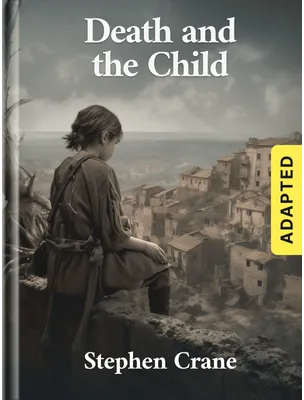
[adapted]
by
Stephen Crane

I
The villagers who were going down the mountain trail were so afraid that they seemed to forget how to count. The cattle and the huge round bundles seemed enough to the crowd if now there were two each time where there had been three. This brown stream kept going with a constant loss of things and animals. A goat fell behind to look at the dry grass and its owner, shouting, hitting his donkeys, went far ahead. A young horse, suddenly afraid, ran, stumbling, up the hillside. The waste was always very great and always without a name, not noticed. It was as if fear was a river, and this crowd had simply been caught in the flood, man tumbling over beast, beast over man, as helpless in it as the logs that fall and push hard through the deep valleys in a place where people cut wood. It was a sudden flood that might burn the face of the tall quiet mountain; it might draw a pale line across the land, this downpour of fear with a thousand homes floating in the stream — men, women, babies, animals. From it there came a constant noise of voices, high, broken, and sometimes choking, like men who are drowning. Many made hand signs, showing their pain in the air with fingers that turned quickly.
The blue bay with its pointed ships and the white town lay below them, distant, flat, calm. There was upon this view a peace that a bird knows when high in the air it looks over the world, a great calm thing moving quietly toward the end of the mystery. Here on the high place one felt the whole world coldly showing the pain in ten thousand minds. The sky was an arch of deep blue. Even to the mountains lifting their great shapes from the valley, this wild rush of the people who fled was too small. The sea, the sky, and the hills combined in their greatness to call this suffering unimportant. Then too it sometimes happened that a face seen as it passed in the crowd showed the feeling of them all and even more. One saw then a woman who seemed to think like the sky above the clouds. When a child cried it cried always because of some nearby bad thing, some discomfort of a pack saddle or roughness of an arm around it. In the sad music of this escape there were often notes of not caring. Into these worried faces, one felt that needles could be pushed without getting a scream. The trail twisted here and there as the sheep had wanted when making it.
Although this crowd seemed to show that all people were running away in one direction — with every tie cut that binds us to the ground — a young man was walking quickly up the mountain, hurrying to a side of the path from time to time to avoid some especially wide rush of people and cattle. He looked at everything in worry and pity. Often he called warnings to crazy people who were running away, and at other times he shared strange looks with the calm ones. They seemed to him to have only the looks of so many big rocks rolling down the hill. He showed wonder and amazement with his sorry looks.
Turning once toward the back, he saw a man wearing the uniform of an infantry lieutenant marching the same way. He waited then, without knowing it, very happy at the chance to put into words the feeling which before had only been shown in the flash of eyes and the sensitive movements of his flexible mouth. He spoke to the officer in fast French, waving his arms wildly, and often pointing with a dramatic finger. “Ah, this is too cruel, too cruel, too cruel. Isn’t it? I did not think it would be as bad as this. I did not think — God’s mercy — I did not think at all. And yet I am a Greek. Or at least my father was a Greek. I did not come here to fight. I am really a reporter, you see? I was to write for an Italian newspaper. I have been educated in Italy. I have spent nearly all my life in Italy. At the schools and universities! I knew nothing of war! I was a student — a student. I came here only because my father was a Greek, and because of him I thought of Greece — I loved Greece. But I did not dream — ”
He paused, breathing heavily. His eyes shone with that soft wetness that sometimes comes to the look of a young woman. Eager, full of strong feeling, deeply moved, his first words, while facing the line of people running away, had been a clear statement of himself, his personal connection to people, the land, life. All through it he had kept the strong pride of an actor in a tragedy.
The officer’s way at once gave in to this shout. “Yes,” he said, polite but sad, “these poor people! These poor people! I do not know what will happen to these poor people.”
The young man spoke loudly again. “I did not dream — I did not dream that it would be like this! This is too cruel! Too cruel! Now I want to be a soldier. Now I want to fight. Now I want to fight for my father’s land.” He made a big movement with his hand into the north-west.
The officer was also a young man, but he was very tanned and steady. Above his high military collar of dark red cloth with one silver star on it, there was a face, stern, quiet, and confident, accepting fate, afraid only of what people think. His clothes were covered with dust; the only bright spot was the bright red of the collar. At the loud cries of his friend he smiled as if to himself, while keeping his eyes looking straight ahead.
From a land toward which their faces were turned came a steady boom of big guns. It was sounding in regular beats like the ticking of a huge clock, a clock that was counting the seconds in the lives of the stars, and men had time to die between the ticks. Serious, like a warning, and that could not be stopped, the great seconds rang over the hills as if God stood before this clock face with the horizon all around it. The soldier and the reporter found themselves silent. The latter especially was in a great sadness, as if he had decided, whether he wanted to or not, to swing to the bottom of the deep pit where secrets of his kind live, and had learned before that all to be met there was cruelty and no hope. A strap of his bright new leather leggings came loose, and he bent over it slowly, seriously, like one bending over the grave of a child.
Then suddenly, the echoes mixed until one could not tell one explosion from another, and into the noise came the slow sound of gunfire. Instantly, for some reason of rhythm, the noise was annoying, silly, childlike. This loud noise was childish. It made the nerves complain, to protest against this loud noise which was as useless as the noise of a boy with a drum.
The officer lifted his finger and pointed. He spoke in an annoyed voice, as if he blamed the other man personally for the noise. “Well, there!” he said. “If you want war, you now have a great chance.”
The reporter stood on his toes. He tapped his chest with sad pride. “Yes! There is war! There is the war I want to join. I will jump in. I am a Greek, a Greek, you understand. I want to fight for my country. You know the way. Lead me. I volunteer.” Suddenly he had an idea; he took a case from his pocket, and taking out a card gave it to the officer with a bow. “My name is Peza,” he said simply.
A strange smile came over the soldier’s face. There was pity and pride — the pride from experience — and no respect in it. “Very well,” he said, bowing back. “If my company is in the middle of the fight I will be glad for the honour of you being with me. If my company is not in the middle of the fight — I will make other plans for you.”
Peza bowed once more, very stiffly, and politely said his thanks. On the edge of what he thought was a great step toward death, he found that he was annoyed at something in the lieutenant’s tone. Things suddenly seemed new and very big. The battle, the great festival of sadness, was at once the same as a bother from a stranger. He wanted to ask the lieutenant what he meant. He bowed again in a grand way; the lieutenant bowed. They threw a shadow of manners, of dancing, shiny ceremony across a land that groaned, and it completely pleased something inside them.
Meanwhile, the stream of villagers running away had become only a last few late people, who ran past stuttering and throwing their hands up high. The two men had come to the top of the great hill. Before them was a green flat land as level as a sea on land. It stretched to the north, and finally became a long line of silver mist. On the near part of this flat land, and on two grey mountains without trees at the side of it, were small black lines from which floated slanted sheets of smoke. It did not trouble the nerves. One could look at it with calm, as if it were a tea-table; but it hit Peza’s mind like a loud clanging blow. It was war. Taught, shocked, proud, he paused suddenly, his lips apart. He remembered the parades of killing that had marched through the dreams of his childhood. Love he knew that he had faced, alone, apart, wondering, an individual, a tiny thing taking the hand of a huge idea. But, like the softest wind on his forehead, he felt here the beat from the hearts of forty thousand men.
The officer’s nose was moving. “I must go right away,” he said. “I must go right away.”
“I will go with you anywhere you go,” shouted Peza loudly.
A rough path went down the side of the mountain, and in their hurry they jumped from place to place, choosing risks which, with normal care, would surely have seemed very dangerous. The excitement of the reporter was greater than the full energy of the soldier. Several times he turned and shouted, “Come on! Come on!”
At the bottom of the path they came to a wide road, which went toward the battle in a yellow and straight line. Some men were walking slowly and tiredly to the back. They were without rifles; their clumsy uniforms were dirty and all crooked. They turned their eyes, dull and glowing with fever, on the pair walking toward the battle. Others were bandaged with the triangular scarf on which you could still see, through the blood stains, the little pictures that show how to tie up different wounds. “Fig. 1.” — “Fig. 2.” — “Fig. 7.” Mixed with the walking soldiers were farmers, not caring, able to smile, chattering about the battle, which to them was a distant play.
A man was leading a line of three donkeys to the back, and from time to time he was stopped by hurt soldiers or soldiers with a fever, from whom he protected his animals with monkey-like cries and wild hand movements. After much talking they usually gave up sadly, and allowed him to go with his smooth little donkeys with no load. Finally he met a soldier who walked slowly with the help of a stick. His head was wrapped with a wide bandage, dirty from blood and mud. He asked the farmer, and at once they were in an ugly Levantine argument.
The farmer cried and shouted, sometimes spitting like a kitten. The wounded soldier kept shouting very loudly, his big hands stretched out like claws over the farmer’s head. Once he raised his stick and threatened with it. Then suddenly the argument was over. The other sick men saw their friend get on the first donkey and at once begin to kick with his heels. None tried to get on the backs of the other donkeys. They watched them go without interest. Finally they saw the caravan as a shape for a moment against the sky. The soldier was still waving his arms wildly, arguing with the farmer.
Peza was full of sadness for these men who looked at him with such sad, quiet eyes. “Ah, my God!” he cried to the officer, “these poor people! These poor people!”
The officer turned around angrily. “If you are coming with me there is no time for this.” Peza obeyed right away and in a sudden humble way. At that moment some part of his pride left him, and he quietly wondered if the universe noticed him much. This theatre for killing, built by the strange needs of the earth, was a very big thing, and he thought that the accidental death of a person, Peza by name, would perhaps be nothing at all.
With the officer he was soon walking along behind a series of small crescent-shaped trenches, in which were soldiers, calmly interested, chatting with the soft sound of a tea party. Though these men were not at this time being shot at, he decided that they were very brave. Otherwise they would not be so comfortable, so at home in their sticky brown trenches. They were sure to be badly attacked later that day. The universities had not taught him to understand this way of thinking.
As the young man in very nice tweed clothes passed, with his new leggings, his new white helmet, his new case for his binoculars, his new holder for his gun, the dirty soldiers turned with the same curiosity that a person in strange clothes meets at street corners. He might as well have been walking on a busy street. The soldiers talked a lot about who he was.
To Peza there was something terrible in how completely familiar every tone, expression, and gesture was. These men, facing battle, showed the curiosity of the café. Then, about to have his great meeting with death, he felt very embarrassed, trying to control his face with difficulty, wondering what to do with his hands, like an awkward person at a formal reception.
He felt silly, and also he felt amazed, shocked, at these men who could turn their faces from the dangerous front and talk about his clothes, his business. There was a part which was just born into his idea of war. He did not mind the quick pace at which the lieutenant moved along the line.
The roar of fighting was always in Peza’s ears. It came from some short hills ahead and to the left. The road turned suddenly and entered a forest. The trees stretched their thick and beautiful branches over grassy slopes. A breeze made all this green gently rustle and speak in long soft sighs. Lost in listening to the very loud noise like a storm from the front, he still remembered that these trees were growing, the blades of grass were spreading in their own way. He inhaled a deep breath of wet air and good smell from the forest, a wet smell which showed all the rich life of still nature, going on with her million plans for many lives, many deaths.
Further on, they came to a place where the Turkish shells were landing. There was a long whooshing sound in the air, and then they saw a shell. To Peza it was one of the cone-shaped shells that friendly officers had shown him on warships. Strangely enough, too, this first shell reminded him of an iron factory, of men with dirty faces, of the roar of furnace fires. It made him think of machines at once. He thought that if he was killed there at that time it would be as romantic, by old standards, as death by a piece of falling iron in a factory.
II
A child was playing on a mountain and ignoring a battle that was going on on the plain below. Behind him was the little stone hut of his parents who had run away. It was now used by a pale cow that stared out from the darkness, calm and gentle-eyed. The child ran back and forth, playing with sticks and making big plans with pebbles. By using a lot of imagination the sticks were ponies, cows, and dogs, and the pebbles were sheep. He was managing big farming and herding work. He was too busy with them to pay much attention to the fight four miles away, which from that distance sounded like waves on rocks. However, there were times when a louder burst of that noise made him look up from his serious work, and he then looked at the battle with a wondering look, a small stick held ready in his hand, stopped in the act of sending his dog after his sheep. His calm about the death on the plain was as strong as that of the mountain he stood on.
It was clear that fear had driven the parents away from their home in a way that could make them forget this child, the first-born. Still, the hut was completely bare. The cow had done nothing wrong by staying at the home of her owners. This smoke-coloured and smelly inside contained nothing as large as a humming-bird. Fear had worked on these people who ran away in a bad way, making small things seem very important, causing a man to remember a button while he forgot a coat, filling everyone with memories of a broken coffee-cup, giving them many fears for the safety of an old pipe, and causing them to forget their first-born. Meanwhile, the child played quietly with his small toys.
He was alone; busy with his own activities, it was rarely that he lifted his head to ask the world why it made so much noise. The stick in his hand was much larger to him than was a group of soldiers far away. It was too childish for the child’s mind. He was playing with sticks.
The battle lines twisted at times like a sea animal in pain on the sands. These long arms moved and waved in very great pain, and the struggles of the big shape brought it nearer and nearer to the child. Once he looked at the plain and saw some men running wildly across a field. He had seen people chasing stubborn animals in such a way, and he thought at once that it was a brave thing which he would put into his game. So he ran very fast at his stone sheep, waving a stick, shouting the shepherd calls. He stopped often to learn how to act from the soldiers fighting on the plain. He copied, a little, any movements that he thought made sense for his idea of sheep-herding, the work of men, the old and noble life of his father.
III
It was as if Peza was a dead body walking on the bottom of the sea, and finding there fields of grain, small groups of trees, weeds, the faces of men, voices. War, a strange work of people, showed him a scene crowded with familiar things which kept their usual look, calmly, without fear. He was hit with strong surprise; a spread of green grass lit with the flames of poppies was too old for the company of this new monster. If he had been giving all his mind to this part, he would have known he was amazed that the trees, the flowers, the grass, all gentle and peaceful nature had not run away at once at the start of the battle. He respected the poppies that did not move.
The road seemed to lead to the point where the two defensive lines of the Greeks met. There was a trail of wounded men and of men without guns and tired men. These last men did not seem to be afraid. They stayed very calm, walking slowly and busy talking. Peza tried to understand them. Perhaps during the fight they had reached the limit of what their minds could take, their ability for excitement, for sad events, and had then simply gone away.
Peza remembered his visit to a certain place of pictures, where he had found himself among heavenly skies and evil midnights — the sunshine beating red upon desert sands, naked bodies thrown to the shore in the green moonlight, terrible and starving men scratching at a wall in darkness, a girl at her bath with soft rays falling upon her white shoulders, a dance, a funeral, a parade, an execution, all the strength of watchful art: and he had whirled and whirled among this universe with cries of sorrow and joy, sin and beauty hurting his ears until he had been forced to simply come away. He remembered that as he had come out he had lit a cigarette with pleasure and had gone quickly to a café. A great empty quiet seemed to be on the earth.
This was a different case, but in his thoughts he thought the same reasons explained many of these wanderers without guns. They too may have dreamed very fast until they could not do it anymore. As he watched them, he again saw himself walking toward the café, puffing on his cigarette. As if to support his idea, a soldier stopped him with an eager but polite request for a match. He watched the man light his small roll of tobacco and paper and begin to smoke hungrily.
Peza was no longer very sad at the sight of wounded men. Clearly he found that pity had a limit, and when this was passed the feeling became something else. Now, as he looked at them, he only felt himself very lucky, and begged for his good luck to continue. As these bent and dirty figures passed he now heard a repeated warning. A part of himself was calling to him through these sad shapes. It was pulling at his sleeve and pointing, telling him to be careful; and so it happened that he cared for the endless misery of these soldiers only as he would have cared for the harm done to broken dolls. His whole attention was on his own chance.
The lieutenant suddenly stopped. “Look,” he said. “I see that my duty is somewhere else. I must go another way. But if you want to fight you only have to go forward, and any officer at the front line will give you a chance.” He raised his cap politely; Peza raised his new white helmet. The person new to battles said thanks to his guide, the one who had introduced him. They bowed very politely, staring at each other with polite eyes.
The officer moved quietly away through a field. In a moment it suddenly came to Peza’s mind that this leaving was very wrong. He had been treated in a very rude way. The officer had brought him into the middle of the thing, and then left him to walk with no help toward death. At one time he was about to shout at the officer.
In the valley there was a feeling as if one was then under the battle. It was going on above somewhere. Alone and without a guide, Peza felt like a man feeling his way in a cellar. He also thought that one should always see the start of a fight. It was too hard to come to it this way when the fight was already going strong. The trees hid all movements of the soldiers from him, and he thought he might be walking out to the very spot that chance had prepared to receive a fool. He asked eager questions of passing soldiers. Some paid no attention to him; others shook their heads sadly. They knew nothing except that war was hard work. If they talked at all it was to say that they had fought well, very hard. They did not know if the army was going to go forward, stay where it was, or go back; they were tired.
A long pointed shell flew fast through the air and hit near the base of a tree, with a big explosion, made of earth and fire. Looking back, Peza could see the broken tree shaking from top to bottom. Its whole body had a wild shaking that showed pain, and also deep surprise. As he moved forward through the valley, the shells kept hissing and rushing in long, low lines, and the bullets buzzed in the air. The shots were flying into the heart of a shocked nature. The land, confused, in great pain, was suffering a rain of terrible shots, and Peza imagined a million eyes staring at him with the look of frightened antelopes.
There was a strong crashing of gunfire from the tall hill on the left, and from directly in front there was a mixed loud noise of cannon and gunfire. Peza felt that his pride was playing a big trick, forcing him forward in this way under conditions of being in a strange place, being alone, and not knowing. But he remembered the way of the lieutenant, the smile on the hill-top among the peasants running away. Peza blushed and pulled the peak of his helmet down on his forehead. He walked on firmly. Even so he hated the lieutenant, and he decided that at some future time he would work hard to plan a hurtful social revenge upon that grinning fool. He did not realize until later that he was now going to battle mainly because earlier a certain man had smiled.
IV
The road bent around the foot of a little hill, and on this hill a group of mountain guns was slowly firing at something unseen. In the shelter of the hill the mules, happy under their heavy saddles, were quietly eating the long grass. Peza went up the hill by a sloping path. He felt his heart beat quickly; once at the top of the hill he would have to look this thing in the face. He hurried, with a strange idea that by this plan he could stop the battle from making his arrival a sign for some big new start. This unclear thought seemed reasonable at the time. Surely this living thing knew he was coming. He gave it the mind of a wild god. And so he hurried; he wanted to surprise war, this terrible emperor, when it was growling on its throne. The fierce and horrible ruler was not to be allowed to make the arrival an excuse for some burst of smoky anger and blood. In this half-quiet, Peza clearly had the feeling of sneaking up on the battle without it knowing.
The soldiers watching the mules did not seem to be impressed by anything important. Two of them sat side by side and talked comfortably; another lay flat on his back staring dreamily at the sky; another cursed a mule for being stubborn. Despite their uniforms, their bullet belts and rifles, they were living in the peace of stable workers. However, the long shells were whistling from time to time over the top of the hill, and flying in almost straight lines toward the valley of trees, flowers, and grass. Peza, hearing and seeing the shells, and seeing the thoughtful keepers of the mules, felt safer. They were accepting the state of war as easily as an old sailor accepts the chair behind the counter of a tobacco-shop.
Or, it was only that the farm boy had gone to sea, and he had got used to the new situation right away, and with only the usual first small mistakes in behavior. Peza was proud and ashamed that he was not one of them, these stupid farm people, who, all over the world, keep rulers on their thrones, make politicians famous, give generals long-lasting wins, all with not knowing, not caring, or foolish hatred, moving the world with their strong arms and getting their heads banged together in the name of God, the king, or the stock market; immortal, dreaming, hopeless donkeys who give up their sense to the care of a shining puppet, and ask some toy to carry their lives in his pocket. Peza, in his mind, bowed down before them, and wanted to wake them with angry kicks.
As he looked over the edge of the high flat land, he saw a group of gun officers talking busily. They turned at once and watched him climb. A moment later a row of soldiers on foot in a ditch past the small guns all faced him. Peza bowed to the officers. He knew then that he had made a good and calm bow, and he was surprised at it, for he was breathing hard, he was almost choking from great excitement. He felt like a slightly drunk man trying to hide his shaky body from the people in the street. But the officers did not show that they noticed.
They bowed. Behind them Peza saw the flat land, shining green, with three black lines clearly marked on it. The front of the first of these lines was covered with smoke. To the left of this hill was a rocky mountain, from which came a constant low rattling sound of gunfire. Its top was circled with the white smoke. The black lines on the flat land slowly moved. The big shells that came from there passed overhead with the sound of large birds wildly flapping their wings. Peza thought of the first look at the sea during a storm. He seemed to feel against his face the wind that races over the tops of cold and wild waves.