'The Colour Out of Space' was first published in 1927 in a magazine called 'Weird Tales'.
[{"id":"para_1","index":0,"start":0,"offset":356,"words":5,"paraNum":"","lastModified":1775039330000,"semanticType":"title-book-title","voicework":"tts","blockId":"the_colour_out_of_space_short_story_en-bl2s","language":"en","wordsRange":{"start":100000000,"end":106000000},"paragraphVersion":41,"direction":"ltr","paragraph":"<h1 class=\"ilm-title ilm-x-large\" id=\"para_1\" semantictype=\"title-book-title\" data-ilmid=\"the_colour_out_of_space_short_story_en-bl2s\" data-audio=\"1\" data-chapter=\"para_1\" data-words-count=\"5\" data-before=\"0\" data-ww=\"\"><span class=\"block-pb\"> <span class=\"block-pb is-animated\"></span> </span><span class=\"itm-wrap\">The Colour Out of Space<br></span></h1>","hasContent":true,"isFirst":true,"isLast":false},{"id":"para_2","index":1,"start":356,"offset":337,"words":1,"paraNum":"","lastModified":1775039360000,"semanticType":"title-subtitle","voicework":"tts","blockId":"the_colour_out_of_space_short_story_en-bl55","language":"en","wordsRange":{"start":139333333,"end":172666667},"paragraphVersion":51,"direction":"ltr","paragraph":"<h1 class=\"ilm-title ilm-subtitle\" id=\"para_2\" semantictype=\"title-subtitle\" data-ilmid=\"the_colour_out_of_space_short_story_en-bl55\" data-audio=\"1\" data-chapter=\"para_2\" data-words-count=\"1\" data-before=\"5\" data-ww=\"\"><span class=\"block-pb\"> <span class=\"block-pb is-animated\"></span> </span><span class=\"itm-wrap\">[adapted]</span></h1>","hasContent":true,"isFirst":false,"isLast":false},{"id":"para_3","index":2,"start":693,"offset":366,"words":3,"paraNum":"","lastModified":1775040074000,"semanticType":"title-author","voicework":"tts","blockId":"the_colour_out_of_space_short_story_en-bl2t","language":"en","wordsRange":{"start":206000000,"end":211000000},"paragraphVersion":51,"direction":"ltr","paragraph":"<h1 class=\"ilm-title ilm-author ilm-nopad ilm-large\" id=\"para_3\" semantictype=\"title-author\" data-ilmid=\"the_colour_out_of_space_short_story_en-bl2t\" data-audio=\"1\" data-chapter=\"para_3\" data-words-count=\"3\" data-before=\"6\" data-ww=\"\"><span class=\"block-pb\"> <span class=\"block-pb is-animated\"></span> </span><span class=\"itm-wrap\">by <br>H. P. Lovecraft</span></h1>","hasContent":true,"isFirst":false,"isLast":false},{"id":"para_4","index":3,"start":1059,"offset":166,"words":0,"paraNum":"","lastModified":1718884669000,"semanticType":"line","blockId":"the_colour_out_of_space_short_story_en-bl2u","language":"en","wordsRange":{"start":311000000,"end":411000000},"paragraphVersion":30,"direction":"ltr","paragraph":"<hr class=\"ilm-hr ilm-small\" id=\"para_4\" semantictype=\"line\" data-ilmid=\"the_colour_out_of_space_short_story_en-bl2u\" data-words-count=\"0\" data-before=\"9\" data-ww=\"\">","hasContent":true,"isFirst":false,"isLast":false},{"id":"para_5","index":4,"start":1225,"offset":1690,"words":0,"paraNum":"","lastModified":1719318819000,"semanticType":"illustration","blockId":"the_colour_out_of_space_short_story_en-bl53","language":"en","wordsRange":{"start":511000000,"end":611000000},"paragraphVersion":30,"direction":"ltr","paragraph":"<div class=\"ilm-illustration\" id=\"para_5\" semantictype=\"illustration\" data-ilmid=\"the_colour_out_of_space_short_story_en-bl53\" data-words-count=\"0\" data-before=\"9\" data-ww=\"\"><img width=\"600\" height=\"343\" data-src=\"ch0p0\" src=\"data:image/webp;base64,UklGRgwEAABXRUJQVlA4IAAEAACQEQCdASo8ACIAPm0ukEWkIqGYDAVUQAbEoAw6O4CNUAW1GzWHCD6Xk4nC/Q5EBya9wcnfYZcn/qHEBwSXgYGIc+/057BH60dar0JS2+IwMkU7zlVioJfQl48endlzLRnqQ6OBvGh6QqwTLzWrZCJhZW93sCsaN2J6/1UJJxpYkT+XZqAKVUsXxKN9l8cwbDVuX9OoAAD+/P3zEb9P09h22R4sp79WJ6mVNh+efjXUz7canbbPRtBGJzLG1/71dM2CyiYqlEig9wgC3iOPdGByx5uFvpW4QUr3RnetupNaivZdsOSSQkysr79iYSS+fVK/FNzlzKa7HAD/sc+yHgGDUj4U/caeNnBgeJQxU9R4yyf2RCSbQjKPX9DEUeovnVk325P/31t12ksBKvhYst1bwdwyO+bJ4KbOgK0fSgUKV6xBbekZAyRf2g2ZIuPpbe8u2U77RIUmtc2LPoBLqx0VoSdk7wO4+bKdwtkKT2vBPc87L7BfLL4Ec1ex9eNHeh8xwiFQfcxzkWYugRBgBuHLSnUKYe1p2CPgJuznix2E3PjPcoH/yWK7x6l3/kV+e50VPVxKpxU/rr3m9jZxPOMx9F7mQJnIVmH3AH89tb9JVxdPsvel7o45ODbninoVY1iCp3iuq+bE/u0LrJ4R/PbbNnuv9XdmcxLJl/U0kv5ZhOjhyu08ivi82hl8dZKWRv2vzj2t0RM4e7j0N4huEaB+THNHrBPXnIP6kYDbx/mOhfv6DepGJ1v54JEZmiEdrPLhFweSfnGMseRhP7xEIlrdmyjMnprhLcRsdk8D8E1KoFrBEhv7PvH4Suo/9MwwY12twugK6esdVOMno6FO0mqRVSsBfy02coVFXa/boYRmxtwBXOPB1FFjhZM5Z9DdTCYaK4tYR7jIgucLGeaUB6jWFmMx9efEVt3Bk9Y8+7E1KM8VkucsAjY2GImYdQq5mxckNlb6xJouH+0ZiqQR16poO96Ssp90jSuexln7vcnC+QlsX77RB5Ri6UPBvVv9qN94YSX46N0YQqG1/Mj47N5EcLKArJGXzi1IoEmigN/4gQu3bex0IYQoE4Ol/FeTLyJ0PJvo37XT9CEP7e/BqSF2VOy6KqCPJLofvhnpR2pT91wW9uw6qfX7NkzUF/U/1xc/tqlb8HHuN3XeontdYhSI8N40LHj6x/6g7I+nfv/ZH9+IE1yq43blSggQm1f+qS5AQcaaqBW6LLel8u+yMVvDm414xmoxb+X+ZX3YcZXp2yPQW6J8c5zvorW1Qoygg4q+gswuA501C25WqGzvIXQQUVl+GnBT9wCtNkDKYOdALostuYRurjODLyUITC3ULNw9gFG7dIQYAPz4Ui7MoAAA\" alt=\"The Colour Out of Space (adapted)\"></div>","hasContent":true,"isFirst":false,"isLast":false},{"id":"para_6","index":5,"start":2915,"offset":870,"words":102,"paraNum":"1","lastModified":1775040312000,"semanticType":"par","voicework":"tts","blockId":"the_colour_out_of_space_short_story_en-bl2v","language":"en","wordsRange":{"start":711000000,"end":806000000},"paragraphVersion":42,"direction":"ltr","paragraph":"<p class=\"ilm-blockquote\" id=\"para_6\" semantictype=\"par\" data-ilmid=\"the_colour_out_of_space_short_story_en-bl2v\" data-audio=\"1\" data-words-count=\"102\" data-before=\"9\" data-ww=\"\"><span class=\"block-num\" data-id=\"1\"></span><span class=\"block-pb\"> <span class=\"block-pb is-animated\"></span> </span><span class=\"itm-wrap\">… and in the scary moment of even deeper darkness, the people watching saw moving at that treetop height, a thousand tiny points of weak and unholy light, at the tip of each branch like the fire of St. Elmo … and at the same time the beam of glowing light from the well was getting brighter and brighter and giving to the huddled men, a feeling of doom and strangeness…. It was no longer shining out; it was pouring out; and as the shapeless stream of a colour no one could name left the well, it seemed to flow straight into the sky.</span></p>","hasContent":true,"isFirst":false,"isLast":false},{"id":"para_7","index":6,"start":3785,"offset":870,"words":97,"paraNum":"2","lastModified":1775040342000,"semanticType":"par","voicework":"tts","blockId":"the_colour_out_of_space_short_story_en-bl2y","language":"en","wordsRange":{"start":906000000,"end":997000000},"paragraphVersion":42,"direction":"ltr","paragraph":"<p id=\"para_7\" semantictype=\"par\" data-ilmid=\"the_colour_out_of_space_short_story_en-bl2y\" data-audio=\"1\" data-words-count=\"97\" data-before=\"111\" data-ww=\"\"><span class=\"block-num\" data-id=\"2\"></span><span class=\"block-pb\"> <span class=\"block-pb is-animated\"></span> </span><span class=\"itm-wrap\">West of Arkham the hills rise wild, and there are valleys with deep woods that no axe has ever cut. There are dark narrow valleys where the trees lean in strange ways, and where thin little streams trickle without ever seeing the shine of sunlight. On the gentler slopes there are farms, very old and rocky, with short, moss-covered cottages watching forever over old New England secrets in the shelter of great rock ledges; but these are all empty now, the wide chimneys falling apart and the sides with shingles pushing out dangerously under low gambrel roofs.</span></p>","hasContent":true,"isFirst":false,"isLast":false},{"id":"para_8","index":7,"start":4655,"offset":1082,"words":144,"paraNum":"3","lastModified":1775040419000,"semanticType":"par","voicework":"tts","blockId":"the_colour_out_of_space_short_story_en-bl2z","language":"en","wordsRange":{"start":1097000000,"end":1234000000},"paragraphVersion":42,"direction":"ltr","paragraph":"<p id=\"para_8\" semantictype=\"par\" data-ilmid=\"the_colour_out_of_space_short_story_en-bl2z\" data-audio=\"1\" data-words-count=\"144\" data-before=\"208\" data-ww=\"\"><span class=\"block-num\" data-id=\"3\"></span><span class=\"block-pb\"> <span class=\"block-pb is-animated\"></span> </span><span class=\"itm-wrap\">The old people have gone away, and people from other countries do not like to live there. French-Canadians have tried it, Italians have tried it, and the Poles have come and left. It is not because of anything that can be seen or heard or touched, but because of something that is only imagined. The place is not good for imagining things, and does not bring peaceful dreams at night. It must be this which keeps the people from other countries away, because old Ammi Pierce has never told them anything he remembers from the strange days. Ammi, whose mind has been a little odd for years, is the only one who still stays, or who ever talks about the strange days; and he dares to do this because his house is so near the open fields and the roads people use around Arkham.</span></p>","hasContent":true,"isFirst":false,"isLast":false},{"id":"para_9","index":8,"start":5737,"offset":1000,"words":137,"paraNum":"4","lastModified":1775040328000,"semanticType":"par","voicework":"tts","blockId":"the_colour_out_of_space_short_story_en-bl30","language":"en","wordsRange":{"start":1334000000,"end":1465000000},"paragraphVersion":42,"direction":"ltr","paragraph":"<p id=\"para_9\" semantictype=\"par\" data-ilmid=\"the_colour_out_of_space_short_story_en-bl30\" data-audio=\"1\" data-words-count=\"137\" data-before=\"352\" data-ww=\"\"><span class=\"block-num\" data-id=\"4\"></span><span class=\"block-pb\"> <span class=\"block-pb is-animated\"></span> </span><span class=\"itm-wrap\">There was once a road over the hills and through the valleys, that ran straight where the blasted heath is now; but people stopped using it and a new road was made, curving far to the south. Traces of the old one can still be found among the weeds of a wild land coming back, and some of them will surely stay even when half the low places are filled with water for the new lake. Then the dark woods will be cut down and the blasted heath will sleep far below blue waters whose top will reflect the sky and ripple in the sun. And the secrets of the strange days will be one with the deep sea’s secrets; one with the hidden knowledge of the old ocean, and all the mystery of very old earth.</span></p>","hasContent":true,"isFirst":false,"isLast":false},{"id":"para_10","index":9,"start":6737,"offset":1204,"words":170,"paraNum":"5","lastModified":1775040406000,"semanticType":"par","voicework":"tts","blockId":"the_colour_out_of_space_short_story_en-bl31","language":"en","wordsRange":{"start":1565000000,"end":1726000000},"paragraphVersion":42,"direction":"ltr","paragraph":"<p id=\"para_10\" semantictype=\"par\" data-ilmid=\"the_colour_out_of_space_short_story_en-bl31\" data-audio=\"1\" data-words-count=\"170\" data-before=\"489\" data-ww=\"\"><span class=\"block-num\" data-id=\"5\"></span><span class=\"block-pb\"> <span class=\"block-pb is-animated\"></span> </span><span class=\"itm-wrap\">When I went into the hills and valleys to survey the land for the new reservoir they told me the place was evil. They told me this in Arkham, and because that is a very old town full of stories about witches I thought the evil must be something which grandmas had whispered to children for centuries. The name “blasted heath” seemed to me very odd and like a play, and I wondered how it had come into the old stories of a Puritan people. Then I saw that dark tangle of small valleys and slopes to the west for myself, and stopped wondering about anything except its own older mystery. It was morning when I saw it, but shadow always hid there. The trees grew too close together, and their trunks were too big for any healthy New England forest. There was too much silence in the dark paths between them, and the ground was too soft with the damp moss and thick mats of endless years of rot.</span></p>","hasContent":true,"isFirst":false,"isLast":false},{"id":"para_11","index":10,"start":7941,"offset":985,"words":124,"paraNum":"6","lastModified":1775040358000,"semanticType":"par","voicework":"tts","blockId":"the_colour_out_of_space_short_story_en-bl32","language":"en","wordsRange":{"start":1826000000,"end":1945000000},"paragraphVersion":42,"direction":"ltr","paragraph":"<p id=\"para_11\" semantictype=\"par\" data-ilmid=\"the_colour_out_of_space_short_story_en-bl32\" data-audio=\"1\" data-words-count=\"124\" data-before=\"659\" data-ww=\"\"><span class=\"block-num\" data-id=\"6\"></span><span class=\"block-pb\"> <span class=\"block-pb is-animated\"></span> </span><span class=\"itm-wrap\">In the open spaces, mostly along the line of the old road, there were little hillside farms; sometimes with all the buildings standing, sometimes with only one or two, and sometimes with only a single chimney or fast-filling cellar. Weeds and thorny bushes took over, and shy wild animals moved in the thick plants. Over everything was a feeling of unease and heaviness; a bit of the unreal and the very strange, as if some important part of distance or light and shadow was wrong. I was not surprised that the strangers would not stay, for this was no place to sleep in. It was too much like a picture by Salvator Rosa; too much like some banned wood print in a scary story.</span></p>","hasContent":true,"isFirst":false,"isLast":false},{"id":"para_12","index":11,"start":8926,"offset":1226,"words":195,"paraNum":"7","lastModified":1775040286000,"semanticType":"par","voicework":"tts","blockId":"the_colour_out_of_space_short_story_en-bl33","language":"en","wordsRange":{"start":2045000000,"end":2239333333},"paragraphVersion":46,"direction":"ltr","paragraph":"<p id=\"para_12\" semantictype=\"par\" data-ilmid=\"the_colour_out_of_space_short_story_en-bl33\" data-audio=\"1\" data-words-count=\"195\" data-before=\"783\" data-ww=\"\"><span class=\"block-num\" data-id=\"7\"></span><span class=\"block-pb\"> <span class=\"block-pb is-animated\"></span> </span><span class=\"itm-wrap\">But even all this was not so bad as the blasted heath. I knew it the moment I came to it at the bottom of a wide valley; for no other name could fit such a thing, or any other thing fit such a name. It was as if the poet had made the phrase after seeing this one place. It must, I thought as I looked at it, be the result of a fire; but why had nothing new ever grown over those five acres of grey emptiness that lay open to the sky like a great spot eaten by acid in the woods and fields? It lay mostly to the north of the old road line, but crossed a little to the other side. I felt a strange unwillingness about going near, and did so at last only because my work took me through and past it. There were no plants of any kind on that wide area, but only a fine grey dust or ash which no wind seemed ever to blow about. The trees near it were weak and small, and many dead trunks stood or lay rotting at the edge.</span></p>","hasContent":true,"isFirst":false,"isLast":false},{"id":"para_13","index":12,"start":10152,"offset":1042,"words":144,"paraNum":"8","lastModified":1775040374000,"semanticType":"par","voicework":"tts","blockId":"the_colour_out_of_space_short_story_en-bl56","language":"en","wordsRange":{"start":2239666667,"end":2371000000},"paragraphVersion":37,"direction":"ltr","paragraph":"<p id=\"para_13\" semantictype=\"par\" data-ilmid=\"the_colour_out_of_space_short_story_en-bl56\" data-audio=\"1\" data-words-count=\"144\" data-before=\"978\" data-ww=\"\"><span class=\"block-num\" data-id=\"8\"></span><span class=\"block-pb\"> <span class=\"block-pb is-animated\"></span> </span><span class=\"itm-wrap\">As I walked quickly by I saw the fallen bricks and stones of an old chimney and cellar, on my right, and the wide black mouth of an abandoned well whose still vapors made strange changes in the colors of the sunlight. Even the long, dark climb in the woods beyond seemed welcome in contrast, and I no longer wondered at the frightened whispers of the people of Arkham. There had been no house or ruin near; even in the old days the place must have been lonely and far away. And at dusk, afraid to pass that scary spot again, I walked the long way back to the town by the curving road on the south. I wished a little that some clouds would gather, for a strange fear of the deep empty spaces in the sky above had crept into my heart.</span></p>","hasContent":true,"isFirst":false,"isLast":false},{"id":"para_14","index":13,"start":11194,"offset":1435,"words":218,"paraNum":"9","lastModified":1775040393000,"semanticType":"par","voicework":"tts","blockId":"the_colour_out_of_space_short_story_en-bl34","language":"en","wordsRange":{"start":2471000000,"end":2684000000},"paragraphVersion":45,"direction":"ltr","paragraph":"<p id=\"para_14\" semantictype=\"par\" data-ilmid=\"the_colour_out_of_space_short_story_en-bl34\" data-audio=\"1\" data-words-count=\"218\" data-before=\"1122\" data-ww=\"\"><span class=\"block-num\" data-id=\"9\"></span><span class=\"block-pb\"> <span class=\"block-pb is-animated\"></span> </span><span class=\"itm-wrap\">In the evening I asked old people in Arkham about the ruined heath, and what that phrase “strange days” meant which so many people said without explaining. I could not, however, get any good answers, except that the whole mystery was much more recent than I had thought. It was not a matter of old legends at all, but something in the lives of the people who spoke. It had happened in the eighties, and a family had disappeared or was killed. People would not be exact; and because they all told me not to listen to old Ammi Pierce’s crazy stories, I looked for him the next morning, because I had heard that he lived alone in the very old, shaky cottage where the trees first begin to grow very thick. It was a terribly old place, and had begun to give off a faint, sickly smell that sticks to houses that have stood too long. Only with knocking again and again could I wake the old man, and when he shuffled shyly to the door I could tell he was not glad to see me. He was not as weak as I had expected; but his eyes drooped in a strange way, and his untidy clothing and white beard made him seem very tired and sad.</span></p>","hasContent":true,"isFirst":false,"isLast":false},{"id":"para_15","index":14,"start":12629,"offset":1254,"words":180,"paraNum":"10","lastModified":1775040436000,"semanticType":"par","voicework":"tts","blockId":"the_colour_out_of_space_short_story_en-bl35","language":"en","wordsRange":{"start":2784000000,"end":2964000000},"paragraphVersion":47,"direction":"ltr","paragraph":"<p id=\"para_15\" semantictype=\"par\" data-ilmid=\"the_colour_out_of_space_short_story_en-bl35\" data-audio=\"1\" data-words-count=\"180\" data-before=\"1340\" data-ww=\"\"><span class=\"block-num\" data-id=\"10\"></span><span class=\"block-pb\"> <span class=\"block-pb is-animated\"></span> </span><span class=\"itm-wrap\">Not knowing how to start him on his stories, I pretended a matter of business; told him about my work measuring the land, and asked general questions about the area. He was much smarter and more educated than I had thought, and before I knew it he had understood as much of the subject as any man I had talked with in Arkham. He was not like other country people I had known in the places where reservoirs were to be. He made no protests about the miles of old woods and farmland to be wiped out, though maybe there would have been if his home had not been outside the border of the future lake. Relief was all that he showed; relief at the end of the dark old valleys through which he had walked all his life. They were better under water now — better under water since the strange days. And with this beginning his rough voice sank low, while his body leaned forward and his right index finger began to point shakily and in a serious way.</span></p>","hasContent":true,"isFirst":false,"isLast":false},{"id":"para_16","index":15,"start":13883,"offset":1470,"words":229,"paraNum":"11","lastModified":1775040305000,"semanticType":"par","voicework":"tts","blockId":"the_colour_out_of_space_short_story_en-bl37","language":"en","wordsRange":{"start":3064000000,"end":3281000000},"paragraphVersion":47,"direction":"ltr","paragraph":"<p id=\"para_16\" semantictype=\"par\" data-ilmid=\"the_colour_out_of_space_short_story_en-bl37\" data-audio=\"1\" data-words-count=\"229\" data-before=\"1520\" data-ww=\"\"><span class=\"block-num\" data-id=\"11\"></span><span class=\"block-pb\"> <span class=\"block-pb is-animated\"></span> </span><span class=\"itm-wrap\">It was then that I heard the story, and as the voice talked on and on in a rough whisper I shook again and again even though it was a summer day. Often I had to call the speaker back from his wandering talk, fill in the science points which he knew only by a weak, parrot-like memory of professors’ talk, or cover the gaps, where his sense of clear order and flow failed. When he was done I did not wonder that his mind had broken a little, or that the people of Arkham would not speak much of the burned, dead wasteland. I hurried back before sunset to my hotel, not willing to have the stars come out above me in the open; and the next day I went back to Boston to leave my job. I could not go into that dark mess of old forest and hillside again, or face again that grey, burned wasteland where the black well opened deep beside the fallen bricks and stones. The big water lake will soon be built now, and all those ancient secrets will lie safe forever under deep water. But even then I do not think I would like to visit that country by night — at least not when the scary stars are out; and nothing could make me drink the new city water of Arkham.</span></p>","hasContent":true,"isFirst":false,"isLast":false},{"id":"para_17","index":16,"start":15353,"offset":1152,"words":160,"paraNum":"12","lastModified":1775053480000,"semanticType":"par","voicework":"tts","blockId":"the_colour_out_of_space_short_story_en-bl38","language":"en","wordsRange":{"start":3381000000,"end":3539000000},"paragraphVersion":83,"direction":"ltr","paragraph":"<p id=\"para_17\" semantictype=\"par\" data-ilmid=\"the_colour_out_of_space_short_story_en-bl38\" data-audio=\"1\" data-words-count=\"160\" data-before=\"1749\" data-ww=\"\"><span class=\"block-num\" data-id=\"12\"></span><span class=\"block-pb\"> <span class=\"block-pb is-animated\"></span> </span><span class=\"itm-wrap\">It all began, old Ammi said, with the meteor. Before that time there had been no wild stories at all since the witch trials, and even then these western woods were not feared nearly as much as the small island in the Miskatonic where the devil had his court beside a strange stone altar older than the Indians. These were not haunted woods, and their strange dusk was never terrible until the strange days. Then there came that white cloud at noon, a lot of explosions in the air, and that tall pillar of smoke from the valley far in the wood. And by that night all Arkham had heard of the big rock that fell out of the sky and stuck in the ground beside the well at Nahum Gardner’s place. That was the house which had stood where the blasted heath would come — the neat white Nahum Gardner house among its rich gardens and fruit trees.</span></p>","hasContent":true,"isFirst":false,"isLast":false},{"id":"para_18","index":17,"start":16505,"offset":1014,"words":139,"paraNum":"13","lastModified":1775053494000,"semanticType":"par","voicework":"tts","blockId":"the_colour_out_of_space_short_story_en-bl39","language":"en","wordsRange":{"start":3639000000,"end":3769333333},"paragraphVersion":76,"direction":"ltr","paragraph":"<p id=\"para_18\" semantictype=\"par\" data-ilmid=\"the_colour_out_of_space_short_story_en-bl39\" data-audio=\"1\" data-words-count=\"139\" data-before=\"1909\" data-ww=\"\"><span class=\"block-num\" data-id=\"13\"></span><span class=\"block-pb\"> <span class=\"block-pb is-animated\"></span> </span><span class=\"itm-wrap\">Nahum had come to town to tell people about the stone, and had stopped at Ammi Pierce’s on the way. Ammi was forty then, and all the strange things were very clear in his mind. He and his wife had gone with the three professors from Miskatonic University who went out quickly the next morning to see the strange visitor from unknown outer space, and had wondered why Nahum had said it was so big the day before. It had got smaller, Nahum said as he pointed at the big brown pile above the torn earth and burned grass near the old well-sweep in his front yard; but the professors said that stones do not get smaller. Its heat stayed for a long time, and Nahum said it had glowed a little in the night.</span></p>","hasContent":true,"isFirst":false,"isLast":false},{"id":"para_19","index":18,"start":17519,"offset":907,"words":114,"paraNum":"14","lastModified":1775040776000,"semanticType":"par","voicework":"tts","blockId":"the_colour_out_of_space_short_story_en-bl57","language":"en","wordsRange":{"start":3769666667,"end":3875000000},"paragraphVersion":36,"direction":"ltr","paragraph":"<p id=\"para_19\" semantictype=\"par\" data-ilmid=\"the_colour_out_of_space_short_story_en-bl57\" data-audio=\"1\" data-words-count=\"114\" data-before=\"2048\" data-ww=\"\"><span class=\"block-num\" data-id=\"14\"></span><span class=\"block-pb\"> <span class=\"block-pb is-animated\"></span> </span><span class=\"itm-wrap\">The professors tried it with a rock hammer and found it was strangely soft. It was, in fact, so soft that it was almost like soft plastic; and they dug it out instead of chipping off a sample to take back to the college to test it. They took it in an old bucket borrowed from Nahum’s kitchen, because even the small piece would not cool down. On the way back they stopped at Ammi’s house to rest, and looked thoughtful when Mrs. Pierce said that the piece was getting smaller and burning the bottom of the bucket. It was true, it was not big, but maybe they had taken less than they thought.</span></p>","hasContent":true,"isFirst":false,"isLast":false},{"id":"para_20","index":19,"start":18426,"offset":978,"words":119,"paraNum":"15","lastModified":1775040762000,"semanticType":"par","voicework":"tts","blockId":"the_colour_out_of_space_short_story_en-bl3a","language":"en","wordsRange":{"start":3975000000,"end":4087333333},"paragraphVersion":54,"direction":"ltr","paragraph":"<p id=\"para_20\" semantictype=\"par\" data-ilmid=\"the_colour_out_of_space_short_story_en-bl3a\" data-audio=\"1\" data-words-count=\"119\" data-before=\"2162\" data-ww=\"\"><span class=\"block-num\" data-id=\"15\"></span><span class=\"block-pb\"> <span class=\"block-pb is-animated\"></span> </span><span class=\"itm-wrap\">The day after that — all this was in June of ’82 — the professors went out together again very excited. As they passed Ammi’s they told him what strange things the sample had done, and how it had faded completely away when they put it in a glass beaker. The beaker had gone, too, and the wise men talked about the strange stone’s liking for silicon. It had acted very strangely in that tidy lab; doing nothing at all and showing no trapped gases when heated on charcoal, being completely negative in the borax bead, and soon showing itself to be completely unable to turn into a gas at any heat they could make, including that of the oxy-hydrogen blowpipe.</span></p>","hasContent":true,"isFirst":false,"isLast":false},{"id":"para_21","index":20,"start":19404,"offset":739,"words":75,"paraNum":"16","lastModified":1775040850000,"semanticType":"par","voicework":"tts","blockId":"the_colour_out_of_space_short_story_en-bl58","language":"en","wordsRange":{"start":4087666667,"end":4167000000},"paragraphVersion":34,"direction":"ltr","paragraph":"<p id=\"para_21\" semantictype=\"par\" data-ilmid=\"the_colour_out_of_space_short_story_en-bl58\" data-audio=\"1\" data-words-count=\"75\" data-before=\"2281\" data-ww=\"\"><span class=\"block-num\" data-id=\"16\"></span><span class=\"block-pb\"> <span class=\"block-pb is-animated\"></span> </span><span class=\"itm-wrap\">On an anvil it seemed very easy to shape, and in the dark its glow was very strong. Still refusing to cool down, it soon had the college very excited; and when, upon heating in front of the spectroscope, it showed bright bands unlike any known colours of the normal spectrum, there was much excited talk of new elements, strange light properties, and other things that confused scientists usually say when they meet the unknown.</span></p>","hasContent":true,"isFirst":false,"isLast":false},{"id":"para_22","index":21,"start":20143,"offset":1010,"words":126,"paraNum":"17","lastModified":1775040988000,"semanticType":"par","voicework":"tts","blockId":"the_colour_out_of_space_short_story_en-bl3b","language":"en","wordsRange":{"start":4267000000,"end":4377333333},"paragraphVersion":53,"direction":"ltr","paragraph":"<p id=\"para_22\" semantictype=\"par\" data-ilmid=\"the_colour_out_of_space_short_story_en-bl3b\" data-audio=\"1\" data-words-count=\"126\" data-before=\"2356\" data-ww=\"\"><span class=\"block-num\" data-id=\"17\"></span><span class=\"block-pb\"> <span class=\"block-pb is-animated\"></span> </span><span class=\"itm-wrap\">Hot as it was, they tested it in a pot that could stand great heat with all the right chemicals. Water did nothing. Hydrochloric acid was the same. Nitric acid and even aqua regia only hissed and splashed against it, which was very hot and could not be harmed. Ammi had trouble remembering all these things, but he knew some liquids used to dissolve things as I named them in the usual order. There were ammonia and caustic soda, alcohol and ether, nasty-smelling carbon disulphide and twelve others; but although the weight kept getting less as time passed, and the piece seemed to be getting a little cooler, there was no change in the liquids to show that they had worked on the material at all.</span></p>","hasContent":true,"isFirst":false,"isLast":false},{"id":"para_23","index":22,"start":21153,"offset":821,"words":98,"paraNum":"18","lastModified":1775040820000,"semanticType":"par","voicework":"tts","blockId":"the_colour_out_of_space_short_story_en-bl59","language":"en","wordsRange":{"start":4377666667,"end":4476000000},"paragraphVersion":34,"direction":"ltr","paragraph":"<p id=\"para_23\" semantictype=\"par\" data-ilmid=\"the_colour_out_of_space_short_story_en-bl59\" data-audio=\"1\" data-words-count=\"98\" data-before=\"2482\" data-ww=\"\"><span class=\"block-num\" data-id=\"18\"></span><span class=\"block-pb\"> <span class=\"block-pb is-animated\"></span> </span><span class=\"itm-wrap\">It was a metal, without a doubt. It was magnetic, for one thing; and after putting it in acid liquids there seemed to be faint marks of the Widmanstätten patterns found on iron from a meteor. When it had cooled a lot, the testing was done in glass; and in a glass beaker they left all the small pieces made from the original piece during the work. The next morning both the small pieces and the beaker were gone without a trace, and only a burned mark marked the place on the wooden shelf where they had been.</span></p>","hasContent":true,"isFirst":false,"isLast":false},{"id":"para_24","index":23,"start":21974,"offset":1055,"words":145,"paraNum":"19","lastModified":1775040794000,"semanticType":"par","voicework":"tts","blockId":"the_colour_out_of_space_short_story_en-bl3c","language":"en","wordsRange":{"start":4576000000,"end":4718000000},"paragraphVersion":51,"direction":"ltr","paragraph":"<p id=\"para_24\" semantictype=\"par\" data-ilmid=\"the_colour_out_of_space_short_story_en-bl3c\" data-audio=\"1\" data-words-count=\"145\" data-before=\"2580\" data-ww=\"\"><span class=\"block-num\" data-id=\"19\"></span><span class=\"block-pb\"> <span class=\"block-pb is-animated\"></span> </span><span class=\"itm-wrap\">All this the professors told Ammi as they stopped at his door, and once more he went with them to see the stone messenger from the stars, but this time his wife did not go with him. It had now clearly shrunk, and even the serious professors could not doubt what they saw. All around the shrinking brown lump near the well was an empty space, except where the earth had fallen in; and while it had been a full seven feet across the day before, it was now hardly five. It was still hot, and the wise men looked closely at its outside as they took off another and larger piece with hammer and chisel. They cut very deep this time, and as they pulled away the smaller piece they saw that the inside of the thing was not quite the same all through.</span></p>","hasContent":true,"isFirst":false,"isLast":false},{"id":"para_25","index":24,"start":23029,"offset":1003,"words":128,"paraNum":"20","lastModified":1775040808000,"semanticType":"par","voicework":"tts","blockId":"the_colour_out_of_space_short_story_en-bl3e","language":"en","wordsRange":{"start":4818000000,"end":4943000000},"paragraphVersion":50,"direction":"ltr","paragraph":"<p id=\"para_25\" semantictype=\"par\" data-ilmid=\"the_colour_out_of_space_short_story_en-bl3e\" data-audio=\"1\" data-words-count=\"128\" data-before=\"2725\" data-ww=\"\"><span class=\"block-num\" data-id=\"20\"></span><span class=\"block-pb\"> <span class=\"block-pb is-animated\"></span> </span><span class=\"itm-wrap\">They had found what seemed to be the side of a large coloured ball set in the material. The colour, which looked like some of the stripes in the meteor’s strange range of colours, was almost impossible to describe; and only by comparison did they call it a colour at all. Its surface was shiny, and when they tapped it, it seemed both easy to break and empty inside. One of the professors hit it hard with a hammer, and it broke with a small, sharp pop. Nothing came out, and every sign of the thing vanished when it was pierced. It left behind an empty round space about three inches across, and everyone thought it likely that others would be found as the surrounding material wore away.</span></p>","hasContent":true,"isFirst":false,"isLast":false},{"id":"para_26","index":25,"start":24032,"offset":1001,"words":127,"paraNum":"21","lastModified":1775040838000,"semanticType":"par","voicework":"tts","blockId":"the_colour_out_of_space_short_story_en-bl3f","language":"en","wordsRange":{"start":5043000000,"end":5162000000},"paragraphVersion":53,"direction":"ltr","paragraph":"<p id=\"para_26\" semantictype=\"par\" data-ilmid=\"the_colour_out_of_space_short_story_en-bl3f\" data-audio=\"1\" data-words-count=\"127\" data-before=\"2853\" data-ww=\"\"><span class=\"block-num\" data-id=\"21\"></span><span class=\"block-pb\"> <span class=\"block-pb is-animated\"></span> </span><span class=\"itm-wrap\">Guessing was useless; so after a useless try to find more little balls by drilling, the seekers left again with their new sample — which was, however, as confusing in the lab as the one before. Aside from being almost soft, having heat, magnetism, and a weak light, cooling a little in strong acids, having an unknown light pattern, slowly disappearing in the air, and attacking silicon compounds so that both were ruined, it showed no signs to tell what it was at all; and at the end of the tests the college scientists had to admit that they could not say what it was. It was not of this earth, but a piece of the great outside; and so it had outside qualities and obeyed outside laws.</span></p>","hasContent":true,"isFirst":false,"isLast":false},{"id":"para_27","index":26,"start":25033,"offset":907,"words":109,"paraNum":"22","lastModified":1775053342000,"semanticType":"par","voicework":"tts","blockId":"the_colour_out_of_space_short_story_en-bl3g","language":"en","wordsRange":{"start":5262000000,"end":5364333333},"paragraphVersion":68,"direction":"ltr","paragraph":"<p id=\"para_27\" semantictype=\"par\" data-ilmid=\"the_colour_out_of_space_short_story_en-bl3g\" data-audio=\"1\" data-words-count=\"109\" data-before=\"2980\" data-ww=\"\"><span class=\"block-num\" data-id=\"22\"></span><span class=\"block-pb\"> <span class=\"block-pb is-animated\"></span> </span><span class=\"itm-wrap\">That night there was a storm with thunder, and when the professors went out to Nahum’s place the next day they were very disappointed. The stone, magnetic as it had been, must have had some strange electrical power; because it had “drawn the lightning,” as Nahum said, again and again. Six times within an hour the farmer saw the lightning hit the line in the ground in the front yard, and when the storm was over nothing was left but a rough hole by the very old well-sweep, half full of fallen-in dirt. Digging had found nothing, and the scientists made sure that it was completely gone.</span></p>","hasContent":true,"isFirst":false,"isLast":false},{"id":"para_28","index":27,"start":25940,"offset":850,"words":99,"paraNum":"23","lastModified":1775040866000,"semanticType":"par","voicework":"tts","blockId":"the_colour_out_of_space_short_story_en-bl5a","language":"en","wordsRange":{"start":5364666667,"end":5458000000},"paragraphVersion":33,"direction":"ltr","paragraph":"<p id=\"para_28\" semantictype=\"par\" data-ilmid=\"the_colour_out_of_space_short_story_en-bl5a\" data-audio=\"1\" data-words-count=\"99\" data-before=\"3089\" data-ww=\"\"><span class=\"block-num\" data-id=\"23\"></span><span class=\"block-pb\"> <span class=\"block-pb is-animated\"></span> </span><span class=\"itm-wrap\">The failure was complete; so that nothing was left to do but go back to the lab and test again the disappearing piece that was kept carefully in a lead case. That piece lasted a week, and at the end of that week nothing useful had been learned about it. When it was gone, no trace was left behind, and after a while the professors were hardly sure they had really seen with their eyes open that mysterious trace of the endless depths outside; that single, strange message from other universes and other worlds of matter, energy, and being.</span></p>","hasContent":true,"isFirst":false,"isLast":false},{"id":"para_29","index":28,"start":26790,"offset":1206,"words":167,"paraNum":"24","lastModified":1775041021000,"semanticType":"par","voicework":"tts","blockId":"the_colour_out_of_space_short_story_en-bl3h","language":"en","wordsRange":{"start":5558000000,"end":5722000000},"paragraphVersion":53,"direction":"ltr","paragraph":"<p id=\"para_29\" semantictype=\"par\" data-ilmid=\"the_colour_out_of_space_short_story_en-bl3h\" data-audio=\"1\" data-words-count=\"167\" data-before=\"3188\" data-ww=\"\"><span class=\"block-num\" data-id=\"24\"></span><span class=\"block-pb\"> <span class=\"block-pb is-animated\"></span> </span><span class=\"itm-wrap\">As was normal, the Arkham newspapers made a big deal of the event with its college backing, and sent reporters to talk with Nahum Gardner and his family. At least one Boston daily paper also sent a reporter, and Nahum quickly became a kind of local star. He was a thin, friendly person of about fifty, living with his wife and three sons on the pleasant farm in the valley. He and Ammi visited each other often, as did their wives; and Ammi had nothing but praise for him after all these years. He seemed a little proud of the attention his place had got, and talked often of the meteorite in the following weeks. That July and August were hot; and Nahum worked hard cutting hay in the ten-acre field across Chapman’s Brook; his rattling wagon making deep tracks in the shady lanes between. The work tired him more than it had in other years, and he felt that age was starting to show on him.</span></p>","hasContent":true,"isFirst":false,"isLast":false},{"id":"para_30","index":29,"start":27996,"offset":1142,"words":153,"paraNum":"25","lastModified":1775040900000,"semanticType":"par","voicework":"tts","blockId":"the_colour_out_of_space_short_story_en-bl3i","language":"en","wordsRange":{"start":5822000000,"end":5972000000},"paragraphVersion":52,"direction":"ltr","paragraph":"<p id=\"para_30\" semantictype=\"par\" data-ilmid=\"the_colour_out_of_space_short_story_en-bl3i\" data-audio=\"1\" data-words-count=\"153\" data-before=\"3355\" data-ww=\"\"><span class=\"block-num\" data-id=\"25\"></span><span class=\"block-pb\"> <span class=\"block-pb is-animated\"></span> </span><span class=\"itm-wrap\">Then came the time of fruit and harvest. The pears and apples slowly ripened, and Nahum said that his orchards were doing better than ever before. The fruit was growing to very large size and unusual shine, and in such abundance that extra barrels were ordered to handle the coming crop. But with the ripening came big disappointment, for of all that beautiful show of fake tastiness not one single bit was fit to eat. Into the fine flavour of the pears and apples had crept a hidden bitterness and sick taste, so that even the smallest of bites caused a lasting disgust. It was the same with the melons and tomatoes, and Nahum sadly saw that his entire crop was lost. Quick to see the link, he said that the meteorite had poisoned the soil, and thanked Heaven that most of the other crops were in the higher field along the road.</span></p>","hasContent":true,"isFirst":false,"isLast":false},{"id":"para_31","index":30,"start":29138,"offset":1087,"words":142,"paraNum":"26","lastModified":1775054955000,"semanticType":"par","voicework":"tts","blockId":"the_colour_out_of_space_short_story_en-bl3k","language":"en","wordsRange":{"start":6072000000,"end":6202333333},"paragraphVersion":74,"direction":"ltr","paragraph":"<p id=\"para_31\" semantictype=\"par\" data-ilmid=\"the_colour_out_of_space_short_story_en-bl3k\" data-audio=\"1\" data-words-count=\"142\" data-before=\"3508\" data-ww=\"\"><span class=\"block-num\" data-id=\"26\"></span><span class=\"block-pb\"> <span class=\"block-pb is-animated\"></span> </span><span class=\"itm-wrap\">Winter came early, and was very cold. Ammi saw Nahum less often than usual, and noticed that he had started to look worried. The rest of his family too, seemed to have grown very quiet; and were not regular in their churchgoing or their going to the different social events of the countryside. For this quietness or sadness no cause could be found, though all the household said now and then that their health was worse and that they had a feeling of unclear worry. Nahum himself gave the most clear statement of anyone when he said he was worried about some footprints in the snow. They were the usual winter prints of red squirrels, white rabbits, and foxes, but the serious farmer said he saw something not quite right about what they were like and how they were arranged.</span></p>","hasContent":true,"isFirst":false,"isLast":false},{"id":"para_32","index":31,"start":30225,"offset":989,"words":128,"paraNum":"27","lastModified":1775053584000,"semanticType":"par","voicework":"tts","blockId":"the_colour_out_of_space_short_story_en-bl5b","language":"en","wordsRange":{"start":6202666667,"end":6331000000},"paragraphVersion":61,"direction":"ltr","paragraph":"<p id=\"para_32\" semantictype=\"par\" data-ilmid=\"the_colour_out_of_space_short_story_en-bl5b\" data-audio=\"1\" data-words-count=\"128\" data-before=\"3650\" data-ww=\"\"><span class=\"block-num\" data-id=\"27\"></span><span class=\"block-pb\"> <span class=\"block-pb is-animated\"></span> </span><span class=\"itm-wrap\">He never gave details, but seemed to think that they did not match the bodies and ways of squirrels and rabbits and foxes as they should. Ammi listened without interest to this talk until one night when he drove past Nahum’s house in his sleigh on the way back from Clark’s Corners. There was a moon, and a rabbit ran across the road; and the jumps of that rabbit were longer than either Ammi or his horse liked. The horse, in fact, had almost run away, but it was stopped by a tight rein. After that Ammi gave Nahum’s tales more respect, and wondered why the Gardner dogs seemed so scared and shaking every morning. They had, it turned out, almost lost the wish to bark.</span></p>","hasContent":true,"isFirst":false,"isLast":false},{"id":"para_33","index":32,"start":31214,"offset":928,"words":112,"paraNum":"28","lastModified":1775053599000,"semanticType":"par","voicework":"tts","blockId":"the_colour_out_of_space_short_story_en-bl3l","language":"en","wordsRange":{"start":6431000000,"end":6543000000},"paragraphVersion":69,"direction":"ltr","paragraph":"<p id=\"para_33\" semantictype=\"par\" data-ilmid=\"the_colour_out_of_space_short_story_en-bl3l\" data-audio=\"1\" data-words-count=\"112\" data-before=\"3778\" data-ww=\"\"><span class=\"block-num\" data-id=\"28\"></span><span class=\"block-pb\"> <span class=\"block-pb is-animated\"></span> </span><span class=\"itm-wrap\">In February, the McGregor boys from Meadow Hill were out shooting woodchucks, and not far from the Gardner place shot a very strange animal. The shape of its body seemed a little changed in a strange way that was impossible to describe, while its face had a look which no one had ever seen in a woodchuck before. The boys were truly frightened, and threw the thing away at once, so that only their strange stories of it ever reached the people of the countryside. But horses getting scared near Nahum’s house had now become a known thing, and all the reasons for a series of whispered stories were quickly forming.</span></p>","hasContent":true,"isFirst":false,"isLast":false},{"id":"para_34","index":33,"start":32142,"offset":1253,"words":164,"paraNum":"29","lastModified":1775053632000,"semanticType":"par","voicework":"tts","blockId":"the_colour_out_of_space_short_story_en-bl3m","language":"en","wordsRange":{"start":6643000000,"end":6818000000},"paragraphVersion":68,"direction":"ltr","paragraph":"<p id=\"para_34\" semantictype=\"par\" data-ilmid=\"the_colour_out_of_space_short_story_en-bl3m\" data-audio=\"1\" data-words-count=\"164\" data-before=\"3890\" data-ww=\"\"><span class=\"block-num\" data-id=\"29\"></span><span class=\"block-pb\"> <span class=\"block-pb is-animated\"></span> </span><span class=\"itm-wrap\">People said that the snow melted faster around Nahum’s than anywhere else, and early in March there was amazed talk in Potter’s general store at Clark’s Corners. Stephen Rice drove past Gardner’s in the morning, and noticed the skunk-cabbages coming up through the mud by the woods across the road. No one had ever seen things so big before, and they had strange colours that no one could describe. Their shapes were like monsters, and the horse snorted at a smell which Stephen thought was completely new. That afternoon several people drove past to see the strange growth, and all agreed that plants of that kind should never sprout in a healthy world. People often talked about the bad fruit from the fall before, and people kept saying that there was poison in Nahum’s ground. Of course it was the meteorite; and remembering how strange the men from the college had said that stone was, several farmers talked to them about it.</span></p>","hasContent":true,"isFirst":false,"isLast":false},{"id":"para_35","index":34,"start":33395,"offset":903,"words":108,"paraNum":"30","lastModified":1775041092000,"semanticType":"par","voicework":"tts","blockId":"the_colour_out_of_space_short_story_en-bl3n","language":"en","wordsRange":{"start":6918000000,"end":7025333333},"paragraphVersion":61,"direction":"ltr","paragraph":"<p id=\"para_35\" semantictype=\"par\" data-ilmid=\"the_colour_out_of_space_short_story_en-bl3n\" data-audio=\"1\" data-words-count=\"108\" data-before=\"4054\" data-ww=\"\"><span class=\"block-num\" data-id=\"30\"></span><span class=\"block-pb\"> <span class=\"block-pb is-animated\"></span> </span><span class=\"itm-wrap\">One day they went to see Nahum; but having no love of wild stories and old tales were very careful in what they guessed. The plants were certainly odd, but all skunk-cabbags are more or less odd in shape and color. Perhaps some mineral stuff from the stone had got into the soil, but it would soon be washed away. And as for the footprints and frightened horses — of course this was only village talk which such a thing as the meteor would surely start. There was really nothing for serious men to do in cases of wild gossip, for superstitious country people will say and believe anything.</span></p>","hasContent":true,"isFirst":false,"isLast":false},{"id":"para_36","index":35,"start":34298,"offset":872,"words":105,"paraNum":"31","lastModified":1775041046000,"semanticType":"par","voicework":"tts","blockId":"the_colour_out_of_space_short_story_en-bl5c","language":"en","wordsRange":{"start":7025666667,"end":7122000000},"paragraphVersion":34,"direction":"ltr","paragraph":"<p id=\"para_36\" semantictype=\"par\" data-ilmid=\"the_colour_out_of_space_short_story_en-bl5c\" data-audio=\"1\" data-words-count=\"105\" data-before=\"4162\" data-ww=\"\"><span class=\"block-num\" data-id=\"31\"></span><span class=\"block-pb\"> <span class=\"block-pb is-animated\"></span> </span><span class=\"itm-wrap\">And so all through the strange days the professors stayed away, because they had no respect for it. Only one of them, when given two small bottles of dust to test in a police case more than a year and a half later, remembered that the strange colour of that skunk-cabbage had been very like one of the odd bands of light shown by the meteor piece in the college spectroscope, and like the fragile little ball found embedded in the stone from the deep hole. The samples in this test case showed the same odd bands at first, though later they lost this property.</span></p>","hasContent":true,"isFirst":false,"isLast":false},{"id":"para_37","index":36,"start":35170,"offset":957,"words":118,"paraNum":"32","lastModified":1775053645000,"semanticType":"par","voicework":"tts","blockId":"the_colour_out_of_space_short_story_en-bl3o","language":"en","wordsRange":{"start":7222000000,"end":7326333333},"paragraphVersion":75,"direction":"ltr","paragraph":"<p id=\"para_37\" semantictype=\"par\" data-ilmid=\"the_colour_out_of_space_short_story_en-bl3o\" data-audio=\"1\" data-words-count=\"118\" data-before=\"4267\" data-ww=\"\"><span class=\"block-num\" data-id=\"32\"></span><span class=\"block-pb\"> <span class=\"block-pb is-animated\"></span> </span><span class=\"itm-wrap\">The trees budded too early around Nahum’s, and at night they swayed in a scary way in the wind. Nahum’s second son Thaddeus, a boy of fifteen, said that they swayed also when there was no wind; but even the people who gossip would not believe this. Certainly, however, there was a nervous feeling in the air. The whole Gardner family got the habit of secret, quiet listening, though not for any sound they could clearly name. The listening was, in fact, more a result of times when they felt their minds half slip away. Sadly, such times grew week by week, until it became common talk that “something was wrong with all Nahum’s folks.”</span></p>","hasContent":true,"isFirst":false,"isLast":false},{"id":"para_38","index":37,"start":36127,"offset":860,"words":100,"paraNum":"33","lastModified":1775055507000,"semanticType":"par","voicework":"tts","blockId":"the_colour_out_of_space_short_story_en-bl5d","language":"en","wordsRange":{"start":7326666667,"end":7423000000},"paragraphVersion":47,"direction":"ltr","paragraph":"<p id=\"para_38\" semantictype=\"par\" data-ilmid=\"the_colour_out_of_space_short_story_en-bl5d\" data-audio=\"1\" data-words-count=\"100\" data-before=\"4385\" data-ww=\"\"><span class=\"block-num\" data-id=\"33\"></span><span class=\"block-pb\"> <span class=\"block-pb is-animated\"></span> </span><span class=\"itm-wrap\">When the early saxifrage came out it had another strange colour; not quite like the colour of the skunk-cabbage, but clearly related and just as unknown to anyone who saw it. Nahum took some flowers to Arkham and showed them to the editor of the <i>Gazette,</i> but that important man only wrote a funny article about them, where the dark fears of the country people were made fun of in a polite way. It was a mistake for Nahum to tell a dull man from the city about how the big, overgrown mourning-cloak butterflies acted around these saxifrages.</span></p>","hasContent":true,"isFirst":false,"isLast":false},{"id":"para_39","index":38,"start":36987,"offset":1031,"words":129,"paraNum":"34","lastModified":1775040957000,"semanticType":"par","voicework":"tts","blockId":"the_colour_out_of_space_short_story_en-bl3p","language":"en","wordsRange":{"start":7523000000,"end":7649333333},"paragraphVersion":63,"direction":"ltr","paragraph":"<p id=\"para_39\" semantictype=\"par\" data-ilmid=\"the_colour_out_of_space_short_story_en-bl3p\" data-audio=\"1\" data-words-count=\"129\" data-before=\"4485\" data-ww=\"\"><span class=\"block-num\" data-id=\"34\"></span><span class=\"block-pb\"> <span class=\"block-pb is-animated\"></span> </span><span class=\"itm-wrap\">April brought a kind of madness to the country people, and began that not using of the road past Nahum’s which led to it being left for good. Next, it was the plants. All the fruit trees bloomed in strange colours, and through the rocky soil of the yard and nearby pasture there came up a very strange growth which only a plant expert could link to the normal plants of the area. No normal healthy colours could be seen anywhere except in the green grass and leaves; but everywhere were those wild and rainbow-like kinds of some sick, hidden main colour with no place among the known colours of earth. The “Dutchman’s breeches” became a thing of dark danger, and the bloodroots grew bold in their wrong colours.</span></p>","hasContent":true,"isFirst":false,"isLast":false},{"id":"para_40","index":39,"start":38018,"offset":1060,"words":138,"paraNum":"35","lastModified":1775055494000,"semanticType":"par","voicework":"tts","blockId":"the_colour_out_of_space_short_story_en-bl5e","language":"en","wordsRange":{"start":7649666667,"end":7791000000},"paragraphVersion":47,"direction":"ltr","paragraph":"<p id=\"para_40\" semantictype=\"par\" data-ilmid=\"the_colour_out_of_space_short_story_en-bl5e\" data-audio=\"1\" data-words-count=\"138\" data-before=\"4614\" data-ww=\"\"><span class=\"block-num\" data-id=\"35\"></span><span class=\"block-pb\"> <span class=\"block-pb is-animated\"></span> </span><span class=\"itm-wrap\">Ammi and the Gardners thought that most of the colours felt strangely familiar, and decided that they reminded them of the easily broken little ball in the meteor. Nahum plowed and planted the ten-acre pasture and the field up the hill, but did nothing with the land around the house. He knew it would be no use, and hoped that the summer’s strange plants would pull all the poison from the ground. He was ready for almost anything now, and had got used to the feeling of something near him waiting to be heard. The neighbours avoiding his house hurt him, of course; but it hurt his wife more. The boys were better off, being at school each day; but they could not help being scared by the talk. Thaddeus, a very sensitive boy, suffered the most.</span></p>","hasContent":true,"isFirst":false,"isLast":false},{"id":"para_41","index":40,"start":39078,"offset":992,"words":123,"paraNum":"36","lastModified":1775055523000,"semanticType":"par","voicework":"tts","blockId":"the_colour_out_of_space_short_story_en-bl3r","language":"en","wordsRange":{"start":7891000000,"end":8007333333},"paragraphVersion":86,"direction":"ltr","paragraph":"<p id=\"para_41\" semantictype=\"par\" data-ilmid=\"the_colour_out_of_space_short_story_en-bl3r\" data-audio=\"1\" data-words-count=\"123\" data-before=\"4752\" data-ww=\"\"><span class=\"block-num\" data-id=\"36\"></span><span class=\"block-pb\"> <span class=\"block-pb is-animated\"></span> </span><span class=\"itm-wrap\">In May the insects came, and Nahum’s place became full of buzzing and crawling. Most of the creatures seemed not quite usual in their looks and movements, and their night habits were not like anything seen before. The Gardners started watching at night — watching in all directions without a plan for something they could not tell what. It was then that they all agreed that Thaddeus had been right about the trees. Mrs. Gardner was the next to see it from the window as she watched the swollen branches of a maple against a sky lit by the moon. The branches surely moved, and there was no wind. It must be the tree sap. Something strange had come into everything growing now.</span></p>","hasContent":true,"isFirst":false,"isLast":false},{"id":"para_42","index":41,"start":40070,"offset":1028,"words":140,"paraNum":"37","lastModified":1775053763000,"semanticType":"par","voicework":"tts","blockId":"the_colour_out_of_space_short_story_en-bl5f","language":"en","wordsRange":{"start":8007666667,"end":8146000000},"paragraphVersion":42,"direction":"ltr","paragraph":"<p id=\"para_42\" semantictype=\"par\" data-ilmid=\"the_colour_out_of_space_short_story_en-bl5f\" data-audio=\"1\" data-words-count=\"140\" data-before=\"4875\" data-ww=\"\"><span class=\"block-num\" data-id=\"37\"></span><span class=\"block-pb\"> <span class=\"block-pb is-animated\"></span> </span><span class=\"itm-wrap\">Yet none of Nahum’s family made the next discovery. They were too used to it, and what they could not see was seen by a shy windmill salesman from Bolton who drove by one night, not knowing the country stories. What he told in Arkham was put in a short paragraph in the Gazette; and it was there that all the farmers, Nahum included, saw it first. The night had been dark and the buggy lamps weak, but around a farm in the valley which everyone knew from the report must be Nahum’s, the darkness had been less heavy. A faint but clear light seemed to be in all the plants, grass, leaves, and flowers alike, while at one moment a separate bit of the glowing light seemed to move quietly in the yard near the barn.</span></p>","hasContent":true,"isFirst":false,"isLast":false},{"id":"para_43","index":42,"start":41098,"offset":1108,"words":149,"paraNum":"38","lastModified":1775041140000,"semanticType":"par","voicework":"tts","blockId":"the_colour_out_of_space_short_story_en-bl3s","language":"en","wordsRange":{"start":8246000000,"end":8384000000},"paragraphVersion":63,"direction":"ltr","paragraph":"<p id=\"para_43\" semantictype=\"par\" data-ilmid=\"the_colour_out_of_space_short_story_en-bl3s\" data-audio=\"1\" data-words-count=\"149\" data-before=\"5015\" data-ww=\"\"><span class=\"block-num\" data-id=\"38\"></span><span class=\"block-pb\"> <span class=\"block-pb is-animated\"></span> </span><span class=\"itm-wrap\">The grass had seemed untouched until then, and the cows grazed freely in the field near the house, but toward the end of May the milk started to be bad. Then Nahum had the cows taken to the higher land, after that this trouble stopped. Not long after this, the change in the grass and leaves could be seen. All the greenery was turning grey, and was getting a very strange quality of being easy to break. Ammi was now the only person who ever visited the place, and his visits were becoming fewer and fewer. When school closed, the Gardners were almost cut off from the world, and sometimes let Ammi do their shopping and other small jobs in town. They were getting worse in strange ways, both in body and mind, and no one was surprised when the news that Mrs. Gardner had gone mad spread around.</span></p>","hasContent":true,"isFirst":false,"isLast":false},{"id":"para_44","index":43,"start":42206,"offset":895,"words":103,"paraNum":"39","lastModified":1775041333000,"semanticType":"par","voicework":"tts","blockId":"the_colour_out_of_space_short_story_en-bl3t","language":"en","wordsRange":{"start":8484000000,"end":8580333333},"paragraphVersion":69,"direction":"ltr","paragraph":"<p id=\"para_44\" semantictype=\"par\" data-ilmid=\"the_colour_out_of_space_short_story_en-bl3t\" data-audio=\"1\" data-words-count=\"103\" data-before=\"5164\" data-ww=\"\"><span class=\"block-num\" data-id=\"39\"></span><span class=\"block-pb\"> <span class=\"block-pb is-animated\"></span> </span><span class=\"itm-wrap\">It happened in June, about one year after the meteor fell, and the poor woman screamed about things in the air which she could not explain. When she talked wildly, she did not use any clear names, only action words and words like he, she, and it. Things moved and changed and shook, and ears felt a tingling from waves which were not completely sounds. Something was taken away — she was being emptied of something — something was clinging to her that should not be there — someone must make it stay away — nothing was ever still in the night — the walls and windows moved.</span></p>","hasContent":true,"isFirst":false,"isLast":false},{"id":"para_45","index":44,"start":43101,"offset":875,"words":114,"paraNum":"40","lastModified":1775053778000,"semanticType":"par","voicework":"tts","blockId":"the_colour_out_of_space_short_story_en-bl5g","language":"en","wordsRange":{"start":8580666667,"end":8687000000},"paragraphVersion":45,"direction":"ltr","paragraph":"<p id=\"para_45\" semantictype=\"par\" data-ilmid=\"the_colour_out_of_space_short_story_en-bl5g\" data-audio=\"1\" data-words-count=\"114\" data-before=\"5267\" data-ww=\"\"><span class=\"block-num\" data-id=\"40\"></span><span class=\"block-pb\"> <span class=\"block-pb is-animated\"></span> </span><span class=\"itm-wrap\">Nahum did not send her to the county mental hospital, but let her walk around the house as long as she was not dangerous to herself and others. Even when the look on her face changed he did nothing. But when the boys grew afraid of her, and Thaddeus almost fainted at the way she made faces at him, he decided to keep her locked in the attic. By July she had stopped speaking and crawled on her hands and knees, and before that month was over Nahum got the crazy idea that she glowed a little in the dark, as he now clearly saw was also true of the nearby plants.</span></p>","hasContent":true,"isFirst":false,"isLast":false},{"id":"para_46","index":45,"start":43976,"offset":1169,"words":171,"paraNum":"41","lastModified":1775055556000,"semanticType":"par","voicework":"tts","blockId":"the_colour_out_of_space_short_story_en-bl3u","language":"en","wordsRange":{"start":8787000000,"end":8932333333},"paragraphVersion":87,"direction":"ltr","paragraph":"<p id=\"para_46\" semantictype=\"par\" data-ilmid=\"the_colour_out_of_space_short_story_en-bl3u\" data-audio=\"1\" data-words-count=\"171\" data-before=\"5381\" data-ww=\"\"><span class=\"block-num\" data-id=\"41\"></span><span class=\"block-pb\"> <span class=\"block-pb is-animated\"></span> </span><span class=\"itm-wrap\">It was a little before this that the horses had run away in a panic. Something had woken them in the night, and their neighing and kicking in their stalls had been terrible. There seemed almost nothing to do to calm them, and when Nahum opened the stable door they all ran out fast like frightened forest deer. It took a week to find all four, and when they were found they were seen to be quite useless and could not be controlled. Something had broken in their brains, and each one had to be shot for its own good. Nahum borrowed a horse from Ammi for his hay work, but found it would not go near the barn. It was scared and moved away, refused to move, and neighed, and in the end he could do nothing but drive it into the yard while the men used their own strength to get the heavy wagon near enough to the loft where the hay was kept for easy throwing.</span></p>","hasContent":true,"isFirst":false,"isLast":false},{"id":"para_47","index":46,"start":45145,"offset":825,"words":93,"paraNum":"42","lastModified":1775053152000,"semanticType":"par","voicework":"tts","blockId":"the_colour_out_of_space_short_story_en-bl5h","language":"en","wordsRange":{"start":8932666667,"end":9019000000},"paragraphVersion":30,"direction":"ltr","paragraph":"<p id=\"para_47\" semantictype=\"par\" data-ilmid=\"the_colour_out_of_space_short_story_en-bl5h\" data-audio=\"1\" data-words-count=\"93\" data-before=\"5552\" data-ww=\"\"><span class=\"block-num\" data-id=\"42\"></span><span class=\"block-pb\"> <span class=\"block-pb is-animated\"></span> </span><span class=\"itm-wrap\">And all the while the plants were turning grey and dry and easy to break. Even the flowers whose colors had been so strange were graying now, and the fruit was coming out grey and very small and with no taste. The asters and goldenrod bloomed grey and twisted, and the roses and zinneas and hollyhocks in the front yard were such awful-looking things that Nahum’s oldest boy Zenas cut them down. The strangely puffed-up insects died about that time, even the bees that had left their hives and gone to the woods.</span></p>","hasContent":true,"isFirst":false,"isLast":false},{"id":"para_48","index":47,"start":45970,"offset":1417,"words":212,"paraNum":"43","lastModified":1775056420000,"semanticType":"par","voicework":"tts","blockId":"the_colour_out_of_space_short_story_en-bl3v","language":"en","wordsRange":{"start":9119000000,"end":9317000000},"paragraphVersion":104,"direction":"ltr","paragraph":"<p id=\"para_48\" semantictype=\"par\" data-ilmid=\"the_colour_out_of_space_short_story_en-bl3v\" data-audio=\"1\" data-words-count=\"212\" data-before=\"5645\" data-ww=\"\"><span class=\"block-num\" data-id=\"43\"></span><span class=\"block-pb\"> <span class=\"block-pb is-animated\"></span> </span><span class=\"itm-wrap\">By September all the plants were quickly crumbling to a greyish powder, and Nahum feared that the trees would die before the poison was out of the ground. His wife now had times of terrible screaming, and he and the boys were in a constant state of nervous worry. They avoided people now, and when school started the boys did not go. But it was Ammi, on one of his rare visits, who first saw that the well water was no longer good. It had a bad taste that was not exactly rotten nor exactly salty, and Ammi told his friend to dig another well on higher land to use until the ground was good again. Nahum, however, did not listen to the warning, for by then he had become used to strange and unpleasant things. He and the boys continued to use the bad supply of water, drinking it without energy and like a machine, just as they ate their small and badly cooked meals and did their thankless and boring chores through the days with no purpose. There was something of quiet giving up about them all, as if they walked half in another world between lines of guards with no names to a sure and familiar death.</span></p>","hasContent":true,"isFirst":false,"isLast":false},{"id":"para_49","index":48,"start":47387,"offset":1115,"words":147,"paraNum":"44","lastModified":1775579052000,"semanticType":"par","voicework":"tts","blockId":"the_colour_out_of_space_short_story_en-bl3w","language":"en","wordsRange":{"start":9417000000,"end":9561000000},"paragraphVersion":85,"direction":"ltr","paragraph":"<p id=\"para_49\" semantictype=\"par\" data-ilmid=\"the_colour_out_of_space_short_story_en-bl3w\" data-audio=\"1\" data-words-count=\"147\" data-before=\"5857\" data-ww=\"\"><span class=\"block-num\" data-id=\"44\"></span><span class=\"block-pb\"> <span class=\"block-pb is-animated\"></span> </span><span class=\"itm-wrap\">Thaddeus went mad in September after a visit to the well. He had gone with a bucket and had come back empty-handed, screaming and waving his arms, and sometimes falling into a silly giggle or a whisper about “the moving colours down there.” Two in one family was pretty bad, but Nahum was very brave about it. He let the boy run about for a week until he began tripping and hurting himself, and then he shut him in a room in the attic across the hall from his mother’s. The way they screamed at each other from behind their locked doors was very terrible, especially to little Merwin, who thought they talked in some terrible language that was not of the earth. Merwin was getting very imaginative, and he was more restless after the locking away of the brother who had been his greatest playmate.</span></p>","hasContent":true,"isFirst":false,"isLast":false},{"id":"para_50","index":49,"start":48502,"offset":1140,"words":149,"paraNum":"45","lastModified":1775041486000,"semanticType":"par","voicework":"tts","blockId":"the_colour_out_of_space_short_story_en-bl3x","language":"en","wordsRange":{"start":9661000000,"end":9794333333},"paragraphVersion":70,"direction":"ltr","paragraph":"<p id=\"para_50\" semantictype=\"par\" data-ilmid=\"the_colour_out_of_space_short_story_en-bl3x\" data-audio=\"1\" data-words-count=\"149\" data-before=\"6004\" data-ww=\"\"><span class=\"block-num\" data-id=\"45\"></span><span class=\"block-pb\"> <span class=\"block-pb is-animated\"></span> </span><span class=\"itm-wrap\">Almost at the same time the death among the farm animals began. The farm birds turned greyish and died very quickly, their meat was found dry and very smelly when cut. Pigs grew too fat, then suddenly began to go through horrible changes which no one could explain. Their meat was of course useless, and Nahum did not know what to do. No country vet would come to his place, and the city vet from Arkham was clearly confused. The pigs began growing grey and dry and easy to break and falling to pieces before they died, and their eyes and noses developed strange changes. It was very hard to explain, for they had never been fed with the bad plants. Then something happened to the cows. Certain areas or sometimes the whole body would be strangely shrivelled or pressed in, and terrible collapses or breakings apart were common.</span></p>","hasContent":true,"isFirst":false,"isLast":false},{"id":"para_51","index":50,"start":49642,"offset":1176,"words":157,"paraNum":"46","lastModified":1775041185000,"semanticType":"par","voicework":"tts","blockId":"the_colour_out_of_space_short_story_en-bl5i","language":"en","wordsRange":{"start":9794666667,"end":9951000000},"paragraphVersion":28,"direction":"ltr","paragraph":"<p id=\"para_51\" semantictype=\"par\" data-ilmid=\"the_colour_out_of_space_short_story_en-bl5i\" data-audio=\"1\" data-words-count=\"157\" data-before=\"6153\" data-ww=\"\"><span class=\"block-num\" data-id=\"46\"></span><span class=\"block-pb\"> <span class=\"block-pb is-animated\"></span> </span><span class=\"itm-wrap\">In the final stages — and death was always the result — there would be turning grey and turning hard and breakable like what happened to the pigs. Poison was not possible, for all the cases happened in a locked and untouched barn. No bites from wandering animals could have brought the virus, for what living animal on earth can pass through solid walls? It must be only a natural disease — yet what disease could cause such results was more than anyone could guess. When the harvest time came there was not an animal left alive on the farm, for the farm animals and chickens were dead and the dogs had run away. These three dogs had all disappeared one night and were never seen again. The five cats had left some time before, but their going was hardly noticed since there now seemed to be no mice, and only Mrs. Gardner had kept the graceful cats as pets.</span></p>","hasContent":true,"isFirst":false,"isLast":false},{"id":"para_52","index":51,"start":50818,"offset":1272,"words":191,"paraNum":"47","lastModified":1775053974000,"semanticType":"par","voicework":"tts","blockId":"the_colour_out_of_space_short_story_en-bl3z","language":"en","wordsRange":{"start":10051000000,"end":10235333333},"paragraphVersion":84,"direction":"ltr","paragraph":"<p id=\"para_52\" semantictype=\"par\" data-ilmid=\"the_colour_out_of_space_short_story_en-bl3z\" data-audio=\"1\" data-words-count=\"191\" data-before=\"6310\" data-ww=\"\"><span class=\"block-num\" data-id=\"47\"></span><span class=\"block-pb\"> <span class=\"block-pb is-animated\"></span> </span><span class=\"itm-wrap\">On the nineteenth of October Nahum stumbled into Ammi’s house with terrible news. The death had come to poor Thaddeus in his attic room, and it had come in a way that no one could tell. Nahum had dug a grave in the fenced family plot behind the farm, and had put there what he found. There could have been nothing from outside, for the small window with bars and locked door were unbroken; but it was much like it had been in the barn. Ammi and his wife comforted the sad man as best they could, but shivered as they did so. Great fear seemed to stick to the Gardners and all they touched, and even the presence of one in the house was like a breath from places unnamed and not to be named. Ammi went with Nahum home very unwillingly, and did what he could to calm the wild sobbing of little Merwin. Zenas needed no calming. He had come of late to do nothing but stare into space and obey what his father told him; and Ammi thought that his fate was a mercy.</span></p>","hasContent":true,"isFirst":false,"isLast":false},{"id":"para_53","index":52,"start":52090,"offset":1009,"words":131,"paraNum":"48","lastModified":1775041288000,"semanticType":"par","voicework":"tts","blockId":"the_colour_out_of_space_short_story_en-bl5j","language":"en","wordsRange":{"start":10235666667,"end":10368000000},"paragraphVersion":24,"direction":"ltr","paragraph":"<p id=\"para_53\" semantictype=\"par\" data-ilmid=\"the_colour_out_of_space_short_story_en-bl5j\" data-audio=\"1\" data-words-count=\"131\" data-before=\"6501\" data-ww=\"\"><span class=\"block-num\" data-id=\"48\"></span><span class=\"block-pb\"> <span class=\"block-pb is-animated\"></span> </span><span class=\"itm-wrap\">Now and then Merwin’s screams were answered weakly from the attic, and after a questioning look Nahum said that his wife was getting very weak. When night came, Ammi was able to leave; because not even friendship could make him stay in that place when the weak glow of the plants began and the trees might or might not have moved without wind. It was very lucky for Ammi that he did not have more imagination. Even as things were, his mind was a little troubled; but if he had been able to connect and think about all the signs around him he would surely have become a complete madman. In the dusk he hurried home, the screams of the mad woman and the nervous child ringing terribly in his ears.</span></p>","hasContent":true,"isFirst":false,"isLast":false},{"id":"para_54","index":53,"start":53099,"offset":1170,"words":165,"paraNum":"49","lastModified":1775054004000,"semanticType":"par","voicework":"tts","blockId":"the_colour_out_of_space_short_story_en-bl40","language":"en","wordsRange":{"start":10468000000,"end":10628333333},"paragraphVersion":86,"direction":"ltr","paragraph":"<p id=\"para_54\" semantictype=\"par\" data-ilmid=\"the_colour_out_of_space_short_story_en-bl40\" data-audio=\"1\" data-words-count=\"165\" data-before=\"6632\" data-ww=\"\"><span class=\"block-num\" data-id=\"49\"></span><span class=\"block-pb\"> <span class=\"block-pb is-animated\"></span> </span><span class=\"itm-wrap\">Three days later Nahum ran into Ammi’s kitchen early in the morning, and, when his host was not there, told a very worried story again, stammering, while Mrs. Pierce listened in shaking fear. It was little Merwin this time. He was gone. He had gone out late at night with a lantern and pail for water, and had never come back. He had been getting worse for days, and hardly knew what he was doing. Screamed at everything. There had been a wild scream from the yard then, but before the father could get to the door the boy was gone. There was no light from the lantern he had taken, and there was no sign of the child himself. At the time Nahum thought the lantern and pail were gone too; but when morning came, and the man had walked back, very tired, from his all-night search of the woods and fields, he had found some very strange things near the well.</span></p>","hasContent":true,"isFirst":false,"isLast":false},{"id":"para_55","index":54,"start":54269,"offset":1189,"words":171,"paraNum":"50","lastModified":1775054065000,"semanticType":"par","voicework":"tts","blockId":"the_colour_out_of_space_short_story_en-bl5k","language":"en","wordsRange":{"start":10628666667,"end":10796000000},"paragraphVersion":34,"direction":"ltr","paragraph":"<p id=\"para_55\" semantictype=\"par\" data-ilmid=\"the_colour_out_of_space_short_story_en-bl5k\" data-audio=\"1\" data-words-count=\"171\" data-before=\"6797\" data-ww=\"\"><span class=\"block-num\" data-id=\"50\"></span><span class=\"block-pb\"> <span class=\"block-pb is-animated\"></span> </span><span class=\"itm-wrap\">There was a crushed and a little melted lump of iron which had been the lantern for sure; and a bent pail and twisted iron rings beside it, both half melted, seemed to show the remains of the pail. That was all. Nahum could not imagine anymore, Mrs. Pierce had no words, and Ammi, when he got home and heard the story, could not guess. Merwin was gone, and there would be no use in telling the people nearby, who avoided all Gardners now. No use, either, in telling the city people at Arkham who laughed at everything. Thad was gone, and now Merwin was gone. Something was creeping and creeping and waiting to be seen and heard. Nahum would go soon, and he wanted Ammi to take care of his wife and Zenas if they lived after him. It must all be a kind of punishment; though he could not imagine what for, since he had always lived rightly in the Lord’s ways as far as he knew.</span></p>","hasContent":true,"isFirst":false,"isLast":false},{"id":"para_56","index":55,"start":55458,"offset":920,"words":115,"paraNum":"51","lastModified":1775054108000,"semanticType":"par","voicework":"tts","blockId":"the_colour_out_of_space_short_story_en-bl41","language":"en","wordsRange":{"start":10896000000,"end":11008333333},"paragraphVersion":91,"direction":"ltr","paragraph":"<p id=\"para_56\" semantictype=\"par\" data-ilmid=\"the_colour_out_of_space_short_story_en-bl41\" data-audio=\"1\" data-words-count=\"115\" data-before=\"6968\" data-ww=\"\"><span class=\"block-num\" data-id=\"51\"></span><span class=\"block-pb\"> <span class=\"block-pb is-animated\"></span> </span><span class=\"itm-wrap\">For over two weeks Ammi did not see Nahum; and then, worried about what might have happened, he got over his fears and paid a visit to the Gardner place. There was no smoke from the great chimney, and for a moment the visitor feared the worst. The look of the whole farm was shocking — greyish withered grass and leaves on the ground, vines falling in dry broken pieces from old walls and roof-ends, and great bare trees reaching up at the grey November sky with a careful evil which Ammi could not help feeling had come from some slight change in the angle of the branches. But Nahum was alive, after all.</span></p>","hasContent":true,"isFirst":false,"isLast":false},{"id":"para_57","index":56,"start":56378,"offset":941,"words":123,"paraNum":"52","lastModified":1775054210000,"semanticType":"par","voicework":"tts","blockId":"the_colour_out_of_space_short_story_en-bl5l","language":"en","wordsRange":{"start":11008666667,"end":11118000000},"paragraphVersion":33,"direction":"ltr","paragraph":"<p id=\"para_57\" semantictype=\"par\" data-ilmid=\"the_colour_out_of_space_short_story_en-bl5l\" data-audio=\"1\" data-words-count=\"123\" data-before=\"7083\" data-ww=\"\"><span class=\"block-num\" data-id=\"52\"></span><span class=\"block-pb\"> <span class=\"block-pb is-animated\"></span> </span><span class=\"itm-wrap\">He was weak, and lying on a couch in the kitchen with a low ceiling, but fully awake and able to tell Zenas what to do. The room was very cold; and as Ammi clearly shivered, the man of the house shouted in a rough voice to Zenas for more wood. Wood, really, was very much needed; since the very large fireplace was unlit and empty, with a cloud of black soot blowing about in the cold wind that came down the chimney. Soon Nahum asked him if the extra wood had made him any more comfortable, and then Ammi saw what had happened. The strongest cord had broken at last, and the poor farmer’s mind could not take any more sadness.</span></p>","hasContent":true,"isFirst":false,"isLast":false},{"id":"para_58","index":57,"start":57319,"offset":1112,"words":149,"paraNum":"53","lastModified":1775041245000,"semanticType":"par","voicework":"tts","blockId":"the_colour_out_of_space_short_story_en-bl42","language":"en","wordsRange":{"start":11218000000,"end":11375000000},"paragraphVersion":78,"direction":"ltr","paragraph":"<p id=\"para_58\" semantictype=\"par\" data-ilmid=\"the_colour_out_of_space_short_story_en-bl42\" data-audio=\"1\" data-words-count=\"149\" data-before=\"7206\" data-ww=\"\"><span class=\"block-num\" data-id=\"53\"></span><span class=\"block-pb\"> <span class=\"block-pb is-animated\"></span> </span><span class=\"itm-wrap\">Asking gently, Ammi could get no clear information at all about the missing Zenas. “In the well — he lives in the well — ” was all that the confused father would say. Then the visitor suddenly thought of the mad wife, and he changed his questions. “Nabby? Why, here she is!” was the surprised answer of poor Nahum, and Ammi soon saw that he must look for himself. Leaving the harmless talker on the couch, he took the keys from their nail beside the door and climbed the squeaky stairs to the attic. It was very stuffy and smelly up there, and no sound could be heard from anywhere. Of the four doors in sight, only one was locked, and on this one he tried different keys on the ring he had taken. The third key was the right one, and after some trying Ammi threw open the low white door.</span></p>","hasContent":true,"isFirst":false,"isLast":false},{"id":"para_59","index":58,"start":58431,"offset":1397,"words":209,"paraNum":"54","lastModified":1775041233000,"semanticType":"par","voicework":"tts","blockId":"the_colour_out_of_space_short_story_en-bl43","language":"en","wordsRange":{"start":11475000000,"end":11666000000},"paragraphVersion":74,"direction":"ltr","paragraph":"<p id=\"para_59\" semantictype=\"par\" data-ilmid=\"the_colour_out_of_space_short_story_en-bl43\" data-audio=\"1\" data-words-count=\"209\" data-before=\"7355\" data-ww=\"\"><span class=\"block-num\" data-id=\"54\"></span><span class=\"block-pb\"> <span class=\"block-pb is-animated\"></span> </span><span class=\"itm-wrap\">It was quite dark inside, for the window was small and half-hidden by the rough wooden bars; and Ammi could see nothing at all on the floor of wide boards. The bad smell was too strong to stand, and before going further he had to go back to another room and return with his lungs full of clean air. When he did enter he saw something dark in the corner, and when he saw it more clearly he screamed out loud. While he screamed he thought a passing cloud covered the window, and a second later he felt himself brushed as if by some hateful flow of vapour. Strange colours danced before his eyes; and if the horror there had not made him numb he would have thought of the little ball in the meteor that the geologist’s hammer had broken, and of the sick plants that had grown in the spring. As it was he thought only of the awful monster which stood before him, and which all too clearly had shared the nameless fate of young Thaddeus and the farm animals. But the terrible thing about the horror was that it moved very slowly and so you could see it, as it continued to fall to pieces.</span></p>","hasContent":true,"isFirst":false,"isLast":false},{"id":"para_60","index":59,"start":59828,"offset":1038,"words":139,"paraNum":"55","lastModified":1775054249000,"semanticType":"par","voicework":"tts","blockId":"the_colour_out_of_space_short_story_en-bl45","language":"en","wordsRange":{"start":11766000000,"end":11902000000},"paragraphVersion":85,"direction":"ltr","paragraph":"<p id=\"para_60\" semantictype=\"par\" data-ilmid=\"the_colour_out_of_space_short_story_en-bl45\" data-audio=\"1\" data-words-count=\"139\" data-before=\"7564\" data-ww=\"\"><span class=\"block-num\" data-id=\"55\"></span><span class=\"block-pb\"> <span class=\"block-pb is-animated\"></span> </span><span class=\"itm-wrap\">Ammi would give me no more details of this scene, but the shape in the corners does not appear again in his story as a moving thing. There are things that cannot be said, and what is done from simple human kindness is sometimes cruelly judged by the law. I understood that no moving thing was left in that attic room, and that to leave anything able to move there would have been an act so terrible as to send any responsible person to never-ending pain. Anyone but a calm farmer would have fainted or gone crazy, but Ammi walked awake through that low doorway and locked the cursed secret behind him. There would be Nahum to deal with now; he must be fed and looked after, and taken to some place where he could be cared for.</span></p>","hasContent":true,"isFirst":false,"isLast":false}]
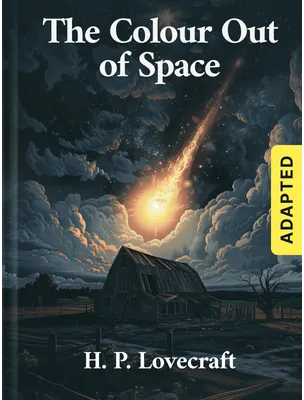
The Colour Out of Space
[adapted]
by
H. P. Lovecraft

… and in the scary moment of even deeper darkness, the people watching saw moving at that treetop height, a thousand tiny points of weak and unholy light, at the tip of each branch like the fire of St. Elmo … and at the same time the beam of glowing light from the well was getting brighter and brighter and giving to the huddled men, a feeling of doom and strangeness…. It was no longer shining out; it was pouring out; and as the shapeless stream of a colour no one could name left the well, it seemed to flow straight into the sky.
West of Arkham the hills rise wild, and there are valleys with deep woods that no axe has ever cut. There are dark narrow valleys where the trees lean in strange ways, and where thin little streams trickle without ever seeing the shine of sunlight. On the gentler slopes there are farms, very old and rocky, with short, moss-covered cottages watching forever over old New England secrets in the shelter of great rock ledges; but these are all empty now, the wide chimneys falling apart and the sides with shingles pushing out dangerously under low gambrel roofs.
The old people have gone away, and people from other countries do not like to live there. French-Canadians have tried it, Italians have tried it, and the Poles have come and left. It is not because of anything that can be seen or heard or touched, but because of something that is only imagined. The place is not good for imagining things, and does not bring peaceful dreams at night. It must be this which keeps the people from other countries away, because old Ammi Pierce has never told them anything he remembers from the strange days. Ammi, whose mind has been a little odd for years, is the only one who still stays, or who ever talks about the strange days; and he dares to do this because his house is so near the open fields and the roads people use around Arkham.
There was once a road over the hills and through the valleys, that ran straight where the blasted heath is now; but people stopped using it and a new road was made, curving far to the south. Traces of the old one can still be found among the weeds of a wild land coming back, and some of them will surely stay even when half the low places are filled with water for the new lake. Then the dark woods will be cut down and the blasted heath will sleep far below blue waters whose top will reflect the sky and ripple in the sun. And the secrets of the strange days will be one with the deep sea’s secrets; one with the hidden knowledge of the old ocean, and all the mystery of very old earth.
When I went into the hills and valleys to survey the land for the new reservoir they told me the place was evil. They told me this in Arkham, and because that is a very old town full of stories about witches I thought the evil must be something which grandmas had whispered to children for centuries. The name “blasted heath” seemed to me very odd and like a play, and I wondered how it had come into the old stories of a Puritan people. Then I saw that dark tangle of small valleys and slopes to the west for myself, and stopped wondering about anything except its own older mystery. It was morning when I saw it, but shadow always hid there. The trees grew too close together, and their trunks were too big for any healthy New England forest. There was too much silence in the dark paths between them, and the ground was too soft with the damp moss and thick mats of endless years of rot.
In the open spaces, mostly along the line of the old road, there were little hillside farms; sometimes with all the buildings standing, sometimes with only one or two, and sometimes with only a single chimney or fast-filling cellar. Weeds and thorny bushes took over, and shy wild animals moved in the thick plants. Over everything was a feeling of unease and heaviness; a bit of the unreal and the very strange, as if some important part of distance or light and shadow was wrong. I was not surprised that the strangers would not stay, for this was no place to sleep in. It was too much like a picture by Salvator Rosa; too much like some banned wood print in a scary story.
But even all this was not so bad as the blasted heath. I knew it the moment I came to it at the bottom of a wide valley; for no other name could fit such a thing, or any other thing fit such a name. It was as if the poet had made the phrase after seeing this one place. It must, I thought as I looked at it, be the result of a fire; but why had nothing new ever grown over those five acres of grey emptiness that lay open to the sky like a great spot eaten by acid in the woods and fields? It lay mostly to the north of the old road line, but crossed a little to the other side. I felt a strange unwillingness about going near, and did so at last only because my work took me through and past it. There were no plants of any kind on that wide area, but only a fine grey dust or ash which no wind seemed ever to blow about. The trees near it were weak and small, and many dead trunks stood or lay rotting at the edge.
As I walked quickly by I saw the fallen bricks and stones of an old chimney and cellar, on my right, and the wide black mouth of an abandoned well whose still vapors made strange changes in the colors of the sunlight. Even the long, dark climb in the woods beyond seemed welcome in contrast, and I no longer wondered at the frightened whispers of the people of Arkham. There had been no house or ruin near; even in the old days the place must have been lonely and far away. And at dusk, afraid to pass that scary spot again, I walked the long way back to the town by the curving road on the south. I wished a little that some clouds would gather, for a strange fear of the deep empty spaces in the sky above had crept into my heart.
In the evening I asked old people in Arkham about the ruined heath, and what that phrase “strange days” meant which so many people said without explaining. I could not, however, get any good answers, except that the whole mystery was much more recent than I had thought. It was not a matter of old legends at all, but something in the lives of the people who spoke. It had happened in the eighties, and a family had disappeared or was killed. People would not be exact; and because they all told me not to listen to old Ammi Pierce’s crazy stories, I looked for him the next morning, because I had heard that he lived alone in the very old, shaky cottage where the trees first begin to grow very thick. It was a terribly old place, and had begun to give off a faint, sickly smell that sticks to houses that have stood too long. Only with knocking again and again could I wake the old man, and when he shuffled shyly to the door I could tell he was not glad to see me. He was not as weak as I had expected; but his eyes drooped in a strange way, and his untidy clothing and white beard made him seem very tired and sad.
Not knowing how to start him on his stories, I pretended a matter of business; told him about my work measuring the land, and asked general questions about the area. He was much smarter and more educated than I had thought, and before I knew it he had understood as much of the subject as any man I had talked with in Arkham. He was not like other country people I had known in the places where reservoirs were to be. He made no protests about the miles of old woods and farmland to be wiped out, though maybe there would have been if his home had not been outside the border of the future lake. Relief was all that he showed; relief at the end of the dark old valleys through which he had walked all his life. They were better under water now — better under water since the strange days. And with this beginning his rough voice sank low, while his body leaned forward and his right index finger began to point shakily and in a serious way.
It was then that I heard the story, and as the voice talked on and on in a rough whisper I shook again and again even though it was a summer day. Often I had to call the speaker back from his wandering talk, fill in the science points which he knew only by a weak, parrot-like memory of professors’ talk, or cover the gaps, where his sense of clear order and flow failed. When he was done I did not wonder that his mind had broken a little, or that the people of Arkham would not speak much of the burned, dead wasteland. I hurried back before sunset to my hotel, not willing to have the stars come out above me in the open; and the next day I went back to Boston to leave my job. I could not go into that dark mess of old forest and hillside again, or face again that grey, burned wasteland where the black well opened deep beside the fallen bricks and stones. The big water lake will soon be built now, and all those ancient secrets will lie safe forever under deep water. But even then I do not think I would like to visit that country by night — at least not when the scary stars are out; and nothing could make me drink the new city water of Arkham.
It all began, old Ammi said, with the meteor. Before that time there had been no wild stories at all since the witch trials, and even then these western woods were not feared nearly as much as the small island in the Miskatonic where the devil had his court beside a strange stone altar older than the Indians. These were not haunted woods, and their strange dusk was never terrible until the strange days. Then there came that white cloud at noon, a lot of explosions in the air, and that tall pillar of smoke from the valley far in the wood. And by that night all Arkham had heard of the big rock that fell out of the sky and stuck in the ground beside the well at Nahum Gardner’s place. That was the house which had stood where the blasted heath would come — the neat white Nahum Gardner house among its rich gardens and fruit trees.
Nahum had come to town to tell people about the stone, and had stopped at Ammi Pierce’s on the way. Ammi was forty then, and all the strange things were very clear in his mind. He and his wife had gone with the three professors from Miskatonic University who went out quickly the next morning to see the strange visitor from unknown outer space, and had wondered why Nahum had said it was so big the day before. It had got smaller, Nahum said as he pointed at the big brown pile above the torn earth and burned grass near the old well-sweep in his front yard; but the professors said that stones do not get smaller. Its heat stayed for a long time, and Nahum said it had glowed a little in the night.
The professors tried it with a rock hammer and found it was strangely soft. It was, in fact, so soft that it was almost like soft plastic; and they dug it out instead of chipping off a sample to take back to the college to test it. They took it in an old bucket borrowed from Nahum’s kitchen, because even the small piece would not cool down. On the way back they stopped at Ammi’s house to rest, and looked thoughtful when Mrs. Pierce said that the piece was getting smaller and burning the bottom of the bucket. It was true, it was not big, but maybe they had taken less than they thought.
The day after that — all this was in June of ’82 — the professors went out together again very excited. As they passed Ammi’s they told him what strange things the sample had done, and how it had faded completely away when they put it in a glass beaker. The beaker had gone, too, and the wise men talked about the strange stone’s liking for silicon. It had acted very strangely in that tidy lab; doing nothing at all and showing no trapped gases when heated on charcoal, being completely negative in the borax bead, and soon showing itself to be completely unable to turn into a gas at any heat they could make, including that of the oxy-hydrogen blowpipe.
On an anvil it seemed very easy to shape, and in the dark its glow was very strong. Still refusing to cool down, it soon had the college very excited; and when, upon heating in front of the spectroscope, it showed bright bands unlike any known colours of the normal spectrum, there was much excited talk of new elements, strange light properties, and other things that confused scientists usually say when they meet the unknown.
Hot as it was, they tested it in a pot that could stand great heat with all the right chemicals. Water did nothing. Hydrochloric acid was the same. Nitric acid and even aqua regia only hissed and splashed against it, which was very hot and could not be harmed. Ammi had trouble remembering all these things, but he knew some liquids used to dissolve things as I named them in the usual order. There were ammonia and caustic soda, alcohol and ether, nasty-smelling carbon disulphide and twelve others; but although the weight kept getting less as time passed, and the piece seemed to be getting a little cooler, there was no change in the liquids to show that they had worked on the material at all.
It was a metal, without a doubt. It was magnetic, for one thing; and after putting it in acid liquids there seemed to be faint marks of the Widmanstätten patterns found on iron from a meteor. When it had cooled a lot, the testing was done in glass; and in a glass beaker they left all the small pieces made from the original piece during the work. The next morning both the small pieces and the beaker were gone without a trace, and only a burned mark marked the place on the wooden shelf where they had been.
All this the professors told Ammi as they stopped at his door, and once more he went with them to see the stone messenger from the stars, but this time his wife did not go with him. It had now clearly shrunk, and even the serious professors could not doubt what they saw. All around the shrinking brown lump near the well was an empty space, except where the earth had fallen in; and while it had been a full seven feet across the day before, it was now hardly five. It was still hot, and the wise men looked closely at its outside as they took off another and larger piece with hammer and chisel. They cut very deep this time, and as they pulled away the smaller piece they saw that the inside of the thing was not quite the same all through.
They had found what seemed to be the side of a large coloured ball set in the material. The colour, which looked like some of the stripes in the meteor’s strange range of colours, was almost impossible to describe; and only by comparison did they call it a colour at all. Its surface was shiny, and when they tapped it, it seemed both easy to break and empty inside. One of the professors hit it hard with a hammer, and it broke with a small, sharp pop. Nothing came out, and every sign of the thing vanished when it was pierced. It left behind an empty round space about three inches across, and everyone thought it likely that others would be found as the surrounding material wore away.
Guessing was useless; so after a useless try to find more little balls by drilling, the seekers left again with their new sample — which was, however, as confusing in the lab as the one before. Aside from being almost soft, having heat, magnetism, and a weak light, cooling a little in strong acids, having an unknown light pattern, slowly disappearing in the air, and attacking silicon compounds so that both were ruined, it showed no signs to tell what it was at all; and at the end of the tests the college scientists had to admit that they could not say what it was. It was not of this earth, but a piece of the great outside; and so it had outside qualities and obeyed outside laws.
That night there was a storm with thunder, and when the professors went out to Nahum’s place the next day they were very disappointed. The stone, magnetic as it had been, must have had some strange electrical power; because it had “drawn the lightning,” as Nahum said, again and again. Six times within an hour the farmer saw the lightning hit the line in the ground in the front yard, and when the storm was over nothing was left but a rough hole by the very old well-sweep, half full of fallen-in dirt. Digging had found nothing, and the scientists made sure that it was completely gone.
The failure was complete; so that nothing was left to do but go back to the lab and test again the disappearing piece that was kept carefully in a lead case. That piece lasted a week, and at the end of that week nothing useful had been learned about it. When it was gone, no trace was left behind, and after a while the professors were hardly sure they had really seen with their eyes open that mysterious trace of the endless depths outside; that single, strange message from other universes and other worlds of matter, energy, and being.
As was normal, the Arkham newspapers made a big deal of the event with its college backing, and sent reporters to talk with Nahum Gardner and his family. At least one Boston daily paper also sent a reporter, and Nahum quickly became a kind of local star. He was a thin, friendly person of about fifty, living with his wife and three sons on the pleasant farm in the valley. He and Ammi visited each other often, as did their wives; and Ammi had nothing but praise for him after all these years. He seemed a little proud of the attention his place had got, and talked often of the meteorite in the following weeks. That July and August were hot; and Nahum worked hard cutting hay in the ten-acre field across Chapman’s Brook; his rattling wagon making deep tracks in the shady lanes between. The work tired him more than it had in other years, and he felt that age was starting to show on him.
Then came the time of fruit and harvest. The pears and apples slowly ripened, and Nahum said that his orchards were doing better than ever before. The fruit was growing to very large size and unusual shine, and in such abundance that extra barrels were ordered to handle the coming crop. But with the ripening came big disappointment, for of all that beautiful show of fake tastiness not one single bit was fit to eat. Into the fine flavour of the pears and apples had crept a hidden bitterness and sick taste, so that even the smallest of bites caused a lasting disgust. It was the same with the melons and tomatoes, and Nahum sadly saw that his entire crop was lost. Quick to see the link, he said that the meteorite had poisoned the soil, and thanked Heaven that most of the other crops were in the higher field along the road.
Winter came early, and was very cold. Ammi saw Nahum less often than usual, and noticed that he had started to look worried. The rest of his family too, seemed to have grown very quiet; and were not regular in their churchgoing or their going to the different social events of the countryside. For this quietness or sadness no cause could be found, though all the household said now and then that their health was worse and that they had a feeling of unclear worry. Nahum himself gave the most clear statement of anyone when he said he was worried about some footprints in the snow. They were the usual winter prints of red squirrels, white rabbits, and foxes, but the serious farmer said he saw something not quite right about what they were like and how they were arranged.
He never gave details, but seemed to think that they did not match the bodies and ways of squirrels and rabbits and foxes as they should. Ammi listened without interest to this talk until one night when he drove past Nahum’s house in his sleigh on the way back from Clark’s Corners. There was a moon, and a rabbit ran across the road; and the jumps of that rabbit were longer than either Ammi or his horse liked. The horse, in fact, had almost run away, but it was stopped by a tight rein. After that Ammi gave Nahum’s tales more respect, and wondered why the Gardner dogs seemed so scared and shaking every morning. They had, it turned out, almost lost the wish to bark.
In February, the McGregor boys from Meadow Hill were out shooting woodchucks, and not far from the Gardner place shot a very strange animal. The shape of its body seemed a little changed in a strange way that was impossible to describe, while its face had a look which no one had ever seen in a woodchuck before. The boys were truly frightened, and threw the thing away at once, so that only their strange stories of it ever reached the people of the countryside. But horses getting scared near Nahum’s house had now become a known thing, and all the reasons for a series of whispered stories were quickly forming.
People said that the snow melted faster around Nahum’s than anywhere else, and early in March there was amazed talk in Potter’s general store at Clark’s Corners. Stephen Rice drove past Gardner’s in the morning, and noticed the skunk-cabbages coming up through the mud by the woods across the road. No one had ever seen things so big before, and they had strange colours that no one could describe. Their shapes were like monsters, and the horse snorted at a smell which Stephen thought was completely new. That afternoon several people drove past to see the strange growth, and all agreed that plants of that kind should never sprout in a healthy world. People often talked about the bad fruit from the fall before, and people kept saying that there was poison in Nahum’s ground. Of course it was the meteorite; and remembering how strange the men from the college had said that stone was, several farmers talked to them about it.
One day they went to see Nahum; but having no love of wild stories and old tales were very careful in what they guessed. The plants were certainly odd, but all skunk-cabbags are more or less odd in shape and color. Perhaps some mineral stuff from the stone had got into the soil, but it would soon be washed away. And as for the footprints and frightened horses — of course this was only village talk which such a thing as the meteor would surely start. There was really nothing for serious men to do in cases of wild gossip, for superstitious country people will say and believe anything.
And so all through the strange days the professors stayed away, because they had no respect for it. Only one of them, when given two small bottles of dust to test in a police case more than a year and a half later, remembered that the strange colour of that skunk-cabbage had been very like one of the odd bands of light shown by the meteor piece in the college spectroscope, and like the fragile little ball found embedded in the stone from the deep hole. The samples in this test case showed the same odd bands at first, though later they lost this property.
The trees budded too early around Nahum’s, and at night they swayed in a scary way in the wind. Nahum’s second son Thaddeus, a boy of fifteen, said that they swayed also when there was no wind; but even the people who gossip would not believe this. Certainly, however, there was a nervous feeling in the air. The whole Gardner family got the habit of secret, quiet listening, though not for any sound they could clearly name. The listening was, in fact, more a result of times when they felt their minds half slip away. Sadly, such times grew week by week, until it became common talk that “something was wrong with all Nahum’s folks.”
When the early saxifrage came out it had another strange colour; not quite like the colour of the skunk-cabbage, but clearly related and just as unknown to anyone who saw it. Nahum took some flowers to Arkham and showed them to the editor of the Gazette, but that important man only wrote a funny article about them, where the dark fears of the country people were made fun of in a polite way. It was a mistake for Nahum to tell a dull man from the city about how the big, overgrown mourning-cloak butterflies acted around these saxifrages.
April brought a kind of madness to the country people, and began that not using of the road past Nahum’s which led to it being left for good. Next, it was the plants. All the fruit trees bloomed in strange colours, and through the rocky soil of the yard and nearby pasture there came up a very strange growth which only a plant expert could link to the normal plants of the area. No normal healthy colours could be seen anywhere except in the green grass and leaves; but everywhere were those wild and rainbow-like kinds of some sick, hidden main colour with no place among the known colours of earth. The “Dutchman’s breeches” became a thing of dark danger, and the bloodroots grew bold in their wrong colours.
Ammi and the Gardners thought that most of the colours felt strangely familiar, and decided that they reminded them of the easily broken little ball in the meteor. Nahum plowed and planted the ten-acre pasture and the field up the hill, but did nothing with the land around the house. He knew it would be no use, and hoped that the summer’s strange plants would pull all the poison from the ground. He was ready for almost anything now, and had got used to the feeling of something near him waiting to be heard. The neighbours avoiding his house hurt him, of course; but it hurt his wife more. The boys were better off, being at school each day; but they could not help being scared by the talk. Thaddeus, a very sensitive boy, suffered the most.
In May the insects came, and Nahum’s place became full of buzzing and crawling. Most of the creatures seemed not quite usual in their looks and movements, and their night habits were not like anything seen before. The Gardners started watching at night — watching in all directions without a plan for something they could not tell what. It was then that they all agreed that Thaddeus had been right about the trees. Mrs. Gardner was the next to see it from the window as she watched the swollen branches of a maple against a sky lit by the moon. The branches surely moved, and there was no wind. It must be the tree sap. Something strange had come into everything growing now.
Yet none of Nahum’s family made the next discovery. They were too used to it, and what they could not see was seen by a shy windmill salesman from Bolton who drove by one night, not knowing the country stories. What he told in Arkham was put in a short paragraph in the Gazette; and it was there that all the farmers, Nahum included, saw it first. The night had been dark and the buggy lamps weak, but around a farm in the valley which everyone knew from the report must be Nahum’s, the darkness had been less heavy. A faint but clear light seemed to be in all the plants, grass, leaves, and flowers alike, while at one moment a separate bit of the glowing light seemed to move quietly in the yard near the barn.
The grass had seemed untouched until then, and the cows grazed freely in the field near the house, but toward the end of May the milk started to be bad. Then Nahum had the cows taken to the higher land, after that this trouble stopped. Not long after this, the change in the grass and leaves could be seen. All the greenery was turning grey, and was getting a very strange quality of being easy to break. Ammi was now the only person who ever visited the place, and his visits were becoming fewer and fewer. When school closed, the Gardners were almost cut off from the world, and sometimes let Ammi do their shopping and other small jobs in town. They were getting worse in strange ways, both in body and mind, and no one was surprised when the news that Mrs. Gardner had gone mad spread around.
It happened in June, about one year after the meteor fell, and the poor woman screamed about things in the air which she could not explain. When she talked wildly, she did not use any clear names, only action words and words like he, she, and it. Things moved and changed and shook, and ears felt a tingling from waves which were not completely sounds. Something was taken away — she was being emptied of something — something was clinging to her that should not be there — someone must make it stay away — nothing was ever still in the night — the walls and windows moved.
Nahum did not send her to the county mental hospital, but let her walk around the house as long as she was not dangerous to herself and others. Even when the look on her face changed he did nothing. But when the boys grew afraid of her, and Thaddeus almost fainted at the way she made faces at him, he decided to keep her locked in the attic. By July she had stopped speaking and crawled on her hands and knees, and before that month was over Nahum got the crazy idea that she glowed a little in the dark, as he now clearly saw was also true of the nearby plants.
It was a little before this that the horses had run away in a panic. Something had woken them in the night, and their neighing and kicking in their stalls had been terrible. There seemed almost nothing to do to calm them, and when Nahum opened the stable door they all ran out fast like frightened forest deer. It took a week to find all four, and when they were found they were seen to be quite useless and could not be controlled. Something had broken in their brains, and each one had to be shot for its own good. Nahum borrowed a horse from Ammi for his hay work, but found it would not go near the barn. It was scared and moved away, refused to move, and neighed, and in the end he could do nothing but drive it into the yard while the men used their own strength to get the heavy wagon near enough to the loft where the hay was kept for easy throwing.
And all the while the plants were turning grey and dry and easy to break. Even the flowers whose colors had been so strange were graying now, and the fruit was coming out grey and very small and with no taste. The asters and goldenrod bloomed grey and twisted, and the roses and zinneas and hollyhocks in the front yard were such awful-looking things that Nahum’s oldest boy Zenas cut them down. The strangely puffed-up insects died about that time, even the bees that had left their hives and gone to the woods.
By September all the plants were quickly crumbling to a greyish powder, and Nahum feared that the trees would die before the poison was out of the ground. His wife now had times of terrible screaming, and he and the boys were in a constant state of nervous worry. They avoided people now, and when school started the boys did not go. But it was Ammi, on one of his rare visits, who first saw that the well water was no longer good. It had a bad taste that was not exactly rotten nor exactly salty, and Ammi told his friend to dig another well on higher land to use until the ground was good again. Nahum, however, did not listen to the warning, for by then he had become used to strange and unpleasant things. He and the boys continued to use the bad supply of water, drinking it without energy and like a machine, just as they ate their small and badly cooked meals and did their thankless and boring chores through the days with no purpose. There was something of quiet giving up about them all, as if they walked half in another world between lines of guards with no names to a sure and familiar death.
Thaddeus went mad in September after a visit to the well. He had gone with a bucket and had come back empty-handed, screaming and waving his arms, and sometimes falling into a silly giggle or a whisper about “the moving colours down there.” Two in one family was pretty bad, but Nahum was very brave about it. He let the boy run about for a week until he began tripping and hurting himself, and then he shut him in a room in the attic across the hall from his mother’s. The way they screamed at each other from behind their locked doors was very terrible, especially to little Merwin, who thought they talked in some terrible language that was not of the earth. Merwin was getting very imaginative, and he was more restless after the locking away of the brother who had been his greatest playmate.
Almost at the same time the death among the farm animals began. The farm birds turned greyish and died very quickly, their meat was found dry and very smelly when cut. Pigs grew too fat, then suddenly began to go through horrible changes which no one could explain. Their meat was of course useless, and Nahum did not know what to do. No country vet would come to his place, and the city vet from Arkham was clearly confused. The pigs began growing grey and dry and easy to break and falling to pieces before they died, and their eyes and noses developed strange changes. It was very hard to explain, for they had never been fed with the bad plants. Then something happened to the cows. Certain areas or sometimes the whole body would be strangely shrivelled or pressed in, and terrible collapses or breakings apart were common.
In the final stages — and death was always the result — there would be turning grey and turning hard and breakable like what happened to the pigs. Poison was not possible, for all the cases happened in a locked and untouched barn. No bites from wandering animals could have brought the virus, for what living animal on earth can pass through solid walls? It must be only a natural disease — yet what disease could cause such results was more than anyone could guess. When the harvest time came there was not an animal left alive on the farm, for the farm animals and chickens were dead and the dogs had run away. These three dogs had all disappeared one night and were never seen again. The five cats had left some time before, but their going was hardly noticed since there now seemed to be no mice, and only Mrs. Gardner had kept the graceful cats as pets.
On the nineteenth of October Nahum stumbled into Ammi’s house with terrible news. The death had come to poor Thaddeus in his attic room, and it had come in a way that no one could tell. Nahum had dug a grave in the fenced family plot behind the farm, and had put there what he found. There could have been nothing from outside, for the small window with bars and locked door were unbroken; but it was much like it had been in the barn. Ammi and his wife comforted the sad man as best they could, but shivered as they did so. Great fear seemed to stick to the Gardners and all they touched, and even the presence of one in the house was like a breath from places unnamed and not to be named. Ammi went with Nahum home very unwillingly, and did what he could to calm the wild sobbing of little Merwin. Zenas needed no calming. He had come of late to do nothing but stare into space and obey what his father told him; and Ammi thought that his fate was a mercy.
Now and then Merwin’s screams were answered weakly from the attic, and after a questioning look Nahum said that his wife was getting very weak. When night came, Ammi was able to leave; because not even friendship could make him stay in that place when the weak glow of the plants began and the trees might or might not have moved without wind. It was very lucky for Ammi that he did not have more imagination. Even as things were, his mind was a little troubled; but if he had been able to connect and think about all the signs around him he would surely have become a complete madman. In the dusk he hurried home, the screams of the mad woman and the nervous child ringing terribly in his ears.
Three days later Nahum ran into Ammi’s kitchen early in the morning, and, when his host was not there, told a very worried story again, stammering, while Mrs. Pierce listened in shaking fear. It was little Merwin this time. He was gone. He had gone out late at night with a lantern and pail for water, and had never come back. He had been getting worse for days, and hardly knew what he was doing. Screamed at everything. There had been a wild scream from the yard then, but before the father could get to the door the boy was gone. There was no light from the lantern he had taken, and there was no sign of the child himself. At the time Nahum thought the lantern and pail were gone too; but when morning came, and the man had walked back, very tired, from his all-night search of the woods and fields, he had found some very strange things near the well.
There was a crushed and a little melted lump of iron which had been the lantern for sure; and a bent pail and twisted iron rings beside it, both half melted, seemed to show the remains of the pail. That was all. Nahum could not imagine anymore, Mrs. Pierce had no words, and Ammi, when he got home and heard the story, could not guess. Merwin was gone, and there would be no use in telling the people nearby, who avoided all Gardners now. No use, either, in telling the city people at Arkham who laughed at everything. Thad was gone, and now Merwin was gone. Something was creeping and creeping and waiting to be seen and heard. Nahum would go soon, and he wanted Ammi to take care of his wife and Zenas if they lived after him. It must all be a kind of punishment; though he could not imagine what for, since he had always lived rightly in the Lord’s ways as far as he knew.
For over two weeks Ammi did not see Nahum; and then, worried about what might have happened, he got over his fears and paid a visit to the Gardner place. There was no smoke from the great chimney, and for a moment the visitor feared the worst. The look of the whole farm was shocking — greyish withered grass and leaves on the ground, vines falling in dry broken pieces from old walls and roof-ends, and great bare trees reaching up at the grey November sky with a careful evil which Ammi could not help feeling had come from some slight change in the angle of the branches. But Nahum was alive, after all.
He was weak, and lying on a couch in the kitchen with a low ceiling, but fully awake and able to tell Zenas what to do. The room was very cold; and as Ammi clearly shivered, the man of the house shouted in a rough voice to Zenas for more wood. Wood, really, was very much needed; since the very large fireplace was unlit and empty, with a cloud of black soot blowing about in the cold wind that came down the chimney. Soon Nahum asked him if the extra wood had made him any more comfortable, and then Ammi saw what had happened. The strongest cord had broken at last, and the poor farmer’s mind could not take any more sadness.
Asking gently, Ammi could get no clear information at all about the missing Zenas. “In the well — he lives in the well — ” was all that the confused father would say. Then the visitor suddenly thought of the mad wife, and he changed his questions. “Nabby? Why, here she is!” was the surprised answer of poor Nahum, and Ammi soon saw that he must look for himself. Leaving the harmless talker on the couch, he took the keys from their nail beside the door and climbed the squeaky stairs to the attic. It was very stuffy and smelly up there, and no sound could be heard from anywhere. Of the four doors in sight, only one was locked, and on this one he tried different keys on the ring he had taken. The third key was the right one, and after some trying Ammi threw open the low white door.
It was quite dark inside, for the window was small and half-hidden by the rough wooden bars; and Ammi could see nothing at all on the floor of wide boards. The bad smell was too strong to stand, and before going further he had to go back to another room and return with his lungs full of clean air. When he did enter he saw something dark in the corner, and when he saw it more clearly he screamed out loud. While he screamed he thought a passing cloud covered the window, and a second later he felt himself brushed as if by some hateful flow of vapour. Strange colours danced before his eyes; and if the horror there had not made him numb he would have thought of the little ball in the meteor that the geologist’s hammer had broken, and of the sick plants that had grown in the spring. As it was he thought only of the awful monster which stood before him, and which all too clearly had shared the nameless fate of young Thaddeus and the farm animals. But the terrible thing about the horror was that it moved very slowly and so you could see it, as it continued to fall to pieces.
Ammi would give me no more details of this scene, but the shape in the corners does not appear again in his story as a moving thing. There are things that cannot be said, and what is done from simple human kindness is sometimes cruelly judged by the law. I understood that no moving thing was left in that attic room, and that to leave anything able to move there would have been an act so terrible as to send any responsible person to never-ending pain. Anyone but a calm farmer would have fainted or gone crazy, but Ammi walked awake through that low doorway and locked the cursed secret behind him. There would be Nahum to deal with now; he must be fed and looked after, and taken to some place where he could be cared for.