The original story was written by Leo Tolstoy in the late 19th century, and adapted versions have been published since then.
[{"id":"para_1","index":0,"start":0,"offset":353,"words":4,"paraNum":"","lastModified":1764765700000,"semanticType":"title-book-title","voicework":"tts","blockId":"the_coffeehouse_of_surat_short_en-bl4g","language":"en","wordsRange":{"start":100000000,"end":105000000},"paragraphVersion":21,"direction":"ltr","paragraph":"<h1 class=\"ilm-title ilm-x-large\" id=\"para_1\" semantictype=\"title-book-title\" data-ilmid=\"the_coffeehouse_of_surat_short_en-bl4g\" data-audio=\"1\" data-chapter=\"para_1\" data-words-count=\"4\" data-before=\"0\" data-ww=\"\"><span class=\"block-pb\"> <span class=\"block-pb is-animated\"></span> </span><span class=\"itm-wrap\">The Coffee-House of Surat<br></span></h1>","hasContent":true,"isFirst":true,"isLast":false},{"id":"para_2","index":1,"start":353,"offset":332,"words":1,"paraNum":"","lastModified":1764765684000,"semanticType":"title-subtitle","voicework":"tts","blockId":"the_coffeehouse_of_surat_short_en-bl4m","language":"en","wordsRange":{"start":138333333,"end":171666667},"paragraphVersion":25,"direction":"ltr","paragraph":"<h1 class=\"ilm-title ilm-subtitle\" id=\"para_2\" semantictype=\"title-subtitle\" data-ilmid=\"the_coffeehouse_of_surat_short_en-bl4m\" data-audio=\"1\" data-chapter=\"para_2\" data-words-count=\"1\" data-before=\"4\" data-ww=\"\"><span class=\"block-pb\"> <span class=\"block-pb is-animated\"></span> </span><span class=\"itm-wrap\">[adapted]</span></h1>","hasContent":true,"isFirst":false,"isLast":false},{"id":"para_3","index":2,"start":685,"offset":357,"words":2,"paraNum":"","lastModified":1764765840000,"semanticType":"title-author","voicework":"tts","blockId":"the_coffeehouse_of_surat_short_en-bl4h","language":"en","wordsRange":{"start":205000000,"end":209000000},"paragraphVersion":32,"direction":"ltr","paragraph":"<h1 class=\"ilm-title ilm-author ilm-nopad ilm-large\" id=\"para_3\" semantictype=\"title-author\" data-ilmid=\"the_coffeehouse_of_surat_short_en-bl4h\" data-audio=\"1\" data-chapter=\"para_3\" data-words-count=\"2\" data-before=\"5\" data-ww=\"\"><span class=\"block-pb\"> <span class=\"block-pb is-animated\"></span> </span><span class=\"itm-wrap\">by <br>Leo Tolstoy</span></h1>","hasContent":true,"isFirst":false,"isLast":false},{"id":"para_4","index":3,"start":1042,"offset":161,"words":0,"paraNum":"","lastModified":1671252864000,"semanticType":"line","blockId":"the_coffeehouse_of_surat_short_en-bl4i","language":"en","wordsRange":{"start":309000000,"end":409000000},"paragraphVersion":9,"direction":"ltr","paragraph":"<hr class=\"ilm-hr ilm-small\" id=\"para_4\" semantictype=\"line\" data-ilmid=\"the_coffeehouse_of_surat_short_en-bl4i\" data-words-count=\"0\" data-before=\"7\" data-ww=\"\">","hasContent":true,"isFirst":false,"isLast":false},{"id":"para_5","index":4,"start":1203,"offset":6794,"words":0,"paraNum":"","lastModified":1671549376000,"semanticType":"illustration","blockId":"the_coffeehouse_of_surat_short_en-bl4l","language":"en","wordsRange":{"start":509000000,"end":609000000},"paragraphVersion":9,"direction":"ltr","paragraph":"<div class=\"ilm-illustration\" id=\"para_5\" semantictype=\"illustration\" data-ilmid=\"the_coffeehouse_of_surat_short_en-bl4l\" data-words-count=\"0\" data-before=\"7\" data-ww=\"\"><img width=\"512\" height=\"341\" data-src=\"ch0p0\" src=\"data:image/png;base64,iVBORw0KGgoAAAANSUhEUgAAADMAAAAiCAIAAAB9SXZDAAAACXBIWXMAAAsTAAALEwEAmpwYAAASu0lEQVRYhS2V91LqCYKFeYeZnZnt6b63bzKAZAUxi6AgSlCy5Jwk55zhR84ZCYIomG7qULs7f+yTbd2pfYOvvnNOHZBBK73WyN0Ok8d27XdZwl6b33EdcFkcZo1Vr7SZdA6rXquQ2Ixqt0XjNKksWrnFoNDJ+A6dxGtSaIUsu06SClgyQVsh5rFrpXa9xCDnBxy6kPParpcX4950wKYUc5xmfSbqCbstyZDboBKL+ZcWg9Jl1nms+qDLpFeIIiG3nM/hMU4vycc00iFo1O+Mh73p7WA6Ht7dju4no4fJ+HE2eXqYPt9Pnx8m8+nopll9vrv5vpj88Xz/7WH0fT4e1grNTCjkNDJp58mA43VU/zrt+m1GIn4Hg0Zq5OJs3BvzOUU89sukE/M70Eik3WzMpwLZuF8nF0t4F9dqqfiKRSbgyccE27WKx6Ae4w9Qa2uQD8urH8HwlVXQ82L2+nT/+vTw+Xn++WXx+Wnx+Xn+5Xn+2+fH758X31+fvj7P2/XC092gXckmQ65KNpaL+Uxq0Tn5+HBvi0M/kws4i365lApymTQxh4HDYM4oZMopyWM3bW5u9KuZuN92crTPOD0yyAVGjVTAuVBIBafkk3UUAoddX/r4CY1AwiBgNBSKQ6+fnxDlV8yjbQzo4W48n90u7v8taTF7WcxeHh+eF/cvi9nzfPY0v4vHg0A89DQbOa0GGZ+RCTtPT/D7uzv00xMpnyUXch3Xilmn8HBTc1v1ain/jESAI9BEAtFp1h7id20G2fHB9s4mWsSmCvmXfBb19ITw/t2H1eXVo/1tMvGQw6BYdeKQU58JOXIRVzMXALwGKnEfNL+//UE2myxm06eH2fNi9jSfPd7fPf3Amk3GPQaN4rYZ78ZdIB6KuC2tUhqDwQrZ7JjXxrqgFROBSROYdSpJv+tafiVg0REIJJlM1mtkeoWQTiEq+D9ESniXBgWfz6QT9nfp5yQUEr2ORKGR0MNtLBm/xT4/knHOHTqpSSWIeY1RpzHu0f+/s4e7yfz+7nbYv59NF/PZ4/z+4X76+jTvdxs2kyYRcIbd1qDLXAFiYY+LfUlPhZxeu4HP5bSK6UW/nPDb8AfbFrWUTiZBIOAdHPZgG8s8I0j5lwG7Oh2wlFJ+n/2afkY6Otgj7G/j0Aji3haLesxjkOT8y7jH3MwGe+W4RSdRCi/MKoFOwgPdT8ezyWh+P6tXSgGHrpiJTSejZrVUKQCdZqVZK0Z8jufp4GnSbxQymWhAKRdpZYKox6pViPlcTr+aeRk21DLh4f42Eg799e1byMrK0f6O9OoCCNmKce/8ptjOR606GZdBJh9uXZwSeBcUq06ai9jzUWe3FBs1Ut+mjd9m7adBuV9N5uOe8I9RK0CxkLfTas7nj6V8JuEzZyPuRNjjthkiXmc2GQ0HXIV46HE8KqVjRqWQd0ElHe25jZpkyO006yRCfj0bselkm+uwrQ3UCX5PKeL4rGogYHLoJONmoQoEEz4Lj06iHu9dXZ4ZVUIg7OiU4vV8GAhZG5nAfa84qgNPw+rruPE4KE9a+cWwNm0V5XwmyGpQAqlEt93KxkOLm8rTuBb22KN+56Dd+Pby1KwW/Haz1aARs2kqEdegkrotOq9ZHXSZAg4jj8281kgvaWQJ98JnUcXdunLU3kq7+/mg26TSyrgiNkUjZunlV+mwu5IJV4BQLRNqF6OVtL+a9g9qwHxQfr1tvt42P09aL+PGvF99HNQnzYJVIwX5rFqLXuIwKuM+2+fb1tOoEfU5SpnY5KaTiYaUAhafQdFIuMmAIxF02vRyo0oUsOncVp1UwL5i0Yxqkc+izQZs5ZitDvh7xfCoGg9YNWoRy2NSNgvxUTsPRNzVTKiej9SykU451ShEgbBDL+elgvZRA3gc1Rc39S/Tzsuk9TppP4+aX6bdcT0LchmVHpM67DHbjJrX2+7TbTfksailfL1CrODTrWpJwudIeE1Bm6YQcQIhVyUdKMTcGjGnkg5W0oEG4I3YtZ1c8K6ZHFUS43qiXwrnY+5RI/fH4/B53HwYVDoVoAyE8jFPzGfWSbnKK4bi6sKsleQizlLc3a+khs3crFeZ9So3tcywDoyb+WE9CzKqZNNuNZf0GXWyWb+Wj3m1EpZCwPZYNOmgPWQ3OPQSt0EWdhnuu6XPd61aNtIrJVuFWCnpjToNMZehnQ0+9/N39dSkmpzUUoNK/GlU+zLtPo1b9/1KqxDzWdR2vdSuFSd85mo6eNvMf73v/fk86pYS42ZhPqi9TLuf7/qvd/2HYeu2XRrW8/VMFBR2meejVirs1Mn43UpaJ+VF3aZMxJnyWQJ2fcRpLAOxZiHZKqUGtfTn20Y5GZh1coubSjbk6JXipWRoWEl9HpTm7exDO7/ol6bN7KAG9MpAJmwHgpaIQwcEbP0q8Hp38+fn+3/99vj783Q+aj1NO8+T7tf5eNav33bKbPqpy37dKmWepr35+GbQKIOG9UKvkjGqRK187HHc9Fi1zmtlOemvZqKdWqFdzuXTsV41U8snm8XUl7vObbsy65aKcW81Hbpr51vF+Kyd+zZuPPXLz4Pa17vuYlBrFeIxn6NXTP72MPjjafLfXx7+5+vjy2yUjvqTYY/FoMLvb9LOSA7LtZTPOicenh7tQj69w8AgxB2cWsTl0qinhEMQEPVLrpjlZOD3xehlXG/m49VMeFDP9aq523Y5FnCKBcxGLtouZcqZ6GLYbOQS9XysDgR75fTTsNYuJmfd0h+z3pdx+3XU+n538zxudyvAXa++GDannXotG4u4jZmwW8CkbkCX9jaQ63AIGrKyAV3bQsFX3/0CW1pGra2g18AoyOr6GhgFXkKtgJd+fQeSi/h727heMfH7fe+3h/a4Vazlk/1abtgoDuo5k1p8xblIBmyZkNVllOuUQp9FnQvbmtlYu5CaD+rtQmLaLryOWrNW4a5dmHWrtUykmY+9TG8SAXvMZ3GZNULWuYhJPt3H4uDQvXXkLhq6jVjDwsBo8PI6ZA0Ng6KhYAwcjIasbsJhOAQMh0TCV1dAvAsalUyZNjPf73rf7jrjZr6QDABhZ8husGvFhzj0+zdvmbSzUtSe8hm9ZlXIaciF7EG7wWGQhxwGn0XtNEhSfmsl6SslfJmQK+IyhdxWhYjPopElHDqXcUo/JdLJR0zS3vEWdncdiUNAcIg1DByCWAWvw6Gb6ygUDLG9jtzHIHbRqP0N5AF2A4OAgbRysVzIuu8Wv89ufn8Y9Upxj1Fq0wgZ5APizsbe5ubx0eHR0X4x6kn5TB6TymdRpkMuDpXMpZK4jPMrFt1n0SZ9llzUk4t6GrlINuwiHu5sopES3oVDK1ILLiVsOuv8hHOO552fnBxs72PRuxj01joCg0RiUTD8Fm4Hi8GiEPsY1O4Gah+LPNzc2EIjQNGAQy3hP/QqL+NOuxDPRuwGBU/KZdDJeI2QdUmnkI/xR4eH6aD7phyvZ2LFRNBn03iMSiDo7JYT9UwYCLqiLpPfqrWqRTaNyCznCWgnfBrlgnRokPAGpWS/knoY1gxyLvuMeHKws4WCb8LXsHDoBnRtEwndw2KIO+u7G4gtFGJnHbWJgm6hkAjIKigd9Xis6sdhfX5TTYacW9sYDBaDPybs7WAMEjb55GhncxMOReAPdjJBWxUINHJxrZRr1UgNUva1mGXXiMUc+vEujko4ZJAIQgaJe3Z8yaDKRewtBFIhFvzv14f/ep78+TxSi9nnx/ukg+116Oo6BLwOhcBXllHgVeL21hlhewsJwyKg22gEBgbBwOGrnz6AvC6zlE8bVlOfb5udUvycckKjUlU6g8UgNwsu7RoZj8lgXNBpZwQx84xxTlSIWDopl0YhwhAIq15lMShjfguHQVXJxEIRx6gS66V8PP6AwzjHb+NUcuHvj7ffHobfH8fKH2R75MNd+MoyEgJGQSBrS58Qq6vQlRXwyjICDEbDIBjYGha+tr4GXXn/DiSRXHEY5Ieb0vOwMijGRHwml8fWGgxGjdQg5jpNahH/UiTgGuQ8KZv68eOHn999uFZchR36A/xeOeHNBF31pNeglnL5TJtBCfhMJjmPdU7hMM4RK6t8Nutf357+fL3/9nSnlQkYp0dnhAP46ipidRUBXoEtfdqAQpY+LH14v4RYW4NDVlFQ6DocgkPCIUsfQEqZUMii9kqRXiFcitjIxAPi0TGDTtNLODohx6wRa4VsIOTPR2xWOXdjfeOnt++NyqtSxHq4t5FyaNtpbwvweax6NAYTCnqqGb9Jxrti0q4uKdsIlFDAm4yG9XL+dbEwqpUcOolKPMDAYbCVFSQEDFn6uImAwsFry58+oWGwdegaAgxBrYF31lFrKx9BJp2Sf3FeA4KNfDwTsZ8c41Fo7PEZw6hTKrl0u0p2rRDUK7lhLRW8Fl9QSDDEmlEllIlYWAw6YlM+1CJ3tZRJLT0k4C84rKjbpBYxRRzaFRW/DYOQyCS9RkU/JZdrbbVMLGCekQ52YcvL0JUV6PIK5OPHDRiYS6UgYeAfaULXkKsQ1NrqOgyx/P5XkNeuV4s4Npve6rTKJVenhKP9/RORwWowm1VXrFw8eK0SpmPBZr2i5NPNci6dchJ16Sw6BYVM0Iku2nFrM2oPWhS72ztLa5sanYZ/QZHwGJfkA9inT7v7Byw6bQe7dUjEY5Awxhn5WqcS89k//fQPFByBRsAQ4CWtXIRYW0GursDBy0jIGhwCWV1e/vWXn0HtcqoM+K4NijMKiUYmMMikYzyRx768pJ4FnPpk2KGWcoMuY7NarlXz10qJz+v2mDVOvWJ/a9OskmTCdqOCb5fzWGdUOGZPLBGxqcc6AVVAJcKWIQQCXiTRXvBlBpOVwTjji9jpaGDaKnFpxGspj3d2hIN9Yp8cMknHB5so5MoHA5/GOyX86N2HN6DXh/7DqNZv5IpANBX1RrxWg1oadpuqmXC3lh608+NesVaItmvZ0aAjlQgsdotExLlWiUj4Q7/LHAp4ZVcsAeNsHbXx85s3aASac3qi5VG0nHPCwTbx+EQgEDEoNLPJ7PV7jde6DJCqAVEg5FBxLy9wGAp8jYhAiIUCjYDnN4tMbDr6rz9xTna1lwTQ9KbWq2fHveps1Lobtu6GzbtRu14C+q1Sv5nPxP1hvy2T9OeBUKOSLmTCtWKiXUuHPCaFmGM3yPRi9hXtiHV+vo3bgyFQhwd7HOrxOeGAST6SMkkiPkshFjHpVJVc4vO4oyG3XqeIWMRSFmVnb5tyenqMxfGOds/W3ieYhzYWnkGibGK2qcRt4SkeNO6Uu7VMu5ppFFM3zeJs3Hm47c4n/fvb3nTYGnRr9XImFfPbLFqbVWc1qf0eU8hnCfssVoPM79BmIg7+5RkWg6XRKHu7uKN97MU5gXS0TznZv/j3vykErGPCoYTDkArYMj7rEAOOm0UGKZdO2tmBQ4/wJMrpKfrvf+GjIU7GHv308JhyRtrCMYnboGGrcNstDVvFTjXXruXbtXy3Ue53ar1WZdBv9DvVQbd+P+k93t9MBo2bVjEPhM0mzbVerpRfsZlnBo3YoBJdMsgaldBkkFuNCrNObNaJbUa52663WzVet8luMwYDdrGQzWXSLsl7VilbLWaQyUQKcROHwW7htpCrS0golLGFuNrFEDAbWDAY9mkZ1CilqrlwORepFROFbCQedob91ljE5XYY4hF3KOBIJYOVEjC8aUxHncmwdX/bfZh0eq1iJuWPh10uh14pv+LzLpjMcxbzXC7j+lzXpWzoppl5nDS/Lgb3o8ZNK18vpXLpUNhnoZ8dbaKgYjF/ML3nCXnrWzg4Fkc8IW5v4WBLn/Y31rcxmA9vlv7z7z+DyrloOuKM+C3phC+fCWZSgUTUHQ7aXA6dUS91OvQ+jzmZ8GeBSDYVqpWBWindquXa9Xyrnuu3S4tp5+WhP58066WY32OUy3gnZDxma2Mfv3dOOxWJuLGgq10FBu1iq5apl1IKMQsO/uT32tuNhlouFPPppKNdCff8lHCAWoefHOzRqKdwGPKf//gJVM3HSkAw7DXFg45E2JWKutNxfzLmi4Yc0ZAzGfX4nNcOi8bvMUVDzmI22qgCjXK6XkrVCsl6GWhWMuOb2mRQm9xUF9PW86yzmDS69XQsZOfx6Cck/AoMvAxZ2drC0Kgki1F9rZagERAZj86mEqiEzdODjSMcYg8DwaJWPr59iwCvQpbfv/np17/9xz9AJSBUzgSAqDuXDiTCzoDLlE0GirloNhVIRT3FTLRWSubSoVTUm074i5lwo5ys5KKlbKSUjaSjnlImUiskOrVsp57tNfM3rcJs1Lgftx7vOrNhY9wtF4Cgw6bVqsRcNoNA2F9a/viXv/4NsgqOuI0mtYRJI5GIe7gNFBK6+uaXn9/+8ubDu3fv37779ed//h+CeJykkwE4cwAAAABJRU5ErkJggg==\" alt=\"The Coffee-House of Surat (adapted)\"></div>","hasContent":true,"isFirst":false,"isLast":false},{"id":"para_6","index":5,"start":7997,"offset":361,"words":4,"paraNum":"","lastModified":1764765670000,"semanticType":"header-sub-subheader","voicework":"tts","blockId":"the_coffeehouse_of_surat_short_en-bl2t","language":"en","wordsRange":{"start":709000000,"end":714000000},"paragraphVersion":17,"direction":"ltr","paragraph":"<h4 class=\"ilm-header ilm-h4\" id=\"para_6\" semantictype=\"header-sub-subheader\" data-ilmid=\"the_coffeehouse_of_surat_short_en-bl2t\" data-audio=\"1\" data-chapter=\"para_6\" data-words-count=\"4\" data-before=\"7\" data-ww=\"\"><span class=\"block-pb\"> <span class=\"block-pb is-animated\"></span> </span><span class=\"itm-wrap\">(After Bernardin de Saint-Pierre)<br></span></h4>","hasContent":true,"isFirst":false,"isLast":false},{"id":"para_7","index":6,"start":8358,"offset":455,"words":29,"paraNum":"1","lastModified":1764765623000,"semanticType":"par","voicework":"tts","blockId":"the_coffeehouse_of_surat_short_en-bl2u","language":"en","wordsRange":{"start":814000000,"end":839000000},"paragraphVersion":25,"direction":"ltr","paragraph":"<p id=\"para_7\" semantictype=\"par\" data-ilmid=\"the_coffeehouse_of_surat_short_en-bl2u\" data-audio=\"1\" data-words-count=\"29\" data-before=\"11\" data-ww=\"\"><span class=\"block-num\" data-id=\"1\"></span><span class=\"block-pb\"> <span class=\"block-pb is-animated\"></span> </span><span class=\"itm-wrap\">In the town of Surat, in India, there was a coffee shop where many travellers and people from other countries from all parts of the world met and talked.</span></p>","hasContent":true,"isFirst":false,"isLast":false},{"id":"para_8","index":7,"start":8813,"offset":692,"words":72,"paraNum":"2","lastModified":1764765623000,"semanticType":"par","voicework":"tts","blockId":"the_coffeehouse_of_surat_short_en-bl2v","language":"en","wordsRange":{"start":939000000,"end":1012000000},"paragraphVersion":26,"direction":"ltr","paragraph":"<p id=\"para_8\" semantictype=\"par\" data-ilmid=\"the_coffeehouse_of_surat_short_en-bl2v\" data-audio=\"1\" data-words-count=\"72\" data-before=\"40\" data-ww=\"\"><span class=\"block-num\" data-id=\"2\"></span><span class=\"block-pb\"> <span class=\"block-pb is-animated\"></span> </span><span class=\"itm-wrap\">One day a wise Persian religious teacher visited this coffee-house. He was a man who had spent his life studying what God is like, and reading and writing books on the subject. He had thought, read, and written so much about God, that in the end he lost his mind, became very confused, and even stopped believing that a God existed. The Shah, hearing of this, had sent him away from Persia.</span></p>","hasContent":true,"isFirst":false,"isLast":false},{"id":"para_9","index":8,"start":9505,"offset":559,"words":44,"paraNum":"3","lastModified":1764765897000,"semanticType":"par","voicework":"tts","blockId":"the_coffeehouse_of_surat_short_en-bl2w","language":"en","wordsRange":{"start":1112000000,"end":1156000000},"paragraphVersion":22,"direction":"ltr","paragraph":"<p id=\"para_9\" semantictype=\"par\" data-ilmid=\"the_coffeehouse_of_surat_short_en-bl2w\" data-audio=\"1\" data-words-count=\"44\" data-before=\"112\" data-ww=\"\"><span class=\"block-num\" data-id=\"3\"></span><span class=\"block-pb\"> <span class=\"block-pb is-animated\"></span> </span><span class=\"itm-wrap\">After arguing all his life about the First Cause, this unlucky religious thinker had ended up by confusing himself very much, and instead of understanding that he had lost his mind, he began to think that there was no higher power controlling the universe.</span></p>","hasContent":true,"isFirst":false,"isLast":false},{"id":"para_10","index":9,"start":10064,"offset":769,"words":86,"paraNum":"4","lastModified":1764765886000,"semanticType":"par","voicework":"tts","blockId":"the_coffeehouse_of_surat_short_en-bl2x","language":"en","wordsRange":{"start":1256000000,"end":1341000000},"paragraphVersion":22,"direction":"ltr","paragraph":"<p id=\"para_10\" semantictype=\"par\" data-ilmid=\"the_coffeehouse_of_surat_short_en-bl2x\" data-audio=\"1\" data-words-count=\"86\" data-before=\"156\" data-ww=\"\"><span class=\"block-num\" data-id=\"4\"></span><span class=\"block-pb\"> <span class=\"block-pb is-animated\"></span> </span><span class=\"itm-wrap\">This man had an African slave who followed him everywhere. When the religious teacher went into the coffee-house, the slave stayed outside, near the door, sitting on a stone in the bright sun, and shooing away the flies that were buzzing around him. The Persian, after he sat down on a couch in the coffee-house, ordered himself a cup of opium. When he had drunk it and the opium had begun to make his brain work faster, he spoke to his slave through the open door:</span></p>","hasContent":true,"isFirst":false,"isLast":false},{"id":"para_11","index":10,"start":10833,"offset":382,"words":15,"paraNum":"5","lastModified":1764765864000,"semanticType":"par","voicework":"tts","blockId":"the_coffeehouse_of_surat_short_en-bl2y","language":"en","wordsRange":{"start":1441000000,"end":1457000000},"paragraphVersion":25,"direction":"ltr","paragraph":"<p id=\"para_11\" semantictype=\"par\" data-ilmid=\"the_coffeehouse_of_surat_short_en-bl2y\" data-audio=\"1\" data-words-count=\"15\" data-before=\"242\" data-ww=\"\"><span class=\"block-num\" data-id=\"5\"></span><span class=\"block-pb\"> <span class=\"block-pb is-animated\"></span> </span><span class=\"itm-wrap\">“Tell me, poor slave,” he said, “do you think there is a God, or not?”</span></p>","hasContent":true,"isFirst":false,"isLast":false},{"id":"para_12","index":11,"start":11215,"offset":409,"words":20,"paraNum":"6","lastModified":1764766494000,"semanticType":"par","voicework":"tts","blockId":"the_coffeehouse_of_surat_short_en-bl2z","language":"en","wordsRange":{"start":1557000000,"end":1577000000},"paragraphVersion":22,"direction":"ltr","paragraph":"<p id=\"para_12\" semantictype=\"par\" data-ilmid=\"the_coffeehouse_of_surat_short_en-bl2z\" data-audio=\"1\" data-words-count=\"20\" data-before=\"257\" data-ww=\"\"><span class=\"block-num\" data-id=\"6\"></span><span class=\"block-pb\"> <span class=\"block-pb is-animated\"></span> </span><span class=\"itm-wrap\">“Of course there is,” said the slave, and at once pulled out from under his belt a small wooden idol.</span></p>","hasContent":true,"isFirst":false,"isLast":false},{"id":"para_13","index":12,"start":11624,"offset":481,"words":34,"paraNum":"7","lastModified":1764766480000,"semanticType":"par","voicework":"tts","blockId":"the_coffeehouse_of_surat_short_en-bl30","language":"en","wordsRange":{"start":1677000000,"end":1713000000},"paragraphVersion":22,"direction":"ltr","paragraph":"<p id=\"para_13\" semantictype=\"par\" data-ilmid=\"the_coffeehouse_of_surat_short_en-bl30\" data-audio=\"1\" data-words-count=\"34\" data-before=\"277\" data-ww=\"\"><span class=\"block-num\" data-id=\"7\"></span><span class=\"block-pb\"> <span class=\"block-pb is-animated\"></span> </span><span class=\"itm-wrap\">“There,” he said, “that is the God who has protected me since the day I was born. Everyone in our country prays to the sacred tree, and this God was made from its wood.”</span></p>","hasContent":true,"isFirst":false,"isLast":false},{"id":"para_14","index":13,"start":12105,"offset":521,"words":35,"paraNum":"8","lastModified":1764766076000,"semanticType":"par","voicework":"tts","blockId":"the_coffeehouse_of_surat_short_en-bl31","language":"en","wordsRange":{"start":1813000000,"end":1849000000},"paragraphVersion":22,"direction":"ltr","paragraph":"<p id=\"para_14\" semantictype=\"par\" data-ilmid=\"the_coffeehouse_of_surat_short_en-bl31\" data-audio=\"1\" data-words-count=\"35\" data-before=\"311\" data-ww=\"\"><span class=\"block-num\" data-id=\"8\"></span><span class=\"block-pb\"> <span class=\"block-pb is-animated\"></span> </span><span class=\"itm-wrap\">This conversation between the religious teacher and his slave was heard with surprise by the other guests in the coffee-house. They were very surprised at the owner’s question, and even more at the slave’s answer.</span></p>","hasContent":true,"isFirst":false,"isLast":false},{"id":"para_15","index":14,"start":12626,"offset":386,"words":16,"paraNum":"9","lastModified":1764766104000,"semanticType":"par","voicework":"tts","blockId":"the_coffeehouse_of_surat_short_en-bl32","language":"en","wordsRange":{"start":1949000000,"end":1968000000},"paragraphVersion":22,"direction":"ltr","paragraph":"<p id=\"para_15\" semantictype=\"par\" data-ilmid=\"the_coffeehouse_of_surat_short_en-bl32\" data-audio=\"1\" data-words-count=\"16\" data-before=\"346\" data-ww=\"\"><span class=\"block-num\" data-id=\"9\"></span><span class=\"block-pb\"> <span class=\"block-pb is-animated\"></span> </span><span class=\"itm-wrap\">One of them, a Brahmin, when he heard the slave’s words, turned to him and said:</span></p>","hasContent":true,"isFirst":false,"isLast":false},{"id":"para_16","index":15,"start":13012,"offset":842,"words":96,"paraNum":"10","lastModified":1764766158000,"semanticType":"par","voicework":"tts","blockId":"the_coffeehouse_of_surat_short_en-bl33","language":"en","wordsRange":{"start":2068000000,"end":2166000000},"paragraphVersion":22,"direction":"ltr","paragraph":"<p id=\"para_16\" semantictype=\"par\" data-ilmid=\"the_coffeehouse_of_surat_short_en-bl33\" data-audio=\"1\" data-words-count=\"96\" data-before=\"362\" data-ww=\"\"><span class=\"block-num\" data-id=\"10\"></span><span class=\"block-pb\"> <span class=\"block-pb is-animated\"></span> </span><span class=\"itm-wrap\">“You poor fool! Do you really believe that God can be carried under a man’s belt? There is one God — Brahma, and he is greater than the whole world, for he created it. Brahma is the One, the great God, and in his honor temples are built on the banks of the Ganges, where his true priests, the Brahmins, worship him. They know the true God, and no one else. Twenty thousand years have passed, and yet, through revolution after revolution, these priests have kept their power, because Brahma, the one true God, has protected them.”</span></p>","hasContent":true,"isFirst":false,"isLast":false},{"id":"para_17","index":16,"start":13854,"offset":415,"words":19,"paraNum":"11","lastModified":1764766570000,"semanticType":"par","voicework":"tts","blockId":"the_coffeehouse_of_surat_short_en-bl34","language":"en","wordsRange":{"start":2266000000,"end":2288000000},"paragraphVersion":25,"direction":"ltr","paragraph":"<p id=\"para_17\" semantictype=\"par\" data-ilmid=\"the_coffeehouse_of_surat_short_en-bl34\" data-audio=\"1\" data-words-count=\"19\" data-before=\"458\" data-ww=\"\"><span class=\"block-num\" data-id=\"11\"></span><span class=\"block-pb\"> <span class=\"block-pb is-animated\"></span> </span><span class=\"itm-wrap\">So spoke the Brahmin, hoping to convince everyone; but a Jewish trader who was present answered him, and said:</span></p>","hasContent":true,"isFirst":false,"isLast":false},{"id":"para_18","index":17,"start":14269,"offset":923,"words":117,"paraNum":"12","lastModified":1764766204000,"semanticType":"par","voicework":"tts","blockId":"the_coffeehouse_of_surat_short_en-bl35","language":"en","wordsRange":{"start":2388000000,"end":2504000000},"paragraphVersion":25,"direction":"ltr","paragraph":"<p id=\"para_18\" semantictype=\"par\" data-ilmid=\"the_coffeehouse_of_surat_short_en-bl35\" data-audio=\"1\" data-words-count=\"117\" data-before=\"477\" data-ww=\"\"><span class=\"block-num\" data-id=\"12\"></span><span class=\"block-pb\"> <span class=\"block-pb is-animated\"></span> </span><span class=\"itm-wrap\">“No! the temple of the true God is not in India. God does not protect the Brahmin caste either. The true God is not the God of the Brahmins, but of Abraham, Isaac, and Jacob. He protects no one but His chosen people, the Israelites. From the beginning of the world, our nation has been loved by Him, and only ours. If we are now scattered all over the world, it is only to test us; for God has promised that He will one day bring His people together in Jerusalem. Then, with the Temple of Jerusalem — the wonder of the ancient world — brought back to its beauty, Israel will be made a ruler over all nations.”</span></p>","hasContent":true,"isFirst":false,"isLast":false},{"id":"para_19","index":18,"start":15192,"offset":425,"words":23,"paraNum":"13","lastModified":1764766554000,"semanticType":"par","voicework":"tts","blockId":"the_coffeehouse_of_surat_short_en-bl36","language":"en","wordsRange":{"start":2604000000,"end":2627000000},"paragraphVersion":22,"direction":"ltr","paragraph":"<p id=\"para_19\" semantictype=\"par\" data-ilmid=\"the_coffeehouse_of_surat_short_en-bl36\" data-audio=\"1\" data-words-count=\"23\" data-before=\"594\" data-ww=\"\"><span class=\"block-num\" data-id=\"13\"></span><span class=\"block-pb\"> <span class=\"block-pb is-animated\"></span> </span><span class=\"itm-wrap\">So the Jew spoke, and started to cry. He wanted to say more, but an Italian religious teacher who was there stopped him.</span></p>","hasContent":true,"isFirst":false,"isLast":false},{"id":"para_20","index":19,"start":15617,"offset":882,"words":111,"paraNum":"14","lastModified":1764766234000,"semanticType":"par","voicework":"tts","blockId":"the_coffeehouse_of_surat_short_en-bl37","language":"en","wordsRange":{"start":2727000000,"end":2837000000},"paragraphVersion":22,"direction":"ltr","paragraph":"<p id=\"para_20\" semantictype=\"par\" data-ilmid=\"the_coffeehouse_of_surat_short_en-bl37\" data-audio=\"1\" data-words-count=\"111\" data-before=\"617\" data-ww=\"\"><span class=\"block-num\" data-id=\"14\"></span><span class=\"block-pb\"> <span class=\"block-pb is-animated\"></span> </span><span class=\"itm-wrap\">“What you are saying is not true,” he said to the Jew. “You say that God is unfair. He cannot love your nation more than the others. No, rather, even if it is true that long ago He favored the Israelites, it is now nineteen hundred years since they made Him angry, and made Him destroy their nation and scatter them over the earth, so that their faith brings no new believers and has died out except in a few places. God prefers no nation, but calls all who want to be saved to the arms of the Catholic Church of Rome, the one outside which no salvation can be found.”</span></p>","hasContent":true,"isFirst":false,"isLast":false},{"id":"para_21","index":20,"start":16499,"offset":431,"words":21,"paraNum":"15","lastModified":1764766525000,"semanticType":"par","voicework":"tts","blockId":"the_coffeehouse_of_surat_short_en-bl38","language":"en","wordsRange":{"start":2937000000,"end":2960000000},"paragraphVersion":24,"direction":"ltr","paragraph":"<p id=\"para_21\" semantictype=\"par\" data-ilmid=\"the_coffeehouse_of_surat_short_en-bl38\" data-audio=\"1\" data-words-count=\"21\" data-before=\"728\" data-ww=\"\"><span class=\"block-num\" data-id=\"15\"></span><span class=\"block-pb\"> <span class=\"block-pb is-animated\"></span> </span><span class=\"itm-wrap\">So said the Italian. But a Protestant minister, who was there, became pale, turned to the Catholic missionary and said loudly:</span></p>","hasContent":true,"isFirst":false,"isLast":false},{"id":"para_22","index":21,"start":16930,"offset":495,"words":37,"paraNum":"16","lastModified":1764766541000,"semanticType":"par","voicework":"tts","blockId":"the_coffeehouse_of_surat_short_en-bl39","language":"en","wordsRange":{"start":3060000000,"end":3095000000},"paragraphVersion":22,"direction":"ltr","paragraph":"<p id=\"para_22\" semantictype=\"par\" data-ilmid=\"the_coffeehouse_of_surat_short_en-bl39\" data-audio=\"1\" data-words-count=\"37\" data-before=\"749\" data-ww=\"\"><span class=\"block-num\" data-id=\"16\"></span><span class=\"block-pb\"> <span class=\"block-pb is-animated\"></span> </span><span class=\"itm-wrap\">“How can you say that being saved is only for your religion? Only those will be saved, who serve God as the Gospel says, with their heart and with truth, as told by the words of Christ.”</span></p>","hasContent":true,"isFirst":false,"isLast":false},{"id":"para_23","index":22,"start":17425,"offset":462,"words":30,"paraNum":"17","lastModified":1764766180000,"semanticType":"par","voicework":"tts","blockId":"the_coffeehouse_of_surat_short_en-bl3a","language":"en","wordsRange":{"start":3195000000,"end":3225000000},"paragraphVersion":22,"direction":"ltr","paragraph":"<p id=\"para_23\" semantictype=\"par\" data-ilmid=\"the_coffeehouse_of_surat_short_en-bl3a\" data-audio=\"1\" data-words-count=\"30\" data-before=\"786\" data-ww=\"\"><span class=\"block-num\" data-id=\"17\"></span><span class=\"block-pb\"> <span class=\"block-pb is-animated\"></span> </span><span class=\"itm-wrap\">Then a Turk, an official in the customs office at Surat, who was sitting in the coffee house smoking a pipe, turned with a proud look to both the Christians.</span></p>","hasContent":true,"isFirst":false,"isLast":false},{"id":"para_24","index":23,"start":17887,"offset":986,"words":125,"paraNum":"18","lastModified":1764766220000,"semanticType":"par","voicework":"tts","blockId":"the_coffeehouse_of_surat_short_en-bl3b","language":"en","wordsRange":{"start":3325000000,"end":3450000000},"paragraphVersion":22,"direction":"ltr","paragraph":"<p id=\"para_24\" semantictype=\"par\" data-ilmid=\"the_coffeehouse_of_surat_short_en-bl3b\" data-audio=\"1\" data-words-count=\"125\" data-before=\"816\" data-ww=\"\"><span class=\"block-num\" data-id=\"18\"></span><span class=\"block-pb\"> <span class=\"block-pb is-animated\"></span> </span><span class=\"itm-wrap\">“Your belief in your Roman religion is useless,” said he. “It was replaced twelve hundred years ago by the true faith: that of Mohammed! You must see how the true Mohammed faith keeps spreading both in Europe and Asia, and even in the wise country of China. You yourselves say that God does not accept the Jews; and, as proof, you point to the fact that the Jews are looked down on and their faith does not spread. Admit then the truth of Islam, for it is winning and spreads far and wide. Only the followers of Mohammed, God’s last prophet, will be saved; and among them, only the followers of Omar, and not of Ali, because Ali’s followers are not true to the faith.”</span></p>","hasContent":true,"isFirst":false,"isLast":false},{"id":"para_25","index":24,"start":18873,"offset":765,"words":82,"paraNum":"19","lastModified":1764766516000,"semanticType":"par","voicework":"tts","blockId":"the_coffeehouse_of_surat_short_en-bl3c","language":"en","wordsRange":{"start":3550000000,"end":3626000000},"paragraphVersion":22,"direction":"ltr","paragraph":"<p id=\"para_25\" semantictype=\"par\" data-ilmid=\"the_coffeehouse_of_surat_short_en-bl3c\" data-audio=\"1\" data-words-count=\"82\" data-before=\"941\" data-ww=\"\"><span class=\"block-num\" data-id=\"19\"></span><span class=\"block-pb\"> <span class=\"block-pb is-animated\"></span> </span><span class=\"itm-wrap\">To this the Persian religious teacher, who was of the group of Ali, wanted to answer; but by this time a big argument had started among all the strangers of different faiths and beliefs present. There were Abyssinian Christians, Llamas from Thibet, Ismailians and people who worship fire. They all argued about what God is like, and how He should be worshipped. Each of them said that only in his country was the true God known and worshipped in the right way.</span></p>","hasContent":true,"isFirst":false,"isLast":false},{"id":"para_26","index":25,"start":19638,"offset":547,"words":44,"paraNum":"20","lastModified":1764766167000,"semanticType":"par","voicework":"tts","blockId":"the_coffeehouse_of_surat_short_en-bl3d","language":"en","wordsRange":{"start":3726000000,"end":3770000000},"paragraphVersion":22,"direction":"ltr","paragraph":"<p id=\"para_26\" semantictype=\"par\" data-ilmid=\"the_coffeehouse_of_surat_short_en-bl3d\" data-audio=\"1\" data-words-count=\"44\" data-before=\"1023\" data-ww=\"\"><span class=\"block-num\" data-id=\"20\"></span><span class=\"block-pb\"> <span class=\"block-pb is-animated\"></span> </span><span class=\"itm-wrap\">Everyone argued and shouted, except a Chinese man, a student of Confucius, who sat quietly in one corner of the coffee house, not joining in the argument. He sat there drinking tea and listening to what the others said, but he did not speak.</span></p>","hasContent":true,"isFirst":false,"isLast":false},{"id":"para_27","index":26,"start":20185,"offset":367,"words":11,"paraNum":"21","lastModified":1764766584000,"semanticType":"par","voicework":"tts","blockId":"the_coffeehouse_of_surat_short_en-bl3e","language":"en","wordsRange":{"start":3870000000,"end":3882000000},"paragraphVersion":22,"direction":"ltr","paragraph":"<p id=\"para_27\" semantictype=\"par\" data-ilmid=\"the_coffeehouse_of_surat_short_en-bl3e\" data-audio=\"1\" data-words-count=\"11\" data-before=\"1067\" data-ww=\"\"><span class=\"block-num\" data-id=\"21\"></span><span class=\"block-pb\"> <span class=\"block-pb is-animated\"></span> </span><span class=\"itm-wrap\">The Turk noticed him sitting there, and spoke to him, saying:</span></p>","hasContent":true,"isFirst":false,"isLast":false},{"id":"para_28","index":27,"start":20552,"offset":706,"words":78,"paraNum":"22","lastModified":1764766096000,"semanticType":"par","voicework":"tts","blockId":"the_coffeehouse_of_surat_short_en-bl3f","language":"en","wordsRange":{"start":3982000000,"end":4057000000},"paragraphVersion":22,"direction":"ltr","paragraph":"<p id=\"para_28\" semantictype=\"par\" data-ilmid=\"the_coffeehouse_of_surat_short_en-bl3f\" data-audio=\"1\" data-words-count=\"78\" data-before=\"1078\" data-ww=\"\"><span class=\"block-num\" data-id=\"22\"></span><span class=\"block-pb\"> <span class=\"block-pb is-animated\"></span> </span><span class=\"itm-wrap\">“You can say my words are true, my good Chinese man. You say nothing, but if you spoke I know you would support my opinion. Traders from your country, who come to me for help, tell me that though many religions have been brought into China, you Chinese think Islam is the best of all, and accept it gladly. Then say my words are true, and tell us your opinion of the true God and of His prophet.”</span></p>","hasContent":true,"isFirst":false,"isLast":false},{"id":"para_29","index":28,"start":21258,"offset":409,"words":18,"paraNum":"23","lastModified":1764766239000,"semanticType":"par","voicework":"tts","blockId":"the_coffeehouse_of_surat_short_en-bl3g","language":"en","wordsRange":{"start":4157000000,"end":4176000000},"paragraphVersion":22,"direction":"ltr","paragraph":"<p id=\"para_29\" semantictype=\"par\" data-ilmid=\"the_coffeehouse_of_surat_short_en-bl3g\" data-audio=\"1\" data-words-count=\"18\" data-before=\"1156\" data-ww=\"\"><span class=\"block-num\" data-id=\"23\"></span><span class=\"block-pb\"> <span class=\"block-pb is-animated\"></span> </span><span class=\"itm-wrap\">“Yes, yes,” said the others, turning to the Chinese man, “let us hear what you think about it.”</span></p>","hasContent":true,"isFirst":false,"isLast":false},{"id":"para_30","index":29,"start":21667,"offset":546,"words":47,"paraNum":"24","lastModified":1764766617000,"semanticType":"par","voicework":"tts","blockId":"the_coffeehouse_of_surat_short_en-bl3h","language":"en","wordsRange":{"start":4276000000,"end":4323000000},"paragraphVersion":22,"direction":"ltr","paragraph":"<p id=\"para_30\" semantictype=\"par\" data-ilmid=\"the_coffeehouse_of_surat_short_en-bl3h\" data-audio=\"1\" data-words-count=\"47\" data-before=\"1174\" data-ww=\"\"><span class=\"block-num\" data-id=\"24\"></span><span class=\"block-pb\"> <span class=\"block-pb is-animated\"></span> </span><span class=\"itm-wrap\">The Chinese man, the student of Confucius, closed his eyes, and thought a while. Then he opened them again, and took his hands out of the wide sleeves of his robe, and folded them on his chest, he spoke like this, in a calm and quiet voice.</span></p>","hasContent":true,"isFirst":false,"isLast":false},{"id":"para_31","index":30,"start":22213,"offset":495,"words":38,"paraNum":"25","lastModified":1764766601000,"semanticType":"par","voicework":"tts","blockId":"the_coffeehouse_of_surat_short_en-bl3i","language":"en","wordsRange":{"start":4423000000,"end":4465000000},"paragraphVersion":25,"direction":"ltr","paragraph":"<p id=\"para_31\" semantictype=\"par\" data-ilmid=\"the_coffeehouse_of_surat_short_en-bl3i\" data-audio=\"1\" data-words-count=\"38\" data-before=\"1221\" data-ww=\"\"><span class=\"block-num\" data-id=\"25\"></span><span class=\"block-pb\"> <span class=\"block-pb is-animated\"></span> </span><span class=\"itm-wrap\">Sirs, I think that it is mainly pride that stops men from agreeing with one another about faith. If you want to listen to me, I will tell you a story that will explain this with an example.</span></p>","hasContent":true,"isFirst":false,"isLast":false},{"id":"para_32","index":31,"start":22708,"offset":650,"words":68,"paraNum":"26","lastModified":1764766649000,"semanticType":"par","voicework":"tts","blockId":"the_coffeehouse_of_surat_short_en-bl3j","language":"en","wordsRange":{"start":4565000000,"end":4632000000},"paragraphVersion":22,"direction":"ltr","paragraph":"<p id=\"para_32\" semantictype=\"par\" data-ilmid=\"the_coffeehouse_of_surat_short_en-bl3j\" data-audio=\"1\" data-words-count=\"68\" data-before=\"1259\" data-ww=\"\"><span class=\"block-num\" data-id=\"26\"></span><span class=\"block-pb\"> <span class=\"block-pb is-animated\"></span> </span><span class=\"itm-wrap\">I came here from China on an English ship that had been around the world. We stopped for fresh water, and landed on the east coast of the island of Sumatra. It was midday, and some of us, after we landed, sat in the shade of some coconut palm trees by the seashore, not far from a local village. We were a group of men from different countries.</span></p>","hasContent":true,"isFirst":false,"isLast":false},{"id":"para_33","index":32,"start":23358,"offset":501,"words":41,"paraNum":"27","lastModified":1764766286000,"semanticType":"par","voicework":"tts","blockId":"the_coffeehouse_of_surat_short_en-bl3k","language":"en","wordsRange":{"start":4732000000,"end":4773000000},"paragraphVersion":25,"direction":"ltr","paragraph":"<p id=\"para_33\" semantictype=\"par\" data-ilmid=\"the_coffeehouse_of_surat_short_en-bl3k\" data-audio=\"1\" data-words-count=\"41\" data-before=\"1327\" data-ww=\"\"><span class=\"block-num\" data-id=\"27\"></span><span class=\"block-pb\"> <span class=\"block-pb is-animated\"></span> </span><span class=\"itm-wrap\">As we sat there, a blind man came up to us. We learned later that he had become blind from looking at the sun for too long and without stopping, trying to find out what it is, to catch its light.</span></p>","hasContent":true,"isFirst":false,"isLast":false},{"id":"para_34","index":33,"start":23859,"offset":461,"words":33,"paraNum":"28","lastModified":1764766271000,"semanticType":"par","voicework":"tts","blockId":"the_coffeehouse_of_surat_short_en-bl3l","language":"en","wordsRange":{"start":4873000000,"end":4904000000},"paragraphVersion":25,"direction":"ltr","paragraph":"<p id=\"para_34\" semantictype=\"par\" data-ilmid=\"the_coffeehouse_of_surat_short_en-bl3l\" data-audio=\"1\" data-words-count=\"33\" data-before=\"1368\" data-ww=\"\"><span class=\"block-num\" data-id=\"28\"></span><span class=\"block-pb\"> <span class=\"block-pb is-animated\"></span> </span><span class=\"itm-wrap\">He tried a long time to do this, all the time looking at the sun; but the only result was that his eyes were hurt by its bright light, and he became blind.</span></p>","hasContent":true,"isFirst":false,"isLast":false},{"id":"para_35","index":34,"start":24320,"offset":321,"words":3,"paraNum":"29","lastModified":1764766258000,"semanticType":"par","voicework":"tts","blockId":"the_coffeehouse_of_surat_short_en-bl3m","language":"en","wordsRange":{"start":5004000000,"end":5010000000},"paragraphVersion":25,"direction":"ltr","paragraph":"<p id=\"para_35\" semantictype=\"par\" data-ilmid=\"the_coffeehouse_of_surat_short_en-bl3m\" data-audio=\"1\" data-words-count=\"3\" data-before=\"1401\" data-ww=\"\"><span class=\"block-num\" data-id=\"29\"></span><span class=\"block-pb\"> <span class=\"block-pb is-animated\"></span> </span><span class=\"itm-wrap\">Then he thought:</span></p>","hasContent":true,"isFirst":false,"isLast":false},{"id":"para_36","index":35,"start":24641,"offset":736,"words":90,"paraNum":"30","lastModified":1764766637000,"semanticType":"par","voicework":"tts","blockId":"the_coffeehouse_of_surat_short_en-bl3n","language":"en","wordsRange":{"start":5110000000,"end":5201000000},"paragraphVersion":22,"direction":"ltr","paragraph":"<p id=\"para_36\" semantictype=\"par\" data-ilmid=\"the_coffeehouse_of_surat_short_en-bl3n\" data-audio=\"1\" data-words-count=\"90\" data-before=\"1404\" data-ww=\"\"><span class=\"block-num\" data-id=\"30\"></span><span class=\"block-pb\"> <span class=\"block-pb is-animated\"></span> </span><span class=\"itm-wrap\">“The light of the sun is not a liquid; for if it were a liquid it could be poured from one container into another, and it would be moved, like water, by the wind. Neither is it fire; for if it were fire, water would put it out. Neither is light a spirit, for it is seen by the eye; nor is it a thing, for it cannot be moved. So, as the light of the sun is neither liquid, nor fire, nor spirit, nor a thing, it is — nothing!”</span></p>","hasContent":true,"isFirst":false,"isLast":false},{"id":"para_37","index":36,"start":25377,"offset":509,"words":40,"paraNum":"31","lastModified":1764766661000,"semanticType":"par","voicework":"tts","blockId":"the_coffeehouse_of_surat_short_en-bl3o","language":"en","wordsRange":{"start":5301000000,"end":5344000000},"paragraphVersion":22,"direction":"ltr","paragraph":"<p id=\"para_37\" semantictype=\"par\" data-ilmid=\"the_coffeehouse_of_surat_short_en-bl3o\" data-audio=\"1\" data-words-count=\"40\" data-before=\"1494\" data-ww=\"\"><span class=\"block-num\" data-id=\"31\"></span><span class=\"block-pb\"> <span class=\"block-pb is-animated\"></span> </span><span class=\"itm-wrap\">So he argued, and, because he always looked at the sun and always thought about it, he lost both his sight and his mind. And when he went quite blind, he became completely sure that the sun was not real.</span></p>","hasContent":true,"isFirst":false,"isLast":false},{"id":"para_38","index":37,"start":25886,"offset":586,"words":57,"paraNum":"32","lastModified":1764766317000,"semanticType":"par","voicework":"tts","blockId":"the_coffeehouse_of_surat_short_en-bl3p","language":"en","wordsRange":{"start":5444000000,"end":5502000000},"paragraphVersion":22,"direction":"ltr","paragraph":"<p id=\"para_38\" semantictype=\"par\" data-ilmid=\"the_coffeehouse_of_surat_short_en-bl3p\" data-audio=\"1\" data-words-count=\"57\" data-before=\"1534\" data-ww=\"\"><span class=\"block-num\" data-id=\"32\"></span><span class=\"block-pb\"> <span class=\"block-pb is-animated\"></span> </span><span class=\"itm-wrap\">With this blind man came a slave, who after putting his master in the shade of a coconut tree, picked up a coconut from the ground, and started to make it into a night light. He twisted a wick from the coconut fiber, squeezed oil from the nut in the shell, and wet the wick in it.</span></p>","hasContent":true,"isFirst":false,"isLast":false},{"id":"para_39","index":38,"start":26472,"offset":389,"words":17,"paraNum":"33","lastModified":1764766690000,"semanticType":"par","voicework":"tts","blockId":"the_coffeehouse_of_surat_short_en-bl3q","language":"en","wordsRange":{"start":5602000000,"end":5617000000},"paragraphVersion":22,"direction":"ltr","paragraph":"<p id=\"para_39\" semantictype=\"par\" data-ilmid=\"the_coffeehouse_of_surat_short_en-bl3q\" data-audio=\"1\" data-words-count=\"17\" data-before=\"1591\" data-ww=\"\"><span class=\"block-num\" data-id=\"33\"></span><span class=\"block-pb\"> <span class=\"block-pb is-animated\"></span> </span><span class=\"itm-wrap\">While the slave sat and did this, the blind man breathed out sadly and said to him:</span></p>","hasContent":true,"isFirst":false,"isLast":false},{"id":"para_40","index":39,"start":26861,"offset":462,"words":33,"paraNum":"34","lastModified":1764766675000,"semanticType":"par","voicework":"tts","blockId":"the_coffeehouse_of_surat_short_en-bl3r","language":"en","wordsRange":{"start":5717000000,"end":5753000000},"paragraphVersion":25,"direction":"ltr","paragraph":"<p id=\"para_40\" semantictype=\"par\" data-ilmid=\"the_coffeehouse_of_surat_short_en-bl3r\" data-audio=\"1\" data-words-count=\"33\" data-before=\"1608\" data-ww=\"\"><span class=\"block-num\" data-id=\"34\"></span><span class=\"block-pb\"> <span class=\"block-pb is-animated\"></span> </span><span class=\"itm-wrap\">“Well, slave, wasn’t I right when I told you there is no sun? Don’t you see how dark it is? Yet people say there is a sun… But if so, what is it?”</span></p>","hasContent":true,"isFirst":false,"isLast":false},{"id":"para_41","index":40,"start":27323,"offset":508,"words":42,"paraNum":"35","lastModified":1764766301000,"semanticType":"par","voicework":"tts","blockId":"the_coffeehouse_of_surat_short_en-bl3s","language":"en","wordsRange":{"start":5853000000,"end":5900000000},"paragraphVersion":22,"direction":"ltr","paragraph":"<p id=\"para_41\" semantictype=\"par\" data-ilmid=\"the_coffeehouse_of_surat_short_en-bl3s\" data-audio=\"1\" data-words-count=\"42\" data-before=\"1641\" data-ww=\"\"><span class=\"block-num\" data-id=\"35\"></span><span class=\"block-pb\"> <span class=\"block-pb is-animated\"></span> </span><span class=\"itm-wrap\">“I do not know what the sun is,” said the slave. “That is not my business. But I know what light is. Here I have made a night-light, with it I can serve you and find anything I want in the hut.”</span></p>","hasContent":true,"isFirst":false,"isLast":false},{"id":"para_42","index":41,"start":27831,"offset":355,"words":9,"paraNum":"36","lastModified":1764766358000,"semanticType":"par","voicework":"tts","blockId":"the_coffeehouse_of_surat_short_en-bl3t","language":"en","wordsRange":{"start":6000000000,"end":6010000000},"paragraphVersion":22,"direction":"ltr","paragraph":"<p id=\"para_42\" semantictype=\"par\" data-ilmid=\"the_coffeehouse_of_surat_short_en-bl3t\" data-audio=\"1\" data-words-count=\"9\" data-before=\"1683\" data-ww=\"\"><span class=\"block-num\" data-id=\"36\"></span><span class=\"block-pb\"> <span class=\"block-pb is-animated\"></span> </span><span class=\"itm-wrap\">And the slave picked up the coconut shell, saying:</span></p>","hasContent":true,"isFirst":false,"isLast":false},{"id":"para_43","index":42,"start":28186,"offset":326,"words":4,"paraNum":"37","lastModified":1764766705000,"semanticType":"par","voicework":"tts","blockId":"the_coffeehouse_of_surat_short_en-bl3u","language":"en","wordsRange":{"start":6110000000,"end":6115000000},"paragraphVersion":22,"direction":"ltr","paragraph":"<p id=\"para_43\" semantictype=\"par\" data-ilmid=\"the_coffeehouse_of_surat_short_en-bl3u\" data-audio=\"1\" data-words-count=\"4\" data-before=\"1692\" data-ww=\"\"><span class=\"block-num\" data-id=\"37\"></span><span class=\"block-pb\"> <span class=\"block-pb is-animated\"></span> </span><span class=\"itm-wrap\">“This is my sun.”</span></p>","hasContent":true,"isFirst":false,"isLast":false},{"id":"para_44","index":43,"start":28512,"offset":407,"words":18,"paraNum":"38","lastModified":1764766328000,"semanticType":"par","voicework":"tts","blockId":"the_coffeehouse_of_surat_short_en-bl3v","language":"en","wordsRange":{"start":6215000000,"end":6231000000},"paragraphVersion":22,"direction":"ltr","paragraph":"<p id=\"para_44\" semantictype=\"par\" data-ilmid=\"the_coffeehouse_of_surat_short_en-bl3v\" data-audio=\"1\" data-words-count=\"18\" data-before=\"1696\" data-ww=\"\"><span class=\"block-num\" data-id=\"38\"></span><span class=\"block-pb\"> <span class=\"block-pb is-animated\"></span> </span><span class=\"itm-wrap\">A man who could not walk well, with crutches, who was sitting nearby, heard these words, and laughed:</span></p>","hasContent":true,"isFirst":false,"isLast":false},{"id":"para_45","index":44,"start":28919,"offset":655,"words":72,"paraNum":"39","lastModified":1764766348000,"semanticType":"par","voicework":"tts","blockId":"the_coffeehouse_of_surat_short_en-bl3w","language":"en","wordsRange":{"start":6331000000,"end":6405000000},"paragraphVersion":25,"direction":"ltr","paragraph":"<p id=\"para_45\" semantictype=\"par\" data-ilmid=\"the_coffeehouse_of_surat_short_en-bl3w\" data-audio=\"1\" data-words-count=\"72\" data-before=\"1714\" data-ww=\"\"><span class=\"block-num\" data-id=\"39\"></span><span class=\"block-pb\"> <span class=\"block-pb is-animated\"></span> </span><span class=\"itm-wrap\">“You have clearly been blind all your life,” he said to the blind man, “not to know what the sun is. I will tell you what it is. The sun is a ball of fire, which comes up every morning out of the sea and goes down again behind the mountains of our island each evening. We have all seen this, and if you could see you would have seen it too.”</span></p>","hasContent":true,"isFirst":false,"isLast":false},{"id":"para_46","index":45,"start":29574,"offset":353,"words":9,"paraNum":"40","lastModified":1764766720000,"semanticType":"par","voicework":"tts","blockId":"the_coffeehouse_of_surat_short_en-bl3x","language":"en","wordsRange":{"start":6505000000,"end":6516000000},"paragraphVersion":25,"direction":"ltr","paragraph":"<p id=\"para_46\" semantictype=\"par\" data-ilmid=\"the_coffeehouse_of_surat_short_en-bl3x\" data-audio=\"1\" data-words-count=\"9\" data-before=\"1786\" data-ww=\"\"><span class=\"block-num\" data-id=\"40\"></span><span class=\"block-pb\"> <span class=\"block-pb is-animated\"></span> </span><span class=\"itm-wrap\">A fisherman, who was listening to the talk said:</span></p>","hasContent":true,"isFirst":false,"isLast":false},{"id":"para_47","index":46,"start":29927,"offset":703,"words":83,"paraNum":"41","lastModified":1764766124000,"semanticType":"par","voicework":"tts","blockId":"the_coffeehouse_of_surat_short_en-bl3y","language":"en","wordsRange":{"start":6616000000,"end":6697000000},"paragraphVersion":22,"direction":"ltr","paragraph":"<p id=\"para_47\" semantictype=\"par\" data-ilmid=\"the_coffeehouse_of_surat_short_en-bl3y\" data-audio=\"1\" data-words-count=\"83\" data-before=\"1795\" data-ww=\"\"><span class=\"block-num\" data-id=\"41\"></span><span class=\"block-pb\"> <span class=\"block-pb is-animated\"></span> </span><span class=\"itm-wrap\">“It is clear enough that you have never been outside your own island. If you were not lame, and if you had gone out as I have in a fishing boat, you would know that the sun does not go down among the mountains of our island, but as it rises from the ocean every morning, so it goes down again in the sea every night. What I am telling you is true, because I see it every day with my own eyes.”</span></p>","hasContent":true,"isFirst":false,"isLast":false},{"id":"para_48","index":47,"start":30630,"offset":364,"words":12,"paraNum":"42","lastModified":1764766749000,"semanticType":"par","voicework":"tts","blockId":"the_coffeehouse_of_surat_short_en-bl3z","language":"en","wordsRange":{"start":6797000000,"end":6810000000},"paragraphVersion":22,"direction":"ltr","paragraph":"<p id=\"para_48\" semantictype=\"par\" data-ilmid=\"the_coffeehouse_of_surat_short_en-bl3z\" data-audio=\"1\" data-words-count=\"12\" data-before=\"1878\" data-ww=\"\"><span class=\"block-num\" data-id=\"42\"></span><span class=\"block-pb\"> <span class=\"block-pb is-animated\"></span> </span><span class=\"itm-wrap\">Then an Indian who was in our group, stopped him and said:</span></p>","hasContent":true,"isFirst":false,"isLast":false},{"id":"para_49","index":48,"start":30994,"offset":878,"words":113,"paraNum":"43","lastModified":1764766773000,"semanticType":"par","voicework":"tts","blockId":"the_coffeehouse_of_surat_short_en-bl40","language":"en","wordsRange":{"start":6910000000,"end":7023000000},"paragraphVersion":22,"direction":"ltr","paragraph":"<p id=\"para_49\" semantictype=\"par\" data-ilmid=\"the_coffeehouse_of_surat_short_en-bl40\" data-audio=\"1\" data-words-count=\"113\" data-before=\"1890\" data-ww=\"\"><span class=\"block-num\" data-id=\"43\"></span><span class=\"block-pb\"> <span class=\"block-pb is-animated\"></span> </span><span class=\"itm-wrap\">“I am surprised that a sensible man would say such nonsense. How can a ball of fire possibly go down into the water and not be put out? The sun is not a ball of fire at all, it is the god named Deva, who rides forever in a chariot around the golden mountain, Meru. Sometimes the evil snakes Ragu and Ketu attack Deva and swallow him, and then the earth is dark. But our priests pray that the god may be freed, and then he is set free. Only such ignorant men as you, who have never been outside their own island, can think that the sun shines for their country alone.”</span></p>","hasContent":true,"isFirst":false,"isLast":false},{"id":"para_50","index":49,"start":31872,"offset":388,"words":16,"paraNum":"44","lastModified":1764766372000,"semanticType":"par","voicework":"tts","blockId":"the_coffeehouse_of_surat_short_en-bl41","language":"en","wordsRange":{"start":7123000000,"end":7138000000},"paragraphVersion":22,"direction":"ltr","paragraph":"<p id=\"para_50\" semantictype=\"par\" data-ilmid=\"the_coffeehouse_of_surat_short_en-bl41\" data-audio=\"1\" data-words-count=\"16\" data-before=\"2003\" data-ww=\"\"><span class=\"block-num\" data-id=\"44\"></span><span class=\"block-pb\"> <span class=\"block-pb is-animated\"></span> </span><span class=\"itm-wrap\">Then the captain of an Egyptian ship, who was present, spoke when it was his turn.</span></p>","hasContent":true,"isFirst":false,"isLast":false},{"id":"para_51","index":50,"start":32260,"offset":1000,"words":133,"paraNum":"45","lastModified":1764766745000,"semanticType":"par","voicework":"tts","blockId":"the_coffeehouse_of_surat_short_en-bl42","language":"en","wordsRange":{"start":7238000000,"end":7368000000},"paragraphVersion":25,"direction":"ltr","paragraph":"<p id=\"para_51\" semantictype=\"par\" data-ilmid=\"the_coffeehouse_of_surat_short_en-bl42\" data-audio=\"1\" data-words-count=\"133\" data-before=\"2019\" data-ww=\"\"><span class=\"block-num\" data-id=\"45\"></span><span class=\"block-pb\"> <span class=\"block-pb is-animated\"></span> </span><span class=\"itm-wrap\">“No,” he said, “you are also wrong. The sun is not a god, and does not go only around India and its golden mountain. I have sailed a lot on the Black Sea, and along the shores of Arabia, and have been to Madagascar and to the Philippines. The sun shines on the whole earth, and not only India. It does not go around one mountain, but rises far in the east, beyond the islands of Japan, and goes down far, far away in the west, beyond the islands of England. That is why the Japanese call their country ‘Nippon,’ which means ‘the rising of the sun.’ I know this well, because I myself have seen a lot, and heard more from my grandfather, who sailed to the very ends of the sea.”</span></p>","hasContent":true,"isFirst":false,"isLast":false},{"id":"para_52","index":51,"start":33260,"offset":384,"words":15,"paraNum":"46","lastModified":1764766793000,"semanticType":"par","voicework":"tts","blockId":"the_coffeehouse_of_surat_short_en-bl43","language":"en","wordsRange":{"start":7468000000,"end":7483000000},"paragraphVersion":25,"direction":"ltr","paragraph":"<p id=\"para_52\" semantictype=\"par\" data-ilmid=\"the_coffeehouse_of_surat_short_en-bl43\" data-audio=\"1\" data-words-count=\"15\" data-before=\"2152\" data-ww=\"\"><span class=\"block-num\" data-id=\"46\"></span><span class=\"block-pb\"> <span class=\"block-pb is-animated\"></span> </span><span class=\"itm-wrap\">He was going to keep talking, but an English sailor from our ship stopped him.</span></p>","hasContent":true,"isFirst":false,"isLast":false},{"id":"para_53","index":52,"start":33644,"offset":727,"words":79,"paraNum":"47","lastModified":1764766410000,"semanticType":"par","voicework":"tts","blockId":"the_coffeehouse_of_surat_short_en-bl44","language":"en","wordsRange":{"start":7583000000,"end":7664000000},"paragraphVersion":22,"direction":"ltr","paragraph":"<p id=\"para_53\" semantictype=\"par\" data-ilmid=\"the_coffeehouse_of_surat_short_en-bl44\" data-audio=\"1\" data-words-count=\"79\" data-before=\"2167\" data-ww=\"\"><span class=\"block-num\" data-id=\"47\"></span><span class=\"block-pb\"> <span class=\"block-pb is-animated\"></span> </span><span class=\"itm-wrap\">“There is no country,” he said “where people know so much about how the sun moves as in England. The sun, as everyone in England knows, rises nowhere and sets nowhere. It is always moving around the earth. We are sure about this because we have just gone around the world ourselves, and we never ran into the sun anywhere. Wherever we went, the sun came out in the morning and hid at night, just as it does here.”</span></p>","hasContent":true,"isFirst":false,"isLast":false},{"id":"para_54","index":53,"start":34371,"offset":521,"words":41,"paraNum":"48","lastModified":1764766391000,"semanticType":"par","voicework":"tts","blockId":"the_coffeehouse_of_surat_short_en-bl45","language":"en","wordsRange":{"start":7764000000,"end":7807000000},"paragraphVersion":25,"direction":"ltr","paragraph":"<p id=\"para_54\" semantictype=\"par\" data-ilmid=\"the_coffeehouse_of_surat_short_en-bl45\" data-audio=\"1\" data-words-count=\"41\" data-before=\"2246\" data-ww=\"\"><span class=\"block-num\" data-id=\"48\"></span><span class=\"block-pb\"> <span class=\"block-pb is-animated\"></span> </span><span class=\"itm-wrap\">And the Englishman took a stick and, drawing circles on the sand, tried to explain how the sun moves in the sky and goes round the world. But he could not explain it clearly, and pointing to the ship’s pilot said:</span></p>","hasContent":true,"isFirst":false,"isLast":false},{"id":"para_55","index":54,"start":34892,"offset":379,"words":14,"paraNum":"49","lastModified":1764766779000,"semanticType":"par","voicework":"tts","blockId":"the_coffeehouse_of_surat_short_en-bl46","language":"en","wordsRange":{"start":7907000000,"end":7922000000},"paragraphVersion":22,"direction":"ltr","paragraph":"<p id=\"para_55\" semantictype=\"par\" data-ilmid=\"the_coffeehouse_of_surat_short_en-bl46\" data-audio=\"1\" data-words-count=\"14\" data-before=\"2287\" data-ww=\"\"><span class=\"block-num\" data-id=\"49\"></span><span class=\"block-pb\"> <span class=\"block-pb is-animated\"></span> </span><span class=\"itm-wrap\">“This man knows more about it than I do. He can explain it properly.”</span></p>","hasContent":true,"isFirst":false,"isLast":false},{"id":"para_56","index":55,"start":35271,"offset":450,"words":28,"paraNum":"50","lastModified":1764766420000,"semanticType":"par","voicework":"tts","blockId":"the_coffeehouse_of_surat_short_en-bl47","language":"en","wordsRange":{"start":8022000000,"end":8052000000},"paragraphVersion":25,"direction":"ltr","paragraph":"<p id=\"para_56\" semantictype=\"par\" data-ilmid=\"the_coffeehouse_of_surat_short_en-bl47\" data-audio=\"1\" data-words-count=\"28\" data-before=\"2301\" data-ww=\"\"><span class=\"block-num\" data-id=\"50\"></span><span class=\"block-pb\"> <span class=\"block-pb is-animated\"></span> </span><span class=\"itm-wrap\">The pilot, who was a clever man, had listened without speaking to the talk until he was asked to speak. Now everyone turned to him, and he said:</span></p>","hasContent":true,"isFirst":false,"isLast":false},{"id":"para_57","index":56,"start":35721,"offset":1013,"words":135,"paraNum":"51","lastModified":1764766850000,"semanticType":"par","voicework":"tts","blockId":"the_coffeehouse_of_surat_short_en-bl48","language":"en","wordsRange":{"start":8152000000,"end":8290000000},"paragraphVersion":22,"direction":"ltr","paragraph":"<p id=\"para_57\" semantictype=\"par\" data-ilmid=\"the_coffeehouse_of_surat_short_en-bl48\" data-audio=\"1\" data-words-count=\"135\" data-before=\"2329\" data-ww=\"\"><span class=\"block-num\" data-id=\"51\"></span><span class=\"block-pb\"> <span class=\"block-pb is-animated\"></span> </span><span class=\"itm-wrap\">“You are all misleading each other, and you are also mistaken. The sun does not go round the earth, but the earth goes round the sun, spinning as it goes, and turning toward the sun every twenty-four hours, not only Japan, and the Philippines, and Sumatra where we now are, but Africa, and Europe, and America, and many other lands too. The sun does not shine for just one mountain, or for just one island, or for just one sea, nor even for only one earth, but for other planets as well as our earth. If you would only look up at the sky, instead of at the ground under your own feet, you might all understand this, and would then no longer think that the sun shines for you, or only for your country.”</span></p>","hasContent":true,"isFirst":false,"isLast":false},{"id":"para_58","index":57,"start":36734,"offset":409,"words":22,"paraNum":"52","lastModified":1764766134000,"semanticType":"par","voicework":"tts","blockId":"the_coffeehouse_of_surat_short_en-bl49","language":"en","wordsRange":{"start":8390000000,"end":8411000000},"paragraphVersion":22,"direction":"ltr","paragraph":"<p id=\"para_58\" semantictype=\"par\" data-ilmid=\"the_coffeehouse_of_surat_short_en-bl49\" data-audio=\"1\" data-words-count=\"22\" data-before=\"2464\" data-ww=\"\"><span class=\"block-num\" data-id=\"52\"></span><span class=\"block-pb\"> <span class=\"block-pb is-animated\"></span> </span><span class=\"itm-wrap\">So said the wise pilot, who had traveled a lot around the world, and had looked a lot at the sky above.</span></p>","hasContent":true,"isFirst":false,"isLast":false},{"id":"para_59","index":58,"start":37143,"offset":657,"words":67,"paraNum":"53","lastModified":1764766814000,"semanticType":"par","voicework":"tts","blockId":"the_coffeehouse_of_surat_short_en-bl4a","language":"en","wordsRange":{"start":8511000000,"end":8579000000},"paragraphVersion":22,"direction":"ltr","paragraph":"<p id=\"para_59\" semantictype=\"par\" data-ilmid=\"the_coffeehouse_of_surat_short_en-bl4a\" data-audio=\"1\" data-words-count=\"67\" data-before=\"2486\" data-ww=\"\"><span class=\"block-num\" data-id=\"53\"></span><span class=\"block-pb\"> <span class=\"block-pb is-animated\"></span> </span><span class=\"itm-wrap\">“So about faith,” continued the Chinese man, the student of Confucius, “it is pride that causes mistakes and quarrels among people. It is the same with God as with the sun. Each man wants to have a special God of his own, or at least a special God for his own country. Each nation wants to keep in its own temples Him whom the world cannot hold.</span></p>","hasContent":true,"isFirst":false,"isLast":false},{"id":"para_60","index":59,"start":37800,"offset":434,"words":23,"paraNum":"54","lastModified":1764766824000,"semanticType":"par","voicework":"tts","blockId":"the_coffeehouse_of_surat_short_en-bl4b","language":"en","wordsRange":{"start":8679000000,"end":8701000000},"paragraphVersion":22,"direction":"ltr","paragraph":"<p id=\"para_60\" semantictype=\"par\" data-ilmid=\"the_coffeehouse_of_surat_short_en-bl4b\" data-audio=\"1\" data-words-count=\"23\" data-before=\"2553\" data-ww=\"\"><span class=\"block-num\" data-id=\"54\"></span><span class=\"block-pb\"> <span class=\"block-pb is-animated\"></span> </span><span class=\"itm-wrap\">“Can any temple compare with the one that God Himself has built to bring together all people in one faith and one religion?”</span></p>","hasContent":true,"isFirst":false,"isLast":false}]
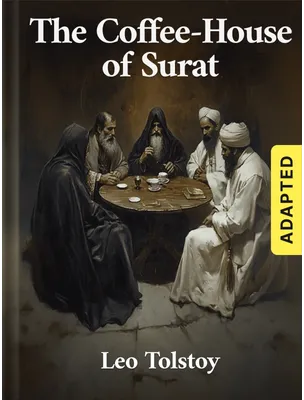
The Coffee-House of Surat
[adapted]
by
Leo Tolstoy

(After Bernardin de Saint-Pierre)
In the town of Surat, in India, there was a coffee shop where many travellers and people from other countries from all parts of the world met and talked.
One day a wise Persian religious teacher visited this coffee-house. He was a man who had spent his life studying what God is like, and reading and writing books on the subject. He had thought, read, and written so much about God, that in the end he lost his mind, became very confused, and even stopped believing that a God existed. The Shah, hearing of this, had sent him away from Persia.
After arguing all his life about the First Cause, this unlucky religious thinker had ended up by confusing himself very much, and instead of understanding that he had lost his mind, he began to think that there was no higher power controlling the universe.
This man had an African slave who followed him everywhere. When the religious teacher went into the coffee-house, the slave stayed outside, near the door, sitting on a stone in the bright sun, and shooing away the flies that were buzzing around him. The Persian, after he sat down on a couch in the coffee-house, ordered himself a cup of opium. When he had drunk it and the opium had begun to make his brain work faster, he spoke to his slave through the open door:
“Tell me, poor slave,” he said, “do you think there is a God, or not?”
“Of course there is,” said the slave, and at once pulled out from under his belt a small wooden idol.
“There,” he said, “that is the God who has protected me since the day I was born. Everyone in our country prays to the sacred tree, and this God was made from its wood.”
This conversation between the religious teacher and his slave was heard with surprise by the other guests in the coffee-house. They were very surprised at the owner’s question, and even more at the slave’s answer.
One of them, a Brahmin, when he heard the slave’s words, turned to him and said:
“You poor fool! Do you really believe that God can be carried under a man’s belt? There is one God — Brahma, and he is greater than the whole world, for he created it. Brahma is the One, the great God, and in his honor temples are built on the banks of the Ganges, where his true priests, the Brahmins, worship him. They know the true God, and no one else. Twenty thousand years have passed, and yet, through revolution after revolution, these priests have kept their power, because Brahma, the one true God, has protected them.”
So spoke the Brahmin, hoping to convince everyone; but a Jewish trader who was present answered him, and said:
“No! the temple of the true God is not in India. God does not protect the Brahmin caste either. The true God is not the God of the Brahmins, but of Abraham, Isaac, and Jacob. He protects no one but His chosen people, the Israelites. From the beginning of the world, our nation has been loved by Him, and only ours. If we are now scattered all over the world, it is only to test us; for God has promised that He will one day bring His people together in Jerusalem. Then, with the Temple of Jerusalem — the wonder of the ancient world — brought back to its beauty, Israel will be made a ruler over all nations.”
So the Jew spoke, and started to cry. He wanted to say more, but an Italian religious teacher who was there stopped him.
“What you are saying is not true,” he said to the Jew. “You say that God is unfair. He cannot love your nation more than the others. No, rather, even if it is true that long ago He favored the Israelites, it is now nineteen hundred years since they made Him angry, and made Him destroy their nation and scatter them over the earth, so that their faith brings no new believers and has died out except in a few places. God prefers no nation, but calls all who want to be saved to the arms of the Catholic Church of Rome, the one outside which no salvation can be found.”
So said the Italian. But a Protestant minister, who was there, became pale, turned to the Catholic missionary and said loudly:
“How can you say that being saved is only for your religion? Only those will be saved, who serve God as the Gospel says, with their heart and with truth, as told by the words of Christ.”
Then a Turk, an official in the customs office at Surat, who was sitting in the coffee house smoking a pipe, turned with a proud look to both the Christians.
“Your belief in your Roman religion is useless,” said he. “It was replaced twelve hundred years ago by the true faith: that of Mohammed! You must see how the true Mohammed faith keeps spreading both in Europe and Asia, and even in the wise country of China. You yourselves say that God does not accept the Jews; and, as proof, you point to the fact that the Jews are looked down on and their faith does not spread. Admit then the truth of Islam, for it is winning and spreads far and wide. Only the followers of Mohammed, God’s last prophet, will be saved; and among them, only the followers of Omar, and not of Ali, because Ali’s followers are not true to the faith.”
To this the Persian religious teacher, who was of the group of Ali, wanted to answer; but by this time a big argument had started among all the strangers of different faiths and beliefs present. There were Abyssinian Christians, Llamas from Thibet, Ismailians and people who worship fire. They all argued about what God is like, and how He should be worshipped. Each of them said that only in his country was the true God known and worshipped in the right way.
Everyone argued and shouted, except a Chinese man, a student of Confucius, who sat quietly in one corner of the coffee house, not joining in the argument. He sat there drinking tea and listening to what the others said, but he did not speak.
The Turk noticed him sitting there, and spoke to him, saying:
“You can say my words are true, my good Chinese man. You say nothing, but if you spoke I know you would support my opinion. Traders from your country, who come to me for help, tell me that though many religions have been brought into China, you Chinese think Islam is the best of all, and accept it gladly. Then say my words are true, and tell us your opinion of the true God and of His prophet.”
“Yes, yes,” said the others, turning to the Chinese man, “let us hear what you think about it.”
The Chinese man, the student of Confucius, closed his eyes, and thought a while. Then he opened them again, and took his hands out of the wide sleeves of his robe, and folded them on his chest, he spoke like this, in a calm and quiet voice.
Sirs, I think that it is mainly pride that stops men from agreeing with one another about faith. If you want to listen to me, I will tell you a story that will explain this with an example.
I came here from China on an English ship that had been around the world. We stopped for fresh water, and landed on the east coast of the island of Sumatra. It was midday, and some of us, after we landed, sat in the shade of some coconut palm trees by the seashore, not far from a local village. We were a group of men from different countries.
As we sat there, a blind man came up to us. We learned later that he had become blind from looking at the sun for too long and without stopping, trying to find out what it is, to catch its light.
He tried a long time to do this, all the time looking at the sun; but the only result was that his eyes were hurt by its bright light, and he became blind.
Then he thought:
“The light of the sun is not a liquid; for if it were a liquid it could be poured from one container into another, and it would be moved, like water, by the wind. Neither is it fire; for if it were fire, water would put it out. Neither is light a spirit, for it is seen by the eye; nor is it a thing, for it cannot be moved. So, as the light of the sun is neither liquid, nor fire, nor spirit, nor a thing, it is — nothing!”
So he argued, and, because he always looked at the sun and always thought about it, he lost both his sight and his mind. And when he went quite blind, he became completely sure that the sun was not real.
With this blind man came a slave, who after putting his master in the shade of a coconut tree, picked up a coconut from the ground, and started to make it into a night light. He twisted a wick from the coconut fiber, squeezed oil from the nut in the shell, and wet the wick in it.
While the slave sat and did this, the blind man breathed out sadly and said to him:
“Well, slave, wasn’t I right when I told you there is no sun? Don’t you see how dark it is? Yet people say there is a sun… But if so, what is it?”
“I do not know what the sun is,” said the slave. “That is not my business. But I know what light is. Here I have made a night-light, with it I can serve you and find anything I want in the hut.”
And the slave picked up the coconut shell, saying:
“This is my sun.”
A man who could not walk well, with crutches, who was sitting nearby, heard these words, and laughed:
“You have clearly been blind all your life,” he said to the blind man, “not to know what the sun is. I will tell you what it is. The sun is a ball of fire, which comes up every morning out of the sea and goes down again behind the mountains of our island each evening. We have all seen this, and if you could see you would have seen it too.”
A fisherman, who was listening to the talk said:
“It is clear enough that you have never been outside your own island. If you were not lame, and if you had gone out as I have in a fishing boat, you would know that the sun does not go down among the mountains of our island, but as it rises from the ocean every morning, so it goes down again in the sea every night. What I am telling you is true, because I see it every day with my own eyes.”
Then an Indian who was in our group, stopped him and said:
“I am surprised that a sensible man would say such nonsense. How can a ball of fire possibly go down into the water and not be put out? The sun is not a ball of fire at all, it is the god named Deva, who rides forever in a chariot around the golden mountain, Meru. Sometimes the evil snakes Ragu and Ketu attack Deva and swallow him, and then the earth is dark. But our priests pray that the god may be freed, and then he is set free. Only such ignorant men as you, who have never been outside their own island, can think that the sun shines for their country alone.”
Then the captain of an Egyptian ship, who was present, spoke when it was his turn.
“No,” he said, “you are also wrong. The sun is not a god, and does not go only around India and its golden mountain. I have sailed a lot on the Black Sea, and along the shores of Arabia, and have been to Madagascar and to the Philippines. The sun shines on the whole earth, and not only India. It does not go around one mountain, but rises far in the east, beyond the islands of Japan, and goes down far, far away in the west, beyond the islands of England. That is why the Japanese call their country ‘Nippon,’ which means ‘the rising of the sun.’ I know this well, because I myself have seen a lot, and heard more from my grandfather, who sailed to the very ends of the sea.”
He was going to keep talking, but an English sailor from our ship stopped him.
“There is no country,” he said “where people know so much about how the sun moves as in England. The sun, as everyone in England knows, rises nowhere and sets nowhere. It is always moving around the earth. We are sure about this because we have just gone around the world ourselves, and we never ran into the sun anywhere. Wherever we went, the sun came out in the morning and hid at night, just as it does here.”
And the Englishman took a stick and, drawing circles on the sand, tried to explain how the sun moves in the sky and goes round the world. But he could not explain it clearly, and pointing to the ship’s pilot said:
“This man knows more about it than I do. He can explain it properly.”
The pilot, who was a clever man, had listened without speaking to the talk until he was asked to speak. Now everyone turned to him, and he said:
“You are all misleading each other, and you are also mistaken. The sun does not go round the earth, but the earth goes round the sun, spinning as it goes, and turning toward the sun every twenty-four hours, not only Japan, and the Philippines, and Sumatra where we now are, but Africa, and Europe, and America, and many other lands too. The sun does not shine for just one mountain, or for just one island, or for just one sea, nor even for only one earth, but for other planets as well as our earth. If you would only look up at the sky, instead of at the ground under your own feet, you might all understand this, and would then no longer think that the sun shines for you, or only for your country.”
So said the wise pilot, who had traveled a lot around the world, and had looked a lot at the sky above.
“So about faith,” continued the Chinese man, the student of Confucius, “it is pride that causes mistakes and quarrels among people. It is the same with God as with the sun. Each man wants to have a special God of his own, or at least a special God for his own country. Each nation wants to keep in its own temples Him whom the world cannot hold.
“Can any temple compare with the one that God Himself has built to bring together all people in one faith and one religion?”