'The Black Cat' was first published in 1843.
[{"id":"para_1","index":0,"start":0,"offset":342,"words":3,"paraNum":"","lastModified":1757992189000,"semanticType":"title-book-title","voicework":"tts","blockId":"the_black_cat_short_story_ffa_1_en-bl2s","language":"en","wordsRange":{"start":100000000,"end":104000000},"paragraphVersion":24,"direction":"ltr","paragraph":"<h1 class=\"ilm-title ilm-x-large\" id=\"para_1\" semantictype=\"title-book-title\" data-ilmid=\"the_black_cat_short_story_ffa_1_en-bl2s\" data-audio=\"1\" data-chapter=\"para_1\" data-words-count=\"3\" data-before=\"0\" data-ww=\"\"><span class=\"block-pb\"> <span class=\"block-pb is-animated\"></span> </span><span class=\"itm-wrap\">The Black Cat<br></span></h1>","hasContent":true,"isFirst":true,"isLast":false},{"id":"para_2","index":1,"start":342,"offset":333,"words":1,"paraNum":"","lastModified":1758010276000,"semanticType":"title-subtitle","voicework":"tts","blockId":"the_black_cat_short_story_ffa_1_en-bl3t","language":"en","wordsRange":{"start":137333333,"end":170666667},"paragraphVersion":34,"direction":"ltr","paragraph":"<h1 class=\"ilm-title ilm-subtitle\" id=\"para_2\" semantictype=\"title-subtitle\" data-ilmid=\"the_black_cat_short_story_ffa_1_en-bl3t\" data-audio=\"1\" data-chapter=\"para_2\" data-words-count=\"1\" data-before=\"3\" data-ww=\"\"><span class=\"block-pb\"> <span class=\"block-pb is-animated\"></span> </span><span class=\"itm-wrap\">[adapted]</span></h1>","hasContent":true,"isFirst":false,"isLast":false},{"id":"para_3","index":2,"start":675,"offset":366,"words":3,"paraNum":"","lastModified":1758006166000,"semanticType":"title-author","voicework":"tts","blockId":"the_black_cat_short_story_ffa_1_en-bl3n","language":"en","wordsRange":{"start":204000000,"end":208000000},"paragraphVersion":35,"direction":"ltr","paragraph":"<h1 class=\"ilm-title ilm-author ilm-large ilm-nopad\" id=\"para_3\" semantictype=\"title-author\" data-ilmid=\"the_black_cat_short_story_ffa_1_en-bl3n\" data-audio=\"1\" data-chapter=\"para_3\" data-words-count=\"3\" data-before=\"4\" data-ww=\"\"><span class=\"block-pb\"> <span class=\"block-pb is-animated\"></span> </span><span class=\"itm-wrap\">by <br>Edgar Allan Poe<br></span></h1>","hasContent":true,"isFirst":false,"isLast":false},{"id":"para_4","index":3,"start":1041,"offset":162,"words":0,"paraNum":"","lastModified":1664040936000,"semanticType":"line","blockId":"the_black_cat_short_story_ffa_1_en-bl3o","language":"en","wordsRange":{"start":308000000,"end":408000000},"paragraphVersion":10,"direction":"ltr","paragraph":"<hr class=\"ilm-hr ilm-small\" id=\"para_4\" semantictype=\"line\" data-ilmid=\"the_black_cat_short_story_ffa_1_en-bl3o\" data-words-count=\"0\" data-before=\"7\" data-ww=\"\">","hasContent":true,"isFirst":false,"isLast":false},{"id":"para_5","index":4,"start":1203,"offset":1984,"words":0,"paraNum":"","lastModified":1665067592000,"semanticType":"illustration","blockId":"the_black_cat_short_story_ffa_1_en-bl3p","language":"en","wordsRange":{"start":508000000,"end":608000000},"paragraphVersion":10,"direction":"ltr","paragraph":"<div class=\"ilm-illustration\" id=\"para_5\" semantictype=\"illustration\" data-ilmid=\"the_black_cat_short_story_ffa_1_en-bl3p\" data-words-count=\"0\" data-before=\"7\" data-ww=\"\"><img width=\"422\" height=\"600\" data-src=\"ch0p0\" src=\"data:image/webp;base64,UklGRvIEAABXRUJQVlA4IOYEAACQFQCdASoqADwAPm0qkkakIiGhKrv8AIANiWIArDKvP/SWbP1/w1tu/0MbaHnkdNi3pf/fWjlt9xQcqvrvNGwBz1vznlx3w7Vnfk7KQAG6V9a9ce8S9gD9H+h/n3+nvYH6YIbUe2ulfmMHew/pCl3f6QRxeteJN34GNukfvCC34wiNyT9JEl8Ykz6g1FTIA/eJrvrPv//393nQHRAYZgkzNxCX5bzs33Amf6CLbyXkwUsKuWQoAP7s3+Pdh/viThDACC8PyGrgO7O7vqtJYDngBKOZhqT8As4Cd1ZuCIQSIliHIoHu9XvtCmW1sg5a8/NUz2Mlr/n2LxtqyJXR+Q5DPPp5tGQFOf9kXzmyhi4L78WOw2MTS0MD5n3aMjP7MkCLXVmgS2YsAvJRTutr5APl+pVpbjYd2ukIrrcr94qpJaGS+m9lJbeit4ndsvdI7Bv/ecmNiSgbuMy1/pDiohORKvU5J4dxU2yRWr3a0cgHe+U4Gy7iImRb8LVEXm82laTOODyG1O9nTdg+TvBizNwRIF7joLZnyFFDd4IyeCdmebaezJzcILGKIYSGtGkkjoZ/PadcUf0b97SZhg5rpcgos7LDyFL3rEJcEta2IEv4rEVOcaPZ4Eaq007z/j4p7s/GmgYOjQDsOA/xbRBZ7+Jd9KqjFxlaaw/JcaBHP8HEYC9ixYIJYpdYd4yE93qV4+T+yMKp3f7AGl9EzMPtO1UbenO+JYHv4udtKtQ3yfL/pig+Y6ipCzsBzqzyMK25bPxmaGhoR7UmzWqBXJmnE7g40qsIcvHbQKv569ua/XCgr/DImOcJKuPmlZwf39ozyYtML5Z4+wNEWpKx6POLOQ6M/ZNHuvET/E9NeDui356htLlx/sppLylH3+1hWcssvH8539/zbybm9q4MoemEsdwfgcWoMm0XYu3xyyQtgo0oGtqADRKphOMs44tOkO2drETrA+dS3WhxbdA5+Rz81+TWMJ339wAp7rc+LRz8f3k4wnSfbEaUqusTrYtdDPsphBe0uI55bXNvWl3Wk/rNyRKfDBVb16dJ1ImscCZZ22t+t13ejiq62Tt0Pta07Fn6x/Qns76q3DdqaiiQPh7XHdtdZPgPd129PGOe2CNAKJNPrT80EzEC560zrar85bG2TgWJGktJOqBmy+bQj26le6JOazf38n5ed8PKGaQEbA3Yfh8gV4RwtRvXWP5SQs600v4IV9rM0+KpQ74E6pKS/Fb926rSB845mvTmluYUQEk7gvKKhn/KO+m6GJt1mThVmrtRK3BbudDK+7oQeD7zHmubiLQzTcT+8WEMdCaeL58xnztkqoTUR/1sJgBFMx9YddUGBpJnCD/ZTWo4a9QTuFKyG8zsP1F2IEedVL+1GFW/3hPkZefODNv9kRCSqQvlfia4vQRI5AUKHbMy4bxCuSHOH5tBl5XjzvfgouOaS+GSDHr6Zuo3SM1/ltpqi5Rozi9tYfhq1bXKTr4CyrhAn07tTOAaxcdx8wnTYJxmFs8XlRTqz6tbEyoqHXfalVOYP3uwpgT7xNYxHI0X6QK22VD59vucu3h6O9B9ImrJFllFeZSNOzxvmgg5kYllbzfvvbVAcNawrwNngLU0DM1soISq57VN/oP5m5NaKXvGnf87vRiYAEKKda3lbXecYSk1tRganfqAAAA=\" alt=\"The Black Cat (adapted)\"></div>","hasContent":true,"isFirst":false,"isLast":false},{"id":"para_6","index":5,"start":3187,"offset":1213,"words":171,"paraNum":"1","lastModified":1758006539000,"semanticType":"par","voicework":"tts","blockId":"the_black_cat_short_story_ffa_1_en-bl2t","language":"en","wordsRange":{"start":708000000,"end":878000000},"paragraphVersion":37,"direction":"ltr","paragraph":"<p id=\"para_6\" semantictype=\"par\" data-ilmid=\"the_black_cat_short_story_ffa_1_en-bl2t\" data-audio=\"1\" data-words-count=\"171\" data-before=\"7\" data-ww=\"\"><span class=\"block-num\" data-id=\"1\"></span><span class=\"block-pb\"> <span class=\"block-pb is-animated\"></span> </span><span class=\"itm-wrap\">For the most wild, yet most plain story which I am about to write, I neither expect nor ask for belief. I would be truly mad to expect it, in a case where my own senses refuse their own proof. Yet, I am not mad — and surely I do not dream. But tomorrow I die, and today I would unburden my soul. My aim now is to put before the world, plainly, briefly, and without comment, a set of simple household events. In their results, these events have terrified — have tortured — have destroyed me. Yet I will not try to explain them. To me, they have shown little but horror — to many they will seem less terrible than strange things. Later, maybe, some mind may be found which will make my dream seem common — some mind more calm, more reasonable, and far less easy to excite than my own, which will see, in the things I tell with fear, nothing more than an ordinary set of very natural causes and effects.</span></p>","hasContent":true,"isFirst":false,"isLast":false},{"id":"para_7","index":6,"start":4400,"offset":1063,"words":153,"paraNum":"2","lastModified":1758006539000,"semanticType":"par","voicework":"tts","blockId":"the_black_cat_short_story_ffa_1_en-bl2u","language":"en","wordsRange":{"start":978000000,"end":1138000000},"paragraphVersion":30,"direction":"ltr","paragraph":"<p id=\"para_7\" semantictype=\"par\" data-ilmid=\"the_black_cat_short_story_ffa_1_en-bl2u\" data-audio=\"1\" data-words-count=\"153\" data-before=\"178\" data-ww=\"\"><span class=\"block-num\" data-id=\"2\"></span><span class=\"block-pb\"> <span class=\"block-pb is-animated\"></span> </span><span class=\"itm-wrap\">From my early childhood I was known for the gentleness and kindness of my nature. My kind heart was even so obvious as to make me the joke of my friends. I was especially fond of animals, and was allowed by my parents to have many kinds of pets. With these I spent most of my time, and never was so happy as when feeding and petting them. This special part of my character grew as I grew, and as a man, I got from it one of my main joys. To those who have loved a faithful and wise dog, I hardly need to explain the kind or the strength of the pleasure that comes from it. There is something in the unselfish and giving love of an animal, which goes straight to the heart of someone who has often had to test the poor friendship and weak loyalty of mere Man.</span></p>","hasContent":true,"isFirst":false,"isLast":false},{"id":"para_8","index":7,"start":5463,"offset":528,"words":45,"paraNum":"3","lastModified":1758006539000,"semanticType":"par","voicework":"tts","blockId":"the_black_cat_short_story_ffa_1_en-bl2v","language":"en","wordsRange":{"start":1238000000,"end":1289000000},"paragraphVersion":25,"direction":"ltr","paragraph":"<p id=\"para_8\" semantictype=\"par\" data-ilmid=\"the_black_cat_short_story_ffa_1_en-bl2v\" data-audio=\"1\" data-words-count=\"45\" data-before=\"331\" data-ww=\"\"><span class=\"block-num\" data-id=\"3\"></span><span class=\"block-pb\"> <span class=\"block-pb is-animated\"></span> </span><span class=\"itm-wrap\">I married early, and was happy to find that my wife had a nature like mine. Seeing that I liked pets, she never missed a chance to get the nicest ones. We had birds, gold-fish, a fine dog, rabbits, a small monkey, and a cat.</span></p>","hasContent":true,"isFirst":false,"isLast":false},{"id":"para_9","index":8,"start":5991,"offset":681,"words":67,"paraNum":"4","lastModified":1758006539000,"semanticType":"par","voicework":"tts","blockId":"the_black_cat_short_story_ffa_1_en-bl2w","language":"en","wordsRange":{"start":1389000000,"end":1470000000},"paragraphVersion":25,"direction":"ltr","paragraph":"<p id=\"para_9\" semantictype=\"par\" data-ilmid=\"the_black_cat_short_story_ffa_1_en-bl2w\" data-audio=\"1\" data-words-count=\"67\" data-before=\"376\" data-ww=\"\"><span class=\"block-num\" data-id=\"4\"></span><span class=\"block-pb\"> <span class=\"block-pb is-animated\"></span> </span><span class=\"itm-wrap\">This one was a very large and beautiful animal, completely black, and very clever. When talking about how smart he was, my wife, who in her heart was a little superstitious, often mentioned the old common belief that said all black cats were witches in disguise. Not that she was ever serious about this — and I mention it only because it happens, just now, to be remembered.</span></p>","hasContent":true,"isFirst":false,"isLast":false},{"id":"para_10","index":9,"start":6672,"offset":525,"words":44,"paraNum":"5","lastModified":1758006595000,"semanticType":"par","voicework":"tts","blockId":"the_black_cat_short_story_ffa_1_en-bl2x","language":"en","wordsRange":{"start":1570000000,"end":1613000000},"paragraphVersion":36,"direction":"ltr","paragraph":"<p id=\"para_10\" semantictype=\"par\" data-ilmid=\"the_black_cat_short_story_ffa_1_en-bl2x\" data-audio=\"1\" data-words-count=\"44\" data-before=\"443\" data-ww=\"\"><span class=\"block-num\" data-id=\"5\"></span><span class=\"block-pb\"> <span class=\"block-pb is-animated\"></span> </span><span class=\"itm-wrap\">Pluto — this was the cat’s name — was my favorite pet and friend to play with. I alone fed him, and he followed me wherever I went in the house. It was even hard for me to stop him from following me in the streets.</span></p>","hasContent":true,"isFirst":false,"isLast":false},{"id":"para_11","index":10,"start":7197,"offset":1235,"words":173,"paraNum":"6","lastModified":1758006539000,"semanticType":"par","voicework":"tts","blockId":"the_black_cat_short_story_ffa_1_en-bl2y","language":"en","wordsRange":{"start":1713000000,"end":1881000000},"paragraphVersion":25,"direction":"ltr","paragraph":"<p id=\"para_11\" semantictype=\"par\" data-ilmid=\"the_black_cat_short_story_ffa_1_en-bl2y\" data-audio=\"1\" data-words-count=\"173\" data-before=\"487\" data-ww=\"\"><span class=\"block-num\" data-id=\"6\"></span><span class=\"block-pb\"> <span class=\"block-pb is-animated\"></span> </span><span class=\"itm-wrap\">Our friendship lasted, like this, for several years, during which my general temper and character — because of the demon of drinking — had (I am ashamed to say it) changed a lot for the worse. I became, day by day, more often in a bad mood, more easily angry, more careless of the feelings of others. I let myself use bad language to my wife. At last, I even used violence against her. My pets, of course, were made to feel the change in my mood. I not only neglected them, but also treated them badly. For Pluto, however, I still kept enough care to stop me from treating him badly, as I had no problem treating badly the rabbits, the monkey, or even the dog, when by accident, or because of love, they came near me. But my sickness grew on me — for what sickness is like Alcohol! — and at last even Pluto, who was now becoming old, and so somewhat bad-tempered — even Pluto began to feel the effects of my bad temper.</span></p>","hasContent":true,"isFirst":false,"isLast":false},{"id":"para_12","index":11,"start":8432,"offset":922,"words":129,"paraNum":"7","lastModified":1758006539000,"semanticType":"par","voicework":"tts","blockId":"the_black_cat_short_story_ffa_1_en-bl2z","language":"en","wordsRange":{"start":1981000000,"end":2101000000},"paragraphVersion":25,"direction":"ltr","paragraph":"<p id=\"para_12\" semantictype=\"par\" data-ilmid=\"the_black_cat_short_story_ffa_1_en-bl2z\" data-audio=\"1\" data-words-count=\"129\" data-before=\"660\" data-ww=\"\"><span class=\"block-num\" data-id=\"7\"></span><span class=\"block-pb\"> <span class=\"block-pb is-animated\"></span> </span><span class=\"itm-wrap\">One night, going home, very drunk, from one of my usual places in town, I thought that the cat stayed away from me. I grabbed him; when, in his fear because of my rough act, he made a small wound on my hand with his teeth. The anger of a demon took over me at once. I did not know myself any more. My true soul seemed, at once, to leave my body and a more than devilish evil, fed by gin, filled every part of my body. I took from my vest pocket a penknife, opened it, held the poor animal by the throat, and on purpose cut one of its eyes out of the socket! I blush, I burn, I shiver, while I write this awful crime.</span></p>","hasContent":true,"isFirst":false,"isLast":false},{"id":"para_13","index":12,"start":9354,"offset":639,"words":65,"paraNum":"8","lastModified":1758006539000,"semanticType":"par","voicework":"tts","blockId":"the_black_cat_short_story_ffa_1_en-bl30","language":"en","wordsRange":{"start":2201000000,"end":2268000000},"paragraphVersion":28,"direction":"ltr","paragraph":"<p id=\"para_13\" semantictype=\"par\" data-ilmid=\"the_black_cat_short_story_ffa_1_en-bl30\" data-audio=\"1\" data-words-count=\"65\" data-before=\"789\" data-ww=\"\"><span class=\"block-num\" data-id=\"8\"></span><span class=\"block-pb\"> <span class=\"block-pb is-animated\"></span> </span><span class=\"itm-wrap\">When clear reason returned with the morning — when I had slept off the effects of the night’s wild drinking — I felt a feeling half horror, half regret, for the crime I had done; but it was, at best, a weak and unsure feeling, and the soul stayed the same. I again went too far, and soon I drowned in wine all memory of the act.</span></p>","hasContent":true,"isFirst":false,"isLast":false},{"id":"para_14","index":13,"start":9993,"offset":1305,"words":195,"paraNum":"9","lastModified":1758006539000,"semanticType":"par","voicework":"tts","blockId":"the_black_cat_short_story_ffa_1_en-bl31","language":"en","wordsRange":{"start":2368000000,"end":2571333333},"paragraphVersion":32,"direction":"ltr","paragraph":"<p id=\"para_14\" semantictype=\"par\" data-ilmid=\"the_black_cat_short_story_ffa_1_en-bl31\" data-audio=\"1\" data-words-count=\"195\" data-before=\"854\" data-ww=\"\"><span class=\"block-num\" data-id=\"9\"></span><span class=\"block-pb\"> <span class=\"block-pb is-animated\"></span> </span><span class=\"itm-wrap\">Meanwhile the cat slowly recovered. The hole where the lost eye had been looked, it is true, very scary, but he no longer seemed to feel any pain. He went about the house as usual, but, as you might expect, ran away in great fear when I came near. I had so much of my old heart left that I was at first sad about this clear dislike from a creature that had once so loved me. But this feeling soon changed to anger. And then came, as if to my final and unchangeable ruin, the spirit of <i>Perverseness.</i> Philosophy does not think about this spirit. Yet I am just as sure that my soul lives, as I am that perverseness is one of the basic urges of the human heart — one of the simple, first abilities, or feelings, which guide the character of Man. Who has not, a hundred times, found himself doing a bad or a silly act, for no other reason than because he knows he should not? Do we not have a constant desire, against our best judgment, to break that which is Law, only because we know it is so.</span></p>","hasContent":true,"isFirst":false,"isLast":false},{"id":"para_15","index":14,"start":11298,"offset":1152,"words":167,"paraNum":"10","lastModified":1758006539000,"semanticType":"par","voicework":"tts","blockId":"the_black_cat_short_story_ffa_1_en-bl3s","language":"en","wordsRange":{"start":2571666667,"end":2737000000},"paragraphVersion":27,"direction":"ltr","paragraph":"<p id=\"para_15\" semantictype=\"par\" data-ilmid=\"the_black_cat_short_story_ffa_1_en-bl3s\" data-audio=\"1\" data-words-count=\"167\" data-before=\"1049\" data-ww=\"\"><span class=\"block-num\" data-id=\"10\"></span><span class=\"block-pb\"> <span class=\"block-pb is-animated\"></span> </span><span class=\"itm-wrap\">This feeling of doing wrong, I say, brought me to my final ruin. It was this deep wish of the soul to hurt itself — to go against its own nature — to do wrong only because it is wrong — that pushed me to continue and finally to complete the harm I had done to the harmless animal. One morning, calmly, I put a noose around its neck and hung it on the branch of a tree; — hung it with the tears running from my eyes, and with the deepest regret at my heart; — hung it <i>because</i> I knew that it had loved me, and because I felt it had given me no reason to be angry; — hung it because I knew that in so doing I was doing a sin — a deadly sin that would so endanger my soul that never dies as to place it — if such a thing were possible — even beyond the reach of the endless mercy of the Most Merciful and Most Terrible God.</span></p>","hasContent":true,"isFirst":false,"isLast":false},{"id":"para_16","index":15,"start":12450,"offset":646,"words":70,"paraNum":"11","lastModified":1758006539000,"semanticType":"par","voicework":"tts","blockId":"the_black_cat_short_story_ffa_1_en-bl32","language":"en","wordsRange":{"start":2837000000,"end":2910000000},"paragraphVersion":31,"direction":"ltr","paragraph":"<p id=\"para_16\" semantictype=\"par\" data-ilmid=\"the_black_cat_short_story_ffa_1_en-bl32\" data-audio=\"1\" data-words-count=\"70\" data-before=\"1216\" data-ww=\"\"><span class=\"block-num\" data-id=\"11\"></span><span class=\"block-pb\"> <span class=\"block-pb is-animated\"></span> </span><span class=\"itm-wrap\">On the night of the day when this cruel act was done, I was woken from sleep by the shout of “Fire!” The curtains of my bed were in flames. The whole house was on fire. It was very hard for my wife, a servant, and me to escape from the fire. Everything was destroyed. All the things I owned were gone, and I lost all hope from then on.</span></p>","hasContent":true,"isFirst":false,"isLast":false},{"id":"para_17","index":16,"start":13096,"offset":1269,"words":183,"paraNum":"12","lastModified":1758006539000,"semanticType":"par","voicework":"tts","blockId":"the_black_cat_short_story_ffa_1_en-bl33","language":"en","wordsRange":{"start":3010000000,"end":3195000000},"paragraphVersion":30,"direction":"ltr","paragraph":"<p id=\"para_17\" semantictype=\"par\" data-ilmid=\"the_black_cat_short_story_ffa_1_en-bl33\" data-audio=\"1\" data-words-count=\"183\" data-before=\"1286\" data-ww=\"\"><span class=\"block-num\" data-id=\"12\"></span><span class=\"block-pb\"> <span class=\"block-pb is-animated\"></span> </span><span class=\"itm-wrap\">I am not so weak as to try to make a chain of cause and effect between the disaster and the terrible act. But I am telling a chain of facts — and I do not want to leave even a possible link not complete. On the day after the fire, I visited the ruins. The walls, except one, had fallen in. This one was an inside wall, not very thick, which stood about the middle of the house, and the head of my bed had rested against it. Here, the plaster had, in large part, resisted the fire — a fact which I thought was because it had been put on recently. Around this wall a thick crowd had gathered, and many people seemed to be looking at a particular part of it with very careful and eager attention. The words “strange!” “odd!” and other similar words, made me curious. I approached and saw, as if carved on the white surface, the figure of a huge <i>cat.</i> The mark was made with an accuracy truly wonderful. There was a rope about the animal’s neck.</span></p>","hasContent":true,"isFirst":false,"isLast":false},{"id":"para_18","index":17,"start":14365,"offset":1020,"words":138,"paraNum":"13","lastModified":1758006539000,"semanticType":"par","voicework":"tts","blockId":"the_black_cat_short_story_ffa_1_en-bl34","language":"en","wordsRange":{"start":3295000000,"end":3430000000},"paragraphVersion":30,"direction":"ltr","paragraph":"<p id=\"para_18\" semantictype=\"par\" data-ilmid=\"the_black_cat_short_story_ffa_1_en-bl34\" data-audio=\"1\" data-words-count=\"138\" data-before=\"1469\" data-ww=\"\"><span class=\"block-num\" data-id=\"13\"></span><span class=\"block-pb\"> <span class=\"block-pb is-animated\"></span> </span><span class=\"itm-wrap\">When I first saw this ghost — for I could hardly think it was anything else — my surprise and my fear were very great. But at last thinking came to help me. The cat, I remembered, had been hung in a garden next to the house. When the alarm of fire rang, this garden had been at once filled by the crowd — by someone among them the animal must have been cut down from the tree and thrown, through an open window, into my room. This had probably been done to wake me from sleep. The falling of other walls had pressed the victim of my cruel act into the material of the freshly spread plaster; the lime in it, with the flames, and the <i>ammonia</i> from the dead body, had then made the picture as I saw it.</span></p>","hasContent":true,"isFirst":false,"isLast":false},{"id":"para_19","index":18,"start":15385,"offset":850,"words":105,"paraNum":"14","lastModified":1758006539000,"semanticType":"par","voicework":"tts","blockId":"the_black_cat_short_story_ffa_1_en-bl35","language":"en","wordsRange":{"start":3530000000,"end":3640000000},"paragraphVersion":27,"direction":"ltr","paragraph":"<p id=\"para_19\" semantictype=\"par\" data-ilmid=\"the_black_cat_short_story_ffa_1_en-bl35\" data-audio=\"1\" data-words-count=\"105\" data-before=\"1607\" data-ww=\"\"><span class=\"block-num\" data-id=\"14\"></span><span class=\"block-pb\"> <span class=\"block-pb is-animated\"></span> </span><span class=\"itm-wrap\">Although I could easily explain to my reason, if not completely to my feelings, the shocking fact just described, it still made a deep impression on my imagination. For months I could not get rid of the vision of the cat; and, during this time, there came back into my heart a half-feeling that seemed, but was not, real regret. I went so far as to be sorry for the loss of the animal, and to look around me, in the dirty places which I now often visited, for another pet of the same kind, and with a somewhat similar look, to take its place.</span></p>","hasContent":true,"isFirst":false,"isLast":false},{"id":"para_20","index":19,"start":16235,"offset":1310,"words":199,"paraNum":"15","lastModified":1758006539000,"semanticType":"par","voicework":"tts","blockId":"the_black_cat_short_story_ffa_1_en-bl36","language":"en","wordsRange":{"start":3740000000,"end":3940000000},"paragraphVersion":27,"direction":"ltr","paragraph":"<p id=\"para_20\" semantictype=\"par\" data-ilmid=\"the_black_cat_short_story_ffa_1_en-bl36\" data-audio=\"1\" data-words-count=\"199\" data-before=\"1712\" data-ww=\"\"><span class=\"block-num\" data-id=\"15\"></span><span class=\"block-pb\"> <span class=\"block-pb is-animated\"></span> </span><span class=\"itm-wrap\">One night as I sat, half dazed, in a place of great shame, I suddenly noticed a black object, resting on top of one of the huge barrels of gin, or of rum, which were the main furniture of the room. I had been looking without stopping at the top of this barrel for some minutes, and what now surprised me was that I had not noticed the object there sooner. I approached it, and touched it with my hand. It was a black cat — a very large one — just as big as Pluto, and very much like him in every way but one. Pluto did not have a white hair on any part of his body; but this cat had a large, although not clear in shape, spot of white, covering nearly the whole area of the chest. When I touched him, he right away got up, purred loudly, rubbed against my hand, and seemed very happy that I noticed him. This, then, was the very creature I was looking for. I right away offered to buy it from the landlord; but this person said it was not his — knew nothing about it — had never seen it before.</span></p>","hasContent":true,"isFirst":false,"isLast":false},{"id":"para_21","index":20,"start":17545,"offset":583,"words":58,"paraNum":"16","lastModified":1758006539000,"semanticType":"par","voicework":"tts","blockId":"the_black_cat_short_story_ffa_1_en-bl37","language":"en","wordsRange":{"start":4040000000,"end":4093000000},"paragraphVersion":27,"direction":"ltr","paragraph":"<p id=\"para_21\" semantictype=\"par\" data-ilmid=\"the_black_cat_short_story_ffa_1_en-bl37\" data-audio=\"1\" data-words-count=\"58\" data-before=\"1911\" data-ww=\"\"><span class=\"block-num\" data-id=\"16\"></span><span class=\"block-pb\"> <span class=\"block-pb is-animated\"></span> </span><span class=\"itm-wrap\">I kept petting it, and, when I got ready to go home, the animal showed that it wanted to come with me. I let it do so; sometimes bending down and patting it as I went. When it reached the house it made itself at home at once, and right away became a big favorite with my wife.</span></p>","hasContent":true,"isFirst":false,"isLast":false},{"id":"para_22","index":21,"start":18128,"offset":931,"words":120,"paraNum":"17","lastModified":1758006539000,"semanticType":"par","voicework":"tts","blockId":"the_black_cat_short_story_ffa_1_en-bl38","language":"en","wordsRange":{"start":4193000000,"end":4316000000},"paragraphVersion":27,"direction":"ltr","paragraph":"<p id=\"para_22\" semantictype=\"par\" data-ilmid=\"the_black_cat_short_story_ffa_1_en-bl38\" data-audio=\"1\" data-words-count=\"120\" data-before=\"1969\" data-ww=\"\"><span class=\"block-num\" data-id=\"17\"></span><span class=\"block-pb\"> <span class=\"block-pb is-animated\"></span> </span><span class=\"itm-wrap\">For my part, I soon felt a dislike for it growing inside me. This was the opposite of what I had expected; but — I do not know how or why — its clear liking for me instead made me feel sick and annoyed. Slowly, these feelings of strong dislike and annoyance grew into strong hate. I avoided the animal; a feeling of shame, and the memory of my earlier cruel act, stopped me from hurting it. I did not, for some weeks, hit it, or hurt it in any other violent way; but slowly — very slowly — I began to look at it with terrible hate, and to run away quietly from its hateful presence, as from the breath of a disease.</span></p>","hasContent":true,"isFirst":false,"isLast":false},{"id":"para_23","index":22,"start":19059,"offset":676,"words":73,"paraNum":"18","lastModified":1758006539000,"semanticType":"par","voicework":"tts","blockId":"the_black_cat_short_story_ffa_1_en-bl39","language":"en","wordsRange":{"start":4416000000,"end":4493000000},"paragraphVersion":27,"direction":"ltr","paragraph":"<p id=\"para_23\" semantictype=\"par\" data-ilmid=\"the_black_cat_short_story_ffa_1_en-bl39\" data-audio=\"1\" data-words-count=\"73\" data-before=\"2089\" data-ww=\"\"><span class=\"block-num\" data-id=\"18\"></span><span class=\"block-pb\"> <span class=\"block-pb is-animated\"></span> </span><span class=\"itm-wrap\">What added, no doubt, to my hate of the animal, was the finding, on the morning after I brought it home, that, like Pluto, it also had lost one of its eyes. This fact, however, only made my wife love it more, who, as I have already said, had, very much, that kindness of feeling which had once been my main quality, and the reason for many of my simplest and best joys.</span></p>","hasContent":true,"isFirst":false,"isLast":false},{"id":"para_24","index":23,"start":19735,"offset":944,"words":124,"paraNum":"19","lastModified":1758006539000,"semanticType":"par","voicework":"tts","blockId":"the_black_cat_short_story_ffa_1_en-bl3a","language":"en","wordsRange":{"start":4593000000,"end":4720000000},"paragraphVersion":27,"direction":"ltr","paragraph":"<p id=\"para_24\" semantictype=\"par\" data-ilmid=\"the_black_cat_short_story_ffa_1_en-bl3a\" data-audio=\"1\" data-words-count=\"124\" data-before=\"2162\" data-ww=\"\"><span class=\"block-num\" data-id=\"19\"></span><span class=\"block-pb\"> <span class=\"block-pb is-animated\"></span> </span><span class=\"itm-wrap\">With my dislike for this cat, however, its liking for me seemed to increase. It followed me with a persistence that would be hard for the reader to understand. Whenever I sat, it would sit under my chair, or jump onto my knees, covering me with its disgusting touches. If I got up to walk it would get between my feet and almost make me fall, or, hooking its long and sharp claws in my clothes, climb, in this way, to my chest. At such times, although I wanted to kill it with a hit, I still stopped myself from doing so, partly by the memory of my earlier crime, but mainly — let me say it at once — by complete fear of the animal.</span></p>","hasContent":true,"isFirst":false,"isLast":false},{"id":"para_25","index":24,"start":20679,"offset":1492,"words":222,"paraNum":"20","lastModified":1758006539000,"semanticType":"par","voicework":"tts","blockId":"the_black_cat_short_story_ffa_1_en-bl3b","language":"en","wordsRange":{"start":4820000000,"end":5037000000},"paragraphVersion":33,"direction":"ltr","paragraph":"<p id=\"para_25\" semantictype=\"par\" data-ilmid=\"the_black_cat_short_story_ffa_1_en-bl3b\" data-audio=\"1\" data-words-count=\"222\" data-before=\"2286\" data-ww=\"\"><span class=\"block-num\" data-id=\"20\"></span><span class=\"block-pb\"> <span class=\"block-pb is-animated\"></span> </span><span class=\"itm-wrap\">This fear was not exactly a fear of hurt to the body — and yet I do not know how else to describe it. I am almost ashamed to admit — yes, even in this prisoner’s cell, I am almost ashamed to admit — that the terror and horror the animal made me feel, had been made stronger by one of the smallest imaginary ideas it would be possible to think of. My wife had called my attention, more than once, to the look of the mark of white hair, which I have spoken about, and which was the only visible difference between the strange animal and the one I had killed. The reader will remember that this mark, although large, had been at first very unclear; but, by slow steps — steps nearly impossible to see, and which for a long time my reason tried to reject as only fancy — it had, at last, taken a very clear outline. It was now the picture of an object that I shiver to name — and for this, above all, I hated, and feared, and would have got rid of the monster if <i>I </i><i>had </i><i>dared</i> — it was now, I say, the image of a horrible — of an awful thing — of the <i>Gallows!— </i> oh, sad and terrible machine of Horror and of Crime — of Pain and of Death!</span></p>","hasContent":true,"isFirst":false,"isLast":false},{"id":"para_26","index":25,"start":22171,"offset":923,"words":119,"paraNum":"21","lastModified":1758006539000,"semanticType":"par","voicework":"tts","blockId":"the_black_cat_short_story_ffa_1_en-bl3c","language":"en","wordsRange":{"start":5137000000,"end":5253000000},"paragraphVersion":36,"direction":"ltr","paragraph":"<p id=\"para_26\" semantictype=\"par\" data-ilmid=\"the_black_cat_short_story_ffa_1_en-bl3c\" data-audio=\"1\" data-words-count=\"119\" data-before=\"2508\" data-ww=\"\"><span class=\"block-num\" data-id=\"21\"></span><span class=\"block-pb\"> <span class=\"block-pb is-animated\"></span> </span><span class=\"itm-wrap\">And now I was indeed more miserable than any human could be. And an animal — whose friend I had killed without respect — an animal to cause me — for <i>me,</i> a man, made in the image of the High God — so much pain I could not bear! Sadly! neither by day nor by night did I know the gift of rest any more! During the day the animal left me no moment alone, and at night I woke every hour from dreams of fear I could not speak of to find the hot breath of <i>the </i><i>thing</i> on my face, and its great weight — a living nightmare that I had no power to shake off — lying forever on my <i>heart!</i></span></p>","hasContent":true,"isFirst":false,"isLast":false},{"id":"para_27","index":26,"start":23094,"offset":749,"words":79,"paraNum":"22","lastModified":1758006539000,"semanticType":"par","voicework":"tts","blockId":"the_black_cat_short_story_ffa_1_en-bl3d","language":"en","wordsRange":{"start":5353000000,"end":5432000000},"paragraphVersion":27,"direction":"ltr","paragraph":"<p id=\"para_27\" semantictype=\"par\" data-ilmid=\"the_black_cat_short_story_ffa_1_en-bl3d\" data-audio=\"1\" data-words-count=\"79\" data-before=\"2627\" data-ww=\"\"><span class=\"block-num\" data-id=\"22\"></span><span class=\"block-pb\"> <span class=\"block-pb is-animated\"></span> </span><span class=\"itm-wrap\">Under the pressure of pains like these, the weak rest of the good in me gave in. Evil thoughts became my only close friends — the darkest and most evil of thoughts. The moodiness of my usual temper grew into hatred of all things and of all people; while, because of the sudden, often, and uncontrollable bursts of rage to which I now blindly gave myself, my uncomplaining wife, sadly, was the one who suffered most often and most patiently.</span></p>","hasContent":true,"isFirst":false,"isLast":false},{"id":"para_28","index":27,"start":23843,"offset":972,"words":132,"paraNum":"23","lastModified":1758006539000,"semanticType":"par","voicework":"tts","blockId":"the_black_cat_short_story_ffa_1_en-bl3e","language":"en","wordsRange":{"start":5532000000,"end":5655000000},"paragraphVersion":27,"direction":"ltr","paragraph":"<p id=\"para_28\" semantictype=\"par\" data-ilmid=\"the_black_cat_short_story_ffa_1_en-bl3e\" data-audio=\"1\" data-words-count=\"132\" data-before=\"2706\" data-ww=\"\"><span class=\"block-num\" data-id=\"23\"></span><span class=\"block-pb\"> <span class=\"block-pb is-animated\"></span> </span><span class=\"itm-wrap\">One day she went with me, on some household task, into the basement of the old building which our poverty forced us to live in. The cat followed me down the steep stairs, and, almost making me fall headfirst, made me crazy with anger. Lifting an axe, and forgetting, in my anger, the childish fear which had until then stopped my hand, I aimed a blow at the animal which, of course, would have killed it at once if it had come down as I wished. But this blow was stopped by the hand of my wife. Driven, by her stopping me, into a rage worse than a demon’s, I pulled my arm from her hold and buried the axe in her head. She fell dead on the spot, without a sound.</span></p>","hasContent":true,"isFirst":false,"isLast":false},{"id":"para_29","index":28,"start":24815,"offset":1108,"words":161,"paraNum":"24","lastModified":1758006539000,"semanticType":"par","voicework":"tts","blockId":"the_black_cat_short_story_ffa_1_en-bl3f","language":"en","wordsRange":{"start":5755000000,"end":5914000000},"paragraphVersion":27,"direction":"ltr","paragraph":"<p id=\"para_29\" semantictype=\"par\" data-ilmid=\"the_black_cat_short_story_ffa_1_en-bl3f\" data-audio=\"1\" data-words-count=\"161\" data-before=\"2838\" data-ww=\"\"><span class=\"block-num\" data-id=\"24\"></span><span class=\"block-pb\"> <span class=\"block-pb is-animated\"></span> </span><span class=\"itm-wrap\">After this horrible murder was done, I began at once, and very carefully, the task of hiding the body. I knew that I could not take it out of the house, either by day or by night, without the danger of being seen by the neighbors. Many plans came into my mind. At one time I thought of cutting the dead body into very small pieces, and burning them. At another time, I decided to dig a grave for it in the cellar floor. Again, I thought about throwing it into the well in the yard — about packing it in a box, as if it were goods, with the usual steps, and getting a delivery man to take it from the house. Finally I found what I thought was a much better plan than either of these. I decided to wall it up in the cellar — as the monks of the Middle Ages are said to have walled up their victims.</span></p>","hasContent":true,"isFirst":false,"isLast":false},{"id":"para_30","index":29,"start":25923,"offset":1522,"words":236,"paraNum":"25","lastModified":1758006539000,"semanticType":"par","voicework":"tts","blockId":"the_black_cat_short_story_ffa_1_en-bl3g","language":"en","wordsRange":{"start":6014000000,"end":6248000000},"paragraphVersion":27,"direction":"ltr","paragraph":"<p id=\"para_30\" semantictype=\"par\" data-ilmid=\"the_black_cat_short_story_ffa_1_en-bl3g\" data-audio=\"1\" data-words-count=\"236\" data-before=\"2999\" data-ww=\"\"><span class=\"block-num\" data-id=\"25\"></span><span class=\"block-pb\"> <span class=\"block-pb is-animated\"></span> </span><span class=\"itm-wrap\">For a purpose like this the cellar was very good. Its walls were built loosely, and had recently been covered everywhere with a rough plaster, which the wet air had kept from getting hard. Also, in one of the walls was a part that stuck out, caused by a fake chimney, or fireplace, that had been filled up, and made to look like the rest of the cellar. I had no doubt that I could easily move the bricks at this point, put the dead body inside, and wall the whole up as before, so that no one could see anything strange. And in this plan I was not wrong. With a crowbar I easily took out the bricks, and, having carefully put the body against the inner wall, I held it up in that position, while, with little effort, I put the whole wall back as it was before. After getting mortar, sand, and hair, with every possible care, I made a plaster that looked the same as the old, and with this I very carefully covered the new bricks. When I had finished, I felt sure that all was right. The wall did not show the smallest sign of having been moved. The trash on the floor was picked up with the greatest care. I looked around with pride, and said to myself: “Here at least, then, my work has not been for nothing.”</span></p>","hasContent":true,"isFirst":false,"isLast":false},{"id":"para_31","index":30,"start":27445,"offset":998,"words":138,"paraNum":"26","lastModified":1758006539000,"semanticType":"par","voicework":"tts","blockId":"the_black_cat_short_story_ffa_1_en-bl3h","language":"en","wordsRange":{"start":6348000000,"end":6489000000},"paragraphVersion":27,"direction":"ltr","paragraph":"<p id=\"para_31\" semantictype=\"par\" data-ilmid=\"the_black_cat_short_story_ffa_1_en-bl3h\" data-audio=\"1\" data-words-count=\"138\" data-before=\"3235\" data-ww=\"\"><span class=\"block-num\" data-id=\"26\"></span><span class=\"block-pb\"> <span class=\"block-pb is-animated\"></span> </span><span class=\"itm-wrap\">My next step was to look for the animal which had been the cause of so much misery; for I had, at last, firmly decided to kill it. If I had been able to meet it at that moment, there would have been no doubt about its fate; but it seemed that the clever animal had been scared by the strength of my earlier anger, and did not show itself while I was in this mood. It is impossible to describe, or to imagine, the deep, the joyful feeling of relief which the hated creature not being there caused in my heart. It did not appear during the night; and so for one night at least, since its coming into the house, I slept soundly and calmly; yes, slept even with the weight of murder on my soul!</span></p>","hasContent":true,"isFirst":false,"isLast":false},{"id":"para_32","index":31,"start":28443,"offset":762,"words":89,"paraNum":"27","lastModified":1758006539000,"semanticType":"par","voicework":"tts","blockId":"the_black_cat_short_story_ffa_1_en-bl3i","language":"en","wordsRange":{"start":6589000000,"end":6673000000},"paragraphVersion":27,"direction":"ltr","paragraph":"<p id=\"para_32\" semantictype=\"par\" data-ilmid=\"the_black_cat_short_story_ffa_1_en-bl3i\" data-audio=\"1\" data-words-count=\"89\" data-before=\"3373\" data-ww=\"\"><span class=\"block-num\" data-id=\"27\"></span><span class=\"block-pb\"> <span class=\"block-pb is-animated\"></span> </span><span class=\"itm-wrap\">The second and the third day passed, and still the one who hurt me did not come. Once again I breathed like a free man. The monster, in fear, had run away from the place forever! I would see it no more! My happiness was very great! The guilt from my bad act bothered me only a little. A few questions had been asked, but these had been easily answered. Even a search had been started — but of course nothing was found. I saw my future happiness as safe.</span></p>","hasContent":true,"isFirst":false,"isLast":false},{"id":"para_33","index":32,"start":29205,"offset":1131,"words":162,"paraNum":"28","lastModified":1758006539000,"semanticType":"par","voicework":"tts","blockId":"the_black_cat_short_story_ffa_1_en-bl3j","language":"en","wordsRange":{"start":6773000000,"end":6927000000},"paragraphVersion":27,"direction":"ltr","paragraph":"<p id=\"para_33\" semantictype=\"par\" data-ilmid=\"the_black_cat_short_story_ffa_1_en-bl3j\" data-audio=\"1\" data-words-count=\"162\" data-before=\"3462\" data-ww=\"\"><span class=\"block-num\" data-id=\"28\"></span><span class=\"block-pb\"> <span class=\"block-pb is-animated\"></span> </span><span class=\"itm-wrap\">On the fourth day after the killing, a group of police came, very suddenly, into the house, and began again to make a careful search of the place. Sure, however, that my hiding place could not be found, I felt no worry at all. The officers told me to go with them in their search. They checked every small place and corner. At last, for the third or fourth time, they went down into the cellar. I did not shake a muscle. My heart beat calmly like that of someone who sleeps in innocence. I walked the cellar from end to end. I folded my arms on my chest, and walked easily back and forth. The police were completely satisfied and ready to leave. The joy in my heart was too strong to be held back. I strongly wanted to say even one word, as a way to show my victory, and to make even more sure their belief in my innocence.</span></p>","hasContent":true,"isFirst":false,"isLast":false},{"id":"para_34","index":33,"start":30336,"offset":920,"words":114,"paraNum":"29","lastModified":1758006539000,"semanticType":"par","voicework":"tts","blockId":"the_black_cat_short_story_ffa_1_en-bl3k","language":"en","wordsRange":{"start":7027000000,"end":7140000000},"paragraphVersion":27,"direction":"ltr","paragraph":"<p id=\"para_34\" semantictype=\"par\" data-ilmid=\"the_black_cat_short_story_ffa_1_en-bl3k\" data-audio=\"1\" data-words-count=\"114\" data-before=\"3624\" data-ww=\"\"><span class=\"block-num\" data-id=\"29\"></span><span class=\"block-pb\"> <span class=\"block-pb is-animated\"></span> </span><span class=\"itm-wrap\">“Gentlemen,” I said at last, as the group went up the steps, “I am glad to have eased your doubts. I wish you all health, and a little more politeness. By the way, gentlemen, this — this is a very well-built house.” (In my wild wish to say something simple, I hardly knew what I said at all.) — “I may say a very well-built house. These walls — are you going, gentlemen? — these walls are strongly put together;” and here, in just a wild act of showing off, I knocked hard, with a cane which I held in my hand, upon that very part of the brickwork behind which stood the body of my dear wife.</span></p>","hasContent":true,"isFirst":false,"isLast":false},{"id":"para_35","index":34,"start":31256,"offset":864,"words":106,"paraNum":"30","lastModified":1758006539000,"semanticType":"par","voicework":"tts","blockId":"the_black_cat_short_story_ffa_1_en-bl3l","language":"en","wordsRange":{"start":7240000000,"end":7345000000},"paragraphVersion":27,"direction":"ltr","paragraph":"<p id=\"para_35\" semantictype=\"par\" data-ilmid=\"the_black_cat_short_story_ffa_1_en-bl3l\" data-audio=\"1\" data-words-count=\"106\" data-before=\"3738\" data-ww=\"\"><span class=\"block-num\" data-id=\"30\"></span><span class=\"block-pb\"> <span class=\"block-pb is-animated\"></span> </span><span class=\"itm-wrap\">But may God protect and save me from the teeth of the Arch-Devil! No sooner had the echo of my blows faded into silence, than I was answered by a voice from inside the grave! — by a cry, at first soft and broken, like the crying of a child, and then quickly growing into one long, loud, and nonstop scream, completely strange and not human — a howl — a wailing scream, half of horror and half of victory, such as might have come only out of hell, together from the mouths of the cursed in their great pain and of the demons that rejoice in the curse.</span></p>","hasContent":true,"isFirst":false,"isLast":false},{"id":"para_36","index":35,"start":32120,"offset":905,"words":116,"paraNum":"31","lastModified":1758006539000,"semanticType":"par","voicework":"tts","blockId":"the_black_cat_short_story_ffa_1_en-bl3m","language":"en","wordsRange":{"start":7445000000,"end":7553000000},"paragraphVersion":27,"direction":"ltr","paragraph":"<p id=\"para_36\" semantictype=\"par\" data-ilmid=\"the_black_cat_short_story_ffa_1_en-bl3m\" data-audio=\"1\" data-words-count=\"116\" data-before=\"3844\" data-ww=\"\"><span class=\"block-num\" data-id=\"31\"></span><span class=\"block-pb\"> <span class=\"block-pb is-animated\"></span> </span><span class=\"itm-wrap\">It is silly to talk about my own thoughts. Fainting, I stumbled to the opposite wall. For one moment the group on the stairs stayed still, from great fear and shock. In the next moment, a dozen strong arms were working hard at the wall. It fell down in one piece. The dead body, already very rotten and covered with thick blood, stood upright before the eyes of the people watching. Upon its head, with a red wide mouth and one fiery eye, sat the ugly beast whose trick had led me into murder, and whose voice had told on me and sent me to the hangman. I had walled the monster up inside the tomb!</span></p>","hasContent":true,"isFirst":false,"isLast":false},{"id":"para_37","index":36,"start":33025,"offset":166,"words":0,"paraNum":"","lastModified":1664125355000,"semanticType":"line","blockId":"the_black_cat_short_story_ffa_1_en-bl3r","language":"en","wordsRange":{"start":7653000000,"end":7753000000},"paragraphVersion":10,"direction":"ltr","paragraph":"<hr class=\"ilm-hr ilm-small\" id=\"para_37\" semantictype=\"line\" data-ilmid=\"the_black_cat_short_story_ffa_1_en-bl3r\" data-words-count=\"0\" data-before=\"3960\" data-ww=\"\">","hasContent":true,"isFirst":false,"isLast":true}]
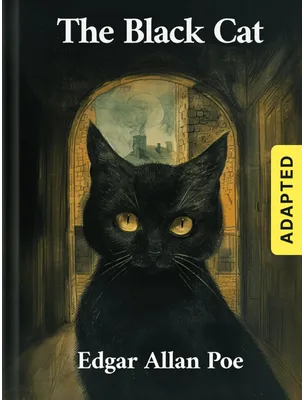
The Black Cat
[adapted]
by
Edgar Allan Poe

For the most wild, yet most plain story which I am about to write, I neither expect nor ask for belief. I would be truly mad to expect it, in a case where my own senses refuse their own proof. Yet, I am not mad — and surely I do not dream. But tomorrow I die, and today I would unburden my soul. My aim now is to put before the world, plainly, briefly, and without comment, a set of simple household events. In their results, these events have terrified — have tortured — have destroyed me. Yet I will not try to explain them. To me, they have shown little but horror — to many they will seem less terrible than strange things. Later, maybe, some mind may be found which will make my dream seem common — some mind more calm, more reasonable, and far less easy to excite than my own, which will see, in the things I tell with fear, nothing more than an ordinary set of very natural causes and effects.
From my early childhood I was known for the gentleness and kindness of my nature. My kind heart was even so obvious as to make me the joke of my friends. I was especially fond of animals, and was allowed by my parents to have many kinds of pets. With these I spent most of my time, and never was so happy as when feeding and petting them. This special part of my character grew as I grew, and as a man, I got from it one of my main joys. To those who have loved a faithful and wise dog, I hardly need to explain the kind or the strength of the pleasure that comes from it. There is something in the unselfish and giving love of an animal, which goes straight to the heart of someone who has often had to test the poor friendship and weak loyalty of mere Man.
I married early, and was happy to find that my wife had a nature like mine. Seeing that I liked pets, she never missed a chance to get the nicest ones. We had birds, gold-fish, a fine dog, rabbits, a small monkey, and a cat.
This one was a very large and beautiful animal, completely black, and very clever. When talking about how smart he was, my wife, who in her heart was a little superstitious, often mentioned the old common belief that said all black cats were witches in disguise. Not that she was ever serious about this — and I mention it only because it happens, just now, to be remembered.
Pluto — this was the cat’s name — was my favorite pet and friend to play with. I alone fed him, and he followed me wherever I went in the house. It was even hard for me to stop him from following me in the streets.
Our friendship lasted, like this, for several years, during which my general temper and character — because of the demon of drinking — had (I am ashamed to say it) changed a lot for the worse. I became, day by day, more often in a bad mood, more easily angry, more careless of the feelings of others. I let myself use bad language to my wife. At last, I even used violence against her. My pets, of course, were made to feel the change in my mood. I not only neglected them, but also treated them badly. For Pluto, however, I still kept enough care to stop me from treating him badly, as I had no problem treating badly the rabbits, the monkey, or even the dog, when by accident, or because of love, they came near me. But my sickness grew on me — for what sickness is like Alcohol! — and at last even Pluto, who was now becoming old, and so somewhat bad-tempered — even Pluto began to feel the effects of my bad temper.
One night, going home, very drunk, from one of my usual places in town, I thought that the cat stayed away from me. I grabbed him; when, in his fear because of my rough act, he made a small wound on my hand with his teeth. The anger of a demon took over me at once. I did not know myself any more. My true soul seemed, at once, to leave my body and a more than devilish evil, fed by gin, filled every part of my body. I took from my vest pocket a penknife, opened it, held the poor animal by the throat, and on purpose cut one of its eyes out of the socket! I blush, I burn, I shiver, while I write this awful crime.
When clear reason returned with the morning — when I had slept off the effects of the night’s wild drinking — I felt a feeling half horror, half regret, for the crime I had done; but it was, at best, a weak and unsure feeling, and the soul stayed the same. I again went too far, and soon I drowned in wine all memory of the act.
Meanwhile the cat slowly recovered. The hole where the lost eye had been looked, it is true, very scary, but he no longer seemed to feel any pain. He went about the house as usual, but, as you might expect, ran away in great fear when I came near. I had so much of my old heart left that I was at first sad about this clear dislike from a creature that had once so loved me. But this feeling soon changed to anger. And then came, as if to my final and unchangeable ruin, the spirit of Perverseness. Philosophy does not think about this spirit. Yet I am just as sure that my soul lives, as I am that perverseness is one of the basic urges of the human heart — one of the simple, first abilities, or feelings, which guide the character of Man. Who has not, a hundred times, found himself doing a bad or a silly act, for no other reason than because he knows he should not? Do we not have a constant desire, against our best judgment, to break that which is Law, only because we know it is so.
This feeling of doing wrong, I say, brought me to my final ruin. It was this deep wish of the soul to hurt itself — to go against its own nature — to do wrong only because it is wrong — that pushed me to continue and finally to complete the harm I had done to the harmless animal. One morning, calmly, I put a noose around its neck and hung it on the branch of a tree; — hung it with the tears running from my eyes, and with the deepest regret at my heart; — hung it because I knew that it had loved me, and because I felt it had given me no reason to be angry; — hung it because I knew that in so doing I was doing a sin — a deadly sin that would so endanger my soul that never dies as to place it — if such a thing were possible — even beyond the reach of the endless mercy of the Most Merciful and Most Terrible God.
On the night of the day when this cruel act was done, I was woken from sleep by the shout of “Fire!” The curtains of my bed were in flames. The whole house was on fire. It was very hard for my wife, a servant, and me to escape from the fire. Everything was destroyed. All the things I owned were gone, and I lost all hope from then on.
I am not so weak as to try to make a chain of cause and effect between the disaster and the terrible act. But I am telling a chain of facts — and I do not want to leave even a possible link not complete. On the day after the fire, I visited the ruins. The walls, except one, had fallen in. This one was an inside wall, not very thick, which stood about the middle of the house, and the head of my bed had rested against it. Here, the plaster had, in large part, resisted the fire — a fact which I thought was because it had been put on recently. Around this wall a thick crowd had gathered, and many people seemed to be looking at a particular part of it with very careful and eager attention. The words “strange!” “odd!” and other similar words, made me curious. I approached and saw, as if carved on the white surface, the figure of a huge cat. The mark was made with an accuracy truly wonderful. There was a rope about the animal’s neck.
When I first saw this ghost — for I could hardly think it was anything else — my surprise and my fear were very great. But at last thinking came to help me. The cat, I remembered, had been hung in a garden next to the house. When the alarm of fire rang, this garden had been at once filled by the crowd — by someone among them the animal must have been cut down from the tree and thrown, through an open window, into my room. This had probably been done to wake me from sleep. The falling of other walls had pressed the victim of my cruel act into the material of the freshly spread plaster; the lime in it, with the flames, and the ammonia from the dead body, had then made the picture as I saw it.
Although I could easily explain to my reason, if not completely to my feelings, the shocking fact just described, it still made a deep impression on my imagination. For months I could not get rid of the vision of the cat; and, during this time, there came back into my heart a half-feeling that seemed, but was not, real regret. I went so far as to be sorry for the loss of the animal, and to look around me, in the dirty places which I now often visited, for another pet of the same kind, and with a somewhat similar look, to take its place.
One night as I sat, half dazed, in a place of great shame, I suddenly noticed a black object, resting on top of one of the huge barrels of gin, or of rum, which were the main furniture of the room. I had been looking without stopping at the top of this barrel for some minutes, and what now surprised me was that I had not noticed the object there sooner. I approached it, and touched it with my hand. It was a black cat — a very large one — just as big as Pluto, and very much like him in every way but one. Pluto did not have a white hair on any part of his body; but this cat had a large, although not clear in shape, spot of white, covering nearly the whole area of the chest. When I touched him, he right away got up, purred loudly, rubbed against my hand, and seemed very happy that I noticed him. This, then, was the very creature I was looking for. I right away offered to buy it from the landlord; but this person said it was not his — knew nothing about it — had never seen it before.
I kept petting it, and, when I got ready to go home, the animal showed that it wanted to come with me. I let it do so; sometimes bending down and patting it as I went. When it reached the house it made itself at home at once, and right away became a big favorite with my wife.
For my part, I soon felt a dislike for it growing inside me. This was the opposite of what I had expected; but — I do not know how or why — its clear liking for me instead made me feel sick and annoyed. Slowly, these feelings of strong dislike and annoyance grew into strong hate. I avoided the animal; a feeling of shame, and the memory of my earlier cruel act, stopped me from hurting it. I did not, for some weeks, hit it, or hurt it in any other violent way; but slowly — very slowly — I began to look at it with terrible hate, and to run away quietly from its hateful presence, as from the breath of a disease.
What added, no doubt, to my hate of the animal, was the finding, on the morning after I brought it home, that, like Pluto, it also had lost one of its eyes. This fact, however, only made my wife love it more, who, as I have already said, had, very much, that kindness of feeling which had once been my main quality, and the reason for many of my simplest and best joys.
With my dislike for this cat, however, its liking for me seemed to increase. It followed me with a persistence that would be hard for the reader to understand. Whenever I sat, it would sit under my chair, or jump onto my knees, covering me with its disgusting touches. If I got up to walk it would get between my feet and almost make me fall, or, hooking its long and sharp claws in my clothes, climb, in this way, to my chest. At such times, although I wanted to kill it with a hit, I still stopped myself from doing so, partly by the memory of my earlier crime, but mainly — let me say it at once — by complete fear of the animal.
This fear was not exactly a fear of hurt to the body — and yet I do not know how else to describe it. I am almost ashamed to admit — yes, even in this prisoner’s cell, I am almost ashamed to admit — that the terror and horror the animal made me feel, had been made stronger by one of the smallest imaginary ideas it would be possible to think of. My wife had called my attention, more than once, to the look of the mark of white hair, which I have spoken about, and which was the only visible difference between the strange animal and the one I had killed. The reader will remember that this mark, although large, had been at first very unclear; but, by slow steps — steps nearly impossible to see, and which for a long time my reason tried to reject as only fancy — it had, at last, taken a very clear outline. It was now the picture of an object that I shiver to name — and for this, above all, I hated, and feared, and would have got rid of the monster if I had dared — it was now, I say, the image of a horrible — of an awful thing — of the Gallows!— oh, sad and terrible machine of Horror and of Crime — of Pain and of Death!
And now I was indeed more miserable than any human could be. And an animal — whose friend I had killed without respect — an animal to cause me — for me, a man, made in the image of the High God — so much pain I could not bear! Sadly! neither by day nor by night did I know the gift of rest any more! During the day the animal left me no moment alone, and at night I woke every hour from dreams of fear I could not speak of to find the hot breath of the thing on my face, and its great weight — a living nightmare that I had no power to shake off — lying forever on my heart!
Under the pressure of pains like these, the weak rest of the good in me gave in. Evil thoughts became my only close friends — the darkest and most evil of thoughts. The moodiness of my usual temper grew into hatred of all things and of all people; while, because of the sudden, often, and uncontrollable bursts of rage to which I now blindly gave myself, my uncomplaining wife, sadly, was the one who suffered most often and most patiently.
One day she went with me, on some household task, into the basement of the old building which our poverty forced us to live in. The cat followed me down the steep stairs, and, almost making me fall headfirst, made me crazy with anger. Lifting an axe, and forgetting, in my anger, the childish fear which had until then stopped my hand, I aimed a blow at the animal which, of course, would have killed it at once if it had come down as I wished. But this blow was stopped by the hand of my wife. Driven, by her stopping me, into a rage worse than a demon’s, I pulled my arm from her hold and buried the axe in her head. She fell dead on the spot, without a sound.
After this horrible murder was done, I began at once, and very carefully, the task of hiding the body. I knew that I could not take it out of the house, either by day or by night, without the danger of being seen by the neighbors. Many plans came into my mind. At one time I thought of cutting the dead body into very small pieces, and burning them. At another time, I decided to dig a grave for it in the cellar floor. Again, I thought about throwing it into the well in the yard — about packing it in a box, as if it were goods, with the usual steps, and getting a delivery man to take it from the house. Finally I found what I thought was a much better plan than either of these. I decided to wall it up in the cellar — as the monks of the Middle Ages are said to have walled up their victims.
For a purpose like this the cellar was very good. Its walls were built loosely, and had recently been covered everywhere with a rough plaster, which the wet air had kept from getting hard. Also, in one of the walls was a part that stuck out, caused by a fake chimney, or fireplace, that had been filled up, and made to look like the rest of the cellar. I had no doubt that I could easily move the bricks at this point, put the dead body inside, and wall the whole up as before, so that no one could see anything strange. And in this plan I was not wrong. With a crowbar I easily took out the bricks, and, having carefully put the body against the inner wall, I held it up in that position, while, with little effort, I put the whole wall back as it was before. After getting mortar, sand, and hair, with every possible care, I made a plaster that looked the same as the old, and with this I very carefully covered the new bricks. When I had finished, I felt sure that all was right. The wall did not show the smallest sign of having been moved. The trash on the floor was picked up with the greatest care. I looked around with pride, and said to myself: “Here at least, then, my work has not been for nothing.”
My next step was to look for the animal which had been the cause of so much misery; for I had, at last, firmly decided to kill it. If I had been able to meet it at that moment, there would have been no doubt about its fate; but it seemed that the clever animal had been scared by the strength of my earlier anger, and did not show itself while I was in this mood. It is impossible to describe, or to imagine, the deep, the joyful feeling of relief which the hated creature not being there caused in my heart. It did not appear during the night; and so for one night at least, since its coming into the house, I slept soundly and calmly; yes, slept even with the weight of murder on my soul!
The second and the third day passed, and still the one who hurt me did not come. Once again I breathed like a free man. The monster, in fear, had run away from the place forever! I would see it no more! My happiness was very great! The guilt from my bad act bothered me only a little. A few questions had been asked, but these had been easily answered. Even a search had been started — but of course nothing was found. I saw my future happiness as safe.
On the fourth day after the killing, a group of police came, very suddenly, into the house, and began again to make a careful search of the place. Sure, however, that my hiding place could not be found, I felt no worry at all. The officers told me to go with them in their search. They checked every small place and corner. At last, for the third or fourth time, they went down into the cellar. I did not shake a muscle. My heart beat calmly like that of someone who sleeps in innocence. I walked the cellar from end to end. I folded my arms on my chest, and walked easily back and forth. The police were completely satisfied and ready to leave. The joy in my heart was too strong to be held back. I strongly wanted to say even one word, as a way to show my victory, and to make even more sure their belief in my innocence.
“Gentlemen,” I said at last, as the group went up the steps, “I am glad to have eased your doubts. I wish you all health, and a little more politeness. By the way, gentlemen, this — this is a very well-built house.” (In my wild wish to say something simple, I hardly knew what I said at all.) — “I may say a very well-built house. These walls — are you going, gentlemen? — these walls are strongly put together;” and here, in just a wild act of showing off, I knocked hard, with a cane which I held in my hand, upon that very part of the brickwork behind which stood the body of my dear wife.
But may God protect and save me from the teeth of the Arch-Devil! No sooner had the echo of my blows faded into silence, than I was answered by a voice from inside the grave! — by a cry, at first soft and broken, like the crying of a child, and then quickly growing into one long, loud, and nonstop scream, completely strange and not human — a howl — a wailing scream, half of horror and half of victory, such as might have come only out of hell, together from the mouths of the cursed in their great pain and of the demons that rejoice in the curse.
It is silly to talk about my own thoughts. Fainting, I stumbled to the opposite wall. For one moment the group on the stairs stayed still, from great fear and shock. In the next moment, a dozen strong arms were working hard at the wall. It fell down in one piece. The dead body, already very rotten and covered with thick blood, stood upright before the eyes of the people watching. Upon its head, with a red wide mouth and one fiery eye, sat the ugly beast whose trick had led me into murder, and whose voice had told on me and sent me to the hangman. I had walled the monster up inside the tomb!