'The Artist of the Beautiful' was first published in 1844 as part of Nathaniel Hawthorne's collection 'The Mosses from an Old Manse'.
[{"id":"para_1","index":0,"start":0,"offset":352,"words":5,"paraNum":"","lastModified":1666053697000,"semanticType":"title-book-title","voicework":"audio_file","blockId":"the_artist_of_the_beautiful_short_story_ffa_en-blq8","language":"en","wordsRange":{"start":46444444,"end":92888889},"paragraphVersion":51,"direction":"ltr","paragraph":"<h1 class=\"ilm-title\" id=\"para_1\" semantictype=\"title-book-title\" data-ilmid=\"the_artist_of_the_beautiful_short_story_ffa_en-blq8\" data-audio=\"1\" data-chapter=\"para_1\" data-words-count=\"5\" data-before=\"0\" data-ww=\"\"><span class=\"block-pb\"> <span class=\"block-pb is-animated\"></span> </span><span class=\"itm-wrap\">The Artist of the Beautiful</span></h1>","hasContent":true,"isFirst":true,"isLast":false},{"id":"para_2","index":1,"start":352,"offset":379,"words":2,"paraNum":"","lastModified":1667478551000,"semanticType":"title-author","voicework":"audio_file","blockId":"the_artist_of_the_beautiful_short_story_ffa_en-blq5","language":"en","wordsRange":{"start":139333333,"end":172666667},"paragraphVersion":66,"direction":"ltr","paragraph":"<h1 class=\"ilm-title ilm-author ilm-nopad ilm-x-large\" id=\"para_2\" semantictype=\"title-author\" data-ilmid=\"the_artist_of_the_beautiful_short_story_ffa_en-blq5\" data-audio=\"1\" data-chapter=\"para_2\" data-words-count=\"2\" data-before=\"5\" data-ww=\"\"><span class=\"block-pb\"> <span class=\"block-pb is-animated\"></span> </span><span class=\"itm-wrap\">by<br>Nathaniel Hawthorne</span></h1>","hasContent":true,"isFirst":false,"isLast":false},{"id":"para_3","index":2,"start":731,"offset":174,"words":0,"paraNum":"","lastModified":1665988514000,"semanticType":"line","blockId":"the_artist_of_the_beautiful_short_story_ffa_en-blq6","language":"en","wordsRange":{"start":183777778,"end":194888889},"paragraphVersion":38,"direction":"ltr","paragraph":"<hr class=\"ilm-hr ilm-small\" id=\"para_3\" semantictype=\"line\" data-ilmid=\"the_artist_of_the_beautiful_short_story_ffa_en-blq6\" data-words-count=\"0\" data-before=\"7\" data-ww=\"\">","hasContent":true,"isFirst":false,"isLast":false},{"id":"para_4","index":3,"start":905,"offset":1600,"words":0,"paraNum":"","lastModified":1667378604000,"semanticType":"illustration","blockId":"the_artist_of_the_beautiful_short_story_ffa_en-blq9","language":"en","wordsRange":{"start":198592593,"end":202296296},"paragraphVersion":29,"direction":"ltr","paragraph":"<div class=\"ilm-illustration\" id=\"para_4\" semantictype=\"illustration\" data-ilmid=\"the_artist_of_the_beautiful_short_story_ffa_en-blq9\" data-words-count=\"0\" data-before=\"7\" data-ww=\"\"><img width=\"523\" height=\"600\" data-src=\"ch0p0\" src=\"data:image/webp;base64,UklGRsYDAABXRUJQVlA4ILoDAABwDwCdASo0ADwAPm0ukUYkIqGhLhJOMIANiWcAyn7y+dYxpjNza5YGkvmmeQbUPGe2PnORdFnw//gVE8jfZx4xa1GEQeBo7U9MzNSl9qx4BwBs1cBwyaOoE5gYZc4w++WDeW9dEW8hs1UF/m3Ngr3NuvMTjzScftvs66al+6rY8JqYMGgA/vmaHbkcotEx62kZCeiVGAFQfob+zftYKCKwHZIwWhd0wK2mWTMibLfFpymyYW/qkyMudiILq36nbp4yaKwGpScGqaiCA3r+oTlfiVb/gv139Hm6e31d2yr1eY3NY9ROYWcfyHmMiFMpUXkT2ro/R5/nl3B6qWkBrJ+Ug701HiOmIPK55TP815JKNCF2l5wGsWZ94aarUDrpYZMVq91JNfpMQgenzut7uAz88CmROYKzyutVVn0DIYEq5txZnF0qF3p1WZMxr/fBKBbejhv5PNjD+uU7nZHm2GiAIl6ie2jIrSACsHwyfFtpA8Wj87oeBfSWURw8k+DQy3vdhGPEldOnC1llg5wa/sFWiwZXI4xsR2zWEORWhorze1cW6GdFFHJY9Z/kQGUd3P4bXToK4cS8lXT2yOXJnzKUy6ED3pG2bguG4+PkPSHN+OHAIl4egoB5gPHdPGdCR6MIsn2wfTpDGB4RnuXIEP/aqD3xegjxZ+xglwTYnbUIevoFXSOPIpyvVNLiJF+dtXsWgPA3igIQGmYDRZAxlZuwPCklIwAeaj+73OfOIOlcOGrzn13Y/BwqCMpjVqHUAf9yVUPtVJOKgi5QCoUFIMvD3hgJyDeZywOf5ur9+xlGs1QASXKbtnMsHHDucXOcbLl69Eid0pZt9TeS6GBUkI6dlX8TB2uAK4joiS9ZvRJrz0dbqiItzRF5C5ixknc+znDYxOaXWPOaZdsHJioZEKwAOf0sJWahzQvMJfORMhxvoOFLvwb4bXtS/f0PGR5JodvjKmSahkYEmOZh1dUDAjzQPKFHmSBJYP3DEjYmWFZfPvG5WO18oqFQERDBOSHZ/2cF030MnKekod4su3jvU9iKS9nrOGt6mC+Qil1sBphDrL6sbX69XpJEvKdwkPTlK+K12XjM7ADUCZU5rjfbDbNqJrZMrZR3faVNHO8iDlR60+2VTofx1ublAMRjrfSxZANrTZr7x1GaG5eIsXjkOR9UxQFZn03/ZWL667P2VDSB5fEXoYOU62srlaq3t13wqs+BwOle+KdISQvqMWSWiG2QJEqJsbCjGs670Z8+Nh+1yLPcNAM3DmvAAAA=\" alt=\"The Artist of the Beautiful\"></div>","hasContent":true,"isFirst":false,"isLast":false},{"id":"para_5","index":4,"start":2505,"offset":974,"words":117,"paraNum":"1","lastModified":1667378604000,"semanticType":"par","voicework":"audio_file","blockId":"the_artist_of_the_beautiful_short_story_ffa_en-bln5","language":"en","wordsRange":{"start":206000000,"end":324000000},"paragraphVersion":80,"direction":"ltr","paragraph":"<p id=\"para_5\" semantictype=\"par\" data-ilmid=\"the_artist_of_the_beautiful_short_story_ffa_en-bln5\" data-audio=\"1\" data-words-count=\"117\" data-before=\"7\" data-ww=\"\"><span class=\"block-num\" data-id=\"1\"></span><span class=\"block-pb\"> <span class=\"block-pb is-animated\"></span> </span><span class=\"itm-wrap\">An elderly man, with his pretty daughter on his arm, was passing along the street, and emerged from the gloom of the cloudy evening into the light that fell across the pavement from the window of a small shop. It was a projecting window; and on the inside were suspended a variety of watches, pinchbeck, silver, and one or two of gold, all with their faces turned from the streets, as if churlishly disinclined to inform the wayfarers what o’clock it was. Seated within the shop, sidelong to the window with his pale face bent earnestly over some delicate piece of mechanism on which was thrown the concentrated lustre of a shade lamp, appeared a young man.</span></p>","hasContent":true,"isFirst":false,"isLast":false},{"id":"para_6","index":5,"start":3479,"offset":848,"words":101,"paraNum":"2","lastModified":1667378604000,"semanticType":"par","voicework":"audio_file","blockId":"the_artist_of_the_beautiful_short_story_ffa_en-bln6","language":"en","wordsRange":{"start":424000000,"end":526000000},"paragraphVersion":75,"direction":"ltr","paragraph":"<p id=\"para_6\" semantictype=\"par\" data-ilmid=\"the_artist_of_the_beautiful_short_story_ffa_en-bln6\" data-audio=\"1\" data-words-count=\"101\" data-before=\"124\" data-ww=\"\"><span class=\"block-num\" data-id=\"2\"></span><span class=\"block-pb\"> <span class=\"block-pb is-animated\"></span> </span><span class=\"itm-wrap\">“What can Owen Warland be about?” muttered old Peter Hovenden, himself a retired watchmaker, and the former master of this same young man whose occupation he was now wondering at. “What can the fellow be about? These six months past I have never come by his shop without seeing him just as steadily at work as now. It would be a flight beyond his usual foolery to seek for the perpetual motion; and yet I know enough of my old business to be certain that what he is now so busy with is no part of the machinery of a watch.”</span></p>","hasContent":true,"isFirst":false,"isLast":false},{"id":"para_7","index":6,"start":4327,"offset":482,"words":26,"paraNum":"3","lastModified":1667378604000,"semanticType":"par","voicework":"audio_file","blockId":"the_artist_of_the_beautiful_short_story_ffa_en-bln7","language":"en","wordsRange":{"start":626000000,"end":653000000},"paragraphVersion":75,"direction":"ltr","paragraph":"<p id=\"para_7\" semantictype=\"par\" data-ilmid=\"the_artist_of_the_beautiful_short_story_ffa_en-bln7\" data-audio=\"1\" data-words-count=\"26\" data-before=\"225\" data-ww=\"\"><span class=\"block-num\" data-id=\"3\"></span><span class=\"block-pb\"> <span class=\"block-pb is-animated\"></span> </span><span class=\"itm-wrap\">“Perhaps, father,” said Annie, without showing much interest in the question, “Owen is inventing a new kind of timekeeper. I am sure he has ingenuity enough.”</span></p>","hasContent":true,"isFirst":false,"isLast":false},{"id":"para_8","index":7,"start":4809,"offset":813,"words":92,"paraNum":"4","lastModified":1667378604000,"semanticType":"par","voicework":"audio_file","blockId":"the_artist_of_the_beautiful_short_story_ffa_en-bln8","language":"en","wordsRange":{"start":753000000,"end":846000000},"paragraphVersion":75,"direction":"ltr","paragraph":"<p id=\"para_8\" semantictype=\"par\" data-ilmid=\"the_artist_of_the_beautiful_short_story_ffa_en-bln8\" data-audio=\"1\" data-words-count=\"92\" data-before=\"251\" data-ww=\"\"><span class=\"block-num\" data-id=\"4\"></span><span class=\"block-pb\"> <span class=\"block-pb is-animated\"></span> </span><span class=\"itm-wrap\">“Poh, child! He has not the sort of ingenuity to invent anything better than a Dutch toy,” answered her father, who had formerly been put to much vexation by Owen Warland’s irregular genius. “A plague on such ingenuity! All the effect that ever I knew of it was to spoil the accuracy of some of the best watches in my shop. He would turn the sun out of its orbit and derange the whole course of time, if, as I said before, his ingenuity could grasp anything bigger than a child’s toy!”</span></p>","hasContent":true,"isFirst":false,"isLast":false},{"id":"para_9","index":8,"start":5622,"offset":507,"words":33,"paraNum":"5","lastModified":1667378604000,"semanticType":"par","voicework":"audio_file","blockId":"the_artist_of_the_beautiful_short_story_ffa_en-bln9","language":"en","wordsRange":{"start":946000000,"end":980000000},"paragraphVersion":75,"direction":"ltr","paragraph":"<p id=\"para_9\" semantictype=\"par\" data-ilmid=\"the_artist_of_the_beautiful_short_story_ffa_en-bln9\" data-audio=\"1\" data-words-count=\"33\" data-before=\"343\" data-ww=\"\"><span class=\"block-num\" data-id=\"5\"></span><span class=\"block-pb\"> <span class=\"block-pb is-animated\"></span> </span><span class=\"itm-wrap\">“Hush, father! He hears you!” whispered Annie, pressing the old man’s arm. “His ears are as delicate as his feelings; and you know how easily disturbed they are. Do let us move on.”</span></p>","hasContent":true,"isFirst":false,"isLast":false},{"id":"para_10","index":9,"start":6129,"offset":1502,"words":208,"paraNum":"6","lastModified":1667480569000,"semanticType":"par","voicework":"audio_file","blockId":"the_artist_of_the_beautiful_short_story_ffa_en-blna","language":"en","wordsRange":{"start":1080000000,"end":1289000000},"paragraphVersion":87,"direction":"ltr","paragraph":"<p id=\"para_10\" semantictype=\"par\" data-ilmid=\"the_artist_of_the_beautiful_short_story_ffa_en-blna\" data-audio=\"1\" data-words-count=\"208\" data-before=\"376\" data-ww=\"\"><span class=\"block-num\" data-id=\"6\"></span><span class=\"block-pb\"> <span class=\"block-pb is-animated\"></span> </span><span class=\"itm-wrap\">So Peter Hovenden and his daughter Annie plodded on without further conversation, until in a by-street of the town they found themselves passing the open door of a blacksmith’s shop. Within was seen the forge, now blazing up and illuminating the high and dusky roof, and now confining its lustre to a narrow precinct of the coal-strewn floor, according as the breath of the bellows was puffed forth or again inhaled into its vast leathern lungs. In the intervals of brightness it was easy to distinguish objects in remote corners of the shop and the horseshoes that hung upon the wall; in the momentary gloom the fire seemed to be glimmering amidst the vagueness of unenclosed space. Moving about in this red glare and alternate dusk was the figure of the blacksmith, well worthy to be viewed in so picturesque an aspect of light and shade, where the bright blaze struggled with the black night, as if each would have snatched his comely strength from the other. Anon he drew a white-hot bar of iron from the coals, laid it on the anvil, uplifted his arm of might, and was soon enveloped in the myriads of sparks which the strokes of his hammer scattered into the surrounding gloom.</span></p>","hasContent":true,"isFirst":false,"isLast":false},{"id":"para_11","index":10,"start":7631,"offset":544,"words":44,"paraNum":"7","lastModified":1667378604000,"semanticType":"par","voicework":"audio_file","blockId":"the_artist_of_the_beautiful_short_story_ffa_en-blnb","language":"en","wordsRange":{"start":1389000000,"end":1434000000},"paragraphVersion":75,"direction":"ltr","paragraph":"<p id=\"para_11\" semantictype=\"par\" data-ilmid=\"the_artist_of_the_beautiful_short_story_ffa_en-blnb\" data-audio=\"1\" data-words-count=\"44\" data-before=\"584\" data-ww=\"\"><span class=\"block-num\" data-id=\"7\"></span><span class=\"block-pb\"> <span class=\"block-pb is-animated\"></span> </span><span class=\"itm-wrap\">“Now, that is a pleasant sight,” said the old watchmaker. “I know what it is to work in gold; but give me the worker in iron after all is said and done. He spends his labor upon a reality. What say you, daughter Annie?”</span></p>","hasContent":true,"isFirst":false,"isLast":false},{"id":"para_12","index":11,"start":8175,"offset":412,"words":13,"paraNum":"8","lastModified":1667378604000,"semanticType":"par","voicework":"audio_file","blockId":"the_artist_of_the_beautiful_short_story_ffa_en-blnc","language":"en","wordsRange":{"start":1534000000,"end":1548000000},"paragraphVersion":75,"direction":"ltr","paragraph":"<p id=\"para_12\" semantictype=\"par\" data-ilmid=\"the_artist_of_the_beautiful_short_story_ffa_en-blnc\" data-audio=\"1\" data-words-count=\"13\" data-before=\"628\" data-ww=\"\"><span class=\"block-num\" data-id=\"8\"></span><span class=\"block-pb\"> <span class=\"block-pb is-animated\"></span> </span><span class=\"itm-wrap\">“Pray don’t speak so loud, father,” whispered Annie, “Robert Danforth will hear you.”</span></p>","hasContent":true,"isFirst":false,"isLast":false},{"id":"para_13","index":12,"start":8587,"offset":999,"words":135,"paraNum":"9","lastModified":1667480632000,"semanticType":"par","voicework":"audio_file","blockId":"the_artist_of_the_beautiful_short_story_ffa_en-blnd","language":"en","wordsRange":{"start":1648000000,"end":1784000000},"paragraphVersion":87,"direction":"ltr","paragraph":"<p id=\"para_13\" semantictype=\"par\" data-ilmid=\"the_artist_of_the_beautiful_short_story_ffa_en-blnd\" data-audio=\"1\" data-words-count=\"135\" data-before=\"641\" data-ww=\"\"><span class=\"block-num\" data-id=\"9\"></span><span class=\"block-pb\"> <span class=\"block-pb is-animated\"></span> </span><span class=\"itm-wrap\">“And what if he should hear me?” said Peter Hovenden. “I say again, it is a good and a wholesome thing to depend upon main strength and reality, and to earn one’s bread with the bare and brawny arm of a blacksmith. A watchmaker gets his brain puzzled by his wheels within a wheel, or loses his health or the nicety of his eyesight, as was my case, and finds himself at middle age, or a little after, past labor at his own trade and fit for nothing else, yet too poor to live at his ease. So I say once again, give me main strength for my money. And then, how it takes the nonsense out of a man! Did you ever hear of a blacksmith being such a fool as Owen Warland yonder?”</span></p>","hasContent":true,"isFirst":false,"isLast":false},{"id":"para_14","index":13,"start":9586,"offset":624,"words":53,"paraNum":"10","lastModified":1667378604000,"semanticType":"par","voicework":"audio_file","blockId":"the_artist_of_the_beautiful_short_story_ffa_en-blne","language":"en","wordsRange":{"start":1884000000,"end":1938000000},"paragraphVersion":75,"direction":"ltr","paragraph":"<p id=\"para_14\" semantictype=\"par\" data-ilmid=\"the_artist_of_the_beautiful_short_story_ffa_en-blne\" data-audio=\"1\" data-words-count=\"53\" data-before=\"776\" data-ww=\"\"><span class=\"block-num\" data-id=\"10\"></span><span class=\"block-pb\"> <span class=\"block-pb is-animated\"></span> </span><span class=\"itm-wrap\">“Well said, uncle Hovenden!” shouted Robert Danforth from the forge, in a full, deep, merry voice, that made the roof re-echo. “And what says Miss Annie to that doctrine? She, I suppose, will think it a genteeler business to tinker up a lady’s watch than to forge a horseshoe or make a gridiron.”</span></p>","hasContent":true,"isFirst":false,"isLast":false},{"id":"para_15","index":14,"start":10210,"offset":381,"words":11,"paraNum":"11","lastModified":1667378604000,"semanticType":"par","voicework":"audio_file","blockId":"the_artist_of_the_beautiful_short_story_ffa_en-blnf","language":"en","wordsRange":{"start":2038000000,"end":2050000000},"paragraphVersion":72,"direction":"ltr","paragraph":"<p id=\"para_15\" semantictype=\"par\" data-ilmid=\"the_artist_of_the_beautiful_short_story_ffa_en-blnf\" data-audio=\"1\" data-words-count=\"11\" data-before=\"829\" data-ww=\"\"><span class=\"block-num\" data-id=\"11\"></span><span class=\"block-pb\"> <span class=\"block-pb is-animated\"></span> </span><span class=\"itm-wrap\">Annie drew her father onward without giving him time for reply.</span></p>","hasContent":true,"isFirst":false,"isLast":false},{"id":"para_16","index":15,"start":10591,"offset":2906,"words":432,"paraNum":"12","lastModified":1667480855000,"semanticType":"par","voicework":"audio_file","blockId":"the_artist_of_the_beautiful_short_story_ffa_en-blng","language":"en","wordsRange":{"start":2150000000,"end":2583000000},"paragraphVersion":134,"direction":"ltr","paragraph":"<p id=\"para_16\" semantictype=\"par\" data-ilmid=\"the_artist_of_the_beautiful_short_story_ffa_en-blng\" data-audio=\"1\" data-words-count=\"432\" data-before=\"840\" data-ww=\"\"><span class=\"block-num\" data-id=\"12\"></span><span class=\"block-pb\"> <span class=\"block-pb is-animated\"></span> </span><span class=\"itm-wrap\">But we must return to Owen Warland’s shop, and spend more meditation upon his history and character than either Peter Hovenden, or probably his daughter Annie, or Owen’s old school-fellow, Robert Danforth, would have thought due to so slight a subject. From the time that his little fingers could grasp a penknife, Owen had been remarkable for a delicate ingenuity, which sometimes produced pretty shapes in wood, principally figures of flowers and birds, and sometimes seemed to aim at the hidden mysteries of mechanism. But it was always for purposes of grace, and never with any mockery of the useful. He did not, like the crowd of school-boy artisans, construct little windmills on the angle of a barn or watermills across the neighboring brook. Those who discovered such peculiarity in the boy as to think it worth their while to observe him closely, sometimes saw reason to suppose that he was attempting to imitate the beautiful movements of Nature as exemplified in the flight of birds or the activity of little animals. It seemed, in fact, a new development of the love of the beautiful, such as might have made him a poet, a painter, or a sculptor, and which was as completely refined from all utilitarian coarseness as it could have been in either of the fine arts. He looked with singular distaste at the stiff and regular processes of ordinary machinery. Being once carried to see a steam-engine, in the expectation that his intuitive comprehension of mechanical principles would be gratified, he turned pale and grew sick, as if something monstrous and unnatural had been presented to him. This horror was partly owing to the size and terrible energy of the iron laborer; for the character of Owen’s mind was microscopic, and tended naturally to the minute, in accordance with his diminutive frame and the marvellous smallness and delicate power of his fingers. Not that his sense of beauty was thereby diminished into a sense of prettiness. The beautiful idea has no relation to size, and may be as perfectly developed in a space too minute for any but microscopic investigation as within the ample verge that is measured by the arc of the rainbow. But, at all events, this characteristic minuteness in his objects and accomplishments made the world even more incapable than it might otherwise have been of appreciating Owen Warland’s genius. The boy’s relatives saw nothing better to be done — as perhaps there was not — than to bind him apprentice to a watchmaker, hoping that his strange ingenuity might thus be regulated and put to utilitarian purposes. </span></p>","hasContent":true,"isFirst":false,"isLast":false},{"id":"para_17","index":16,"start":13497,"offset":2435,"words":339,"paraNum":"13","lastModified":1667481011000,"semanticType":"par","voicework":"audio_file","blockId":"the_artist_of_the_beautiful_short_story_ffa_en-blnh","language":"en","wordsRange":{"start":2683000000,"end":3026000000},"paragraphVersion":86,"direction":"ltr","paragraph":"<p id=\"para_17\" semantictype=\"par\" data-ilmid=\"the_artist_of_the_beautiful_short_story_ffa_en-blnh\" data-audio=\"1\" data-words-count=\"339\" data-before=\"1272\" data-ww=\"\"><span class=\"block-num\" data-id=\"13\"></span><span class=\"block-pb\"> <span class=\"block-pb is-animated\"></span> </span><span class=\"itm-wrap\">Peter Hovenden’s opinion of his apprentice has already been expressed. He could make nothing of the lad. Owen’s apprehension of the professional mysteries, it is true, was inconceivably quick; but he altogether forgot or despised the grand object of a watchmaker’s business, and cared no more for the measurement of time than if it had been merged into eternity. So long, however, as he remained under his old master’s care, Owen’s lack of sturdiness made it possible, by strict injunctions and sharp oversight, to restrain his creative eccentricity within bounds; but when his apprenticeship was served out, and he had taken the little shop which Peter Hovenden’s failing eyesight compelled him to relinquish, then did people recognize how unfit a person was Owen Warland to lead old blind Father Time along his daily course. One of his most rational projects was to connect a musical operation with the machinery of his watches, so that all the harsh dissonances of life might be rendered tuneful, and each flitting moment fall into the abyss of the past in golden drops of harmony. If a family clock was intrusted to him for repair, — one of those tall, ancient clocks that have grown nearly allied to human nature by measuring out the lifetime of many generations, — he would take upon himself to arrange a dance or funeral procession of figures across its venerable face, representing twelve mirthful or melancholy hours. Several freaks of this kind quite destroyed the young watchmaker’s credit with that steady and matter-of-fact class of people who hold the opinion that time is not to be trifled with, whether considered as the medium of advancement and prosperity in this world or preparation for the next. His custom rapidly diminished — a misfortune, however, that was probably reckoned among his better accidents by Owen Warland, who was becoming more and more absorbed in a secret occupation which drew all his science and manual dexterity into itself, and likewise gave full employment to the characteristic tendencies of his genius. This pursuit had already consumed many months.</span></p>","hasContent":true,"isFirst":false,"isLast":false},{"id":"para_18","index":17,"start":15932,"offset":583,"words":48,"paraNum":"14","lastModified":1667378604000,"semanticType":"par","voicework":"audio_file","blockId":"the_artist_of_the_beautiful_short_story_ffa_en-blni","language":"en","wordsRange":{"start":3126000000,"end":3175000000},"paragraphVersion":68,"direction":"ltr","paragraph":"<p id=\"para_18\" semantictype=\"par\" data-ilmid=\"the_artist_of_the_beautiful_short_story_ffa_en-blni\" data-audio=\"1\" data-words-count=\"48\" data-before=\"1611\" data-ww=\"\"><span class=\"block-num\" data-id=\"14\"></span><span class=\"block-pb\"> <span class=\"block-pb is-animated\"></span> </span><span class=\"itm-wrap\">After the old watchmaker and his pretty daughter had gazed at him out of the obscurity of the street, Owen Warland was seized with a fluttering of the nerves, which made his hand tremble too violently to proceed with such delicate labor as he was now engaged upon.</span></p>","hasContent":true,"isFirst":false,"isLast":false},{"id":"para_19","index":18,"start":16515,"offset":902,"words":104,"paraNum":"15","lastModified":1667481095000,"semanticType":"par","voicework":"audio_file","blockId":"the_artist_of_the_beautiful_short_story_ffa_en-blnj","language":"en","wordsRange":{"start":3275000000,"end":3380000000},"paragraphVersion":80,"direction":"ltr","paragraph":"<p id=\"para_19\" semantictype=\"par\" data-ilmid=\"the_artist_of_the_beautiful_short_story_ffa_en-blnj\" data-audio=\"1\" data-words-count=\"104\" data-before=\"1659\" data-ww=\"\"><span class=\"block-num\" data-id=\"15\"></span><span class=\"block-pb\"> <span class=\"block-pb is-animated\"></span> </span><span class=\"itm-wrap\">“It was Annie herself!” murmured he. “I should have known it, by this throbbing of my heart, before I heard her father’s voice. Ah, how it throbs! I shall scarcely be able to work again on this exquisite mechanism to-night. Annie! dearest Annie! thou shouldst give firmness to my heart and hand, and not shake them thus; for if I strive to put the very spirit of beauty into form and give it motion, it is for thy sake alone. O throbbing heart, be quiet! If my labor be thus thwarted, there will come vague and unsatisfied dreams which will leave me spiritless to-morrow.”</span></p>","hasContent":true,"isFirst":false,"isLast":false},{"id":"para_20","index":19,"start":17417,"offset":778,"words":76,"paraNum":"16","lastModified":1667378604000,"semanticType":"par","voicework":"audio_file","blockId":"the_artist_of_the_beautiful_short_story_ffa_en-blnk","language":"en","wordsRange":{"start":3480000000,"end":3557000000},"paragraphVersion":68,"direction":"ltr","paragraph":"<p id=\"para_20\" semantictype=\"par\" data-ilmid=\"the_artist_of_the_beautiful_short_story_ffa_en-blnk\" data-audio=\"1\" data-words-count=\"76\" data-before=\"1763\" data-ww=\"\"><span class=\"block-num\" data-id=\"16\"></span><span class=\"block-pb\"> <span class=\"block-pb is-animated\"></span> </span><span class=\"itm-wrap\">As he was endeavoring to settle himself again to his task, the shop door opened and gave admittance to no other than the stalwart figure which Peter Hovenden had paused to admire, as seen amid the light and shadow of the blacksmith’s shop. Robert Danforth had brought a little anvil of his own manufacture, and peculiarly constructed, which the young artist had recently bespoken. Owen examined the article and pronounced it fashioned according to his wish.</span></p>","hasContent":true,"isFirst":false,"isLast":false},{"id":"para_21","index":20,"start":18195,"offset":816,"words":95,"paraNum":"17","lastModified":1667481154000,"semanticType":"par","voicework":"audio_file","blockId":"the_artist_of_the_beautiful_short_story_ffa_en-blnl","language":"en","wordsRange":{"start":3657000000,"end":3753000000},"paragraphVersion":76,"direction":"ltr","paragraph":"<p id=\"para_21\" semantictype=\"par\" data-ilmid=\"the_artist_of_the_beautiful_short_story_ffa_en-blnl\" data-audio=\"1\" data-words-count=\"95\" data-before=\"1839\" data-ww=\"\"><span class=\"block-num\" data-id=\"17\"></span><span class=\"block-pb\"> <span class=\"block-pb is-animated\"></span> </span><span class=\"itm-wrap\">“Why, yes,” said Robert Danforth, his strong voice filling the shop as with the sound of a bass viol, “I consider myself equal to anything in the way of my own trade; though I should have made but a poor figure at yours with such a fist as this,” added he, laughing, as he laid his vast hand beside the delicate one of Owen. “But what then? I put more main strength into one blow of my sledge hammer than all that you have expended since you were a ‘prentice. Is not that the truth?”</span></p>","hasContent":true,"isFirst":false,"isLast":false},{"id":"para_22","index":21,"start":19011,"offset":514,"words":32,"paraNum":"18","lastModified":1667378604000,"semanticType":"par","voicework":"audio_file","blockId":"the_artist_of_the_beautiful_short_story_ffa_en-blnm","language":"en","wordsRange":{"start":3853000000,"end":3886000000},"paragraphVersion":64,"direction":"ltr","paragraph":"<p id=\"para_22\" semantictype=\"par\" data-ilmid=\"the_artist_of_the_beautiful_short_story_ffa_en-blnm\" data-audio=\"1\" data-words-count=\"32\" data-before=\"1934\" data-ww=\"\"><span class=\"block-num\" data-id=\"18\"></span><span class=\"block-pb\"> <span class=\"block-pb is-animated\"></span> </span><span class=\"itm-wrap\">“Very probably,” answered the low and slender voice of Owen. “Strength is an earthly monster. I make no pretensions to it. My force, whatever there may be of it, is altogether spiritual.”</span></p>","hasContent":true,"isFirst":false,"isLast":false},{"id":"para_23","index":22,"start":19525,"offset":634,"words":54,"paraNum":"19","lastModified":1667378604000,"semanticType":"par","voicework":"audio_file","blockId":"the_artist_of_the_beautiful_short_story_ffa_en-blnn","language":"en","wordsRange":{"start":3986000000,"end":4041000000},"paragraphVersion":64,"direction":"ltr","paragraph":"<p id=\"para_23\" semantictype=\"par\" data-ilmid=\"the_artist_of_the_beautiful_short_story_ffa_en-blnn\" data-audio=\"1\" data-words-count=\"54\" data-before=\"1966\" data-ww=\"\"><span class=\"block-num\" data-id=\"19\"></span><span class=\"block-pb\"> <span class=\"block-pb is-animated\"></span> </span><span class=\"itm-wrap\">“Well, but, Owen, what are you about?” asked his old school-fellow, still in such a hearty volume of tone that it made the artist shrink, especially as the question related to a subject so sacred as the absorbing dream of his imagination. “Folks do say that you are trying to discover the perpetual motion.”</span></p>","hasContent":true,"isFirst":false,"isLast":false},{"id":"para_24","index":23,"start":20159,"offset":829,"words":93,"paraNum":"20","lastModified":1667481208000,"semanticType":"par","voicework":"audio_file","blockId":"the_artist_of_the_beautiful_short_story_ffa_en-blno","language":"en","wordsRange":{"start":4141000000,"end":4235000000},"paragraphVersion":83,"direction":"ltr","paragraph":"<p id=\"para_24\" semantictype=\"par\" data-ilmid=\"the_artist_of_the_beautiful_short_story_ffa_en-blno\" data-audio=\"1\" data-words-count=\"93\" data-before=\"2020\" data-ww=\"\"><span class=\"block-num\" data-id=\"20\"></span><span class=\"block-pb\"> <span class=\"block-pb is-animated\"></span> </span><span class=\"itm-wrap\">“The perpetual motion? Nonsense!” replied Owen Warland, with a movement of disgust; for he was full of little petulances. “It can never be discovered. It is a dream that may delude men whose brains are mystified with matter, but not me. Besides, if such a discovery were possible, it would not be worth my while to make it only to have the secret turned to such purposes as are now effected by steam and water power. I am not ambitious to be honored with the paternity of a new kind of cotton machine.”</span></p>","hasContent":true,"isFirst":false,"isLast":false},{"id":"para_25","index":24,"start":20988,"offset":757,"words":77,"paraNum":"21","lastModified":1667378604000,"semanticType":"par","voicework":"audio_file","blockId":"the_artist_of_the_beautiful_short_story_ffa_en-blnp","language":"en","wordsRange":{"start":4335000000,"end":4413000000},"paragraphVersion":64,"direction":"ltr","paragraph":"<p id=\"para_25\" semantictype=\"par\" data-ilmid=\"the_artist_of_the_beautiful_short_story_ffa_en-blnp\" data-audio=\"1\" data-words-count=\"77\" data-before=\"2113\" data-ww=\"\"><span class=\"block-num\" data-id=\"21\"></span><span class=\"block-pb\"> <span class=\"block-pb is-animated\"></span> </span><span class=\"itm-wrap\">“That would be droll enough!” cried the blacksmith, breaking out into such an uproar of laughter that Owen himself and the bell glasses on his work-board quivered in unison. “No, no, Owen! No child of yours will have iron joints and sinews. Well, I won’t hinder you any more. Good night, Owen, and success, and if you need any assistance, so far as a downright blow of hammer upon anvil will answer the purpose, I’m your man.”</span></p>","hasContent":true,"isFirst":false,"isLast":false},{"id":"para_26","index":25,"start":21745,"offset":381,"words":12,"paraNum":"22","lastModified":1667481250000,"semanticType":"par","voicework":"audio_file","blockId":"the_artist_of_the_beautiful_short_story_ffa_en-blnq","language":"en","wordsRange":{"start":4513000000,"end":4526000000},"paragraphVersion":76,"direction":"ltr","paragraph":"<p id=\"para_26\" semantictype=\"par\" data-ilmid=\"the_artist_of_the_beautiful_short_story_ffa_en-blnq\" data-audio=\"1\" data-words-count=\"12\" data-before=\"2190\" data-ww=\"\"><span class=\"block-num\" data-id=\"22\"></span><span class=\"block-pb\"> <span class=\"block-pb is-animated\"></span> </span><span class=\"itm-wrap\">And with another laugh the man of main strength left the shop.</span></p>","hasContent":true,"isFirst":false,"isLast":false},{"id":"para_27","index":26,"start":22126,"offset":882,"words":102,"paraNum":"23","lastModified":1667481297000,"semanticType":"par","voicework":"audio_file","blockId":"the_artist_of_the_beautiful_short_story_ffa_en-blnr","language":"en","wordsRange":{"start":4626000000,"end":4728000000},"paragraphVersion":85,"direction":"ltr","paragraph":"<p id=\"para_27\" semantictype=\"par\" data-ilmid=\"the_artist_of_the_beautiful_short_story_ffa_en-blnr\" data-audio=\"1\" data-words-count=\"102\" data-before=\"2202\" data-ww=\"\"><span class=\"block-num\" data-id=\"23\"></span><span class=\"block-pb\"> <span class=\"block-pb is-animated\"></span> </span><span class=\"itm-wrap\">“How strange it is,” whispered Owen Warland to himself, leaning his head upon his hand, “that all my musings, my purposes, my passion for the beautiful, my consciousness of power to create it, — a finer, more ethereal power, of which this earthly giant can have no conception, — all, all, look so vain and idle whenever my path is crossed by Robert Danforth! He would drive me mad were I to meet him often. His hard, brute force darkens and confuses the spiritual element within me; but I, too, will be strong in my own way. I will not yield to him.”</span></p>","hasContent":true,"isFirst":false,"isLast":false},{"id":"para_28","index":27,"start":23008,"offset":726,"words":76,"paraNum":"24","lastModified":1667378604000,"semanticType":"par","voicework":"audio_file","blockId":"the_artist_of_the_beautiful_short_story_ffa_en-blns","language":"en","wordsRange":{"start":4828000000,"end":4905000000},"paragraphVersion":68,"direction":"ltr","paragraph":"<p id=\"para_28\" semantictype=\"par\" data-ilmid=\"the_artist_of_the_beautiful_short_story_ffa_en-blns\" data-audio=\"1\" data-words-count=\"76\" data-before=\"2304\" data-ww=\"\"><span class=\"block-num\" data-id=\"24\"></span><span class=\"block-pb\"> <span class=\"block-pb is-animated\"></span> </span><span class=\"itm-wrap\">He took from beneath a glass a piece of minute machinery, which he set in the condensed light of his lamp, and, looking intently at it through a magnifying glass, proceeded to operate with a delicate instrument of steel. In an instant, however, he fell back in his chair and clasped his hands, with a look of horror on his face that made its small features as impressive as those of a giant would have been.</span></p>","hasContent":true,"isFirst":false,"isLast":false},{"id":"para_29","index":28,"start":23734,"offset":633,"words":55,"paraNum":"25","lastModified":1667378604000,"semanticType":"par","voicework":"audio_file","blockId":"the_artist_of_the_beautiful_short_story_ffa_en-blnt","language":"en","wordsRange":{"start":5005000000,"end":5061000000},"paragraphVersion":68,"direction":"ltr","paragraph":"<p id=\"para_29\" semantictype=\"par\" data-ilmid=\"the_artist_of_the_beautiful_short_story_ffa_en-blnt\" data-audio=\"1\" data-words-count=\"55\" data-before=\"2380\" data-ww=\"\"><span class=\"block-num\" data-id=\"25\"></span><span class=\"block-pb\"> <span class=\"block-pb is-animated\"></span> </span><span class=\"itm-wrap\">“Heaven! What have I done?” exclaimed he. “The vapor, the influence of that brute force, — it has bewildered me and obscured my perception. I have made the very stroke — the fatal stroke — that I have dreaded from the first. It is all over — the toil of months, the object of my life. I am ruined!”</span></p>","hasContent":true,"isFirst":false,"isLast":false},{"id":"para_30","index":29,"start":24367,"offset":445,"words":23,"paraNum":"26","lastModified":1667378604000,"semanticType":"par","voicework":"audio_file","blockId":"the_artist_of_the_beautiful_short_story_ffa_en-blnu","language":"en","wordsRange":{"start":5161000000,"end":5185000000},"paragraphVersion":65,"direction":"ltr","paragraph":"<p id=\"para_30\" semantictype=\"par\" data-ilmid=\"the_artist_of_the_beautiful_short_story_ffa_en-blnu\" data-audio=\"1\" data-words-count=\"23\" data-before=\"2435\" data-ww=\"\"><span class=\"block-num\" data-id=\"26\"></span><span class=\"block-pb\"> <span class=\"block-pb is-animated\"></span> </span><span class=\"itm-wrap\">And there he sat, in strange despair, until his lamp flickered in the socket and left the Artist of the Beautiful in darkness.</span></p>","hasContent":true,"isFirst":false,"isLast":false},{"id":"para_31","index":30,"start":24812,"offset":880,"words":100,"paraNum":"27","lastModified":1667481356000,"semanticType":"par","voicework":"audio_file","blockId":"the_artist_of_the_beautiful_short_story_ffa_en-blnv","language":"en","wordsRange":{"start":5285000000,"end":5386000000},"paragraphVersion":119,"direction":"ltr","paragraph":"<p id=\"para_31\" semantictype=\"par\" data-ilmid=\"the_artist_of_the_beautiful_short_story_ffa_en-blnv\" data-audio=\"1\" data-words-count=\"100\" data-before=\"2458\" data-ww=\"\"><span class=\"block-num\" data-id=\"27\"></span><span class=\"block-pb\"> <span class=\"block-pb is-animated\"></span> </span><span class=\"itm-wrap\">Thus it is that ideas, which grow up within the imagination and appear so lovely to it and of a value beyond whatever men call valuable, are exposed to be shattered and annihilated by contact with the practical. It is requisite for the ideal artist to possess a force of character that seems hardly compatible with its delicacy; he must keep his faith in himself while the incredulous world assails him with its utter disbelief; he must stand up against mankind and be his own sole disciple, both as respects his genius and the objects to which it is directed.</span></p>","hasContent":true,"isFirst":false,"isLast":false},{"id":"para_32","index":31,"start":25692,"offset":2157,"words":308,"paraNum":"28","lastModified":1667481503000,"semanticType":"par","voicework":"audio_file","blockId":"the_artist_of_the_beautiful_short_story_ffa_en-blnw","language":"en","wordsRange":{"start":5486000000,"end":5795000000},"paragraphVersion":101,"direction":"ltr","paragraph":"<p id=\"para_32\" semantictype=\"par\" data-ilmid=\"the_artist_of_the_beautiful_short_story_ffa_en-blnw\" data-audio=\"1\" data-words-count=\"308\" data-before=\"2558\" data-ww=\"\"><span class=\"block-num\" data-id=\"28\"></span><span class=\"block-pb\"> <span class=\"block-pb is-animated\"></span> </span><span class=\"itm-wrap\">For a time Owen Warland succumbed to this severe but inevitable test. He spent a few sluggish weeks with his head so continually resting in his hands that the towns-people had scarcely an opportunity to see his countenance. When at last it was again uplifted to the light of day, a cold, dull, nameless change was perceptible upon it. In the opinion of Peter Hovenden, however, and that order of sagacious understandings who think that life should be regulated, like clockwork, with leaden weights, the alteration was entirely for the better. Owen now, indeed, applied himself to business with dogged industry. It was marvellous to witness the obtuse gravity with which he would inspect the wheels of a great old silver watch thereby delighting the owner, in whose fob it had been worn till he deemed it a portion of his own life, and was accordingly jealous of its treatment. In consequence of the good report thus acquired, Owen Warland was invited by the proper authorities to regulate the clock in the church steeple. He succeeded so admirably in this matter of public interest that the merchants gruffly acknowledged his merits on ‘Change; the nurse whispered his praises as she gave the potion in the sick-chamber; the lover blessed him at the hour of appointed interview; and the town in general thanked Owen for the punctuality of dinner time. In a word, the heavy weight upon his spirits kept everything in order, not merely within his own system, but wheresoever the iron accents of the church clock were audible. It was a circumstance, though minute, yet characteristic of his present state, that, when employed to engrave names or initials on silver spoons, he now wrote the requisite letters in the plainest possible style, omitting a variety of fanciful flourishes that had heretofore distinguished his work in this kind.</span></p>","hasContent":true,"isFirst":false,"isLast":false},{"id":"para_33","index":32,"start":27849,"offset":428,"words":18,"paraNum":"29","lastModified":1667378604000,"semanticType":"par","voicework":"audio_file","blockId":"the_artist_of_the_beautiful_short_story_ffa_en-blnx","language":"en","wordsRange":{"start":5895000000,"end":5914000000},"paragraphVersion":86,"direction":"ltr","paragraph":"<p id=\"para_33\" semantictype=\"par\" data-ilmid=\"the_artist_of_the_beautiful_short_story_ffa_en-blnx\" data-audio=\"1\" data-words-count=\"18\" data-before=\"2866\" data-ww=\"\"><span class=\"block-num\" data-id=\"29\"></span><span class=\"block-pb\"> <span class=\"block-pb is-animated\"></span> </span><span class=\"itm-wrap\">One day, during the era of this happy transformation, old Peter Hovenden came to visit his former apprentice.</span></p>","hasContent":true,"isFirst":false,"isLast":false},{"id":"para_34","index":33,"start":28277,"offset":929,"words":108,"paraNum":"30","lastModified":1667378604000,"semanticType":"par","voicework":"audio_file","blockId":"the_artist_of_the_beautiful_short_story_ffa_en-blny","language":"en","wordsRange":{"start":6014000000,"end":6123000000},"paragraphVersion":82,"direction":"ltr","paragraph":"<p id=\"para_34\" semantictype=\"par\" data-ilmid=\"the_artist_of_the_beautiful_short_story_ffa_en-blny\" data-audio=\"1\" data-words-count=\"108\" data-before=\"2884\" data-ww=\"\"><span class=\"block-num\" data-id=\"30\"></span><span class=\"block-pb\"> <span class=\"block-pb is-animated\"></span> </span><span class=\"itm-wrap\">“Well, Owen,” said he, “I am glad to hear such good accounts of you from all quarters, and especially from the town clock yonder, which speaks in your commendation every hour of the twenty-four. Only get rid altogether of your nonsensical trash about the beautiful, which I nor nobody else, nor yourself to boot, could ever understand, — only free yourself of that, and your success in life is as sure as daylight. Why, if you go on in this way, I should even venture to let you doctor this precious old watch of mine; though, except my daughter Annie, I have nothing else so valuable in the world.”</span></p>","hasContent":true,"isFirst":false,"isLast":false},{"id":"para_35","index":34,"start":29206,"offset":451,"words":23,"paraNum":"31","lastModified":1667378604000,"semanticType":"par","voicework":"audio_file","blockId":"the_artist_of_the_beautiful_short_story_ffa_en-blnz","language":"en","wordsRange":{"start":6223000000,"end":6247000000},"paragraphVersion":86,"direction":"ltr","paragraph":"<p id=\"para_35\" semantictype=\"par\" data-ilmid=\"the_artist_of_the_beautiful_short_story_ffa_en-blnz\" data-audio=\"1\" data-words-count=\"23\" data-before=\"2992\" data-ww=\"\"><span class=\"block-num\" data-id=\"31\"></span><span class=\"block-pb\"> <span class=\"block-pb is-animated\"></span> </span><span class=\"itm-wrap\">“I should hardly dare touch it, sir,” replied Owen, in a depressed tone; for he was weighed down by his old master’s presence.</span></p>","hasContent":true,"isFirst":false,"isLast":false},{"id":"para_36","index":35,"start":29657,"offset":396,"words":13,"paraNum":"32","lastModified":1667481621000,"semanticType":"par","voicework":"audio_file","blockId":"the_artist_of_the_beautiful_short_story_ffa_en-blo0","language":"en","wordsRange":{"start":6347000000,"end":6361000000},"paragraphVersion":96,"direction":"ltr","paragraph":"<p id=\"para_36\" semantictype=\"par\" data-ilmid=\"the_artist_of_the_beautiful_short_story_ffa_en-blo0\" data-audio=\"1\" data-words-count=\"13\" data-before=\"3015\" data-ww=\"\"><span class=\"block-num\" data-id=\"32\"></span><span class=\"block-pb\"> <span class=\"block-pb is-animated\"></span> </span><span class=\"itm-wrap\">“In time,” said the latter, — “In time, you will be capable of it.”</span></p>","hasContent":true,"isFirst":false,"isLast":false},{"id":"para_37","index":36,"start":30053,"offset":841,"words":85,"paraNum":"33","lastModified":1667378604000,"semanticType":"par","voicework":"audio_file","blockId":"the_artist_of_the_beautiful_short_story_ffa_en-blo1","language":"en","wordsRange":{"start":6461000000,"end":6547000000},"paragraphVersion":86,"direction":"ltr","paragraph":"<p id=\"para_37\" semantictype=\"par\" data-ilmid=\"the_artist_of_the_beautiful_short_story_ffa_en-blo1\" data-audio=\"1\" data-words-count=\"85\" data-before=\"3028\" data-ww=\"\"><span class=\"block-num\" data-id=\"33\"></span><span class=\"block-pb\"> <span class=\"block-pb is-animated\"></span> </span><span class=\"itm-wrap\">The old watchmaker, with the freedom naturally consequent on his former authority, went on inspecting the work which Owen had in hand at the moment, together with other matters that were in progress. The artist, meanwhile, could scarcely lift his head. There was nothing so antipodal to his nature as this man’s cold, unimaginative sagacity, by contact with which everything was converted into a dream except the densest matter of the physical world. Owen groaned in spirit and prayed fervently to be delivered from him.</span></p>","hasContent":true,"isFirst":false,"isLast":false},{"id":"para_38","index":37,"start":30894,"offset":713,"words":67,"paraNum":"34","lastModified":1667481678000,"semanticType":"par","voicework":"audio_file","blockId":"the_artist_of_the_beautiful_short_story_ffa_en-blo2","language":"en","wordsRange":{"start":6647000000,"end":6715000000},"paragraphVersion":98,"direction":"ltr","paragraph":"<p id=\"para_38\" semantictype=\"par\" data-ilmid=\"the_artist_of_the_beautiful_short_story_ffa_en-blo2\" data-audio=\"1\" data-words-count=\"67\" data-before=\"3113\" data-ww=\"\"><span class=\"block-num\" data-id=\"34\"></span><span class=\"block-pb\"> <span class=\"block-pb is-animated\"></span> </span><span class=\"itm-wrap\">“But what is this?” cried Peter Hovenden abruptly, taking up a dusty bell glass, beneath which appeared a mechanical something, as delicate and minute as the system of a butterfly’s anatomy. “What have we here? Owen! Owen! there is witchcraft in these little chains, and wheels, and paddles. See! with one pinch of my finger and thumb I am going to deliver you from all future peril.”</span></p>","hasContent":true,"isFirst":false,"isLast":false},{"id":"para_39","index":38,"start":31607,"offset":519,"words":32,"paraNum":"35","lastModified":1667378604000,"semanticType":"par","voicework":"audio_file","blockId":"the_artist_of_the_beautiful_short_story_ffa_en-blo3","language":"en","wordsRange":{"start":6815000000,"end":6848000000},"paragraphVersion":86,"direction":"ltr","paragraph":"<p id=\"para_39\" semantictype=\"par\" data-ilmid=\"the_artist_of_the_beautiful_short_story_ffa_en-blo3\" data-audio=\"1\" data-words-count=\"32\" data-before=\"3180\" data-ww=\"\"><span class=\"block-num\" data-id=\"35\"></span><span class=\"block-pb\"> <span class=\"block-pb is-animated\"></span> </span><span class=\"itm-wrap\">“For Heaven’s sake,” screamed Owen Warland, springing up with wonderful energy, “as you would not drive me mad, do not touch it! The slightest pressure of your finger would ruin me forever.”</span></p>","hasContent":true,"isFirst":false,"isLast":false},{"id":"para_40","index":39,"start":32126,"offset":629,"words":53,"paraNum":"36","lastModified":1667378604000,"semanticType":"par","voicework":"audio_file","blockId":"the_artist_of_the_beautiful_short_story_ffa_en-blo4","language":"en","wordsRange":{"start":6948000000,"end":7002000000},"paragraphVersion":86,"direction":"ltr","paragraph":"<p id=\"para_40\" semantictype=\"par\" data-ilmid=\"the_artist_of_the_beautiful_short_story_ffa_en-blo4\" data-audio=\"1\" data-words-count=\"53\" data-before=\"3212\" data-ww=\"\"><span class=\"block-num\" data-id=\"36\"></span><span class=\"block-pb\"> <span class=\"block-pb is-animated\"></span> </span><span class=\"itm-wrap\">“Aha, young man! And is it so?” said the old watchmaker, looking at him with just enough penetration to torture Owen’s soul with the bitterness of worldly criticism. “Well, take your own course; but I warn you again that in this small piece of mechanism lives your evil spirit. Shall I exorcise him?”</span></p>","hasContent":true,"isFirst":false,"isLast":false},{"id":"para_41","index":40,"start":32755,"offset":566,"words":43,"paraNum":"37","lastModified":1667378604000,"semanticType":"par","voicework":"audio_file","blockId":"the_artist_of_the_beautiful_short_story_ffa_en-blo5","language":"en","wordsRange":{"start":7102000000,"end":7146000000},"paragraphVersion":86,"direction":"ltr","paragraph":"<p id=\"para_41\" semantictype=\"par\" data-ilmid=\"the_artist_of_the_beautiful_short_story_ffa_en-blo5\" data-audio=\"1\" data-words-count=\"43\" data-before=\"3265\" data-ww=\"\"><span class=\"block-num\" data-id=\"37\"></span><span class=\"block-pb\"> <span class=\"block-pb is-animated\"></span> </span><span class=\"itm-wrap\">“You are my evil spirit,” answered Owen, much excited, — “you and the hard, coarse world! The leaden thoughts and the despondency that you fling upon me are my clogs, else I should long ago have achieved the task that I was created for.”</span></p>","hasContent":true,"isFirst":false,"isLast":false},{"id":"para_42","index":41,"start":33321,"offset":911,"words":103,"paraNum":"38","lastModified":1667481771000,"semanticType":"par","voicework":"audio_file","blockId":"the_artist_of_the_beautiful_short_story_ffa_en-blo6","language":"en","wordsRange":{"start":7246000000,"end":7350000000},"paragraphVersion":98,"direction":"ltr","paragraph":"<p id=\"para_42\" semantictype=\"par\" data-ilmid=\"the_artist_of_the_beautiful_short_story_ffa_en-blo6\" data-audio=\"1\" data-words-count=\"103\" data-before=\"3308\" data-ww=\"\"><span class=\"block-num\" data-id=\"38\"></span><span class=\"block-pb\"> <span class=\"block-pb is-animated\"></span> </span><span class=\"itm-wrap\">Peter Hovenden shook his head, with the mixture of contempt and indignation which mankind, of whom he was partly a representative, deem themselves entitled to feel towards all simpletons who seek other prizes than the dusty one along the highway. He then took his leave, with an uplifted finger and a sneer upon his face that haunted the artist’s dreams for many a night afterwards. At the time of his old master’s visit, Owen was probably on the point of taking up the relinquished task; but, by this sinister event, he was thrown back into the state whence he had been slowly emerging.</span></p>","hasContent":true,"isFirst":false,"isLast":false},{"id":"para_43","index":42,"start":34232,"offset":2220,"words":316,"paraNum":"39","lastModified":1667481915000,"semanticType":"par","voicework":"audio_file","blockId":"the_artist_of_the_beautiful_short_story_ffa_en-blo7","language":"en","wordsRange":{"start":7450000000,"end":7766000000},"paragraphVersion":105,"direction":"ltr","paragraph":"<p id=\"para_43\" semantictype=\"par\" data-ilmid=\"the_artist_of_the_beautiful_short_story_ffa_en-blo7\" data-audio=\"1\" data-words-count=\"316\" data-before=\"3411\" data-ww=\"\"><span class=\"block-num\" data-id=\"39\"></span><span class=\"block-pb\"> <span class=\"block-pb is-animated\"></span> </span><span class=\"itm-wrap\">But the innate tendency of his soul had only been accumulating fresh vigor during its apparent sluggishness. As the summer advanced he almost totally relinquished his business, and permitted Father Time, so far as the old gentleman was represented by the clocks and watches under his control, to stray at random through human life, making infinite confusion among the train of bewildered hours. He wasted the sunshine, as people said, in wandering through the woods and fields and along the banks of streams. There, like a child, he found amusement in chasing butterflies or watching the motions of water insects. There was something truly mysterious in the intentness with which he contemplated these living playthings as they sported on the breeze or examined the structure of an imperial insect whom he had imprisoned. The chase of butterflies was an apt emblem of the ideal pursuit in which he had spent so many golden hours; but would the beautiful idea ever be yielded to his hand like the butterfly that symbolized it? Sweet, doubtless, were these days, and congenial to the artist’s soul. They were full of bright conceptions, which gleamed through his intellectual world as the butterflies gleamed through the outward atmosphere, and were real to him, for the instant, without the toil, and perplexity, and many disappointments of attempting to make them visible to the sensual eye. Alas that the artist, whether in poetry, or whatever other material, may not content himself with the inward enjoyment of the beautiful, but must chase the flitting mystery beyond the verge of his ethereal domain, and crush its frail being in seizing it with a material grasp. Owen Warland felt the impulse to give external reality to his ideas as irresistibly as any of the poets or painters who have arrayed the world in a dimmer and fainter beauty, imperfectly copied from the richness of their visions.</span></p>","hasContent":true,"isFirst":false,"isLast":false},{"id":"para_44","index":43,"start":36452,"offset":1185,"words":150,"paraNum":"40","lastModified":1667481982000,"semanticType":"par","voicework":"audio_file","blockId":"the_artist_of_the_beautiful_short_story_ffa_en-blo8","language":"en","wordsRange":{"start":7866000000,"end":8017000000},"paragraphVersion":96,"direction":"ltr","paragraph":"<p id=\"para_44\" semantictype=\"par\" data-ilmid=\"the_artist_of_the_beautiful_short_story_ffa_en-blo8\" data-audio=\"1\" data-words-count=\"150\" data-before=\"3727\" data-ww=\"\"><span class=\"block-num\" data-id=\"40\"></span><span class=\"block-pb\"> <span class=\"block-pb is-animated\"></span> </span><span class=\"itm-wrap\">The night was now his time for the slow progress of re-creating the one idea to which all his intellectual activity referred itself. Always at the approach of dusk he stole into the town, locked himself within his shop, and wrought with patient delicacy of touch for many hours. Sometimes he was startled by the rap of the watchman, who, when all the world should be asleep, had caught the gleam of lamplight through the crevices of Owen Warland’s shutters. Daylight, to the morbid sensibility of his mind, seemed to have an intrusiveness that interfered with his pursuits. On cloudy and inclement days, therefore, he sat with his head upon his hands, muffling, as it were, his sensitive brain in a mist of indefinite musings, for it was a relief to escape from the sharp distinctness with which he was compelled to shape out his thoughts during his nightly toil.</span></p>","hasContent":true,"isFirst":false,"isLast":false},{"id":"para_45","index":44,"start":37637,"offset":599,"words":53,"paraNum":"41","lastModified":1667378604000,"semanticType":"par","voicework":"audio_file","blockId":"the_artist_of_the_beautiful_short_story_ffa_en-blo9","language":"en","wordsRange":{"start":8117000000,"end":8171000000},"paragraphVersion":86,"direction":"ltr","paragraph":"<p id=\"para_45\" semantictype=\"par\" data-ilmid=\"the_artist_of_the_beautiful_short_story_ffa_en-blo9\" data-audio=\"1\" data-words-count=\"53\" data-before=\"3877\" data-ww=\"\"><span class=\"block-num\" data-id=\"41\"></span><span class=\"block-pb\"> <span class=\"block-pb is-animated\"></span> </span><span class=\"itm-wrap\">From one of these fits of torpor he was aroused by the entrance of Annie Hovenden, who came into the shop with the freedom of a customer, and also with something of the familiarity of a childish friend. She had worn a hole through her silver thimble, and wanted Owen to repair it.</span></p>","hasContent":true,"isFirst":false,"isLast":false},{"id":"para_46","index":45,"start":38236,"offset":492,"words":30,"paraNum":"42","lastModified":1667378604000,"semanticType":"par","voicework":"audio_file","blockId":"the_artist_of_the_beautiful_short_story_ffa_en-bloa","language":"en","wordsRange":{"start":8271000000,"end":8302000000},"paragraphVersion":82,"direction":"ltr","paragraph":"<p id=\"para_46\" semantictype=\"par\" data-ilmid=\"the_artist_of_the_beautiful_short_story_ffa_en-bloa\" data-audio=\"1\" data-words-count=\"30\" data-before=\"3930\" data-ww=\"\"><span class=\"block-num\" data-id=\"42\"></span><span class=\"block-pb\"> <span class=\"block-pb is-animated\"></span> </span><span class=\"itm-wrap\">“But I don’t know whether you will condescend to such a task,” said she, laughing, “now that you are so taken up with the notion of putting spirit into machinery.”</span></p>","hasContent":true,"isFirst":false,"isLast":false},{"id":"para_47","index":46,"start":38728,"offset":393,"words":12,"paraNum":"43","lastModified":1667378604000,"semanticType":"par","voicework":"audio_file","blockId":"the_artist_of_the_beautiful_short_story_ffa_en-blob","language":"en","wordsRange":{"start":8402000000,"end":8415000000},"paragraphVersion":86,"direction":"ltr","paragraph":"<p id=\"para_47\" semantictype=\"par\" data-ilmid=\"the_artist_of_the_beautiful_short_story_ffa_en-blob\" data-audio=\"1\" data-words-count=\"12\" data-before=\"3960\" data-ww=\"\"><span class=\"block-num\" data-id=\"43\"></span><span class=\"block-pb\"> <span class=\"block-pb is-animated\"></span> </span><span class=\"itm-wrap\">“Where did you get that idea, Annie?” said Owen, starting in surprise.</span></p>","hasContent":true,"isFirst":false,"isLast":false},{"id":"para_48","index":47,"start":39121,"offset":516,"words":39,"paraNum":"44","lastModified":1667378604000,"semanticType":"par","voicework":"audio_file","blockId":"the_artist_of_the_beautiful_short_story_ffa_en-bloc","language":"en","wordsRange":{"start":8515000000,"end":8555000000},"paragraphVersion":86,"direction":"ltr","paragraph":"<p id=\"para_48\" semantictype=\"par\" data-ilmid=\"the_artist_of_the_beautiful_short_story_ffa_en-bloc\" data-audio=\"1\" data-words-count=\"39\" data-before=\"3972\" data-ww=\"\"><span class=\"block-num\" data-id=\"44\"></span><span class=\"block-pb\"> <span class=\"block-pb is-animated\"></span> </span><span class=\"itm-wrap\">“Oh, out of my own head,” answered she, “and from something that I heard you say, long ago, when you were but a boy and I a little child. But come, will you mend this poor thimble of mine?”</span></p>","hasContent":true,"isFirst":false,"isLast":false},{"id":"para_49","index":48,"start":39637,"offset":445,"words":18,"paraNum":"45","lastModified":1667378604000,"semanticType":"par","voicework":"audio_file","blockId":"the_artist_of_the_beautiful_short_story_ffa_en-blod","language":"en","wordsRange":{"start":8655000000,"end":8674000000},"paragraphVersion":86,"direction":"ltr","paragraph":"<p id=\"para_49\" semantictype=\"par\" data-ilmid=\"the_artist_of_the_beautiful_short_story_ffa_en-blod\" data-audio=\"1\" data-words-count=\"18\" data-before=\"4011\" data-ww=\"\"><span class=\"block-num\" data-id=\"45\"></span><span class=\"block-pb\"> <span class=\"block-pb is-animated\"></span> </span><span class=\"itm-wrap\">“Anything for your sake, Annie,” said Owen Warland, — “anything, even were it to work at Robert Danforth’s forge.”</span></p>","hasContent":true,"isFirst":false,"isLast":false},{"id":"para_50","index":49,"start":40082,"offset":489,"words":25,"paraNum":"46","lastModified":1667378604000,"semanticType":"par","voicework":"audio_file","blockId":"the_artist_of_the_beautiful_short_story_ffa_en-bloe","language":"en","wordsRange":{"start":8774000000,"end":8800000000},"paragraphVersion":86,"direction":"ltr","paragraph":"<p id=\"para_50\" semantictype=\"par\" data-ilmid=\"the_artist_of_the_beautiful_short_story_ffa_en-bloe\" data-audio=\"1\" data-words-count=\"25\" data-before=\"4029\" data-ww=\"\"><span class=\"block-num\" data-id=\"46\"></span><span class=\"block-pb\"> <span class=\"block-pb is-animated\"></span> </span><span class=\"itm-wrap\">“And that would be a pretty sight!” retorted Annie, glancing with imperceptible slightness at the artist’s small and slender frame. “Well; here is the thimble.”</span></p>","hasContent":true,"isFirst":false,"isLast":false},{"id":"para_51","index":50,"start":40571,"offset":416,"words":15,"paraNum":"47","lastModified":1667378604000,"semanticType":"par","voicework":"audio_file","blockId":"the_artist_of_the_beautiful_short_story_ffa_en-blof","language":"en","wordsRange":{"start":8900000000,"end":8916000000},"paragraphVersion":82,"direction":"ltr","paragraph":"<p id=\"para_51\" semantictype=\"par\" data-ilmid=\"the_artist_of_the_beautiful_short_story_ffa_en-blof\" data-audio=\"1\" data-words-count=\"15\" data-before=\"4054\" data-ww=\"\"><span class=\"block-num\" data-id=\"47\"></span><span class=\"block-pb\"> <span class=\"block-pb is-animated\"></span> </span><span class=\"itm-wrap\">“But that is a strange idea of yours,” said Owen, “about the spiritualization of matter.”</span></p>","hasContent":true,"isFirst":false,"isLast":false},{"id":"para_52","index":51,"start":40987,"offset":1025,"words":129,"paraNum":"48","lastModified":1667378604000,"semanticType":"par","voicework":"audio_file","blockId":"the_artist_of_the_beautiful_short_story_ffa_en-blog","language":"en","wordsRange":{"start":9016000000,"end":9146000000},"paragraphVersion":92,"direction":"ltr","paragraph":"<p id=\"para_52\" semantictype=\"par\" data-ilmid=\"the_artist_of_the_beautiful_short_story_ffa_en-blog\" data-audio=\"1\" data-words-count=\"129\" data-before=\"4069\" data-ww=\"\"><span class=\"block-num\" data-id=\"48\"></span><span class=\"block-pb\"> <span class=\"block-pb is-animated\"></span> </span><span class=\"itm-wrap\">And then the thought stole into his mind that this young girl possessed the gift to comprehend him better than all the world besides. And what a help and strength would it be to him in his lonely toil if he could gain the sympathy of the only being whom he loved! To persons whose pursuits are insulated from the common business of life — who are either in advance of mankind or apart from it — there often comes a sensation of moral cold that makes the spirit shiver as if it had reached the frozen solitudes around the pole. What the prophet, the poet, the reformer, the criminal, or any other man with human yearnings, but separated from the multitude by a peculiar lot, might feel, poor Owen felt.</span></p>","hasContent":true,"isFirst":false,"isLast":false},{"id":"para_53","index":52,"start":42012,"offset":580,"words":46,"paraNum":"49","lastModified":1667378604000,"semanticType":"par","voicework":"audio_file","blockId":"the_artist_of_the_beautiful_short_story_ffa_en-bloh","language":"en","wordsRange":{"start":9246000000,"end":9293000000},"paragraphVersion":86,"direction":"ltr","paragraph":"<p id=\"para_53\" semantictype=\"par\" data-ilmid=\"the_artist_of_the_beautiful_short_story_ffa_en-bloh\" data-audio=\"1\" data-words-count=\"46\" data-before=\"4198\" data-ww=\"\"><span class=\"block-num\" data-id=\"49\"></span><span class=\"block-pb\"> <span class=\"block-pb is-animated\"></span> </span><span class=\"itm-wrap\">“Annie,” cried he, growing pale as death at the thought, “how gladly would I tell you the secret of my pursuit! You, methinks, would estimate it rightly. You, I know, would hear it with a reverence that I must not expect from the harsh, material world.”</span></p>","hasContent":true,"isFirst":false,"isLast":false},{"id":"para_54","index":53,"start":42592,"offset":575,"words":45,"paraNum":"50","lastModified":1667378604000,"semanticType":"par","voicework":"audio_file","blockId":"the_artist_of_the_beautiful_short_story_ffa_en-bloi","language":"en","wordsRange":{"start":9393000000,"end":9439000000},"paragraphVersion":86,"direction":"ltr","paragraph":"<p id=\"para_54\" semantictype=\"par\" data-ilmid=\"the_artist_of_the_beautiful_short_story_ffa_en-bloi\" data-audio=\"1\" data-words-count=\"45\" data-before=\"4244\" data-ww=\"\"><span class=\"block-num\" data-id=\"50\"></span><span class=\"block-pb\"> <span class=\"block-pb is-animated\"></span> </span><span class=\"itm-wrap\">“Would I not? to be sure I would!” replied Annie Hovenden, lightly laughing. “Come; explain to me quickly what is the meaning of this little whirligig, so delicately wrought that it might be a plaything for Queen Mab. See! I will put it in motion.”</span></p>","hasContent":true,"isFirst":false,"isLast":false},{"id":"para_55","index":54,"start":43167,"offset":357,"words":4,"paraNum":"51","lastModified":1667378604000,"semanticType":"par","voicework":"audio_file","blockId":"the_artist_of_the_beautiful_short_story_ffa_en-bloj","language":"en","wordsRange":{"start":9539000000,"end":9544000000},"paragraphVersion":83,"direction":"ltr","paragraph":"<p id=\"para_55\" semantictype=\"par\" data-ilmid=\"the_artist_of_the_beautiful_short_story_ffa_en-bloj\" data-audio=\"1\" data-words-count=\"4\" data-before=\"4289\" data-ww=\"\"><span class=\"block-num\" data-id=\"51\"></span><span class=\"block-pb\"> <span class=\"block-pb is-animated\"></span> </span><span class=\"itm-wrap\">“Hold!” exclaimed Owen, “hold!”</span></p>","hasContent":true,"isFirst":false,"isLast":false},{"id":"para_56","index":55,"start":43524,"offset":723,"words":72,"paraNum":"52","lastModified":1667378604000,"semanticType":"par","voicework":"audio_file","blockId":"the_artist_of_the_beautiful_short_story_ffa_en-blok","language":"en","wordsRange":{"start":9644000000,"end":9717000000},"paragraphVersion":86,"direction":"ltr","paragraph":"<p id=\"para_56\" semantictype=\"par\" data-ilmid=\"the_artist_of_the_beautiful_short_story_ffa_en-blok\" data-audio=\"1\" data-words-count=\"72\" data-before=\"4293\" data-ww=\"\"><span class=\"block-num\" data-id=\"52\"></span><span class=\"block-pb\"> <span class=\"block-pb is-animated\"></span> </span><span class=\"itm-wrap\">Annie had but given the slightest possible touch, with the point of a needle, to the same minute portion of complicated machinery which has been more than once mentioned, when the artist seized her by the wrist with a force that made her scream aloud. She was affrighted at the convulsion of intense rage and anguish that writhed across his features. The next instant he let his head sink upon his hands.</span></p>","hasContent":true,"isFirst":false,"isLast":false},{"id":"para_57","index":56,"start":44247,"offset":690,"words":67,"paraNum":"53","lastModified":1667382776000,"semanticType":"par","voicework":"audio_file","blockId":"the_artist_of_the_beautiful_short_story_ffa_en-blol","language":"en","wordsRange":{"start":9817000000,"end":9885000000},"paragraphVersion":91,"direction":"ltr","paragraph":"<p id=\"para_57\" semantictype=\"par\" data-ilmid=\"the_artist_of_the_beautiful_short_story_ffa_en-blol\" data-audio=\"1\" data-words-count=\"67\" data-before=\"4365\" data-ww=\"\"><span class=\"block-num\" data-id=\"53\"></span><span class=\"block-pb\"> <span class=\"block-pb is-animated\"></span> </span><span class=\"itm-wrap\">“Go, Annie,” murmured he; “I have deceived myself, and must suffer for it. I yearned for sympathy, and thought, and fancied, and dreamed that you might give it me; but you lack the talisman, Annie, that should admit you into my secrets. That touch has undone the toil of months and the thought of a lifetime! It was not your fault, Annie; but you have ruined me!”</span></p>","hasContent":true,"isFirst":false,"isLast":false},{"id":"para_58","index":57,"start":44937,"offset":622,"words":49,"paraNum":"54","lastModified":1667482031000,"semanticType":"par","voicework":"audio_file","blockId":"the_artist_of_the_beautiful_short_story_ffa_en-blom","language":"en","wordsRange":{"start":9985000000,"end":10036000000},"paragraphVersion":103,"direction":"ltr","paragraph":"<p id=\"para_58\" semantictype=\"par\" data-ilmid=\"the_artist_of_the_beautiful_short_story_ffa_en-blom\" data-audio=\"1\" data-words-count=\"49\" data-before=\"4432\" data-ww=\"\"><span class=\"block-num\" data-id=\"54\"></span><span class=\"block-pb\"> <span class=\"block-pb is-animated\"></span> </span><span class=\"itm-wrap\">Poor Owen Warland! He had indeed erred, yet pardonably; for if any human spirit could have sufficiently reverenced the processes so sacred in his eyes, it must have been a woman’s. Even Annie Hovenden, possibly might not have disappointed him had she been enlightened by the deep intelligence of love.</span></p>","hasContent":true,"isFirst":false,"isLast":false},{"id":"para_59","index":58,"start":45559,"offset":2130,"words":321,"paraNum":"55","lastModified":1667378604000,"semanticType":"par","voicework":"audio_file","blockId":"the_artist_of_the_beautiful_short_story_ffa_en-blon","language":"en","wordsRange":{"start":10136000000,"end":10458000000},"paragraphVersion":93,"direction":"ltr","paragraph":"<p id=\"para_59\" semantictype=\"par\" data-ilmid=\"the_artist_of_the_beautiful_short_story_ffa_en-blon\" data-audio=\"1\" data-words-count=\"321\" data-before=\"4481\" data-ww=\"\"><span class=\"block-num\" data-id=\"55\"></span><span class=\"block-pb\"> <span class=\"block-pb is-animated\"></span> </span><span class=\"itm-wrap\">The artist spent the ensuing winter in a way that satisfied any persons who had hitherto retained a hopeful opinion of him that he was, in truth, irrevocably doomed to unutility as regarded the world, and to an evil destiny on his own part. The decease of a relative had put him in possession of a small inheritance. Thus freed from the necessity of toil, and having lost the steadfast influence of a great purpose, — great, at least, to him, — he abandoned himself to habits from which it might have been supposed the mere delicacy of his organization would have availed to secure him. But when the ethereal portion of a man of genius is obscured the earthly part assumes an influence the more uncontrollable, because the character is now thrown off the balance to which Providence had so nicely adjusted it, and which, in coarser natures, is adjusted by some other method. Owen Warland made proof of whatever show of bliss may be found in riot. He looked at the world through the golden medium of wine, and contemplated the visions that bubble up so gayly around the brim of the glass, and that people the air with shapes of pleasant madness, which so soon grow ghostly and forlorn. Even when this dismal and inevitable change had taken place, the young man might still have continued to quaff the cup of enchantments, though its vapor did but shroud life in gloom and fill the gloom with spectres that mocked at him. There was a certain irksomeness of spirit, which, being real, and the deepest sensation of which the artist was now conscious, was more intolerable than any fantastic miseries and horrors that the abuse of wine could summon up. In the latter case he could remember, even out of the midst of his trouble, that all was but a delusion; in the former, the heavy anguish was his actual life.</span></p>","hasContent":true,"isFirst":false,"isLast":false},{"id":"para_60","index":59,"start":47689,"offset":720,"words":71,"paraNum":"56","lastModified":1667482114000,"semanticType":"par","voicework":"audio_file","blockId":"the_artist_of_the_beautiful_short_story_ffa_en-bloo","language":"en","wordsRange":{"start":10558000000,"end":10630000000},"paragraphVersion":76,"direction":"ltr","paragraph":"<p id=\"para_60\" semantictype=\"par\" data-ilmid=\"the_artist_of_the_beautiful_short_story_ffa_en-bloo\" data-audio=\"1\" data-words-count=\"71\" data-before=\"4802\" data-ww=\"\"><span class=\"block-num\" data-id=\"56\"></span><span class=\"block-pb\"> <span class=\"block-pb is-animated\"></span> </span><span class=\"itm-wrap\">From this perilous state he was redeemed by an incident which more than one person witnessed, but of which the shrewdest could not explain or conjecture the operation on Owen Warland’s mind. It was very simple. On a warm afternoon of spring, as the artist sat among his riotous companions with a glass of wine before him, a splendid butterfly flew in at the open window and fluttered about his head.</span></p>","hasContent":true,"isFirst":false,"isLast":false}]
by
Nathaniel Hawthorne

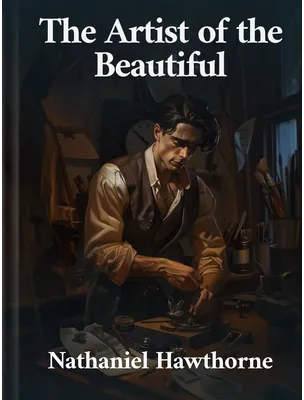
An elderly man, with his pretty daughter on his arm, was passing along the street, and emerged from the gloom of the cloudy evening into the light that fell across the pavement from the window of a small shop. It was a projecting window; and on the inside were suspended a variety of watches, pinchbeck, silver, and one or two of gold, all with their faces turned from the streets, as if churlishly disinclined to inform the wayfarers what o’clock it was. Seated within the shop, sidelong to the window with his pale face bent earnestly over some delicate piece of mechanism on which was thrown the concentrated lustre of a shade lamp, appeared a young man.
“What can Owen Warland be about?” muttered old Peter Hovenden, himself a retired watchmaker, and the former master of this same young man whose occupation he was now wondering at. “What can the fellow be about? These six months past I have never come by his shop without seeing him just as steadily at work as now. It would be a flight beyond his usual foolery to seek for the perpetual motion; and yet I know enough of my old business to be certain that what he is now so busy with is no part of the machinery of a watch.”
“Perhaps, father,” said Annie, without showing much interest in the question, “Owen is inventing a new kind of timekeeper. I am sure he has ingenuity enough.”
“Poh, child! He has not the sort of ingenuity to invent anything better than a Dutch toy,” answered her father, who had formerly been put to much vexation by Owen Warland’s irregular genius. “A plague on such ingenuity! All the effect that ever I knew of it was to spoil the accuracy of some of the best watches in my shop. He would turn the sun out of its orbit and derange the whole course of time, if, as I said before, his ingenuity could grasp anything bigger than a child’s toy!”
“Hush, father! He hears you!” whispered Annie, pressing the old man’s arm. “His ears are as delicate as his feelings; and you know how easily disturbed they are. Do let us move on.”
So Peter Hovenden and his daughter Annie plodded on without further conversation, until in a by-street of the town they found themselves passing the open door of a blacksmith’s shop. Within was seen the forge, now blazing up and illuminating the high and dusky roof, and now confining its lustre to a narrow precinct of the coal-strewn floor, according as the breath of the bellows was puffed forth or again inhaled into its vast leathern lungs. In the intervals of brightness it was easy to distinguish objects in remote corners of the shop and the horseshoes that hung upon the wall; in the momentary gloom the fire seemed to be glimmering amidst the vagueness of unenclosed space. Moving about in this red glare and alternate dusk was the figure of the blacksmith, well worthy to be viewed in so picturesque an aspect of light and shade, where the bright blaze struggled with the black night, as if each would have snatched his comely strength from the other. Anon he drew a white-hot bar of iron from the coals, laid it on the anvil, uplifted his arm of might, and was soon enveloped in the myriads of sparks which the strokes of his hammer scattered into the surrounding gloom.
“Now, that is a pleasant sight,” said the old watchmaker. “I know what it is to work in gold; but give me the worker in iron after all is said and done. He spends his labor upon a reality. What say you, daughter Annie?”
“Pray don’t speak so loud, father,” whispered Annie, “Robert Danforth will hear you.”
“And what if he should hear me?” said Peter Hovenden. “I say again, it is a good and a wholesome thing to depend upon main strength and reality, and to earn one’s bread with the bare and brawny arm of a blacksmith. A watchmaker gets his brain puzzled by his wheels within a wheel, or loses his health or the nicety of his eyesight, as was my case, and finds himself at middle age, or a little after, past labor at his own trade and fit for nothing else, yet too poor to live at his ease. So I say once again, give me main strength for my money. And then, how it takes the nonsense out of a man! Did you ever hear of a blacksmith being such a fool as Owen Warland yonder?”
“Well said, uncle Hovenden!” shouted Robert Danforth from the forge, in a full, deep, merry voice, that made the roof re-echo. “And what says Miss Annie to that doctrine? She, I suppose, will think it a genteeler business to tinker up a lady’s watch than to forge a horseshoe or make a gridiron.”
Annie drew her father onward without giving him time for reply.
But we must return to Owen Warland’s shop, and spend more meditation upon his history and character than either Peter Hovenden, or probably his daughter Annie, or Owen’s old school-fellow, Robert Danforth, would have thought due to so slight a subject. From the time that his little fingers could grasp a penknife, Owen had been remarkable for a delicate ingenuity, which sometimes produced pretty shapes in wood, principally figures of flowers and birds, and sometimes seemed to aim at the hidden mysteries of mechanism. But it was always for purposes of grace, and never with any mockery of the useful. He did not, like the crowd of school-boy artisans, construct little windmills on the angle of a barn or watermills across the neighboring brook. Those who discovered such peculiarity in the boy as to think it worth their while to observe him closely, sometimes saw reason to suppose that he was attempting to imitate the beautiful movements of Nature as exemplified in the flight of birds or the activity of little animals. It seemed, in fact, a new development of the love of the beautiful, such as might have made him a poet, a painter, or a sculptor, and which was as completely refined from all utilitarian coarseness as it could have been in either of the fine arts. He looked with singular distaste at the stiff and regular processes of ordinary machinery. Being once carried to see a steam-engine, in the expectation that his intuitive comprehension of mechanical principles would be gratified, he turned pale and grew sick, as if something monstrous and unnatural had been presented to him. This horror was partly owing to the size and terrible energy of the iron laborer; for the character of Owen’s mind was microscopic, and tended naturally to the minute, in accordance with his diminutive frame and the marvellous smallness and delicate power of his fingers. Not that his sense of beauty was thereby diminished into a sense of prettiness. The beautiful idea has no relation to size, and may be as perfectly developed in a space too minute for any but microscopic investigation as within the ample verge that is measured by the arc of the rainbow. But, at all events, this characteristic minuteness in his objects and accomplishments made the world even more incapable than it might otherwise have been of appreciating Owen Warland’s genius. The boy’s relatives saw nothing better to be done — as perhaps there was not — than to bind him apprentice to a watchmaker, hoping that his strange ingenuity might thus be regulated and put to utilitarian purposes.
Peter Hovenden’s opinion of his apprentice has already been expressed. He could make nothing of the lad. Owen’s apprehension of the professional mysteries, it is true, was inconceivably quick; but he altogether forgot or despised the grand object of a watchmaker’s business, and cared no more for the measurement of time than if it had been merged into eternity. So long, however, as he remained under his old master’s care, Owen’s lack of sturdiness made it possible, by strict injunctions and sharp oversight, to restrain his creative eccentricity within bounds; but when his apprenticeship was served out, and he had taken the little shop which Peter Hovenden’s failing eyesight compelled him to relinquish, then did people recognize how unfit a person was Owen Warland to lead old blind Father Time along his daily course. One of his most rational projects was to connect a musical operation with the machinery of his watches, so that all the harsh dissonances of life might be rendered tuneful, and each flitting moment fall into the abyss of the past in golden drops of harmony. If a family clock was intrusted to him for repair, — one of those tall, ancient clocks that have grown nearly allied to human nature by measuring out the lifetime of many generations, — he would take upon himself to arrange a dance or funeral procession of figures across its venerable face, representing twelve mirthful or melancholy hours. Several freaks of this kind quite destroyed the young watchmaker’s credit with that steady and matter-of-fact class of people who hold the opinion that time is not to be trifled with, whether considered as the medium of advancement and prosperity in this world or preparation for the next. His custom rapidly diminished — a misfortune, however, that was probably reckoned among his better accidents by Owen Warland, who was becoming more and more absorbed in a secret occupation which drew all his science and manual dexterity into itself, and likewise gave full employment to the characteristic tendencies of his genius. This pursuit had already consumed many months.
After the old watchmaker and his pretty daughter had gazed at him out of the obscurity of the street, Owen Warland was seized with a fluttering of the nerves, which made his hand tremble too violently to proceed with such delicate labor as he was now engaged upon.
“It was Annie herself!” murmured he. “I should have known it, by this throbbing of my heart, before I heard her father’s voice. Ah, how it throbs! I shall scarcely be able to work again on this exquisite mechanism to-night. Annie! dearest Annie! thou shouldst give firmness to my heart and hand, and not shake them thus; for if I strive to put the very spirit of beauty into form and give it motion, it is for thy sake alone. O throbbing heart, be quiet! If my labor be thus thwarted, there will come vague and unsatisfied dreams which will leave me spiritless to-morrow.”
As he was endeavoring to settle himself again to his task, the shop door opened and gave admittance to no other than the stalwart figure which Peter Hovenden had paused to admire, as seen amid the light and shadow of the blacksmith’s shop. Robert Danforth had brought a little anvil of his own manufacture, and peculiarly constructed, which the young artist had recently bespoken. Owen examined the article and pronounced it fashioned according to his wish.
“Why, yes,” said Robert Danforth, his strong voice filling the shop as with the sound of a bass viol, “I consider myself equal to anything in the way of my own trade; though I should have made but a poor figure at yours with such a fist as this,” added he, laughing, as he laid his vast hand beside the delicate one of Owen. “But what then? I put more main strength into one blow of my sledge hammer than all that you have expended since you were a ‘prentice. Is not that the truth?”
“Very probably,” answered the low and slender voice of Owen. “Strength is an earthly monster. I make no pretensions to it. My force, whatever there may be of it, is altogether spiritual.”
“Well, but, Owen, what are you about?” asked his old school-fellow, still in such a hearty volume of tone that it made the artist shrink, especially as the question related to a subject so sacred as the absorbing dream of his imagination. “Folks do say that you are trying to discover the perpetual motion.”
“The perpetual motion? Nonsense!” replied Owen Warland, with a movement of disgust; for he was full of little petulances. “It can never be discovered. It is a dream that may delude men whose brains are mystified with matter, but not me. Besides, if such a discovery were possible, it would not be worth my while to make it only to have the secret turned to such purposes as are now effected by steam and water power. I am not ambitious to be honored with the paternity of a new kind of cotton machine.”
“That would be droll enough!” cried the blacksmith, breaking out into such an uproar of laughter that Owen himself and the bell glasses on his work-board quivered in unison. “No, no, Owen! No child of yours will have iron joints and sinews. Well, I won’t hinder you any more. Good night, Owen, and success, and if you need any assistance, so far as a downright blow of hammer upon anvil will answer the purpose, I’m your man.”
And with another laugh the man of main strength left the shop.
“How strange it is,” whispered Owen Warland to himself, leaning his head upon his hand, “that all my musings, my purposes, my passion for the beautiful, my consciousness of power to create it, — a finer, more ethereal power, of which this earthly giant can have no conception, — all, all, look so vain and idle whenever my path is crossed by Robert Danforth! He would drive me mad were I to meet him often. His hard, brute force darkens and confuses the spiritual element within me; but I, too, will be strong in my own way. I will not yield to him.”
He took from beneath a glass a piece of minute machinery, which he set in the condensed light of his lamp, and, looking intently at it through a magnifying glass, proceeded to operate with a delicate instrument of steel. In an instant, however, he fell back in his chair and clasped his hands, with a look of horror on his face that made its small features as impressive as those of a giant would have been.
“Heaven! What have I done?” exclaimed he. “The vapor, the influence of that brute force, — it has bewildered me and obscured my perception. I have made the very stroke — the fatal stroke — that I have dreaded from the first. It is all over — the toil of months, the object of my life. I am ruined!”
And there he sat, in strange despair, until his lamp flickered in the socket and left the Artist of the Beautiful in darkness.
Thus it is that ideas, which grow up within the imagination and appear so lovely to it and of a value beyond whatever men call valuable, are exposed to be shattered and annihilated by contact with the practical. It is requisite for the ideal artist to possess a force of character that seems hardly compatible with its delicacy; he must keep his faith in himself while the incredulous world assails him with its utter disbelief; he must stand up against mankind and be his own sole disciple, both as respects his genius and the objects to which it is directed.
For a time Owen Warland succumbed to this severe but inevitable test. He spent a few sluggish weeks with his head so continually resting in his hands that the towns-people had scarcely an opportunity to see his countenance. When at last it was again uplifted to the light of day, a cold, dull, nameless change was perceptible upon it. In the opinion of Peter Hovenden, however, and that order of sagacious understandings who think that life should be regulated, like clockwork, with leaden weights, the alteration was entirely for the better. Owen now, indeed, applied himself to business with dogged industry. It was marvellous to witness the obtuse gravity with which he would inspect the wheels of a great old silver watch thereby delighting the owner, in whose fob it had been worn till he deemed it a portion of his own life, and was accordingly jealous of its treatment. In consequence of the good report thus acquired, Owen Warland was invited by the proper authorities to regulate the clock in the church steeple. He succeeded so admirably in this matter of public interest that the merchants gruffly acknowledged his merits on ‘Change; the nurse whispered his praises as she gave the potion in the sick-chamber; the lover blessed him at the hour of appointed interview; and the town in general thanked Owen for the punctuality of dinner time. In a word, the heavy weight upon his spirits kept everything in order, not merely within his own system, but wheresoever the iron accents of the church clock were audible. It was a circumstance, though minute, yet characteristic of his present state, that, when employed to engrave names or initials on silver spoons, he now wrote the requisite letters in the plainest possible style, omitting a variety of fanciful flourishes that had heretofore distinguished his work in this kind.
One day, during the era of this happy transformation, old Peter Hovenden came to visit his former apprentice.
“Well, Owen,” said he, “I am glad to hear such good accounts of you from all quarters, and especially from the town clock yonder, which speaks in your commendation every hour of the twenty-four. Only get rid altogether of your nonsensical trash about the beautiful, which I nor nobody else, nor yourself to boot, could ever understand, — only free yourself of that, and your success in life is as sure as daylight. Why, if you go on in this way, I should even venture to let you doctor this precious old watch of mine; though, except my daughter Annie, I have nothing else so valuable in the world.”
“I should hardly dare touch it, sir,” replied Owen, in a depressed tone; for he was weighed down by his old master’s presence.
“In time,” said the latter, — “In time, you will be capable of it.”
The old watchmaker, with the freedom naturally consequent on his former authority, went on inspecting the work which Owen had in hand at the moment, together with other matters that were in progress. The artist, meanwhile, could scarcely lift his head. There was nothing so antipodal to his nature as this man’s cold, unimaginative sagacity, by contact with which everything was converted into a dream except the densest matter of the physical world. Owen groaned in spirit and prayed fervently to be delivered from him.
“But what is this?” cried Peter Hovenden abruptly, taking up a dusty bell glass, beneath which appeared a mechanical something, as delicate and minute as the system of a butterfly’s anatomy. “What have we here? Owen! Owen! there is witchcraft in these little chains, and wheels, and paddles. See! with one pinch of my finger and thumb I am going to deliver you from all future peril.”
“For Heaven’s sake,” screamed Owen Warland, springing up with wonderful energy, “as you would not drive me mad, do not touch it! The slightest pressure of your finger would ruin me forever.”
“Aha, young man! And is it so?” said the old watchmaker, looking at him with just enough penetration to torture Owen’s soul with the bitterness of worldly criticism. “Well, take your own course; but I warn you again that in this small piece of mechanism lives your evil spirit. Shall I exorcise him?”
“You are my evil spirit,” answered Owen, much excited, — “you and the hard, coarse world! The leaden thoughts and the despondency that you fling upon me are my clogs, else I should long ago have achieved the task that I was created for.”
Peter Hovenden shook his head, with the mixture of contempt and indignation which mankind, of whom he was partly a representative, deem themselves entitled to feel towards all simpletons who seek other prizes than the dusty one along the highway. He then took his leave, with an uplifted finger and a sneer upon his face that haunted the artist’s dreams for many a night afterwards. At the time of his old master’s visit, Owen was probably on the point of taking up the relinquished task; but, by this sinister event, he was thrown back into the state whence he had been slowly emerging.
But the innate tendency of his soul had only been accumulating fresh vigor during its apparent sluggishness. As the summer advanced he almost totally relinquished his business, and permitted Father Time, so far as the old gentleman was represented by the clocks and watches under his control, to stray at random through human life, making infinite confusion among the train of bewildered hours. He wasted the sunshine, as people said, in wandering through the woods and fields and along the banks of streams. There, like a child, he found amusement in chasing butterflies or watching the motions of water insects. There was something truly mysterious in the intentness with which he contemplated these living playthings as they sported on the breeze or examined the structure of an imperial insect whom he had imprisoned. The chase of butterflies was an apt emblem of the ideal pursuit in which he had spent so many golden hours; but would the beautiful idea ever be yielded to his hand like the butterfly that symbolized it? Sweet, doubtless, were these days, and congenial to the artist’s soul. They were full of bright conceptions, which gleamed through his intellectual world as the butterflies gleamed through the outward atmosphere, and were real to him, for the instant, without the toil, and perplexity, and many disappointments of attempting to make them visible to the sensual eye. Alas that the artist, whether in poetry, or whatever other material, may not content himself with the inward enjoyment of the beautiful, but must chase the flitting mystery beyond the verge of his ethereal domain, and crush its frail being in seizing it with a material grasp. Owen Warland felt the impulse to give external reality to his ideas as irresistibly as any of the poets or painters who have arrayed the world in a dimmer and fainter beauty, imperfectly copied from the richness of their visions.
The night was now his time for the slow progress of re-creating the one idea to which all his intellectual activity referred itself. Always at the approach of dusk he stole into the town, locked himself within his shop, and wrought with patient delicacy of touch for many hours. Sometimes he was startled by the rap of the watchman, who, when all the world should be asleep, had caught the gleam of lamplight through the crevices of Owen Warland’s shutters. Daylight, to the morbid sensibility of his mind, seemed to have an intrusiveness that interfered with his pursuits. On cloudy and inclement days, therefore, he sat with his head upon his hands, muffling, as it were, his sensitive brain in a mist of indefinite musings, for it was a relief to escape from the sharp distinctness with which he was compelled to shape out his thoughts during his nightly toil.
From one of these fits of torpor he was aroused by the entrance of Annie Hovenden, who came into the shop with the freedom of a customer, and also with something of the familiarity of a childish friend. She had worn a hole through her silver thimble, and wanted Owen to repair it.
“But I don’t know whether you will condescend to such a task,” said she, laughing, “now that you are so taken up with the notion of putting spirit into machinery.”
“Where did you get that idea, Annie?” said Owen, starting in surprise.
“Oh, out of my own head,” answered she, “and from something that I heard you say, long ago, when you were but a boy and I a little child. But come, will you mend this poor thimble of mine?”
“Anything for your sake, Annie,” said Owen Warland, — “anything, even were it to work at Robert Danforth’s forge.”
“And that would be a pretty sight!” retorted Annie, glancing with imperceptible slightness at the artist’s small and slender frame. “Well; here is the thimble.”
“But that is a strange idea of yours,” said Owen, “about the spiritualization of matter.”
And then the thought stole into his mind that this young girl possessed the gift to comprehend him better than all the world besides. And what a help and strength would it be to him in his lonely toil if he could gain the sympathy of the only being whom he loved! To persons whose pursuits are insulated from the common business of life — who are either in advance of mankind or apart from it — there often comes a sensation of moral cold that makes the spirit shiver as if it had reached the frozen solitudes around the pole. What the prophet, the poet, the reformer, the criminal, or any other man with human yearnings, but separated from the multitude by a peculiar lot, might feel, poor Owen felt.
“Annie,” cried he, growing pale as death at the thought, “how gladly would I tell you the secret of my pursuit! You, methinks, would estimate it rightly. You, I know, would hear it with a reverence that I must not expect from the harsh, material world.”
“Would I not? to be sure I would!” replied Annie Hovenden, lightly laughing. “Come; explain to me quickly what is the meaning of this little whirligig, so delicately wrought that it might be a plaything for Queen Mab. See! I will put it in motion.”
“Hold!” exclaimed Owen, “hold!”
Annie had but given the slightest possible touch, with the point of a needle, to the same minute portion of complicated machinery which has been more than once mentioned, when the artist seized her by the wrist with a force that made her scream aloud. She was affrighted at the convulsion of intense rage and anguish that writhed across his features. The next instant he let his head sink upon his hands.
“Go, Annie,” murmured he; “I have deceived myself, and must suffer for it. I yearned for sympathy, and thought, and fancied, and dreamed that you might give it me; but you lack the talisman, Annie, that should admit you into my secrets. That touch has undone the toil of months and the thought of a lifetime! It was not your fault, Annie; but you have ruined me!”
Poor Owen Warland! He had indeed erred, yet pardonably; for if any human spirit could have sufficiently reverenced the processes so sacred in his eyes, it must have been a woman’s. Even Annie Hovenden, possibly might not have disappointed him had she been enlightened by the deep intelligence of love.
The artist spent the ensuing winter in a way that satisfied any persons who had hitherto retained a hopeful opinion of him that he was, in truth, irrevocably doomed to unutility as regarded the world, and to an evil destiny on his own part. The decease of a relative had put him in possession of a small inheritance. Thus freed from the necessity of toil, and having lost the steadfast influence of a great purpose, — great, at least, to him, — he abandoned himself to habits from which it might have been supposed the mere delicacy of his organization would have availed to secure him. But when the ethereal portion of a man of genius is obscured the earthly part assumes an influence the more uncontrollable, because the character is now thrown off the balance to which Providence had so nicely adjusted it, and which, in coarser natures, is adjusted by some other method. Owen Warland made proof of whatever show of bliss may be found in riot. He looked at the world through the golden medium of wine, and contemplated the visions that bubble up so gayly around the brim of the glass, and that people the air with shapes of pleasant madness, which so soon grow ghostly and forlorn. Even when this dismal and inevitable change had taken place, the young man might still have continued to quaff the cup of enchantments, though its vapor did but shroud life in gloom and fill the gloom with spectres that mocked at him. There was a certain irksomeness of spirit, which, being real, and the deepest sensation of which the artist was now conscious, was more intolerable than any fantastic miseries and horrors that the abuse of wine could summon up. In the latter case he could remember, even out of the midst of his trouble, that all was but a delusion; in the former, the heavy anguish was his actual life.
From this perilous state he was redeemed by an incident which more than one person witnessed, but of which the shrewdest could not explain or conjecture the operation on Owen Warland’s mind. It was very simple. On a warm afternoon of spring, as the artist sat among his riotous companions with a glass of wine before him, a splendid butterfly flew in at the open window and fluttered about his head.